Results by title
314 books match the query 'Environmental aspects' and 56 start with t

Toward an Aesthetic of Reception
Hans Jauss
University of Minnesota Press, 1982
[more]
Toxic Tourism
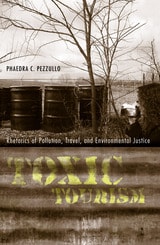
Rhetorics of Pollution, Travel, and Environmental JusticePhaedra C. Pezzullo
University of Alabama Press, 2009
Winner of the:
2010 Jane Jacobs Urban Communication Book Award, sponsored by National Communication Association
2007 James A. Winans-Herbert A. Wichelns Memorial Award for Distinguished Scholarship in Rhetoric and Public Address, sponsored by National Communication Association
2007 Best Book of the Year for Critical and Cultural Studies, sponsored by National Communication Association
2007 Christine L. Oravec Research Award, sponsored by Environmental Communications Division of the National Communication Association
The first book length study of the environmental justice movement, tourism, and the links between race, class, and waste
The first book length study of the environmental justice movement, tourism, and the links between race, class, and waste
Tourism is at once both a beloved pastime and a denigrated form of popular culture. Romanticized for its promise of pleasure, tourism is also potentially toxic, enabling the deadly exploitation of the cultures and environments visited. For many decades, the environmental justice movement has offered “toxic tours,” non-commercial trips intended to highlight people and locales polluted by poisonous chemicals. Out of these efforts and their popular reception, a new understanding of democratic participation in environmental decision-making has begun to arise. Phaedra C. Pezzullo examines these tours as a tactic of resistance and for their potential in reducing the cultural and physical distance between hosts and visitors.
Pezzullo begins by establishing the ambiguous roles tourism and the toxic have played in the U.S. cultural imagination since the mid-20th century in a range of spheres, including Hollywood films, women’s magazines, comic books, and scholarly writings. Next, drawing on participant observation, interviews, documentaries, and secondary accounts in popular media, she identifies and examines a range of tourist performances enabled by toxic tours. Extended illustrations of the racial, class, and gender politics involved include Louisiana’s “Cancer Alley,” California’s San Francisco Bay Area, and the Mexican border town of Matamoros. Weaving together social critiques of tourism and community responses to toxic chemicals, this critical, rhetorical, and cultural analysis brings into focus the tragedy of ongoing patterns of toxification and our assumptions about travel, democracy, and pollution.
[more]
Toxic and Intoxicating Oil
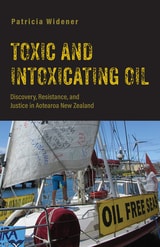
Discovery, Resistance, and Justice in Aotearoa New ZealandPatricia Widener
Rutgers University Press, 2021
When oil and gas exploration was expanding across Aotearoa New Zealand, Patricia Widener was there interviewing affected residents and environmental and climate activists, and attending community meetings and anti-drilling rallies. Exploration was occurring on an unprecedented scale when oil disasters dwelled in recent memory, socioecological worries were high, campaigns for climate action were becoming global, and transitioning toward a low carbon society seemed possible. Yet unlike other communities who have experienced either an oil spill, or hydraulic fracturing, or offshore exploration, or climate fears, or disputes over unresolved Indigenous claims, New Zealanders were facing each one almost simultaneously. Collectively, these grievances created the foundation for an organized civil society to construct and then magnify a comprehensive critical oil narrative--in dialogue, practice, and aspiration. Community advocates and socioecological activists mobilized for their health and well-being, for their neighborhoods and beaches, for Planet Earth and Planet Ocean, and for terrestrial and aquatic species and ecosystems. They rallied against toxic, climate-altering pollution; the extraction of fossil fuels; a myriad of historic and contemporary inequities; and for local, just, and sustainable communities, ecologies, economies, and/or energy sources. In this allied ethnography, quotes are used extensively to convey the tenor of some of the country’s most passionate and committed people. By analyzing the intersections of a social movement and the political economy of oil, Widener reveals a nuanced story of oil resistance and promotion at a time when many anti-drilling activists believed themselves to be on the front lines of the industry’s inevitable decline.
[more]
Transforming Environmentalism
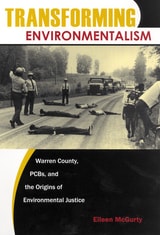
Warren County, PCBs, and the Origins of Environmental JusticeMcGurty, Eileen
Rutgers University Press, 2006
Contemporary public policy circles are quick to acknowledge that environmental factors contribute to ill health and pose a particular threat to poor and minority communities. But public officials rarely examined the distribution of environmental hazards such as polluted air and contaminated water. In the 1980s, as toxic waste facilities proliferated, the environmental justice movement demanded that impoverished communities no longer be burdened by excessive environmental risks.
In Transforming Environmentalism, Eileen McGurty explores a moment central to the emergence of the environmental justice movement. In 1978, residents of predominantly African American Warren County, North Carolina, were horrified to learn that the state planned to build a landfill in their county to hold forty thousand cubic yards of soil that was contaminated with PCBs from illegal dumping. They responded to the state's plans with a four-year resistance, ending in a month of protests with over 500 arrests from civil disobedience and disruptive actions.McGurty traces the evolving approaches that residents took to contest "environmental racism" in their community and shows how activism in Warren County spurred greater political debate and became a model for communities across the nation. Transforming Environmentalism explores how the specific circumstances of the Warren County events shaped the formation of the environmental justice movement and influenced contemporary environmentalism.
In Transforming Environmentalism, Eileen McGurty explores a moment central to the emergence of the environmental justice movement. In 1978, residents of predominantly African American Warren County, North Carolina, were horrified to learn that the state planned to build a landfill in their county to hold forty thousand cubic yards of soil that was contaminated with PCBs from illegal dumping. They responded to the state's plans with a four-year resistance, ending in a month of protests with over 500 arrests from civil disobedience and disruptive actions.McGurty traces the evolving approaches that residents took to contest "environmental racism" in their community and shows how activism in Warren County spurred greater political debate and became a model for communities across the nation. Transforming Environmentalism explores how the specific circumstances of the Warren County events shaped the formation of the environmental justice movement and influenced contemporary environmentalism.
[more]
Transportation and the Culture of Climate Change
Accelerating Ride to Global CrisisTatiana Prorokova-Konrad
West Virginia University Press, 2020
This interdisciplinary collection of eleven original essays focuses on the environmental impact of transportation, which is, as Tatiana Prorokova-Konrad and Brian C. Black note in their introduction, responsible for 26 percent of global energy use. Approaching mobility not solely as a material, logistical question but as a phenomenon mediated by culture, the book interrogates popular assumptions deeply entangled with energy choices. Rethinking transportation, the contributors argue, necessarily involves fundamental understandings of consumption, freedom, and self.
The essays in Transportation and the Culture of Climate Change cover an eclectic range of subject matter, from the association of bicycles with childhood to the songs of Bruce Springsteen, but are united in a central conviction: “Transport is a considerable part of our culture that is as hard to transform as it is for us to stop using fossil fuels—but we do not have an alternative.”
The essays in Transportation and the Culture of Climate Change cover an eclectic range of subject matter, from the association of bicycles with childhood to the songs of Bruce Springsteen, but are united in a central conviction: “Transport is a considerable part of our culture that is as hard to transform as it is for us to stop using fossil fuels—but we do not have an alternative.”
[more]
Travel Behaviour Reconsidered in an Era of Decarbonisation
David Metz
University College London, 2024
Makes the case for investment in transport systems in an age of great climate change concern.
Transport systems are central to daily life, but simultaneously have a salient impact on our environment. However, this perspective has little influence on conventional economic analysis and transport investments, creating dissonance between traditional investment goals and the need to reduce carbon emissions to net zero by 2050. For fifty years, public road and railway expenditures were justified by claims to improve travel time. On the contrary, the average time of travel never changed. Travel Behaviour Reconsidered in an Era of Decarbonisation argues that this outdated economic analysis is misconceived and that fresh perspectives on transport networks are imperative.
Transport systems are central to daily life, but simultaneously have a salient impact on our environment. However, this perspective has little influence on conventional economic analysis and transport investments, creating dissonance between traditional investment goals and the need to reduce carbon emissions to net zero by 2050. For fifty years, public road and railway expenditures were justified by claims to improve travel time. On the contrary, the average time of travel never changed. Travel Behaviour Reconsidered in an Era of Decarbonisation argues that this outdated economic analysis is misconceived and that fresh perspectives on transport networks are imperative.
[more]