Results by title
1104 books match the query 'Gender Studies' and 189 start with t
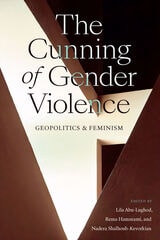
The Cunning of Gender Violence
Geopolitics and FeminismLila Abu-Lughod, Rema Hammami, and Nadera Shalhoub-Kevorkian, editors
Duke University Press, 2023
Contributors. Lila Abu-Lughod, Nina Berman, Inderpal Grewal, Rema Hammami, Janet R. Jakobsen, Shenila Khoja-Moolji, Vasuki Nesiah, Samira Shackle, Sima Shakhsari, Nadera Shalhoub-Kevorkian, Dina M Siddiqi, Shahla Talebi, Leti Volpp, Rafia Zakaria
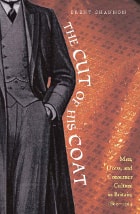
The Cut of His Coat
Men, Dress, and Consumer Culture in Britain, 1860–1914Brent Shannon
Ohio University Press, 2006
The English middle class in the late nineteenth century enjoyed an increase in the availability and variety of material goods. With that, the visual markers of class membership and manly behavior underwent a radical change. In The Cut of His Coat: Men, Dress, and Consumer Culture in Britain, 1860–1914, Brent Shannon examines familiar novels by authors such as George Eliot, Anthony Trollope, Thomas Hughes, and H. G. Wells, as well as previously unexamined etiquette manuals, period advertisements, and fashion monthlies, to trace how new ideologies emerged as mass-produced clothes, sartorial markers, and consumer culture began to change.
While Victorian literature traditionally portrayed women as having sole control of class representations through dress and manners, Shannon argues that middle-class men participated vigorously in fashion. Public displays of their newly acquired mannerisms, hairstyles, clothing, and consumer goods redefined masculinity and class status for the Victorian era and beyond.
The Cut of His Coat probes the Victorian disavowal of men’s interest in fashion and shopping to recover men’s significant role in the representation of class through self-presentation and consumer practices.
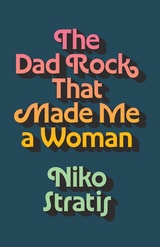
The Dad Rock That Made Me a Woman
Niko Stratis
University of Texas Press, 2025
A memoir-in-essays on transness, dad rock, and the music that saves us.
When Wilco’s 2007 album Sky Blue Sky was infamously criticized as “dad rock,” Niko Stratis was a twenty-five-year-old closeted trans woman working in her dad’s glass shop in the Yukon Territory. As she sought escape from her hypermasculine environment, Stratis found an unlikely lifeline amid dad rock’s emotionally open and honest music. Listening to dad rock, Stratis could access worlds beyond her own and imagine a path forward.
In taut, searing essays rendered in propulsive and unguarded prose, Stratis delves into the emotional core of bands like Wilco and The National, telling her story through the dad rock that accompanied her along the way. She found footing in Michael Stipe’s allusions to queer longing, Radiohead’s embrace of unknowability, and Bruce Springsteen’s very trans desire to “change my clothes my hair my face”—and she found in artists like Neko Case and Sharon Van Etten that the label transcends gender. A love letter to the music that saves us and a tribute to dads like Stratis’s own who embody the tenderness at the genre’s heart, The Dad Rock That Made Me a Woman rejoices in music unafraid to bare its soul.
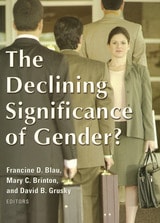
The Declining Significance of Gender?
Francine D. Blau
Russell Sage Foundation, 2006
The Deconstruction of Sex
Jean-Luc Nancy and Irving Goh
Duke University Press, 2021
The Diva's Mouth
Body, Voice, and Prima Donna PoliticsLeonardi, Susan J.
Rutgers University Press, 1996
The Domesticated Penis
How Womanhood Has Shaped ManhoodLoretta A. Cormier
University of Alabama Press, 2015
The Domesticated Penis challenges long-held assumptions that, in the development of Homo sapiens, form follows function alone. In this fascinating exploration, Loretta A. Cormier and Sharyn R. Jones explain the critical contribution that conscious female selection has made to the attributes of the modern male phallus.
Synthesizing a wealth of robust scholarship from the fields of archaeology, cultural anthropology, evolutionary theory, and primatology, the authors successfully dismantle the orthodox view that each part of the human anatomy has followed a vector of development along which only changes and mutations that increased functional utility were retained and extended. Their research animates our understanding of human morphology with insights about how choices early females made shaped the male reproductive anatomy.
In crisp and droll prose, Cormier’s and Jones’s rigorous scholarship incorporates engaging examples and lore about the human phallus in a variety of foraging, agrarian, and contemporary cultures. By detailing how female selection in mating led directly to a matrix of anatomical attributes in the male, their findings illuminate how the penis also acquired a matrix of attributes of the imagination and mythical powers—powers to be assuaged, channeled, or deployed for building productive societies.
These analyses offer a highly persuasive alternative to moribund biological and behavioral assumptions about prehistoric alpha males as well as the distortions such assumptions give rise to in contemporary popular culture. In this anthropological tour de force, Cormier and Jones transcend reductive gender stereotypes and bring to our concepts of evolutional biomechanics an invigorating new balance and nuance.
The Dressing Room
Backstage Lives and American FilmDesirée J. Garcia
Rutgers University Press, 2025
A recurrent and popular setting in American cinema, the dressing room has captured the imaginations of filmmakers and audiences for over a century. In The Dressing Room: Backstage Lives and American Film, the only book-length study of the space, author Desirée J. Garcia explores how dressing rooms are dynamic realms in which a diverse cast of performers are made and exposed. Garcia analyzes the backstage film, which spans film history, modes, and genre, to show how dressing rooms have been a useful space for filmmakers to examine the performativity of American life. From the Black maid to the wife and mother to the leading man, dressing rooms navigate, shape, and challenge society’s norms. The stakes are high in dressing rooms, Garcia argues, because they rehearse larger questions about identity and its performance, negotiating who can succeed and who cannot and on what terms.
The Empire of Love
Toward a Theory of Intimacy, Genealogy, and CarnalityElizabeth A. Povinelli
Duke University Press, 2006
For more than twenty years, Povinelli has traveled to the social worlds of indigenous men and women living at Belyuen, a small community in the Northern Territory of Australia. More recently she has moved across communities of alternative progressive queer movements in the United States, particularly those who identify as radical faeries. In this book she traces how liberal binary concepts of individual freedom and social constraint influence understandings of intimacy in these two worlds. At the same time, she describes alternative models of social relations within each group in order to highlight modes of intimacy that transcend a reductive choice between freedom and constraint.
Shifting focus away from identities toward the social matrices out of which identities and divisions emerge, Povinelli offers a framework for thinking through such issues as what counts as sexuality and which forms of intimate social relations result in the distribution of rights, recognition, and resources, and which do not. In The Empire of Love Povinelli calls for, and begins to formulate, a politics of “thick life,” a way of representing social life nuanced enough to meet the density and variation of actual social worlds.
The Eurabia Myth
Countercolonization and Masculine Fragility in FranceMehammed Amadeus Mack
University of Minnesota Press, 2025
The roots—and reach—of “Great Replacement” theory in France and beyond
The Eurabia Myth delves into the origins and evolution of far-right anxieties about the future of a Europe that welcomes postcolonial migration, racial and ethnic diversity, and tolerance of Islam. Nationalists deploy the specter of “Eurabia”—an Arabized and Islamized Europe—as a doomsday scenario of demographic replacement that only they can avert. Mehammed Amadeus Mack traces this dark vision to a sociopolitical conspiracy theory that began in France, spread throughout Europe, and has become especially virulent in the United States: Great Replacement Theory.
Examining how the Eurabia narrative gained traction, Mack analyzes dystopian fiction that envisions how this Replacement will take place, the contemporary politicization of medieval history, and ecofascist rhetoric depicting immigrants as an “invasive” species. He also interviews prominent French activists of color about how they subvert being portrayed as Replacers and destroyers of European civilization, and he explores the American echoes of the Great Replacement Theory.
Innovatively deploying gender and sexuality theory to the concept of Eurabia, Mack demonstrates that the demographic and racial anxieties underlying Great Replacement Theory are intertwined with a more fundamental crisis of masculinity, evident in the far right’s accusations that feminists and the LGBT community are responsible for the decline in white birth rates. As it uncovers the deeper roots of this pervasive theory, The Eurabia Myth shows its insidious relevance to a rising tide of nativist fear, hatred, and violence.
Retail e-book files for this title are screen-reader friendly with images accompanied by short alt text and/or extended descriptions.

The Extractive Zone
Social Ecologies and Decolonial PerspectivesMacarena Gómez-Barris
Duke University Press, 2017
The Failure of Our Fathers
Family, Gender, and Power in Confederate AlabamaVictoria E. Ott
University of Alabama Press, 2023
An in-depth study of non-elite white families in Alabama—from the state’s creation through the end of the Civil War
The Failure of Our Fathers: Family, Gender, and Power in Confederate Alabama examines the evolving position of non-elite white families in Alabama during one of the most pivotal epochs in the state’s history. Drawing on a wide range of personal and public documents reflecting the state’s varied regions and economies, Victoria E. Ott uses gender and family as a lens to examine the yeomanry and poor whites, a constituency that she collectively defines as “common whites,” who identified with the Confederate cause.
Ott provides a nuanced examination of how these Alabamians fit within the antebellum era’s paternalistic social order, eventually identifying with and supporting the Confederate mission to leave the Union and create an independent, slaveholding state. But as the reality of the war slowly set in and the Confederacy began to fray, the increasing dangers families faced led Alabama’s common white men and women to find new avenues to power as a distinct socioeconomic class.
Ott argues that family provided the conceptual framework necessary to understand why common whites supported a war to protect slavery despite having little or no investment in the institution. Going to war meant protecting their families from outsiders who threatened to turn their worlds upside down. Despite class differences, common whites envisioned the Confederacy as a larger family and the state as paternal figures who promised to protect its loyal dependents throughout the conflict. Yet, as the war ravaged many Alabama communities, devotion to the Confederacy seemed less a priority as families faced continued separations, threats of death, and the potential for starvation. The construct of a familial structure that once created a sense of loyalty to the Confederacy now gave them cause to question its leadership. Ott shows how these domestic values rooted in highly gendered concepts ultimately redefined Alabama’s social structure and increased class distinctions after the war.
The Flesh of the Matter
A Critical Forum on Hortense SpillersEdited by Margo Natalie Crawford and C. Riley Snorton
Vanderbilt University Press, 2024
Hortense Spillers is one of the most important literary critics and Black feminist scholars of the last fifty years. Her 1987 scholarly article “Mama’s Baby, Papa’s Maybe: An American Grammar Book” is one of the most-cited essays in African American literary studies.
Edited by Margo Natalie Crawford and C. Riley Snorton, The Flesh of the Matter: A Critical Forum on Hortense Spillers is the first collection to take up directly how Spillers’s writing on literature, culture, and theory have been signal posts to the varied and universal threads of Black thought, as well as countless other areas of the academy. Interspersed with archival fragments from Spillers’s papers kept at the Pembroke Center for Feminist Thought at Brown University, the fourteen essays in this collection demonstrate a fidelity to the ways of reading Spillers has taught us, the nomenclature of enslavement keyed into the American lexicon, and the ways that history permeates our cultural boundaries today.
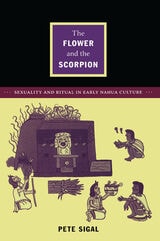
The Flower and the Scorpion
Sexuality and Ritual in Early Nahua CulturePete Sigal
Duke University Press, 2011
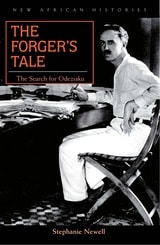
The Forger’s Tale
The Search for OdeziakuStephanie Newell
Ohio University Press, 2006
Between 1905 and 1939 a conspicuously tall white man with a shock of red hair, dressed in a silk shirt and white linen trousers, could be seen on the streets of Onitsha, in Eastern Nigeria. How was it possible for an unconventional, boy-loving Englishman to gain a social status among the local populace enjoyed by few other Europeans in colonial West Africa?
In The Forger’s Tale: The Search for Odeziaku Stephanie Newell charts the story of the English novelist and poet John Moray Stuart-Young (1881–1939) as he traveled from the slums of Manchester to West Africa in order to escape the homophobic prejudices of late-Victorian society. Leaving behind a criminal record for forgery and embezzlement and his notoriety as a “spirit rapper,” Stuart-Young found a new identity as a wealthy palm oil trader and a celebrated author, known to Nigerians as “Odeziaku.”
In this fascinating biographical account, Newell draws on queer theory, African gender debates, and “new imperial history” to open up a wider study of imperialism, (homo)sexuality, and nonelite culture between the 1880s and the late 1930s. The Forger’s Tale pays close attention to different forms of West African cultural production in the colonial period and to public debates about sexuality and ethics, as well as to movements in mainstream English literature.
The Gender Knot
Unraveling Our Patriarchal LegacyAllan Johnson
Temple University Press, 2014
The Gender Knot, Allan Johnson's response to the pain and confusion that men and women experience by living with gender inequality, explains what patriarchy is and isn't, how it works, and what gets in the way of understanding and doing something about it. Johnson's simple yet powerful approach avoids the paralyzing trap of guilt, blame, anger, and defensive denial that often results from conversations about gender.
This edition features:
• Updated references, data, resources, and examples, especially in relation to issues of sexual orientation and gender identity (e.g., gay marriage, transgender/cisgender)
• A glossary of terms
• A new chapter, "What Changes and What Does Not: Manhood and Violence," that provides an extended analysis of the causes of men's violence as a patriarchal phenomenon
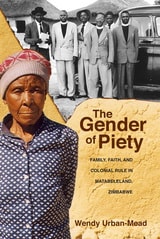
The Gender of Piety
Family, Faith, and Colonial Rule in Matabeleland, ZimbabweWendy Urban-Mead
Ohio University Press, 2015
The Gender of Piety is an intimate history of the Brethren in Christ Church in Zimbabwe, or BICC, as related through six individual life histories that extend from the early colonial years through the first decade after independence. Taken together, these six lives show how men and women of the BICC experienced and sequenced their piety in different ways. Women usually remained tied to the church throughout their lives, while men often had a more strained relationship with it. Church doctrine was not always flexible enough to accommodate expected masculine gender roles, particularly male membership in political and economic institutions or participation in important male communal practices.
The study is based on more than fifteen years of extensive oral history research supported by archival work in Zimbabwe, the United Kingdom, and the United States. The oral accounts make it clear, official versions to the contrary, that the church was led by spiritually powerful women and that maleness and mission-church notions of piety were often incompatible.
The life-history approach illustrates how the tension of gender roles both within and without the church manifested itself in sometimes unexpected ways: for example, how a single family could produce both a legendary woman pastor credited with mediating multiple miracles and a man—her son—who joined the armed wing of the Zimbabwe African People’s Union nationalist political party and fought in Zimbabwe’s liberation war in the 1970s. Investigating the lives of men and women in equal measure, The Gender of Piety uses a gendered interpretive lens to analyze the complex relationship between the church and broader social change in this region of southern Africa.
The Gendering of Men, 1600–1750
The English PhallusThomas A. King
University of Wisconsin Press, 2004
Taking on nothing less than the formation of modern genders and sexualities, Thomas A. King develops a history of the political and performative struggles that produced both normative and queer masculinities in the seventeenth and eighteenth centuries. The result is a major contribution to gender studies, gay studies, and theater and performance history.
The Gendering of Men, 1600–1750 traces the transition from a society based on alliance, which had subordinated all men, women, and boys to higher ranked males, to one founded in sexuality, through which men have embodied their claims to personal and political privacy. King proposes that the male body is a performative production marking men’s resistance to their subjection within patriarchy and sovereignty. Emphasizing that categories of gender must come under historical analysis, The Gendering of Men explores men’s particpation in an ongoing struggle for access to a universal manliness transcending other biological and social differentials.
This is volume one of two projected volumes.
The Gendering of Men, 1600–1750
Volume 2, Queer ArticulationsThomas A. King
University of Wisconsin Press, 2008
The Genesis of Desire
Jean-Michel Oughourlian
Michigan State University Press, 2010
We seem to be abandoning the codes that told previous generations who they should love. But now that many of us are free to choose whoever we want, nothing is less certain. The proliferation of divorces and separations reveal a dynamic we would rather not see: others sometimes reject us as passionately as we are attracted to them.
Our desire makes us sick. The throes of rivalry are at the heart of our attraction to one another. This is the central thesis of Jean-Michel Oughourlian's The Genesis of Desire, where the war of the sexes is finally given a scientific explanation. The discovery of mirror neurons corroborates his ideas, clarifying the phenomena of empathy and the mechanisms of violent reciprocity.
How can a couple be saved when they have declared war on one another? By helping them realize that desire originates not in the self but in the other. There are strategies that can help, which Dr. Oughourlian has prescribed successfully to his patients. This work, alternating between case studies and more theoretical statements, convincingly defends the possibility that breakups need not be permanent.
The Goddess in the Mirror
An Anthropology of BeautyTulasi Srinivas
Duke University Press, 2025
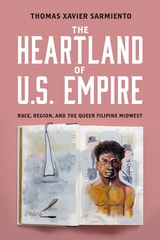
The Heartland of U.S. Empire
Race, Region, and the Queer Filipinx MidwestThomas Xavier Sarmiento
Temple University Press, 2026
Examining Filipinx cultural representations in the Midwest since the early twentieth century, Thomas Sarmiento shrewdly considers the impact of American exceptionalism and U.S. imperialism in a region where white, middle class, heterosexual, and Christian is the norm. The Heartland of U.S. Empire offers a cogent analysis of the 1904 St. Louis World’s Fair and its infamous Philippine Exhibit alongside minor museum displays and archives of Midwesterners in the Philippines. Sarmiento also considers the “exile literature” of Filipino/American writer Bienvenido Santos as well as the TV shows Glee and Superstore, which provide mainstream visibility of the queer Filipinx Midwest.
He employs a queer, decolonial Filipinx methodology that traces how narratives of America’s heartland position Filipinxs in the region as nonnormative due to their racial, gender, sexual, and national statuses. The Heartland of U.S. Empire locates queer Filipinxs in the geographic center of the nation and at the center of cultural narratives, thereby mapping alternative images of diasporic Filipinx identity and experience alongside U.S. regional and national identities, histories, and realities.
In the series Asian American History and Culture

The High School
Sports, Spirit, and Citizens, 1903-2024Michael A. Messner
Rutgers University Press, 2025
In The High School, acclaimed sociologist Michael A. Messner reads through 120 years of El Gabilan, the yearbook from his own alma mater, Salinas High School in California, where his father taught and coached. Treating the yearbooks as a historical archive, Messner makes surprising discoveries about the school he thought he knew so well. For example, over fifty years before Title IX, the earliest yearbooks gave equal spotlights to boys’ and girls’ athletics, while the cheerleaders were all boys.
Tracing American life and culture from 1903 to 2024, Messner illuminates shifts in social practices at his high school that reflect broader changes in American culture across the twentieth century. The High School spotlights how the meanings and iconography of certain activities have changed radically over the decades, even as the “sports spirit complex”—involving athletes, cheerleaders, band members, and community boosters—has remained a central part of the high school experience. By exploring evolving sports cultures, socioeconomic conditions, racial demographics, and gender norms, Messner offers a fresh perspective on a defining feature of American teenage life.
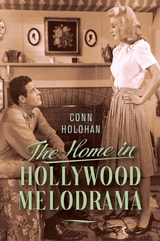
The Home in Hollywood Melodrama
Conn Holohan
Rutgers University Press, 2027
The Home in Hollywood Melodrama considers the home’s narrative, thematic, and visual construction within domestic melodramas of the 1930s and 1940s, exploring the assumptions of gender, class, and race through which the home is visualized on screen. Informed by approaches from genre studies, architectural and urban studies, feminist film theory, critical race theory, and phenomenology, amongst others, the book traces how routine domestic activities and unremarkable stylistic gestures become charged with meaning via melodrama’s emphasis on recurrence and return and its moral elevation of victimhood. Drawing on original archival research and detailed textual analysis, The Home in Hollywood Melodrama offers a series of detailed case studies that explore the onscreen home as a product of both Hollywood production norms and wider cultural conceptions of belonging. Addressing questions of female movement and labor, property relations and class, race, and national identity, the book argues that the generic structures of domestic melodrama are fundamental to understanding how the home within these films takes shape onscreen.
The IQ Mythology
Class, Race, Gender, and InequalityElaine Mensh and Harry Mensh
Southern Illinois University Press, 1991
Ever since Alfred Binet carried out a 1904 commission from France’s minister of public instruction to devise a means for deciding which pupils should be sent to what would now be called special education classes, IQ scores have been used to label and track children. Those same scores have been cited as "proof" that different races, classes, and genders are of superior and inferior intelligence.
The Menshes make clear that from the beginning IQ tests have been fundamentally biased. Offered as a means for seeking solutions to social problems, the actual measurements have been used to maintain the status quo. Often the most telling comments are from the test-makers themselves, whether Binet ("little girls weak in orthography are strong in sewing and capable in the instruction concerning housekeeping; and, all things considered, this is more important for their future") or Wigdor and Garner ("naive use of intelligence tests . . . to place children of linguistic or racial minority status in special education programs will not be defensible in court").
Among the disturbing facts that the authors share is that there is mounting political pressure for more tests and testing despite a court trial in which the judge stated that "defendants’ expert witnesses, even those clearly affiliated with the companies that devise and distribute the standardized intelligence tests, agreed, with one exception, that we cannot truly define, much less measure, intelligence." The testing firms have responded to this carefully orchestrated need with new products that extend even to the IQ testing of three-month-old infants. The authors stress that, if the testers prevail, there is little doubt that these and similar tests would be used "ad infinitum to justify superior and inferior education along class and racial lines."

The Intellect Handbook of Men’s Fashion
Edited by Ben Barry, Andy Reilly, and José Blanco F.
Intellect Books, 2026
Recent years have seen the study of men’s fashion grow from an emerging topic into a vibrant and expanding field, engaging with critical conversations on gender, race, sexuality, disability, colonialism, and globalization. Reflecting this shift, this volume moves beyond traditional narratives by highlighting three key approaches: decentralizing and decolonizing men’s fashion studies, embracing global perspectives, and focusing on multiple, overlapping social identities. Comprising thirty-four chapters by insightful scholars in fashion and dress studies, the collection offers a fresh and forward-looking examination of the field’s development.
Primarily designed for academic audiences, this handbook serves as an ideal textbook or core reading for undergraduate and graduate courses on gender and fashion. At the same time, it appeals to fashion practitioners, curators, cultural critics, and general readers interested in the history, culture, and meaning of men’s fashion and dress.

The Intercourse of Knowledge
On Gendering Desire and 'Sexuality' in the Hebrew BibleAthalya Brenner
SBL Press, 2016
Now in paperback!
This groundbreaking book, which builds on the author's earlier work in On Gendering Texts, studies how, by what means, and to what extent human love, desire and sex, and possibly even "sexuality"; are gendered in the Hebrew Bible. The investigation looks into the construction of male and female bodies in language and ideologies; the praxis and ideology of sex, procreation, and contraception; deviation from socio-sexual boundaries (e.g. incest, rape, adultery, homosexuality, prostitution); eroticism and "pornoprophetics."
Features:
- Paperback format of an essential Brill monograph
- A classification and gendering of the linguistic and semantic data
- Discussion of wider sociological and theological implications
The Invention of Heterosexuality
Jonathan Ned Katz
University of Chicago Press, 2007
“Heterosexuality,” assumed to denote a universal sexual and cultural norm, has been largely exempt from critical scrutiny. In this boldly original work, Jonathan Ned Katz challenges the common notion that the distinction between heterosexuality and homosexuality has been a timeless one. Building on the history of medical terminology, he reveals that as late as 1923, the term “heterosexuality” referred to a "morbid sexual passion," and that its current usage emerged to legitimate men and women having sex for pleasure. Drawing on the works of Sigmund Freud, James Baldwin, Betty Friedan, and Michel Foucault, The Invention of Heterosexuality considers the effects of heterosexuality’s recently forged primacy on both scientific literature and popular culture.
“Lively and provocative.”—Carol Tavris, New York Times Book Review
“A valuable primer . . . misses no significant twists in sexual politics.”—Gary Indiana, Village Voice Literary Supplement
“One of the most important—if not outright subversive—works to emerge from gay and lesbian studies in years.”—Mark Thompson, The Advocate
The Lettered Knight
Knowledge and aristocratic behaviour in the twelfth and thirteenth centuriesMartin Aurell
Central European University Press, 2017
The Lexington Six
Lesbian and Gay Resistance in 1970s AmericaJosephine Donovan
University of Massachusetts Press, 2020
Finalist for the 2021 Lambda Literary Awards
On September 23, 1970, a group of antiwar activists staged a robbery at a bank in Massachusetts, during which a police officer was killed. While the three men who participated in the robbery were soon apprehended, two women escaped and became fugitives on the FBI's Ten Most Wanted list, eventually landing in a lesbian collective in Lexington, Kentucky, during the summer of 1974. In pursuit, the FBI launched a massive dragnet. Five lesbian women and one gay man ended up in jail for refusing to cooperate with federal officials, whom they saw as invading their lives and community. Dubbed the Lexington Six, the group's resistance attracted national attention, inspiring a nationwide movement in other minority communities. Like the iconic Stonewall demonstrations, this gripping story of spirited defiance has special resonance in today's America.
Drawing on transcripts of the judicial hearings, contemporaneous newspaper accounts, hundreds of pages of FBI files released to the author under the Freedom of Information Act, and interviews with many of the participants, Josephine Donovan reconstructs this fascinating, untold story. The Lexington Six is a vital addition to LGBTQ, feminist, and radical American history.
The Light of the Home
An Intimate View of the Lives of Women in Victorian AmericaHarvey Green
University of Arkansas Press, 2003
The Literary Voices of Winnifred Eaton
Redefining Ethnicity and AuthenticityCole, Jean Lee
Rutgers University Press, 2002
Eaton attempted to disguise her Chinese heritage by writing under a hypothetically Japanese pen name. In legal documents, she usually claimed a "white" racial identity. In her fiction, Eaton portrayed Japanese, Chinese, Irish, and American characters, relying on the accepted stereotypes of the day. Jean Lee Cole shows that the many voices Eaton adopted show her deep preoccupations with "American" identity as a whole. The author attempts to reconcile all of these "voices," examining how Eaton survived in a climate hostile to minority writers in the early twentieth century, and how her seemingly anomalous works conjoin Asian American and American literary history.

The Lives of Jessie Sampter
Queer, Disabled, ZionistSarah Imhoff
Duke University Press, 2022
The Long Journey of Gracia Mendes
Marianna D. Birnbaum
Central European University Press, 2003
The Look of a Woman
Facial Feminization Surgery and the Aims of Trans- MedicineEric Plemons
Duke University Press, 2017
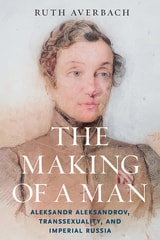
The Making of a Man
Aleksandr Aleksandrov, Transsexuality, and Imperial RussiaRuth Averbach
University of Wisconsin Press, 2026
Aleksandr Aleksandrov was an author and soldier in service of the Russian tsar, active in the Prussian theater of the War of the Fourth Coalition (1806–7) and in the Napoleonic Wars. In scholarship, he is better known by his birth name, Nadezhda Andreevna Durova, and often referred to with the female pronouns bestowed upon him at birth. In this first book-length study of Aleksandrov, Ruth Averbach argues that we should understand this celebrated figure of Imperial Russia, whose sex was legally changed by Tsar Aleksandr I, simply as a man, one whose masculinity was intimately connected to the imperialist cause and Russian nationalism.
For the majority of his life, Aleksandrov lived, wrote, and fought as a man and was recognized as such by most of his contemporaries. This contradicts the dominant position in especially Western feminist scholarship, which understands “Durova” either as a woman so patriotic that she dressed as a man to fight Russia’s wars or as a woman so frustrated by gender restrictions that she dramatically sought to cast them aside. Averbach instead asserts that we should take Aleksandrov at his word and accept his transition as genuine. Doing so allows for fresh interpretations of both his autobiographical writings and his works of fiction, interpretations that Averbach deftly shows have salience not just for a single man’s life but also for how we understand masculinity, imperialism, and nationalism in nineteenth-century Russia more broadly.
The Marriage Exchange
Property, Social Place, and Gender in Cities of the Low Countries, 1300-1550Martha C. Howell
University of Chicago Press, 1998
Based on extensive research in this archive, this book reveals how these documents were produced in a centuries-long effort to regulate—and ultimately to redefine—property and gender relations. At the center of the transformation was a shift from a marital property regime based on custom to one based on contract. In the former, a widow typically inherited her husband's property; in the latter, she shared it with or simply held it for his family or offspring. Howell asks why the law changed as it did and assesses the law's effects on both social and gender meanings but she insists that the reform did not originate in general dissatisfaction with custom or a desire to disempower widows. Instead, it was born in a complex economic, social and cultural history during which Douaisiens gradually came to think about both property and gender in new ways.
The Masculine Self in Late Medieval England
Derek G. Neal
University of Chicago Press, 2008
Marshalling a wide array of colorful evidence—including legal records, letters, medical sources, and the literature of the period—Derek G. Neal here plumbs the social and cultural significance of masculinity during the generations born between the Black Death and the Protestant Reformation. He discovers that social relations between men, founded on the ideals of honesty and self-restraint, were at least as important as their domination and control of women in defining their identities. By carefully exploring the social, physical, and psychological aspects of masculinity, The Masculine Self in Late Medieval England offers a uniquely comprehensive account of the exterior and interior lives of medieval men.

The Masculine Woman in America, 1890-1935
Laura L. Behling
University of Illinois Press, 2001
Scrutinizing depictions of the masculine woman in literature and the popular press, Laura L. Behling explicates the literary, artistic, and rhetorical strategies used to eliminate the "sexually inverted" woman: punishing her by imprisonment or death; "rescuing" her into heterosexuality; subverting her through parody; or removing her from society to some remote or mystical place. Behling also shows how fictional same-sex relationships in the writings of Henry James, Charlotte Perkins Gilman, Gertrude Stein, and others conformed to and ultimately reaffirmed heterosexual models.
The Masculine Woman in America, 1890-1935 demonstrates that the women's suffrage movement did not so much suggest alternatives to women's gender and sexual behavior as it offered men and women afraid of perceived changes a tangible movement on which to blame their fears. A biting commentary on the insubstantial but powerful ghosts stirred up by the media, this study shows how, though legally enfranchised, the new woman was systematically disfranchised socially through scientific theory, popular press illustrations, and fictional predictions of impending sociobiological disaster.
The Measure of Manliness
Disability and Masculinity in the Mid-Victorian NovelKaren Bourrier
University of Michigan Press, 2015

The Miniaturists
Barbara Browning
Duke University Press, 2022

The Motherlode
Why Most US Mothers Will Find Themselves Financially Supporting Their ChildrenJennifer L. Glass
Russell Sage Foundation, 2026
Despite cultural scripts that continue to view fathers as the primary breadwinners in their families, there has been a striking escalation of mothers’ assumption of that role. Over the last twenty years, the rate at which mothers become the primary breadwinner has increased by almost 50 percent and an astonishing 70 percent of American mothers can expect to become the primary earner for their household for at least a year before their first child turns eighteen. In The Motherlode, sociologist Jennifer L. Glass traces the rise of mothers as the primary financial providers for their children, investigates the causes of this increase, and evaluates the consequences of this shift for mothers and families.
Glass finds the swift increase of fiscal responsibility for children by their mothers is occurring in households of all racial backgrounds and across the educational spectrum. This increase is not due to more divorces or relationship breakups. In fact, the most rapid growth in mothers’ financial responsibility for the household has come from married mothers, not single mothers, and about half of contemporary mom-breadwinners have spouses or romantic partners living in the home. Nor is it due to a narrowing of the gender pay gap or mothers’ ability to out-earn their partners—the bulk of breadwinning mothers see large financial losses or are better off financially but still living in poverty when they become the primary earner. Instead, this rise is due to broader, long-term changes in the economy, which have led to less job security and wage stagnation for all workers.
The increase of mothers’ financial obligations to their children has occurred at the same time that nonfinancial responsibilities for children has increased—more time is dedicated to identifying, evaluating, and obtaining goods and services for children, including healthcare and schooling. There has not been a corresponding increase in support for mothers by their employers, the government, or fathers. This leaves mothers with greater burdens of both financial support and nonmonetary care for their children, which increases the number of children that are vulnerable to dependency on their mothers’ earnings and intermittent poverty. While this rise in maternal breadwinning is unlikely to decline anytime soon, Glass suggests policies that could provide mothers with more support, such as enacting labor protections for care occupations dominated by women and federal paid family and medical leave and providing federally funded, wraparound, non-means-tested systems of childcare.
The Motherlode is an illuminating and in-depth examination of the surprisingly pervasive phenomenon of maternal breadwinning in American society.

The Movies of Racial Childhoods
Screening Self-Sovereignty in Asian/AmericaCeline Parreñas Shimizu
Duke University Press, 2024
The Myth of Manliness in Irish National Culture, 1880-1922
Joseph Valente
University of Illinois Press, 2011
The Narrative of Lucy Ann Lobdell
A Woman's Case for EqualityLisa Macchia Ohliger
Westholme Publishing, 2024
Lucy Ann Lobdell’s (1829–1912) extraordinary life was shaped by personal strife and the hardships of survival in upstate New York. Struggling with an abusive, alcoholic husband, a young child, ailing parents, and financial strain, Lucy did what was necessary to support her family. In a rural world defined by hunting, farming, and lumbering, she dressed, labored, and lived in a traditional masculine manner. Her prowess as a rifle shot and fiddle player were known locally, but because of her unconventional, androgynous lifestyle, she became a target of public gossip and ridicule. Educated and eloquent, Lucy penned and published, Lucy Ann Lobdell, the Female Hunter of Delaware and Sullivan Counties, N.Y., in 1855. The narrative provides a unique look at the persecution of a woman whose only “offense” was disregard for contemporary societal norms.
After her husband was killed during the Civil War, she received a widow’s pension. Ostracized and eventually hospitalized in 1880—gender laws of the time imprisoned indigent men, but sent women to mental hospitals—she underwent torturous experimental treatment until she confessed to a self-serving doctor that she was “a man in all that the name implies.” Whether Lucy was a lesbian, cross dresser, or transgender, we don’t know from the historical record, but as Lisa Macchia Ohliger demonstrates in The Narrative of Lucy Ann Lobdell: A Woman’s Case for Equality, Lucy did embody the nascent women’s rights movement. At the same time, and not far from where Lucy lived and went to school, Amelia Bloomer was advocating the right for women to wear pants and was publishing the feminist newspaper, The Lily, while Susan B. Anthony was pushing for land rights and equal pay for women. All of these issues are found in Lucy’s autobiographical account, fully reproduced in this volume. Lucy’s life is an illustration of the historical significance and destructive power of gender in society, and her narrative bears painful witness to the clash between taboo and survival.
The Neoliberal Self in Bollywood
Cinema, Popular Culture, and IdentityNamrata Rele Sathe
Intellect Books, 2025
The neoliberal self, far from being a stable marker of urban, liberal, millennial Indian identity, is replete with contradictions and oppositions. This study of the unstable neoliberal identity lays bare the sense of precarity and inherent inequality that neoliberal regimes confer upon their subjects.
This analysis draws upon theories of feminist media studies, popular culture analyses, and film studies to critique mainstream Hindi cinema texts produced in the last two decades. Rele Sathe also examines a variety of peripheral subjects and texts, including the film star, the urban space, web series, YouTube videos, and social media content.
The New Feminist Movement
Marion Lockwood Carden
Russell Sage Foundation, 1974
The New Politics of Online Feminism
Akane Kanai
Duke University Press, 2026
The Occasions of Poetry
Essays in Criticism and AutobiographyThom Gunn
University of Michigan Press, 1999
Thom Gunn is well-known as a poet, and increasingly as a literary critic. The Occasions of Poetry includes insightful critical pieces on writers ranging from William Carlos Williams and Gary Snyder to Thomas Hardy and Robert Duncan. "The occasion in all cases," writes Gunn, "is the starting point, only, of a poem, but it should be a starting point to which the poet must in some sense stay true." The first loyalty of a writer who is "true to his occasions," he writes, must be to the facts of experience.
The book includes five autobiographical essays, which combine to form an engaging account of the author's development as a poet and to chronicle some of the most significant literary currents of recent decades, both in England and America.
Thom Gunn, born in England in 1929, has lived in America since 1954. His books include Shelf Life: Essays, Memoirs, and an Interview; The Man with Night Sweats; Collected Poems; and The Passages of Joy. The Occasions of Poetry was originally published by Faber and Faber.

The Oocyte Economy
The Changing Meaning of Human EggsCatherine Waldby
Duke University Press, 2019