Results by title
218 books match the query 'Handbooks, manuals, etc' and 66 start with t
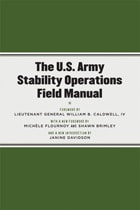
The U.S. Army Stability Operations Field Manual
U.S. Army Field Manual No. 3-07The United States Army
University of Michigan Press, 2009
Field Manual 3-07, Stability Operations, represents a milestone in Army doctrine.
With a focus on transforming conflict, managing violence when it does occur and maintaining stable peace, The U.S. Army Stability Operations Field Manual (otherwise known as FM 3-07) signals a stark departure from traditional military doctrine. The Army officially acknowledges the complex continuum from conflict to peace, outlines the military's responsibility to provide stability and security, and recognizes the necessity of collaboration, coordination, and cooperation among military, state, commercial, and non-government organizations in nation-building efforts.
The manual reflects a truly unique collaboration between the Army and a wide array of experts from hundreds of groups across the United States Government, the intergovernmental and non-governmental communities, America's allies around the world, and the private sector. All branches of the armed forces, U.S. agencies ranging from the State Department to Homeland Security to Health and Human Services, international agencies from the United Nations to the Red Cross to the World Bank, countries from the United Kingdom to India to South Africa, private think tanks from RAND to the United States Institute of Peace to the Center for New American Security, all took part in the shaping of this document.
The U.S. Army Stability Operations FieldManual, marks just the second time in modern history that the U.S. Army has worked with a private publisher to produce a military doctrinal document.
Lieutenant General William B. Caldwell, IV is Commander of the Combined Arms Center at Fort Leavenworth, Kansas.
Michèle Flournoy, Under Secretary of Defense for Policy
Shawn Brimley, Fellow, Center for a New American Security
Janine Davidson, Deputy Assistant Secretary of Defense for Plans
"It is a roadmap from conflict to peace, a practical guidebook for adaptive, creative leadership at a critical time in our history. It institutionalizes the hard-won lessons of the past while charting a path for tomorrow. This manual postures our military forces for the challenges of an uncertain future, an era of persistent conflict where the unflagging bravery of our Soldiers will continue to carry the banner of freedom, hope, and opportunity to the people of the world."
—From the foreword by Lieutenant General William B. Caldwell, IV, Commander of the Combined Arms Center at Fort Leavenworth, Kansas
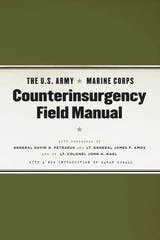
The U.S. Army/Marine Corps Counterinsurgency Field Manual
The United States Army and Marine Corps
University of Chicago Press, 2007
When the U.S. military invaded Iraq, it lacked a common understanding of the problems inherent in counterinsurgency campaigns. It had neither studied them, nor developed doctrine and tactics to deal with them. It is fair to say that in 2003, most Army officers knew more about the U.S. Civil War than they did about counterinsurgency.
The U.S. Army / Marine Corps Counterinsurgency Field Manual was written to fill that void. The result of unprecedented collaboration among top U.S. military experts, scholars, and practitioners in the field, the manual espouses an approach to combat that emphasizes constant adaptation and learning, the importance of decentralized decision-making, the need to understand local politics and customs, and the key role of intelligence in winning the support of the population. The manual also emphasizes the paradoxical and often counterintuitive nature of counterinsurgency operations: sometimes the more you protect your forces, the less secure you are; sometimes the more force you use, the less effective it is; sometimes doing nothing is the best reaction.
An new introduction by Sarah Sewall, director of the Carr Center for Human Rights Policy at Harvard’s Kennedy School of Government, places the manual in critical and historical perspective, explaining the significance and potential impact of this revolutionary challenge to conventional U.S. military doctrine.
An attempt by our military to redefine itself in the aftermath of 9/11 and the new world of international terrorism, The U.S. Army / Marine Corps Counterinsurgency Field Manual will play a vital role in American military campaigns for years to come.
The University of Chicago Press will donate a portion of the proceeds from this book to the Fisher House Foundation, a private-public partnership that supports the families of America’s injured servicemen. To learn more about the Fisher House Foundation, visit www.fisherhouse.org.
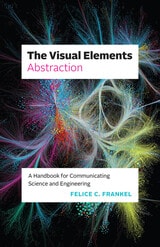
The Visual Elements—Abstraction
A Handbook for Communicating Science and EngineeringFelice C. Frankel
University of Chicago Press, 2026
For anyone interested in visual communication, a training guide for evaluating and developing visual representations for the big ideas in science and technology, essential skills for journal submissions, grant applications, and public understanding.
As a scientist, engineer, or other researcher, you may have written an abstract. In a paragraph, you explain the purpose of your research, your approach, the questions you have asked and answered, and your work’s impact. The abstract is a summary and an invitation—to read the paper, attend your talk, and join you in your thinking. You may even have been asked to create a visual abstract—a single image—to achieve the same goals. As a designer or public information officer, you may have had a similar brief—to explain a compelling subject with a visual for a journal cover or press release. And yet, this important skill—devising visual metaphors—isn’t typically taught. With her decades of experience creating compelling images and instructing MIT researchers, award-winning photographer and science communicator Felice C. Frankel helps readers evaluate and create their own visual abstractions.
Like in her other books in the Visual Elements series, on photography and design, Frankel asks readers to evaluate different choices—for example, in conveying the uncertainty of a hurricane’s path or the organization of the Standard Model for elementary particles. But in Abstraction, she offers more. With examples from science, engineering, and beyond, the book helps readers consider and evaluate the visuals around them and determine how they work and when they fail: Is this representation the best for communication? Will these abstractions encourage others to engage with my work? Will they mislead? Will they help my ideas evolve? Frankel invites researchers to think about the many meanings behind their images—and, in turn, to think more deeply about their research.
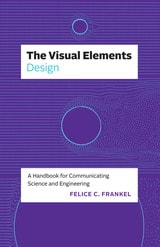
The Visual Elements—Design
A Handbook for Communicating Science and EngineeringFelice C. Frankel
University of Chicago Press, 2024
In this short handbook, award-winning science communicator Felice C. Frankel offers a quick guide for scientists and engineers who want to share—and better understand—their research by designing compelling graphics for journal submissions, grant applications, presentations, and posters. Like all the books in the Visual Elements series, this handbook is also a training tool for researchers. Distilling her celebrated books and courses to the essentials, Frankel shows scientists and engineers, from students to primary investigators, the importance of thinking visually. This crucial volume in the Visual Elements series offers a wealth of engaging design examples. Case studies and advice from designers at prestigious publications and researchers’ own before-and-after examples show how even the smallest changes—to color, type, composition, and layering—can greatly improve communication. Ideal for researchers who want a foothold for presenting and preparing their work for everything from conferences to publications, the book explains the steps for creating a concise and communicative graphic to highlight the most important aspects of research—and to clarify researchers’ own thinking. The resulting book is an essential element of any scientist’s, engineer’s, or designer’s library.
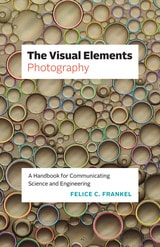
The Visual Elements—Photography
A Handbook for Communicating Science and EngineeringFelice C. Frankel
University of Chicago Press, 2023
Award-winning photographer Felice C. Frankel, whose work has graced the covers of Science, Nature, and Scientific American, among other publications, offers a quick guide for scientists and engineers who want to communicate—and better understand—their research by creating compelling photographs. Like all the books in the Visual Elements series, this short guide uses engaging examples to train researchers to learn visual communication. Distilling her celebrated books and courses to the essentials, Frankel shows scientists and engineers the importance of thinking visually. When she creates stunning images of scientific phenomena, she is not only interested in helping researchers to convey understanding to others in their research community or to gain media attention, but also in making these experts themselves “look longer” to understand more fully. Ideal for researchers who want a foothold for presenting and preparing their work for conferences, journal publications, and funding agencies, the book explains four tools that all readers can use—a phone, a camera, a scanner, and a microscope—and then offers important advice on composition and image manipulation ethics. The Visual Elements—Photography is an essential element in any scientist’s, engineer’s, or photographer’s library.

The Weeding Handbook
A Shelf-by-Shelf GuideRebecca Vnuk
American Library Association, 2015

The Weeding Handbook
A Shelf-by-Shelf GuideRebecca Vnuk
American Library Association, 2022
"Manages to be a thorough and informative source on weeding library collections and yet also an easy, engaging read ... Recommended." That rave review from Technicalities sums up the acclaim and appeal of this bestselling resource’s first edition. Now Vnuk has revised and updated her text to keep pace with libraries’ longer-term shifts in collection development and access, such as a growing emphasis on digital collections and managing duplicate physical materials. She demonstrates how weeding helps a library thrive by focusing its resources on those parts of the collection that are the most useful to its users. Walking collections staff through the proverbial stacks shelf by shelf, this book
- includes a new “Tales from the Front” feature, providing real-life case studies of librarians working on weeding projects;
- explains why weeding is important for a healthy library and how it can positively affect library budgets;
- systematically walks readers through a library's shelves, with recommended weeding criteria and call-outs in each area for the different considerations of large collections and smaller collections;
- offers easily adaptable, updated sample development plans which reflect the latest thinking in collection development;
- advises readers on weeding problematic materials, such as those that include racist themes and depictions;
- presents updated and expanded guidance on special considerations for youth collections;
- addresses reference, media, magazines and newspapers, e-books, and other special materials;
- shares guidance for determining how to delegate responsibility for weeding, plus pointers for getting other staff members on board; and
- gives advice for educating the community about the process, how to head off PR disasters, and what to do with weeded materials.

The Whole Library Handbook 5
Current Data, Professional Advice, and CuriosaGeorge M. Eberhart
American Library Association, 2013
The Whole School Library Handbook 2
Blanche Woolls
American Library Association, 2013
The Writer's Reference Guide to Spanish
By David William Foster, Daniel Altamiranda, and Carmen de Urioste
University of Texas Press, 2000
Writers and editors of Spanish have long needed an authoritative guide to written language usage, similar to The MLA Style Manual and The Chicago Manual of Style. And here it is! This reference guide provides comprehensive information on how the Spanish language is copyedited for publication.
The book covers these major areas:
- Language basics: capitalization, word division, spelling, and punctuation.
- Language conventions: abbreviations, professional and personal titles, names of organizations, and nationalities.
- Bibliographic format, particularly how Spanish differs from English.
- Spanish language forms of classical authors' names.
- Literary and grammatical terminology.
- Linguistic terminology.
- Biblical names and allusions.
- A dictionary of grammatical doubts, including usage, grammatical constructions of particular words and phrases, verbal irregularities, and gender variations.
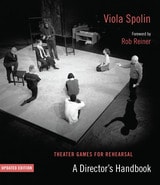
Theater Games for Rehearsal
A Director's Handbook, Updated EditionViola Spolin with a foreword by Rob Reiner
Northwestern University Press, 2010
An updated edition of a key reference text by “the high priestess of improvisational theater”
A major force in the development of American theater, Viola Spolin devised pedagogical techniques that have influenced and inspired legions of actors, improvisers, and directors. Theater Games for Rehearsal: A Director's Handbook, first published in 1985, is a practical application of Spolin's famous method that guides directors and their companies step-by-step through all phases of the rehearsal period.
In Theater Games for Rehearsal, Spolin shows in easy-to-follow detail how her techniques can be used for a variety of theater needs, from selecting performance material, casting, and building a harmonious company to warming up actors, creating stage space, and overcoming opening-night jitters. This new edition, edited by Carol Bleackley Sills, incorporates Spolin's wished-for updates: four important exercises have been added, and instructions presenting her improvisational approach have been clarified throughout. Sidecoaching instructions and game evaluations are boxed and highlighted for on-the-spot reading by the director during rehearsal.
With these additions and improvements, Theater Games for Rehearsal: A Director's Handbook brings Spolin's ideas to a new generation with greater accessibility and excitement. Featuring a new foreword by renowned film director Rob Reiner, the updated edition is mandatory for any theater bookshelf.

Tips, Tools, and Techniques to Care for Antiques, Collectibles, and Other Treasures
Georgia Kemp Caraway
University of North Texas Press, 2012

Tribal Administration Handbook
A Guide for Native Nations in the United StatesRebecca M. Webster
Michigan State University Press, 2022
Tutoring Matters
Everything You Always Wanted To Know About How To TutorJerome Rabow
Temple University Press, 1999
Tutoring Matters is the authoritative manual for both the aspiring and seasoned tutor. Using firsthand experiences of over one hundred new and experienced tutors, this long-awaited guide offers chapters on attitudes and anxieties, teaching techniques, and building relationships. It educates the tutor on how to handle and appreciate social and language differences; how to use other adults -- teachers, administrators, parents, employers -- to a student's advantage; and, when your student or circumstances determine that it's time, how to put a positive and supportive end to the tutor-tutee relationship.
Written by experienced tutors and tutoring educators, Tutoring Matters celebrates -- and provides just the right tools for -- an individualized and successful tutoring relationship and shows just how much you can learn -- about the world and yourself -- through teaching others.
Tutoring Matters
Everything You Always Wanted to Know about How to TutorAuthored by Tiffani Chin, Jerome Rabow and Jeimee Estrada
Temple University Press, 2011
Tutoring Matters is the authoritative guide for both the aspiring and seasoned tutor. Using firsthand experiences of over one hundred new and experienced college student tutors, the authors offer techniques for handling tutoring anxieties, teaching strategies, and tips for building relationships.
This new edition has been fully updated to help tutors to engage the interest of their students. In addition, it features practical “tip boxes” that provide quick-reference guidelines on a range of tutoring challenges—from making a connection in your first tutoring session to becoming familiar with your pupil's life and tutoring needs. This new edition also provides practical experience-based tips "from the trenches" about how to tutor math and reading and how to help students develop other academic skills and interests.
Tutoring Second Language Writers
Shanti Bruce
Utah State University Press, 2015
Tutoring Second Language Writers, a complete update of Bruce and Rafoth’s 2009 ESL Writers, is a guide for writing center tutors that addresses the growing need for tutors who are better prepared to work with the increasingly international population of students seeking guidance at the writing center.
Drawing upon philosopher John Dewey’s belief in reflective thinking as a way to help build new knowledge, the book is divided into four parts. Part 1: Actions and Identities is about creating a proactive stance toward language difference, thinking critically about labels, and the mixed feelings students may have about learning English. Part 2: Research Opportunities demonstrates writing center research projects and illustrates methods tutors can use to investigate their questions about writing center work. Part 3: Words and Passages offers four personal stories of inquiry and discovery, and Part 4: Academic Expectations describes some of the challenges tutors face when they try to help writers meet readers’ specific expectations.
Advancing the conversations tutors have with one another and their directors about tutoring second language writers and writing, Tutoring Second Language Writers engages readers with current ideas and issues that highlight the excitement and challenge of working with those who speak English as a second or additional language.
Contributors include Jocelyn Amevuvor, Rebecca Day Babcock, Valerie M. Balester, Shanti Bruce, Frankie Condon, Michelle Cox, Jennifer Craig, Kevin Dvorak, Paula Gillespie, Glenn Hutchinson, Pei-Hsun Emma Liu, Bobbi Olson, Pimyupa W. Praphan, Ben Rafoth, Jose L. Reyes Medina, Guiboke Seong, and Elizabeth (Adelay) Witherite.