Results by title
405 books match the query 'Human Geography' and 79 start with t
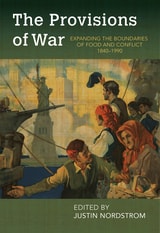
The Provisions of War
Expanding the Boundaries of Food and Conflict, 1840-1990Justin Nordstrom
University of Arkansas Press, 2021
The Provisions of War examines how soldiers, civilians, communities, and institutions have used food and its absence as both a destructive weapon and a unifying force in establishing governmental control and cultural cohesion during times of conflict. Historians as well as scholars of literature, regional studies, and religious studies problematize traditional geographic boundaries and periodization in this essay collection, analyzing various conflicts of the nineteenth and twentieth centuries through a foodways lens to reveal new insights about the parameters of armed interactions.
The subjects covered are as varied and inclusive as the perspectives offered—ranging from topics like military logistics and animal disease in colonial Africa, Indian vegetarian identity, and food in the counterinsurgency of the Malayan Emergency, to investigations of hunger in Egypt after World War I and American soldiers’ role in the making of US–Mexico borderlands. Taken together, the essays here demonstrate the role of food in shaping prewar political debates and postwar realities, revealing how dietary adjustments brought on by military campaigns reshape national and individual foodways and identities long after the cessation of hostilities
The Pulse of the Earth
Political Geology in JavaAdam Bobbette
Duke University Press, 2023
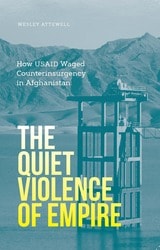
The Quiet Violence of Empire
How USAID Waged Counterinsurgency in AfghanistanWesley Attewell
University of Minnesota Press, 2023
How the U.S. empire-state transformed post-1945 Afghanistan into a key site for reimagining development
Established in 1961 by President Kennedy, the United States Agency for International Development (USAID) is often viewed as an extension of the security state, playing a constant role on the ground in Afghanistan since the early sixties. The Quiet Violence of Empire traces USAID’s long and bloody history of development work in the region, revealing an empirically rich account of the transnational entanglements of imperialism and racial capitalism.
Wesley Attewell carefully analyzes three chronological moments of development as counterinsurgency in action: the Helmand Valley Project, the Soviet–Afghan conflict, and the post-9/11 occupation in Afghanistan. These case studies expose how USAID’s very public commitment to bringing seemingly inclusionary forms of self-help, technical assistance, and market development to Afghanistan has been undergirded by longer-standing infrastructures of race war and racial management. Attewell exposes how one of the net effects of USAID’s development mission to Afghanistan has been to constrain the life chances of Afghan beneficiaries while simultaneously diverting development capital back to U.S. contractors, deftly underscoring the notion of development as a form of slow violence.
The Quiet Violence of Empire asks the critical question: how might we refuse the ruse of USAID and its endlessly deferred promise of development? Thinking relationally across the fields of human geography, global studies, and critical ethnic studies, it uncovers the explicitly racial underpinnings of international development theory and praxis.
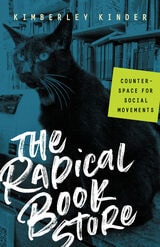
The Radical Bookstore
Counterspace for Social MovementsKimberley Kinder
University of Minnesota Press, 2021
Examines how radical bookstores and similar spaces serve as launching pads for social movements
How does social change happen? It requires an identified problem, an impassioned and committed group, a catalyst, and a plan. In this deeply researched consideration of seventy-seven stores and establishments, Kimberley Kinder argues that activists also need autonomous space for organizing, and that these spaces are made, not found. She explores the remarkably enduring presence of radical bookstores in America and how they provide infrastructure for organizing—gathering places, retail offerings that draw new people into what she calls “counterspaces.”
Kinder focuses on brick-and-mortar venues where owners approach their businesses primarily as social movement tools. These may be bookstores, infoshops, libraries, knowledge cafes, community centers, publishing collectives, thrift stores, or art installations. They are run by activist-entrepreneurs who create centers for organizing and selling books to pay the rent. These spaces allow radical and contentious ideas to be explored and percolate through to actual social movements, and serve as crucibles for activists to challenge capitalism, imperialism, white privilege, patriarchy, and homophobia. They also exist within a central paradox: participating in the marketplace creates tensions, contradictions, and shortfalls. Activist retail does not end capitalism; collective ownership does not enable a retreat from civic requirements like zoning; and donations, no matter how generous, do not offset the enormous power of corporations and governments.
In this timely and relevant book, Kinder presents a necessary, novel, and apt analysis of the role these retail spaces play in radical organizing, one that demonstrates how such durable hubs manage to persist, often for decades, between the spikes of public protest.
The Republican Aventine and Rome’s Social Order
Lisa Marie Mignone
University of Michigan Press, 2016
The myth of the “plebeian Aventine” became embedded not only in classical scholarship, but also in modern political and cultural consciousness; it has even been used by modern figures to support their political agenda. Yet The Republican Aventine and Rome’s Social Order makes bold new claims regarding the urban design and social history of ancient Rome and raises a significant question about ancient urbanism and social stability more generally: Did social integration reduce violence in premodern cities and promote urban concord?
The Security Archipelago
Human-Security States, Sexuality Politics, and the End of NeoliberalismPaul Amar
Duke University Press, 2013
The Settlement of the American Continents
A Multidisciplinary Approach to Human BiogeographyEdited by C. Michael Barton, Geoffrey A. Clark, David R. Yesner, and Georges A. Pearson
University of Arizona Press, 2004
This book approaches the human settlement of the Americas from a biogeographical perspective in order to provide a better understanding of the mechanisms and consequences of this unique event. It considers many of the questions that continue to surround the peopling of the Western Hemisphere, focusing not on sites, dates, and artifacts but rather on theories and models that attempt to explain how the colonization occurred.
Unlike other studies, this book draws on a wide range of disciplines—archaeology, human genetics and osteology, linguistics, ethnology, and ecology—to present the big picture of this migration. Its wide-ranging content considers who the Pleistocene settlers were and where they came from, their likely routes of migration, and the ecological role of these pioneers and the consequences of colonization. Comprehensive in both geographic and topical coverage, the contributions include an explanation of how the first inhabitants could have spread across North America within several centuries, the most comprehensive review of new mitochondrial DNA and Y-chromosome data relating to the colonization, and a critique of recent linguistic theories.
Although the authors lean toward a conservative rather than an extreme chronology, this volume goes beyond the simplistic emphasis on dating that has dominated the debate so far to a concern with late Pleistocene forager adaptations and how foragers may have coped with a wide range of environmental and ecological factors. It offers researchers in this exciting field the most complete summary of current knowledge and provides non-specialists and general readers with new answers to the questions surrounding the origins of the first Americans.
The Solidarity Economy
Jean-Louis Laville
University of Minnesota Press, 2023
Questioning the boundaries between politics and economics
Jean-Louis Laville’s large body of work has focused on an intellectual history of the concept of solidarity since the Industrial Revolution. In The Solidarity Economy, his most famous distillation of this work, Laville establishes how the formations of economic solidarities (unions, activism, and other forms of associationalism) reveal that the boundaries between politics and economics are porous and structured such that politics, ideally a pure expression of ethics and values, is instead integrated with economic concerns.
Exploring the possibilities and long histories of association, The Solidarity Economy identifies the power of contemporary social and solidarity movements and examines the history of postcapitalist practices in which democratic demands invade the heart of the economy. The Solidarity Economy ranges in focus from workers associations in France dating back to the nineteenth century, to associations of African Americans and feminists in the United States in the late nineteenth and early twentieth centuries, to a Brazilian landless-worker coalition in the twentieth century.
Studying solidarity associations over time allows us to examine how we can recombine the economic and political spheres to address dependencies and inequalities. Ultimately, The Solidarity Economy has global scope and inspiring examples of associations that deepen democracy.
The Surrounds
Urban Life within and beyond CaptureAbdouMaliq Simone
Duke University Press, 2022
The Time beneath the Concrete
Palestine between Camp and ColonyNasser Abourahme
Duke University Press, 2025
The Tragedy of the Commodity
Oceans, Fisheries, and AquacultureLongo, Stefano B
Rutgers University Press, 2015
Although humans have long depended on oceans and aquatic ecosystems for sustenance and trade, only recently has human influence on these resources dramatically increased, transforming and undermining oceanic environments throughout the world. Marine ecosystems are in a crisis that is global in scope, rapid in pace, and colossal in scale. In The Tragedy of the Commodity, sociologists Stefano B. Longo, Rebecca Clausen, and Brett Clark explore the role human influence plays in this crisis, highlighting the social and economic forces that are at the heart of this looming ecological problem.

The Victoria History of Hampshire
Cliddesden, Hatch and Farleigh WallopAlison Deveson and Sue Lane
University of London Press, 2018
The Wealth and Poverty of Regions
Why Cities MatterMario Polèse
University of Chicago Press, 2009
As the world becomes more interconnected through travel and electronic communication, many believe that physical places will become less important. But as Mario Polèse argues in The Wealth and Poverty of Regions, geography will matter more than ever before in a world where distance is allegedly dead.
This provocative book surveys the globe, from London and Cape Town to New York and Beijing, contending that regions rise—or fall—due to their location, not only within nations but also on the world map. Polèse reveals how concentrations of industries and populations in specific locales often result in minor advantages that accumulate over time, resulting in reduced prices, improved transportation networks, increased diversity, and not least of all, “buzz”—the excitement and vitality that attracts ambitious people. The Wealth and Poverty of Regions maps out how a heady mix of size, infrastructure, proximity, and cost will determine which urban centers become the thriving metropolises of the future, and which become the deserted cities of the past. Engagingly written, the book provides insight to the past, present, and future of regions.
The World as Abyss
The Caribbean and Critical Thought in the AnthropoceneJonathan Pugh and David Chandler
University of Westminster Press, 2023
This book is about a distinctive ‘abyssal’ approach to the crisis of modernity. In this framing, influenced by contemporary critical Black studies, another understanding of the world of modernity is foregrounded – a world violently forged through the projects of Indigenous dispossession, chattel slavery and colonial world-making. Modern and colonial world-making violently forged the ‘human’ by dividing those with ontological security from those without, and by carving out the ‘world’ in a fixed grid of space and time, delineating a linear temporality of ‘progress’ and ‘development’. The distinctiveness of abyssal thought is that it inverts the stakes of critique and brings indeterminacy into the heart of ontological assumptions of a world of entities, essences, and universal determination. This is an approach that does not focus upon tropes of rescue and salvation but upon the generative power of negation. In doing so, it highlights how Caribbean experiences and writings have been drawn upon to provide an important and distinct perspective for critical thought.
"How is it that ontology has come to be seen as the antidote for modernity? While Foucault denigrated ontology as a mistaken and parochial exercise, contemporary social theory holds out the promise that new modes of planetary knowledge will save us from our own excesses. Drawing together long traditions in Caribbean scholarship with Afro-pessimist thought, Pugh and Chandler illustrate how the search for more emancipatory ontologies - relational ontologies, indigenous ontologies, non-human ontologies, etc. – not only misunderstands the problem of modernity but (more importantly) works to veil the negative force that marks both the limit and cause of all such knowledge practices: what they term the abyss. To engage in abyssal thought – as they lay out – is to inhabit a site of refusal: a determination not to be drawn into the lure of ontological ‘correction’ and to recognise that the practice of world making cannot not bear the imprint of colonial violence. Articulated in passionate declarative prose, these authors powerfully illuminate the trap of the emancipatory instinct and the promise of a deconstructive ethic." — Mitch Rose, Senior Lecturer in Human Geography, Aberystwyth University, UK
“A much-needed intellectual effort in the non-reductionist and non-essentialising style of Pugh and Chandler's previous book. The World as Abyss gives Caribbean thought and culture the place they deserve within critical theory and materialist studies.” — Mónica Fernández Jiménez, Valladolid University, Spain
“For some time now scholars have questioned the overly general assumptions about the ‘anthropos’ of the Anthropocene, but much work needs to be done to flesh out what a decolonized Anthropocene might be. Pugh and Chandler’s The World as Abyss provides an original, intriguing and compelling counterpoint to bland Anthropocene humanism (and posthumanism). This timely work explores the poetics of the Caribbean and provides a way to think about the Anthropocene and the future beyond the managerialism of the present. This book is essential reading for those working in the environmental humanities or Anthropocene studies.” — Claire Colebrook, Professor, Penn State University, USA
“This book names an apocalypse that began long ago. Pugh and Chandler patiently follow the journey of thought as it travels from the Middle Passage to the Caribbean. This brings them face-to-face with the horror of anti-Black violence, not as just another resource to strip-mine, but as an unavoidable abyss that confines all thought. Its reminder: that we have still not yet begun to think a truly Black world.” — Andrew Culp, Professor, California Institute of the Arts, USA
"With the force of a manifesto, the intensity of a polemic, and the nuance of a treatise, thisbook sets out to disavow the disavowal of Colonial violence in the making of thecontemporary world and thought. Learning from Caribbean thinkers, writers, and poets, itsets to work unworking, desedimenting and deconstructing, the violent ontologicalfoundations by which anti-Black worlds maintain and reproduce their innocence andignorance. Replaying and reiterating, extending and multiplying, gestures of refusal –refusals of subjection, of History, of Geography, of meaning, of Being – there is the refusalof the World as it is and of the World as it could be. The World as Abyss artfully combines acritique of the historical forces which make and unmake the contemporary moment withthe suspension of horizons, of ends, of grounds. What emerges in the wake is anintensification of the generative capacity of this refusal; voids, arrhythmia, counter-times,displacements, dislocations, the abyssal. First as threat and then as promise" — PaulHarrison, Associate Professor of Human Geography, Durham University, UK
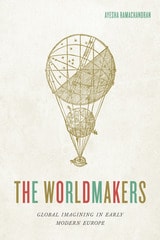
The Worldmakers
Global Imagining in Early Modern EuropeAyesha Ramachandran
University of Chicago Press, 2015
The Worldmakers moves beyond histories of globalization to explore how “the world” itself—variously understood as an object of inquiry, a comprehensive category, and a system of order—was self-consciously shaped by human agents. Gathering an international cast of characters, from Dutch cartographers and French philosophers to Portuguese and English poets, Ramachandran describes a history of firsts: the first world atlas, the first global epic, the first modern attempt to develop a systematic natural philosophy—all part of an effort by early modern thinkers to capture “the world” on the page.
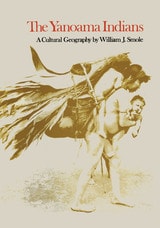
The Yanoama Indians
A Cultural GeographyBy William J. Smole
University of Texas Press, 1976
The Yanoama are one of the most numerous remaining aboriginal populations of the South American tropical forests, and their large territory constitutes a significant culture region. Although other scholars (anthropologists, geneticists, linguists) have studied this contemporary "neolithic" population, this is the first geographic study of the Yanoama. It is also the only book to focus on the Yanoama highland core area—the Parima massif—and it is the first study to analyze Yanoama horticulture as an integral part of their ecosystem.
The author is concerned principally with the spatial dimension as developed in Yanoama culture, with the spatial patterns of functioning systems, and with Yanoama ecology in this highland habitat. The natural environment is viewed, not as a cultural determinant, but as part of the total ecosystem. Livelihood activities constitute a major organizing theme and, among these, gardening receives the most attention. Frequently classified as a nomadic hunter-gatherer group, the Yanoama are found to have a deep-seated horticultural tradition, and many new data on this tradition are presented. As this study reveals, the Yanoama have created and maintained a cultural landscape that bears their distinctive stamp.
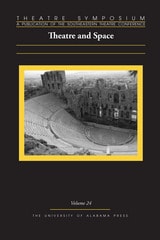
Theatre Symposium, Vol. 24
Theatre and SpaceEdited by Becky K. Becker
University of Alabama Press, 2016
Exploring the dynamic intersections of performance and place.
At a time when so many options exist for access to theatrical entertainments, it is no surprise that theatre practitioners and scholars are often preoccupied with the role of the audience. While space undoubtedly impacts the rehearsal and production processes, its greater significance seems to rest in the impact a specific location has on the audience.
This volume provides diverse viewpoints on theatre and space, as well as its relationship to the audience. Sebastian Trainor and Samuel T. Shanks offer contemporary perspectives on two ancient theatre spaces, while Lisa Marie Bowler describes the Globe Theatre, a replica of the original, as embodying a kind of absence despite its rich link to the past. Focusing on distinctly different periods and settings, both Andrew Gibb and Christine Woodworth describe a politics of space in which specific players gain prestige and power. Chase Bringardner identifies the audience as playing an important role in creating a space for parody in a historic Nashville venue, while Arnab Banerji describes an exhausting process for members of the Bengali group theatre who must continually move from space to space. Finally, Alicia Corts discusses virtual performance spaces and the degree to which participants are able to control their online identities within virtual performances. Bookending these eight essays are Marvin Carlson’s keynote presentation “Whose Space Is It Anyway?” and his closing remarks for the symposium, both of which allude to, and richly explicate, the ultimate arbiters of theatrical space: the audience.
Thinking Like a Climate
Governing a City in Times of Environmental ChangeHannah Knox
Duke University Press, 2020
This Is Our Land
Grassroots Environmentalism in the Late Twentieth CenturyFerguson, Cody
Rutgers University Press, 2015
Through Amazonian Eyes
The Human Ecology of Amazonian PopulationsEmilio F. Moran
University of Iowa Press, 1993
In this well-written, comprehensive, reasonable yet passionate volume, Emilio Moran introduces us to the range of human and ecological diversity in the Amazon Basin. By describing the complex heterogeneity on the Amazon's ecological mosaic and its indigenous populations' conscious adaptations to this diversity, he leads us to realize that there are strategies of resource use which do not destroy the structure and function of ecosystems. Finally, and most important, he examines ways in which we might benefit from the study of human ecology to design and implement a balance between conservation and use.

Time Maps
Collective Memory and the Social Shape of the PastEviatar Zerubavel
University of Chicago Press, 2003
Who were the first people to inhabit North America? Does the West Bank belong to the Arabs or the Jews? Why are racists so obsessed with origins? Is a seventh cousin still a cousin? Why do some societies name their children after dead ancestors?
As Eviatar Zerubavel demonstrates in Time Maps, we cannot answer burning questions such as these without a deeper understanding of how we envision the past. In a pioneering attempt to map the structure of our collective memory, Zerubavel considers the cognitive patterns we use to organize the past in our minds and the mental strategies that help us string together unrelated events into coherent and meaningful narratives, as well as the social grammar of battles over conflicting interpretations of history. Drawing on fascinating examples that range from Hiroshima to the Holocaust, from Columbus to Lucy, and from ancient Egypt to the former Yugoslavia, Zerubavel shows how we construct historical origins; how we tie discontinuous events together into stories; how we link families and entire nations through genealogies; and how we separate distinct historical periods from one another through watersheds, such as the invention of fire or the fall of the Berlin Wall.
Most people think the Roman Empire ended in 476, even though it lasted another 977 years in Byzantium. Challenging such conventional wisdom, Time Maps will be must reading for anyone interested in how the history of our world takes shape.
Tourism Geopolitics
Assemblages of Infrastructure, Affect, and ImaginationEdited by Mary Mostafanezhad, Matilde Córdoba Azcárate, Roger Norum
University of Arizona Press, 2021
In Tourism Geopolitics, contributors show enacted processes such as labor migration, conservation, securitization, nation building, territorial disputes, ethnic cleansing, heritage revitalization, and global health crisis management, among others. These contended societal processes are deployed through tourism development initiatives that mobilize deeply uneven symbolic and material landscapes. The chapters reveal how a range of experiences are implicated in this process: museum visits, walking tours, architectonical evocations of the past, road construction, militarized island imaginations, gendered cultural texts, and official silences. Collectively, the chapters offer ethnographically rich illustrations from around the world that demonstrate the critical nature of tourism in formal geopolitical practices, as well as the geopolitical nature of everyday tourism encounters. This volume is a vital read for critical geographers, anthropologists, and political scientists, as well as scholars of tourism and cultural studies.
Contributors: Sarah Becklake, M. Bianet Castellanos, Matilde Córdoba Azcárate, Jason Dittmer, Klaus Dodds, Jamie Gillen, Simon Halink, Jordan Hallbauer, James Igoe, Debbie Lisle, Mary Mostafanezhad, Dieter K. Müller, Roger Norum, Alessandro Rippa, Ian Rowen, Robert Saunders, Juan Francisco Salazar, Tani Sebro, Mimi Sheller, Henry Szadziewski, Vernadette Vicuña González, Emma Waterton
Tourism and the Metropolis
Exploring Conceptual and Geographical FrontiersEdited by Maria Gravari-Barbas, Sébastien Jacquot, Maja Jovic, and Johannes Novy
University of Westminster Press, 2026
What forms does tourism take in today’s metropolises and metropolitan regions? How do these forms differ from tourism in other urban contexts? Are these differences significant enough to warrant the classification of ‘metropolitan tourism’ as a distinct type of urban tourism? What are their implications for policy and planning processes? How do policy and planning processes in different metropolises and metropolitan regions differ from each other, and what can they learn from each other? And finally, how could tourism in metropolises and metropolitan regions be made more sustainable, resilient, and inclusive?
Given the importance widely attributed to major metropolises and metropolitan regions as contemporary engines of economic development, innovation, and change, the widespread portrayal of tourism as a leading economic and social force of the 21st century, and the fact that the world's large metropolitan areas are key recipients of tourism flows, it is surprising how little systematic attention is paid to tourism in metropolitan contexts. This book aims to fill these gaps.
Toward Border Abolition
Migrant Struggles and the LawNicholas De Genova and Daniel I. Morales, editors
Duke University Press, 2026
Toxic Timescapes
Examining Toxicity across Time and SpaceSimone M. Müller
Ohio University Press, 2022
An interdisciplinary environmental humanities volume that explores human-environment relationships on our permanently polluted planet.
While toxicity and pollution are ever present in modern daily life, politicians, juridical systems, media outlets, scholars, and the public alike show great difficulty in detecting, defining, monitoring, or generally coming to terms with them. This volume’s contributors argue that the source of this difficulty lies in the struggle to make sense of the intersecting temporal and spatial scales working on the human and more-than-human body, while continuing to acknowledge race, class, and gender in terms of global environmental justice and social inequality.
The term toxic timescapes refers to this intricate intersectionality of time, space, and bodies in relation to toxic exposure. As a tool of analysis, it unpacks linear understandings of time and explores how harmful substances permeate temporal and physical space as both event and process. It equips scholars with new ways of creating data and conceptualizing the past, present, and future presence and possible effects of harmful substances and provides a theoretical framework for new environmental narratives. To think in terms of toxic timescapes is to radically shift our understanding of toxicants in the complex web of life.
Toxicity, pollution, and modes of exposure are never static; therefore, dose, timing, velocity, mixture, frequency, and chronology matter as much as the geographic location and societal position of those exposed. Together, these factors create a specific toxic timescape that lies at the heart of each contributor’s narrative. Contributors from the disciplines of history, human geography, science and technology studies, philosophy, and political ecology come together to demonstrate the complex reality of a toxic existence. Their case studies span the globe as they observe the intersection of multiple times and spaces at such diverse locations as former battlefields in Vietnam, aging nuclear-weapon storage facilities in Greenland, waste deposits in southern Italy, chemical facilities along the Gulf of Mexico, and coral-breeding laboratories across the world.
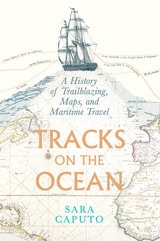
Tracks on the Ocean
A History of Trailblazing, Maps, and Maritime TravelSara Caputo
University of Chicago Press, 2024
Sara Caputo’s Tracks on the Ocean is a sweeping history of how we have understood routes of travel over the ocean and how we came to represent that movement as a cartographical line. Focusing on the representation of sea journeys in the Western world from the early sixteenth century to the present, Caputo deftly argues that the depiction of these lines is inextricable from European imperialism, the rise of modernity, and attempts at mastery over nature. Caputo recounts the history of ocean tracks through an array of lively stories and characters, from the expeditions of Captain James Cook in the eighteenth century to tracks depicted in Moby Dick and popular culture of the nineteenth century to the use of navigational techniques by the British navy. She discusses how tracks evolved from tools of surveying into tools of surveillance and, eventually, into paths of environmental calamity. The impulse to record tracks on the ocean is, Caputo argues, reflective of an ongoing desire for order, schematization, and personal visibility, as well as occupation and permanent ownership—in this case over something that is unoccupiable and impossible to truly possess. Both beautifully written and deeply researched, Tracks on the Ocean shares how the lines drawn on maps tell the audacious and often tragic and violent stories of ocean voyages.
Transformation of the Mormon Culture Region
Ethan R. Yorgason
University of Illinois Press, 2010
Translation in a Global Market, Volume 13
Emily Apter, ed.
Duke University Press, 0
Translation in a Global Market assembles contributors from several academic disciplines as well as visual artists for a closer look at the formation of an international canon and at the kinds of texts that gain international visibility. The essays urge a shift in emphasis from global literacy—which implies the use of a standard language and a preference for translatability in texts—to transnational literacy, which places minority and diaspora literatures in direct conversation with each other rather than with Paris, London, or New York.
Contributors. Dina Al-Kassim, Emily Apter, Timothy Brennan, Elena Climent, Maryse Condé, Michael Eng, Renée Green, Rainer Ganahl, Sarah M. Hudgins, Michael North, Gayatri Chakravorty Spivak
Transmedia Geographies
Decoloniality, Democratization, Cultural Citizenship, and Media ConvergenceKevin Glynn
Rutgers University Press, 2025
The authors explore the cultural politics that have developed within this new media environment by moving across the mediated landscapes of the first, third, and fourth (Indigenous people’s) worlds, which are deeply intertwined and interconnected under contemporary conditions of neoliberal globalization and emergent regimes of authoritarian postdemocracy. The book attends both to the platforms and digital networks of the new media environment and to the cultural forms and practices that have constituted television as the dominant medium of communication throughout the second half of the twentieth century. In the new media environment, transmediation works on behalf not only of those corporate megaconglomerates that have become all too familiar to media consumers around the world but also of many communities that have previously been excluded from access to the means of electronic textual production and circulation. For the latter, grassroots transmediation has become an important technique for the production of cultural citizenship.