Results by title
936 books match the query 'LGBTQ+ Studies' and 156 start with t
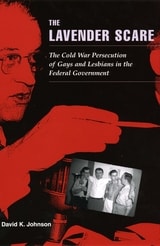
The Lavender Scare
The Cold War Persecution of Gays and Lesbians in the Federal GovernmentDavid K. Johnson
University of Chicago Press, 2003
Historian David K. Johnson here relates the frightening, untold story of how, during the Cold War, homosexuals were considered as dangerous a threat to national security as Communists. Charges that the Roosevelt and Truman administrations were havens for homosexuals proved a potent political weapon, sparking a "Lavender Scare" more vehement and long-lasting than McCarthy's Red Scare. Relying on newly declassified documents, years of research in the records of the National Archives and the FBI, and interviews with former civil servants, Johnson recreates the vibrant gay subculture that flourished in New Deal-era Washington and takes us inside the security interrogation rooms where thousands of Americans were questioned about their sex lives. The homosexual purges ended promising careers, ruined lives, and pushed many to suicide. But, as Johnson also shows, the purges brought victims together to protest their treatment, helping launch a new civil rights struggle.
The Lavender Scare shatters the myth that homosexuality has only recently become a national political issue, changing the way we think about both the McCarthy era and the origins of the gay rights movement. And perhaps just as importantly, this book is a cautionary tale, reminding us of how acts taken by the government in the name of "national security" during the Cold War resulted in the infringement of the civil liberties of thousands of Americans.
The Lesbian Issue
Essays from SignsEdited by Estelle B. Freedman, Barbara C. Gelpi, Susan L. Johnson, and Kathleen M. Weston
University of Chicago Press, 1985
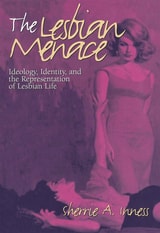
The Lesbian Menace
Ideology, Identity, and the Representation of Lesbian LifeSherrie A. Inness
University of Massachusetts Press, 1997
Electroshock. Hysterectomy. Lobotomy. These are only three of the many “cures” to which lesbians have been subjected in this century. How does a society develop such a profound aversion to a particular minority? In what ways do images in the popular media perpetuate cultural stereotypes about lesbians, and to what extent have lesbians been able to subvert and revise those images? This book addresses these and other questions by examining how lesbianism has been represented in American popular culture in the twentieth century and how conflicting ideologies have shaped lesbian experiences and identity.
In the first section, “Inventing the Lesbian,” Sherrie A. Inness explores depictions of lesbians in popular texts aimed primarily at heterosexual consumers. She moves from novels of the 1920s to books about life at women's colleges and boarding schools, to such contemporary women's magazines as Cosmopolitan, Glamour, and Vogue.
In the next section, “Forms of Resistance,” Inness probes the ways in which lesbians have refashioned texts intended for a heterosexual audience or created their own narratives. One chapter shows how lesbian readers have reinterpreted the Nancy Drew mysteries, looking at them from a distinctly “queer” perspective. Another chapter addresses the changing portrayal of lesbians in children's books over the past two decades.
The last section, “Writing in the Margins,” scrutinizes the extent to which lesbians, themselves a marginalized group, have created a society that relegates some of its own members to the outskirts. Topics include the geographic politics of lesbianism, the complex issue of "passing," and the meaning of butch identity in twentieth-century lesbian culture.
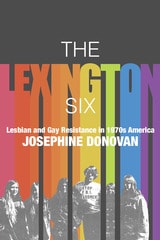
The Lexington Six
Lesbian and Gay Resistance in 1970s AmericaJosephine Donovan
University of Massachusetts Press, 2020
Finalist for the 2021 Lambda Literary Awards
On September 23, 1970, a group of antiwar activists staged a robbery at a bank in Massachusetts, during which a police officer was killed. While the three men who participated in the robbery were soon apprehended, two women escaped and became fugitives on the FBI's Ten Most Wanted list, eventually landing in a lesbian collective in Lexington, Kentucky, during the summer of 1974. In pursuit, the FBI launched a massive dragnet. Five lesbian women and one gay man ended up in jail for refusing to cooperate with federal officials, whom they saw as invading their lives and community. Dubbed the Lexington Six, the group's resistance attracted national attention, inspiring a nationwide movement in other minority communities. Like the iconic Stonewall demonstrations, this gripping story of spirited defiance has special resonance in today's America.
Drawing on transcripts of the judicial hearings, contemporaneous newspaper accounts, hundreds of pages of FBI files released to the author under the Freedom of Information Act, and interviews with many of the participants, Josephine Donovan reconstructs this fascinating, untold story. The Lexington Six is a vital addition to LGBTQ, feminist, and radical American history.

The Libertine's Friend
Homosexuality and Masculinity in Late Imperial ChinaGiovanni Vitiello
University of Chicago Press, 2011
Delving into three hundred years of Chinese literature, from the mid-sixteenth century to the mid-nineteenth, The Libertine’s Friend uncovers the complex and fascinating history of male homosexual and homosocial relations in the late imperial era. Drawing particularly on overlooked works of pornographic fiction, Giovanni Vitiello offers a frank exploration of the importance of same-sex love and eroticism to the evolution of masculinity in China.
Vitiello’s story unfolds chronologically, beginning with the earliest sources on homoeroticism in pre-imperial China and concluding with a look at developments in the twentieth century. Along the way, he identifies a number of recurring characters—for example, the libertine scholar, the chivalric hero, and the lustful monk—and sheds light on a set of key issues, including the social and legal boundaries that regulated sex between men, the rise of male prostitution, and the aesthetics of male beauty. Drawing on this trove of material, Vitiello presents a historical outline of changing notions of male homosexuality in China, revealing the integral part that same-sex desire has played in its culture.
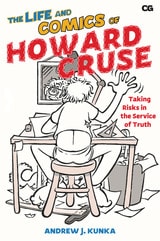
The Life and Comics of Howard Cruse
Taking Risks in the Service of TruthAndrew J. Kunka
Rutgers University Press, 2022
The Life and Comics of Howard Cruse tells the remarkable story of how a self-described “preacher’s kid” from Birmingham, Alabama, became the so-called “Godfather of Gay Comics.” This study showcases a remarkable fifty-year career that included working in the 1970s underground comics scene, becoming founding editor of the groundbreaking anthology series Gay Comix, and publishing the graphic novel Stuck Rubber Baby, partially based on his own experience of coming of age in the Civil Rights era.
Through his exploration of Cruse’s life and work, Andrew J. Kunka also chronicles the dramatic ways that gay culture changed over the course of Cruse’s lifetime, from Cold War-era homophobia to the gay liberation movement to the AIDS crisis to the legalization of gay marriage. Highlighting Cruse’s skills as a trenchant satirist and social commentator, Kunka explores how he cast a queer look at American politics, mainstream comics culture, and the gay community’s own norms.
Lavishly illustrated with a broad selection of comics from Cruse’s career, this study serves as a perfect introduction to this pioneering cartoonist, as well as an insightful read for fans who already love how his work sketched a new vision of gay life.

The Logic of the Lure
John Paul Ricco
University of Chicago Press, 2002
The Lonely Letters
Ashon T. Crawley
Duke University Press, 2020
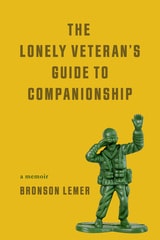
The Lonely Veteran's Guide to Companionship
Bronson Lemer
University of Wisconsin Press, 2025
Lemer’s distinct take on the veteran’s story boldly engages the intersection of military narratives and queer culture, including examinations into the role of thirst traps in contemporary dating culture, the fears of long-term health damage caused by military service, and the ways in which intimate relationships can lead to a loss of self. Taken together, his essays illustrate how one queer veteran managed to carve out a path that led him, however awkwardly at times, closer to the person he wanted to be.
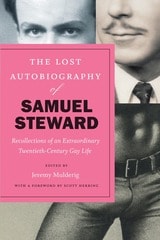
The Lost Autobiography of Samuel Steward
Recollections of an Extraordinary Twentieth-Century Gay LifeSamuel Steward
University of Chicago Press, 2018
The story of this life would undoubtedly have been a sensation if it had reached publication. But after finishing a 110,000-word draft in 1979, Steward lost interest in the project and subsequently published only a slim volume of selections from his manuscript.
In The Lost Autobiography of Samuel Steward, Jeremy Mulderig has integrated Steward’s truncated published text with the text of the original manuscript to create the first extended version of Steward’s autobiography to appear in print—the first sensational, fascinating, and ultimately enlightening story of his many lives told in his own words. The product of a rigorous line-by-line comparison of these two sources and a thoughtful editing of their contents, Mulderig’s thoroughly annotated text is more complete and coherent than either source alone while also remaining faithful to Steward’s style and voice, to his engaging self-deprecation and his droll sense of humor. Compellingly readable and often unexpectedly funny, this newly discovered story of a gay life full of wildly improbable—but nonetheless true—events is destined to become a landmark queer autobiography from the twentieth century.

The Man Who Would Marry Susan Sontag
And Other Intimate Literary Portraits of the Bohemian EraEdward Field
University of Wisconsin Press, 2007
Long before Stonewall, young Air Force veteran Edward Field, fresh from combat in WWII, threw himself into New York’s literary bohemia, searching for fulfillment as a gay man and poet. In this vivid account of his avant-garde years in Greenwich Village and the bohemian outposts of Paris’s Left Bank and Tangier—where you could write poetry, be radical, and be openly gay—Field opens the closet door to reveal, as never been seen before, some of the most important writers of his time.
Here are young, beautiful Susan Sontag sitting at the feet of her idol Alfred Chester, who shrewdly plotted to marry her; May Swenson and her two loves; Paul and Jane Bowles in their ambiguous marriage; Frank O’Hara in and out of bed; Fritz Peters, the anointed son of Gurdjieff; and James Baldwin, Isabel Miller (Patience and Sarah), Tobias Schneebaum, Robert Friend, and many others. With its intimate portraits, Field’s memoir brings back a forgotten era—postwar bohemia—bawdy, comical, romantic, sad, and heroic.

The Marrying Kind?
Debating Same-Sex Marriage within the Lesbian and Gay MovementMary Bernstein
University of Minnesota Press, 2013
As the fight for same-sex marriage rages across the United States and lesbian and gay couples rush to marriage license counters, the goal of marriage is still fiercely questioned within the LGBT movement. Rarely has an objective so central to a social movement’s political agenda been so controversial within the movement itself. While antigay forces work to restrict marriage to one man and one woman, lesbian and gay activists are passionately arguing about the desirability, viability, and social consequences of same-sex marriage.
The Marrying Kind? is the first book to draw on empirical research to examine these debates and how they are affecting marriage equality campaigns. The essays in this volume analyze the rhetoric, strategies, and makeup of the LGBT social movement organizations pushing for same-sex marriage, and address the dire predictions of some LGBT commentators that same-sex marriage will spell the end of queer identity and community. Case studies from California, Connecticut, Massachusetts, New Jersey, Oklahoma, Vermont, and Canada illuminate the complicated politics of same-sex marriage, making clear that the current disagreements among LGBT activists over whether marriage is conforming or transformative are far too simplistic. Instead, the impact of the marriage equality movement is complex and often contradictory, neither fully assimilationist nor fully oppositional.
Contributors: Ellen Ann Andersen, U of Vermont; Mary C. Burke, U of Vermont; Adam Isaiah Green, U of Toronto; Melanie Heath, McMaster U, Ontario; Kathleen E. Hull, U of Minnesota; Katrina Kimport, U of California, San Francisco; Jeffrey Kosbie; Katie Oliviero, U of Colorado, Boulder; Kristine A. Olsen; Timothy A. Ortyl; Arlene Stein, Rutgers U; Amy L. Stone, Trinity U; Nella Van Dyke, U of California, Merced.
The Misfit of the Family
Balzac and the Social Forms of SexualityMichael Lucey
Duke University Press, 2003
The Misfit of the Family is a compelling argument that Balzac must be taken seriously as a major inventor and purveyor of new tools for analyzing connections between the sexual and the social. Lucey’s account of the novelist’s deployment of "sexual misfits" to impel a wide range of his most canonical works—Cousin Pons, Cousin Bette, Eugenie Grandet, Lost Illusions, The Girl with the Golden Eyes—demonstrates how even the flexible umbrella term "queer" barely covers the enormous diversity of erotic and social behaviors of his characters. Lucey draws on the thinking of Michel Foucault and Pierre Bourdieu and engages the work of critics of nineteenth-century French fiction, including Naomi Schor, D. A. Miller, Franco Moretti, and others. His reflections on Proust as Balzac’s most cannily attentive reader suggest how the lines of social and erotic force he locates in Balzac’s work continued to manifest themselves in twentieth-century writing and society.

The Motion Of Light In Water
Sex And Science Fiction Writing In The East VillageSamuel R. Delany
University of Minnesota Press, 2004
Winner of the Hugo Award for Non-fiction
The unexpurgated edition of the award-winning autobiography
Born in New York City’s black ghetto Harlem at the start of World War II, Samuel R. Delany married white poet Marilyn Hacker right out of high school. The interracial couple moved into the city’s new bohemian quarter, the Lower East Side, in summer 1961. Through the decade’s opening years, new art, new sexual practices, new music, and new political awareness burgeoned among the crowded streets and cheap railroad apartments. Beautifully, vividly, insightfully, Delany calls up this era of exploration and adventure as he details his development as a black gay writer in an open marriage, with tertiary walk-ons by Bob Dylan, Stokely Carmichael, W. H. Auden, and James Baldwin, and a panoply of brilliantly drawn secondary characters.
The Mourning After
Loss and Longing among Midcentury American MenJohn Ibson
University of Chicago Press, 2018

The Music Diva Spectacle
Camp, Female Performers and Queer Audiences in the Arena Tour ShowConstantine Chatzipapatheodoridis
Intellect Books, 2021
In this original new work, Constantine Chatzipapatheodoridis pulls back the curtain on the production of camp as a queer praxis that constantly feeds the diva-queer culture relationship. By examining the iconography and theatrics of the diva tour show, the author presents a performance studies reading of camp and the culture-sharing process of production and audience reception. Detailed case studies take a close look at popular contemporary performers like Madonna, Kylie Minogue, Beyoncé, and Lady Gaga, and a final section analyzes audience drag in the arena space. Chatzipapatheodoridis also investigates the relationship between camp theory as an academic subject and the figure of the diva as an expression of camp.
A rich and insightful revival of the question of camp in contemporary queer performance, The Music Diva Spectacle seeks to establish how camp is appropriated by the diva and explores how this affects—and is in turn appropriated by—the audience.
The New Gay for Pay
The Sexual Politics of American Television ProductionBy Julia Himberg
University of Texas Press, 2017
Television conveys powerful messages about sexual identities, and popular shows such as Will & Grace, Ellen, Glee, Modern Family, and The Fosters are often credited with building support for gay rights, including marriage equality. At the same time, however, many dismiss TV’s portrayal of LGBT characters and issues as “gay for pay”—that is, apolitical and exploitative programming created simply for profit. In The New Gay for Pay, Julia Himberg moves beyond both of these positions to investigate the complex and multifaceted ways that television production participates in constructing sexuality, sexual identities and communities, and sexual politics.
Himberg examines the production stories behind explicitly LGBT narratives and characters, studying how industry workers themselves negotiate processes of TV development, production, marketing, and distribution. She interviews workers whose views are rarely heard, including market researchers, public relations experts, media advocacy workers, political campaigners designing strategies for TV messaging, and corporate social responsibility department officers, as well as network executives and producers. Thoroughly analyzing their comments in the light of four key issues—visibility, advocacy, diversity, and equality—Himberg reveals how the practices and belief systems of industry workers generate the conceptions of LGBT sexuality and political change that are portrayed on television. This original approach complicates and broadens our notions about who makes media; how those practitioners operate within media conglomerates; and, perhaps most important, how they contribute to commonsense ideas about sexuality.

The Nuptial Deal
Same-Sex Marriage and Neo-Liberal GovernanceJaye Cee Whitehead
University of Chicago Press, 2011
The Only Way Out
The Racial and Sexual Performance of EscapeKatherine Brewer Ball
Duke University Press, 2024
The Poetics of Cruising
Queer Visual Culture from Whitman to GrindrJack Parlett
University of Minnesota Press, 2022
The Poetics of Cruising explores the relationship between cruising, photography, and the visual in the work of leading poets, from Walt Whitman in the nineteenth century to Eileen Myles in the twenty-first. What is it that happens, asks Jack Parlett, and what is it that is sought, in this often transient moment of perception we call cruising, this perceptual arena where acts of looking between strangers are intensified and eroticized? Parlett believes that this moment is not only optical in nature but visual: a mode of looking that warrants comparison with the ways in which we behold still and moving images.
Whether it’s Whitman’s fixation with daguerreotypes, Langston Hughes’s hybrid photographic works, or Frank O’Hara’s love of Hollywood movie stars, argues Parlett, the history of poets cruising abounds with this intermingling between the verbal and the visual, the passing and the fixed. To look at someone in the act of cruising, this history suggests, is to capture, consider, and aestheticize, amid the flux and instantaneity of urban time. But it is also to reveal the ambivalence at the heart of this erotic search, where power may be unevenly distributed across glances, and gendered and racialized bodies are marked. Thus, in identifying for the first time this confluence of cruising, poetry, and visual culture, Parlett concludes that the visual erotic economy associated with gay cruising today, exemplified by the photographic grid of an app like Grindr, is not a uniquely contemporary phenomenon.
Innovative, astute, and highly readable, and drawing on compelling archival material, The Poetics of Cruising is a must for scholars of queer and LGBTQ literature and culture, modern and contemporary poetry, visual studies, and the history of sexuality.
The Politics of Gay Rights
Edited by Craig A. Rimmerman, Kenneth D. Wald, and Clyde Wilcox
University of Chicago Press, 2000
Forcefully argued and accessibly written, this collection is an important contribution to the current discussion about civil rights for gays and lesbians.

The Politics of Love
Queer Heterosexuality in Nineteenth-Century French LiteratureMaxime Foerster
University of New Hampshire Press, 2018
Maxime Foerster examines the “heterosexual trouble” between men and women in nineteenth-century French Romantic and Decadent literature. Key works by authors ranging from George Sand to Charles Baudelaire persistently demonstrate that heterosexuality did not work: these authors, and many others, investigated the struggle that men and women alike waged against patriarchal norms. Whereas Romantic fiction dedicated itself to the reinvention of love, Decadence promoted sexual and gender deviance.
In expertly evaluating the discord afflicting fictional heterosexual couples, male and female dandies, and doctors and their female patients, Foerster shows the crucial role that literature played in the fashioning of alternative identities. A concluding look at Proust’s À la recherche du temps perdu traces the legacy of heterosexual trouble in the twentieth century.
Hardcover is un-jacketed.
The Politics of Same-Sex Marriage
Edited by Craig A. Rimmerman and Clyde Wilcox
University of Chicago Press, 2007
Same-sex marriage emerged in 2004 as one of the hottest issues of the campaign season. But in a severe blow to gay rights advocates, all eleven states that had the issue on the ballot passed amendments banning the practice, and the subject soon dropped off the media’s radar. This pattern of waxing and waning in the public eye has characterized the debate over same-sex marriage since 1996 and the passing of the Defense of Marriage Act. Since then, court rulings and local legislatures have kept the issue alive in the political sphere, and conservatives and gay rights advocates have made the issue a key battlefield in the culture wars.
The Politics of Same-Sex Marriage brings together an esteemed list of scholars to explore all facets of this heated issue, including the ideologies and strategies on both sides of the argument, the public’s response, the use of the issue in political campaigns, and how same-sex marriage fits into the broad context of policy cycles and windows of political opportunity. With comprehensive coverage from a variety of different approaches, this volume will be a vital sourcebook for activists, politicians, and scholars alike.

The Postcolonial Animal
African Literature and Posthuman EthicsEvan Maina Mwangi
University of Michigan Press, 2019
Despite the central role that animals play in African writing and daily life, African literature and African thinkers remain conspicuously absent from the field of animal studies. The Postcolonial Animal: African Literature and Posthuman Ethics demonstrates the importance of African writing to animal studies by analyzing how postcolonial African writing—including folktales, religion, philosophy, and anticolonial movements—has been mobilized to call for humane treatment of nonhuman others. Mwangi illustrates how African authors grapple with the possibility of an alternative to eating meat, and how they present postcolonial animal-consuming cultures as shifting toward an embrace of cultural and political practices that avoid the use of animals and minimize animal suffering. The Postcolonial Animal analyzes texts that imagine a world where animals are not abused or used as a source of food, clothing, or labor, and that offer instruction in how we might act responsibly and how we should relate to others—both human and nonhuman—in order to ensure a world free of oppression. The result is an equitable world where even those who are utterly foreign to us are accorded respect and where we recognize the rights of all marginalized groups.

The Pox Lover
An Activist's Decade in New York and ParisAnne-christine d'Adesky
University of Wisconsin Press, 2017
D'Adesky takes us through a fast-changing East Village: squatter protests and civil disobedience lead to all-night drag and art-dance parties, the fun-loving Lesbian Avengers organize dyke marches, and the protest group ACT UP stages public funerals. Traveling as a journalist to Paris, an insomniac d'Adesky trolls the Seine, encountering waves of exiles fleeing violence in the Balkans, Haiti, and Rwanda. As the last of the French Nazis stand trial and the new National Front rises in the polls, d'Adesky digs into her aristocratic family's roots in Vichy France and colonial Haiti. This is a testament with a message for every generation: grab at life and love, connect with others, fight for justice, keep despair at bay, and remember.
The Problem of Passing
Sandra Harvey
Duke University Press, 2026

The Problem of the Negro as a Problem for Gender
Marquis Bey
University of Minnesota Press, 2020
A complex articulation of the ways blackness and nonnormative gender intersect—and a deeper understanding of how subjectivities are formed
A deep meditation on and expansion of the figure of the Negro and insurrectionary effects of the “X” as theorized by Nahum Chandler, The Problem of the Negro as a Problem for Gender thinks through the problematizing effects of blackness as, too, a problematizing of gender. Through the paraontological, the between, and the figure of the “X” (with its explicit contemporary link to nonbinary and trans genders) Marquis Bey presents a meditation on black feminism and gender nonnormativity. Chandler’s text serves as both an argumentative tool for rendering the “radical alternative” in and as blackness as well as demonstrating the necessarily trans/gendered valences of that radical alternative.
Forerunners is a thought-in-process series of breakthrough digital works. Written between fresh ideas and finished books, Forerunners draws on scholarly work initiated in notable blogs, social media, conference plenaries, journal articles, and the synergy of academic exchange. This is gray literature publishing: where intense thinking, change, and speculation take place in scholarship.
The Promise of Happiness
Sara Ahmed
Duke University Press, 2010
Ahmed draws on the intellectual history of happiness, from classical accounts of ethics as the good life, through seventeenth-century writings on affect and the passions, eighteenth-century debates on virtue and education, and nineteenth-century utilitarianism. She engages with feminist, antiracist, and queer critics who have shown how happiness is used to justify social oppression, and how challenging oppression causes unhappiness. Reading novels and films including Mrs. Dalloway, The Well of Loneliness, Bend It Like Beckham, and Children of Men, Ahmed considers the plight of the figures who challenge and are challenged by the attribution of happiness to particular objects or social ideals: the feminist killjoy, the unhappy queer, the angry black woman, and the melancholic migrant. Through her readings she raises critical questions about the moral order imposed by the injunction to be happy.
The Queer Aesthetics of Childhood
Asymmetries of Innocence and the Cultural Politics of Child DevelopmentHannah Dyer
Rutgers University Press, 2020
In The Queer Aesthetics of Childhood, Hannah Dyer offers a study of how children’s art and art about childhood can forecast new models of social life that redistribute care, belonging, and political value. Dyer suggests that childhood’s cultural expressions offer insight into the persisting residues of colonial history, nation building, homophobia, and related violence. Drawing from queer and feminist theory, psychoanalysis, settler-colonial studies, and cultural studies, this book helps to explain how some theories of childhood can hurt children. Dyer’s analysis moves between diverse sites and scales, including photographs and an art installation, children’s drawings after experiencing war in Gaza, a novel about gay love and childhood trauma, and debates in sex-education. In the cultural formations of art, she finds new theories of childhood that attend to the knowledge, trauma, fortitude and experience that children might possess. In addressing aggressions against children, ambivalences towards child protection, and the vital contributions children make to transnational politics, she seeks new and queer theories of childhood.

The Queer Art of Failure
Jack Halberstam
Duke University Press, 2011
The Queer Art of History
Queer Kinship after FascismJennifer V. Evans
Duke University Press, 2023
The Queer Child, or Growing Sideways in the Twentieth Century
Kathryn Bond Stockton
Duke University Press, 2009
Engaging and challenging the work of sociologists, legal theorists, and historians, Stockton coins the term “growing sideways” to describe ways of growing that defy the usual sense of growing “up” in a linear trajectory toward full stature, marriage, reproduction, and the relinquishing of childish ways. Growing sideways is a mode of irregular growth involving odd lingerings, wayward paths, and fertile delays. Contending that children’s queerness is rendered and explored best in fictional forms, including literature, film, and television, Stockton offers dazzling readings of works ranging from novels by Henry James, Radclyffe Hall, Virginia Woolf, Djuna Barnes, and Vladimir Nabokov to the movies Guess Who’s Coming to Dinner, The Hanging Garden, Heavenly Creatures, Hoop Dreams, and the 2005 remake of Willy Wonka and the Chocolate Factory. The result is a fascinating look at children’s masochism, their interactions with pedophiles and animals, their unfathomable, hazy motives (leading them at times into sex, seduction, delinquency, and murder), their interracial appetites, and their love of consumption and destruction through the alluring economy of candy.

The Queer Commons
Gavin Butt and Nadja Millner-Larsen, special issue editors
Duke University Press, 2018
Contributors look to radical networks of care, sex, and activism present within diverse queer communities including HIV/AIDS organizing, the Wages for Housework movement, New York’s Clit Club community, and trans/queer collectives in San Francisco. The issue also includes a dossier of shorter contributions that offer speculative provocations about the radicalism of queer commonality across time and space, from Gezi Park uprisings in Turkey to future visions of collectivity outside of the internet.
Contributors
Arlen Austin, Zach Blas, Gavin Butt, Beth Capper, Ashon Crawley, Amalle Dublon, Macarena Gomez-Barris, Christina Hanhardt, Diarmuid Hester, Nadja Millner-Larsen, José Esteban Muñoz, Cenk Ozbay, Evren Savci, Eric Stanley
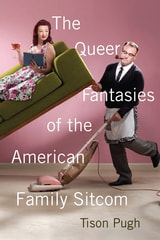
The Queer Fantasies of the American Family Sitcom
Pugh, Tison
Rutgers University Press, 2018
The Queer Fantasies of the American Family Sitcom examines the evasive depictions of sexuality in domestic and family-friendly sitcoms. Tison Pugh charts the history of increasing sexual depiction in this genre while also unpacking how sitcoms use sexuality as a source of power, as a kind of camouflage, and as a foundation for family building. The book examines how queerness, at first latent, became a vibrant yet continually conflicted part of the family-sitcom tradition.
Taking into account elements such as the casting of child actors, the use of and experimentation with plot traditions, the contradictory interpretive valences of comedy, and the subtle subversions of moral standards by writers and directors, Pugh points out how innocence and sexuality conflict on television. As older sitcoms often sit on a pedestal of nostalgia as representative of the Golden Age of the American Family, television history reveals a deeper, queerer vision of family bonds.
Download open access ebook here.
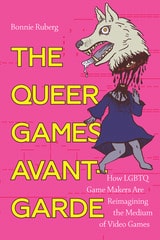
The Queer Games Avant-Garde
How LGBTQ Game Makers Are Reimagining the Medium of Video GamesBonnie Ruberg
Duke University Press, 2020
Interviewees:
Ryan Rose Aceae, Avery Alder, Jimmy Andrews, Santo Aveiro-Ojeda, Aevee Bee, Tonia B******, Mattie Brice, Nicky Case, Naomi Clark, Mo Cohen, Heather Flowers, Nina Freeman, Jerome Hagen, Kat Jones, Jess Marcotte, Andi McClure, Llaura McGee, Seanna Musgrave, Liz Ryerson, Elizabeth Sampat, Loren Schmidt, Sarah Schoemann, Dietrich Squinkifer, Kara Stone, Emilia Yang, Robert Yang
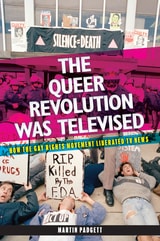
The Queer Revolution Was Televised
How the Gay Rights Movement Liberated TV NewsMartin Padgett
Rutgers University Press, 2027
This book demonstrates, in part through a history of emotions, how assumptions and prejudices about queer lives were challenged throughout the decade through the deceptively prosaic medium of television. Passion and disgust neatly outline the contours of the gay community’s press for equal rights at the dawn of the 1980s, just as fear and anxiety encapsulate the inchoate reactions to the emerging epidemic and the simultaneous explorations of privacy that were initiated by the onslaught of television as technology. While queer people anguished over their very survival and over the indifference of many to their situation, hope surfaced as a cause and potential treatments for HIV emerged and as the Supreme Court decided to make its first direct ruling on gay rights in a generation. When that latter hope was dashed by the Hardwick decision, the anger of gay rights advocates was trebled as they massed for the national March on Washington in homage to the 1963 March on Washington for Jobs and Freedom that lent its key political organizing and messaging tactics to it. With the realization that progress would then be slow and all-consuming, a desperation to change queer lives was enjoined by a determination to do so in the most visible ways possible, through television.
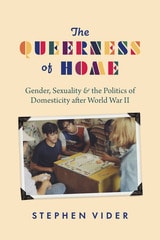
The Queerness of Home
Gender, Sexuality, and the Politics of Domesticity after World War IIStephen Vider
University of Chicago Press, 2021
From the Stonewall riots to the protests of ACT UP, histories of queer and trans politics have almost exclusively centered on public activism. In The Queerness of Home, Stephen Vider turns the focus inward, showing that the intimacy of domestic space has been equally crucial to the history of postwar LGBTQ life.
Beginning in the 1940s, LGBTQ activists looked increasingly to the home as a site of connection, care, and cultural inclusion. They struggled against the conventions of marriage, challenged the gendered codes of everyday labor, reimagined domestic architecture, and contested the racial and class boundaries of kinship and belonging. Retelling LGBTQ history from the inside out, Vider reveals the surprising ways that the home became, and remains, a charged space in battles for social and economic justice, making it clear that LGBTQ people not only realized new forms of community and culture for themselves—they remade the possibilities of home life for everyone.
The Reification of Desire
Toward a Queer MarxismKevin Floyd
University of Minnesota Press, 2009
Kevin Floyd brings queer critique to bear on the Marxian categories of reification and totality and considers the dialectic that frames the work of Georg Lukács, Herbert Marcuse, and Fredric Jameson. Reading the work of these theorists together with influential queer work by such figures as Michel Foucault and Judith Butler, and alongside reconsiderations of such texts as The Sun Also Rises and Midnight Cowboy, Floyd reformulates these two central categories that have been inseparable from a key strand of Marxist thought and have marked both its explanatory power and its limitations. Floyd theorizes a dissociation of sexuality from gender at the beginning of the twentieth century in terms of reification to claim that this dissociation is one aspect of a larger dynamic of social reification enforced by capitalism.
Developing a queer examination of reification and totality, Kevin Floyd ultimately argues that the insights of queer theory require a fundamental rethinking of both.

The Rest of It
Hustlers, Cocaine, Depression, and Then Some, 1976–1988Martin Duberman
Duke University Press, 2018
Despite the hardships, Duberman managed to be incredibly productive: he wrote his biography of Paul Robeson, rededicated himself to teaching, wrote plays, and coedited the prize-winning Hidden from History. His exploration of new paths of scholarship culminated in his founding of the Center for Lesbian and Gay Studies, thereby inaugurating a new academic discipline. At the outset of the HIV/AIDS epidemic Duberman increased his political activism, and in these pages he also describes the tensions between the New Left and gay organizers, as well as the profound homophobia that created the conditions for queer radical activism. Filled with gossip, featuring cameo appearances by luminaries such as Gore Vidal, Norman Mailer, Vivian Gornick, Susan Brownmiller, Kate Millett, and Néstor Almendros, among many others, and most importantly, written with an unflinching and fearless honesty, The Rest of It provides scathing insights into a troubling decade of both personal and political history. It is a stimulating look into a key period of Duberman's life, which until now had been too painful to share.
The Resurrection of the Body
Pier Paolo Pasolini from Saint Paul to SadeArmando Maggi
University of Chicago Press, 2009

The Right to Be Out
Sexual Orientation and Gender Identity in America's Public Schools, Second EditionStuart Biegel
University of Minnesota Press, 2018
An updated edition of this measured, practical, and timely guide to LGBT rights and issues for educators and school officials
With ongoing battles over transgender rights, bullying cases in the news almost daily, and marriage equality only recently the law of the land, the information in The Right to Be Out could not be more timely or welcome. In an updated second edition that explores the altered legal terrain of LGBT rights for students and educators, Stuart Biegel offers expert guidance on the most challenging concerns in this fraught context.
Taking up the pertinent questions likely to arise regarding curriculum and pedagogy in the classroom, school sports, and transgender issues, Biegel reviews the dramatic legal developments of the past decades, identifies the principles at work, and analyzes the policy considerations that result from these changes. Central to his work is an understanding of the social, political, and personal tensions regarding the nature and extent of the right to be out, which includes both the First Amendment right to express an identity and the Fourteenth Amendment right to be treated equally. Acknowledging that LGBT issues affect people of every sexual orientation and gender identity, Biegel provides a road map of viable strategies for school officials and educators.
The Right to Be Out, informed by the latest research-based findings, advances the proposition that a safe and supportive educational environment, built upon shared values and geared toward a greater appreciation of our pluralistic society, can lead to a better world for everyone.

The Right to Play Oneself
Looking Back on Documentary FilmThomas Waugh
University of Minnesota Press, 2010
Waugh analyzes an eclectic international selection of films and issues from the 1920s to the present day. The essays provide a transcultural focus, moving from documentaries of the industrialized societies of North America and Europe to those of 1980s India and addressing such canonical directors as Dziga Vertov, Emile de Antonio, Barbara Hammer, Rosa von Praunheim, and Anand Patwardhan. Woven through the volume is the relationship of the documentary with the history of the Left, including discussions of LGBT documentary pioneers and the firebrand collectives that changed the history of documentary, such as Challenge for Change and ACT UP’s Women’s Collective.
Together with the introduction by the author, Waugh’s essays advance a defiantly and persuasively personal point of view on the history and significance of documentary film.
The Ruling Passion
British Colonial Allegory and the Paradox of Homosexual DesireChristopher Lane
Duke University Press, 1995
Through attentive readings of sexual and political allegory in the work of Kipling, Forster, James, Beerbohm, Firbank, and others—and deft use of psychoanalytic theory—The Ruling Passion interprets turbulent scenes of masculine identification and pleasure, power and mastery, intimacy and antagonism. By foregrounding the shattering effects of male homosexuality and interracial desire, and by insisting on the centrality of unconscious fantasy and the death drive, The Ruling Passion examines the startling recurrence of colonial failure in narratives of symbolic doubt and ontological crisis. Lane argues compellingly that Britain can progress culturally and politically only when it has relinquished its residual fantasies of global mastery.

The Seduction of Space
Cruising French CinemaJules O'Dwyer
University of Minnesota Press, 2025
A bold and far-reaching new study of French queer cinema reimagines the relationship between sexuality and space
Spatiality has long been a crucial and potent lens for understanding French culture and aesthetics. While canonical greats of French cinema such as Jean-Luc Godard, Agnès Varda, and Louis Malle invoked the notion of flânerie to explore ideas of modernism, spatial exploration, and urban sociality, Jules O’Dwyer demonstrates how a more recent generation of French queer filmmakers continues to engage with—and contest—this legacy by focusing attention on the cognate practice of cruising.
Through the work of Jacques Nolot, Sébastien Lifshitz, Christophe Honoré, Vincent Dieutre, Alain Guiraudie, and others, The Seduction of Space draws film theory, queer studies, and spatial inquiry into close proximity to examine the politics of cruising and the gendering of space. Making the case that cinema not only documents the queer spaces of the past but continues to produce them, O’Dwyer maps the relationships between sex and spatiality as he takes up such varied topics as public sex in the porn theater, racial eroticization in the banlieue, and the ecocritical valences of rural cruising.
Foregrounding the crucial role that spatiality plays in shaping the parameters of France’s visual cultures and political imaginary, The Seduction of Space is both an urgent queer reconceptualization of this tradition and a clarion call for film scholars to tarry with the politics of sexuality in all its messiness.
Retail e-book files for this title are screen-reader friendly with images accompanied by short alt text and/or extended descriptions.
The Sexual Politics of Empire
Postcolonial Homophobia in HaitiErin L. Durban
University of Illinois Press, 2023
Evangelical Christians and members of the global LGBTQI human rights movement have vied for influence in Haiti since the 2010 earthquake. Each side accuses the other of serving foreign interests. Yet each proposes future foreign interventions on behalf of their respective causes despite the country’s traumatic past with European colonialism and American imperialism. As Erin L. Durban shows, two discourses dominate discussions of intervention. One maintains imperialist notions of a backward Haiti so riddled with cultural deficiencies that foreign supervision is necessary to overcome Haitians’ resistance to progress. The other sees Haiti as a modern but failed state that exists only through its capacity for violence, including homophobia. In the context of these competing claims, Durban explores the creative ways that same-sex desiring and gender creative Haitians contend with anti-LGBTQI violence and ongoing foreign intervention.
Compelling and thought-provoking, The Sexual Politics of Empire examines LGBTQI life in contemporary Haiti against the backdrop of American imperialism and intervention.
The Sexual Self
The Construction of Sexual ScriptsMichael Kimmel
Vanderbilt University Press, 2007
The Sexuality of History
Modernity and the Sapphic, 1565-1830Susan S. Lanser
University of Chicago Press, 2014
In The Sexuality of History, Susan S. Lanser shows how intimacies between women became harbingers of the modern, bringing the sapphic into the mainstream of some of the most significant events in Western Europe. Ideas about female same-sex relations became a focal point for intellectual and cultural contests between authority and liberty, power and difference, desire and duty, mobility and change, order and governance. Lanser explores the ways in which a historically specific interest in lesbians intersected with, and stimulated, systemic concerns that would seem to have little to do with sexuality. Departing from the prevailing trend of queer reading whereby scholars ferret out hidden content in “closeted” texts, Lanser situates overtly erotic representations within wider spheres of interest. The Sexuality of History shows that just as we can understand sexuality by studying the past, so too can we understand the past by studying sexuality.

The Single Life
Unpatriarchal Manhoods in English Renaissance LiteratureJordan Windholz
University of Alabama Press, 2025
Exploring the Varied Roles of Bachelors during the Renaissance
What if the Renaissance bachelor wasn’t just a social outlier but a literary lens through which early modern masculinity reveals its cracks? In The Single Life: Unpatriarchal Manhoods in English Renaissance Literature, Jordan Windholz examines the overlooked and often subversive roles played by never-married men in shaping gender, sexuality, and social order.
Windholz challenges conventional views on gender and sexuality, identifying five archetypes of bachelorhood that complicate our understanding of patriarchal success: the chaste youth, the journeyman bachelor, the true gallant, the incel scholar, and the unmarried eunuch. These figures don’t conform to ideals of marriage, legacy, or economic productivity, but they also weren’t merely left behind. Instead, they served to define what early modern society valued by embodying what it resisted. Windholz shows how Renaissance texts constructed, contained, and occasionally celebrated these “unpatriarchal manhoods.”
By examining the intersections of sexuality, labor, gentility, emotion, and gender, the book provides a nuanced understanding of how single men both upheld and resisted patriarchal norms. Each chapter offers a detailed analysis of literary texts, blending historical and literary analysis with feminist and queer theory. The first study of its kind, Windholz’s work is essential reading for anyone interested in Renaissance literature, gender studies, or those looking to understand the margins of masculinity and the meanings of singledom—then and now.

The Small Book of Hip Checks
On Queer Gender, Race, and WritingErica Rand
Duke University Press, 2021

The Souls of Cyberfolk
Posthumanism as Vernacular TheoryThomas Foster
University of Minnesota Press, 2005