372 books match the query 'Language' and 85 start with t

cover of The Possibility of Language: Internal Tensions in Wittgenstein's Tractatus

The Possibility of Language

Internal Tensions in Wittgenstein's Tractatus

Maria Cerezo

CSLI, 2003

In this volume, Maria Cerezo examines Wittgenstein's Tractatus Logico-Philosophicus as a response to some of Frege's and Russel's logical problems. In analyzing the tractarian conditions for the possibility of language, she explains the two main theories of the proposition in Tractatus: the truth-functions theory and the picture theory. Cerezo shows that Wittgenstein initially separates the account of the structure of a proposition from the explanation of its expression. However, contrary to his intention, the combination of these theories creates new difficulties, since the requirements of each theory cannot be fully respected by the others. Cerezo also argues that Wittgenstein's theory of language cannot be fully understood unless attention is paid to his theory of expression and his doctrine of projection by the metaphysical subject.
[more]
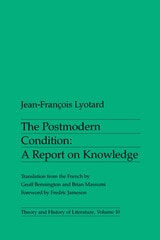
cover of The Postmodern Condition: A Report on Knowledge

The Postmodern Condition

A Report on Knowledge

Jean-Francois Lyotard

University of Minnesota Press, 1984
Many definitions of postmodernism focus on its nature as the aftermath of the modern industrial age when technology developed dynamically. In The Postmodern Condition Jean-Francois Lyotard extends that analysis to postmodernism by looking at the status of science, technology, and the arts, the significance of technocracy, and the way the flow of information and knowledge are controlled in the Western world. Lyotard emphasized language; the world of postmodern knowledge can be represented as a game of language where speaking is participation in the game whose goal is the creation of new and ever-changing social linkages.
[more]
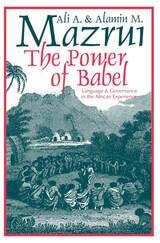
cover of The Power of Babel: Language and Governance in the African Experience

The Power of Babel

Language and Governance in the African Experience

Ali A. Mazrui and Alamin M. Mazrui

University of Chicago Press, 1998

Linguists estimate that there are currently nearly 2,000 languages in Africa, a staggering figure that is belied by the relatively few national languages. While African national politics, economics, and law are all conducted primarily in the colonial languages, the cultural life of the majority of citizens is conducted in a bewildering Babel of local and regional dialects, making language itself the center of debates over multiculturalism, gender studies, and social theory. In The Power of Babel, the noted Africanist scholar Ali Mazrui and linguist Alamin Mazrui explore this vast territory of African language.

The Power of Babel is one of the first comprehensive studies of the complex linguistic constellations of Africa. It draws on Ali Mazrui's earlier work in its examination of the "triple heritage" of African culture, in which indigenous, Islamic, and Western traditions compete for influence. In bringing the idea of the triple heritage to language, the Mazruis unravel issues of power, culture, and modernity as they are embedded in African linguistic life.

The first section of the book takes a global perspective, exploring such issues as the Eurocentrism of much linguistic scholarship on Africa; part two takes an African perspective on a variety of issues from the linguistically disadvantaged position of women in Africa to the relation of language policy and democratic development; the third section presents a set of regional studies, centering on the Swahili language's exemplification of the triple heritage.The Power of Babel unites empirical information with theories of nationalism and pluralism—among others—to offer the richest contextual account of African languages to date.
[more]
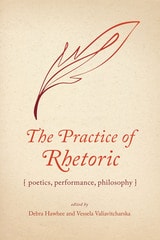
cover of The Practice of Rhetoric: Poetics, Performance, Philosophy

The Practice of Rhetoric

Poetics, Performance, Philosophy

Edited by Debra Hawhee and Vessela Valiavitcharska

University of Alabama Press, 2022

Essays that show what a broad conception of rhetoric means and does in relation to practice

Rhetoric is the art of emphasis, in the ancient sense of bringing to light or obscuring in shadow, and it is both a practice and a theory about that practice. In recent decades, scholars of rhetoric have turned to approaches that braid together poetics, performance, and philosophy into a “practical art.” The Practice of Rhetoric: Poetics, Performance, Philosophy presents just such an account of rhetoric that presumes and incorporates theoretical approaches, offering a collection of principles assembled in the heat and trials of public practice. The essays gathered in this volume are inspired by the capacious conception of rhetoric put forth by historian of rhetoric Jeffrey Walker, who is perhaps best known for stressing rhetoric’s educational mission and its investments in both theory and practice.

The book extends that vision through the prisms of poetics, performance, and philosophy of argument. Poetics shows rhetoric’s meaning making in all its verbal possibilities and material manifestations, in contexts ranging from mouse-infested medieval fields to the threat of toxin-ridden streams in the twentieth century. Performance puts what is created into the heat of public life, tapping out the rhythms of Byzantine prose or using collage to visually depict the beliefs and convictions of Martin Luther King Jr. Philosophy of argument enacts the mutually constitutive relationship between rhetoric and dialectic, offering new insights on and contexts for old tools like stasis and disputation, while keeping the focus on usefulness and teachability.

Ranging across centuries and contexts, the essays collected here demonstrate the continued need to attend carefully to the cooperation of descriptive language and normative reality, conceptual vocabulary and material practice, public speech and moral self-shaping. This volume will rekindle long-standing conversations about the public, world-making practice of rhetoric, thereby enlivening anew its civic mission.
 

[more]
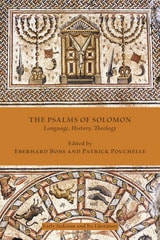
cover of The Psalms of Solomon: Language, History, Theology

The Psalms of Solomon

Language, History, Theology

Eberhard Bons

SBL Press, 2015

A fresh analysis of that sheds new light on the Psalms of Solomon

Researchers whose work focuses on the Psalms of Solomon, experts on the Septuagint, and scholars of Jewish Hellenistic literature take a fresh look at debates surrounding the text. Authors engage linguistic, historical, and theological issues including the original language of the psalms, their historical setting, and their theological intentions with the goal of expanding our understanding of first-century BCE Jewish theology.

Features:

  • New methods applied to open questions of authorship and historical context
  • Focusd scholarly attention on a work of theological and literary importance
  • Revised essays originally presented at the First International Meeting on the Psalms of Solomon
[more]
cover of The Rhetoric of Law

The Rhetoric of Law

Austin Sarat and Thomas R. Kearns, Editors

University of Michigan Press, 1996
Law is a profession of words. Simultaneously celebratory of great prose and dogmatically insistent on precise usage, law is a stage for verbal virtuosity, linguistic mastery, and persuasive argument. Yet the linguistic display is not without substance: the words of law take on a seriousness virtually unparalleled in any other domain of human experience. The Rhetoric of Law examines the words used in legal institutions and proceedings and explores both the literary aspect of legal life and the role of rhetoric in shaping the life of the law.
The essays in The Rhetoric of Law reflect the diverse influences of literary theory, feminism, and interpretive social science. Yet all call into question the rigid separation of rhetoric and justice that has been characteristic of the philosophical inquiry as far back as Plato. As a result, they open the way for a new understanding of law--an understanding that takes language to be neither esoteric nor frivolous and that views rhetoric as essential to the pursuit of justice. This volume provides a bracing reminder of the possibilities and problems of law, of its capacity to engage the best of human character, and of its vulnerability to cynical manipulation. Contributors are Lawrence Douglas, Robert A. Ferguson, Peter Goodrich, Barbara Johnson, Thomas R. Kearns, Austin Sarat, Adam Thurschwell, James Boyd White, and Lucie White.
Austin Sarat is William Nelson Cromwell Professor of Jurisprudence and Political Science, Amherst College. Thomas R. Kearns is William H. Hastie Professor of Philosophy, Amherst College.
[more]
cover of The Rhetoric of Rebel Women: Civil War Diaries and Confederate Persuasion

The Rhetoric of Rebel Women

Civil War Diaries and Confederate Persuasion

Kimberly Harrison

Southern Illinois University Press, 2013

During the American Civil War, southern white women found themselves speaking and acting in unfamiliar and tumultuous circumstances. With the war at their doorstep, women who supported the war effort took part in defining what it meant to be, and to behave as, a Confederate through their verbal and nonverbal rhetorics. Though most did not speak from the podium, they viewed themselves as participants in the war effort, indicating that what they did or did not say could matter. Drawing on the rich evidence in women’s Civil War diaries, The Rhetoric of Rebel Women recognizes women’s persuasive activities as contributions to the creation and maintenance of Confederate identity and culture.

Informed by more than one hundred diaries, this study provides insight into how women cultivated rhetorical agency, challenging traditional gender expectations while also upholding a cultural status quo. Author Kimberly Harrison analyzes the rhetorical choices these women made and valued in wartime and postwar interactions with Union officers and soldiers, slaves and former slaves, local community members, and even their God. In their intimate accounts of everyday war, these diarists discussed rhetorical strategies that could impact their safety, their livelihoods, and those of their families. As they faced Union soldiers in attempts to protect their homes and property, diarists saw their actions as not only having local, immediate impact on their well-being but also as reflecting upon their cause and the character of the southern people as a whole. They instructed themselves through their personal writing, allowing insight into how southern women prepared themselves to speak and act in new and contested contexts.

The Rhetoric of Rebel Women highlights the contributions of privileged white southern women in the development of the Confederate national identity, presenting them not as passive observers but as active participants in the war effort.
[more]
cover of The Rhetorical Invention of Diversity: Supreme Court Opinions, Public Arguments, and Affirmative Action

The Rhetorical Invention of Diversity

Supreme Court Opinions, Public Arguments, and Affirmative Action

M. Kelly Carr

Michigan State University Press, 2018
Despite the tepid reception of Regents of the University of California v. Bakke in 1978, the Supreme Court has thrice affirmed its holding: universities can use race as an admissions factor to achieve the goal of a diverse student body. This book examines the process of rhetorical invention followed by Justice Lewis F. Powell Jr., his colleagues, and other interlocutors as they sifted through arguments surrounding affirmative action policies to settle on diversity as affirmative action’s best constitutional justification. Here M. Kelly Carr explores the goals, constraints, and argumentative tools of the various parties as they utilized the linguistic resources available to them, including arguments about race, merit, and the role of the public university in civic life. Using public address texts, legal briefs, memoranda, and draft opinions, Carr looks at how public arguments informed the amicus briefs, chambers memos, and legal principles before concluding that Powell’s pragmatic decision making fused the principle of individualism with an appreciation of multiculturalism to accommodate his colleagues’ differing opinions. She argues that Bakke is thus a legal and rhetorical milestone that helped to shift the justificatory grounds of race-conscious policy away from a recognition of historical discrimination and its call for reparative equality, and toward an appreciation of racial diversity.
[more]
cover of The Sound of Leadership: Presidential Communication in the Modern Age

The Sound of Leadership

Presidential Communication in the Modern Age

Roderick P. Hart

University of Chicago Press, 1987

Why did Gerald Ford speak in public once every six hours during 1976? Why did no president spreak in Massachusetts during one ten-year period? Why did Jimmy Carter conduct public ceremonies four times more often than Harry Truman? Why are television viewers two-and-a-half times more likely to see a president speak on the nightly news than to hear him speak?

The Sound of Leadership answers these questions and many more. Based on analysis of nearly 10,000 presidential speeches delivered between 1945 and 1985, this book is the first comprehensive examination of the ways in which presidents Truman through Reagan have used the powers of communication to advance their political goals. This communication revolution has produced, Roderick P. Hart argues, a new form of governance, one in which public speech has come to be taken as political action. Using a rhetorical appraoch, Hart details the features of this new American presidency by carefully examining when and where presidents spoke in public during the last four decades and what they said. Even though presidents have been speaking more and more, Hart reveals, they have been saying less and less. Rather than leading the nation, the modern president usually offers only the hollow "sound" of leadership. Written with great flair and acuteness, The Sound of Leadership will become a standard guide to the voices of modern presidential politics.
[more]
cover of The Spell of Language: Poststructuralism and Speculation

The Spell of Language

Poststructuralism and Speculation

Thomas G. Pavel

University of Chicago Press, 2001

Originally published as Le Mirage linguistique, this book remains the definitive study of the role of linguistics in structuralism and poststructuralism. Thomas Pavel examines recent French thought through the work of luminaries such as Lévi-Strauss, Lacan, Foucault, and Derrida. The "spell of language" for Pavel consists of three things: the promise that linguistics seemed to represent for the humanities and social sciences; the distortions, misunderstandings, and willful neglect incumbent upon the "linguistic turn"; and, above all, the break with traditional humanism. He isolates three modes of thought-moderate structuralism, scientific structuralism, and speculative structuralism-and shows how even as they diverge from each other, they all advocate an antihumanist point of view.

In this spirited book, Pavel shows that structuralism's flawed use of linguistic theory has rendered hollow the philosophical core of a whole generation of work in the human sciences.
[more]
cover of The Tbilisi Symposium on Logic, Language and Computation: Selected Papers

The Tbilisi Symposium on Logic, Language and Computation

Selected Papers

Edited by Jonathan Ginzburg, Zurab Khasidashvili, Carl Vogel, Jean-Jacques Lévy,

CSLI, 1998

This volume brings together papers from linguists, logicians, and computer scientists from thirteen countries (Armenia, Denmark, France, Georgia, Germany, Israel, Italy, Japan, Poland, Spain, Sweden, UK, and USA). This collection aims to serve as a catalyst for new interdisciplinary developments in language, logic and computation and to introduce new ideas from the expanded European academic community. Spanning a wide range of disciplines, the papers cover such topics as formal semantics of natural language, dynamic semantics, channel theory, formal syntax of natural language, formal language theory, corpus-based methods in computational linguistics, computational semantics, syntactic and semantic aspects of l-calculus, non-classical logics, and a fundamental problem in predicate logic.
[more]
cover of The Tenth Muse: Victorian Philology and the Genesis of the Poetic Language of Gerard Manley Hopkins

The Tenth Muse

Victorian Philology and the Genesis of the Poetic Language of Gerard Manley Hopkins

By Cary H. Plotkin

Southern Illinois University Press, 1989

With authority and sensitivity Plotkin traces the close relationship between Hopkins’s poetry and the theories of language suggested in his Journals and expounded by Victorian philologists such as Max Müller and George Marsh.

Plotkin seeks to determine what changed Hopkins’s perception of language between the writing of such early poems as "The Habit of Perfection" and "Nondum" (1866) and his creation of The Wreck of the Deutschland (1875–76). Did the language of the ode, and of Hopkins’s mature poetry generally, arise as spontaneously as it appears to have done, or does it have a traceable genesis in the ways in which language as a whole was conceived and studied in mid-century England? In answer, Plotkin fixes the development of Hopkins’s singular poetic language in the philological context of his time.

If one is to understand Hopkins’s writings and poetic language in the context in which they developed rather than in the terms of a present-day theory of history or textuality, then that movement in all of its complexity must be considered. Hopkins "translates" into the language of poetry patterns and categories common to Victorian language study.
[more]
cover of The Three and a Half Minute Transaction: Boilerplate and the Limits of Contract Design

The Three and a Half Minute Transaction

Boilerplate and the Limits of Contract Design

Mitu Gulati and Robert E. Scott

University of Chicago Press, 2012

Boilerplate language in contracts tends to stick around long after its origins and purpose have been forgotten. Usually there are no serious repercussions, but sometimes it can cause unexpected problems. Such was the case with the obscure pari passu clause in cross-border sovereign debt contracts, until a novel judicial interpretation rattled international finance by forcing a defaulting sovereign—for one of the first times in the market’s centuries-long history—to repay its foreign creditors. Though neither party wanted this outcome, the vast majority of contracts subsequently issued demonstrate virtually no attempt to clarify the imprecise language of the clause.
Using this case as a launching pad to explore the broader issue of the “stickiness” of contract boilerplate, Mitu Gulati and Robert E. Scott have sifted through more than one thousand sovereign debt contracts and interviewed hundreds of practitioners to show that the problem actually lies in the nature of the modern corporate law firm. The financial pressure on large firms to maintain a high volume of transactions contributes to an array of problems that deter innovation. With the near certainty of massive sovereign debt restructuring in Europe, The Three and a Half Minute Transaction speaks to critical issues facing the industry and has broader implications for contract design that will ensure it remains relevant to our understanding of legal practice long after the debt crisis has subsided.
[more]
cover of The Translations of Nebrija: Language, Culture, and Circulation in the Early Modern World

The Translations of Nebrija

Language, Culture, and Circulation in the Early Modern World

Byron Ellsworth Hamann

University of Massachusetts Press, 2015

In 1495, the Spanish humanist Antonio de Nebrija published a Spanish-to-Latin dictionary that became a best seller. Over the next century it was revised dozens of times, in nine European cities. As these dictionaries made their way around the globe in this age of encounters, their lists of Spanish words became frameworks for dictionaries of non-Latin languages. What began as Spanish to Latin became Spanish to Arabic, French, English, Tuscan, Nahuatl, Mayan, Quechua, Aymara, Tagalog, and more.

Tracing the global influence of Nebrija's dictionary, Byron Ellsworth Hamann, in this interdisciplinary, deeply researched book, connects pagan Rome, Muslim Spain, Aztec Tenochtitlan, Elizabethan England, the Spanish Philippines, and beyond, revealing new connections in world history. The Translations of Nebrija re-creates the travels of people, books, and ideas throughout the early modern world and reveals the adaptability of Nebrija's text, tracing the ways heirs and pirate printers altered the dictionary in the decades after its first publication. It reveals how entries in various editions were expanded to accommodate new concepts, such as for indigenous languages in the Americas—a process with profound implications for understanding pre-Hispanic art, architecture, and writing. It shows how words written in the margins of surviving dictionaries from the Americas shed light on the writing and researching of dictionaries across the early modern world.

Exploring words and the dictionaries that made sense of them, this book charts new global connections and challenges many assumptions about the early modern world.
[more]
cover of The Use of Language

The Use of Language

Prashant Parikh

CSLI, 2001
Building on the work of J. L. Austin and Paul Grice, The Use of Language develops an original and systematic game-theoretic account of communication, speaker meaning, and addressee interpretation, extending this analysis to conversational implicature and the Gricean maxims, illocutionary force, miscommunication, visual representation and visual implicature, and aspects of discourse.
[more]
cover of The Violence of the Letter: Toward a Theory of Writing

The Violence of the Letter

Toward a Theory of Writing

Melanie McMahon

University of Michigan Press, 2023

Co-Winner of the 2024 ACLA Renè Wellek Prize for Monograph 

The emergence of the alphabet in ancient Greece, usually heralded as the first step in the inexorable march toward reason and progress, in fact signaled the introduction of a chance technology that hijacked the future, with devastating consequences for humanity. By investigating an array of cultural artifacts, ranging from Kubrick's 2001: A Space Odyssey to the Oracle at Delphi to Luther's challenge to the Church, this book demonstrates how the apparently benign emergence of writing made possible far-ranging systems of organized domination and unprecedented levels of violence. The Violence of the Letter considers how a twenty-six-letter code changed the face of the world, and not always for the better.
[more]
cover of The Voice in the Drum: Music, Language, and Emotion in Islamicate South Asia

The Voice in the Drum

Music, Language, and Emotion in Islamicate South Asia

Richard K. Wolf

University of Illinois Press, 2014

Based on extensive field research in India and Pakistan, this new study examines the ways drumming and voices interconnect over vast areas of South Asia and considers what it means for instruments to be voice-like and carry textual messages in particular contexts. Richard K. Wolf employs a hybrid, novelistic form of presentation, in which a fictional protagonist interacts with Wolf's field consultants, to communicate ethnographic and historical realities that transcend the local details of any one person's life. The narrative explores how the themes of South Asian Muslims and their neighbors coming together, moving apart, and relating to God and spiritual intermediaries resonate across ritual and expressive forms such as drumming and dancing. Wolf weaves in the story of a family led by Ahmed Ali Khan, a North Indian ruler who revels in the glories of 19th century life, when many religious communities joined together harmoniously in grand processions. His journalist son Muharram Ali obsessively scours the subcontinent in pursuit of a music he naively hopes will dissolve religious and political barriers. The story charts the breakdown of this naiveté. A daring narrative of music, religion and politics in late twentieth century South Asia, The Voice in the Drum delves into the social and religious principles around which Muslims, Hindus, and others bond, create distinctions, reflect upon one another, or decline to acknowledge differences.
[more]
cover of The Women and Language Debate: A Sourcebook

The Women and Language Debate

A Sourcebook

Edited by Camille Roman, Suzanne Juhasz, and Cristanne Miller

Rutgers University Press, 1993

This book "gathers together for the first time influential essays from the fields of psychoanalysis, anthropology, linguistics, and literary criticism and theory that have sparked the debate about language and gender since the turn of century."
[more]
cover of The Word and the Spiritual Realities (the I and the Thou)

The Word and the Spiritual Realities (the I and the Thou)

Ferdinand Ebner

Catholic University of America Press, 2021
This volume will constitute the first published English translation of Ferdinand Ebner’s seminal 1921 work, Das Wort und die geistigen realitäten – long available in major languages but never in English. It is frequently compared with Martin Buber’s, I and Thou, published in 1923, which actually draws its central I-Thou insight from Ebner. In recent centuries, Philosophy reflects a turn toward the autonomous subject vs. a biblical sense of person. The limits/failures of science manifest in the horrors of World War I led to the emergence of a “Dialogical Personalist Philosophy” in reaction to the universal doubt of Cartesian thought and to German Idealism, which engages the idea or representation but not the reality of “things-in-themselves.” The core of Ebner: human speech is constitutive of human existence: humans are given the "word." "Having the word" is a miraculous gift from God. It is only in the word, in language, that an "I" meets a "Thou," that relationship and self-identity can occur, and this word is given in Jesus Christ, the Word made flesh: “In the beginning was the Word”; Jesus, the Logos of St. John's Gospel, mediates between God and man and “stands” between I and Thou. It is through Jesus that it is possible to address God in the human thou. The key to life’s meaning, to the centrality of relationship, and to God's continuous action in His creation, is found in the I-Thou question: why the I can never be found in itself, and so must look in the thou, while the false I will try to possess the thou as an object of power. This is Ebner's critique of idealist thought: reality, truth, and personal identity are neither ideas, nor found in ideas, therefore, Descartes' cogito must be rejected, for the existence of the I can't be founded or proved by solitary thinking, but only in relation with a thou.
[more]
cover of The World of Early Egyptian Christianity: Language, Literature, and Social Context (CUA Studies in Early Christianity)

The World of Early Egyptian Christianity

Language, Literature, and Social Context (CUA Studies in Early Christianity)

James E. Goehring

Catholic University of America Press, 2007
With increasing interest in early Egyptian (Coptic) Christianity, this volume offers an important collection of essays about Coptic language, literature, and social history by the very finest authors in the field. The essays explore a wide range of topics and offer much to the advancement of Coptic studies
[more]
cover of Theories of Translation: An Anthology of Essays from Dryden to Derrida

Theories of Translation

An Anthology of Essays from Dryden to Derrida

Edited by John Biguenet and Rainer Schulte

University of Chicago Press, 1992

Spanning the centuries, from the seventeenth to the twentieth, and ranging across cultures, from England to Mexico, this collection gathers together important statements on the function and feasibility of literary translation. The essays provide an overview of the historical evolution in thinking about translation and offer strong individual opinions by prominent contemporary theorists.

Most of the twenty-one pieces appear in translation, some here in English for the first time and many difficult to find elsewhere. Selections include writings by Scheiermacher, Nietzsche, Ortega, Benjamin, Pound, Jakobson, Paz, Riffaterre, Derrida, and others.

A fine companion to The Craft of Translation, this volume will be a valuable resource for all those who translate, those who teach translation theory and practice, and those interested in questions of language philosophy and literary theory.
[more]
cover of These Words: Poetic Midrash on the Language of Torah

These Words

Poetic Midrash on the Language of Torah

Alden Solovy

Central Conference of American Rabbis, 2023

In These Words, liturgist Alden Solovy distills the Torah into its very essence: the individual words it contains. Echoing the midrash that the Torah has seventy faces, Solovy selects seventy of its Hebrew words that are pregnant with meaning. For each word, he delves into the etymology, translation, and usage, providing deeper insights into familiar texts. Then Solovy presents a beautiful poem—what he calls “poetic midrash”—inspired by and interpreting each word. From b’reishit (“in beginning”) to shamayim (“heavens”) to zachor (“remember”), These Words will change the way you look at the language of the Torah.
[more]
cover of Things, Thoughts, Words, and Actions: The Problem of Language in Late Eighteenth-Century British Rhetorical Theory

Things, Thoughts, Words, and Actions

The Problem of Language in Late Eighteenth-Century British Rhetorical Theory

H. Lewis Ulman

Southern Illinois University Press, 1994

H. Lewis Ulman here examines the roles of language theory in eighteenth-century British rhetorics, linking those roles to philosophical issues informing twentieth-century rhetorical theory. In doing so, Ulman develops a general model of the "problem of language" for rhetorical theory, a model that transcends the impasse between realism and skepticism that marks both eighteenth- and twentieth-century rhetorical theory.

The nature of language was never more central to rhetorical theory than in the second half of the eighteenth century. Yet, until now, the articulation of theories of language and the arts of rhetoric in eighteenth-century Britain has received little attention. Ulman examines the role of grammar and theories of language in the formation of eighteenth-century rhetorical theory, investigating the significance of language theory for such key concerns of eighteenth-century rhetoric as verbal criticism, style, and elocution. His study highlights what he understands as the central motive of late eighteenth-century British rhetoricians—to construct for their particular cultural context philosophically rigorous accounts of verbal communication based on carefully articulated theories of thought and language.

Toward this end, Ulman examines three eighteenth-century British rhetorical treatises: George Campbell’s Philosophy of Rhetoric, Hugh Blair’s Lectures on Rhetoric and Belles Lettres, and Thomas Sheridan’s Course of Lectures on Elocution. He then identifies the continuities and discontinuities between the problem of language for eighteenth- and twentieth-century rhetorical theory and proposes a pluralistic stance toward the problem of language in rhetoric as an alternative to the theoretical standoff that currently characterizes the debate between realist and antirealist rhetorics.
[more]
cover of Thinking, Language, and Experience

Thinking, Language, and Experience

Hector-Neri Castañeda

University of Minnesota Press, 1989
Thinking, Language, and Experience was first published in 1989.Hector-Neri Castañeda’s intricate and provocative essays have been widely influential, especially his work in epistemology and ethics, and his theory on the relation of thought to action. The fourteen essays in Thinking, Language, and Experience -- half of them written expressly for this volume -- demonstrate the breadth and richness of his recent work on the unitary structure of human experience.A comprehensive, unified study of phenomena at the intersection between experience, thinking, language, and reality, this book focuses on singular reference -- that is, reference to individuals insofar as they are thought of as individuals: indicators, quasi-indicators, proper names, singular descriptions. Castañeda establishes a large number of new facts -- linguistic, semantic, psychological, and sociological -- about the workings of language in human experience, and from them develops a network of new theories, all grounded in his comprehensive Guise Theory.These theories offer a systematic account for: the structure of human experience and the world at large; the mental powers required to think of the world and to undergo experiences; self-consciousness; the language for thinking of other minds; perception and the interaction between indexical reference and perceptual fields; and the role of subjectivity in perception and intentional action.
[more]
cover of This Is Not Civil Rights: Discovering Rights Talk in 1939 America

This Is Not Civil Rights

Discovering Rights Talk in 1939 America

George I. Lovell

University of Chicago Press, 2012
Since at least the time of Tocqueville, observers have noted that Americans draw on the language of rights when expressing dissatisfaction with political and social conditions. As the United States confronts a complicated set of twenty-first-century problems, that tradition continues, with Americans invoking symbolic events of the founding era to frame calls for change. Most observers have been critical of such “rights talk.” Scholars on the left worry that it limits the range of political demands to those that can be articulated as legally recognized rights, while conservatives fear that it creates unrealistic expectations of entitlement.
 
Drawing on a remarkable cache of Depression-era complaint letters written by ordinary Americans to the Justice Department, George I. Lovell challenges these common claims. Although the letters were written prior to the emergence of the modern civil rights movement—which most people assume is the origin of rights talk—many contain novel legal arguments, including expansive demands for new entitlements that went beyond what authorities had regarded as legitimate or required by law. Lovell demonstrates that rights talk is more malleable and less constraining than is generally believed. Americans, he shows, are capable of deploying idealized legal claims as a rhetorical tool for expressing their aspirations for a more just society while retaining a realistic understanding that the law often falls short of its own ideals.
[more]
cover of This New Yet Unapproachable America: Lectures after Emerson after Wittgenstein

This New Yet Unapproachable America

Lectures after Emerson after Wittgenstein

Stanley Cavell

University of Chicago Press, 2013

Stanley Cavell is a titan of the academic world; his work in aesthetics and philosophy has shaped both fields in the United States over the past forty years. In this brief yet enlightening collection of lectures, Cavell investigates the work of two of his most tried-and-true subjects: Emerson and Wittgenstein. Beginning with an introductory essay that places his own work in a philosophical and historical context, Cavell guides his reader through his thought process when composing and editing his lectures while making larger claims about the influence of institutions on philosophers, and the idea of progress within the discipline of philosophy. In “Declining Decline,” Cavell explains how language modifies human existence, looking specifically at the culture of Wittgenstein’s writings. He draws on Emerson, Thoreau, and many others to make his case that Wittgenstein can indeed be viewed as a “philosopher of culture.” In his final lecture, “Finding as Founding,” Cavell writes in response to Emerson’s “Experience,” and explores the tension between the philosopher and language—that he or she must embrace language as his or her “form of life,” while at the same time surpassing its restrictions. He compares finding new ideas to discovering a previously unknown land in an essay that unabashedly celebrates the power and joy of philosophical thought.   

[more]
cover of Three Demonstrations and a Funeral and Other Essays

Three Demonstrations and a Funeral and Other Essays

Maria de Ponte, Kepa Korta, and John Perry

CSLI, 2024

A collaboration between three distinguished professors of linguistics and philosophy.

The result of the collaboration between three distinguished philosophers, this book comprises the best sample of one of the most original theories in contemporary philosophy of language and communication—Critical Pragmatics. They present the development of the theory from its initial sprout, with “Three Demonstrations and a Funeral” (2006) as its first visible result, to a critical clarification of its tenets in “Critical Pragmatics: Nine Misconceptions” (2023). After Korta and Perry’s Critical Pragmatics (2011), this is the most important book on Critical Pragmatics, as it was conceived, developed and applied by its creators. Having de Ponte, Korta and Perry’s most important papers together on one place will be of great value to both philosophers and linguists.
[more]
cover of Thucydides Book I: A Students' Grammatical Commentary

Thucydides Book I

A Students' Grammatical Commentary

H. D. Cameron

University of Michigan Press, 2003

The first book of Thucydides is a compact masterpiece. Here he sets up the conditions that led to the outbreak of the Peloponnesian War in 431 B.C. With great economy, he analyzes the origins of large-scale wars; integrates a sketch of the historical background into the larger thematic threads of his narrative; presents a brief statement of his methods and goals; outlines a hierarchy of causation; develops a theory of character and human nature; and presents a theory of leadership, chance, and foresight, all within a narrative structure that perfectly focuses these elements.
Because Book I is not primarily historical narrative, it inevitably proves difficult for inexperienced readers. Despite the convolutions and density of Thucydides' prose style, no authoritative commentary has been published since the early days of the last century. H. D. Cameron is a renowned expert in Greek and comparative grammar and has written this handbook for all levels of classical students and scholars. His commentary authoritatively accounts for the last one hundred years of evolving grammatical and linguistic theory as they apply to the seminal work of Thucydides.
H. D. Cameron is Professor of Greek and Latin and Director of the Great Books Program at the University of Michigan.
[more]
cover of Total Speech: An Integrational Linguistic Approach to Language

Total Speech

An Integrational Linguistic Approach to Language

Michael Toolan

Duke University Press, 1996

Units, rules, codes, systems: this is how most linguists study language. Integrationalists such as Michael Toolan, however, focus instead on how language functions in seamless tandem with the rest of human activity. In Total Speech, Toolan provides a clear and comprehensive account of integrationalism, a major new theory of language that declines to accept that text and context, language and world, are distinct and stable categories. At the same time, Toolan extends the integrationalist argument and calls for a radical change in contemporary theorizing about language and communication.
In every foundational area of linguistics—from literal meaning and metaphor to the nature of repetition to the status of linguistic rules—Toolan advances fascinating and provocative criticisms of received linguistic assumptions. Drawing inspiration from the writings of language theorist Roy Harris, Toolan brings the integrationalist perspective to bear on legal cases, the reception of Salman Rushdie, poetry, and the language of children. Toolan demonstrates that the embeddedness of language and the situation-sensitive mutability of meaning reveal language as a tool for re-fashioning and renewal.
Total Speech breaks free of standard linguistics’ fascinated attraction with “cognitive blueprints” and quasi-algorithmic processing to characterize language anew. Toolan’s reflections on the essence of language, including his important discussion of intention, have strong implications for students and scholars of discourse analysis, literature, the law, anthropology, philosophy of language, communication theory, and cognitive science, as well as linguistics.


[more]
cover of Toward a Transnational University: WAC/WID Across Borders of Language, Nation, and Discipline

Toward a Transnational University

WAC/WID Across Borders of Language, Nation, and Discipline

Jonathan Hall

University Press of Colorado, 2023

We live in the age of trans-, an era of pervasive mobility across linguistic, national, disciplinary, and institutional borders of teachers, students, scholars, and institutional programs. The contributors to Toward a Transnational University examine how approaches to postsecondary writing instruction travel and, in the process, transform the transnational and translingual character of universities worldwide. The chapters in this edited collection investigate, in multiple contexts around the world, the challenges, opportunities, and ambiguities that arise when mobility is taken as their foundation. Writing from a wide range of locations—including Bangladesh, Canada, China, Japan, Nepal, Qatar, and the United States—the contributors to Toward a Transnational University examine the friction points by which particular approaches to academic writing and its teaching are translated and interact with local cultures and concerns. Together, they show how institutions of higher education are engaging the mobility and fluidity of academic writing, its teaching, and its learning.
[more]
cover of Tragic Thoughts at the End of Philosophy: Language, Literature, and Ethical Theory

Tragic Thoughts at the End of Philosophy

Language, Literature, and Ethical Theory

Gerald L. Bruns

Northwestern University Press, 1999
Recently, a number of Anglo-American philosophers of very different sorts--pragmatists, metaphysicians, philosophers of language, philosophers of law, moral philosophers—have taken a reflective rather than merely recreational interest in literature. Does this literary turn mean that philosophy is coming to an end or merely down to earth? In this collection of essays, one of the most insightful of contemporary literary theorists investigates the intersection of literature and philosophy, analyzing the emerging preferences for practice over theory, particulars over universals, events over structures, inhabitants over spectators, an ethics of responsibility over a morality of rules, and a desire for intimacy with the world instead of simply a disengaged knowledge of it.
[more]
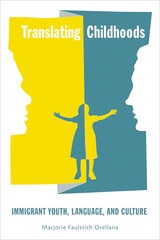
cover of Translating Childhoods: Immigrant Youth, Language, and Culture

Translating Childhoods

Immigrant Youth, Language, and Culture

Orellana, Marjorie Faulstich

Rutgers University Press, 2009

Though the dynamics of immigrant family life has gained attention from scholars, little is known about the younger generation, often considered "invisible." Translating Childhoods, a unique contribution to the study of immigrant youth, brings children to the forefront by exploring the "work" they perform as language and culture brokers, and the impact of this largely unseen contribution.

Skilled in two vernaculars, children shoulder basic and more complicated verbal exchanges for non-English speaking adults. Readers hear, through children's own words, what it means be "in the middle" or the "keys to communication" that adults otherwise would lack. Drawing from ethnographic data and research in three immigrant communities, Marjorie Faulstich Orellana's study expands the definition of child labor by assessing children's roles as translators as part of a cost equation in an era of global restructuring and considers how sociocultural learning and development is shaped as a result of children's contributions as translators.
[more]
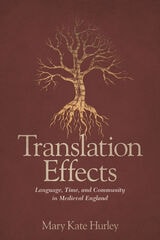
cover of Translation Effects: Language, Time, and Community in Medieval England

Translation Effects

Language, Time, and Community in Medieval England

Mary Kate Hurley

The Ohio State University Press, 2021
In Translation Effects: Language, Time, and Community in Medieval England, Mary Kate Hurley reinterprets a well-recognized and central feature of medieval textual production: translation. Medieval texts often leave conspicuous evidence of the translation process. These translation effects are observable traces that show how medieval writers reimagined the nature of the political, cultural, and linguistic communities within which their texts were consumed. Examining translation effects closely, Hurley argues, provides a means of better understanding not only how medieval translations imagine community but also how they help create communities. Through fresh readings of texts such as the Old English Orosius, Ælfric’s Lives of the Saints, Ælfric’s Homilies, Chaucer, Trevet, Gower, and Beowulf, Translation Effects adds a new dimension to medieval literary history, connecting translation to community in a careful and rigorous way and tracing the lingering outcomes of translation effects through the whole of the medieval period.
[more]
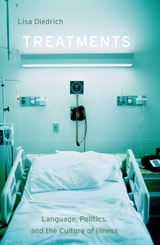
cover of Treatments: Language, Politics, and the Culture of Illness

Treatments

Language, Politics, and the Culture of Illness

Lisa Diedrich

University of Minnesota Press, 2007

Creative expression inspired by disease has been criticized as a celebration of victimhood, unmediated personal experience, or just simply bad art. Despite debate, however, memoirs written about illness—particularly AIDS or cancer—have proliferated since the late twentieth century and occupy a highly influential place on the cultural landscape today.

In Treatments, Lisa Diedrich considers illness narratives, demonstrating that these texts not only recount and interpret symptoms but also describe illness as an event that reflects wider cultural contexts, including race, gender, class, and sexuality. Diedrich begins this theoretically rigorous analysis by offering examples of midcentury memoirs of tuberculosis. She then looks at Susan Sontag’s Illness As Metaphor, Audre Lorde’s The Cancer Journals, and Eve Kosofsky Sedgwick’s “White Glasses,” showing how these breast cancer survivors draw on feminist health practices of the 1970s and also anticipate the figure that would appear in the wake of the AIDS crisis in the 1980s—the “politicized patient.” She further reveals how narratives written by doctors Abraham Verghese and Rafael Campo about treating people with AIDS can disrupt the doctor–patient hierarchy, and she explores practices of witnessing that emerge in writing by Paul Monette and John Bayley.

Through these records of intensely personal yet universal experience, Diedrich demonstrates how language both captures and fails to capture these “scenes of loss” and how illness narratives affect the literary, medical, and cultural contexts from which they arise. Finally, by examining the ways in which the sick speak and are spoken for, she argues for an ethics of failure—the revaluation of loss as creating new possibilities for how we live and die.

Lisa Diedrich is assistant professor of women’s studies at Stony Brook University.
[more]
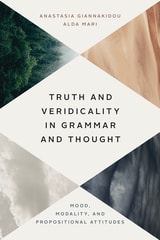
cover of Truth and Veridicality in Grammar and Thought: Mood, Modality, and Propositional Attitudes

Truth and Veridicality in Grammar and Thought

Mood, Modality, and Propositional Attitudes

Anastasia Giannakidou and Alda Mari

University of Chicago Press, 2021

Can language directly access what is true, or is the truth judgment affected by the subjective, perhaps even solipsistic, constructs of reality built by the speakers of that language? The construction of such subjective representations is known as veridicality, and in this book Anastasia Giannakidou and Alda Mari deftly address the interaction between truth and veridicality in the grammatical phenomena of mood choice: the indicative and subjunctive choice in the complements of modal expressions and propositional attitude verbs.

Combining several strands of analysis—formal linguistic semantics, syntactic theory, modal logic, and philosophy of language—Giannakidou and Mari’s theory not only enriches the analysis of linguistic modality, but also offers a unified perspective of modals and propositional attitudes. Their synthesis covers mood, modality, and attitude verbs in Greek and Romance languages, while also offering broader applications for languages lacking systematic mood distinction, such as English. Truth and Veridicality in Grammar and Thought promises to shape longstanding conversations in formal semantics, pragmatics, and philosophy of language, among other areas of linguistics.

[more]