Results by title
328 books match the query 'Literature and society' and 55 start with t

Theory and Practice of Sociocriticism
Thl Vol 53Edmond CrosTranslated by Jerome SchwartzForeword by Jurgen Link and Ursula Link-Heer
University of Minnesota Press, 1988
Theory and Practice of Sociocriticism was first published in 1988. Minnesota Archive Editions uses digital technology to make long-unavailable books once again accessible, and are published unaltered from the original University of Minnesota Press editions.
Edmond Cros is a leading French Hispanicist whose work is unique in Continental theory because it brings Spanish and Mexican texts into current literary debates, which have so far centered mainly on the French and German traditions. Equally distinctive is the nature of his work, which Cros terms sociocriticism. Unlike most sociological approaches to literature, which leave the structure of texts untouched, sociocriticism aims to prove that the encounter with "ideological traces," and with antagonistic tensions between social classes, is central to any reading of texts. Cros's method distinguishes between the "semiotic and "ideological" elements within a text, and involves the patient, exacting reconstruction of the concrete text from these elements, a process that enables the sociocritic to interpret its fault lines, its internal contradictions - in the end , its irreducibly social nature.
As its title suggests, Theory and Practice of Sociocriticism is structured in two parts. Its opening chapters analyze sociological theories of discourse, including those of Foucault, Bakhtin, and Goldman; in the second part, Cros applies theory to practice in readings of specific works: the film Scarface, contemporary Mexican poetry and prose (Octavio Paz, Carlos Fuentes), and the picaresque novel of the Spanish Golden Age. In their foreword, Jurgen Link and Ursula Link-Heer differentiate sociocriticism from other social approaches to literature and show how Cros's method works in specific textual readings. They emphasize his resistance to the reductive modes and "misreadings" that dominate much of contemporary theory.
Edmond Cros is a professor of literary theory and Hispanic studies at the Universite Paul Valery in Montpellier, France, and Andrew W. Mellon Professor of Hispanic Studies at the University of Pittsburgh. Jurgen Link teaches at the Ruhr-Universitat Bochum and Ursula Link-Heer at the Universitat Siegen, both in West Germany.
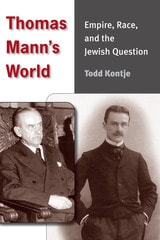
Thomas Mann's World
Empire, Race, and the Jewish QuestionTodd Kontje
University of Michigan Press, 2011
Tirana Modern
Biblio-Ethnography on the Margins of EuropeMatthew Rosen
Vanderbilt University Press, 2022
Drawing on material collected through fieldwork with a community of readers, writers, and translators attached to the independent Albanian publisher Pika pa sipërfaqe (Point without Surface), Tirana Modern provides a tightly focused ethnography of literary culture in Albania that brings into relief the more general dialectic between social imagination and social reality as mediated by reading and literature.
Training for Catastrophe
Fictions of National Security after 9/11Lindsay Thomas
University of Minnesota Press, 2021
A timely, politically savvy examination of how impossible disasters shape the very real possibilities of our world
Why would the normally buttoned-down national security state imagine lurid future scenarios like a zombie apocalypse? In Training for Catastrophe, author Lindsay Thomas shows how our security regime reimagines plausibility to focus on unlikely and even unreal events rather than probable ones. With an in-depth focus on preparedness (a pivotal, emergent national security paradigm since 9/11) she explores how fiction shapes national security.
Thomas finds fiction at work in unexpected settings, from policy documents and workplace training manuals to comics and video games. Through these texts—as well as plenty of science fiction—she examines the philosophy of preparedness, interrogating the roots of why it asks us to treat explicitly fictional events as real. Thomas connects this philosophical underpinning to how preparedness plays out in contemporary politics, emphasizing how it uses aesthetic elements like realism, genre, character, and plot to train people both to regard some disasters as normal and to ignore others.
Training for Catastrophe makes an important case for how these documents elicit consent and compliance. Thomas draws from a huge archive of texts—including a Centers for Disease Control comic about a zombie apocalypse, the work of Audre Lorde, and the political thrillers of former national security advisor Richard Clarke—to ask difficult questions about the uses and values of fiction. A major statement on how national security intrudes into questions of art and life, Training for Catastrophe is a timely intervention into how we confront disasters.
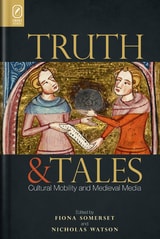
Truth and Tales
Cultural Mobility and Medieval MediaEdited by Fiona Somerset and Nicholas Watson
The Ohio State University Press, 2015
Truth and Tales includes fourteen essays by medieval literary scholars and historians. Some essays focus on written artifacts that convey high or popular learning in unexpected ways. Others address a social problem of concern to all, demonstrating the genres and media through which it was negotiated. Still others are centered on one or more texts, detailing their investments in popular as well as learned knowledge, in performance as well as writing. This collective archaeology of medieval media provides fresh insight for medieval scholars and media theorists alike.