Results by title
321 books match the query 'Mexican Americans' and 55 start with t
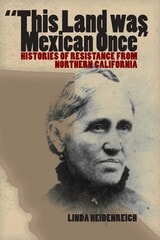
This Land Was Mexican Once
Histories of Resistance from Northern CaliforniaBy Linda Heidenreich
University of Texas Press, 2007
The territory of Napa County, California, contains more than grapevines. The deepest roots belong to Wappo-speaking peoples, a group whose history has since been buried by the stories of Spanish colonizers, Californios (today's Latinos), African Americans, Chinese immigrants, and Euro Americans. Napa's history clearly is one of co-existence; yet, its schoolbooks tell a linear story that climaxes with the arrival of Euro Americans. In "This Land was Mexican Once," Linda Heidenreich excavates Napa's subaltern voices and histories to tell a complex, textured local history with important implications for the larger American West, as well.
Heidenreich is part of a new generation of scholars who are challenging not only the old, Euro-American depiction of California, but also the linear method of historical storytelling—a method that inevitably favors the last man writing. She first maps the overlapping histories that comprise Napa's past, then examines how the current version came to dominate—or even erase—earlier events. So while history, in Heidenreich's words, may be "the stuff of nation-building," it can also be "the stuff of resistance." Chapters are interspersed with "source breaks"—raw primary sources that speak for themselves and interrupt the linear, Euro-American telling of Napa's history. Such an inclusive approach inherently acknowledges the connections Napa's peoples have to the rest of the region, for the linear history that marginalizes minorities is not unique to Napa. Latinos, for instance, have populated the American West for centuries, and are still shaping its future. In the end, "This Land was Mexican Once" is more than the story of Napa, it is a multidimensional model for reflecting a multicultural past.

Tracking King Tiger
Reies López Tijerina and the FBIJosé Angel Gutiérrez
Michigan State University Press, 2019
Trochemoche
PoemsLuis J. Rodriguez
Northwestern University Press, 1998
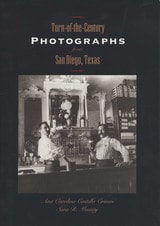
Turn-of-the-Century Photographs from San Diego, Texas
By Ana Carolina Castillo Crimm and Sara R. Massey
University of Texas Press, 2003
Situated in the South Texas borderlands some fifty miles west of Corpus Christi, San Diego was a thriving town already a hundred years old at the turn of the twentieth century. With a population that was 90 percent Mexican or Mexican American and 10 percent Anglo, the bicultural community was the seat of Duval County and a prosperous town of lumberyards, banks, mercantile stores, and cotton gins, which also supplied the needs of area ranchers and farmers. Though Anglos dominated its economic and political life, San Diego was culturally Mexican, and Mexican Americans as well as Anglos built successful businesses and made fortunes.
This collection of nearly one hundred photographs from the estate of amateur photographer William Hoffman captures the cosmopolitan town of San Diego at a vibrant moment in its history between 1898 and 1909. Grouped into the categories women and their jobs, local homes, men and their businesses, children at school and church, families and friends, and entertainment about town, the photos offer an immediate visual understanding of the cultural and economic life of the community, enhanced by detailed captions that identify the subjects and circumstances of the photos. An introductory historical chapter constitutes the first published history of Duval County, which was one of the most important areas of South Texas in the early twentieth century.
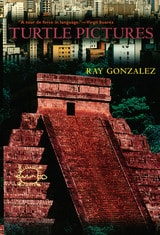
Turtle Pictures
Ray Gonzalez
University of Arizona Press, 2000
Gonzalez has forged a new Chicano manifesto, a cultural memoir that traces both his personal journey and the communal journey that Mexican Americans have traveled throughout this century, across this land. He interweaves lyrical poetry, prose poems, short fiction, and nonfiction commentary into a lush cacophony that traces the evolution of today's politically charged Chicano voices from the deafening silence of their ancestors. Adopting the turtle as a metaphor for the Native American origins of border culture, Gonzalez frames this multitextured individual vision until it becomes a universal portrait of American life: a slow, ancient creature morphing into one of voracious rapidity. In wild and challenging surrealistic images, he hammers out a political statement from language that takes on a special urgency. Walking a fine line between lyricism and polemic, and succeeding where others have stumbled, he calls on Mexican Americans to return to their roots in order to avoid being swept up in American material culture.
Turtle Pictures is a complex body of work by a poet totally in tune with the spirit and nuances of language, imbued with a deep sense of craft and literary tradition. It invites readers to revel in its richness and vitality, to be caught up in its chantlike spirit, to luxuriate in its hauntingly beautiful passages. It is a work to devour, to savor, to return to, for it speaks with all the rhythms of the soul.