Results by title
1427 books match the query 'Politics' and 382 start with t

The German Problem Transformed
Institutions, Politics, and Foreign Policy, 1945-1995Thomas Banchoff
University of Michigan Press, 1999

The Government and Politics of the European Union
Neill Nugent
Duke University Press, 0
There have been many developments within the European Union since the last edition of this volume. In May 2004, the EU increased in size from fifteen to twenty-five member states, and, in so doing, became a pan-European, rather than Western European, organization. The following month, national leaders reached agreement on the contents of the long-discussed and exhaustively negotiated Constitutional Treaty only to see the fruits of their labors rejected in 2005 by voters in France and the Netherlands. These are only the most obvious manifestations of a constantly evolving integration process addressed throughout the book. Every chapter has been extensively revised since the last edition.
The Government and Politics of the European Union also includes reflections on the conceptual and theoretical tools used to analyze the integration process and the EU, as well as on the factors likely to influence the Union’s future development.

The Green Economy
Environment, Sustainable Development and the Politics of the FutureMichael Jacobs
Pluto Press, 1992

The Green Revolution in the Global South
Science, Politics, and Unintended ConsequencesR. Douglas Hurt
University of Alabama Press, 2020
The Green Revolution was devised to increase agricultural production worldwide, particularly in the developing world. Agriculturalists employed anhydrous ammonia and other fertilizing agents, mechanical tilling, hybridized seeds, pesticides, herbicides, and a multitude of other techniques to increase yields and feed a mushrooming human population that would otherwise suffer starvation as the world’s food supply dwindled.
In The Green Revolution in the Global South: Science, Politics, and Unintended Consequences, R. Douglas Hurt demonstrates that the Green Revolution did not turn out as neatly as scientists predicted. When its methods and products were imported to places like Indonesia and Nigeria, or even replicated indigenously, the result was a tumultuous impact on a society’s functioning. A range of factors—including cultural practices, ethnic and religious barriers, cost and availability of new technologies, climate, rainfall and aridity, soil quality, the scale of landholdings, political policies and opportunism, the rise of industrial farms, civil unrest, indigenous diseases, and corruption—entered into the Green Revolution calculus, producing a series of unintended consequences that varied from place to place. As the Green Revolution played out over time, these consequences rippled throughout societies, affecting environments, economies, political structures, and countless human lives.
Analyzing change over time, almost decade by decade, Hurt shows that the Green Revolution was driven by the state as well as science. Rather than acknowledge the vast problems with the Green Revolution or explore other models, Hurt argues, scientists and political leaders doubled down and repeated the same missteps in the name of humanity and food security. In tracing the permutations of modern science’s impact on international agricultural systems, Hurt documents how, beyond increasing yields, the Green Revolution affected social orders, politics, and lifestyles in every place its methods were applied—usually far more than once.

The Gun in Central Africa
A History of Technology and PoliticsGiacomo Macola
Ohio University Press, 2016
Why did some central African peoples embrace gun technology in the nineteenth century, and others turn their backs on it? In answering this question, The Gun in Central Africa offers a thorough reassessment of the history of firearms in central Africa. Marrying the insights of Africanist historiography with those of consumption and science and technology studies, Giacomo Macola approaches the subject from a culturally sensitive perspective that encompasses both the practical and the symbolic attributes of firearms.
Informed by the view that the power of objects extends beyond their immediate service functions, The Gun in Central Africa presents Africans as agents of technological re-innovation who understood guns in terms of their changing social structures and political interests. By placing firearms at the heart of the analysis, this volume casts new light on processes of state formation and military revolution in the era of the long-distance trade, the workings of central African gender identities and honor cultures, and the politics of the colonial encounter.

The Healthiest City
Milwaukee and the Politics of Health ReformJudith W. Leavitt
University of Wisconsin Press, 1996
Between 1850 and 1900, Milwaukee’s rapid population growth also gave rise to high death rates, infectious diseases, crowded housing, filthy streets, inadequate water supplies, and incredible stench. The Healthiest City shows how a coalition of reform groups brought about community education and municipal action to achieve for Milwaukee the title of “the healthiest city” by the 1930s. This highly praised book reminds us that cutting funds and regulations for preserving public health results in inconvenience, illness, and even death.
“A major work. . . . Leavitt focuses on three illustrative issues—smallpox, garbage, and milk, representing the larger areas of infectious disease, sanitation, and food control.”—Norman Gevitz, Journal of the American Medical Association
“Leavitt’s research provides additional evidence . . . that improvements in sanitation, living conditions, and diet contributed more to the overall decline in mortality rates than advances in medical practice. . . . A solid contribution to the history of urban reform politics and public health.”—Jo Ann Carrigan, Journal of American History
The Heidegger Case
On Philosophy and Politicsedited by Tom Rockmore and Joseph Margolis
Temple University Press, 1992

The Heresies of Jan Patocka
Phenomenology, History, and PoliticsJames Dodd
Northwestern University Press, 2023
Foregrounding the turbulent political and intellectual scene in Czechoslovakia following the Prague Spring in 1968, James Dodd explores the unity of philosophy, history, and politics in Jan Patočka’s life and legacy. Dodd presents Patočka as an essential philosopher of modern concepts—such as freedom, subjectivity, and history—and also as an interpreter of prominent thinkers such as Husserl and Heidegger.
Dodd outlines the phenomenology that Patočka, as a late pupil of Husserl and Heidegger, crafted in response to the classical model before turning to his philosophy of history, which was oriented around the problem of Europe and the care for the soul. Finally, Dodd examines Patočka’s role as a dissident intellectual and one of the principal voices of the Charter 77 human rights movement until his death in March 1977. By situating Patočka’s thought in relation to classical phenomenology and to the political and historical conditions of Central Europe, Dodd illuminates the enduring impact of this key thinker of the twentieth century.
The Humanities in the Age of Information and Post-Truth
Edited by Ignacio López-Calvo and Christina Lux
Northwestern University Press, 2019
While the reader may suspect that these types of lucubration are a desperate reaction to decreased public funding for the humanities worldwide, a decreased enrollment of students, or anxiety over the future of our profession, there is in this volume a coherent argument for the continued need, perhaps more now than ever, to invest in humanities education if we are to have informed and socially conscious citizens rather than just willing consumers and obedient workers. Furthermore, the essays prove that the humanities and the arts are, after all, not a luxury but an integral part of a complete scholarly education.
The Idea of Indian Literature
Gender, Genre, and Comparative MethodPreetha Mani
Northwestern University Press, 2022
Indian literature is not a corpus of texts or literary concepts from India, argues Preetha Mani, but a provocation that seeks to resolve the relationship between language and literature, written in as well as against English. Examining canonical Hindi and Tamil short stories from the crucial decades surrounding decolonization, Mani contends that Indian literature must be understood as indeterminate, propositional, and reflective of changing dynamics between local, regional, national, and global readerships. In The Idea of Indian Literature, she explores the paradox that a single canon can be written in multiple languages, each with their own evolving relationships to one another and to English.
Hindi, representing national aspirations, and Tamil, epitomizing the secessionist propensities of the region, are conventionally viewed as poles of the multilingual continuum within Indian literature. Mani shows, however, that during the twentieth century, these literatures were coconstitutive of one another and of the idea of Indian literature itself. The writers discussed here—from short-story forefathers Premchand and Pudumaippittan to women trailblazers Mannu Bhandari and R. Chudamani—imagined a pan-Indian literature based on literary, rather than linguistic, norms, even as their aims were profoundly shaped by discussions of belonging unique to regional identity. Tracing representations of gender and the uses of genre in the shifting thematic and aesthetic practices of short vernacular prose writing, the book offers a view of the Indian literary landscape as itself a field for comparative literature.
The Influence of Campaign Contributions in State Legislatures
The Effects of Institutions and PoliticsLynda W. Powell
University of Michigan Press, 2012
Campaign contributions are widely viewed as a corrupting influence but most scholarly research concludes that they have marginal impact on legislative behavior. Lynda W. Powell shows that contributions have considerable influence in some state legislatures but very little in others. Using a national survey of legislators, she develops an innovative measure of influence and delineates the factors that explain this great variation across the 99 U.S. state legislative chambers.
Powell identifies the personal, institutional, and political factors that determine how much time a legislator devotes to personal fundraising and fundraising for the caucus. She shows that the extent of donors' legislative influence varies in ways corresponding to the same variations in the factors that determine fundraising time. She also confirms a link between fundraising and lobbying with evidence supporting the theory that contributors gain access to legislators based on donations, Powell's findings have important implications for the debate over the role of money in the legislative process.
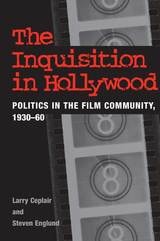
The Inquisition in Hollywood
Politics in the Film Community, 1930-60Larry Ceplair and Steven Englund
University of Illinois Press, 1979
The definitive work on the Hollywood blacklist era
The Inquisition in Hollywood examines the suppression of radical political activity in the film industry from the days of the Great Depression through the tumultuous House Un-American Activities Commission era to the waning days of the infamous blacklist.
Although this thirty-year period of American history is marked by widespread targeting of leftists in all areas of life, those in the film industry–-predominately screenwriters–-were considered to be in positions of great potential indoctrinating power, and found themselves under intense scrutiny as the Cold War hysteria mounted.
Ceplair and Englund trace the history of political struggle in Hollywood back to the formation of the Screen Writers Guild in 1933. Many of the blacklisted filmmakers were members of the Communist Party and all of the graylisted filmmakers had expressed their sympathy with progressive (mainly anti-fascist) causes.
Although no Hollywood Communist has ever been linked to espionage or sabotage, and charges of subversive indoctrination have no basis in documented fact, this book powerfully shows how devastating a mere suspicion or insinuation of guilt could be during the era of the Red Menace.
Twenty-two years after its initial publication, The Inquisition in Hollywood remains the definitive work on the blacklist era, and this new edition features a new introduction by the authors.
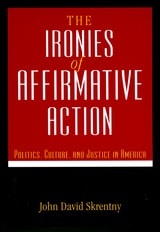
The Ironies of Affirmative Action
Politics, Culture, and Justice in AmericaJohn David Skrentny
University of Chicago Press, 1996
Analyzing both the resistance from the Right and the support from the Left, Skrentny brings to light the unique moral culture that has shaped the affirmative action debate, allowing for starkly different policies for different citizens. He also shows, through an analysis of historical documents and court rulings, the complex and intriguing political circumstances which gave rise to these controversial policies.
By exploring the mystery of how it took less than five years for a color-blind policy to give way to one that explicitly took race into account, Skrentny uncovers and explains surprising ironies: that affirmative action was largely created by white males and initially championed during the Nixon administration; that many civil rights leaders at first avoided advocacy of racial preferences; and that though originally a political taboo, almost no one resisted affirmative action.
With its focus on the historical and cultural context of policy elites, The Ironies of Affirmative Action challenges dominant views of policymaking and politics.
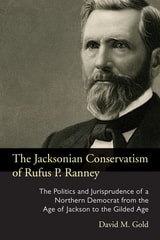
The Jacksonian Conservatism of Rufus P. Ranney
The Politics and Jurisprudence of a Northern Democrat from the Age of Jackson to the Gilded AgeDavid M. Gold
Ohio University Press, 2016
Ohio’s Rufus P. Ranney embodied many of the most intriguing social and political tensions of his time. He was an anticorporate campaigner who became John D. Rockefeller’s favorite lawyer. A student and law partner of abolitionist Benjamin F. Wade, Ranney acquired an antislavery reputation and recruited troops for the Union army; but as a Democratic candidate for governor he denied the power of Congress to restrict slavery in the territories, and during the Civil War and Reconstruction he condemned Republican policies.
Ranney was a key delegate at Ohio’s second constitutional convention and a two-time justice of the Ohio Supreme Court. He advocated equality and limited government as understood by radical Jacksonian Democrats. Scholarly discussions of Jacksonian jurisprudence have primarily focused on a handful of United States Supreme Court cases, but Ranney’s opinions, taken as a whole, outline a broader approach to judicial decision making.
A founder of the Ohio State Bar Association, Ranney was immensely influential but has been understudied until now. He left no private papers, even destroying his own correspondence. In The Jacksonian Conservatism of Rufus P. Ranney, David M. Gold works with the public record to reveal the contours of Ranney’s life and work. The result is a new look at how Jacksonian principles crossed the divide of the Civil War and became part of the fabric of American law and at how radical antebellum Democrats transformed themselves into Gilded Age conservatives.
The Journal of Politics, volume 82 number 1 (January 2020)
The University of Chicago Press
University of Chicago Press Journals, 2020
The Journal of Politics, volume 82 number 2 (April 2020)
The University of Chicago Press
University of Chicago Press Journals, 2020
The Journal of Politics, volume 82 number 3 (July 2020)
The University of Chicago Press
University of Chicago Press Journals, 2020
The Journal of Politics, volume 82 number 4 (October 2020)
The University of Chicago Press
University of Chicago Press Journals, 2020
The Journal of Politics, volume 83 number 1 (January 2021)
The University of Chicago Press
University of Chicago Press Journals, 2021
The Journal of Politics, volume 83 number 2 (April 2021)
The University of Chicago Press
University of Chicago Press Journals, 2021
The Journal of Politics, volume 83 number 3 (July 2021)
The University of Chicago Press
University of Chicago Press Journals, 2021
The Journal of Politics, volume 83 number 4 (October 2021)
The University of Chicago Press
University of Chicago Press Journals, 2021
The Journal of Politics, volume 84 number 1 (January 2022)
The University of Chicago Press
University of Chicago Press Journals, 2022
The Journal of Politics, volume 84 number 2 (April 2022)
The University of Chicago Press
University of Chicago Press Journals, 2022
The Journal of Politics, volume 84 number 3 (July 2022)
The University of Chicago Press
University of Chicago Press Journals, 2022
The Journal of Politics, volume 84 number 4 (October 2022)
The University of Chicago Press
University of Chicago Press Journals, 2022
The Journal of Politics, volume 85 number 1 (January 2023)
The University of Chicago Press
University of Chicago Press Journals, 2023
The Journal of Politics, volume 85 number 2 (April 2023)
The University of Chicago Press
University of Chicago Press Journals, 2023
The Journal of Politics, volume 85 number 3 (July 2023)
The University of Chicago Press
University of Chicago Press Journals, 2023
The Journal of Politics, volume 85 number 4 (October 2023)
The University of Chicago Press
University of Chicago Press Journals, 2023
The Journal of Politics, volume 86 number 1 (January 2024)
The University of Chicago Press
University of Chicago Press Journals, 2024
The Journal of Politics, volume 86 number 2 (April 2024)
The University of Chicago Press
University of Chicago Press Journals, 2024
The Journal of Politics, volume 86 number 3 (July 2024)
The University of Chicago Press
University of Chicago Press Journals, 2024
The Journal of Politics, volume 86 number 4 (October 2024)
The University of Chicago Press
University of Chicago Press Journals, 2024
The Journal of Politics, volume 87 number 1 (January 2025)
The University of Chicago Press
University of Chicago Press Journals, 2025
The Journal of Politics, volume 87 number 2 (April 2025)
The University of Chicago Press
University of Chicago Press Journals, 2025
The Journal of Politics, volume 87 number 3 (July 2025)
The University of Chicago Press
University of Chicago Press Journals, 2025
The Journal of Politics, volume 87 number 4 (October 2025)
The University of Chicago Press
University of Chicago Press Journals, 2025
The Journal of Politics, volume 88 number 1 (January 2026)
The University of Chicago Press
University of Chicago Press Journals, 2026
The Journal of Politics, volume 88 number 2 (April 2026)
The University of Chicago Press
University of Chicago Press Journals, 2026
The Journal of Politics, volume 88 number 3 (July 2026)
The University of Chicago Press
University of Chicago Press Journals, 2026
The Journal of Politics, volume 88 number 4 (October 2026)
The University of Chicago Press
University of Chicago Press Journals, 2026
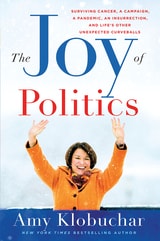
The Joy of Politics
Surviving Cancer, a Campaign, a Pandemic, an Insurrection, and Life’s Other Unexpected CurveballsAmy Klobuchar
University of Minnesota Press, 2023
An intimate and revelatory memoir on personal challenges, political turmoil, and the state of American democracy―now in paperback with a new preface
During the past few years, as our country has faced unprecedented challenges, Senator Amy Klobuchar has been in the room where it happens―on the Senate floor for critical votes during the pandemic, at the debate podium during one of the most crucial presidential primaries in U.S. history, and in the Capitol on January 6, 2021, when insurrectionists stormed the building, interrupting the certification of the Electoral College. It was well past midnight when Klobuchar stood beside then–Vice President Pence to officially certify President Biden's victory.
In her candid, honest, and at times bitingly funny memoir, the pragmatic senator shares insider stories from these historic moments, while also inviting readers into her personal life. An underdog in the 2020 Democratic presidential primary campaign, she built surprising early momentum, only to suspend her candidacy in order to support Joe Biden. Within weeks of returning to work in the Senate, the sudden onslaught of Covid-19 hit her family directly: her husband was hospitalized for a week and spent a month in isolation. Klobuchar shares her experience facing a cancer diagnosis while her beloved father succumbs to Alzheimer's. She recounts the dramatic narrative of January 6 and how close we came to losing our democracy. And, with her signature humor, she reveals what it's like to work with some of her more . . . well, interesting . . . colleagues.
At the crux of these stories is a narrative of resilience—of personal resilience and the resilience of a nation—and, improbably, joy.

The Keystone Province
Politics and Governance in ManitobaKelly Saunders
University of Manitoba Press, 2025
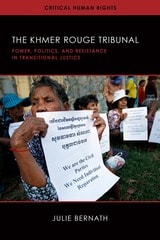
The Khmer Rouge Tribunal
Power, Politics, and Resistance in Transitional JusticeJulie Bernath
University of Wisconsin Press, 2023
Here, Julie Bernath takes a different tack, deliberately decentering the trials in an effort to understand the ECCC in its particular context—and, by extension, the degree to which notions of transitional justice generally must be understood in particular social, cultural, and political contexts. She focuses on “sites of resistance” to the ECCC, including not only members of the elite political class but also citizens who do not, for a variety of tangled reasons, participate in the tribunal—and even resistance from victims of the regime and participants in the trials. Bernath demonstrates that the ECCC both shapes and is shaped by long-term contestation over Cambodia’s social, economic, and political transformations, and thereby argues that transitional justice must be understood locally rather than as a homogenous good that can be implanted by international actors.
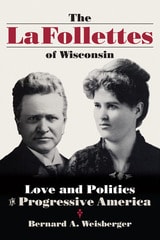
The La Follettes of Wisconsin
Love and Politics in Progressive AmericaBernard A. Weisberger
University of Wisconsin Press, 2013
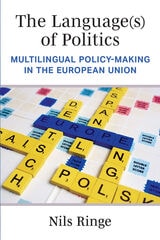
The Language(s) of Politics
Multilingual Policy-Making in the European UnionNils Ringe
University of Michigan Press, 2022
Multilingualism is an ever-present feature in political contexts around the world, including multilingual states and international organizations. Increasingly, consequential political decisions are negotiated between politicians who do not share a common native language. Nils Ringe uses the European Union to investigate how politicians’ reliance on shared foreign languages and translation services affects politics and policy-making. Ringe's research illustrates how multilingualism is an inherent and consequential feature of EU politics—that it depoliticizes policy-making by reducing its political nature and potential for conflict. An atmosphere with both foreign language use and a reliance on translation leads to communication that is simple, utilitarian, neutralized, and involves commonly shared phrases and expressions. Policymakers tend to disregard politically charged language and they are constrained in their ability to use vague or ambiguous language to gloss over disagreements by the need for consistency across languages.
The Last Drop
The Politics of WaterMike Gonzalez and Marianella Yanes
Pluto Press, 2015
This book looks at how we got here and what we can and should do next. Laying out the complex arguments surrounding water, its ownership and access to it, Mike Gonzalez and Marianella Yanes make the technical and scientific aspects of the discussion clear and accessible—and thereby enable themselves to make the political questions more urgent. Pushing back against the market fundamentalists, the authors argue that it is both possible and necessary that considerations of equity and social justice prevail in the debates about water. Powerful and polemical, The Last Drop will be a vital resource for water activists worldwide.

The Last Flower
A Parable in PicturesJames Thurber
University of Iowa Press, 2007
Civilization has collapsed after World War XII, dogs have deserted their masters, all the groves and gardens have been destroyed, and love has vanished from the earth. Then one day, "a young girl who had never seen a flower chanced to come upon the last one in the world." Written among the sorrow and chaos of war, dedicated to this only child " in the wistful hope that her world will be better than mine." The new printing will feature new scans of Thurber's original 1939 drawings.

The Last Half-Century
Societal Change and Politics in AmericaMorris Janowitz
University of Chicago Press, 1978
For Janowitz, social control denotes a society's capacity to regulate itself within a moral framework that transcends simple self-interest. He poses urgent questions: Why has social control been so drastically weakened in our advanced industrial society? And what strategies can we use to strengthen it again?
The expanation rests in part on the changes in social structure which make it more and more complicated for citizens to calculate their political self-interest. At the same time, complex economic and defense problems also strain an already overburdened legislative system, making effective, responsive political rule increasingly difficult.
Janowitz concludes by assessing the response of the social sciences to the pressing problem of social control and asserts that new forms of citizen participation in the government must be found.