Results by title
346 books match the query 'Relations' and 67 start with t
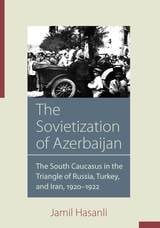
The Sovietization of Azerbaijan
The South Caucasus in the Triangle of Russia, Turkey, and Iran, 1920–1922Jamil Hasanli
University of Utah Press, 2017
World War I and the fall of tsarist Russia brought brief independence to Azerbaijan, but by 1920 the Bolshevik revolution pushed south with the twofold purpose of accessing the oil-rich fields near Baku on the Caspian Sea and spreading communism into the Caucasus. Azerbaijan, the richest and earliest significant source of oil in the world, was the first republic in the South Caucasus occupied by the Red Army, which then advanced into neighboring Armenia and Georgia. Pulling from confidential, newly accessed archives, Hasanli describes Soviet Russia’s aggressive policy toward the three South Caucasian nations, which led to their absorption into the USSR by the end of 1922.
The book highlights the Caucasian peoples’ struggle to retain political independence against Soviet Russia and an international cast that included European powers wanting to retain petroleum concessions; Kemalist Turkey, which claimed special ties to the Turkic Azeris; and Iran, which controlled South Azerbaijan and was thus a possible route of expansion eastward for Bolshevik movement. The author also considers the impact on Azerbaijani-Armenian relations of the first two years of Sovietization and explains how Azerbaijan provided space for Bolshevik experiments. Throughout his book, Hasanli illuminates the tragedy of the complex, confused period of Sovietization of the South Caucasus.
The Spectral Jew
Conversion and Embodiment in Medieval EuropeSteven F. Kruger
University of Minnesota Press, 2006
Looking closely at how medieval Jewish and Christian identities are distinguished from each other, yet intimately intertwined, Kruger demonstrates how Jews were often corporealized in ways that posited them as inferior to Christians—archaic and incapable of change—even as the two mutually shaped each other. But such attempts to differentiate Jews and Christians were inevitably haunted by the knowledge that Christianity had emerged out of Judaism and was, in its own self-understanding, a community of converts.
Examining the points of contact between Christian and Jewish communities, Kruger discloses the profound paradox of the Jew as different in all ways, yet capable of converting to fully Christian status. He draws from central medieval authors and texts such as Peter Damian, Guibert of Nogent, the Barcelona Disputation, and the Hebrew chronicles of the First Crusade, as well as lesser known writings such as the disputations of Ceuta, Majorca, and Tortosa and the immensely popular Dialogues of Peter Alfonsi.
By putting the conversion narrative at the center of this analysis, Kruger exposes it as a disruption of categories rather than a smooth passage and reveals the prominent role Judaism played in the medieval Christian imagination.
Steven F. Kruger is professor of English and medieval studies at Queens College and the Graduate Center, CUNY. He is author of several books and editor with Glenn Burger of Queering the Middle Ages (Minnesota, 2001).
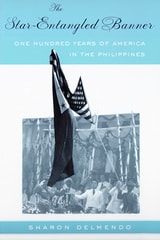
The Star-Entangled Banner
One Hundred Years of America in the PhilippinesDelmendo, Sharon
Rutgers University Press, 2004
During a ceremony held in 1996 to commemorate the fiftieth anniversary of formal Philippine independence, the U.S. flag was being lowered while the Philippine flag was being raised, and the two became entangled. In The Star-Entangled Banner, Sharon Delmendo demonstrates that this incident is indicative of the longstanding problematic relationship between the two countries. When faced with a national crisis or a compelling need to reestablish its autonomy, each nation paradoxically turns to its history with the other to define its place in the world.
Each chapter of the book deals with a separate issue in this linked history: the influence of Buffalo Bill’s show on the proto-nationalism of José Rizal, who is often described as the “First Filipino”; the portrayal of the Philippines in American children’s books; Back to Bataan, a World War II movie starring John Wayne; the post-independence fiction of F. Sionil José; and the refusal of the U..S military to return the Balangiga Bells, which were taken as war booty during the Philippine-American War. Ultimately, Delmendo demonstrates how the effects of U.S. imperialism in the Philippines continue to resonate in U.S. foreign policy in the post cold war era and the war on terrorism.
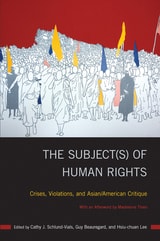
The Subject(s) of Human Rights
Crises, Violations, and Asian/American CritiqueCathy J. Schlund-Vials
Temple University Press, 2020
Human rights violations have always been part of Asian American studies. From Chinese immigration restrictions, the incarceration of Japanese Americans, yellow peril characterizations, and recent acts of deportation and Islamophobia, Asian Americans have consistently functioned as subordinated “subjects” of human rights violations. The Subject(s) of Human Rights brings together scholars from North America and Asia to recalibrate these human rights concerns from both sides of the Pacific.
The essays in this collection provide a sharper understanding of how Asian/Americans have been subjected to human rights violations, how they act as subjects of history and agents of change, and how they produce knowledge around such subjects. The editors of and contributors to The Subject(s) of Human Rights examine refugee narratives, human trafficking, and citizenship issues in twentieth- and twenty-first century literature. These themes further refract issues of American war-making, settler colonialism, military occupation, collateral damage, and displacement that relocate the imagined geographies of Asian America from the periphery to the center of human rights critique.
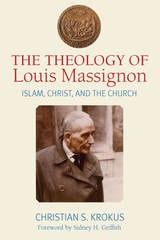
The Theology of Louis Massignon
Christian Krokus
Catholic University of America Press, 2017
The Turk in America
The Creation of an Enduring PrejudiceJustin McCarthy
University of Utah Press, 2010
Utah Series in Middle East Studies
In The Turk in America, historian Justin McCarthy seeks to explain the historical basis for American prejudice towards Turks in the nineteenth and early twentieth centuries. The volume focuses on fraudulent characterizations of Turks, mostly stemming from an antipathy in Europe and America toward non-Christians, and especially Muslims. Spanning one hundred and fifty years, this history explores the misinformation largely responsible for the negative stereotypes of Turks during this period.
The Ukrainian Question
Russian Empire and Nationalism in the 19th CenturyAlexei Miller
Central European University Press, 2003

The United States and Latin America
Myths and Stereotypes of Civilization and NatureBy Fredrick B. Pike
University of Texas Press, 1992
The lazy greaser asleep under a sombrero and the avaricious gringo with money-stuffed pockets are only two of the negative stereotypes that North Americans and Latin Americans have cherished during several centuries of mutual misunderstanding. This unique study probes the origins of these stereotypes and myths and explores how they have shaped North American impressions of Latin America from the time of the Pilgrims up to the end of the twentieth century.
Fredrick Pike's central thesis is that North Americans have identified themselves with "civilization" in all its manifestations, while viewing Latin Americans as hopelessly trapped in primitivism, the victims of nature rather than its masters. He shows how this civilization-nature duality arose from the first European settlers' perception that nature—and everything identified with it, including American Indians, African slaves, all women, and all children—was something to be conquered and dominated. This myth eventually came to color the North American establishment view of both immigrants to the United States and all our neighbors to the south.
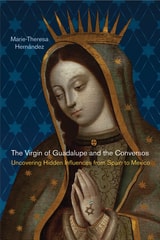
The Virgin of Guadalupe and the Conversos
Uncovering Hidden Influences from Spain to MexicoHernández, Marie-Theresa
Rutgers University Press, 2014
The terms converso and judaizante are often used for descendants of Spanish Jews (the Sephardi, or Sefarditas as they are sometimes called), who converted under duress to Christianity in the fourteenth and fifteenth centuries. There are few, if any, archival documents that prove the existence of judaizantes after the Spanish expulsion of the Jews in 1492 and the Portuguese expulsion in 1497, as it is unlikely that a secret Jew in sixteenth-century Spain would have documented his allegiance to the Law of Moses, thereby providing evidence for the Inquisition.
On a Da Vinci Code – style quest, Hernández persisted in hunting for a trove of forgotten manuscripts at the New York Public Library. These documents, once unearthed, describe the Jewish/Christian religious beliefs of an early nineteenth-century Catholic priest in Mexico City, focusing on the relationship between the Virgin of Guadalupe and Judaism. With this discovery in hand, the author traces the cult of Guadalupe backwards to its fourteenth-century Spanish origins. The trail from that point forward can then be followed to its interface with early modern conversos and their descendants at the highest levels of the Church and the monarchy in Spain and Colonial Mexico. She describes key players who were somehow immune to the dangers of the Inquisition and who were allowed the freedom to display, albeit in a camouflaged manner, vestiges of their family's Jewish identity.
By exploring the narratives produced by these individuals, Hernández reveals the existence of those conversos and judaizantes who did not return to the “covenantal bond of rabbinic law,” who did not publicly identify themselves as Jews, and who continued to exhibit in their influential writings a covert allegiance and longing for a Jewish past. This is a spellbinding and controversial story that offers a fresh perspective on the origins and history of conversos.
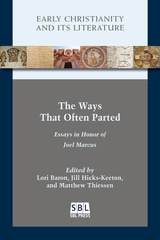
The Ways That Often Parted
Essays in Honor of Joel MarcusLori Baron
SBL Press, 2018
Focused studies on the historical interactions and formations of Judaism and Christianity
This volume of essays, from an internationally renowned group of scholars, challenges popular ways of understanding how Judaism and Christianity came to be separate religions in antiquity. Essays in the volume reject the belief that there was one parting at an early point in time and contest the argument that there was no parting until a very late date. The resulting volume presents a complex account of the numerous ways partings occurred across the ancient Mediterranean spanning the first four centuries CE.
Features:
- Case studies that explore how Jews and Christians engaged in interaction, conflict, and collaboration
- Examinations of the gospels, Paul’s letters, the book of James, as well as rabbinic and noncanonical Christian texts
- New evidence for historical reconstructions of how Christianity came on the world scene
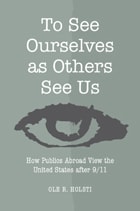
To See Ourselves as Others See Us
How Publics Abroad View the United States after 9/11Ole R. Holsti
University of Michigan Press, 2008
"Holsti, the authority on American foreign policy attitudes, investigates others' views of us. It's not pretty. It matters. Read this."
---Bruce Russett, Dean Acheson Professor of International Relations, Yale University, and editor of the Journal of Conflict Resolution
"Clearly and engagingly written, Holsti's book ranks among the most important---and most objective---of the post-9/11 scholarly studies. It deserves a large readership, both within and beyond academe."
---Ralph Levering, Vail Professor of History, Davidson College
In terms of military and economic power, the United States remains one of the strongest nations in the world. Yet the United States seems to have lost the power of persuasion, the ability to make allies and win international support.
Why? Immediately after the terrorist attacks of 9/11, leaders and citizens of foreign nations generally expressed sympathy for the United States. Since then, attitudes have changed. Drawing upon public opinion surveys conducted in 30 nations, Ole R. Holsti documents an increasing anti-American sentiment. His analysis suggests that the war in Iraq, human rights violations, and unpopular international policies are largely responsible. Consequently, the United States can rebuild its repute by adopting an unselfish, farsighted approach to global issues.
Indeed, the United States must restore goodwill abroad, Holsti asserts, because public opinion indirectly influences the leaders who decide whether or not to side with the Americans.
Ole R. Holsti is George V. Allen Professor Emeritus of International Affairs in the Department of Political Science at Duke University and author of Public Opinion and American Foreign Policy.
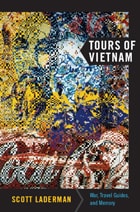
Tours of Vietnam
War, Travel Guides, and MemoryScott Laderman
Duke University Press, 2009
Tracing a history of ideological assertions embedded in travel discourse, Laderman analyzes the use of tourism in the Republic of Vietnam as a form of Cold War cultural diplomacy by a fledgling state that, according to one pamphlet published by the Vietnamese tourism authorities, was joining the “family of free nations.” He chronicles the evolution of the Defense Department pocket guides to Vietnam, the first of which, published in 1963, promoted military service in Southeast Asia by touting the exciting opportunities offered by Vietnam to sightsee, swim, hunt, and water-ski. Laderman points out that, despite historians’ ongoing and well-documented uncertainty about the facts of the 1968 “Hue Massacre” during the National Liberation Front’s occupation of the former imperial capital, the incident often appears in English-language guidebooks as a settled narrative of revolutionary Vietnamese atrocity. And turning to the War Remnants Museum in Ho Chi Minh City, he notes that, while most contemporary accounts concede that the United States perpetrated gruesome acts of violence in Vietnam, many tourists and travel writers still dismiss the museum’s display of that record as little more than “propaganda.”

Tracking Europe
Mobility, Diaspora, and the Politics of LocationGinette Verstraete
Duke University Press, 2009
In demystifying the old and new Europe across a multiplicity of texts, images, media, and cultural practices in various times and locations, Verstraete lays bare a territorial persistence in the European imaginary, one which has been differently tied up with the politics of inclusion and exclusion. Tracking Europe moves from policy papers, cultural tourism, and migration to philosophies of cosmopolitanism, nineteenth-century travel guides, electronic surveillance at the border, virtual pilgrimages to Spain, and artistic interventions in the Balkan region. It is a sustained attempt to situate current developments in Europe within a complex matrix of tourism, migration, and border control, as well as history, poststructuralist theory, and critical media and art projects.
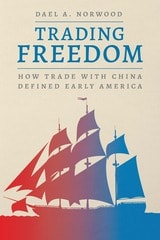
Trading Freedom
How Trade with China Defined Early AmericaDael A. Norwood
University of Chicago Press, 2022
The economic and geographic development of the early United States is usually thought of in trans-Atlantic terms, defined by entanglements with Europe and Africa. In Trading Freedom, Dael A. Norwood recasts these common conceptions by looking to Asia, making clear that from its earliest days, the United States has been closely intertwined with China—monetarily, politically, and psychologically.
Norwood details US trade with China from the late eighteenth through the late nineteenth centuries—a critical period in America’s self-definition as a capitalist nation—and shows how global commerce was central to the articulation of that national identity. Trading Freedom illuminates how debates over political economy and trade policy, the building of the transcontinental railroad, and the looming sectional struggle over slavery were all influenced by Sino-American relations. Deftly weaving together interdisciplinary threads from the worlds of commerce, foreign policy, and immigration, Trading Freedom thoroughly dismantles the idea that American engagement with China is anything new.
Transatlantic Central Europe
Contesting Geography and Redifining Culture beyond the NationJessie Labov
Central European University Press, 2019
Transition Scenarios
China and the United States in the Twenty-First CenturyDavid P. Rapkin and William R. Thompson
University of Chicago Press, 2013
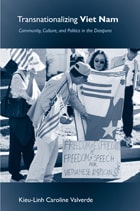
Transnationalizing Viet Nam
Community, Culture, and Politics in the DiasporaKieu-Linh Caroline Valverde
Temple University Press, 2013
Vietnamese diasporic relations affect—and are directly affected by—events in Viet Nam. In Transnationalizing Viet Nam, Kieu-Linh Caroline Valverde explores these connections, providing a nuanced understanding of this globalized community. Valverde draws on 250 interviews and almost two decades of research to show the complex relationship between Vietnamese in the diaspora and those back at the homeland.
Arguing that Vietnamese immigrant lives are inherently transnational, she shows how their acts form virtual communities via the Internet, organize social movements, exchange music and create art, find political representation, and even dissent. Valverde also exposes how generational, gender, class, and political tensions threaten to divide the ethnic community.
Transnationalizing Viet Nam paints a vivid picture of the complex political and personal allegiances that exist within Vietnamese America and shape the relations between this heterogeneous community and its country of origin.
In the series Asian American History and Culture, edited by Sucheng Chan, David Palumbo-Liu, Michael Omi, K. Scott Wong, and Linda Trinh Võ