Results by title
1095 books match the query 'Rhetoric' and 192 start with t
The Ethics and Politics of Speech
Communication and Rhetoric in the Twentieth CenturyPat J. Gehrke
Southern Illinois University Press, 2009
In The Ethics and Politics of Speech, Pat J. Gehrke provides an accessible yet intensive history of the speech communication discipline during the twentieth century. Drawing on several previously unpublished or unexamined sources—including essays, conference proceedings, and archival documents—Gehrke traces the evolution of communication studies and the dilemmas that often have faced academics in this field. In his examination, Gehrke not only provides fresh perspectives on old models of thinking; he reveals new methods for approaching future studies of ethical and political communication.
Gehrke begins his history with the first half of the twentieth century, discussing the development of a social psychology of speech and an ethics based on scientific principles, and showing the importance of democracy to teaching and scholarship at this time. He then investigates the shift toward philosophical—especially existential—ways of thinking about communication and ethics starting in the 1950s and continuing through the mid-1970s, a period associated with the rise of rhetoric in the discipline. In the chapters covering the last decades of the twentieth century, Gehrke demonstrates how the ethics and politics of communication were directed back onto the practices of scholarship within the discipline, examining the increased use of postmodern and poststructuralist theories, as well as the new trend toward writing original theory, rather than reinterpreting the past. In offering a thorough history of rhetoric studies, Gehrke sets the stage for new questions and arguments, ultimately emphasizing the deeply moral and political implications that by nature embed themselves in the field of communication.
More than simply a history of the discipline's major developments, The Ethics and Politics of Speech is an account of the philosophical and moral struggles that have faced communication scholars throughout the last century. As Gehrke explores the themes and movements within rhetoric and speech studies of the past, he also provides a better understanding of the powerful forces behind the forging of the field. In doing so, he reveals history’s potential to act as a vehicle for further academic innovation in the future.
The Ethics of Persuasion
Derrida's Rhetorical LegaciesBrooke Rollins
The Ohio State University Press, 2020
Drawing on Derrida’s (non)definition of ethics and his pointed accounts of performativity, Rollins argues that this vital ethical component of many ancient theories, practices, and pedagogies of persuasion has been undertheorized for more than two millennia. Through deconstructive readings of some of these texts, she shows us that we are not simply sovereign beings who both wield and guard against linguistic techniques of rule. Our persuasive endeavors, rather, are made possible by an ethics—an always prior encounter with otherness that interrupts self-presence.
The Ethos of Drama
Rhetorical Theory and Dramatic WorthRobert L. King
Catholic University of America Press, 2010

The Everest Effect
Nature, Culture, IdeologyElizabeth Mazzolini
University of Alabama Press, 2015
The Everest Effect is an accessibly written cultural history of how nature, technology, and culture have worked together to turn Mount Everest into a powerful and ubiquitous physical measure of Western values.
In The Everest Effect Elizabeth Mazzolini traces a series of ideological shifts in the status of Mount Everest in Western culture over the past century to the present day and links these shifts to technologies used in climbs. By highlighting the intersections of technology and cultural ideologies at this site of environmental extremity, she shows both how nature is shaped—physically and symbolically—by cultural values and how extreme natural phenomena shape culture.
Nostalgia, myth, and legend are intrinsic features of the conversations that surround discussions of historic and contemporary climbs of Everest, and those conversations themselves reflect changing relations between nature, technology, and ideology. Each of the book’s chapters links a particular value with a particular technology to show how technology is implicated in Mount Everest’s cultural standing and commodification: authenticity is linked with supplemental oxygen; utility with portable foodstuffs; individuality with communication technology; extremity with visual technology; and ability with money. These technologies, Mazzolini argues, are persuasive—and increasingly so as they work more quickly and with more intimacy on our bodies and in our daily lives.
As Mazzolini argues, the ideologies that situate Mount Everest in Western culture today are not debased and descended from a more noble time; rather, the material of the mountain and its surroundings and the technologies deployed to encounter it all work more immediately with the bodies and minds of actual and “armchair” mountaineers than ever before. By moving the analysis of a natural site and phenomenon away from the traditional labor of production and toward the symbolic labor of affective attachment, The Everest Effect shows that the body and nature have helped constitute the capitalization that is usually characterized as taking over Everest.
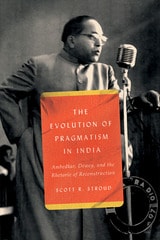
The Evolution of Pragmatism in India
Ambedkar, Dewey, and the Rhetoric of ReconstructionScott R. Stroud
University of Chicago Press, 2023
In The Evolution of Pragmatism in India, Scott R. Stroud delivers a comprehensive exploration of the influence of John Dewey’s pragmatism on Bhimrao Ambedkar, architect of the Republic of India’s constitution. Stroud traces Ambedkar’s development in Dewey’s Columbia University classes in 1913–1916 through his final years in 1950s India when he rewrote the story of Buddhism. Stroud examines pragmatism’s influence not only on the philosophical ideas underpinning Ambedkar’s fight against caste oppression but also how his persuasive techniques drew on pragmatism’s commitment to reconstruction and meliorism. At the same time, Stroud is careful to point out the ways that Ambedkar pushed back against Dewey’s paradigm and developed his own approach to challenges in India. The result is a nuanced study of one of the most important figures in Indian history.
The Force of Fantasy
Restoring the American DreamErnest G. Borman
Southern Illinois University Press, 2000
In this book, first published in 1985, Ernest G. Bormann explores mass persuasion in America from 1620 to 1860, examining closely four rhetorical communities: the revivals of 1739–1740, the hot gospel of the postrevolutionary period, the evangelical revival and reform of the 1830s, and the Free Soil and Republican parties. Each community varies greatly, but Bormann asserts that each succeeding community shares a rhetorical vision of restoring the “American Dream” that is essentially a modification of the previous visions. Thus, they form a family of rhetorical visions that constitutes a rhetorical tradition of importance in nineteenth-century American popular culture.
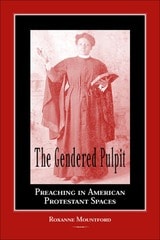
The Gendered Pulpit
Preaching in American Protestant SpacesRoxanne Mountford
Southern Illinois University Press, 2005
In this feminist investigation into the art of preaching—one of the oldest and least studied rhetorical traditions—Roxanne Mountford explores the relationship between bodies, space, race, and gender in rhetorical performance and American Protestant culture. Refiguring delivery and physicality as significant components of the rhetorical situation, The Gendered Pulpit: Preaching in American Protestant Spaces examines the strategies of three contemporary women preachers who have transgressed traditions, rearranged rhetorical space, and conquered gender bias to establish greater intimacy with their congregations.
Mountford’s examinations of the rhetoric inherent in preaching manuals from 1850 to the present provide insight into how “manliness” has remained a central concept in American preaching since the mid-nineteenth century. The manuals illustrate that the character, style, method of delivery, and theological purpose of preachers focused on white men and their cultural standing, leaving contemporary women preachers searching for ways to accommodate themselves to the physicality of preaching.
Three case studies of women preachers who have succeeded or failed in rearranging rhetorical space provide the foundation for the volume. These contemporary examples have important implications for feminist theology and also reveal the importance of gender, space, and bodies to studies of rhetoric in general. Mountford explores the geographies of St. John’s Lutheran Church and the preaching of Rev. Patricia O’Connor who reformed rhetorical space through the delivery of her sermons. At Eastside United Church of Christ, Mountford shows, Rev. Barbara Hill employed narrative style and prophetic utterance in the tradition of black preaching to address gender bias and institute change in her congregation. The final case study details the experiences of Pastor Janet Moore and her struggles at Victory Hills United Methodist Church, where the fractured congregation could not be united even with Pastor Moore’s focus on theological purpose and invention strategies.
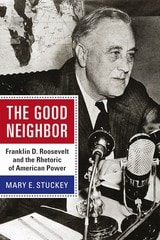
The Good Neighbor
Franklin D. Roosevelt and the Rhetoric of American PowerMary E. Stuckey
Michigan State University Press, 2013
No modern president has had as much influence on American national politics as Franklin D. Roosevelt. During FDR’s administration, power shifted from states and localities to the federal government; within the federal government it shifted from Congress to the president; and internationally, it moved from Europe to the United States. All of these changes required significant effort on the part of the president, who triumphed over fierce opposition and succeeded in remaking the American political system in ways that continue to shape our politics today. Using the metaphor of the good neighbor, Mary E. Stuckey examines the persuasive work that took place to authorize these changes. Through the metaphor, FDR’s administration can be better understood: his emphasis on communal values; the importance of national mobilization in domestic as well as foreign affairs in defense of those values; his use of what he considered a particularly democratic approach to public communication; his treatment of friends and his delineation of enemies; and finally, the ways in which he used this rhetoric to broaden his neighborhood from the limits of the United States to encompass the entire world, laying the groundwork for American ideological dominance in the post–World War II era.
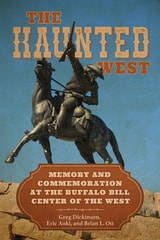
The Haunted West
Memory and Commemoration at the Buffalo Bill Center of the WestGreg Dickinson, Eric Aoki, and Brian L. Ott
University of Alabama Press, 2024
Through incisive analysis of the museum’s five institutions, Greg Dickinson and his coauthors reveal how narratives of Native American heritage, violent colonial settlement, Western art, natural history, and ever‑present gun culture collide to shape a haunted sense of American identity. By tracing the tensions between what is memorialized, what is mythologized, and what is suppressed, the authors expose the ghosts that linger in contemporary understandings of the West and offer a compelling rethinking of how memory and commemoration continue to influence the nation’s cultural imagination.
The Hermeneutics of Original Argument
Demonstration, Dialectic, RhetoricP. Christopher Smith
Northwestern University Press, 1998
The Homesick Phone Book
Addressing Rhetorics in the Age of Perpetual ConflictCynthia Haynes
Southern Illinois University Press, 2016
Terrorist attacks, war, and mass shootings by individuals occur on a daily basis all over the world. In The Homesick Phone Book, author Cynthia Haynes examines the relationship of rhetoric to such atrocities. Aiming to disrupt conventional modes of rhetoric, logic, argument, and the teaching of writing, Haynes illuminates rhetoric’s ties to horrific acts of violence and the state of perpetual conflict around the world, both in the Holocaust era and more recently.
Each chapter, marked by a physical address, functions as a kind of expanded phone book entry, with a discussion of violent events at a particular location giving way to explorations of larger questions related to rhetoric and violence. At the core of the work is Haynes’s call for a writing pedagogy based on abstraction that would allow students to appeal to emotional and ethical grounds in composing arguments. Written in a lyrical style, the book weaves rhetorical theories, poetics, philosophy, works of art, and personal experience into a complex, compelling, and innovative mode of writing.
Ultimately, The Homesick Phone Book demonstrates how scholars of rhetoric and writing studies can break their dependence on conventional argument and logic to discover what might be possible if we dive into and become lost within the very concepts and events that frighten and terrorize us.
The House of My Sojourn
Rhetoric, Women, and the Question of AuthorityJane S. Sutton
University of Alabama Press, 2010
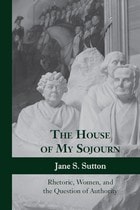
Employing the trope of architecture, Jane Sutton envisions the relationship between women and rhetoric as a house: a structure erected in ancient Greece by men that, historically, has made room for women but has also denied them the authority and agency to speak from within. Sutton’s central argument is that all attempts to include women in rhetoric exclude them from meaningful authority in due course, and this exclusion has been built into the foundations of rhetoric.
Drawing on personal experience, the spatial tropes of ancient Greek architecture, and the study of women who attained significant places in the house of rhetoric, Sutton highlights a number of decisive turns where women were able to increase their rhetorical access but were not able to achieve full authority, among them the work of Frances Wright, Lucy Stone, and suffragists Mott, Anthony, and Stanton; a visit to the 1893 World’s Columbian Exposition in Chicago, where the busts that became the Portrait Monument were displayed in the Woman’s Building (a sideshow, in essence); and a study of working-class women employed as telephone operators in New York in 1919.
With all the undeniable successes—socially, politically, and financially— of modern women, it appears that women are now populating the house of rhetoric as never before. But getting in the house and having public authority once inside are not the same thing. Sutton argues that women “can only act as far as the house permits.” Sojourn calls for a fundamental change in the very foundations of rhetoric.
The Idea of a Writing Laboratory
Neal Lerner
Southern Illinois University Press, 2009
The Idea of a Writing Laboratory is a book about possibilities, about teaching and learning to write in ways that can transform both teachers and students.
Author Neal Lerner explores higher education’s rich history of writing instruction in classrooms, writing centers and science laboratories. By tracing the roots of writing and science educators’ recognition that the method of the lab––hands-on student activity—is essential to learning, Lerner offers the hope that the idea of a writing laboratory will be fully realized more than a century after both fields began the experiment.
Beginning in the late nineteenth century, writing instructors and science teachers recognized that mass instruction was inadequate for a burgeoning, “non-traditional” student population, and that experimental or laboratory methods could prove to be more effective. Lerner traces the history of writing instruction via laboratory methods and examines its successes and failures through case studies of individual programs and larger reform initatives. Contrasting the University of Minnesota General College Writing Laboratory with the Dartmouth College Writing Clinic, for example, Lerner offers a cautionary tale of the fine line between experimenting with teaching students to write and “curing” the students of the disease of bad writing.
The history of writing within science education also wends its way through Lerner’s engaging work, presenting the pedagogical origins of laboratory methods to offer educators in science in addition to those in writing studies possibilities for long-sought after reform. The Idea of a Writing Laboratory compels readers and writers to “don those white coats and safety glasses and discover what works” and asserts that “teaching writing as an experiment in what is possible, as a way of offering meaning-making opportunities for students no matter the subject matter, is an endeavor worth the struggle.”
The Illusion of Equality
The Rhetoric and Reality of Divorce ReformMartha Albertson Fineman
University of Chicago Press, 1991
The Inclusive Work of Global Rhetorics
Moushumi Biswas
Utah State University Press, 2026
Envisioning the next step in the ongoing scholarly movement advocating inclusion of global rhetorics in the composition curriculum, The Inclusive Work of Global Rhetorics demonstrates that the question of why or whether to incorporate tenets of global/non-Western rhetorics into writing is long past. The focus has shifted to how to make this change—and to the best practices of such inclusion.
This book showcases the latest scholarship on rethinking the borders of traditional rhetorical studies, which are typically drawn within Greco-Roman and Euro-American confines, with the objective of incorporating non-Eurocentric rhetorical tenets into rhetoric and composition. This work fosters a spirit of inclusivity in the writing classroom by incorporating the many ways of rhetorical thinking gleaned from global/non-Western communication practices while also reflecting on their situatedness and intersectionalities.
Sitting at the crossroads of theory, methodology, and pedagogy, The Inclusive Work of Global Rhetoric puts in perspective a landmark moment in rhetorical studies, a time when it has become imperative to acknowledge the proliferation of non-Western rhetorical traditions in rhetorical practices and communication. Providing heuristics for creating inclusive composition/rhetoric pedagogy, this book serves students, teachers, scholars, and researchers of rhetoric, writing, and communication as both a classroom guide and a reference at the undergraduate and graduate level
The Insistent Call
Rhetorical Moments in Black Anticolonialism, 1929-1937Aric Putnam
University of Massachusetts Press, 2012
Throughout the nineteenth century, African heritage played an important role in black America, as personal memories and cultural practices continued to shape the everyday experience of people of African descent living under the shadow of slavery. Resisting efforts to de-Africanize their values, customs, and beliefs, Black Americans invoked their African roots in public arguments about their identity and place in the “new” world. At the outset of the twentieth century many still saw Africa primarily as the source of a common cultural and spiritual past. But after the 1920s, the meaning of African heritage changed as people of African descent expressed new relationships between themselves, the United States, and the African Diaspora.
In The Insistent Call, Aric Putnam studies the rhetoric of newspapers, literature, and political pamphlets that expressed this shift. He demonstrates that as people of African descent debated the United States' occupation of Haiti, the Liberian labor crisis, and the Italian invasion of Ethiopia, they formed a new collective identity, one that understood the African Diaspora in primarily political rather than cultural terms. In addition to uncovering a neglected period in the history of Black rhetoric, Putnam shows how rhetoric that articulates the interests of a population not defined by the boundaries of a state can still motivate collective action and influence policies.
The Kingdom Suffereth Violence
The Machiavelli / Erasmus / More Correspondence and Other Unpublished DocumentsPhilippe Bénéton
St. Augustine's Press, 2012
The Knowledge Most Worth Having
Edited by Wayne C. Booth
University of Chicago Press, 1967
The Language of Judges
Lawrence M. Solan
University of Chicago Press, 1993
Solan uses a wealth of examples to illustrate the way linguistics enters the process of judicial decision making: a death penalty case that the Supreme Court decided by analyzing the use of adjectives in a jury instruction; criminal cases whose outcomes depend on the Supreme Court's analysis of the relationship between adverbs and prepositional phrases; and cases focused on the meaning of certain words in the Constitution. Solan finds that judges often describe our use of language poorly because there is no clear relationship between the principles of linguistics and the jurisprudential goals that the judge wishes to promote.
A major contribution to the growing interdisciplinary scholarship on law and its social and cultural context, Solan's lucid, engaging book is equally accessible to linguists, lawyers, philosophers, anthropologists, literary theorists, and political scientists.
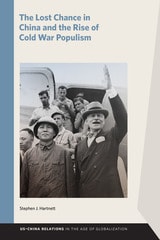
The Lost Chance in China and the Rise of Cold War Populism
Stephen J. Hartnett
Michigan State University Press, 2025
The Lyceum and Public Culture in the Nineteenth-Century United States
Angela G. Ray
Michigan State University Press, 2005
Angela Ray provides a refreshing new look at the lyceum lecture system as it developed in the United States from the 1820s to the 1880s. She argues that the lyceum contributed to the creation of an American "public" at a time when the country experienced a rapid change in land area, increasing immigration, and a revolution in transportation, communication technology, and social roles.
The history of the lyceum in the nineteenth century illustrates a process of expansion, diffusion, and eventual commercialization. In the late 1820s, a politically and economically dominant culture—the white Protestant northeastern middle class—institutionalized the practice of public debating and public lecturing for education and moral uplift. In the 1820s and 1830s, the lyceum was characterized by organized groups in cities and towns, particularly in the Northeast and the Old Northwest (now the Midwest). These groups were established to promote debate, to create a setting for study, and to provide a forum for members’ lecturing. By the 1840s and 1850s, however, most lyceums concentrated on the sponsorship of public lectures, presented for institutional profit as well as public instruction and entertainment. Eventually, lyceum lectures became a commercial enterprise and desirable platform for celebrities who wished to expand their incomes from lecturing.
The Managerial Unconscious in the History of Composition Studies
Donna Strickland
Southern Illinois University Press, 2011
The Managerial Unconscious in the History of Composition Studies is the first book to address the history of composition studies as a profession rather than focusing on its pedagogical theories and systems. Strickland questions why writing and the teaching of writing have been the major areas of scholarly inquiry in the field when specialists often work primarily as writing program administrators, not teachers.
Strickland traces the emergence of writing programs in the early twentieth century, the founding of two professional organizations by and for writing program administrators, and the managerial overtones of the “social turn” of the field during the 1990s. She illustrates how these managerial imperatives not only have provided much of the impetus for the growth of composition studies over the past three decades but also have contributed to the stratified workplaces and managed writing practices the field’s pedagogical research often decries.
The Managerial Unconscious in the History of Composition Studies makes the case that administrative work should not be separated from intellectual work, calling attention to the interplay between these two kinds of work in academia at large and to the pronounced hierarchies of contingent faculty and tenure-track administrators endemic to college writing programs. The result is a reasoned plea for an alternative understanding of the very mission of the field itself.
The Manufacture of Consent
J. Edgar Hoover and the Rhetorical Rise of the FBIStephen M. Underhill
Michigan State University Press, 2020
The Mark of Criminality
Rhetoric, Race, and Gangsta Rap in the War-on-Crime EraBryan J. McCann
University of Alabama Press, 2017
In The Mark of Criminality: Rhetoric, Race, and Gangsta Rap in the War-on-Crime Era, Bryan J. McCann argues that gangsta rap should be viewed as more than a damaging reinforcement of an era’s worst racial stereotypes. Rather, he positions the works of key gangsta rap artists, as well as the controversies their work produced, squarely within the law-and-order politics and popular culture of the 1980s and 1990s to reveal a profoundly complex period in American history when the meanings of crime and criminality were incredibly unstable.
At the center of this era—when politicians sought to prove their “tough-on-crime” credentials—was the mark of criminality, a set of discourses that labeled members of predominantly poor, urban, and minority communities as threats to the social order. Through their use of the mark of criminality, public figures implemented extremely harsh penal polices that have helped make the United States the world’s leading jailer of its adult population.
At the same time when politicians like Ronald Reagan, George H. W. Bush, and Bill Clinton and television shows such as COPS and America’s Most Wanted perpetuated images of gang and drug-filled ghettos, gangsta rap burst out of the hip-hop nation, emanating mainly from the predominantly black neighborhoods of South Central Los Angeles. Groups like NWA and solo artists (including Dr. Dre, Snoop Dogg, and Tupac Shakur) became millionaires by marketing the very discourses political and cultural leaders used to justify their war on crime. For these artists, the mark of criminality was a source of power, credibility, and revenue. By understanding gangsta rap as a potent, if deeply imperfect, enactment of the mark of criminality, we can better understand how crime is always a site of struggle over meaning. Furthermore, by underscoring the nimble rhetorical character of criminality, we can learn lessons that may inform efforts to challenge our nation’s failed policies of mass incarceration.
The Memoir of Ednah Shepard Thomas
Ednah Shepard Thomas
University Press of Colorado, 2017
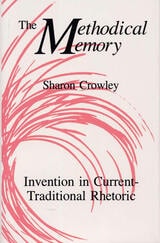
The Methodical Memory
Invention in Current-Traditional RhetoricSharon Crowley
Southern Illinois University Press, 1990
In this first sustained critique of current-traditional rhetorical theory, Sharon Crowley uses a postmodern, deconstructive reading to reexamine the historical development of current-traditional rhetoric. She identifies it (as well as the British new rhetoric from which it developed) as a philosophy of language use that posits universal principles of mind and discourse. Crowley argues that these philosophies are not appropriate bases for the construction of rhetorical theories, much less guides for the teaching of composition. She explains that current-traditional rhetoric is not a rhetorical theory, and she argues that its use as such has led to a misrepresentation of invention.
Crowley contends that current-traditional rhetoric continues to prosper because a considerable number of college composition teachers—graduate students, part-time instructors, and teachers of literature—are not involved in the development of the curricula they are asked to teach. As a result, their voices, necessary to create any true representation of the composition teaching experience, are denied access to the scholarly conversations evaluating the soundness of the institutionalized teaching methods derived from the current-traditional approach.

The Mirror in the Text
Lucien Dällenbach
University of Chicago Press, 1989
In this classic study, Lucien Dällenbach provides the first systematic analysis of this device and its literary and artistic applications from Van Eyck and Velasquez to Gide, Beckett and the French nouveau roman.
Alongside this wealth of examples, Dällenbach constructs his theoretical argument with elegance and clarity, assuming no previous knowledge of arcane and specialized theory, but guiding the reader helpfully through the maze of literary criticism. The result is a new conceptual field, a new grammar of the mise en abyme, and an examination of its function within the work of art and literature.
The highly original study has been acclaimed as one of the most important works of contemporary literary theory. It will be of interest to all students of English and European literature, as well as to students of the visual arts.
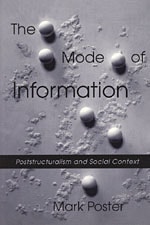
The Mode of Information
Poststructuralism and Social ContextMark Poster
University of Chicago Press, 1990
The difference, Mark Poster argues, is the profound effect electronic mediation exerts on the very way we perceive ourselves and reality. To help decode the linguistic dimensions of our multiple forms of social interaction, he plays upon Marx's theory of the mode of production—the shift to late capitalism has a parallel in the shift from the mode of production to that of information.
Enlisting poststructuralist theory, he links four modes of communication with four poststructuralists: TV ads with Baudrillard, data bases with Foucault, electronic writing with Derrida, and computer science with Lyotard. Mode of Information points the way to a poststructuralist strategy for writing history, a framework well suited to unearthing structures of domination and the means to their disruption.
"An informed, insightful, provocative account of phenomena that have transformed virtually every area of public and private life on our time."—Robert Anchor, American Historical Review
"The importance of Poster's book is unmistakable for he skillfully negotiates between and juxtaposes two wide theoretical domains—electronically mediated communications and poststructuralist theory—about which much has been written, but hardly with the acumen that he brings to bear in a long-awaited critical rapprochement."—Charles J. Stivale, Criticism
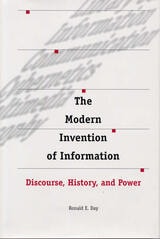
The Modern Invention of Information
Discourse, History, and PowerRonald E. Day
Southern Illinois University Press, 2008
In The Modern Invention of Information: Discourse, History, and Power, Ronald E. Day provides a historically informed critical analysis of the concept and politics of information. Analyzing texts in Europe and the United States, his critical reading method goes beyond traditional historiographical readings of communication and information by engaging specific historical texts in terms of their attempts to construct and reshape history.
After laying the groundwork and justifying his method of close reading for this study, Day examines the texts of two pre–World War II documentalists, Paul Otlet and Suzanne Briet. Through the work of Otlet and Briet, Day shows how documentation and information were associated with concepts of cultural progress. Day also discusses the social expansion of the conduit metaphor in the works of Warren Weaver and Norbert Wiener. He then shows how the work of contemporary French multimedia theorist Pierre Lévy refracts the earlier philosophical writings of Gilles Deleuze and Félix Guattari through the prism of the capitalist understanding of the “virtual society.”
Turning back to the pre–World War II period, Day examines two critics of the information society: Martin Heidegger and Walter Benjamin. He explains Heidegger’s philosophical critique of the information culture’s model of language and truth as well as Benjamin’s aesthetic and historical critique of mass information and communication. Day concludes by contemplating the relation of critical theory and information, particularly in regard to the information culture’s transformation of history, historiography, and historicity into positive categories of assumed and represented knowledge.
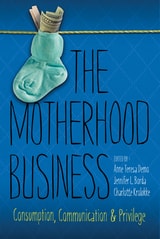
The Motherhood Business
Consumption, Communication, and PrivilegeEdited by Anne Teresa Demo, Jennifer L. Borda, and Charlotte Kroløkke
University of Alabama Press, 2015
Examining how motherhood, consumption, and privilege shape identities in contemporary culture.
The Motherhood Business is a piercing collection of ten original essays that reveal the rhetoric of the motherhood industry. Focusing on the consumer life of mothers and the emerging entrepreneurship associated with motherhood, the collection considers how different forms of privilege (class, race, and nationality) inform discourses about mothering, consumption, mobility, and leisure.
The Motherhood Business follows the harried mother’s path into the anxious maelstrom of intelligent toys, healthy foods and meals, and educational choices. It also traces how some enterprising mothers leverage cultural capital and rhetorical vision to create thriving baby- and child-based businesses of their own, as evidenced by the rise of mommy bloggers and “mompreneurs”over the last decade.
Starting with the rapidly expanding global fertility market, The Motherhood Business explores the intersection of motherhood, consumption, and privilege in the context of fertility tourism, international adoption, and transnational surrogacy. The synergy between motherhood and the marketplace demonstrated across the essays affirms the stronghold of “intensive mothering ideology” in decisions over what mothers buy and how they brand their businesses even as that ideology evolves. Across diverse contexts, the volume also identifies how different forms or privilege shape how mothers construct their identities through their consumption and entrepreneurship.
Although social observers have long commented on the link between motherhood and consumerism, little has been written within the field of rhetoric. Penetrating and interdisciplinary, The Motherhood Business illuminates how consumer culture not only shapes contemporary motherhood but also changes in response to mothers who constitute a driving force of the economy.

The Next New Madrid Earthquake
A Survival Guide for the MidwestWilliam Atkinson
Southern Illinois University Press, 1989
Scientists who specialize in the study of Mississippi Valley earthquakes say that the region is overdue for a powerful tremor that will cause major damage and undoubtedly some casualties.
The inevitability of a future quake and the lack of preparation by both individuals and communities provided the impetus for this book. Atkinson brings together applicable information from many disciplines: history, geology and seismology, engineering, zoology, politics and community planning, economics, environmental science, sociology, and psychology and mental health to provide the most comprehensive perspective to date of the myriad impacts of a major earthquake on the Mississippi Valley.
Atkinson addresses such basic questions as "What, actually, are earthquakes? How do they occur? Where are they likely to occur? Can they be predicted, perhaps even prevented?" He also addresses those steps that individuals can take to improve their chances for survival both during and after an earthquake.
The Nuclear Muse
Literature, Physics, and the First Atomic BombsJohn Canaday
University of Wisconsin Press, 2000
The O. J. Simpson Trials
Rhetoric, Media, and the LawEdited by Janice Schuetz and Lin S. Lilley
Southern Illinois University Press, 1999
The O. J. Simpson case captured the attention of the public like no other event in media history, and the Simpson criminal trial is arguably the most notable example of the media's ability to transform litigation. This collection of original essays provides a critical analysis of the Simpson criminal and civil trials. Edited by communications professor Janice Schuetz and professional trial consultant Lin S. Lilley, the book focuses on telelitigation, the media's transformation of sensational trials, with celebrity defendants and victims, into telemediated forms.
The contributors—Ann Burnett, Patricia M. Ganer, Ann M. Gill, Diane Furno-Lamude, Lin S. Lilley, and Janice Schuetz—describe media spectacles, analyze the opening statements of trial attorneys in both cases, investigate the testimony of Mark Fuhrman in the criminal trial and O. J. Simpson in the civil trial, analyze the summations of trial attorneys in both cases, look at the processes of jury decision making, and identify the unique legal and social outcomes of the trials.
The discussions focus on five "hot button" legal issues sparked by the Simpson trials: the perceived unfairness of the jury system; unprecedented calls for jury reform in both civil and criminal arenas; the fairness issues of jury nullification, wherein a jury disregards the law in a criminal case in favor of leniency; wealth and the question of "buying" justice; and ethical questions about the ways the Simpson trials were conducted, in particular the ways in which Simpson attorney Johnnie Cochran and the "Dream Team" repeatedly nudged and occasionally crossed the ethical line.
The Peace Script
Framing Violence in US Anti-War DissentDominic J. Manthey
University of Alabama Press, 2025
Exposes how appeals to civility, harmony, and nonaggression can unwittingly underpin exclusionary assumptions about race, gender, and class
Offering an innovative critique of peace rhetoric throughout US history, The Peace Script: Framing Violence in US Anti-War Dissent reexamines the language of dissent with lessons for our era defined by digital activism and fierce political debates. Dominic J. Manthey explores the peace arguments of various movements, including the Copperhead Movement during the Civil War, the Anti-Imperialist League’s stance against US colonialism, Henry Ford's Peace Ship expedition during World War I, the Mothers’ Movement during World War II, and the Vietnam Veterans against the War. Each chapter reveals how these movements, while advocating for peace, often upheld or encouraged racial, gender, and class inequalities.
Manthey navigates the complex terrain of grassroots activism by blending rhetorical criticism and historical insight to tell readers about the “peace script” that has echoed across America’s many wars. Through archival materials and case studies, The Peace Script reveals how anti-war movements craft compelling narratives that dramatize society through heroes, antagonists, and transformative ideals.
Redefining the struggle for peace as not only a fight against warfare but also a battle over space, identity, and the right to live with dignity, The Peace Script is essential for scholars of history, rhetoric, and social justice. Manthey provides a crucial perspective on the intersection of race, memory and power, offering urgent insights into how these legacies continue to shape society today.
The Philosophy of Rhetoric
George Campbell. Edited by Lloyd F. Bitzer
Southern Illinois University Press, 1988
Bitzer shows that, by attempting to elaborate a general theory of rhetoric through empirical procedures, Campbell’s project reveals the limitations of his method. He cannot ground all statements empirically and it is at this point that his theological position comes into play. Inspection of his religious views shows that God’s design of human nature, and God’s revelations to humankind, make moral and spiritual truths known and quite secure to human beings, although not empirically.
The Philosophy, Theology, and Rhetoric of Marius Victorinus
Stephen A. Cooper
SBL Press, 2022
Pagan rhetor, (Neo-)Platonist philosopher, Christian theologian
This collection of essays is devoted to the rhetoric, Neoplatonic philosophy, and Christian theology of Marius Victorinus, a mid-fourth-century professor of rhetoric and philosopher who converted to Christianity late in life. Scholars from eight different countries, some of whom have not previously published in English, reflect on debates about his writings and theological development. These topics include Victorinus's deployment of philosophical sources for trinitarian theology, possible connections in his work to Origen, Augustine, Plotinus, Porphyry, and Gnosticism, as well as his contributions to Latin rhetoric and dialectic. Contributors include Jan Dominik Bogataj, Michael Chase, Nello Cipriani, Stephen A. Cooper, Volker Henning Drecoll, Lenka Karfíková, Josef Lössl, Václav Němec, Thomas Riesenweber, Guadalupe Lopetegui Semperena, Miran Špelič, Chiara O. Tommasi, John D. Turner, and Florian Zacher. The chapters in this volume are of great interest to students of late antique philosophy, Christian theology, and Latin rhetoric.
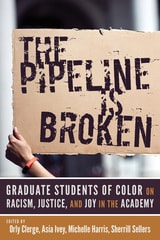
The Pipeline Is Broken
Graduate Students of Color on Racism, Justice, and Joy in the AcademyOrly Clerge
Utah State University Press, 2026
The Pipeline Is Broken explores the reality of racial exclusion and bias in graduate student education, arguing that the insidious effects of structural and institutional racism substantially chip away at the very pipeline of future BIPOC academics—already limited for other racialized reasons.
A series of letters written by graduate students of color, this collection offers a multifaceted account of the challenges, oppositions, microaggressions, and outright discrimination that these students face in higher education settings. Graduate students describe navigating hostile mentoring relationships and unwelcoming campus cultures and peers and laboring for poverty wages to earn their degrees. Yet these letters celebrate joy, community, and agency, offering a more complete and affirming view of graduate student life. Through these brave personal stories, The Pipeline Is Broken asks readers to interrogate what it means to navigate higher education as a person of color and to understand that the reality of faculty of color’s numerical-minority status is a complicated phenomenon whose genesis rests not at the moment of job interview. Rather, these letters show, this status is an intricate manifestation of a process that begins in elementary schools, is reinforced in high schools and colleges, and is part and parcel of the minefield that is graduate education in America.
Essential reading for anyone who cares about racial equity in education, mentorship, leadership development, or student well-being, The Pipeline Is Broken is a guide, a mirror, and a call to action all in one, challenging graduate programs, faculty, and administrators to examine their complicity in maintaining inequitable systems and offering suggestions for building cultures of care.
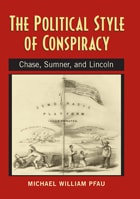
The Political Style of Conspiracy
Chase, Sumner, and LincolnMichael William Pfau
Michigan State University Press, 2005
The turbulent history of the United States has provided a fertile ground for conspiracies, both real and imagined. From the American Revolution to the present day, conspiracy discourse—linguistic and symbolic practices and artifacts revolving around themes, claims, or accusations of conspiracy—has been a staple of political rhetoric. Some conspiracy theories never catch on with the public, while others achieve widespread popularity. Whether successful or not, the means by which particular conspiracy theories spread is a rhetorical process, a process in which persuasive language, symbolism, and arguments act upon individual minds within concrete historical and political settings.
Conspiracy rhetoric was a driving force in the evolution of antebellum political culture, contributing to the rise and fall of the great parties in the nineteenth century. One conspiracy theory in particular—the "slave power" conspiracy—was instrumental in facilitating the growth of the young Republican Party's membership and ideology. The Political Style of Conspiracy analyzes the concept and reality of the "slave power" in the rhetorical discourse of the mid-nineteenth-century, in particular the speeches and writing of politicians Salmon P. Chase, Charles Sumner, and Abraham Lincoln. By examining their mainstream texts, Pfau reveals that, in addition to the "paranoid style" of conspiracy rhetoric that inhabits the margins of political life, Lincoln, Chase, and Sumner also engaged in a distinctive form of conspiracy rhetoric that is often found at the center of mainstream American society and politics.
The Politics of Pain Medicine
A Rhetorical-Ontological InquiryS. Scott Graham
University of Chicago Press, 2015
In The Politics of Pain Medicine: A Rhetorical-Ontological Inquiry, S. Scott Graham offers a rich and detailed exploration of the medical rhetoric surrounding pain medicine. Graham chronicles the work of interdisciplinary pain management specialists to found a new science of pain and a new approach to pain medicine grounded in a more comprehensive biospychosocial model. His insightful analysis demonstrates how these materials ultimately shape the healthcare community’s understanding of what pain medicine is, how the medicine should be practiced and regulated, and how practitioner-patient relationships are best managed. It is a fascinating, novel examination of one of the most vexing issues in contemporary medicine.
The Politics of the Superficial
Visual Rhetoric and the Protocol of DisplayBrett Ommen
University of Alabama Press, 2016
Ommen argues, for example, that on viewing a billboard, a driver isn’t merely being exposed to a set of commercial messages or exhortations, but rather responding in a self-aware way that differentiates her from her collective associations like Democrat, Republican, rich, poor, Catholic, or Jewish.
By examining graphic design—as a profession, practice, and academic field—as the nexus for understanding visual display in public culture, The Politics of the Superficial develops two arguments about contemporary visual communication practices: first, that the study of visual communication privileges visual content at the expense of other dynamics, such as context; and second, that interpretations focusing on content conceal the most persuasive and subversive dimensions of the visual.
Wide-ranging and stimulating, The Politics of the Superficial ultimately posits that, far from serving as a communal oasis for public imagination, contemporary visual culture offers the possibility for politically engaged communication and persuasion while simultaneously threatening the health of public discourse by atomizing its constituent parts. It will serve as a vital contribution to the field of visual rhetoric.
The Power of Writing
Dartmouth '66 in the Twenty-First CenturyEdited by Christiane Donahue and Kelly Blewett
Dartmouth College Press, 2015
The Practice of Rhetoric
Poetics, Performance, PhilosophyEdited by Debra Hawhee and Vessela Valiavitcharska
University of Alabama Press, 2022
Essays that show what a broad conception of rhetoric means and does in relation to practice
Rhetoric is the art of emphasis, in the ancient sense of bringing to light or obscuring in shadow, and it is both a practice and a theory about that practice. In recent decades, scholars of rhetoric have turned to approaches that braid together poetics, performance, and philosophy into a “practical art.” The Practice of Rhetoric: Poetics, Performance, Philosophy presents just such an account of rhetoric that presumes and incorporates theoretical approaches, offering a collection of principles assembled in the heat and trials of public practice. The essays gathered in this volume are inspired by the capacious conception of rhetoric put forth by historian of rhetoric Jeffrey Walker, who is perhaps best known for stressing rhetoric’s educational mission and its investments in both theory and practice.
The book extends that vision through the prisms of poetics, performance, and philosophy of argument. Poetics shows rhetoric’s meaning making in all its verbal possibilities and material manifestations, in contexts ranging from mouse-infested medieval fields to the threat of toxin-ridden streams in the twentieth century. Performance puts what is created into the heat of public life, tapping out the rhythms of Byzantine prose or using collage to visually depict the beliefs and convictions of Martin Luther King Jr. Philosophy of argument enacts the mutually constitutive relationship between rhetoric and dialectic, offering new insights on and contexts for old tools like stasis and disputation, while keeping the focus on usefulness and teachability.
Ranging across centuries and contexts, the essays collected here demonstrate the continued need to attend carefully to the cooperation of descriptive language and normative reality, conceptual vocabulary and material practice, public speech and moral self-shaping. This volume will rekindle long-standing conversations about the public, world-making practice of rhetoric, thereby enlivening anew its civic mission.
The Present State of Scholarship in the History of Rhetoric
A Twenty-First Century GuideEdited by Lynée Lewis Gaillet & Winifred Bryan Horner
University of Missouri Press, 2010
Adopting research methodologies of revision and recovery, this latest edition includes all new material while still following the format of the original and is constructed around bibliographical surveys of both primary and secondary works addressing the Classical, Medieval, Renaissance, and eighteenth through twentieth century periods within the history of rhetoric. The Present State of Scholarship in the History of Rhetoric doesn’t simply update but rather recasts study in the history of rhetoric.
The authors—experienced and well-known scholars in their respective fields—redefine existing strands of rhetorical study within the periods, expand the scope of rhetorical engagement, and include additional figures and their works. The globalization and expansion of rhetoric are demonstrated in each of these parts and seen clearly in the inclusion of more female rhetors, discussions of historical and contemporary electronic resources, and examinations of rhetorical practices falling outside the academy and the traditional canon.
As programs incorporating rhetorical studies continue to expand at the university level, students and researchers are in need of up-to-date bibliographical resources. No other work matches the scope and approach of The Present State of Scholarship in the History of Rhetoric, which carries scholarship on rhetoric into the twenty-first century.
The Prettier Doll
Rhetoric, Discourse, and Ordinary DemocracyEdited by Karen Tracy, James P. McDaniel and Bruce E. Gronbeck
University of Alabama Press, 2007
The Promise of Reason
Studies in The New RhetoricEdited by John T. Gage
Southern Illinois University Press, 2011
Divided into four sections—Conceptual Understandings of The New Rhetoric, Extensions of The New Rhetoric, The Ethical Turn in Perelman and The New Rhetoric, and Uses of The New Rhetoric—this insightful volume covers a wide variety of topics. It includes general assessments of The New Rhetoric and its central concepts, as well as applications of those concepts to innovative areas in which argumentation is being studied, such as scientific reasoning, visual media, and literary texts. Additional essays compare Perelman’s ideas with those of other significant thinkers like Kenneth Burke and Richard McKeon, explore his career as a philosopher and activist, and shed new light on Perelman and Olbrechts- Tyteca’s collaboration. Two contributions present new scholarship based on recent access to letters, interviews, and archival materials housed in the Université Libre de Bruxelles. Among the volume’s unique gifts is a personal memoir from Perelman’s daughter, Noémi Perelman Mattis, published here for the first time.
The Promise of Reason, expertly compiled and edited by John T. Gage, is the first to investigate the pedagogical implications of Perelman and Olbrechts- Tyteca’s groundbreaking work and will lead the way to the next generation of argumentation studies.
The Prose of Things
Transformations of Description in the Eighteenth CenturyCynthia Sundberg Wall
University of Chicago Press, 2006
In The Prose of Things, Wall analyzes literary works in the contexts of natural science, consumer culture, and philosophical change to show how and why the perception and representation of space in the eighteenth-century novel and other prose narratives became so textually visible. Wall examines maps, scientific publications, country house guides, and auction catalogs to highlight the thickening descriptions of domestic interiors. Considering the prose works of John Bunyan, Samuel Pepys, Aphra Behn, Daniel Defoe, Samuel Richardson, David Hume, Ann Radcliffe, and Sir Walter Scott, The Prose of Things is the first full account of the historic shift in the art of describing.
The Radical Case for Teaching Skim Reading in First-Year Writing
Ellen C. Carillo
Utah State University Press, 2025
Data from studies of the lived experiences of undergraduates indicate that students do not need deep reading practices in the majority of their classes across the disciplines and, moreover, that students succeed in their classes by skim reading. Rather than imagining an idealized set of circumstances that allow for sustained deep reading, as does a great deal of the scholarship on reading in writing studies, The Radical Case for Teaching Skim Reading in First-Year Writing argues for teaching students reading practices that will support their success in their college writing assignments rather than those strategies the field believes should support their success.
In our information landscape and our fragile democracy, encouraging skimming as opposed to deep reading may seem like a gamble—this very tendency toward the quick rather than the critical has undoubtedly contributed to the current crisis of mass misinformation. However, teaching students to use skim reading as a strategic tool for purposeful engagement and efficient yet thoughtful information filtering better equips them to navigate the rapidly changing information landscape and manage the fast-paced flow of content from diverse media sources.
The Rhetoric of Abraham's Faith in Romans 4
Andrew Kimseng Tan
SBL Press, 2018
Explore Romans 4 from a sociorhetorical perspective
Andrew Kimseng Tan examines Romans using sociorhetorical interpretation to determine how Paul attempted to alleviate dissension between Judean (or “Jewish”) and non-Judean (or “gentile”) Christians. Through his analysis of Paul’s rhetoric, Tan reveals that Paul used Abraham’s faith in Genesis to demonstrate that the both groups were equally children and heirs of Abraham whose acceptance by God was through the same kind of faith that Abraham possessed, not through the Mosaic law, which Judean Christians claimed gave them a special honored status with God.
Features
- A model for the application of sociorhetorical interpretation for analyzing close readings of biblical texts
- A demonstration of the persuasive power of Romans 4 through the use of sociorhetorical interpretation
- Exploration of the relationships between important theological topics such as resurrection, the Mosaic law, the Holy Spirit, righteousness, ethical living, and eschatological salvation
The Rhetoric of Blair, Campbell, and Whately, Revised Edition
James L. Golden and Edward P. J. Corbett
Southern Illinois University Press, 1990
Hugh Blair, George Campbell, and Richard Whately, whose works were first published in the late 18th and early 19th centuries, constituted the great triumvirate of British Rhetoricians. For 20 years, earlier printings of this book, which contains substantial excerpts comprising the most significant portions of their writings, have been widely used as textbooks in history-of-rhetoric courses. An increasing interest in rhetoric at the college level has created a renewed demand for reprints of such classic primary texts.
The Preface places the three rhetoricians within the context of the rhetorical tradition, which began in 5th-century BCE Greece. The bibliographies have been updated to include 20th-century scholarly work on Blair, Campbell, and Whately, and on the 18th- and 19th-century rhetorical movement. Biographical sketches of Blair, Campbell, and Whately are also provided.
The Rhetoric of Church and State
A Critical Analysis of Religion Clause JurisprudenceFrederick Mark Gedicks
Duke University Press, 1995
Gedicks suggests that the Supreme Court’s inconsistent decisions mirror a divergence in American society between an increasingly secular public culture and the primarily devout private lives of the majority of Americans. He notes that while the Court is committed to principles of secular individualism, it has repeatedly endorsed government actions that violate those principles—actions that would be far more justifiable under the discourse of religious communitarianism. The impossibility of reconciling the two discourses leaves the Court no choice but to efface—often implausibly—the religious nature of practices it deems permissible. Gedicks concludes that the road to a coherent religion clause doctrine lies neither in a return to religious communitarianism nor in its complete displacement by secular individualism, but in a yet-to-be-identified discourse that would attract popular support while protecting a meaningful measure of religious freedom.