Results by title
288 books match the query 'Rise' and 95 start with t
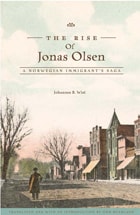
The Rise of Jonas Olsen
A Norwegian Immigrant’s SagaJohannes Wist
University of Minnesota Press, 2005
The Rise of Jonas Olsen is at once an immigrant novel, business novel, political novel, and a western, offering a rich and panoramic view of Scandinavian immigrant life in the Upper Midwest. Wist combines realism and satire to depict the role Norwegian Americans played in the economic, political, and cultural life of the Upper Midwest.
Originally published serially in the Norwegian-language newspaper the Decorah Posten in the 1920s, The Rise of Jonas Olsen illustrates an immigrant’s struggle to preserve his identity and heritage while striving to become fully accepted as an American.
Johannes B. Wist (1864–1923) was a journalist and editor of the Decorah Posten from 1900 to 1923.
Orm Øverland is professor of American literature at the University of Bergen, Norway, and the author of The Western Home: A Literary History of Norwegian America and Immigrant Minds, American Identities: Making the United States Home, 1870-1930.
Todd W. Nichol is editor of the Norwegian-American Historical Association publication program.
Published in cooperation with the Norwegian-American Historical Association.
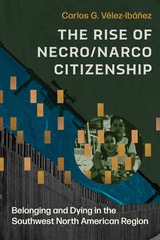
The Rise of Necro/Narco Citizenship
Belonging and Dying in the Southwest North American RegionCarlos G. Vélez-Ibáñez
University of Arizona Press, 2025
Carlos G. Vélez-Ibáñez’s latest work, The Rise of Necro/Narco Citizenship investigates the intricate and often harrowing dynamics that define the borderlands between the United States, Mexico, and beyond. This groundbreaking book provides a comprehensive cultural, economic, social, and political-ecological analysis, illustrating how various forms of violence and militarization have reshaped the daily lives and identities of the region’s inhabitants. Through meticulous ethnographic fieldwork, extensive archival research, and rigorous statistical data, Vélez-Ibáñez exposes the deeply entrenched networks of exploitation and conflict that have emerged in response to global capitalism’s pressures.
Vélez-Ibáñez builds on theorization about necrocitizenship to introduce the concept of necro/narco citizenship, which argues that pervasive violence and socioeconomic disruptions create a unique form of existence on both sides of the border. The author examines the dislocation of thousands, the persistent threat of violence, and the ways in which these forces compel individuals to navigate a reality steeped in addiction, self-destruction, and civil deterioration. This book reveals the transnational networks and the morally compromised political economies that sustain them, offering readers an unflinching look at the cost of survival in this tumultuous region.
This essential volume is not only a critical addition to the field of anthropology but also an invaluable resource for those interested in the sociopolitical landscape of the U.S.-Mexico border. Vélez-Ibáñez’s insights will resonate with scholars, students, and policymakers alike. The Rise of Necro/Narco Citizenship challenges us to rethink the narratives of violence, militarization, and resistance that define our understanding of the Southwest North American Region.

The Rise of Nerd Politics
Digital Activism and Political ChangeJohn Postill
Pluto Press, 2018
Drawing from long-term ethnographic research in Spain, Indonesia and Malaysia--as well as empirical examples from the United States, Iceland, Taiwan and further afield--Postill tracks the rise of technology "nerds" as a new transnational class of political brokers with growing influence. The book identifies and explores four domains of "nerd politics" that have experienced a dramatic expansion since 2010: digital rights, data activism, social protest, and institutional politics.
A lively and engaging intervention at the conjuncture of anthropology, media studies, and sociology, this book offers a pertinent reflection on the future of political change in the digital age.
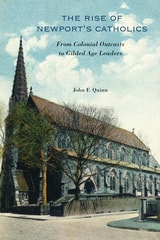
The Rise of Newport’s Catholics
From Colonial Outcasts to Gilded Age LeadersJohn F. Quinn
University of Massachusetts Press, 2024
Honorable Mention, 2025 Catholic Media Association Book Awards
Nineteenth-century New England was a hostile place for Catholics. In Massachusetts a mob torched a convent; in Maine a priest was tarred and feathered; and Rhode Island elected an anti-Catholic Know Nothing governor. “No Irish Need Apply” signs were common.
Newport was different. It was a religiously diverse and tolerant city that welcomed Catholic French troops during the American Revolution. Later, as it became the favored summer retreat for America’s Protestant social elite, Irish Catholics arrived to work in construction jobs, the tourist economy, and the grand Gilded Age cottages. By the end of the century, Newport’s Catholic community was flourishing. Moneyed Catholics acquired their own mansions, an Irish Catholic was mayor, and prominent Protestants were helping Catholic neighbors establish new schools and churches. In this deeply researched study, John F. Quinn delves into this rich Catholic history to discover why nineteenth-century Newport was particularly religiously tolerant and accepting.
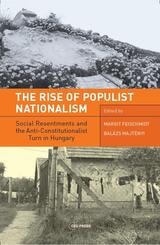
The Rise of Populist Nationalism
Social Resentments and Capturing the Constitution in HungaryBalázs Majtényi
Central European University Press, 2020
The Rise of Roosevelt University
Presidential ReflectionsTheodore L. Gross
Southern Illinois University Press, 2005
Underscoring professional and educational issues pertinent to higher learning at universities across the country, Theodore L. Gross’s memoir of his years in academia chronicles his successful fourteen-year presidency at Chicago’s Roosevelt University, a period of leadership that resulted in an upsurge of fund-raising, sharp increases in enrollment and endowment, and the transformation of an urban campus into a metropolitan university.
Beginning with a description of his childhood and adolescent education and experiences, Gross recalls his years as a faculty member and academic administrator at the City College of New York from 1958 to 1978, when the college was moving from selective admissions to open enrollment. He also served in administrative positions at Penn State University and SUNY Purchase before accepting the Roosevelt presidency in 1988. Focusing on the tension between the promise of open admissions and aspirations of academic excellence, The Rise of Roosevelt University: Presidential Reflections relates Gross’s perceptions of the failure of open admissions at CCNY and his resolution to learn from those mistakes while at Roosevelt.
Drawing on private correspondence and conversations, essays, university documents, and other archival materials and research, Gross re-creates the highs and lows of his quest to make Roosevelt distinctive. His strategic plan included the appointment of senior executives and deans, the creation of a performing arts conservatory, the development of an educational alliance with other universities, online instruction, an honors program, a Chicago School of Real Estate, an MBA for Chinese students, the Partners in Corporate Education program, and the implementation of a second comprehensive campus. He describes the creation of the Albert A. Robin campus in Schaumburg and the realization of Roosevelt as a metropolitan university, creating a vivid portrait of the suburban culture, the educational context of large community colleges throughout the northwest suburbs, the development of a community advisory board that helped secure funds, and the improved morale of faculty and administration.
Gross’s fund-raising efforts increased the endowment from $3 million to $33 million, and a capital campaign surpassed the goal of $45 million. In this volume, he describes meetings with major donors, the successes and failures of contributions, and the development of greater alumni support in the context of fund-raising throughout Chicago. He also analyzes the highly publicized legal dispute between the Auditorium Theatre Council and Roosevelt University over ownership of the world renowned theatre, pointing out how the case epitomizes issues that all universities confront: the university’s need to control its entities, detrimental publicity, sectional and regional conflicts, and a split in the arts community. Throughout this narrative, Gross juxtaposes his personal life and professional career, dramatizing how the two are related.
More than a retelling of anecdotes and statistics, the volume provides a rare perspective on the intersection of higher education and politics in Chicago. Gross analyzes the different public and private universities in the city and in surrounding Cook County to describe their relationships with ethnicity, religion, class, and with city hall. He also covers the Daley political machine’s influence on higher education, the politics of university governance, the spectacular growth of the western suburbs, and city versus suburban identities.
A personal road map of the development of higher education through the post–World War II decades, The Rise of Roosevelt University: Presidential Reflections mirrors the social climate that affected the country’s universities at large, from the open admissions policies and student rebellions of the ’60s and ’70s, to the urban blight and suburban sprawl of the ’80s, to the strategic planning and expansion of the ’90s and the new century. The result is a captivating account of the issues involved in presidential transition and leadership, the strategic development of metropolitan universities, and the future role of Roosevelt and similar institutions.
The Rise of Spanish-Language Filmmaking
Out from Hollywood's Shadow, 1929-1939Jarvinen, Lisa
Rutgers University Press, 2012
Silent film was universally understood and could be exported anywhere. But when “talkies” arrived, the industry began experimenting with dubbing, subtitling, and dual track productions in more than one language. Where language fractured the European film market, for Spanish-speaking countries and communities, it created new opportunities. In The Rise of Spanish-Language Filmmaking, Lisa Jarvinen focuses specifically on how Hollywood lost ground in the lucrative international Spanish-speaking audience between 1929 and 1939.
Hollywood studios initially trained cadres of Spanish-speaking film professionals, created networks among them, and demonstrated the viability of a broadly conceived, transnational, Spanish-speaking film market in an attempt to forestall the competition from other national film industries. By the late 1930s, these efforts led to unintended consequences and helped to foster the growth of remarkably robust film industries in Mexico, Spain, and Argentina. Using studio records, Jarvinen examines the lasting effects of the transition to sound on both Hollywood practices and cultural politics in the Spanish-speaking world. She shows through case studies based on archival research in the United States, Spain, and Mexico how language, as a key marker of cultural identity, led to new expectations from audiences and new possibilities for film producers.
The Rise of Trump
America's Authoritarian SpringMatthew C. MacWilliams
Amherst College Press, 2016

The Rise of West Coast Philanthropy
A History of the Hewlett and Packard FoundationsAsher Orkaby and Tim Mueller
University of Chicago Press, 0
The first full-length history of the Hewlett and Packard foundations and how they were at the forefront of the emergence of a distinctive West Coast approach toward giving.
A new generation of mega-wealthy tech tycoons purported to upend the twenty-first-century practice of philanthropy, but pioneering tech entrepreneurs William Hewlett and David Packard, the co-founders of the Hewlett-Packard Company, had already begun the process four decades earlier. The Rise of West Coast Philanthropy follows Silicon Valley’s first generation of philanthropists and how their work helped establish West Coast philanthropy as a major global force.
Drawing on unprecedented access to archival records and interviews with over 115 philanthropy leaders and insiders around the world, authors Asher Orkaby and Tim Mueller uncover the previously untold histories of the foundations established by William and Flora Hewlett and David and Lucile Packard, two of America’s most famous power couples. Through their foundations, these two families introduced philanthropic trends later echoed by philanthropies on both the West and East Coasts, demonstrating a successful adaptation of the management principles that first made HP a model company. The Rise of West Coast Philanthropy explores more than sixty years of Hewlett and Packard grant-making, from early family enterprises with local ambitions to major regional, national, and international powerhouses.
In telling this story, Orkaby and Mueller offer a fresh perspective on the distinctive model of West Coast philanthropy, which has been crucial in shaping the twenty-first-century global philanthropic landscape.
The Rise of Women Farmers and Sustainable Agriculture
Carolyn Sachs, Mary Barbercheck, Kathryn Braiser, Nancy Ellen Kiernan, Anna Rachel Terman
University of Iowa Press, 2016
Pulling down the barriers that women face requires organizations and institutions to become informed by what the authors call a feminist agrifood systems theory (FAST). This framework values women’s ways of knowing and working in agriculture: emphasizing personal, economic, and environmental sustainability, creating connections through the food system, and developing networks that emphasize collaboration and peer-to-peer education. The creation and growth of a specific organization, the Pennsylvania Women’s Agricultural Network, offers a blueprint for others seeking to incorporate a feminist agrifood systems approach into agricultural programming. The theory has the potential to shift how farmers, agricultural professionals, and anyone else interested in farming think about gender and sustainability, as well as to change how feminist scholars and theorists think about agriculture.
The Rise of Women
The Growing Gender Gap in Education and What it Means for American SchoolsThomas A. DiPrete
Russell Sage Foundation, 2013
The Rise of the African Novel
Politics of Language, Identity, and OwnershipMukoma Wa Ngugi
University of Michigan Press, 2018
Calling it a major crisis in African literary criticism, Mukoma Wa Ngugi considers key questions around the misreading of African literature: Why did Chinua Achebe’s generation privilege African literature in English despite the early South African example? What are the costs of locating the start of Africa’s literary tradition in the wrong literary and historical period? What does it mean for the current generation of writers and scholars of African literature not to have an imaginative consciousness of their literary past?
This book will become a foundational text in African literary studies, as it raises questions about the very nature of African literature and criticism. It will be essential reading for scholars of African literary studies as well as general readers seeking a greater understanding of African literary history and the ways in which critical consensus can be manufactured and rewarded at the expense of a larger and historical literary tradition.
The Rise of the American Conservation Movement
Power, Privilege, and Environmental ProtectionDorceta E. Taylor
Duke University Press, 2016
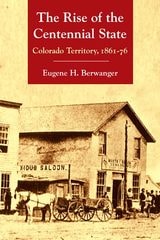
The Rise of the Centennial State
Colorado Territory, 1861-76Eugene H. Berwanger
University of Illinois Press, 2006
A vivid description of Colorado’s beginnings
This is the first single-volume history of the Colorado territory, encompassing the entire territorial period from the beginning of the Civil War to 1876, when Colorado became a state. The Rise of the Centennial State traces the growth of the territory as new technologies increased mining profits and as new modes of transportation--especially the Union Pacific and Kansas Pacific railroads--opened the territory to eastern markets, bringing waves of settlers to farm, ranch, and establish new communities.
Eugene H. Berwanger's history is packed with colorful characters and portraits of sprawling, brawling frontier and mining towns from Denver to Central City. He presents a multifaceted discussion of Colorado's resurgence after the war, with rich discussions of the role of minorities in the territory’s development: Indian-white relations (including discussions of now forgotten battles of Beecher’s Island and Summit Springs, which destroyed the Indians’ hold on the Colorado Plains); the social segregation of blacks in Denver; and Mexican Americans’ displeasure at being separated from the Hispano culture of New Mexico. Berwanger also demonstrates the decisive role of Colorado’s admission to statehood in swinging the disputed presidential election of 1876 to the Republican candidate, Rutherford B. Hayes.
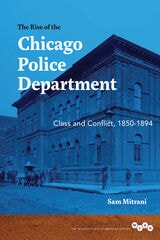
The Rise of the Chicago Police Department
Class and Conflict, 1850-1894Sam Mitrani
University of Illinois Press, 2013
In this book, Sam Mitrani cogently examines the making of the police department in Chicago, which by the late 1800s had grown into the most violent, turbulent city in America. Chicago was roiling with political and economic conflict, much of it rooted in class tensions, and the city's lawmakers and business elite fostered the growth of a professional municipal police force to protect capitalism, its assets, and their own positions in society. Together with city policymakers, the business elite united behind an ideology of order that would simultaneously justify the police force's existence and dictate its functions.
Tracing the Chicago police department's growth through events such as the 1855 Lager Beer riot, the Civil War, the May Day strikes, the 1877 railroad workers strike and riot, and the Haymarket violence in 1886, Mitrani demonstrates that this ideology of order both succeeded and failed in its aims. Recasting late nineteenth-century Chicago in terms of the struggle over order, this insightful history uncovers the modern police department's role in reconciling democracy with industrial capitalism.
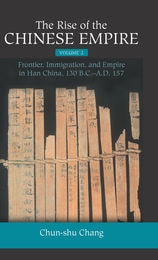
The Rise of the Chinese Empire
Frontier, Immigration, and Empire in Han China, 130 B.C.-A.D.157Chun-shu Chang
University of Michigan Press, 2007
The second and first centuries B.C. were a critical period in Chinese history—they saw the birth and development of the new Chinese empire and its earliest expansion and acquisition of frontier territories.
But for almost two thousand years, because of gaps in the available records, this essential chapter in the history was missing. Fortunately, with the discovery during the last century of about sixty thousand Han-period documents in Central Asia and western China preserved on strips of wood and bamboo, scholars have been able, for the first time, to put together many of the missing pieces.
In this second volume of his monumental history, Chun-shu Chang provides the first systematic reconstruction of the history of the acquisitions and colonization undertaken by the Chinese empire. In never before seen detail, Chang discusses the actions taken by the Chinese empire to develop the Han frontier: the government promoted massive immigration to the newly conquered virgin land; an innovative and complex garrison system was created; and civil institutions and a land system, as well as a regular imperial administration, were established over the region. Chang investigates the long and massive campaigns of the Han territorial expansion movement, considers the impact of early nation-building, and explores the formation and growth of the Chinese empire and its changing national identity. Chang’s comprehensive reconstruction of ancient and early Imperial Chinese history, based on literary, archaeological, and recently discovered ancient texts and classics, reveals the process and mechanics of the Han frontier development through an innovative and complex system of colonization, the core mechanics of the Han empire-building enterprise.
Chun-shu Chang is Professor of History at the University of Michigan and is the author, with Shelley Hsueh-lun Chang, of Crisis and Transformation in Seventeenth-Century China and Redefining History: Ghosts, Spirits, and Human Society in P’u Sung-ling’s World, 1640 – 1715.
"An extraordinary survey of the political and administrative history of early imperial China, which makes available a body of evidence and scholarship otherwise inaccessible to English-readers. The underpinning of research is truly stupendous.”
—Ray Van Dam, Professor, Department of History, University of Michigan
“Powerfully argues from literary and archaeological records that empire, modeled on Han paradigms, has largely defined Chinese civilization ever since.”
—Joanna Waley-Cohen, Professor, Department of History, New York University
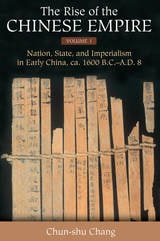
The Rise of the Chinese Empire
Nation, State, and Imperialism in Early China, ca. 1600 B.C.-A.D. 8Chun-shu Chang
University of Michigan Press, 2006
The second and first centuries B.C. were a critical period in Chinese history—they saw the birth and development of the new Chinese empire and its earliest expansion and acquisition of frontier territories. But for almost two thousand years, because of gaps in the available records, this essential chapter in the history was missing. Fortunately, with the discovery during the last century of about sixty thousand Han-period documents in Central Asia and western China preserved on strips of wood and bamboo, scholars have been able, for the first time, to put together many of the missing pieces.
In this first volume of his monumental history, Chun-shu Chang uses these newfound documents to analyze the ways in which political, institutional, social, economic, military, religious, and thought systems developed and changed in the critical period from early China to the Han empire (ca. 1600 B.C. – A.D. 220). In addition to exploring the formation and growth of the Chinese empire and its impact on early nation-building and later territorial expansion, Chang also provides insights into the life and character of critical historical figures such as the First Emperor (221– 210 B.C.) of the Ch’in and Wu-ti (141– 87 B.C.) of the Han, who were the principal agents in redefining China and its relationships with other parts of Asia. As never before, Chang’s study enables an understanding of the origins and development of the concepts of state, nation, nationalism, imperialism, ethnicity, and Chineseness in ancient and early Imperial China, offering the first systematic reconstruction of the history of Chinese acquisition and colonization.
Chun-shu Chang is Professor of History at the University of Michigan and is the author, with Shelley Hsueh-lun Chang, of Crisis and Transformation in Seventeenth-Century China and Redefining History: Ghosts, Spirits, and Human Society in P’u Sung-ling’s World, 1640 – 1715.
“An extraordinary survey of the political and administrative history of early imperial China, which makes available a body of evidence and scholarship otherwise inaccessible to English-readers. The underpinning of research is truly stupendous.”
—Ray Van Dam, Professor, Department of History, University of Michigan
“Powerfully argues from literary and archaeological records that empire, modeled on Han paradigms, has largely defined Chinese civilization ever since.”
—Joanna Waley-Cohen, Professor, Department of History, New York University
The Rise of the City, 1878–1898
Arthur Meier Schlesinger
The Ohio State University Press, 1999
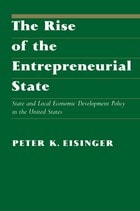
The Rise of the Entrepreneurial State
State and Local Economic Development Policy in the United StatesPeter K. Eisinger
University of Wisconsin Press, 1989
Eisinger’s meticulous research uncovers state and local governments’ transition from supply-side to demand-side strategies of market creation. He shows that, instead of relying solely on the supply-side strategies of tax breaks and other incentives to encourage business relocation, some governments promoted innovation and the creation of new business approaches.

The Rise of the Green Left
Inside the Worldwide Ecosocialist MovementDerek Wall
Pluto Press, 2010
Climate change and other ecological ills are driving the creation of a grassroots global movement for change. From Latin America to Europe, Australia and China a militant movement merging red and green is taking shape.
Ecosocialists argue that capitalism threatens the future of humanity and the rest of nature. From indigenous protest in the Peruvian Amazon to the green transition in Cuba to the creation of red-green parties in Europe, ecosocialism is defining the future of left and green politics globally. Latin American leaders such as Morales and Chavez are increasingly calling for an ecosocialist transition.
Drawing on the work of key thinkers such as Joel Kovel and John Bellamy Foster, Derek Wall provides an unique insider view of how ecosocialism has developed and a practical guide to focused ecosocialist action. A great handbook for activists and engaged students of politics.
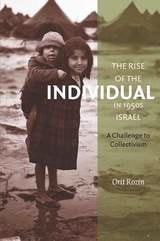
The Rise of the Individual in 1950s Israel
A Challenge to CollectivismOrit Rozin
Brandeis University Press, 2011
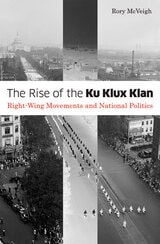
The Rise of the Ku Klux Klan
Right-Wing Movements and National PoliticsRory McVeigh
University of Minnesota Press, 2009
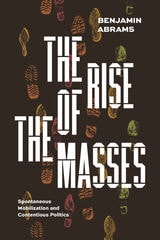
The Rise of the Masses
Spontaneous Mobilization and Contentious PoliticsBenjamin Abrams
University of Chicago Press, 2023
Between 15 and 26 million Americans participated in protests surrounding the murders of George Floyd, Ahmaud Arbery, Breonna Taylor, and others as part of the Black Lives Matter protests in 2020, which is only one of the most recent examples of an immense mobilization of citizens around a cause. In The Rise of the Masses, sociologist Benjamin Abrams addresses why and how people spontaneously protest, riot, and revolt en masse. While most uprisings of such a scale require tremendous resources and organizing, this book focuses on cases where people with no connection to organized movements take to the streets, largely of their own accord. Looking to the Arab Spring, Occupy Wall Street, and the Black Lives Uprising, as well as the historical case of the French Revolution, Abrams lays out a theory of how and why massive mobilizations arise without the large-scale planning that usually goes into staging protests.
Analyzing a breadth of historical and regional cases that provide insight into mass collective behavior, Abrams draws on first-person interviews and archival sources to argue that people organically mobilize when a movement speaks to their pre-existing dispositions and when structural and social conditions make it easier to get involved—what Abrams terms affinity-convergence theory. Shedding a light on the drivers behind large spontaneous protests, The Rise of the Masses offers a significant theory that could help predict movements to come.

The Rise of the National Basketball Association
david G. Surdam
University of Illinois Press, 2012
The Rise of the New York Intellectuals
Partisan Review and Its Circle, 1934–1945Terry A. Cooney
University of Wisconsin Press, 1986
Cosmopolitan visions
Terry A. Cooney traces the evolution of the Partisan Review—often considered to be the most influential little magazine ever published in America—during its formative years, giving a lucid and dispassionate view of the magazine and its luminaries who played a leading role in shaping the public discourse of American intellectuals. Included are Lionel Trilling, Philip Rahv, William Phillips, Dwight Macdonald, F. W. Dupee, Mary McCarthy, Sidney Hook, Harold Rosenberg, and Delmore Schwartz, among others.
“An excellent book, which works at each level on which it operates. It succeeds as a straightforward narrative account of the Partisan Review in the 1930s and 1940s. The magazine’s leading voices—William Phillips, Philip Rahv, Dwight MacDonald, Lionel Trilling, and all the rest—receive their due. . . . Among the themes that engage Cooney. . . . are: how they dealt with ‘modernism’ in culture and radicalism in politics, each on its own and in combination; how Jewishness played a complex and fascinating role in many of the thinkers’ lives; and, especially, how ‘cosmopolitanism’ best explains what the Partisan Review was all about.”—Robert Booth Fowler, Journal of American History
The Rise of the Public Authority
Statebuilding and Economic Development in Twentieth-Century AmericaGail Radford
University of Chicago Press, 2013
The Rise of the Representative
Lawmakers and Constituents in Colonial AmericaPeverill Squire
University of Michigan Press, 2017
The Rise of the Research University
A SourcebookEdited by Louis Menand, Paul Reitter, and Chad Wellmon
University of Chicago Press, 2017
The editors focus on the development of American universities such as Cornell, Johns Hopkins, Harvard, and the Universities of Chicago, California, and Michigan. Looking to Germany, they translate a number of seminal sources that formulate the shape and purpose of the university and place them next to hard-to-find English-language texts that took the German university as their inspiration, one that they creatively adapted, often against stiff resistance. Enriching these texts with short but insightful essays that contextualize their importance, the editors offer an accessible portrait of the early research university, one that provides invaluable insights not only into the historical development of higher learning but also its role in modern society.

The Rise of the Wave Theory of Light
Optical Theory and Experiment in the Early Nineteenth CenturyJed Z. Buchwald
University of Chicago Press, 1989
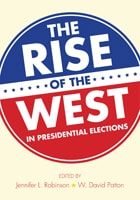
The Rise of the West in Presidential Elections
Jennifer L Robinson
University of Utah Press, 2010
The Rise of the West in Presidential Elections explores the changing role of the region in national elections. The prominence of Nevada as an early caucus state and Denver acting as the host city of the 2008 Democratic National Convention, as well as increased candidate visitation and media expenditure, point to the rising importance of the region, an importance that political candidates will increasingly need to recognize. The book examines the political advantages and barriers to the creation of a regional primary for western states, a move that could further change the influence of the West on the national agenda and highlight western issues and values.
The contributors to The Rise of the West in Presidential Elections analyze the process of nominating presidential candidates, review the issues that make western states a united region unique in the political process, and explore the changing political dynamics in the nation that enable these changes. The book will be of interest to every citizen looking to learn more about the primary process, as well as to the political junkie more focused on the nuances of political maneuvering between states jockeying for position at the front of the election process.
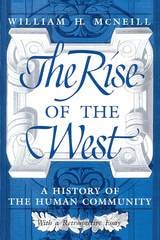
The Rise of the West
A History of the Human CommunityWilliam H. McNeill
University of Chicago Press, 1991
One of the most important works of history from the twentieth century, The Rise of the West, winner of the National Book Award in 1964, is famous for its ambitious scope and intellectual rigor. In it, William H. McNeill challenges the then-prevalent view that a number of separate civilizations pursued essentially independent careers, and argues instead that human cultures interacted at every stage of their history. McNeill argues instead that from the Neolithic beginnings of grain agriculture to the present major social changes in all parts of the world were triggered by new or newly important foreign stimuli, and he presents a persuasive narrative of world history to support this claim.
In a retrospective essay titled "The Rise of the West after Twenty-five Years," McNeill shows how his book was shaped by the time and place in which it was written (1954-63). He discusses how historiography subsequently developed and suggests how his portrait of the world's past in The Rise of the West should be revised to reflect these changes.
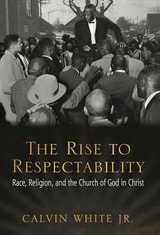
The Rise to Respectability
Race, Religion, and the Church of God in ChristCalvin White
University of Arkansas Press, 2015
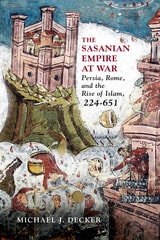
The Sasanian Empire at War
Persia, Rome, and the Rise of Islam, 224–651Michael J. Decker
Westholme Publishing, 2025
A comprehensive military history of one of the most important empires of Late Antiquity
The Sasanian Empire at War: Persia, Rome, and the Rise of Islam, 224–651 is the first comprehensive study in English examining war and society in one of the most important empires in world history: the Persian Empire of 224-651 AD, ruled by the Sasanian clan. At its height the Sasanians governed lands from the Indus River in the east to Egypt and the Mediterranean in the west. Adversaries of Rome, they also faced grave challenges from nomadic powers from Central Asia, notably the Huns and Turks. The Sasanians were able to maintain their empire for hundreds of years through nearly constant warfare, but when their expansion was checked in the north by the Byzantines at Constantinople in 626, and with the Muslim invasions to their south and west beginning in the 630s, the empire could no longer be sustained, and it finally collapsed.
In this book, Michael J. Decker examines Sasanian warfare, including military capabilities, major confrontations, organization and weapons of the Persian army. In addition to providing a comprehensive overview of the conflicts that marked this vital period in the history of Eurasia, The Sasanian Empire at War challenges long cherished notions of the inferiority of Sasanian military capabilities and renders a new image of a sophisticated, confident culture astride the heart of Eurasia at the end of the ancient world and birth of the Silk Road. Persian arms were among the many features of their culture that drew widespread admiration and was one of the keys to the survival of Iranian culture beyond the Arab Conquest and into the present day.
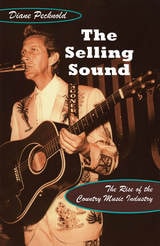
The Selling Sound
The Rise of the Country Music IndustryDiane Pecknold
Duke University Press, 2007
Pecknold draws on sources as diverse as radio advertising journals, fan magazines, Hollywood films, and interviews with industry insiders. Her sweeping social history encompasses the genre’s early days as an adjunct of radio advertising in the 1920s, the friction between Billboard and more genre-oriented trade papers over generating the rankings that shaped radio play lists, the establishment of the Country Music Association, and the influence of rock ‘n’ roll on the trend toward single-genre radio stations. Tracing the rise of a large and influential network of country fan clubs, Pecknold highlights the significant promotional responsibilities assumed by club organizers until the early 1970s, when many of their tasks were taken over by professional publicists.
The Southern Maya in the Late Preclassic
The Rise and Fall of an Early Mesoamerican CivilizationMichael Love
University Press of Colorado, 2011
Recent research has provided a wealth of broadly based new data that have expanded the understanding of this region and its influence on greater Mesoamerica. In The Southern Maya in the Late Preclassic, prominent contributors debate whether the southern region was indeed "Maya" or instead a region of intense multiethnic interaction, with speakers of many languages and many sources of identity. The chapters address a host of advanced developments to which this area can lay claim--urbanism and city-states, the earliest Maya writing, and the origin of the Maya calendar--as well as additional issues including the construction of social and cultural identities, economic networks of early complex societies, relationships between the Maya and the Olmec, and a comprehensive discussion of the ancient city of Kaminaljuyu and its relationship to other cities in the region.
The Southwest in American Literature and Art
The Rise of a Desert AestheticDavid W. Teague
University of Arizona Press, 1997
By focusing on cultures that lived in the Southwest and by analyzing ways in which they described the land, David Teague persuasively argues against the destructive approach that Americans currently take to the region. Included are Native American legends and Spanish and Hispanic literature. However, the bulk of the study concentrates on Anglo American views of the Southwest, which have been generally at odds with the ecology of the deserts.
Ranging from oral traditions of the Navajo, Zuñi, and Hopi Indians to travel journals, fiction, and visual art, Teague examines the work of nearly thirty writers, artists, and explorers, including Alvar Núñez Cabeza de Vaca, Mary Austin, John Wesley Powell, and Frederic Remington. As he traces ideas about the desert over time, the author shows how American literature and art have come to represent the Southwest as a landscape to be sustained rather than transformed.
Bound to gain a prominent place in ecological criticism and in literature of the Southwest, this book offers important insights for scholars and students of literature, environmental studies, history, anthropology, and Native American studies. Its originality and vigor will also appeal to general readers with an interest in the landscape—and the future—of the American Southwest.
The Steamer Parish
The Rise and Fall of Missionary Medicine on an African FrontierCharles M. Good
University of Chicago Press, 2003
In The Steamer Parish, Charles M. Good Jr. traces the Mission's history and its lasting impact on public health care in south-central Africa-and shows how steam and medicine, together with theology, allowed the Mission to impose its will, indelibly, on hundreds of thousands of people. What's more, many of the issues he discusses-rural development, the ecological history of disease, and competition between western and traditional medicine-are as relevant today as they were 100 years ago.
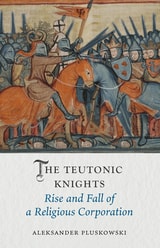
The Teutonic Knights
Rise and Fall of a Religious CorporationAleksander Pluskowski
Reaktion Books, 2024
This book provides a concise and incisive introduction to the knights of the Teutonic Order, the last of the great military orders established in the twelfth century. The book traces the Order’s evolution from a crusader field hospital into a major territorial ruler in northeastern Europe. Notably, the knights constructed distinctive fortified convents, including their headquarters in Western Christendom’s largest castle. The narrative concludes with the Order’s fifteenth-century decline due to the combined effects of a devastating war with Poland-Lithuania and the Protestant Reformation. The result is an accessible overview of this pivotal corporation in European history.
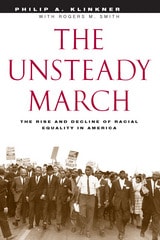
The Unsteady March
The Rise and Decline of Racial Equality in AmericaPhilip A. Klinkner and Rogers M. Smith
University of Chicago Press, 1999
"[An] unflinching portrait of the leviathan of American race relations. . . . This important book should be read by all who aspire to create a more perfect union."—Publishers Weekly, starred review
"Could it be that our unswerving belief in the power of our core values to produce racial equality is nothing but a comforting myth? That is the main argument put forth by Philip Klinkner and Rogers Smith . . . The Unsteady March is disturbing because it calls into question our cherished national belief and does so convincingly. . . . [It] is beautifully written, and the social history it provides is illuminating and penetrating."—Aldon Morris, American Journal of Sociology
Winner of the Horace Mann Bond Award of the W.E.B. Du Bois Institute for Afro-American Research at Harvard University.
To Rise in Darkness
Revolution, Repression, and Memory in El Salvador, 1920–1932Jeffrey L. Gould, Aldo A. Lauria-Santiago
Duke University Press, 2008
Gould conducted more than two hundred interviews with survivors of la Matanza and their descendants. He and Lauria-Santiago combine individual accounts with documentary sources from archives in El Salvador, Guatemala, Washington, London, and Moscow. They describe the political, economic, and cultural landscape of El Salvador during the 1920s and early 1930s, and offer a detailed narrative of the uprising and massacre. The authors challenge the prevailing idea that the Communist organizers of the uprising and the rural Indians who participated in it were two distinct groups. Gould and Lauria-Santiago demonstrate that many Communist militants were themselves rural Indians, some of whom had been union activists on the coffee plantations for several years prior to the rebellion. Moreover, by meticulously documenting local variations in class relations, ethnic identity, and political commitment, the authors show that those groups considered “Indian” in western El Salvador were far from homogeneous. The united revolutionary movement of January 1932 emerged out of significant cultural difference and conflict.
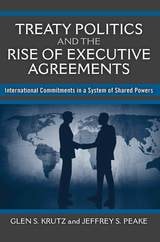
Treaty Politics and the Rise of Executive Agreements
International Commitments in a System of Shared PowersGlen S. Krutz and Jeffrey S. Peake
University of Michigan Press, 2011
"Krutz and Peake's examination of the increase use of executive agreements offers a valuable lesson in how the president and Congress have responded and adjusted to the growth in the complexity of foreign relations to meet the demands of an ever-increasingly complex and interconnected international community."
---Victoria Farrar-Myers, University of Texas, Arlington
"From reading Treaty Politics and the Rise of Executive Agreements, I learned a good deal about a topic that I thought I knew well. This book will be an excellent addition to the literature on the presidency. It will be read and cited by scholars working in this field."
---Benjamin Ginsberg, Johns Hopkins University
"Glen Krutz and Jeffrey Peake's Treaty Politics and the Rise of Executive Agreements offers a provocative analysis of a neglected topic. Their theoretical and empirical challenge to the usual explanation for the growth of executive agreements, their careful analysis of the treaty process in the Senate and when that body can be decisive, and their assessment of the House of Representatives' role in the agreement process provide important new scholarship for students of the presidency, Congress, and foreign policy."
---James M. McCormick, Iowa State University
In foreign relations, U.S. presidents have exercised a growing independence through the use of executive agreements. The U.S. Constitution specifies that two-thirds of the Senate must ratify a proposed treaty but makes no provision for other forms of international agreements. In 1942 the Supreme Court affirmed the legality of executive agreements, and since World War II, they have outnumbered treaties by more than ten to one. Are presidents trampling the Constitution or seeking to streamline the diplomatic process?
Glen S. Krutz and Jeffrey S. Peake argue that the preference for executive agreements is the result of a symbiotic evolution of the executive and the legislative branches and that in order for the United States to survive in a complex, ever-changing global environment and maintain its world power status, it must fulfill international commitments swiftly and confidently. Members of Congress concur that executive agreements allow each branch to function more effectively. At the same time, the House continues to oversee particular policy areas, and presidents still submit the majority of the most significant international commitments to the Senate as treaties.
Krutz and Peake conclude that executive agreements represent a mutual adaptation of the executive and the legislature in a system of shared power.
Glen S. Krutz is Associate Director of the Carl Albert Center and Professor of Political Science at the University of Oklahoma.
Jeffrey S. Peake is Professor and Department Chair, Department of Political Science at Clemson University.
Truth on Trial
The Rise and Fall of the Integrated Humanities Program at the University of KansasRobert K. Carlson
Catholic University of America Press, 2026
Trying Home
The Rise and Fall of an Anarchist Utopia on Puget SoundJustin Wadland
Oregon State University Press, 2014
The true story of an anarchist colony on a remote Puget Sound peninsula, Trying Home traces the history of Home, Washington, from its founding in 1896 to its dissolution amid bitter infighting in 1921.
As a practical experiment in anarchism, Home offered its participants a rare degree of freedom and tolerance in the Gilded Age, but the community also became notorious to the outside world for its open rejection of contemporary values. Using a series of linked narratives, Trying Home reveals the stories of the iconoclastic individuals who lived in Home, among them Lois Waisbrooker, an advocate of women’s rights and free love, who was arrested for her writings after the assassination of President McKinley; Jay Fox, editor of The Agitator, who defended his right to free speech all the way to the Supreme Court; and Donald Vose, a young man who grew up in Home and turned spy for a detective agency.
Justin Wadland weaves his own discovery of Home—and his own reflections on the concept of home—into the story, setting the book apart from a conventional history. After discovering the newspapers published in the colony, Wadland ventures beyond the documents to explore the landscape, travelling by boat along the steamer route most visitors once took to the settlement. He visits Home to talk with people who live there now.
Meticulously researched and engagingly written, Trying Home will fascinate scholars and general readers alike, especially those interested in the history of the Pacific Northwest, utopian communities, and anarchism.
Tuning the World
The Rise of 440 Hertz in Music, Science, and Politics, 1859–1955Fanny Gribenski
University of Chicago Press, 2023
Tuning the World tells the unknown story of how the musical pitch A 440 became the global norm.
Now commonly accepted as the point of reference for musicians in the Western world, A 440 hertz only became the standard pitch during an international conference held in 1939. The adoption of this norm was the result of decades of negotiations between countries, involving a diverse group of performers, composers, diplomats, physicists, and sound engineers. Although there is widespread awareness of the variability of musical pitches over time, as attested by the use of lower frequencies to perform early music repertoires, no study has fully explained the invention of our current concert pitch. In this book, Fanny Gribenski draws on a rich variety of previously unexplored archival sources and a unique combination of musicological perspectives, transnational history, and science studies to tell the unknown story of how A 440 became the global norm. Tuning the World demonstrates the aesthetic, scientific, industrial, and political contingencies underlying the construction of one of the most “natural” objects of contemporary musical performance and shows how this century-old effort was ultimately determined by the influence of a few powerful nations.
Tunnel Visions
The Rise and Fall of the Superconducting Super ColliderMichael Riordan, Lillian Hoddeson, and Adrienne W. Kolb
University of Chicago Press, 2015
Drawing on extensive archival research, contemporaneous press accounts, and over one hundred interviews with scientists, engineers, government officials, and others involved, Tunnel Visions tells the riveting story of the aborted SSC project. The authors examine the complex, interrelated causes for its demise, including problems of large-project management, continuing cost overruns, and lack of foreign contributions. In doing so, they ask whether Big Science has become too large and expensive, including whether academic scientists and their government overseers can effectively manage such an enormous undertaking.