Results by title
279 books match the query 'Slavery' and 64 start with t
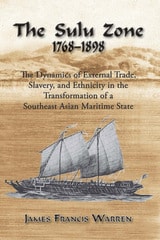
The Sulu Zone
The Dynamics of External Trade, Slavery and Ethnicity in the Transformation of a Southeast Asian Maritime State, 1768-1898 (Second Edition)James F. Warren
National University of Singapore Press, 2007
His work analyzes the dynamics of the last autonomous Malayo-Muslim maritime state over a long historical period and describes its stunning response to the world capitalist economy and the rapid "forward movement" of colonialism and modernity. It also shows how the changing world of global cultural flows and economic interactions caused by cross-cultural trade and European dominance affected men and women who were forest dwellers, highlanders, and slaves, people who worked in everyday jobs as fishers, raiders, divers and traders. Often neglected by historians, the responses of these members of society are a crucial part of the history of Southeast Asia.
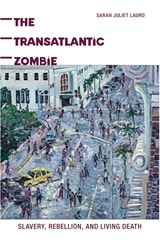
The Transatlantic Zombie
Slavery, Rebellion, and Living DeathSarah Juliet Lauro
Rutgers University Press, 2015
The Travels of Reverend Olafur Egilsson
Karl Smari Hreinsson
Catholic University of America Press, 2016
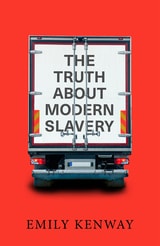
The Truth About Modern Slavery
Emily Kenway
Pluto Press, 2021
'A powerful treatise' - Amelia Gentleman, Guardian
In 2019, over 10,000 possible victims of slavery were found in the UK. From men working in Sports Direct warehouses for barely any pay, to teenaged Vietnamese girls trafficked into small town nail bars, we’re told that modern slavery is all around us, operating in plain sight.
But is this really slavery, and is it even a new phenomenon? Why has the British Conservative Party called it 'one of the great human rights issues of our time', when they usually ignore the exploitation of those at the bottom of the economic pile? The Truth About Modern Slavery reveals how modern slavery has been created as a political tool by those in power. It shows how anti-slavery action acts as a moral cloak, hiding the harms of the ‘hostile environment’ towards migrants, legitimising big brands’ exploitation of the poorest workers and oppressing sex workers.
Blaming the media's complicity, rich philanthropists' opportunism and our collective failure to realise the lies we’re being told, The Truth About Modern Slavery provides a vital challenge to conventional narratives on modern slavery.
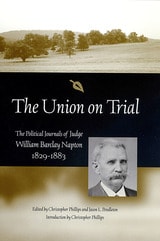
The Union on Trial
The Political Journals of Judge William Barclay Napton, 1829-1883Edited by Christopher Phillips & Jason L. Pendleton. Introduction by Christopher Phillips
University of Missouri Press, 2005
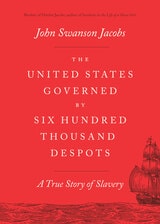
The United States Governed by Six Hundred Thousand Despots
A True Story of SlaveryJohn Swanson Jacobs
University of Chicago Press, 2024
For one hundred and sixty-nine years, a first-person slave narrative written by John Swanson Jacobs—brother of Harriet Jacobs—was buried in a pile of newspapers in Australia. Jacobs’s long-lost narrative, The United States Governed by Six Hundred Thousand Despots, is a startling and revolutionary discovery. A document like this—written by an ex-slave and ex-American, in language charged with all that can be said about America outside America, untampered with and unedited by white abolitionists—has never been seen before. A radical abolitionist, sailor, and miner, John Jacobs has a life story that is as global as it is American. Born into slavery, by 1855 he had fled both the South and the United States altogether, becoming a stateless citizen of the world and its waters. That year, he published his life story in an Australian newspaper, far from American power and its threats. Unsentimental and unapologetic, Jacobs radically denounced slavery and the state, calling out politicians and slaveowners by their names, critiquing America’s founding documents, and indicting all citizens who maintained the racist and intolerable status quo.
Reproduced in full, this narrative—which entwines with that of his sister and with the life of their friend Frederick Douglass—here opens new horizons for how we understand slavery, race, and migration, and all that they entailed in nineteenth-century America and the world at large. To truly reckon with the lives of John Jacobs is to see with new clarity that in 1776, America embarked on two experiments at once: one in democracy, the other in tyranny.
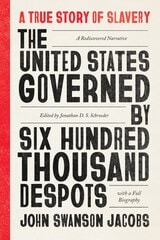
The United States Governed by Six Hundred Thousand Despots
A True Story of Slavery; A Rediscovered Narrative, with a Full BiographyJohn Swanson Jacobs
University of Chicago Press, 2024
For one hundred and sixty-nine years, a first-person slave narrative written by John Swanson Jacobs—brother of Harriet Jacobs—was buried in a pile of newspapers in Australia. Jacobs’s long-lost narrative, The United States Governed by Six Hundred Thousand Despots, is a startling and revolutionary discovery. A document like this—written by an ex-slave and ex-American, in language charged with all that can be said about America outside America, untampered with and unedited by white abolitionists—has never been seen before. A radical abolitionist, sailor, and miner, John Jacobs has a life story that is as global as it is American. Born into slavery, by 1855, he had fled both the South and the United States altogether, becoming a stateless citizen of the world and its waters. That year, he published his life story in an Australian newspaper, far from American power and its threats. Unsentimental and unapologetic, Jacobs radically denounced slavery and the state, calling out politicians and slaveowners by their names, critiquing America’s founding documents, and indicting all citizens who maintained the racist and intolerable status quo.
Reproduced in full, this narrative—which entwines with that of his sister and with the life of their friend Frederick Douglass—here opens new horizons for how we understand slavery, race, and migration, and all that they entailed in nineteenth-century America and the world at large. The second half of the book contains a full-length, nine-generation biography of Jacobs and his family by literary historian Jonathan Schroeder. This new guide to the world of John Jacobs will transform our sense of it—and of the forces and prejudices built into the American project. To truly reckon with the lives of John Jacobs is to see with new clarity that in 1776, America embarked on two experiments at once: one in democracy, the other in tyranny.
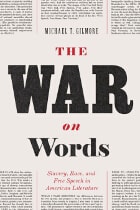
The War on Words
Slavery, Race, and Free Speech in American LiteratureMichael T. Gilmore
University of Chicago Press, 2010
How did slavery and race impact American literature in the nineteenth century? In this ambitious book, Michael T. Gilmore argues that they were the carriers of linguistic restriction, and writers from Frederick Douglass to Stephen Crane wrestled with the demands for silence and circumspection that accompanied the antebellum fear of disunion and the postwar reconciliation between the North and South.
Proposing a radical new interpretation of nineteenth-century American literature, The War on Words examines struggles over permissible and impermissible utterance in works ranging from Thoreau’s “Civil Disobedience” to Henry James’s The Bostonians. Combining historical knowledge with groundbreaking readings of some of the classic texts of the American past, The War on Words places Lincoln’s Cooper Union address in the same constellation as Margaret Fuller’s feminism and Thomas Dixon’s defense of lynching. Arguing that slavery and race exerted coercive pressure on freedom of expression, Gilmore offers here a transformative study that alters our understanding of nineteenth-century literary culture and its fraught engagement with the right to speak.
This Incurable Evil
Mapuche Resistance to Spanish Enslavement, 1598–1687Eugene C.Berger
University of Alabama Press, 2023
Documents how initial Mapuche-Spanish alliances were built and how they were destroyed by increasingly powerful slave-trading elites operating like organized crime families
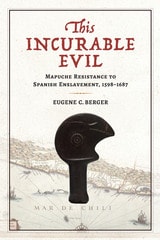
The history of Spanish presence in the Americas is usually viewed as a one-sided conquest. In This Incurable Evil: Mapuche Resistance to Spanish Enslavement, 1598–1687, Eugene C. Berger provides a major corrective in the case of Chile. For example, in the south, indigenous populations were persistent in their resistance against Spanish settlement. By the end of the sixteenth century, Spanish aspirations to conquer the entire Pacific Coast were dashed at least twice by armed resistance from the Mapuche peoples. By 1600, the Mapuche had killed two Spanish governors and occupied more than a dozen Spanish towns. Chile’s colonial future was quite uncertain.
As Berger documents, for much of the seventeenth century it seemed that there could be peace along the Spanish-Mapuche frontier. Through trade, intermarriage, and even mutual distrust of Dutch and English pirates, the Mapuche and the Spanish began to construct a colonial entente. However, this growing alliance was obliterated by the “incurable evil,” an ever-expanding enslavement of Mapuches, and one which prompted a new generation of Mapuche resistance. This trade saw Mapuche rivals, neutrals, and even friends placed in irons and forced to board ships in Valdivia and Concepción or to march northward along the Andes. The Mapuche labored in the gold mines of La Serena, in urban workshops in Lima, in the silver mines of Potosí, or on the thousands of haciendas in between and would never return to their homes. With this tragic betrayal, Chile was left a more corrupt, violent, and polarized place, which would cause deep wounds for centuries.
To Be A Slave in Brazil
1550-1888Mattoso, Katia M de Queiros
Rutgers University Press, 1986
Toussaint Louverture
The Story of the Only Successful Slave Revolt in History; A Play in Three ActsC. L. R. James Edited and Introduced by Christian Høgsbjerg
Duke University Press, 2013
Trafficking Rhetoric
Race, Migration, and the Making of Modern-Day SlaveryAnnie Hill
The Ohio State University Press, 2024
Honorable Mention, 2025 NCA Public Address Division’s Marie Hochmuth Nichols Award
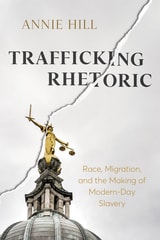
Human trafficking has generated intense global concern, with stories of sex slavery and images of women forced into prostitution so persuasive that states have raced to respond ahead of empirical data and clear definitions of the crime. In Trafficking Rhetoric, Annie Hill analyzes the entanglement of state veneration and state violence by tracking how the United Kingdom points to the alleged crimes of others in order to celebrate itself and conceal its own aggression. Hill compares the UK’s acclaimed rescue approach to human trafficking with its hostile approach to migration, arguing that they are two sides of the same coin—one that relies on rhetorical constructions of “trafficked women” and “illegal migrants” to materialize the UK as an Anglo-white space.
Drawing from official estimates, policy papers, NGO reports, news stories, and awareness campaigns and situating them in the broader EU context, Hill accounts for why the UK’s antitrafficking agenda emerged with such rhetorical force in the early twenty-first century. Trafficking Rhetoric reframes controversies over labor, citizenship, and migration while challenging the continued traction of race-baiting and gender bias in determining who has the right to live, work, and belong in the nation.
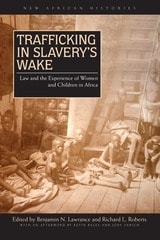
Trafficking in Slavery’s Wake
Law and the Experience of Women and Children in AfricaBenjamin N. Lawrance
Ohio University Press, 2012
Women and children have been bartered, pawned, bought, and sold within and beyond Africa for longer than records have existed. This important collection examines the ways trafficking in women and children has changed from the aftermath of the “end of slavery” in Africa from the late nineteenth century to the present.
The formal abolition of the slave trade and slavery did not end the demand for servile women and children. Contemporary forms of human trafficking are deeply interwoven with their historical precursors, and scholars and activists need to be informed about the long history of trafficking in order to better assess and confront its contemporary forms. This book brings together the perspectives of leading scholars, activists, and other experts, creating a conversation that is essential for understanding the complexity of human trafficking in Africa.
Human trafficking is rapidly emerging as a core human rights issue for the twenty-first century. Trafficking in Slavery’s Wake is excellent reading for the researching, combating, and prosecuting of trafficking in women and children.
Contributors: Margaret Akullo, Jean Allain, Kevin Bales, Liza Stuart Buchbinder, Bernard K. Freamon, Susan Kreston, Benjamin N. Lawrance, Elisabeth McMahon, Carina Ray, Richard L. Roberts, Marie Rodet, Jody Sarich, and Jelmer Vos.