Results by title
250 books match the query 'Subjects' and 55 start with t
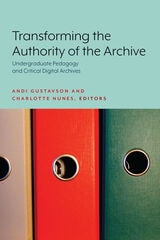
Transforming the Authority of the Archive
Undergraduate Pedagogy and Critical Digital ArchivesAndi Gustavson and Charlotte Nunes, Editors
Lever Press, 2023
Contributions to this volume represent a range of institutions including small liberal arts colleges, HBCUs, Ivy Leagues, large research institutions, and community-based collections. The assignments, projects, and initiatives described across this volume are fundamentally concerned with the challenge to model digital archival collections so as to center individual and community voices that are historically under-engaged in the archives. To address this challenge, contributors describe various approaches to substantively, often radically, redistribute archival resources and authority. The chapters within Transforming the Authority of the Archive offer thoughtful and creative pedagogical approaches to counter the presumed neutrality of the archive and advocate a shared understanding of the contingency of archival collections. This book is a must-read for liberal arts faculty, graduate students, archivists (both community- and institutionally-affiliated), information-studies professionals, librarians, and other professionals working and teaching in archives, museums, libraries, and other cultural heritage institutions.
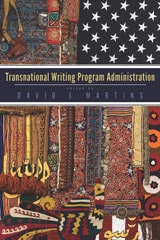
Transnational Writing Program Administration
David S. Martins
Utah State University Press, 2014
While local conditions remain at the forefront of writing program administration, transnational activities are slowly and thoroughly shifting the questions we ask about writing curricula, the space and place in which writing happens, and the cultural and linguistic issues at the heart of the relationships forged in literacy work. Transnational Writing Program Administration challenges taken-for-granted assumptions regarding program identity, curriculum and pedagogical effectiveness, logistics and quality assurance, faculty and student demographics, innovative partnerships and research, and the infrastructure needed to support writing instruction in higher education.
Well-known scholars and new voices in the field extend the theoretical underpinnings of writing program administration to consider programs, activities, and institutions involving students and faculty from two or more countries working together and highlight the situated practices of such efforts. The collection brings translingual graduate students at the forefront of writing studies together with established administrators, teachers, and researchers and intends to enrich the efforts of WPAs by examining the practices and theories that impact our ability to conceive of writing program administration as transnational.
This collection will enable writing program administrators to take the emerging locations of writing instruction seriously, to address the role of language difference in writing, and to engage critically with the key notions and approaches to writing program administration that reveal its transnationality.
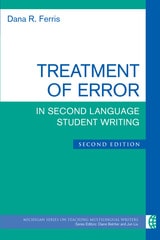
Treatment of Error in Second Language Student Writing, Second Edition
Dana R. Ferris
University of Michigan Press, 2011
Treatment of Error offers a realistic, well-reasoned account of what teachers of multilingual writers need to know about error and how to put what they know to use. As in the first edition, Ferris again persuasively addresses the fundamental error treatment questions that plague novice and expert writing specialists alike: What types of errors should teachers respond to? When should we respond to them? What are the most efficacious ways of responding to them? And ultimately, what role should error treatment play in the teaching of the process of writing?
The second edition improves upon the first by exploring changes in the field since 2002, such as the growing diversity in what is called “L2 writers,” the blurring boundaries between “native” and “non-native” speakers of English, the influence of genre studies and corpus linguistics on the teaching of writing, and the need the move beyond “error” to “second language development” in terms of approaching students and their texts. It also explores what teacher preparation programs need to do to train teachers to treat student error.
The second edition features
* an updating of the literature in all chapters
* a new chapter on academic language development
* a postscript on how to integrate error treatment/language development suggestions in Chapters 4-6 into a writing class syllabus
* the addition of discussion/analysis questions at the end of each chapter, plus suggested readings, to make the book more useful in pedagogy or teacher development workshops

Trends in Communication Policy Research
New Theories, Methods and SubjectsEdited by Natascha Just and Manuel Puppis
Intellect Books, 2012
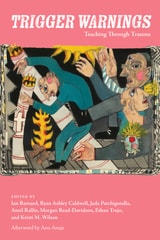
Trigger Warnings
Teaching Through TraumaEdited by Ian Barnard, Ryan Ashley Caldwell, Jada Patchigondla, Aneil Rallin, Morgan Read-Davidson, Ethan Trejo, and Kristi Wilson
Lever Press, 2026
Trigger Warnings: Teaching Through Trauma brings theory and praxis to examine the ideological underpinnings and pedagogy around trigger warnings and trauma, offering multiple heuristics for classroom implementation. The ongoing interest in trigger warnings is partly a result of trigger warnings and trauma becoming more inextricably interwoven in the past few years in the wake of COVID-19, mental health crises, right-wing attacks on educational institutions, climate change, and attempts at political redress and educational equity. Critiques of trigger warnings come from all sides of the political and pedagogical spectra, and even scholars and practitioners who offer a trauma-informed approach to the topic are not unified in their view of the benefits or drawbacks of trigger warnings.
Trigger Warnings: Teaching Through Trauma provides insights through a range of forms: research articles, personal essays, long and short teaching narratives, student perspectives, memoirs, vignettes, autoethnographies, reflections, case studies, manifesto, theory, and history. Not only does this collection create a more varied engagement experience for readers, but, in line with recent scholarship in “counterstory,” it also allows for a wider variety of voices to be heard and for the articulation of experiences that might not be well accommodated by traditional scholarly essays.