Results by title
476 books match the query 'World War, 1939-1945' and 96 start with t
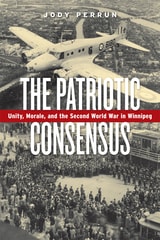
The Patriotic Consensus
Unity, Morale, and the Second World War in WinnipegJody Perrun
University of Manitoba Press, 2014

The People's War
Responses to World War II in the Soviet UnionEdited by Robert W. Thurston and Bernd Bonwetsch
University of Illinois Press, 2000
Drawing on a wealth of archival and recently published material, contributors detail the calculated destruction of a Jewish town by the Germans and present a chilling picture of life in occupied Minsk. They look at the cultural developments of the war as well as the wartime experience of intellectuals, for whom the period was a time of relative freedom. They discuss women's myriad roles in combat and other spheres of activity. They also reassess the behavior and morale of ordinary Red Army troops and offer new conclusions about early crushing defeats at the hands of the Germans–-defeats that were officially explained as cowardice on the part of high officers.
A frank investigation of civilian life behind the front lines, The People's War provides a detailed, balanced picture of the Stalinist USSR by describing not only the command structure and repressive power of the state but also how people reacted to them, cooperated with or opposed them, and adapted or ignored central policy in their own ways. By putting the Soviet people back in their war, this volume helps restore the range and complexity of human experience to one of history's most savage periods.
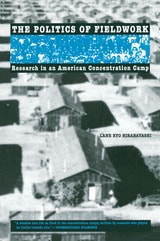
The Politics of Fieldwork
Research in an American Concentration CampLane Ryo Hirabayashi
University of Arizona Press, 1999
In addressing these questions, author Lane Hirabayashi examines the case of the late Dr. Tamie Tsuchiyama. At the time an advanced doctoral student in anthropology, Tsuchiyama was hired in 1942 to conduct ethnographic fieldwork for the University of California at Berkeley's Japanese American Evacuation and Resettlement Study. Drawing from personal letters, ethnographic fieldnotes, reports, interviews, and other archival sources, The Politics of Fieldwork describes Tsuchiyama's experiences as a researcher at Poston, Arizona—a.k.a. the Colorado River Relocation Center. The book relates the daily life, fieldwork methodology, and politics of the residents and researchers at the Poston camp, as well as providing insight into the pressures that led to Tsuchiyama's ultimate resignation, in protest, from the JERS project in 1945.
Facilitating the critical analysis of Tsuchiyama's role in the JERS research are questions regarding the relationships between Japanese American research and the nature of "colonial science" that merit discussion in contemporary field research. A multidisciplinary synthesis of anthropological, historical, and ethnic studies perspectives, The Politics of Fieldwork is rich with lessons about the ethics and politics of ethnographic fieldwork.
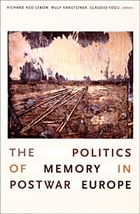
The Politics of Memory in Postwar Europe
Richard Ned Lebow, Wulf Kansteiner and Claudio Fogu, eds.
Duke University Press, 2006
An extensive introduction contains reflections on the significance of Europeans’ memories of World War II and a conclusion provides an analysis of the implications of the contributors’ findings for memory studies. These two pieces tease out some of the findings common to all seven countries: for instance, in each nation, the decade and a half between the late 1960s and the mid-1980s was the period of most profound change in the politics of memory. At the same time, the contributors demonstrate that Europeans understand World War II primarily through national frames of reference, which are surprisingly varied. Memories of the war have important ramifications for the democratization of Central and Eastern Europe and the consolidation of the European Union. This volume clarifies how those memories are formed and institutionalized.
Contributors. Claudio Fogu, Richard J. Golsan, Wulf Kansteiner, Richard Ned Lebow, Regula Ludi, Annamaria Orla-Bukowska, Heidemarie Uhl, Thomas C. Wolfe
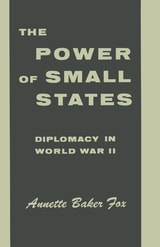
The Power of Small States
Diplomacy in World War IIAnnette Baker Fox
University of Chicago Press, 1959
As World War II ravaged Europe and Asia, smaller nations such as Turkey, Spain, Finland, and Portugal emerged virtually unscathed. How did these smaller powers, which most wrongly viewed as mere political pawns, survive one of the bloodiest conflicts of the 20th century?
From the World War II diplomatic history of Turkey, Finland, Norway, Sweden, and Spain, Annette Baker Fox walks us through backrooms and intense negotiations to illustrate how smaller nations balanced an ever-shifting political landscape to maintain their neutrality. Heavily researched and well-wrought, this book draws upon primary material and interviews with public figures and scholars to give a new historical dimension into lesser-known nations during a time of great political upheaval.
The Powers
A NovelValerie Sayers
Northwestern University Press, 2015
In her inventive novel The Powers, Valerie Sayers, in both realistic and fantastic chapters, transports the reader to an age filled with giants: Dorothy Day and Walker Evans appear beside DiMaggio. The problems they face, from Catholic antisemitism to the challenge of pacifism in the face of overwhelming evil, play out in very public media, among them the photography of Evans and the baseball of DiMaggio. At once magical and familiar, The Powers is a story of witness and moral responsibility that will, like Joe DiMaggio, find some unlikely fans.
The Red Kimono
A NovelJan Morrill
University of Arkansas Press, 2013
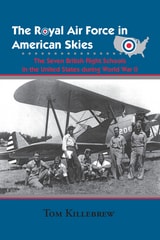
The Royal Air Force in American Skies
The Seven British Flight Schools in the United States during World War IITom Killebrew
University of North Texas Press, 2015

The Second World War
A Marxist HistoryChris Bambery
Pluto Press, 2014
The Second World War casts a long shadow, portrayed as a necessary and paradigmatic war that defeated fascism. During recent wars in Iraq, Afghanistan and elsewhere, US presidents and British prime ministers have tried to claim they were following in the footsteps of Winston Churchill by standing up to dictators.
In The Second World War Chris Bambery tests this position in a thorough account of the war and tries to understand why it still dominates TV history channels and school history books.
Bambery argues that the conflict ultimately was about a division of the world between the great powers, as well as a rising of ordinary people against fascism. He offers a complex and radical analysis, that is unique when compared to many modern and conventional histories of the war.
The Secret Protocol
The Molotov-Ribbentrop Pact and the Falsification of HistoryAntonella Salomoni, Translated by Antony Shugaar
University of Wisconsin Press, 2025
From the moment of the secret protocol’s inception—and the near-instantaneous rumors of its existence—it generated friction and competing narratives. The document became public during the Nuremberg trials, but the USSR declared it a fabrication evidencing the West’s willingness to falsify history. It continues to be relevant to the reconfiguration of history currently advanced by Vladimir Putin. By centering the rumors, accusations, and propaganda the pact precipitated, Salomoni illuminates how political actors can use and abuse history, how they create and disseminate truths and falsehoods, and how they can blur the boundary between facts and fictions even in the glaring face of black-and-white documentation.
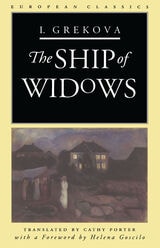
The Ship of Widows
I. Grekova
Northwestern University Press, 1994
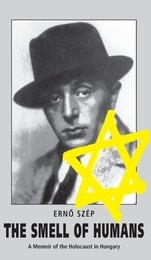
The Smell of Humans
A Memoir of the Holocaust in HungaryErno Szép
Central European University Press, 1994

The Soldier's Friend
A Life of Ernie PyleRay E. Boomhower
Indiana Historical Society Press, 2006

The Tiger in the Attic
Memories of the Kindertransport and Growing Up EnglishEdith Milton
University of Chicago Press, 2006
In this illuminating chronicle, Edith describes how she struggled to fit in and to conquer self-doubts about her German identity. Her realistic portrayal of the seemingly mundane yet historically momentous details of daily life during World War II slowly reveals istelf as a hopeful story about the kindness and generosity of strangers. She paints an account rich with colorful characters and intense relationships, uncanny close calls and unnerving bouts of luck that led to survival. Edith's journey between cultures continues with her final passage to America—yet another chapter in her life that required adjustment to a new world—allowing her, as she narrates it here, to visit her past as an exile all over again.
The Tiger in the Attic is a literary gem from a skilled fiction writer, the story of a thoughtful and observant child growing up against the backdrop of the most dangerous and decisive moment in modern European history. Offering a unique perspective on Holocaust studies, this book is both an exceptional and universal story of a young German-Jewish girl caught between worlds.
“Milton is brilliant at the small stroke . . . as well as broader ones.”—Alana Newhouse, New York Times Book Review
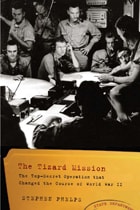
The Tizard Mission
The Top-Secret Operation That Changed the Course of World War IIStephen Phelps
Westholme Publishing, 2010
Alone Against Germany, Britain Gave America Its Most Astonishing Secrets
In August 1940, a German invasion of Britain looked inevitable. Luftwaffe bombers were pounding British cities, France had surrendered, and the Low Countries were under German control. Although sympathetic to Britain’s plight, the United States remained staunchly neutral. Unknown to the rest of the world, Britain’s brightest scientific and military minds had been working on futuristic technology for a decade, including radar and jet propulsion. While the great value of radar to locate and identify objects at long distance and at night or in bad weather was appreciated, at the time it was thought that practical radar required a room-sized device for generating an effective signal. Now, suddenly, British scientists had something extraordinary—the cavity magnetron, a generator hundreds of times more powerful than any other in use and small enough to be held in the hand. With the British economy and industry reeling from the war, Winston Churchill gambled on an unorthodox plan: a team of scientists and engineers would travel under cover to the United States and give the still-neutral Americans the best of Britain’s military secrets. It was hoped that in exchange the United States would provide financial and manufacturing support—which might even lead to their official entry into the war.
The Tizard Mission, named for its leader Sir Henry Tizard, steamed across the Atlantic carrying a suitcase-sized metal deed box. Designed to sink in the event the ship was torpedoed by a U-boat, the box contained details of the Whittle jet engine, research for an atomic bomb, and a precious cavity magnetron. The Americans proved to be astonished, receptive, and efficient: Bell Telephone produced the first thirty magnetrons in October 1940, and over a million by the end of the war. With this device, both warships and aircraft could carry war-winning radar. But Britain did not only give America military secrets, these same technologies would produce a fortune for postwar commercial industries, with the magnetron being the key component to the microwave oven. In The Tizard Mission: The Top-Secret Operation That Changed the Course of World War II, Stephen Phelps reveals how the Tizard Mission was the turning point in the technological war, giving Britain the weapons it desperately needed and laying the groundwork for both the Special Relationship and much of the United States’s postwar economic boom, an effect that still resonates today.
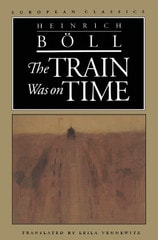
The Train Was on Time
Heinrich Boll
Northwestern University Press, 1994
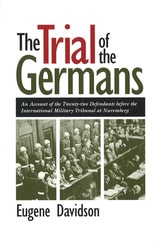
The Trial of the Germans
An Account of the Twenty-two Defendants before the International Military Tribunal at NurembergEugene Davidson
University of Missouri Press, 1997
The "definitive one-volume study of Nuremberg," The Trial of the Germans is now available in paperback. An astute observer of the Nuremberg trial, Eugene Davidson has struggled with the issues it raised: Was it a necessary response to the heinous crimes of the Third Reich? How were Germany and the Germans capable of such extraordinary evil? Was the trial just, given the claims that the defendants were simply serving their country, doing as they had been told to do? And if not just, was it nonetheless necessary as a warning to prevent future crimes against humanity? Davidson's approach to these and other large questions of justice is made through examination of each of the defendants in the trial. His reluctant, but firm, conclusion is: "In a world of mixed human affairs where a rough justice is done that is better than lynching or being shot out of hand, Nuremberg may be defended as a political event if not as a court." Some sentences may have seemed too severe, but none was harsher than the punishments meted out to innocent people by the regime these men served. "In a certain sense," says Davidson, "the trial succeeded in doing what judicial proceedings are supposed to do: it convinced even the guilty that the verdict against them was just."
Faulty as the trial was from the legal point of view, a catharsis of the pent-up emotions of millions of people had to be provided and a record of what had taken place duly preserved for whatever use later generations would make of it.

The US Eighth Air Force in World War II
Ira Eaker, Hap Arnold, and Building American Air Power, 1942–1943William J. Daugherty
University of North Texas Press, 2024
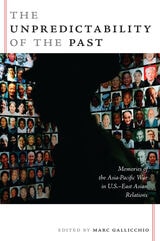
The Unpredictability of the Past
Memories of the Asia-Pacific War in U.S.-East Asian RelationsMarc Gallicchio, ed.
Duke University Press, 2007
The contributors interpret mass media sources, museum displays, monuments, film, and literature, as well as the archival sources traditionally used by historians. They explore how American ideas about Japanese history shaped U.S. occupation policy following Japan’s surrender in 1945, and how memories of the Asia-Pacific War influenced Washington and Tokyo policymakers’ reactions to the postwar rise of Soviet power. They investigate topics from the resurgence of Pearl Harbor images in the U.S. media in the decade before September 11, 2001, to the role of Chinese war museums both within China and in Chinese-Japanese relations, and from the controversy over the Smithsonian Institution’s Enola Gay exhibit to Japanese tourists’ reactions to the USS Arizona memorial at Pearl Harbor. One contributor traces how a narrative commemorating African Americans’ military service during World War II eclipsed the history of their significant early-twentieth-century appreciation of Japan as an ally in the fight against white supremacy. Another looks at the growing recognition and acknowledgment in both the United States and Japan of the Chinese dimension of World War II. By focusing on how memories of the Asia-Pacific War have been contested, imposed, resisted, distorted, and revised, The Unpredictability of the Past demonstrates the crucial role that interpretations of the past play in the present.
Contributors. Marc Gallicchio, Waldo Heinrichs, Haruo Iguchi, Xiaohua Ma, Frank Ninkovich, Emily S. Rosenberg, Takuya Sasaki, Yujin Yaguchi, Daqing Yang
The Victory Album
Reflections on the Good Life after the Good WarPhilip D. Beidler
University of Alabama Press, 2010
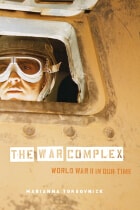
The War Complex
World War II in Our TimeMarianna Torgovnick
University of Chicago Press, 2005
Marianna Torgovnick argues that we have lived, since the end of World War II, under the power of a war complex—a set of repressed ideas and impulses that stems from our unresolved attitudes toward the technological acceleration of mass death. This complex has led to gaps and hesitations in public discourse about atrocities committed during the war itself. And it remains an enduring wartime consciousness, one most recently animated on September 11.
Showing how different events from World War II became prominent in American cultural memory while others went forgotten or remain hidden in plain sight, The War Complex moves deftly from war films and historical works to television specials and popular magazines to define the image and influence of World War II in our time. Torgovnick also explores the 1961 trial of Adolf Eichmann, the emotional legacy of the Holocaust, and the treatment of World War II's missing history by writers such as W. G. Sebald to reveal the unease we feel at our dependence on those who hold the power of total war. Thinking anew, then, about how we account for war to each other and ourselves, Torgovnick ultimately, and movingly, shows how these anxieties and fears have prepared us to think about September 11 and our current war in Iraq.
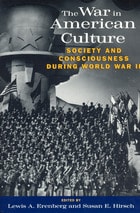
The War in American Culture
Society and Consciousness during World War IIEdited by Lewis A. Erenberg and Susan E. Hirsch
University of Chicago Press, 1996
World War II posed a crisis for American culture: to defeat the enemy, Americans had to unite across the class, racial and ethnic boundaries that had long divided them. Exploring government censorship of war photography, the revision of immigration laws, Hollywood moviemaking, swing music, and popular magazines, these essays reveal the creation of a new national identity that was pluralistic, but also controlled and sanitized. Concentrating on the home front and the impact of the war on the lives of ordinary Americans, the contributors give us a rich portrayal of family life, sexuality, cultural images, and working-class life in addition to detailed consideration of African Americans, Latinos, and women who lived through the unsettling and rapidly altered circumstances of wartime America.
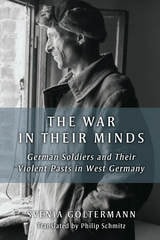
The War in Their Minds
German Soldiers and Their Violent Pasts in West GermanySvenja Goltermann
University of Michigan Press, 2017
Originally published in German as Die Gesellschaft der Uberlebenden, The War in Their Minds examines hitherto unused source material—psychiatric medical files of soldiers—to make clear how difficult it was for the soldiers and their families to readjust to normal, everyday life. Goltermann allows these testimonies of violence, guilt, justification, and helplessness speak for themselves and sensitively explores how the pension claims of returning soldiers were to compete with the claims of the Holocaust victims to compensation.
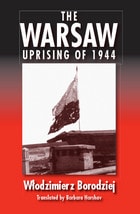
The Warsaw Uprising of 1944
Wlodzimierz Borodziej
University of Wisconsin Press, 2006
The Warsaw Uprising of 1944 dramatically tells the largely unknown story of the Warsaw resistance movement during World War II. Desperate to free themselves from German military oppression but also hoping to show the advancing Soviets that they could not impose easy rule upon the citizens of Warsaw, the Poles launched an almost hopeless attack against the Germans on August 1, 1944.
Wlodzimierz Borodziej presents an evenhanded account of what is commonly considered the darkest chapter in Polish history during World War II. In only sixty-three days, the Germans razed Warsaw to the ground and 200,000 people, mostly civilians, lost their lives. The result—a heroic and historically pivotal turning point—meant that the Poles would lose both their capital and an entire generation. This concise account of the trauma—little known to English-speaking readers—will appeal to anyone interested in the history of World War II in general and is a must-read for students of Polish history in particular.The Way We Really Were
THE GOLDEN STATE IN THE SECOND GREAT WAREdited by Roger W. Lotchin
University of Illinois Press, 2000
The Way We Really Were substantially enlivens this view, addressing topics that have been neglected or incompletely treated in the past to create a more rounded picture of the wartime situation at home. Exploring the developments brought to fruition by the war and linking them to their roots in earlier decades, contributors address the diversity of the musical scene, which arose from a cross-pollination of styles brought by Okies, blacks, and Mexican migrants. They examine increased political involvement by women, Hollywood's response to the war, and the merging of business and labor interests in the Bay Area Council. They also reveal how wartime dynamics led to substantial environmental damage and lasting economic gains by industry.
The Way We Really Were examines significant wartime changes in the circumstances of immigrant groups that have been largely overlooked by historians. Among these are Italian Americans, heavily insular and pro-Fascist before the war and very pro-American and assimilationist after, and Chinese American men, who achieved new legitimacy and entitlement through military service. Also included is a look at cultural negotiation among multiple ethnic groups in the Golden State. A valuable addition to the literature on California history, The War We Really Were provides an entree into new areas of scholarship and a fresh look at familiar ones.
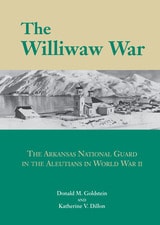
The Williwaw War
The Arkansas National Guard in the Aleutians in World War IIDonald Goldstein
University of Arkansas Press, 1992
When the 206th Coast Artillery Regiment of the Arkansas National Guard was called into federal service in January of 1941, few of the soldiers saw this action as anything more than a temporary detour in their lives. The war, after all, was in Europe and Asia and did not seem to involve them; many of the men thought they would serve their one-year enlistment and go home. The Japanese attack on Pearl Harbor changed all that.
The Williwaw War highlights the event sthat shaped the service of Arkansas’s 206th in the Aleutian Islands, including the Japanese strikes on Dutch Harbor on the third and fourth of June 1942, as well as the naval battle of the Komandorski Islands and the recapture of Attu and Kiska.
Written by the noted co-authors of the best-welling books on World War II, The Williwaw War chronicles the efforts of the men of the 206th as they battled terrible weather, overwhelming boredome and deprivation, and the Japanese, who were succesfully attempting to distract the Americans from the main Japanese assault on Midway Island.
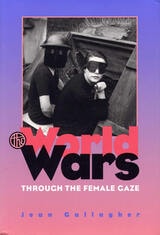
The World Wars Through the Female Gaze
Jean Gallagher
Southern Illinois University Press, 1998
For some women writers and photographers during the two world wars—Edith Wharton, Mildred Aldrich, Martha Gellhorn, Lee Miller, H.D., and Gertrude Stein—the construction of the female subject as an observer of combat became a vital concern. Their explorations of vision took place against the backdrop of a larger shift in Western culture's understanding of what "seeing" meant in common practice and philosophical discourse alike. The role of visuality in their lives was massively transformed not only by the rigid gender roles of war but by the introduction of new combat practices and technologies such as aerial surveillance, trench warfare, and civilian bombardment.
In The World Wars Through the Female Gaze, Jean Gallagher maps one portion of the historicized, gendered territory of what Nancy K. Miller calls the "gaze in representation." Expanding the notion of the gaze in critical discourse, Gallagher situates a number of visual acts within specific historic contexts to reconstruct the wartime female subject. She looks at both the female observer's physical act of seeing—and the refusal to see—for example, a battlefield, a wounded soldier, a torture victim, a national flag, a fashion model, a bombed city, or a wartime hallucination.
The book begins with two instances of wartime propaganda written by American women in France in 1915. Both Edith Wharton's Fighting France and Mildred Aldrich's A Hilltop on the Marne offer a complex and often contradictory sense of a woman writer's struggles with authority, resistance, and killing. In the process, Gallagher teases out the role of specular vision and the impossibility of "directly" seeing the war.
Gallagher then turns to literary and visual texts produced by two female journalists between 1940 and 1945. Martha Gellhorn's 1940 novel A Stricken Field exhibits a range of gendered seeing positions within and in opposition to the visual ideologies of fascism during the Nazi occupation of Czechoslovakia. Lee Miller's war correspondence and photography for Vogue show how Miller constructed herself and her predominantly female American audience as antifascist observers of war by working with and against some of the conventions of surrealist fashion photography.
Gallagher concludes by focusing on the experimental autobiographical prose of H.D. and Gertrude Stein to explore the functions of vision on two World War II "homefronts"—London during the Blitz and Vichy France.
The Young Lions
Irwin Shaw
University of Chicago Press, 2000
In the immediate aftermath of World War II, countless American writers attempted to use fiction to convey the complicated experience they'd just undergone. Few of the novels that emerged from that period were as ambitious and powerful as The Young Lions, a sweeping, dramatic account of war from the point of view of ordinary solders that depicts the danger, excitement, trauma, and loss of a no-holds-barred global war.
When Irwin Shaw published The Young Lions, he was known solely as a writer of short stories, and his panoramic, detailed, unforgettable account of the war was met with nothing short of awe. Shaw tells his story from the points of view of a perceptive young Nazi, a jaded American film producer, and a shy Jewish boy just married to the love of his life. Together they enable us to see, decades lateer, as no other novelist has since, the scope, confusion, and complexity of war.
This is a landmark novel that Washington Post critic Jonathan Yardley ranked with wartime classics like From Here to Eternity, The Naked and the Dead, and The Caine Mutiny. As James Salter writes in his foreword, "The Second World War was the central event of Shaw’s generation. The writers who stand in some glory about its forgotten battlefields and whose novels came from firsthand knowledge—Mailer, heller, James Jones, Michener—include, indomitable in their midst. Irwin Shaw. He need not to have bowed to any of them then, or, if he were still alive, now."
Theater, War, and Memory in Crisis
Vichy, Algeria, the AftermathJohn Ireland
University of Michigan Press, 2025
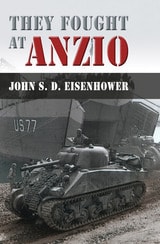
They Fought at Anzio
John S. D. Eisenhower
University of Missouri Press, 2025
Italy, from the toe to the Alps, was the scene of the longest, bloodiest, most frustrating, and least understood series of battles fought by the Western Allies during World War II. Now, John S. D. Eisenhower offers a new look at the Italian campaign, emphasizing the Anzio offensive—an operation pushed by Winston Churchill that fell largely to American troops to carry out. It was visualized as an amphibious landing of two Allied divisions behind German lines that would force the Wehrmacht to evacuate all of Italy. But the Germans held on and, with the arrival of reinforcements, nearly wiped out the Allied troops pinned down at Anzio Beach.
By portraying that struggle from the perspectives of both commanders and foot soldiers, this prominent military historian focuses on the experiences of the individuals who fought in the Italian campaign to reveal what the battle at Anzio was all about. But more than the account of one operation, They Fought at Anzio covers the entire Italian campaign, from the landings at Salerno to the capture of Rome.
Eisenhower brings a trained eye to reconstructing the difficult terrain of battle, approaching the Anzio campaign as a contest between opposing commands striving to anticipate and counter the opponent’s moves—not as a field exercise but as a deadly struggle for survival. He analyzes the command decisions that brought about the Anzio stalemate, interspersing his account with personal experiences of the men in the trenches, the nurses of the 56th Evacuation Hospital, and the young officers witnessing the horrors of war for the first time.
As a study in command, Eisenhower’s narrative gives new credit to generals Lucian Truscott and Fred Walker and assesses both the strengths and weaknesses of General Mark Clark, allowing us to grasp the situation as it appeared to those in command. He also offers compelling portraits of German commanders Field Marshal Albert Kesselring and General Frido von Senger und Etterlin.
It has been said that Anzio was a soldier’s battle, remembered more for blood shed than for military objectives achieved. By focusing on the experiences of the soldiers who fought there and the decisions of commanders in perilous circumstances, They Fought at Anzio offers a new appreciation of the contributions of both and a new understanding of this unheralded theater of the war.
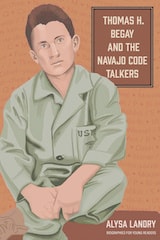
Thomas H. Begay and the Navajo Code Talkers
Alysa Landry
Ohio University Press, 2023
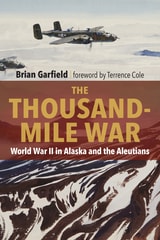
Thousand-Mile War
World War II in Alaska and the AleutiansBrian Garfield
University of Alaska Press, 1995
The war in the Aleutians was fought in some of the worst climatic conditions on earth for men, ships, and airplanes. The sea was rough, the islands craggy and unwelcoming, but the most fearful enemy was the weather—the savage wind, fog, and rain of the Aleutian chain. The fog seemed to reach even into the minds of the military commanders on both sides, as they directed their men into situations with often had tragic results. Frustrating, befuddling, and still the subject of debate, the Aleutian campaign nevertheless marked an important turn of the war in favor of the United States.
More than half a century after the war ended, more of the fog has been lifted. In this updated edition, Garfield supplements his original account drawn from statistics, personal interviews, letters, and diaries, with more recently declassified photographs and significant additional illustrations.
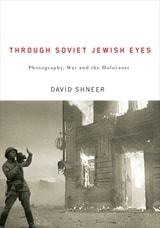
Through Soviet Jewish Eyes
Photography, War, and the HolocaustShneer, David
Rutgers University Press, 2012
These wartime photographers were the first liberators to bear witness with cameras to Nazi atrocities, three years before Americans arrived at Buchenwald and Dachau. In this passionate work, David Shneer tells their stories and highlights their work through their very own images-he has amassed never-before-published photographs from families, collectors, and private archives.
Through Soviet Jewish Eyes helps us understand why so many Jews flocked to Soviet photography; what their lives and work looked like during the rise of Stalinism, during and then after the war; and why Jews were the ones charged with documenting the Soviet experiment and then its near destruction at the hands of the Nazis.
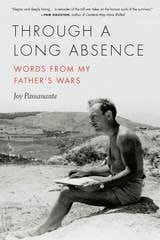
Through a Long Absence
Words from My Father's WarsJoy Passanante
The Ohio State University Press, 2017
Against the backdrop of World War II, Joy Passanante’s touching new book, Through a Long Absence: Words from My Father’s Wars, is the saga of a wartime medical unit, a passionate long-distance love, the making of a surgeon, and two first-generation American families. Told through her father’s eyes—drawing on hundreds of his letters to his beloved wife, his four-volume wartime diary, and his paintings—Passanante masterfully recreates his wartime journey and physically retraces his steps more than sixty years later in an attempt to understand a time in her parents’ lives that they’d spoken about very little.
More than just a World War II story, Through a Long Absence delves into one man’s past to explore his personal wars: a stint as a child bootlegger, a marriage between newlyweds separated by continents and strained by years apart, and his struggle late in life with his own mind. The narrative propels readers to surprising places—from a freight train through North Africa to an underground St. Louis distillery during Prohibition, from a young couple’s forbidden courtship to the chaos of surgical tents under fire in Normandy, from an underground trove of priceless artwork hidden by the Nazis to Jewish New Year services in Paris a week after its liberation. Through a Long Absence is a love story, an honest look into one man’s life, and a daughter’s moving quest to rediscover her father years later through his own words.
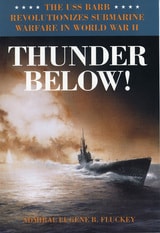
Thunder Below!
The USS *Barb* Revolutionizes Submarine Warfare in World War IIAdmiral Eugene B. Fluckey
University of Illinois Press, 1992
Under the leadership of her fearless skipper, Captain Gene Fluckey, the Barb sank the greatest tonnage of any American sub in World War II. At the same time, the Barb did far more than merely sink ships-she changed forever the way submarines stalk and kill their prey.
This is a gripping adventure chock-full of "you-are-there" moments. Fluckey has drawn on logs, reports, letters, interviews, and a recently discovered illegal diary kept by one of his torpedomen. And in a fascinating twist, he uses archival documents from the Japanese Navy to give its version of events.
The unique story of the Barb begins with its men, who had the confidence to become unbeatable. Each team helped develop innovative ideas, new tactics, and new strategies. All strove for personal excellence, and success became contagious. Instead of lying in wait under the waves, the USS Barb pursued enemy ships on the surface, attacking in the swift and precise style of torpedo boats. She was the first sub to use rocket missiles and to creep up on enemy convoys at night, joining the flank escort line from astern, darting in and out as she sank ships up the column.
Surface-cruising, diving only to escape, "Luckey Fluckey" relentlessly patrolled the Pacific, driving his boat and crew to their limits. There can be no greater contrast to modern warfare's long-distance, videogame style of battle than the exploits of the captain and crew of the USS Barb, where they sub, out of ammunition, actually rammed an enemy ship until it sank.
Thunder Below! is a first-rate, true-life, inspirational story of the courage and heroism of ordinary men under fire.
A Main Selection of the Military Book Club. Winner of the Rear Admiral Samuel Eliot Morison Award for Naval Literature given by the Naval Order of the United States, New York Commandery.

Tides Of War
World News Reporting 1931-1945Robert W. Desmond
University of Iowa Press, 1984
Tito, Mihailovic, and the Allies
Walter R. Roberts
Duke University Press, 1987

To Lose a War
Memories of a German GirlRegina Maria Shelton
Southern Illinois University Press, 1982
Martin Blumenson refers to this book as a “sensitive, beautifully written personal memoir,” and calls it a contribution to understanding, “particularly to Americans who know little of how World War II and its immediate aftermath disrupted the lives of those who survived the defeat of Germany.”
Vividly, humanly, Shelton tells her story from the point of view of a teen-age German girl, one who witnessed her country’s surge to power and who felt the ignominy of both Germany and Germans after the fall. She reaches a point during the war when “Sometimes the way we now live seems unreal, as if we were marionettes, with orders and permits and schedules attached to us instead of strings.”
But after the defeat of Germany life gets considerably worse. The victorious Russians evict the natives from their homes. They sneer and leer at the women who must venture forth for food. In this defeated land “the nights become unbearably long; without any physical activity by day, sleep refuses to come. I yearn for sleep, be it temporary or eternal. Death is becoming a friend; the enemy has a new name now: Rape.”
Then comes the dreaded order to evacuate all Germans from Lower Silesia: “How can a whole people be uprooted, disowned, tossed aside like useless flotsam—how? With the stroke of a pen, with a new line drawn on a map, we are sentenced to homelessness.” Not knowing where they will be sent, they plod out into darkness and cold with the other Germans, their worldly goods reduced to what they can carry. Embittered, they are herded into vermin-infested freight cars, still unaware of their destination.
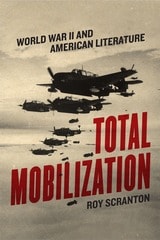
Total Mobilization
World War II and American LiteratureRoy Scranton
University of Chicago Press, 2019
Since World War II, the story of the trauma hero—the noble white man psychologically wounded by his encounter with violence—has become omnipresent in America’s narratives of war, an imaginary solution to the contradictions of American political hegemony. In Total Mobilization, Roy Scranton cuts through the fog of trauma that obscures World War II, uncovering a lost history and reframing the way we talk about war today.
Considering often overlooked works by James Jones, Wallace Stevens, Martha Gellhorn, and others, alongside cartoons and films, Scranton investigates the role of the hero in industrial wartime, showing how such writers struggled to make sense of problems that continue to plague us today: the limits of American power, the dangers of political polarization, and the conflicts between nationalism and liberalism. By turning our attention to the ways we make war meaningful—and by excavating the politics implicit within the myth of the traumatized hero—Total Mobilization revises the way we understand not only World War II, but all of postwar American culture.
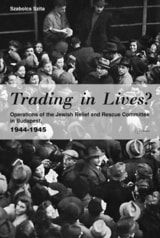
Trading in Lives?
Operations of the Jewish Relief and Rescue Committee in Budapest, 1944-1945Szabolcs Szita
Central European University Press, 2005
Transgenerational Remembrance
Performance and the Asia-Pacific War in Contemporary JapanJessica Nakamura
Northwestern University Press, 2020
In Transgenerational Remembrance, Jessica Nakamura investigates the role of artistic production in the commemoration and memorialization of the Asia-Pacific War (1931–1945) in Japan since 1989. During this time, survivors of Japanese aggression and imperialism, previously silent about their experiences, have sparked contentious public debates about the form and content of war memories.
The book opens with an analysis of the performance of space at Yasukuni Shinto Shrine, which continues to promote an anachronistic veneration of the war. After identifying the centrality of performance in long-standing dominant narratives, Transgenerational Remembrance offers close readings of artistic performances that tackle subject matter largely obscured before 1989: the kamikaze pilot, Japanese imperialism, comfort women, the Battle of Okinawa, and Japanese American internment. These case studies range from Hirata Oriza’s play series about Japanese colonial settlers in Korea and Shimada Yoshiko’s durational performance about comfort women to Kondo Aisuke’s videos and gallery installations about Japanese American internment.
Working from theoretical frameworks of haunting and ethics, Nakamura develops an analytical lens based on the Noh theater ghost. Noh emphasizes the agency of the ghost and the dialogue between the dead and the living. Integrating her Noh-inflected analysis into ethical and transnational feminist queries, Nakamura shows that performances move remembrance beyond current evidentiary and historiographical debates.
Trap with a Green Fence
Survival in TreblinkaRichard Glazar
Northwestern University Press, 1995
Triumph of the Dead
American World War II Cemeteries, Monuments, and Diplomacy in FranceKate Clarke Lemay
University of Alabama Press, 2018
Between 1948 and 1956, the United States government planned an enormous project to build fourteen permanent overseas military cemeteries in Europe. These park-like burial grounds eventually would hold the graves of approximately 80,000 American soldiers and nurses who died during or immediately after World War II. Five of these cemeteries are located in France, more than any other nation: two in Normandy; one in Provence; and two in Lorraine.
In Triumph of the Dead: American World War II Cemeteries, Monuments, and Diplomacy in France, Kate Clarke Lemay explores the relationship between art, architecture, war memory, and Franco-American relations. She addresses the many functions, both original and more recent, that the American war cemeteries have performed, such as: war memorials, diplomatic gestures, Cold War political statements, prompts for debate about Franco-American relations, and the nature of French identity itself. Located on or near former battlefields, the American war cemeteries are at once history lessons, sites of memory, and commemorative monuments. As places of mourning, war cemeteries are considerably different than civic cemeteries in their rituals, designs, and influences on collective memory. As transatlantic sites, the cemeteries both construct and sustain an American memory of World War II for a Francophile and European audience.
The book features ten color photographs, fifty black and white photographs, and four maps. Scholars as well as enthusiasts of World War II history, mid-century art and architecture, and cultural diplomacy will be interested in reading this richly researched book, the first in-depth history of some of the most important sites of American World War II remembrance.
Truman and the Hiroshima Cult
Robert P. Newman
Michigan State University Press, 1995
The United States dropped atomic bombs on Japan in 1945 to end World War II as quickly and with as few casualties as possible. That is the compelling and elegantly simple argument Newman puts forward in his new study of World War II's end, Truman and the Hiroshima Cult. According to Newman: (1) The U.S. Strategic Bombing Survey conclusions that Japan was ready to surrender without "the Bomb" are fraudulent; (2) America’s "unconditional surrender" doctrine did not significantly prolong the war; and (3) President Harry S. Truman’s decision to use atomic weapons on Japanese cities was not a "racist act," nor was it a calculated political maneuver to threaten Joseph Stalin’s Eastern hegemony. Simply stated, Newman argues that Truman made a sensible military decision. As commander in chief, he was concerned with ending a devastating and costly war as quickly as possible and with saving millions of lives.
Yet, Newman goes further in his discussion, seeking the reasons why so much hostility has been generated by what happened in the skies over Hiroshima and Nagasaki in early August, 1945. The source of discontent, he concludes, is a "cult" that has grown up in the United States since the 1960s. It was weaned on the disillusionment spawned by concerns about a military industrial complex, American duplicity and failure in the Vietnam War, and a mistrust of government following Watergate. The cult has a shrine, a holy day, a distinctive rhetoric of victimization, various items of scripture, and, in Japan, support from a powerful Marxist constituency. "As with other cults, it is ahistorical," Newman declares. "Its devotees elevate fugitive and unrepresentative events to cosmic status. And most of all, they believe." Newman’s analysis goes to the heart of the process by which scholars interpret historical events and raises disturbing issues about the way historians select and distort evidence about the past to suit special political agendas.
Tubby
Raymond O. Barton and the US Army, 1889-1963Stephen A. Bourque
University of North Texas Press, 2024
Twenty-Three Minutes to Eternity
The Final Voyage of the Escort Carrier USS Liscome BayJames L. Noles
University of Alabama Press, 2004