Results by title
5448 books match the query 'History and criticism' and 1116 start with t
Theory of African Music, Volume II
Gerhard Kubik
University of Chicago Press, 2010
In this second volume, Kubik explores a variety of topics, including Yoruba chantefables, the musical Kachamba family of Malawˆ i, and the cognitive study of African rhythm. Drawing on his remarkable ability to make cross-cultural comparisons, Kubik illuminates every facet of the African understanding of rhythm, from timing systems to elementary pulsation. His analysis of tusona ideographs in Luchazi culture leads to an exploration of African space/time concepts that synthesizes his theories of art, rhythm, and culture.
Featuring a large number of photographs and accompanied by a compact disc of Kubik’s own recordings, Theory of African Music, Volume II, will be an invaluable reference for years to come.
Theory’s Autoimmunity
Skepticism, Literature, and PhilosophyZahi Zalloua
Northwestern University Press, 2018
Openness to change comes with risks, and the self-protective temptation to immunize oneself or one's community against these risks is strong. Yet without such risks, without openness to otherness, no encounter with the new, with difference, can ever take place. Without autoimmunity, theory becomes stagnant and programmatic, unable to receive and respond to the other or the event, to address, revise, and produce new meanings.
Taking up the challenge of thinking theory as skepticism, with and against philosophy, this study turns to literature as an interlocutor, investigating the ways theory, like the literary works of Montaigne, Baudelaire, Stendhal, Morrison, or Duras, declines to put on the interpretive brakes, to stop reading at a point of understanding. Undoing and remaking itself, theory—those critical interpretive practices that revel in the creation and proliferation of meaning—becomes autoimmune.
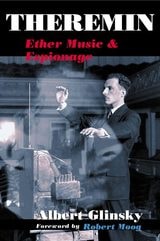
Theremin
Ether Music and EspionageAlbert Glinsky
University of Illinois Press, 2000
A creative genius and prolific inventor, Leon Theremin almost single-handedly launched the field of electronic music in 1920. The theremin--the only musical instrument that is played without being touched--created a sensation worldwide and paved the way for the modern synthesizer. But the otherworldly sound that entranced millions was only part of Theremin's epic life.
As a Soviet scientist, Theremin surrendered his life and work to the service of State espionage. On assignment in Depression-era America, he worked the engines of capitalist commerce while passing data on US industrial technology to the Soviet apparat. Following his sudden disappearance in 1938, Theremin vanished into the top-secret Soviet intelligence machine and was presumed dead for nearly thirty years. Using the same technology that spawned the theremin, he designed bugging devices and a host of other electronic wonders, including an early television and multimedia devices that anticipated performance art and virtual reality by decades.
Albert Glinsky's biography places the inventor at world events stretching from the Russian Revolution through the Cold War to perestroika. Throughout, he spins whimsy and treachery into an astonishing drama of one man's hidden loyalties, mixed motivations, and irrepressibly creative spirit.
There’s No Place Like Home Video
James M. Moran
University of Minnesota Press, 2002
Defines, examines, and elevates home video to its rightful place
From its recording of family events to its influence on filmmaking, home video defies easy categorization and demands serious consideration. In There’s No Place Like Home Video, James Moran takes on this neglected aspect of popular culture. He offers a cultural history of amateur home video, exploring its technological and ideological predecessors, the development of event videography, and its symbiotic relationship with television and film. He also investigates the broader field of video, taking on the question of medium specificity: the attempt to define its unique identity, to capture what constitutes its pure practice.
In Moran’s discussion of video, he argues that previous scholars have not sufficiently dealt with its nature as hybrid, varied, and mutable. He argues that such a medium shouldn’t be conceived as pure in and of itself; it is neither autonomous from other media nor entirely dependent on any other, but instead has a chameleonlike interface with films, television, computers, telephones, and even architecture. Rather than look for a grand narrative to define its specificity, Moran places video and home video at the intersections of multiple forms of communication.
These Valiant Dead
Past Shakespeare'S HistoriesRobert C. Jones
University of Iowa Press, 1991
They Came to Nashville
Marshall Chapman
Vanderbilt University Press, 2010
In They Came to Nashville, Chapman records the personal stories of musicians shaping the modern history of music in Nashville, from the mouths of the musicians themselves. The trials, tribulations, and evolution of Music City are on display, as she sits down with influential figures like Kris Kristofferson, Emmylou Harris, and Miranda Lambert, and a dozen other top names, to record what brought each of them to Nashville and what inspired them to persevere. The book culminates in a hilarious and heroic attempt to find enough free time with Willie Nelson to get a proper interview. Instead, she's brought along on his raucous 2008 tour and winds up onstage in Beaumont, Texas singing "Good-Hearted Woman" with Willie.
They Came to Nashville reveals the daily struggle facing newcomers to the music business, and the promise awaiting those willing to fight for the dream.
Co-published with the Country Music Foundation Press
Thicker Than Water
Blood, Affinity, and Hegemony in Early Modern DramaLauren Weindling
University of Alabama Press, 2023
Examines the discourses around the role of bloodlines and kinship in the social hierarchies of early modern Europe
“Blood is thicker than water,” goes the old proverb. But do common bloodlines in fact demand special duties or prescribe affections? Thicker than Water examines the roots of this belief by studying the omnipresent discourse of bloodlines and kindred relations in the literature of early modern Europe.
Early modern discourses concerning kinship promoted the idea that similar bloodlines dictated greater love or affinity, stabilizing the boundaries of families and social classes, as well as the categories of ethnicity and race. Literary representations of romantic relationships were instrumental in such conceptions, and Lauren Weindling examines how drama from England, France, and Italy tests these assumptions about blood and love, exposing their underlying political function. Among the key texts that Weindling studies are Shakespeare’s Romeo and Juliet¸ Othello, and The Merchant of Venice, Pierre Corneille’s Le Cid, Giambattista della Porta’s La Sorella and its English analog, Thomas Middleton’s No Wit/Help Like a Woman’s, John Ford’s ’Tis Pity She’s a Whore, and Machiavelli’s La Mandragola.
Each of these plays offers an extreme limit case for early modern notions of belonging and exclusion, through plots of love, courtship, and marriage, including blood feuds and incest. Moreover, they feature the voices of marginalized groups, unprivileged by these metrics and ideologies, and thus offer significant counterpoints to this bloody worldview.
While most critical studies of blood onstage pertain to matters of guilt or violence, Thicker Than Water examines the work that blood does unseen in arbitrating social and emotional connections between persons, and thus underwriting our deepest forms of social organization.
Thiefing Sugar
Eroticism between Women in Caribbean LiteratureOmise eke Natasha Tinsley
Duke University Press, 2010
Thieving Three-Fingered Jack
Transatlantic Tales of a Jamaican Outlaw, 1780-2015Botkin, Frances R.
Rutgers University Press, 2018
The fugitive slave known as “Three-Fingered Jack” terrorized colonial Jamaica from 1780 until vanquished by Maroons, self-emancipated Afro-Jamaicans bound by treaty to police the island for runaways and rebels. A thief and a killer, Jack was also a freedom fighter who sabotaged the colonial machine until his grisly death at its behest. Narratives about his exploits shed light on the problems of black rebellion and solutions administered by the colonial state, creating an occasion to consider counter-narratives about its methods of divide and conquer. For more than two centuries, writers, performers, and storytellers in England, Jamaica, and the United States have “thieved" Three Fingered Jack's riveting tale, defining black agency through and against representations of his resistance.
Frances R. Botkin offers a literary and cultural history that explores the persistence of stories about this black rebel, his contributions to constructions of black masculinity in the Atlantic world, and his legacies in Jamaican and United States popular culture.
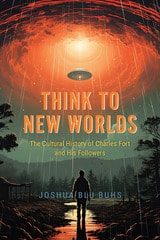
Think to New Worlds
The Cultural History of Charles Fort and His FollowersJoshua Blu Buhs
University of Chicago Press, 2024
Flying saucers. Bigfoot. Frogs raining from the sky. Such phenomena fascinated Charles Fort, the maverick writer who scanned newspapers, journals, and magazines for reports of bizarre occurrences: dogs that talked, vampires, strange visions in the sky, and paranormal activity. His books of anomalies advanced a philosophy that saw science as a small part of a larger system in which truth and falsehood continually transformed into one another. His work found a ragged following of skeptics who questioned not only science but the press, medicine, and politics. Though their worldviews varied, they shared compelling questions about genius, reality, and authority. At the center of this community was adman, writer, and enfant terrible Tiffany Thayer, who founded the Fortean Society and ran it for almost three decades, collecting and reporting on every manner of oddity and conspiracy.
In Think to New Worlds, Joshua Blu Buhs argues that the Fortean effect on modern culture is deeper than you think. Fort’s descendants provided tools to expand the imagination, explore the social order, and demonstrate how power is exercised. Science fiction writers put these ideas to work as they sought to uncover the hidden structures undergirding reality. Avant-garde modernists—including the authors William Gaddis, Henry Miller, and Ezra Pound, as well as Surrealist visual artists—were inspired by Fort’s writing about metaphysical and historical forces. And in the years following World War II, flying saucer enthusiasts convinced of alien life raised questions about who controlled the universe.
Buhs’s meticulous and entertaining book takes a respectful look at a cast of oddballs and eccentrics, plucking them from history’s margins and spotlighting their mark on American modernism. Think to New Worlds is a timely consideration of a group united not only by conspiracies and mistrust of science but by their place in an ever-expanding universe rich with unexplained occurrences and visionary possibilities.
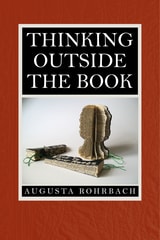
Thinking Outside the Book
Augusta Rohrbach
University of Massachusetts Press, 2014
In Thinking Outside the Book, Augusta Rohrbach works through the increasing convergences between digital humanities and literary studies to explore the meaning and primacy of the book as a literary, material, and cultural artifact. Rohrbach assembles a rather unlikely cohort of nineteenth-century women writers—Jane Johnston Schoolcraft, Sojourner Truth, Hannah Crafts, Augusta Evans, and Mary Chesnut—to consider the publishing culture of their period from the perspective of our current digital age, bringing together scholarly concepts from both print culture and new media studies.
In nineteenth-century America, women from a variety of racial and class affiliations were bombarding the print market with their literary productions, taking advantage of burgeoning rates of literacy and advances in publishing technology. Their work challenged prevailing modes of authorship and continues to do so today. Each chapter of Thinking Outside the Book positions a focal figure as both paradigmatic and problematic within the context of key terms that define the study of the book. In lieu of terms such as literacy, authorship, publication, edition, and editor, Rohrbach develops an alternate typology that includes mediation, memory, history, testimony, and loss. Recognizing that the field spans radio, cinema, television, and the Internet, she draws comparisons to the present day, when Web 2.0 allows writers from varying backgrounds and positions to seek out readers without “gatekeepers” limiting their exposure.
More than a literary history, this book takes up theories of recovery, literacy, authorship, narrative, the book, and new media in connection with race, gender, class, and region.
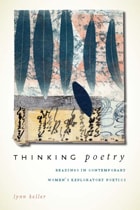
Thinking Poetry
Readings in Contemporary Women’s Exploratory PoeticsLynn Keller
University of Iowa Press, 2010
As the twentieth century drew to a close, experimentalism in American poetry was most commonly identified with Language writing. At the same time, however, a number of poets, many of them women, were developing their own alternative forms of experimentalism, creating “uncommon languages” often indebted to Language writing but distinct from it.
With impressive intellectual engagement and nuanced presentation, Thinking Poetry provides a meticulous and provocative analysis of the ways in which Alice Fulton, Myung Mi Kim, Joan Retallack, Cole Swensen, Rosmarie Waldrop, Susan Wheeler, and C. D. Wright explored varied compositional strategies and created their own innovative works. In doing so, Lynn Keller resourcefully models a range of reading strategies that will assist others in analyzing the complex epistemology and craft of recent “exploratory” writing.
The seven women whose work is discussed here demonstrate widely differing ways of using poetry to, as Swensen puts it, “stretch the boundaries of the sayable.” Thinking Poetry examines approaches to women’s poetic exploration, ranging from radically open, thoroughly disjunctive writing to feminist experimentation within relatively conventional free verse forms; from texts testing the resources of visual elements and page space to those in which multilingualism or digital technology provide arenas for innovation; from revitalized forms of ekphrasis to fresh approaches to pop culture.
Keller illuminates as well a transitional era in U.S. poetry that presaged current developments that are often seen as combining the poetics of personal lyric and Language writing. Thinking Poetry challenges reductive notions of such a synthesis as it makes clear that the groundwork for current poetic trends was laid by poets who, in a far more polarized climate, pursued their own, often distinctly feminist, visions of necessary innovation.
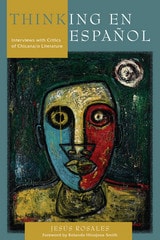
Thinking en español
Interviews with Critics of Chicana/o LiteratureJesús Rosales; Foreword by Rolando Hinojosa-Smith
University of Arizona Press, 2014
The twelve critics interviewed for this project share certain characteristics. For each one, Mexico plays an essential role in his or her personal and academic background, and each is bilingual and bicultural, having received formal literary education in Spanish graduate programs. As products of the working class, each scholar here shares a sense of social consciousness and commitment that lends an urgency to their desire to promote Chicano literature and culture at the local, regional, national, and international levels. They serve as a source of inspiration and commitment for future generations of scholars of Chicano literature and leave a lasting legacy of their own.
Thinking en español legitimizes Chicana/o criticism as an established discipline, and documents the works of some of the most important critics of Chicano literature at the turn of the twentieth and into the twenty-first century. This timely book immortalizes literary historical figures and documents the trajectory of Chicano criticism.

Thinking in Cases
Fiction, Law, and the Case HistoryPeter Brooks
University of Chicago Press, 2027
How the form of the case history became an important way of studying the individual as an exemplary case in medicine, psychoanalysis, law, and the novel.
What does it mean when we address ourselves to a specific problem and treat it as a “case” that needs resolution, a resolution that may in turn offer us more general lessons? The “case history” has become a central form of thought and analysis in our culture, but rarely has it been studied on its own. In Thinking in Cases, the distinguished critic Peter Brooks zeroes in on a kind of thinking that we all know—and often use—without understanding its dimensions and its history.
This book ponders what we do and mean when we think in cases—when we take up specific instances with a view to making them exemplary. Brooks brings to this study decades of reflection on the psychoanalytic case history, on the rhetoric of the legal case, and on novels that unfold as cases seeking solutions. Brooks focuses on the case-history’s emergence in the late nineteenth century: first, he examines how Henry James’s uses of narrative parallel case-study methods in law, medicine, and psychoanalysis. Elsewhere, he traces the case history from Hippocratic medicine through Sir Arthur Conan Doyle’s detective fiction to a startling legal case from Victorian England involving shipwreck and cannibalism. Other chapters discuss a tale of madness by Balzac and Freud’s most speculative works, especially Moses and Monotheism. A final chapter examines recent novels—Duras’s The Ravishing of Lol Stein, Coetzee’s Disgrace, Modiano’s Dora Bruder, and Erpenbeck’s Kairos—as case studies.
Thinking in Henry James
Sharon Cameron
University of Chicago Press, 1989
Thinking in Jazz
The Infinite Art of ImprovisationPaul F. Berliner
University of Chicago Press, 1994
The product of more than fifteen years of immersion in the jazz world, Thinking in Jazz combines participant observation with detailed musicological analysis, the author's experience as a jazz trumpeter, interpretations of published material by scholars and performers, and, above all, original data from interviews with more than fifty professional musicians: bassists George Duvivier and Rufus Reid; drummers Max Roach, Ronald Shannon Jackson, and Akira Tana; guitarist Emily Remler; pianists Tommy Flanagan and Barry Harris; saxophonists Lou Donaldson, Lee Konitz, and James Moody; trombonist Curtis Fuller; trumpeters Doc Cheatham, Art Farmer, Wynton Marsalis, and Red Rodney; vocalists Carmen Lundy and Vea Williams; and others. Together, the interviews provide insight into the production of jazz by great artists like Betty Carter, Miles Davis, Dizzy Gillespie, Coleman Hawkins, and Charlie Parker.
Thinking in Jazz overflows with musical examples from the 1920s to the present, including original transcriptions (keyed to commercial recordings) of collective improvisations by Miles Davis's and John Coltrane's groups. These transcriptions provide additional insight into the structure and creativity of jazz improvisation and represent a remarkable resource for jazz musicians as well as students and educators.
Berliner explores the alternative ways—aural, visual, kinetic, verbal, emotional, theoretical, associative—in which these performers conceptualize their music and describes the delicate interplay of soloist and ensemble in collective improvisation. Berliner's skillful integration of data concerning musical development, the rigorous practice and thought artists devote to jazz outside of performance, and the complexities of composing in the moment leads to a new understanding of jazz improvisation as a language, an aesthetic, and a tradition. This unprecedented journey to the heart of the jazz tradition will fascinate and enlighten musicians, musicologists, and jazz fans alike.
Third-Generation Holocaust Representation
Trauma, History, and MemoryVictoria Aarons and Alan L. Berger
Northwestern University Press, 2017
This Book Is an Action
Feminist Print Culture and Activist AestheticsEdited by Jaime Harker and Cecilia Konchar Farr
University of Illinois Press, 2016

This Giving Birth
Pregnancy and Childbirth in American Women's WritingJulie Tharp
University of Wisconsin Press, 2000
This Is All I Choose to Tell
History and Hybridity in Vietnamese American LiteratureAuthored by Isabelle T. Pelaud
Temple University Press, 2010
In the first book-length study of Vietnamese American literature, Isabelle Thuy Pelaud probes the complexities of Vietnamese American identity and politics. She provides an analytical introduction to the literature, showing how generational differences play out in genre and text. In addition, she asks, can the term Vietnamese American be disassociated from representations of the war without erasing its legacy?
Pelaud delineates the historical, social, and cultural terrains of the writing as well as the critical receptions and responses to them. She moves beyond the common focus on the Vietnam war to develop an interpretive framework that integrates post-colonialism with the multi-generational refugee, immigrant, and transnational experiences at the center of Vietnamese American narratives.
Her readings of key works, such as Andrew Pham's Catfish and Mandala and Lan Cao's Monkey Bridge show how trauma, racism, class and gender play a role in shaping the identities of Vietnamese American characters and narrators.
This Is Called Moving
A Critical Poetics of FilmAbigail Child, with a foreword by Tom Gunning
University of Alabama Press, 2005
A pioneering exploration of how poetry and experimental cinema intersect to reconstruct meaning across visual and linguistic forms.
As the writer, director, producer, and cinematographer of almost all her 30 films, videos, and shorts, Abigail Child has been recognized as a major and influential practitioner of experimental cinema since the early 1970s. Hallmarks of her style are the appropriation and reassembly of found footage and fragments from disparate visual sources, ranging from industrial films and documentaries to home movies, vacation photography, and snippets of old B movies.
The resulting collages and montages are cinematic narratives that have been consistently praised for their beauty and sense of wonder and delight in the purely visual. At the same time, Child's films are noted for their incisive political commentary on issues such as gender and sexuality, class, voyeurism, poverty, and the subversive nature of propaganda.
In the essays of This Is Called Moving, Child draws on her long career as a practicing poet as well as a filmmaker to explore how these two language systems inform and cross-fertilize her work. For Child, poetry and film are both potent means of representation, and by examining the parallels between them—words and frames, lines and shots, stanzas and scenes—she discovers how the two art forms re-construct and re-present social meaning, both private and collective.
This Is My Body
Representational Practices in the Early Middle AgesMichal Kobialka
University of Michigan Press, 2003
Michal Kobialka is Professor in the Department of Theatre Arts and Dance at the University of Minnesota.
This Thing Called the World
The Contemporary Novel as Global FormDebjani Ganguly
Duke University Press, 2016
Thomas Hardy'S Tragic Poetry
The Lyrics And The DynastsKatherine K. Maynard
University of Iowa Press, 1991
Contrary to some scholars, tragic poetry did not die with the rise of melodrama in nineteenth-century theater or the glowing secularism spread by the proliferation of liberal-scientific philosophies. Rather, artists found alternative means to portray tragic situations.Thomas Hardy's Tragic Poetry convincingly argues that Hardy's lyric poetry and The Dynasts occupy a pivotal place in the development of modern tragic poetry and drama, crystallizing the tragic feeling that surfaces intermittently in Romantic and Victorian poems and plays.
Many scholars have noted the tragic forms and themes of Thomas Hardy's novels, but the tragic quality of his lyric poems has received less critical attention. Katherine Maynard remedies that situation by tracing the emergence of the Hardyean figure—tragically isolated against the backdrop of a stark landscape, neutral universe, or indifferent social milieu—through both a review of critical opinion about tragedy's place within modern literature and a survey of the frustrated attempts by major nineteenth-century poets to write tragic drama. Hardy's epic-drama The Dynasts is seen as a fulcrum work, bearing many of the flaws of its dramatic forebears but also illustrating his use of contemporary science and philosophy in the service of dramatic irony. Maynard examines a significant sample of lyrics to identify the contribution of Hardy's poetry to our understanding of tragic literature. She places the thematic and formal innovations of Hardy's tragic poetry squarely within the main lines of development from Wordsworth's Solitary to Beckett's lone figures waiting in a desert for a Godot who never arrives.
Ultimately, Thomas Hardy's Tragic Poetry calls for a rereading of Hardy's poetry as "tragic," arguing that he was able, paradoxically, to incorporate these literary and philosophical conventions of his time which some critics insist signaled the death of tragic literature. This study will prove fascinating for Hardyists, students of nineteenth-century literature, and all those interested in the ongoing development of poetry.
Thomas Hardy's Brains
Psychology, Neurology, and Hardy's ImaginationSuzanne Keen
The Ohio State University Press, 2014
This study reveals how Hardy made sense of diverse sources of an affective human psychology, a discipline that expanded significantly during Hardy’s working life. From the 1870s to the turn of the twentieth century, the tools and techniques for studying the structures and function of the nervous system developed rapidly. Simultaneously, Hardy moved steadily toward realizing a more physiologically accurate rendering of brains and nerves.
Thomas Holcroft’s Revolutionary Drama
Reception and AfterlivesAmy Garnai
Bucknell University Press, 2023
Thomas Merton and the Inclusive Imagination
Ross Labrie
University of Missouri Press, 2001
Thomas Merton (1915-1968) was a Roman Catholic priest, a Trappist monk, a social activist, and a poet. Author of the celebrated autobiography The Seven Storey Mountain, Merton has been described as the most important American religious writer of the past hundred years. One of the notable characteristics of Merton's writing, both in poetry and in prose, was his seamless intermingling of religious and Romantic elements, an intermingling that, because of his gifts as a writer and because of his enormous influence, has had the effect of making widespread a distinctive form of religious thought and expression. In Thomas Merton and the Inclusive Imagination, Ross Labrie reveals the breadth of Merton's intellectual reach by taking an original and systematic look at Merton's thought, which is generally regarded as eclectic and unsystematic.
What captured Merton's attention about Romanticism and mysticism and what held his attention virtually all his life was his consciousness of the ontological significance of unity and wholeness. Even though he was far from being a systematic thinker, Merton's writings form a coherent whole when considered from the point of view of his emphasis on unity and wholeness. Labrie skillfully examines Merton's letters, journals, and individual works to show the full expanse of his contribution. By using insights from the Romantic literary tradition and from the mystical tradition, the author is able to make sense of Merton's writings from all periods of his life. Although Labrie covers such sweeping topics as consciousness, self, being, nature, time, myth, culture, and individuation, remaining focused on Merton's specific, unique contributions in each area.
This thought-provoking work, which takes into account material from the recent full publication of Merton's journals and from his Columbia University notebooks on Romanticism, not only shows Merton's intellectual growth but provides a look at his expansive interests as well. Thomas Merton and the Inclusive Imagination will make a significant contribution to Merton studies.
Thoreaus Sense of Place
Essays in American Environmental WritingRichard J. Schneider
University of Iowa Press, 2000
The contributors to this stimulating collection address the ways in which Thoreau and his successors attempt to cope with the basic epistemological split between perceiver and place inherent in writing about nature; related discussions involve the kinds of discourse most effective for writing about place. They focus on the impact on Thoreau and his successors of culturally constructed assumptions deriving from science, politics, race, gender, history, and literary conventions. Finally, they explore the implications surrounding a writer's appropriation or even exploitation of places and objects.
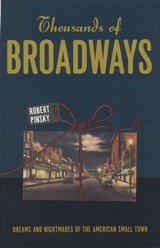
Thousands of Broadways
Dreams and Nightmares of the American Small TownRobert Pinsky
University of Chicago Press, 2009
Broadway, the main street that runs through Robert Pinsky’s home town of Long Branch, New Jersey, was once like thousands of other main streets in small towns across the country. But for Pinsky, one of America’s most admired poets and its former Poet Laureate, this Broadway is the point of departure for a lively journey through the small towns of the American imagination. Thousands of Broadways explores the dreams and nightmares of such small towns—their welcoming yet suffocating, warm yet prejudicial character during their heyday, from the early nineteenth century through World War II.
The citizens of quintessential small towns know one another extensively and even intimately, but fail to recognize the geniuses and criminal minds in their midst. Bringing the works of such figures as Mark Twain, William Faulkner, Alfred Hitchcock, Thornton Wilder, Willa Cather, and Preston Sturges to bear on this paradox, as well as reflections on his own time growing up in a small town, Pinsky explores how such imperfect knowledge shields communities from the anonymity and alienation of modern life. Along the way, he also considers how small towns can be small minded—in some cases viciously judgmental and oppressively provincial. Ultimately, Pinsky examines the uneasy regard that creative talents like him often have toward the small towns that either nurtured or thwarted their artistic impulses.
Of living in a small town, Sherwood Anderson once wrote that "the sensation is one never to be forgotten. On all sides are ghosts, not of the dead, but of living people." Passionate, lyrical, and intensely moving, Thousands of Broadways is a rich exploration of this crucial theme in American literature by one of its most distinguished figures.
Three Modern Italian Poets
Saba, Ungaretti, MontaleJoseph Cary
University of Chicago Press, 1993
Three Sons
Franz Kafka and the Fiction of J. M. Coetzee, Philip Roth, and W. G. SebaldDaniel L. Medin
Northwestern University Press, 2010
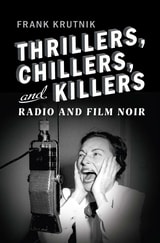
Thrillers, Chillers, and Killers
Radio and Film NoirFrank Krutnik
Rutgers University Press, 2025
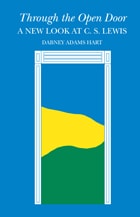
Through the Open Door
A New Look at C.S. LewisDabney Adams Hart
University of Alabama Press, 1984
Unlocking the imagination, language, and vision that shaped C. S. Lewis's enduring legacy.
Through the Open Door: A New Look at C. S. Lewis offers a fresh and illuminating examination of one of the twentieth century's most beloved writers, scholars, and Christian thinkers. In this insightful study, Dabney Adams Hart moves beyond familiar assessments of C. S. Lewis as the creator of The Chronicles of Narnia to explore the intellectual foundations that shaped his work as a literary critic, educator, and defender of the Christian faith. Drawing on Lewis's essays, criticism, fiction, and apologetic writings, Hart reveals the central importance of imagination, language, myth, and meaning in Lewis's understanding of literature and human experience.
Rather than treating Lewis's diverse writings as separate endeavors, Hart demonstrates how they reflect a coherent and unified vision of truth, beauty, and morality. The book shows how Lewis used story and symbolism to address enduring questions about faith, reason, and the search for purpose in a modern world. Accessible to general readers while engaging for scholars, this volume provides valuable insight into the ideas that continue to make Lewis a significant figure in literary and religious studies. An important contribution to Lewis scholarship, Through the Open Door invites readers to discover anew the imagination and intellect behind one of the most influential Christian authors of the modern era.
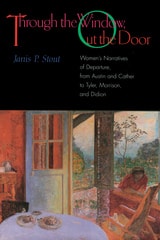
Through the Window, Out the Door
Women's Narratives of Departure, from Austin and Cather to Tyler, Morrison, and DidionJanis P. Stout
University of Alabama Press, 1998
This informative and provocative study focuses on the centrality of departure in the texts of five major American women novelists.
An important moment in many novels and poems by American women writers occurs when a central character looks out a window or walks out the door of a house. These acts of departure serve to convey such values as the rejection of constraining social patterns, the search for individual fulfillment, and the entry into the political.
Janis Stout examines such moments and related patterns of venture and travel in the fiction of five major American novelists of the 20th century: Mary Austin, Willa Cather, Anne Tyler, Toni Morrison, and Joan Didion. Stout views these five writers within a spectrum of narrative engagements with issues of home and departure—a spectrum anchored at one end by Sarah Orne Jewett and at the other by Marilynne Robinson, whose Housekeeping posits a vision of female transience.
Through the Window, Out the Door ranges over an expansive territory. Moving between texts as well as between texts and contexts, Stout shows how women writers have envisioned the walls of physical and social structures (including genres) as permeable boundaries, drawing on both a rhetoric of liberation and a rhetoric of domesticity to construct narrative arguments for women's right to move freely between the two. Stout concludes with a personal essay on the dilemmas of domesticity and the ambivalence of departure.
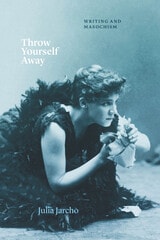
Throw Yourself Away
Writing and MasochismJulia Jarcho
University of Chicago Press, 2024
In a series of readings that engage American and European works of fiction, drama, and theory from the late nineteenth through the early twenty-first centuries, critic and playwright Julia Jarcho argues that these works conceive writing itself as masochistic, and masochism as sexuality enacted in writing. Throw Yourself Away is distinctive in its sustained focus on masochism as an engine of literary production across multiple authors and genres. In particular, Jarcho shows that theater has played a central role in modern erotic fantasies of the literary.
Jarcho foregrounds writing as a project of distressed subjects: When masochistic writing is examined as a strategy of response to injurious social systems, it yields a surprisingly feminized—and less uniformly white—image of both masochism and authorship. Ultimately, Jarcho argues that a retheorized concept of masochism helps us understand literature itself as a sex act and shows us how writing can tend to our burdened, desirous bodies. With startling insights into such writers as Henry James, Henrik Ibsen, Mary Gaitskill, and Adrienne Kennedy, Throw Yourself Away furnishes a new masochistic theory of literature itself.
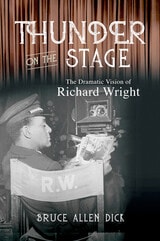
Thunder on the Stage
The Dramatic Vision of Richard WrightBruce Allen Dick
University of Illinois Press, 2024
Drawing on decades of research and interviews with Wright’s family and Wright scholars, Bruce Allen Dick uncovers the theatrical influence on Wright’s oeuvre--from his 1930s boxing journalism to his unpublished one-acts on returning Black GIs in WWII to his unproduced pageant honoring Vladimir Lenin. Wright maintained rewarding associations with playwrights, writers, and actors such as Langston Hughes, Theodore Ward, Paul Robeson, and Lillian Hellman, and took particular inspiration from French literary figures like Jean-Paul Sartre. Dick’s analysis also illuminates Wright’s direct involvement with theater and film, including the performative aspects of his travel writings; the Orson Welles-directed Native Son on Broadway; his acting debut in Native Son’s first film version; and his play “Daddy Goodness,” a satire of religious charlatans like Father Divine, in the 1930s.
Bold and original, Thunder on the Stage offers a groundbreaking reinterpretation of a major American writer.
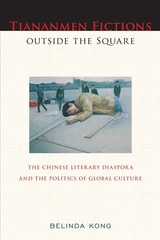
Tiananmen Fictions outside the Square
The Chinese Literary Diaspora and the Politics of Global CultureBelinda Kong
Temple University Press, 2012
An exciting analysis of the myriad literary effects of Tiananmen, Belinda Kong's Tiananmen Fictions Outside the Square is the first full-length study of fictions related to the 1989 movement and massacre. More than any other episode in recent world history, Tiananmen has brought a distinctly politicized Chinese literary diaspora into stark relief.
Kong redefines Tiananmen's meaning from an event that ended in local political failure to one that succeeded in producing a vital dimension of contemporary transnational writing today. She spotlights key writers-Gao Xingjian, Ha Jin, Annie Wang, and Ma Jian-who have written and published about the massacre from abroad. Their outsider/distanced perspectives inform their work, and reveal how diaspora writers continually reimagine Tiananmen's relevance to the post-1989 world at large.
Compelling us to think about how Chinese culture, identity, and politics are being defined in the diaspora, Tiananmen Fictions Outside the Square candidly addresses issues of political exile, historical trauma, global capital, and state biopower.
Tigers of a Different Stripe
Performing Gender in Dominican MusicSydney Hutchinson
University of Chicago Press, 2016
Drawing on over a decade of fieldwork in the Dominican Republic and New York among musicians, fans, and patrons of merengue típico—not to mention her own experiences as a female instrumentalist—Hutchinson details a complex nexus of class, race, and artistic tradition that unsettles the typical binary between the masculine and feminine. She sketches the portrait of the classic male figure of the tíguere, a dandified but sexually aggressive and street-smart “tiger,” and she shows how female musicians have developed a feminine counterpart: the tíguera, an assertive, sensual, and respected female figure who looks like a woman but often plays and even sings like a man. Through these musical figures and studies of both straight and queer performers, she unveils rich ambiguities in gender construction in the Dominican Republic and the long history of a unique form of Caribbean feminism.
Time Slips
Queer Temporalities, Contemporary Performance, and the Hole of HistoryJaclyn I. Pryor
Northwestern University Press, 2017
Masterfully synthesizing a wealth of research and experiences, Time Slips will interest scholars and readers in the fields of theater and performance studies, queer studies, and American studies.
Time and the Erotic in Horace's Odes
Ronnie Ancona
Duke University Press, 1994
Drawing on contemporary theory, including recent work in feminist criticism, Ancona provides close readings of fourteen odes, which are presented in English translation as well as in Latin. Through a discussion of the poet’s use of various temporal devices—the temporal adverb, seasonal imagery, and the lover or beloved’s own temporality—she shows how Horace makes time dominate the erotic context and, further, how the version of love that appears in his poems is characterized by the lover’s desire to control the beloved. The romantic ideal of a timeless love, apparently rejected by the poet, emerges here instead as an underlying element of the poet’s portrayal of the erotic. In a critique of the predominant modes of recent Horatian scholarship on the love odes, Ancona offers an alternative view that takes into account the male gender of the lover and its effect on the structure of desire in the poems. By doing so, she advances a broader project in recent classical studies that aims to include discussion of features of classical literature, such as sexuality and gender, which have previously escaped critical attention.
Addressing aspects of Horace as a love poet—especially the dynamics of gender relations—that critics have tended to ignore, this book articulates his version of love as something not to be championed or condemned but rather to be seen as challengingly problematic. Of primary interest to classicists, it will also engage the attention of scholars and teachers in the humanities with specializations in gender, sexuality, lyric poetry, or feminist theory.
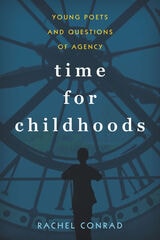
Time for Childhoods
Young Poets and Questions of AgencyRachel Conrad
University of Massachusetts Press, 2020
Time for Childhoods presents a selection of striking twentieth-and twenty-first-century American poetry written by young people, and highlights how young poets imagined and shaped time for their own poetic purposes. Through close engagement with archival materials, as well as select interviews and correspondence with adult mentors, Conrad discerns how young writers figured social realities and political and racial injustices, and discusses what important advocates such as Gwendolyn Brooks and June Jordan can teach us about supporting the agency of young poets. This essential study demonstrates that young poets have much to contribute to ongoing conversations about time and power.
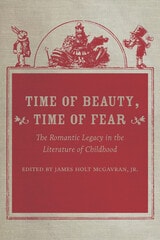
Time of Beauty, Time of Fear
The Romantic Legacy in the Literature of ChildhoodJames Holt McGavran, Jr.
University of Iowa Press, 2012

Times Remembered
The Final Years of the Bill Evans TrioJoe La Barbera
University of North Texas Press, 2021
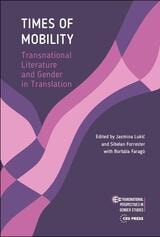
Times of Mobility
Transnational Literature and Gender in TranslationJasmina Lukic
Central European University Press, 2020
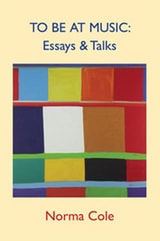
To Be At Music
Essays & TalksNorma Cole
Omnidawn, 2010
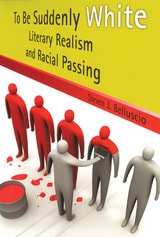
To Be Suddenly White
Literary Realism and Racial PassingSteven J. Belluscio
University of Missouri Press, 2006
To Be Suddenly White offers new readings of traditional passing narratives from the African American literary tradition, such as James Weldon Johnson’s The Autobiography of an Ex-Coloured Man, Nella Larsen’s Passing, and George Schuyler’s Black No More. It is also the first full-length work to consider a number of Jewish American and Italian American prose texts, such as Mary Antin’s The Promised Land, Anzia Yezierska’s Bread Givers, and Guido d’Agostino’s Olives on the Apple Tree, as racial passing narratives in their own right. Belluscio also demonstrates the contradictions that result from the passing narrative’s exploration of racial subjectivity, racial difference, and race itself.
When they are seen in comparison, ideological differences begin to emerge between African American passing narratives and “white ethnic” (Jewish American and Italian American) passing narratives. According to Belluscio, the former are more likely to engage in a direct critique of ideas of race, while the latter have a tendency to become more simplistic acculturation narratives in which a character moves from a position of ethnic difference to one of full American identity.
The desire “to be suddenly white” serves as a continual point of reference for Belluscio, enabling him to analyze how writers, even when overtly aware of the problematic nature of race (especially African American writers), are also aware of the conditions it creates, the transformations it provokes, and the consequences of both. Byexamining the content and context of these works, Belluscio elucidates their engagement with discourses of racial and ethnic differences, assimilation, passing, and identity, an approach that has profound implications for the understanding of American literary history.
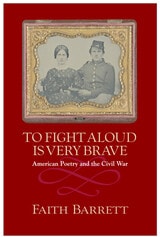
To Fight Aloud Is Very Brave
American Poetry and the Civil WarFaith Barrett
University of Massachusetts Press, 2012
Focusing on literary and popular poets, as well as work by women, African Americans, and soldiers, this book considers how writers used poetry to articulate their relationships to family, community, and nation during the Civil War. Faith Barrett suggests that the nationalist “we” and the personal “I” are not opposed in this era; rather they are related positions on a continuous spectrum of potential stances. For example, while Julia Ward Howe became famous for her “Battle Hymn of the Republic,” in an earlier poem titled “The Lyric I” she struggles to negotiate her relationship to domestic, aesthetic, and political stances.
Barrett makes the case that Americans on both sides of the struggle believed that poetry had an important role to play in defining national identity. She considers how poets created a platform from which they could speak both to their own families and local communities and to the nations of the Confederacy, the Union, and the United States. She argues that the Civil War changed the way American poets addressed their audiences and that Civil War poetry changed the way Americans understood their relationship to the nation.
To Go Into the Words
Norman Finkelstein
University of Michigan Press, 2023
To Go Into the Words is the latest book of critical prose from renowned poet and scholar of Jewish literature Norman Finkelstein. Through a rigorous examination of poets such as William Bronk, Helen Adam, and Nathaniel Mackey, the book engages the contemporary poetic fascination with transcendence through the radical delight with language. By opening up a given poem, Finkelstein seeks the “gnosis” or insight of what it contains so that other readers can understand and appreciate the works even more.
Pulling from Finkelstein’s experience of writing thirteen books of poetry and six books of literary criticism, To Go Into the Words consistently rewards the reader with insights as transformative as they are well-considered and deftly mapped out. This volume opens the world of poetry to poets, scholars, and readers by showcasing “the gnosis that is to be found in modern poetry.”
To Make Negro Literature
Writing, Literary Practice, and African American AuthorshipElizabeth McHenry
Duke University Press, 2021
To Make a Prairie
Essays on Poets, Poetry, and Country LivingMaxine Kumin
University of Michigan Press, 1980