Results by title
8113 books match the query 'Literary Criticism' and 1818 start with t
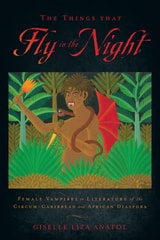
The Things That Fly in the Night
Female Vampires in Literature of the Circum-Caribbean and African DiasporaGiselle Liza Anatol
Rutgers University Press, 2015
This book is available as an audio book (https://www.abantuaudio.com/books/1197052/The-Things-That-Fly-in-the-Night).

The Thinker As Artist
From Homer To Plato and AristotleGeorge Anastaplo
Ohio University Press, 1997
The Thinking Woman
Julienne van Loon
Rutgers University Press, 2021
While women have struggled to gain recognition in the discipline of philosophy, there is no shortage of brilliant female thinkers. What can these women teach us about ethics, politics, and the nature of existence, and how might we relate these big ideas back to the smaller everyday concerns of domestic life, work, play, love, and relationships?
Australian novelist Julienne van Loon goes on a worldwide quest to answer these questions, by engaging with eight world-renowned thinkers who have deep insights on humanity and society: media scholar Laura Kipnis, novelist Siri Hustvedt, political philosopher Nancy Holmstrom, psychoanalytic theorist Julia Kristeva, domestic violence reformer Rosie Batty, peace activist Helen Caldicott, historian Marina Warner, and feminist philosopher Rosi Braidotti. As she speaks to these women, she reflects on her own experiences. Combining the intimacy of a memoir with the intellectual stimulation of a theoretical text, The Thinking Woman draws novel connections between the philosophical, personal, and political. Giving readers a new appreciation for both the ethical complexities and wonder of everyday life, this book is inspiration to all thinking people.
The Thinking of the Master
Bataille between Hegel and SurrealismPeter Burger
Northwestern University Press, 2002
The Three Rimbauds
Dominique Noguez
Seagull Books, 2021
The myth of Arthur Rimbaud (1854–1891) focuses on his early years: how the great enfant terrible tore through the nineteenth-century literary scene with reckless abandon, leaving behind him a trail of enemies, the failed marriage of an ex-lover who shot him, and a body of revolutionary poetry that changed French literature forever. He stopped writing poetry at the age of twenty-one when he left Europe to travel the world. He returned only shortly before his death at the age of thirty-seven.
But what if 1891 marked not the year of his death, but the start of a great new beginning: the poet’s secret return to Paris, which launched the mature phase of his literary career? This slim, experimental volume by Dominique Noguez shows that the imaginary “mature” Rimbaud—the one who returned from Harar in 1891, married Paul Claudel’s sister in 1907, converted to Catholicism in 1925, and went on to produce some of the greatest works in twentieth-century French prose—was already present in the almost forgotten works of his childhood, in style and themes alike. Only by reacquainting ourselves with the three Rimbauds—child, young adult, and imaginary older adult—can we truly gauge the range of the complete writer.
The Three Sustainabilities
Energy, Economy, TimeAllan Stoekl
University of Minnesota Press, 2021
Bringing the word sustainability back from the brink of cliché—to a substantive, truly sustainable future
Is sustainability a hopelessly vague word, with meager purpose aside from a feel-good appeal to the consumer? In The Three Sustainabilities, Allan Stoekl seeks to (re)valorize the word, for a simple reason: it is useful. Sustainability designates objects in time, their birth or genesis, their consistency, their survival, their demise. And it raises the question, as no other word does, of the role of humans in the survival of a world that is quickly disappearing—and perhaps in the genesis of another world.
Stoekl considers a range of possibilities for the word, touching upon questions of object ontology, psychoanalysis, urban critique, technocracy, and religion. He argues that there are three varieties of sustainability, seen from philosophical, cultural, and economic perspectives. One involves the self-sustaining world “without us”; another, the world under our control, which can run the political spectrum from corporatism to Marxism to the Green New Deal; and a third that carries a social and communitarian charge, an energy of the “universe” affirmed through, among other things, meditation and gifting. Each of these carves out a different space in the relations between objects, humans, and their survival and degradation. Each is necessary, unavoidable, and intimately bound with, and infinitely distant from, the others.
Along the way, Stoekl cites a wide range of authors, from philosophers to social thinkers, literary theorists to criminologists, anthropologists to novelists. This beautifully written, compelling, and nuanced book is a must for anyone interested in questions of ecology, energy, the environmental humanities, contemporary theories of the object, postmodern and posthuman aesthetics, or religion and the sacred in relation to community.
The Three Treasures
A Revised and Illustrated Study and Translation of Minamoto no Tamenori's SanboeEdward Kamens and Ethan Bushelle
University of Michigan Press, 2023
When the young Princess Sonshi became a Buddhist nun in the year 984, a scholar-official of the royal court was commissioned to create a guide to the Buddhist religion that would be accessible for her. He did so in the form of the illustrated works of fiction (monogatari) that appealed to women readers of her time and class. The text has survived in later manuscripts; the illustrations, if they ever existed, have not. This revised translation recreates Sonshi’s experience of receiving this multimedia presentation, with illustrations selected to help contemporary readers visualize its content and essays that provide context on the religious and cultural experience of the author. The Three Jewels is a unique document that opens a window onto the world of Buddhist religious experience—especially for women—in high classical Japan, the time of Sei Shōnagon’s Pillow Book and Murasaki Shikibu’s Tale of Genji.
The Time of the Goats
Luan Starova; Translated by Christina E. Kramer
University of Wisconsin Press, 2012
The Time of the Goats is the second novel in Luan Starova’s acclaimed multivolume Balkan saga. It follows the main characters from My Father’s Books and the tragicomic events of their lives in Skopje as the narrator’s intellectual father and the head goatherd become friends. As local officials clumsily carry out absurd policies, Starova conveys the bonds of understanding and mutual support that form in Skopje’s poorest neighborhoods. At once historical and allegorical, folkloric and fantastic, The Time of the Goats draws lyrically on Starova’s own childhood.
The Timelessness of Proust
Charles R. Embry
St. Augustine's Press, 2016
Marcel Proust’s À la recherche du temps perdu—In Search of Lost Time—is one of the most important and influential novels of the modern era. In recent decades, Proust has enjoyed a new surge of critical attention, as well as a sustained growth in readership—well beyond that of other prose masters of twentieth century modernism such as Joyce, Woolf, Kafka, and Beckett. The MLA Bibliography presently lists over 3,000 citations to scholarly works devoted to Proust’s novel, and if one Googles “Proust,” the number of hits exceeds 2,000,000.
The temporal nature of human existence and consciousness is one of the many themes explored in In Search of Lost Time, and it is this dimension of Proust’s work that unifies this collection of essays that grew from a roundtable discussion entitled “The Timelessness of Proust” conducted at the 31st annual meeting of the Eric Voegelin Society. The collection includes the following essays:
“In Search of Lost Time: Biographies of Consciousness,” Charles R. Embry
“Proust, Transcendence, and Metaxic Existence,” Glenn Hughes
“The Normative Flow of Consciousness and the Self: A Philosophical Meditation on
Proust’s In Search of Lost Time,” Thomas J. McPartland;
“Imprisonment and Freedom: Resisting and Embracing the Tension of Existence in
Marcel Proust’s In Search of Lost Time,” Paulette Kidder;
“Proust’s Luminous Memory and L’Homme Éternel: The Quest for Limitless Meaning,”
Michael Henry
“Unsought Revelations of Eternal Reality in Eliot’s Four Quartets and Proust’s In Search
of Lost Time,” Glenn Hughes
Persons who are interested not only in the philosophical importance of literary masterworks and in how the philosophical thought of Eric Voegelin may illuminate them, but also in letting Proust serve as a guide in the exploration and understanding of their own lives, will find these essays to be of lasting interest and value.
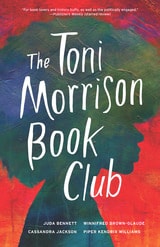
The Toni Morrison Book Club
Juda Bennett
University of Wisconsin Press, 2020
Framing their book club around collective secrets, the group bears witness to how Morrison’s works and words can propel us forward while we sit with uncomfortable questions about race, gender, and identity. How do we make space for black vulnerability in the face of white supremacy and internalized self-loathing? How do historical novels speak to us now about the delicate seams that hold black minds and bodies together?
This slim and brilliant confessional offers a radical vision for book clubs as sites of self-discovery and communal healing. The Toni Morrison Book Club insists that we find ourselves in fiction and think of Morrison as a spiritual guide to our most difficult thoughts and ideas about American literature and life.
The Trace of Judaism
Dostoevsky, Babel, Mandelstam, LevinasVal Vinokur
Northwestern University Press, 2009
The defining quality of Russian literature, for most critics, is its ethical seriousness expressed through formal originality. The Trace of Judaism addresses this characteristic through the thought of the Lithuanian-born Franco-Jewish philosopher Emmanuel Levinas. Steeped in the Russian classics from an early age, Levinas drew significantly from Dostoevsky in his ethical thought. One can profitably read Russian literature through Levinas, and vice versa.

The Traditional Theory of Literature
Ray Livingston
University of Minnesota Press, 1962
The Traditional Theory of Literature was first published in 1962. Minnesota Archive Editions uses digital technology to make long-unavailable books once again accessible, and are published unaltered from the original University of Minnesota Press editions.
Through a study of works of the contemporary Indian scholar Ananda K. Coomaraswamy, as well as of other exponents of the ancient doctrine of the Perennial Philosophy, Professor Livingston develops and explicates a traditional theory of literature.
Coomaraswamy, who died in 1947, published widely on a broad range of subjects in art, philosophy, literature, and other fields. Although he is relatively little known, those acquainted with is work acclaim him as one of the great thinkers of our time. His study and writing were devoted primarily to bridging the gap between Oriental and Western cultures.
From the treasury of traditional learning which Coomaraswamy amassed in his profusion of books and articles, Professor Livingston has drawn those elements which contribute to an essential theory of literature. Although he quotes from some of Coomaraswamy's Oriental sources, he delineates the theory in an idiom that is more familiar to the West, as stated or implied in the works of Dante, Milton, and Blake, among others.
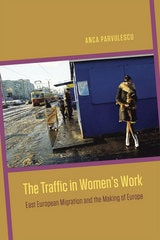
The Traffic in Women's Work
East European Migration and the Making of EuropeAnca Parvulescu
University of Chicago Press, 2014
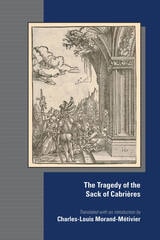
The Tragedy of the Sack of Cabrières
Translated by Charles-Louis Morand-Métivier
Arizona Center for Medieval and Renaissance Studies, 2022
April 1542 saw a massacre of epic proportions in the Luberon, in southeastern France, of its Waldensian population, who had been peacefully living there after they settled in a few centuries before. This massacre foreshadowed the wars of religion, which tore apart the kingdom for almost forty years. The Tragédie du Sac de Cabrières is the only play devoted to these events. This is a critical edition and English translation of the French play. Three critical editions of the play have been published in 1927, 1928, and 1998, and this new edition complements the previous works. This is the first English translation of the play and makes it available to an international audience of scholars and students of the early modern period.
This edition “translates” the moment of the play's creation, the representation of the event, and its importance in the narrative of religious persecutions in sixteenth-century France. It explains how history is dramatized through the creation of the scenic story and scenic play of Cabrières. and how the specific retelling of the events of Cabrières makes this a tool of historical narration, thus allowing the audience to participate in the unfolding of history before their eyes. Therefore, they become part of history, because it is played before their eyes so that they can not only witness it but also propagate the glory of the martyrs for future generations. This is not only a translation and a work of literary scholarship, it is an analysis of the literary, political, and religious production of this period, and a multidisciplinary analysis of Waldensianism in southeastern France.
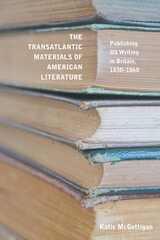
The Transatlantic Materials of American Literature
Publishing US Writing in Britain, 1830–1860Katie McGettigan
University of Massachusetts Press, 2023
Winner, Transatlantic Studies Association and Cambridge University Press Book Prize, 2023
During the antebellum period, British publishers increasingly brought out their own authorized and unauthorized editions of American literary works as the popularity of print exploded and literacy rates grew. Playing a formative role in the shaping of American literature, the industry championed the work of US-based writers, highlighted the cultural value of American literary works, and intervened in debates about the future of American literature, authorship, and print culture.
The Transatlantic Materials of American Literature examines the British editions of American fiction, poetry, essays, and autobiographies from writers like Edgar Allan Poe, Harriet Beecher Stowe, Frederick Douglass, and Hannah Flagg Gould. Putting these publications into historical context, Katie McGettigan considers key issues of the day, including developments in copyright law, changing print technologies, and the financial considerations at play for authors and publishers. This innovative study also uncovers how the transatlantic circulation of these works exposed the racial violence and cultural nationalism at the heart of the American experiment, producing overlapping and competing visions of American nationhood in the process.
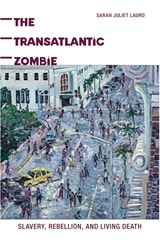
The Transatlantic Zombie
Slavery, Rebellion, and Living DeathSarah Juliet Lauro
Rutgers University Press, 2015
The Transformation of Authorship in America
Grantland S. Rice
University of Chicago Press, 1997
Rice shows that the rigorous censorship practiced by Puritan authorities conferred an implicit prestige on texts as civic interventions, helping to foster a vigorous and indigenous tradition of sociopolitical criticism. With special attention to the sudden emergence of the novel in post-revolutionary America, Rice reveals how the emergence of economic liberalism undermined the earlier tradition of political writing by transforming American authorship from an expression of individual civic conscience to a market-oriented profession.
Includes discussions of the writings of Benjamin Franklin, Michel-Guillaume-Jean de Crèvecoeur, and Hugh Henry Brackenridge.
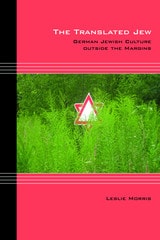
The Translated Jew
German Jewish Culture outside the MarginsLeslie Morris
Northwestern University Press, 2018
The Translated Jew brings together an eclectic set of literary and visual texts to reimagine the transnational potential for German Jewish culture in the twenty-first century. Departing from scholarship that has located the German Jewish text as an object that can be defined geographically and historically, Leslie Morris challenges national literary historiography and redraws the maps by which transnational Jewish culture and identity must be read.
Morris explores the myriad acts of translation, actual and metaphorical, through which Jewishness leaves its traces, taking as a given the always provisional nature of Jewish text and Jewish language. Although the focus is on contemporary German Jewish literary cultures, The Translated Jew also turns its attention to a number of key visual and architectural projects by American, British, and French artists and writers, including W. G. Sebald, Anne Blonstein, Hélène Cixous, Ulrike Mohr, Daniel Blaufuks, Paul Celan, Raymond Federman, and Rose Ausländer.
In thus realigning German Jewish culture with European and American Jewish culture and post-Holocaust aesthetics, this book explores the circulation of Jewishness between the United States and Europe. The insistence on the polylingualism of any single language and the multidirectionality of Jewishness are at the very center of The Translated Jew.
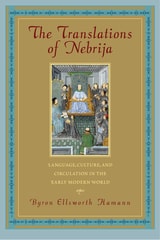
The Translations of Nebrija
Language, Culture, and Circulation in the Early Modern WorldByron Ellsworth Hamann
University of Massachusetts Press, 2015
Tracing the global influence of Nebrija's dictionary, Byron Ellsworth Hamann, in this interdisciplinary, deeply researched book, connects pagan Rome, Muslim Spain, Aztec Tenochtitlan, Elizabethan England, the Spanish Philippines, and beyond, revealing new connections in world history. The Translations of Nebrija re-creates the travels of people, books, and ideas throughout the early modern world and reveals the adaptability of Nebrija's text, tracing the ways heirs and pirate printers altered the dictionary in the decades after its first publication. It reveals how entries in various editions were expanded to accommodate new concepts, such as for indigenous languages in the Americas—a process with profound implications for understanding pre-Hispanic art, architecture, and writing. It shows how words written in the margins of surviving dictionaries from the Americas shed light on the writing and researching of dictionaries across the early modern world.
Exploring words and the dictionaries that made sense of them, this book charts new global connections and challenges many assumptions about the early modern world.
The Translator in the Text
On Reading Russian Literature in EnglishRachel May
Northwestern University Press, 1994
The Transmutation of Love and Avant-Garde Poetics
Jeanne Heuving
University of Alabama Press, 2016
Reimagining love as a force of poetic innovation in modern and avant-garde literature.
The Transmutation of Love and Avant-Garde Poetics is a probing examination of how the writing of sexual love undergoes a radical revision by avant-garde poets in the twentieth and twenty-first centuries. Today, the exploration of love by poets—long a fixture of Western poetic tradition—is thought to be in decline, with love itself understood to be a mere ideological overlay for the more “real” entities of physical sex and desire.
In The Transmutation of Love and Avant-Garde Poetics, Jeanne Heuving claims that a key achievement of poetry by Ezra Pound, H.D., Robert Duncan, Kathleen Fraser, Nathaniel Mackey, and others lies significantly in their engagement with the synergistic relations between being in love and writing love. These poets, she argues, have traded the clichéd lover of yore for impersonal or posthuman poetic speakers that sustain the gloire and mystery of love poetry of prior centuries. As Robert Duncan writes, “There is a love in which we are outcast and vagabond from what we are that we call ‘falling in love.’”
Heuving claims that this writing of love is defining for avant-garde poetics, identifying how such important discoveries as Pound’s and H.D.’s Imagism, Pound’s Cantos, and Duncan’s “open field poetics” are derived through their changed writing of love. She draws attention to how the prevailing concept of language as material is inadequate to the ways these poets also engage language as a medium—as a conduit—enabling them to address love afresh in a time defined through preoccupations with sexuality. They engage love as immanent and change it through a writing that acts on itself.
The Transmutation of Love and Avant-Garde Poetics ascribes the waning of love poetry to its problematic form: a genre in which empowered poetic speakers constitute their speech through the objectification of comparatively disempowered subjects, or beloveds. Refusing this pervasive practice, the poets she highlights reject the delimiting, one-sided tradition of masculine lovers and passive feminine beloveds; instead, they create a more nuanced, dynamic poetics of ecstatic exploration, what Heuving calls “projective love” and “libidinized field poetics,” a formally innovative poetry, in which one perception leads directly to the next and all aspects of a poem are generative of meaning.
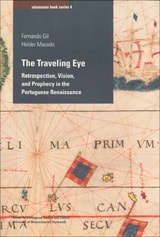
The Traveling Eye
Retrospection, Vision, and Prophecy in the Portuguese RenaissanceFernando Gil
Tagus Press, 2009
The idea for The Traveling Eye came as a new departure in an old dialogue between the two authors, one a literary scholar, the other a philosopher. Our focus was initially centered on a philosophical hypothesis concerning evidence, with specific reference to the prophetic writings of Father António Vieira, but it occurred to us that this perspective could be applied to literary works, particularly those of the Portuguese Renaissance. The studies that one of us had dedicated to the initiatory aspects of The Lusiads and to the codification of esoteric meanings in the work of Bernardim Ribeiro suggested a possible convergence of our two lines of research. But there are other issues raised by the Portuguese Renaissance: voyages, the new, the encounter with difference and how to understand it. The most obvious and direct expression of these issues is found in the chronicles of voyage and empire, whose importance is duly noted in the study by Luís de Sousa Rebelo included in Chapter III of this book. The literary treatment of this material seems to us no less revealing. Seeing ("seeing clearly seen" as Camões says in The Lusiads) poses the problem of simultaneously seeing "what is there" and of how what is there could be seen. This questioning from the outside by "the traveling eye" went hand in hand with new ways of relating to oneself and to others. Three key Renaissance authors, Luís de Camões (1525?-1580), Francisco de Sá de Miranda (1481?-1558?) and Bernardim Ribeiro (b.1480s?), address the human subject's relationship as a perplexing issue. Their works transform the feeling of love into a multifaceted investigation that questions the identity of the individual. A recurring theme in this book is the metamorphoses of the self brought about by love.
The Treacherous Imagination
Intimacy, Ethics, and Autobiographical FictionRobert McGill
The Ohio State University Press, 2013
The Treadmill Affect
Marxism, Subjectivity, and the PresentBenjamin Lee
Prickly Paradigm Press, 2025
The Treadmill Affect draws upon the work of three University of Chicago professors, each a former program director at the Center for Transcultural Studies: literary and cultural critic Lauren Berlant, historian and social theorist Moishe Postone, and linguist Michael Silverstein. Through this intellectual synthesis, Benjamin Lee demonstrates the critical possibilities of uniting a revived linguistic turn with Marxist accounts of affect and subjectivity, adding new dimensions to the "treadmill" affective structure of cruel optimism.
The Tree Stump
An Arabic Historical NovelSamiha Khrais
Michigan State University Press, 2017
The Tribe of John
Ashbery and Contemporary PoetrySusan M. Schultz
University of Alabama Press, 1995
This concentration on Ashbery's influence on contemporary American poetry provides new methods for interpreting and understanding his poetic achievement.
The Tribe of Pyn
Literary Generations in the Postmodern PeriodDavid Cowart
University of Michigan Press, 2015
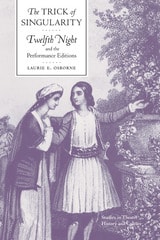
The Trick of Singularity
"Twelfth Night" and the Performance EditionsLaurie E. Osborne
University of Iowa Press, 1996
In this innovative union of textual studies and performance criticism, Laurie Osborne explores the important ways in which an apparently single, unproblematic text is in fact multiple and various. Through a close analysis of the performance editions of Twelfth Night, she argues that the complex interaction between text and performance establishes a comedy as a work realized within changing social and erotic constructions.
Because it appears in a relatively clean and dated version in the Folio, Twelfth Night seems to be exempt from arguments for variant texts—but there are significant and persistent variations represented in the performance editions. Osborne's careful reading of these provides a crucial bridge linking theatre history and textual criticism. She employs a wide variety of approaches and disciplines—Shakespearean and Renaissance studies, theatre history, gender studies, contemporary literary criticism, and cultural history—to provide a fresh and engaging yet rigorous view.
Although she focuses on Twelfth Night, Osborne's argument applies more broadly to the history of performance and criticism, including a chapter on video versions of the play. Widely read in Shakespearean and Renaissance scholarship, she employs her archival research in promptbooks, the publishing history of the plays, and the history of Shakespearean production to accomplish a major job of scholarly integration and analysis of Shakespearean drama in performance.
The Tristan Legend
A Study in SourcesSigmund Eisner
Northwestern University Press, 1969
The Triumph of Human Empire
Verne, Morris, and Stevenson at the End of the WorldRosalind Williams
University of Chicago Press, 2013
The Trojan Women
Euripides
University of Chicago Press, 2013
A stand-alone edition of Euripides’s The Trojan Women, taken from Chicago’s renowned translations of the Greek tragedies.
Drawn from the authoritative third edition of the University of Chicago Press’s Complete Greek Tragedies series, this stand-alone edition presents Richmond Lattimore’s celebrated translation of a play with an antiwar message that continues to inspire and resonate with readers today. The Trojan Women takes place following the conquest of Troy and tells the story of its sole survivors—all women—who have been enslaved by the Greeks. Mourning their families and their fate, they grapple with the trauma they have experienced and contemplate a future far from home.
The aftermath of the Trojan War, while extensively depicted in ancient Greek epic, lyric poetry, and art, is rendered especially powerful through the hands of Euripides. An introduction by Mark Griffith and Glenn W. Most provides essential contextual information about the play’s first production, plot, and reception in antiquity.
The Tropics Bite Back
Culinary Coups in Caribbean LiteratureValérie Loichot
University of Minnesota Press, 2013
The ubiquitous presence of food and hunger in Caribbean writing—from folktales, fiction, and poetry to political and historical treatises—signals the traumas that have marked the Caribbean from the Middle Passage to the present day. The Tropics Bite Back traces the evolution of the Caribbean response to the colonial gaze (or rather the colonial mouth) from the late nineteenth century to the twenty-first. Unlike previous scholars, Valérie Loichot does not read food simply as a cultural trope. Instead, she is interested in literary cannibalism, which she interprets in parallel with theories of relation and creolization.
For Loichot, “the culinary” is an abstract mode of resistance and cultural production. The Francophone and Anglophone authors whose works she interrogates—including Patrick Chamoiseau, Suzanne Césaire, Aimé Césaire, Maryse Condé, Edwidge Danticat, Édouard Glissant, Lafcadio Hearn, and Dany Laferrière—“bite back” at the controlling images of the cannibal, the starved and starving, the cunning cook, and the sexualized octoroon with the ultimate goal of constructing humanity through structural, literal, or allegorical acts of ingesting, cooking, and eating.
The Tropics Bite Back employs cross-disciplinary methods to rethink notions of race and literary influence by providing a fresh perspective on forms of consumption both metaphorical and material.
The Troubadour of Knowledge
Michel Serres
University of Michigan Press, 1997
The Trouble with Sauling Around
Conversion in Ethnic American Autobiography, 1965-2002Madeline R. Walker
University of Iowa Press, 2011
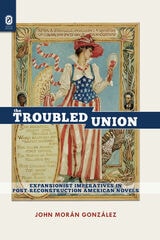
The Troubled Union
Expansionist Imperatives in Post-Reconstruction American NovelsJohn Morán González
The Ohio State University Press, 2010

The True Adventures of Huckleberry Finn
John Seelye
University of Illinois Press, 1987
funnier than the original, and also more moving, since Seelye's Huck Finn is
even less sentimental about life and Tom Sawyer than Twain's Huck Finn. He is
also more perceptive about black people than the original."
-- Hughes Rudd, CBS News
"Seelye has stitched together
a whale of a book. Without reference to Twain's own version, it is almost impossible
to see the seams where 1970 joins 1884."
-- Geoffrey Wolff, Newsweek
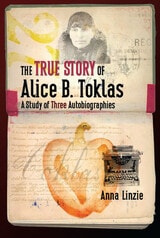
The True Story of Alice B. Toklas
A Study of Three AutobiographiesAnna Linzie
University of Iowa Press, 2006
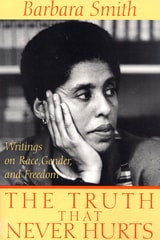
The Truth That Never Hurts
Writings on Race, Gender, and FreedomSmith, Barbara
Rutgers University Press, 2000
Smith’s essay “Toward a Black Feminist Criticism,” is often cited as a major catalyst in opening the field of black women’s literature. Pieces about racism in the women’s movement, black and Jewish relations, and homophobia in the Black community have ignited dialogue about topics that few other writers address. The collection also brings together topical political commentaries on the 1968 Chicago convention demonstrations; attacks on the NEA; the Anita Hill–Clarence Thomas Senate hearings; and police brutality against Rodney King and Abner Louima. It also includes a never-before-published personal essay on racial violence and the bonds between black women that make it possible to survive.
The Truth of Uncertainty
Beyond Ideology in Science and LiteratureEdward L. Galligan
University of Missouri Press, 1998
In the last chapter of Walden, Henry David Thoreau proclaims a simple yet profound conviction: "Any truth is better than make- believe." Edward Galligan shares this conviction. In The Truth of Uncertainty: Beyond Ideology in Science and Literature, he argues that contemporary American critics should embrace literary truths with all of their ardent uncertainties rather than cling to the make-believe certainties of ideologies.
Postmodern critics fail to ask the truth-seeker's essential question, What does the evidence prove? and instead trust the generalizations and slogans of ideologies to guide their interpretations. Attempting to be up-to-date and profound, these critics lose sight of the literature they are supposed to explore.
The Truth of Uncertainty celebrates values commonly associated with modern, not postmodern criticism, applying them to contemporary works in a series of fresh and unusual inquiries. Galligan finds important implications for criticism in work from the physical sciences that are rarely touched on by American intellectuals, such as Gerald M. Edelman's Bright Air, Brilliant Fire: On the Matter of the Mind and Roger Penrose's The Emperor's New Mind: Concerning Computers, Minds, and the Laws of Physics. Likewise, he finds illumination in the works of novelists that American critics have largely ignored—Josef Skvorecky, George V. Higgins, Mary Lee Settle, Robertson Davies.
As a consequence of dealing with these "unusual" texts, Galligan presents a refreshing interpretation of a number of important concepts: language is grounded in talk; all literary criticism is subjective and tentative because reading is a highly subjective enterprise; and, most important, the world is real and any truth is indeed better than make-believe. He moves from a rejection of criticism in the service of ideology to an affirmation of criticism in the service of truthfulness.
The ideas celebrated in The Truth of Uncertainty are timeless and valuable. Galligan returns to the text and provides a penetrating critique of the state of contemporary criticism, which has abandoned truth for ideology. The result is an eloquent salute to literature itself.
The Twelve Best Books by African Women
Critical ReadingsChikwenye Okonjo Ogunyemi
Ohio University Press, 2009
The Twelve Best Books by African Women is a collection of critical essays on eleven works of fiction and one play. The titles by African women that were included in the list of “Africa’s 100 Best Books of the Twentieth Century” are: Anowa, Ama Ata Aidoo (1970); A Question of Power, Bessie Head (1974); Woman at Point Zero, Nawal El Saadawi (1975); The Beggars’ Strike, Aminata Sow Fall (1979); Burger’s Daughter, Nadine Gordimer (1979); The Joys of Motherhood, Buchi Emesheta (1979); So Long a Letter, Mariama Bâ (1980); Fantasia: An Algerian Cavalcade, Assia Djebar (1983); Nervous Conditions, Tsitsi Dangarembga (1988); Living, Loving and Lying Awake at Night, Sindiwe Magona (1991); Butterfly Burning, Yvonne Vera (1998); Riwan ou le chemin de sable, Ken Bugul (1999).
This collection of original essays recognizes the gesture of inclusion as an important shift in consciousness and creates a fresh awareness of the literary works by African women writers. Each essay offers a penetrating analysis of individual texts and opens up a fresh perspective that allows scholars and students alike to explore new dimensions of these writers’ work.
The Twentieth-Century Spanish American Novel
By Raymond Leslie Williams
University of Texas Press, 2003
A Choice Magazine Outstanding Academic Book
Spanish American novels of the Boom period (1962-1967) attracted a world readership to Latin American literature, but Latin American writers had already been engaging in the modernist experiments of their North American and European counterparts since the turn of the twentieth century. Indeed, the desire to be "modern" is a constant preoccupation in twentieth-century Spanish American literature and thus a very useful lens through which to view the century's novels.
In this pathfinding study, Raymond L. Williams offers the first complete analytical and critical overview of the Spanish American novel throughout the entire twentieth century. Using the desire to be modern as his organizing principle, he divides the century's novels into five periods and discusses the differing forms that "the modern" took in each era. For each period, Williams begins with a broad overview of many novels, literary contexts, and some cultural debates, followed by new readings of both canonical and significant non-canonical novels. A special feature of this book is its emphasis on women writers and other previously ignored and/or marginalized authors, including experimental and gay writers. Williams also clarifies the legacy of the Boom, the Postboom, and the Postmodern as he introduces new writers and new novelistic trends of the 1990s.
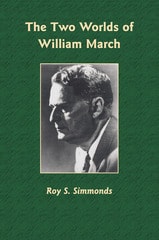
The Two Worlds of William March
Roy S. Simmonds
University of Alabama Press, 1984
In the work of literary resurrection there is always a small act of defiance. The Two Worlds of William March by Roy S. Simmonds restores to view one of the most remarkable and least celebrated American writers of the twentieth century. With intelligence, restraint, and a keen eye for contradiction, Simmonds traces March’s path from Alabama beginnings through war, business success, and literary achievement. The result is more than a biography. It is an inquiry into the making of a writer whose novels continue to unsettle, disturb, and illuminate long after the fashions of his age have passed.
What lingers is the paradox of William March himself. He was a man of outward accomplishment who remained drawn to the hidden regions of experience. He wrote memorably of war without glamorizing it, and of evil without simplifying it. Unlike so many public literary figures, he seemed to cultivate disappearance rather than celebrity. The silence around him became part of the story. Simmonds treats that silence not as a void but as evidence, revealing a complex and deeply observant mind at work beneath an unusually quiet life.
The questions that occupied March remain with us. How well do we know ourselves? What lies beneath ordinary behavior? How does experience become art? For readers of Southern literature, literary biography, American history, war literature, psychology, Alabama culture, and twentieth-century fiction, this book offers both discovery and reconsideration. It will especially appeal to those who suspect that the most revealing stories are often hidden in plain sight.
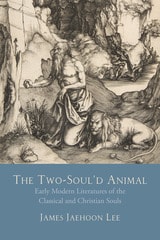
The Two-Soul'd Animal
Early Modern Literatures of the Classical and Christian SoulsJames Jaehoon Lee
Northwestern University Press, 2019
The English writers studied in The Two-Soul’d Animal place two prevailing interpretations of the soul’s faculties—one rhetorical on the plane of aesthetics, the other theological on the plane of ethics—into contact as a way to construct a new mode of Christian agency.
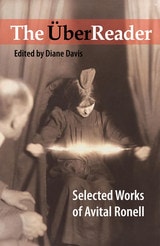
The UberReader
SELECTED WORKS OF AVITAL RONELLEdited by Diane Davis
University of Illinois Press, 2007
For twenty years Avital Ronell has stood at the forefront of the confrontation between literary study and European philosophy. She has tirelessly investigated the impact of technology on thinking and writing, with groundbreaking work on Heidegger, dependency and drug rhetoric, intelligence and artificial intelligence, and the obsession with testing. Admired for her insights and breadth of field, she has attracted a wide readership by writing with guts, candor, and wit.
Coyly alluding to Nietzsche’s “gay science,” The ÜberReader presents a solid introduction to Avital Ronell’s later oeuvre. It includes at least one selection from each of her books, two classic selections from a collection of her early essays (Finitude’s Score), previously uncollected interviews and essays, and some of her most powerful published and unpublished talks. An introduction by Diane Davis surveys Ronell’s career and the critical response to it thus far.
With its combination of brevity and power, this Ronell “primer” will be immensely useful to scholars, students, and teachers throughout the humanities, but particularly to graduate and undergraduate courses in contemporary theory.
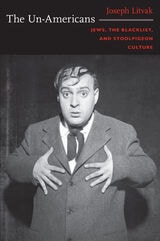
The Un-Americans
Jews, the Blacklist, and Stoolpigeon CultureJoseph Litvak
Duke University Press, 2009
Litvak traces the outlines of comic cosmopolitanism in a series of performances in film and theater and before HUAC, performances by Jewish artists and intellectuals such as Zero Mostel, Judy Holliday, and Abraham Polonsky. At the same time, through an uncompromising analysis of work by informers including Jerome Robbins, Elia Kazan, and Budd Schulberg, he explains the triumph of a stoolpigeon culture that still thrives in the America of the early twenty-first century.
The Unbeliever
THE POETRY OF ELIZABETH BISHOPRobert Dale Parker
University of Illinois Press, 1988
literary history and theory to give the poems of Elizabeth Bishop (1911-79)
the serious critical attention they deserve. The Unbeliever shows that
Bishop's poems, already famous for their clear and quiet tone, also struggle
with confusion and wonder about things she can never make quiet or clear.
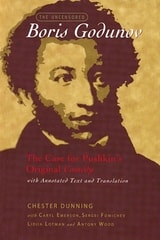
The Uncensored Boris Godunov
The Case for Pushkin's Original ComedyChester Dunning with Caryl Emerson, Sergei Fomichev, Lidiia Lotman, and Antony Wood
University of Wisconsin Press, 2007
Includes the original Russian text and, for the first time, an English translation of that version.
“Antony Wood’s translation is fluent and idiomatic; analyses by Dunning et al. are incisive; and the ‘case’ they make is skillfully argued. . . . Highly recommended.”—Choice
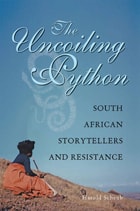
The Uncoiling Python
South African Storytellers and ResistanceHarold Scheub
Ohio University Press, 2010
There are many collections of African oral traditions, but few as carefully organized as The Uncoiling Python. Harold Scheub, one of the world’s leading scholars of African oral traditions and folklore, explores the ways in which oral traditions have served to combat and subvert colonial domination in South Africa. From the time colonial forces first came to southern Africa in 1487, oral and written traditions have been a bulwark against what became 350 years of colonial rule, characterized by the racist policies of apartheid. The Uncoiling Python: South African Storytellers and Resistance is the first in-depth study of oral tradition as a means of survival.
In open insurrections and other subversive activities Africans resisted the daily humiliations of colonial rule, but perhaps the most effective and least apparent expression of subversion was through indigenous storytelling and poetic traditions. Harold Scheub has collected the stories and poetry of the Xhosa, Zulu, Swati, and Ndebele peoples to present a fascinating analysis of how the apparently harmless tellers of tales and creators of poetry acted as front-line soldiers.
The Uncommon Tongue
The Poetry and Criticism of Geoffrey HillVincent Sherry
University of Michigan Press, 1987
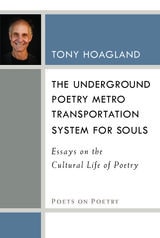
The Underground Poetry Metro Transportation System for Souls
Essays on the Cultural Life of PoetryTony Hoagland
University of Michigan Press, 2019