496 books match the query 'Christian Theology' and 141 start with t
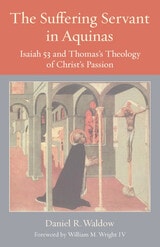
cover of The Suffering Servant in Aquinas: Isaiah 53 and Thomas's Theology of Christ's Passion

The Suffering Servant in Aquinas

Isaiah 53 and Thomas's Theology of Christ's Passion

Daniel R. Waldow

Catholic University of America Press, 2024
The “Suffering Servant” text of Isaiah 53 is a perennial topic of debate within Jewish and Christian biblical theology. Is the Suffering Servant an individual, a group, or both? How and why did he suffer? What role did God play in his suffering? How is his suffering related to human salvation? The answers to these questions often divide Jewish and Christian readers of Scripture as well as Christians across different denominations. In particular, Isaiah 53 tends to inform different Christian accounts of the origin, nature, and saving value of Christ’s Passion. The Suffering Servant in Aquinas contributes to the debate on the meaning of Isaiah 53 and its bearing upon the Passion of Christ by examining how St. Thomas Aquinas engaged this biblical text. This book examines every explicit reference to Isaiah 53 that Aquinas makes in his biblical commentaries, Commentary on the Sentences, Summa Theologiae, and Opuscula. It analyzes how and why Aquinas interprets Isaiah 53 in the ways that he does. It focuses especially upon how Aquinas draws upon Isaiah 53 to shed light on the saving mystery of Christ’s Passion. Readers will see how Aquinas articulates the relationship between God’s will and Christ’s suffering, the diverse forms of Christ’s pain, the degree to which the Passion can be considered a “punishment,” and the saving functions of the Passion as example, merit, satisfaction, and sacrifice. This book makes an original contribution to the growing field of Biblical Thomism. It examines Aquinas’s exegetical methods as well as the role of Scripture within his speculative theology. And it properly contextualizes Aquinas’s exegesis by considering the differences between his Latin version of Isaiah 53 and contemporary renderings of Hebrew and Greek versions. Readers will see that Aquinas’s Christological interpretations of Isaiah 53 are both exegetically intriguing and theologically rich.
[more]
cover of The Teacher; The Free Choice of the Will; Grace and Free Will

The Teacher; The Free Choice of the Will; Grace and Free Will

Saint Augustine

Catholic University of America Press, 1968
No description available
[more]
cover of The Testimony of Two Nations: How the Book of Mormon Reads, and Rereads, the Bible

The Testimony of Two Nations

How the Book of Mormon Reads, and Rereads, the Bible

Michael Austin

University of Illinois Press, 2024

Understanding the Book of Mormon on its own terms and through its two-way connection with the Bible

Like the Hebrew Bible and the Christian Bible, the Book of Mormon uses narratives to develop ideas and present instruction. Michael Austin reveals how the Book of Mormon connects itself to narratives in the Christian Bible with many of the same tools that the New Testament used to connect itself to the Hebrew Bible to create the Christian Bible. As Austin shows, the canonical context for interpreting the Book of Mormon includes the Christian Bible, the Book of Mormon itself, and other writings and revelations that hold scriptural status in most Restoration denominations. Austin pays particular attention to how the Book of Mormon connects itself to the Christian Bible both to form a new canon and to use the canonical relationship to reframe and reinterpret biblical narratives. This canonical context provides an important and fruitful method for interpreting the Book of Mormon.
[more]
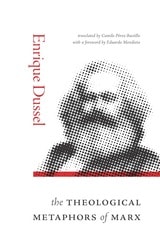
cover of The Theological Metaphors of Marx

The Theological Metaphors of Marx

Enrique Dussel

Duke University Press, 2024
In The Theological Metaphors of Marx, Enrique Dussel provides a groundbreaking combination of Marxology, theology, and ethical theory. Dussel shows that Marx unveils the theology of capitalism in his critique of commodity fetishization. Capitalism constitutes an idolatry of the commodity that undergirds the capitalist expropriation of labor. Dussel examines Marx’s early writings on religion and fetishism and proceeds through what Dussel refers to as the four major drafts of Capital, ultimately situating Marx’s philosophical, economic, ethical, and historical insights in relation to the theological problems of his time. Dussel notes a shift in Marx’s underlying theological schema from a political critique of the state to an economic critique of the commodity fetish as the Devil, or anti-God, of modernity. Marx’s thought, impact, and influence cannot be fully understood without Dussel’s historic reinterpretation of the theological origins and implications of Marx’s critiques of political economy and politics.
[more]
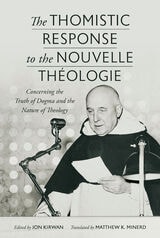
cover of The Thomistic Response to the Nouvelle Theologie: Concerning the Truth of Dogma and the Nature of Theology

The Thomistic Response to the Nouvelle Theologie

Concerning the Truth of Dogma and the Nature of Theology

Jon Kirwan

Catholic University of America Press, 2023
The Thomistic Response to the Nouvelle Théologie: Concerning the Truth of Dogma and the Nature of Theology retrieves the most important and largely forgotten exchanges in the mid-20th-century debate surrounding ressourcement thinkers. It makes available new translations of works by the leading Thomists in the exchange: Dominican Fathers Reginald Garrigou-Lagrange, Michel Labourdette, Marie-Joseph Nicolas, and Raymond Bruckberger. In addition to a lengthy historical and theological introduction, the volume contains sixteen articles, thirteen of which have never appeared in English. All the major critical responses of the Dominican Thomists to the nouvelle théologie are here presented chronologically according to the primary debates carried on, respectively, in the journals Revue Thomiste and Angelicum. A lengthy introduction describes the unfolding of the entire debate, article by article, and explains and references the ressourcement interventions. Unfortunately, the history of this important debate is largely surrounded by polemics, half-truths, caricatures, and journalistic soundbites. In the articles gathered in this volume, along with the accompanying introduction, the Toulouse and Roman Dominicans speak in their own voice. The central theses that define the two sides of the debate are sympathetically set forth. However, the texts gathered here show the immense lengths to which the Thomists went to initiate an authentic and fraternal theological dialogue with the nouveaux théologiens. Frs. Labourdette and Nicolas repeatedly argued for the importance of ressourcement work: they applauded its historical efforts, and they were generally sympathetic and complementary (although always pointed and persistent in gently expressing their concerns). Even Fr. Garrigou-Lagrange—whose infamous intervention is remembered as being a theological “atomic bomb”—is revealed as being no more guilty of escalation than the Dominicans’ interlocutors in their own responses to him and Fr. Labourdette. This volume will greatly aid in the task of theological and historical reconstruction and will, undoubtedly, assist in a certain rapprochement between the two sides, as the essential texts, concerns, and theological arguments are made available in their entirety to professional and lay anglophone readers.
[more]
cover of The Time Has Grown Short: René Girard, or the Last Law

The Time Has Grown Short

René Girard, or the Last Law

Benoît Chantre

Michigan State University Press, 2022
The protagonist of Marcel Proust’s In Search of Lost Time observes with wonder the comings and goings of the crows that roost in the belfry of the village church in Combray, his childhood home. For René Girard, one of Proust’s great interpreters, their mysterious flight, first departing from and then returning to the vertical axis of the steeple, suggests the movement of modern history—the crisis of aristocratic models, the growing servitude of individuals possessed by mimetic desire, and the final irruption of authentic transcendence. In this rich exploration of Girard’s insights, his French editor and longtime collaborator Benoît Chantre brings Saint Paul’s Letter to the Romans into dialogue with both Proust and Girard in order to push to its logical endpoint the idea of a back-and-forth movement from chaos to order. History, Chantre argues, has been driven mad by the revelation of its sacrificial engine. The only way out lies in a transformation internal to the crisis itself—only that faith which is capable of hearing the One who speaks in the Law makes it possible to avoid the perpetual ups and downs of rivalry. Acting and revealing Himself at the heart of history, an intimate model “hidden since the foundation of the world” deals a fatal blow to the circle of sin. Authentic transcendence coincides with the eschaton, the moment when—according to Saint Paul—historical time implodes into eternity.
[more]
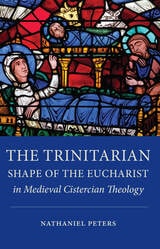
cover of The Trinitarian Shape of the Eucharist in Medieval Cistercian Theology

The Trinitarian Shape of the Eucharist in Medieval Cistercian Theology

Nathaniel Peters

Catholic University of America Press, 2026
William of Saint-Thierry, Isaac of Stella, and Baldwin of Forde created a distinctly Cistercian body of Eucharistic theology in the twelfth century. In this book, Nathaniel Peters offers a scholarly account of that theology and examines the connection between medieval Trinitarian and Eucharistic theology. These Cistercian authors thought that the character of God as a Trinity of persons united in essence provides the structure of the economy of salvation—especially its turning point, the Eucharist. They saw the Eucharist as the place where the ontological union of the Incarnation becomes intimate, personal, and communal. In the Eucharist, God the Father draws those who receive to himself by uniting them to the body and blood of the Son. This unity brings an increase of unity with the Holy Spirit. Once united to the Son and Spirit, the faithful are united to the Father. The Eucharist also connects the meditation, sacrifices, and offering of their own lives to the life of Christ, with which they are offered to the Father. Chapter 1 examines the thought of William of Saint-Thierry, who has the most developed understanding of Eucharistic presence, conversion, and reception. It also treats the connections William draws between Eucharistic reception and meditation on scripture and the passion of Christ. Chapter 2 treats Isaac of Stella, who uses more intellectualist imagery and imagery of the mystical body of Christ. Chapter 3 studies Baldwin of Forde, who argues that the term transubstantiation best describes Eucharistic conversion and emphasizes reception by faith in the truth about Christ. Chapter 5 offers a brief conclusion, with reference to later thinkers who explore the Trinitarian shape of the Eucharist in similar ways.
[more]
cover of The Trinity

The Trinity

Saint Hilary of Poitiers

Catholic University of America Press, 1954
No description available
[more]
cover of The Trinity

The Trinity

Saint Augustine

Catholic University of America Press, 1963
No description available
[more]
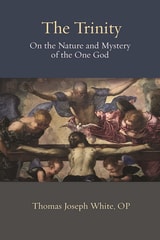
cover of The Trinity: On the Nature and Mystery of the One God

The Trinity

On the Nature and Mystery of the One God

Thomas Joseph White, OP

Catholic University of America Press, 2021
The Trinity is the central mystery of the Christian faith. What can we say about the divine nature, and what does it mean to say that God is Father, Son, Holy Spirit, three persons who are one in being? In this book, best selling author Thomas Joseph White, OP, examines the development of early Christian reflection on the Trinity, arguing that essential contributions of Patristic theology are preserved and expanded in the thought of Thomas Aquinas. By focusing on Aquinas’ theology of the divine nature as well as his treatment of divine personhood, White explores in depth the mystery of Trinitarian monotheism. The Trinity: On the Nature and Mystery of the One God also engages with influential proposals of modern theologians on major topics such as Trinitarian creation, Incarnation and crucifixion, and presents creative engagements with these topics. Ultimately any theology of the cross is also a theology of the Trinity, and this book seeks to illustrate how the human life, death, and resurrection of Jesus reveal the inner life of God as Trinity.
[more]
cover of The Trinity; The Spectacle; Jewish Foods; In Praise of Purity; Letters

The Trinity; The Spectacle; Jewish Foods; In Praise of Purity; Letters

Catholic University of America Press, 1974
No description available
[more]
cover of The True Christian Life: Thomistic Reflections on Divinization, Prudence, Religion, and Prayer

The True Christian Life

Thomistic Reflections on Divinization, Prudence, Religion, and Prayer

Ambroise Gardeil, OP

Catholic University of America Press, 2022
Although not well-known in the English-speaking world, Fr. Ambroise Gardeil, OP (1859-1931) was a Dominican of significant influence in French Catholic thought at the turn of the 20th century. Conservative theologians like Frs. Reginald Garrigou-Lagrange, OP, Michel Labourdette, OP, Jean-Hervé Nicolas, OP and many others hailed him as a careful expositor of the supernaturality of faith, a defender of the theological nature of rational apologetics, and a spiritual master. In his controversial Le Saulchoir: Une école de théologie, Fr. Marie-Dominique Chenu, OP praised Fr. Gardeil as an important Dominican initiator of reforms in historical theology, presenting the latter as a kind of precursor to one of the streams of what is now referred to historically as the “Nouvelle Théologie.” And one cannot read the words of Fr. Gardeil’s contemporary Fr. Antoine Lemonnyer, OP, without hearing echoes and re-echoes of common cause regarding our lofty spiritual vocation, resounding within the halls of the Saulchoir. With such a broad appeal, it is no surprise that in private correspondence, a young Yves Simon, writing to Jacques Maritain, referred to Fr. Gardeil as “The Great Gardeil.” The True Christian Life provides a thorough and stirring introduction to Fr. Gardeil’s work in spiritual theology. The volume was originally published posthumously through the collaboration of Fr. Gardeil’s nephew, Fr. Henri-Dominique Gardeil, OP and Jacques Maritain. Fr. Ambroise, prior to beginning work on his masterpiece on spiritual experience, La Structure de l'âme et l'expérience mystique, drafted nearly eight-hundred pages that would have set forth a full presentation of moral-ascetical theology. While drafting this massive work, his reflection on the soul’s receptive capacity for grace led him to the two-volume study, La Structure, and he never was able to finish his original designs for a comprehensive study of the Christian moral-spiritual life. Soon after his death, his nephew gathered several essays from the Revue thomiste and Revue de Jeunes, along with a complete-but-unpublished study on prayer. Drafting a lengthy introduction on the basis of Fr. Ambroise’s unpublished notes, Fr. Henri-Dominique assembled a volume of moral / spiritual theology that sets out the principles of many important themes: divinization through grace, Christian prudence /conscience, the virtue of religion, devotion, and prayer. In his In memoriam written after the passing of Fr. Gardeil, Fr. Reginald Garrigou-Lagrange emphasized Fr. Gardeil’s ability to meditate on a given topic’s central principles, like someone who sees the highest peaks that give structure to the entire mountain range of theology. In this volume, the reader will find a clear and rhetorically striking presentation of the central mysteries of the spiritual life, presented with stirring and beautiful rhetoric by a theological master from the Thomist tradition.
[more]
cover of The Unchanging Truth of God? Crucial Philosophical Issues for Theology

The Unchanging Truth of God? Crucial Philosophical Issues for Theology

Thomas G. Guarino

Catholic University of America Press, 2021
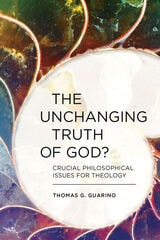
It has long been a cornerstone of Catholic belief that Christians can be intelligent and creative thinkers—inquisitive seekers after truth—as well as men and women of ardent faith. Catholics are entirely committed, then, to the claim that human rationality and religious faith are complementary realities since they are equally gifts of God. But understanding precisely how faith and reason cohere has not always been a smooth path. At times, theology has allowed philosophy to become the leading (and baleful) partner in the faith-reason relationship, thereby lapsing into rationalism or relativism. At other times, theology has been tempted by fideism, with philosophy now regarded as little more than a pernicious intruder corrupting Christian faith, life and thought. The essays in this volume display how Catholicism understands the proper confluence between philosophy and theology, between human rationality and Christian faith, between the natural order and supernatural grace. To illustrate these points, the book draws on a long line of Christian thinkers: Origen, Augustine, Anselm, Aquinas and, in our own day, Fides et Ratio of John Paul II and the Regensburg Address of Benedict XVI. How is theology always a “Jewgreek” enterprise—to borrow a term from Jacques Derrida—always a combination of the biblical (Hebraic) and philosophical (Hellenic) traditions? Why is one particular element of philosophy, metaphysics, essential for the intelligibility and clarity of Catholic theology? Why is this so much the case that John Paul II could state emphatically: “a philosophy which shuns metaphysics would be radically unsuited to the task of mediation in the understanding of Revelation”? But theology cannot simply be about dialogue with philosophers of yesteryear. Theology must constantly incorporate fresh thinking and remain in lively conversation with an extensive variety of contemporary perspectives. This book displays how reciprocity and absorption has been characteristic of theology’s past and must represent its future as well.
[more]
cover of The Unity of Faith: Essays for the Building Up of the Body of Christ

The Unity of Faith

Essays for the Building Up of the Body of Christ

Thomas G. Weinandy

Catholic University of America Press, 2024
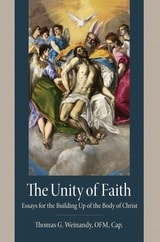
In this volume, The Unity of Faith: Essays for the Building Up of the Body of Christ, Thomas G. Weinandy, OFM, Cap., has compiled a theologically significant medley of essays. The title is taken from Ephesians 4:11–13 (“And his gifts were … for building up the body of Christ, until we all attain to the unity of the faith and of the knowledge of the Son of God….”). The “unity of faith” in this book refers both to the interrelation between the truths of the faith, whether Trinitarian, Christological, or ecclesiological, and to unity among those who hold the faith. The first section deals with the Trinity, usually with ecumenical questions in mind, ranging from the question of the filioque to the trinitarian thought of Johnathan Edwards. The second section presents the author’s mature judgments in a topic for which Weinandy has become notable—the impassability of God and the human suffering of Christ. The third looks at other aspects of Christology with the help of patristic writers, but for sake of the contemporary theological milieu. For example, what is the relationship between the Incarnation and soteriology? What is the nature of Christ’s human consciousness and knowledge? How does Paul perceive the primacy of Christ within his Christological hymns? The fourth section turns to the unity between faith and reason. In doing Catholic theology, how do theologians apply reason when contemplating the mysteries of faith? What is the philosophical and theological significance of Pope John Paul II’s encyclical, Fides et Ratio? The final section turns to the life of believers in the unity of faith, with topics such as Henri de Lubac’s contributions to ecclesiology, the sacramentality of the Catholic priesthood, the very delicate issue of the need for conversion and the Jews in relationship to the Church, and the Christian family as a domestic church, taking up the roles of priest, prophet, and king. Weinandy invariably writes in a clear and engaging manner, so much so that these essays will bring to the greater knowledge of God not only academics and students of theology, but also the educated laity.
[more]
cover of The Visionary Queen: Justice, Reform, and the Labyrinth in Marguerite de Navarre

The Visionary Queen

Justice, Reform, and the Labyrinth in Marguerite de Navarre

Theresa Brock

University of Delaware Press, 2024
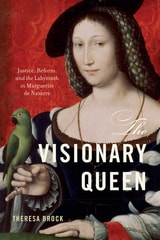
The Visionary Queen affirms Marguerite de Navarre’s status not only as a political figure, author, or proponent of nonschismatic reform but also as a visionary. In her life and writings, the queen of Navarre dissected the injustices that her society and its institutions perpetuated against women. We also see evidence that she used her literary texts, especially the Heptaméron, as an exploratory space in which to generate a creative vision for institutional reform. The Heptaméron’s approach to reform emerges from statistical analysis of the text’s seventy-two tales, which reveals new insights into trends within the work, including the different categories of wrongdoing by male, institutional representatives from the Church and aristocracy, as well as the varying responses to injustice that characters in the tales employ as they pursue reform. Throughout its chapters, The Visionary Queen foregrounds the trope of the labyrinth, a potent symbol in early modern Europe that encapsulated both the fallen world and redemption, two themes that underlie Marguerite's project of reform.
[more]
cover of The Way of Humility: St. Augustine's Theology of Preaching

The Way of Humility

St. Augustine's Theology of Preaching

Charles J. Kim

Catholic University of America Press, 2023
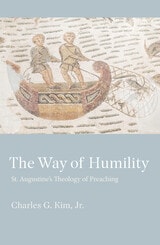
For Augustine, that the Word became flesh transformed a merely human understanding of the virtues and grounds all virtue in humility. The Way of Humility: Augustine’s Theology of Preaching explores how this truth became a new paradigm for understanding the scriptures and thus, how Augustine embodied the virtue in the preaching of the scriptures. One of Augustine’s most devoted students, Possidius, said that anyone can learn from reading Augustine, but “those were able to profit still more who could hear him speak in church and see him with their own eyes. Truly, he was indeed one of those of whom it is written, ‘speak this way and act the same way.’” The Way of Humility searches for evidence of the virtue of humility in action through the preaching of the humble Word in the sermons of Augustine. Many know of Augustine through his more famous treatises but few have encountered the Doctor of Grace where he had his most immediate impact, preaching. The Way of Humility follows the sermons through several traditional theological loci, ecclesiology, Christology, soteriology to uncover what can be learned about Augustine’s theology through the way he preached to a mixed audience of urbanites and rustics, many of whom did not have the benefit of a formal education. Throughout the book, we see the interplay between Augustine’s action in speech and Augustine’s more direct statements on his theology of Preaching. Through handing over Christ in his sermons, he became himself an example of humility for the congregation on their journey toward the final end for all people, the Beatific Vision.
[more]
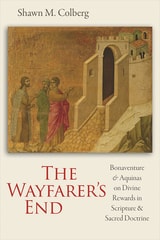
cover of The Wayfarer's End: Bonaventure and Aquinas on Divine Rewards in Scripture and Sacred Doctrine

The Wayfarer's End

Bonaventure and Aquinas on Divine Rewards in Scripture and Sacred Doctrine

Shawn M. Colberg

Catholic University of America Press, 2020
The Wayfarer’s End follows the human person’s journey to union with God in the theologies of Saint Bonaventure and Saint Thomas Aquinas. It argues that these seminal thinkers of the 13th Century emphasize scriptural notions of divine rewards as ordering principles for the graced movement of human viators to eternal life. Divine rewards emerge as a fundamental category through the study’s emphasis on Thomas and Bonaventure as scriptural commentators and preachers whose work in sacra pagina structures the content of their sacra doctrina. Shawn Colberg places Bonaventure’s and Aquinas’s scriptural, dogmatic, and polemical works into conversation and illumines their mutually edifying depictions of the way to eternal life. Looking to the journey itself, The Wayfarer’s End demonstrates a nuanced understanding of the roles played by God and human beings in the movement to full beatitude. To that end, it explores the relationships between grace and human nature, the effects of sin on the human person, the vital themes of predestination, conversion, perseverance, and the place of “reward-worthy” human action within the overall movement toward union with God. While St. Bonaventure and St. Thomas both stress the priority of grace and divine action for the journey, the study also illustrates their distinct frameworks for human action, unpacking Bonaventure’s preference for the language of acceptatio versus Thomas’s emphasis on ordinatio. This difference inflects their language of rewards, their exposition of scripture, and the scope of free human action in the movement to union with God. This study places the two most seminal theologians of the 13th Century into conversation on central and enduring topics of Christian life. Such a comparative study has been sorely lacking in the field of studies on Aquinas and Bonaventure. It offers insight to those interested in high scholastic thought, Franciscan and Dominican understandings of human salvation, and Thomist and Franciscan theology as it pertains to questions of the Reformation, including biblical exegesis on justification and sanctification. Above all, the study appreciates and foregrounds the richness of Bonaventure’s and Aquinas’s vocations: mendicant theologians concerned to share the fruits of contemplation with fellow friars and others seeking the goal of the wayfarer’s end.
[more]
cover of The Works of Saint Cyril of Jerusalem, Volume 1

The Works of Saint Cyril of Jerusalem, Volume 1

Saint Cyril of Jerusalem

Catholic University of America Press, 1969
No description available
[more]
cover of The Works of Saint Cyril of Jerusalem, Volume 2

The Works of Saint Cyril of Jerusalem, Volume 2

Saint Cyril of Jerusalem

Catholic University of America Press, 1970
No description available
[more]
cover of The Writings of Salvian, the Presbyter

The Writings of Salvian, the Presbyter

The Presbyter Salvian, The Presbyter

Catholic University of America Press, 1947
No description available
[more]
cover of Theological Treatises on the Trinity

Theological Treatises on the Trinity

Marius Victorinus

Catholic University of America Press, 1981
No description available
[more]
cover of Theological and Dogmatic Works

Theological and Dogmatic Works

Saint Ambrose

Catholic University of America Press, 1963
No description available
[more]
cover of Theology as an Ecclesial Discipline: Ressourcement and Dialogue

Theology as an Ecclesial Discipline

Ressourcement and Dialogue

J. Augustine Di Noia

Catholic University of America Press, 2024
The practice of theology depends in part on asking the right questions. Not any sorts of questions, not idle questions, nor questions framed entirely by our own experience or the great issues of our times, but good theological questions focus the mind of the inquirer on the endlessly intelligible self-revelation of God to which the Sacred Scripture bears witness. Our own questions and the great questions of our times have a place, as long as they are purged of the ideological outlooks that can suppress or obscure the questions that the sacra pagina itself presses upon us. Among the essays gathered in Theology as an Ecclesial Discipline, the first set directs the reader’s attention precisely to questions that trace the distinctive features of the nature of theology itself. What are the principles and scope of the field of theology as practiced by believers in an ecclesial context? Are historical-critical methods of exegesis compatible with a properly theological interpretation of the Scriptures? How can theology have a place in the academy as an intellectual discipline if the Magisterium seems to limit the scope of its inquiries? The second part considers a range of questions that preoccupy contemporary Protestant and Catholic theologians. Can the names Father, Son and Holy Spirit be replaced by more inclusive titles in doctrine and liturgy? By placing humanity at the center of theological investigation, is Christian humanism distinct from secular humanism? How can we be guilty of a sin committed by our first ancestors? Can the Christian vision of procreative human sexuality survive the cultural onslaught of the sexual revolution? The questions in the third part of this book arise from Catholic dialogue with non-Christian religions, or with other Christian communities, or with conceptions of a cosmos in ecological crisis. Is there a future for Catholic theology of religions? How can people who do not believe in Christ be saved? Is the cosmos a safe environment for human beings, or, alternatively, how can the cosmos be protected from human depredation? Can the concept of “church” stretch far enough to encompass Christian communities that see themselves as strictly local and independent bodies?
[more]
cover of Theology of the Hebrew Bible, Volume 1: Methodological Studies

Theology of the Hebrew Bible, Volume 1

Methodological Studies

Marvin A. Sweeney

SBL Press, 2019

Diverse approaches to biblical theology

This volume presents a collection of studies on the methodology for conceiving the theological interpretation of the Hebrew Bible among Jews and Christians as well as the treatment of key issues such as creation, the land of Israel, and divine absence. Contributors include Georg Fischer, SJ, David Frankel, Benjamin J. M. Johnson, Soo J. Kim, Wonil Kim, Jacqueline E. Lapsley, Julia M. O’Brien, Dalit Rom-Shiloni, Marvin A. Sweeney, and Andrea L. Weiss.

Features:

  • Examination of metaphor, repentance, and shame in the presence of God
  • Ten essays addressing the nature of biblical theology from a Jewish, Christian, or critical perspective
  • Discussion of the changes that have taken place in the field of biblical theology since World War II
[more]
cover of Thomas Aquinas Today: Still the Common Doctor?

Thomas Aquinas Today

Still the Common Doctor?

Andrew Hofer

Catholic University of America Press, 2026

[more]
cover of Thomas Aquinas as Spiritual Teacher

Thomas Aquinas as Spiritual Teacher

Michael A. Dauphinais

Sapientia Press of Ave Maria University, 2023
St. Thomas Aquinas preaches in his sermon Puer Jesus "Just as your father begot you bodily, your teacher begets you spiritually." St. Thomas himself has been blessed with prodigious fecundity through the centuries for his teaching in the Holy Spirit. Always, he leads us to think of the Blessed Trinity and all things from God's own view. With new insights into St. Thomas's spiritual teaching in its sources, context, breadth, wisdom, and influences, Thomas Aquinas as Spiritual Teacher presents chapters inspired by an international conference co-sponsored by the Aquinas Center for Theological Renewal at Ave Maria University and the Thomistic Institute of the Dominican House of Studies. The volume, like its conference, honors Archbishop J. Augustine Di Noia, OP, adjunct secretary of the Dicastery for the Doctrine of the Faith, for his dedication to the spiritual teaching of St. Thomas in several decades of service to the Church and the academy. Luis F. Cardinal Ladaria, SJ, prefect of the Dicastery for the Doctrine of the Faith, contributed the volume's foreword.
[more]
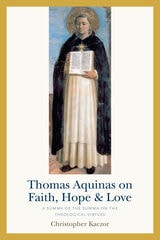
cover of Thomas Aquinas on Faith, Hope, and Love: A Summa of the Summa on the Theological Virtues

Thomas Aquinas on Faith, Hope, and Love

A Summa of the Summa on the Theological Virtues

Christopher Kaczor

Catholic University of America Press, 2020
Thomas Aquinas on Faith, Hope, and Love is designed to make as easy as possible a first reading of key passages from the Summa theologiae. This book contains selections from the Summa that are most influential, most important, or likely to be most interesting to the contemporary reader. The text of the Summa itself is edited and arranged for beginners. Each article begins with Thomas’s answers to the question at hand and then goes to the first objection, followed by the reply to the first objection, the second objection and its reply, and so on. This arrangement provides a greater accessibility and ease in following the argument. Below the text, copious footnotes illuminate the text as a professor in the classroom might. Some notes provide historical background to figures that Thomas presupposes his reader will know such as Gratian, Dionysius, and Lombard. Other notes offer doctrinal summaries of other parts of the Summa that illuminate what Thomas says about faith, hope, or love. Thomas had an enormous influence on theologians, Church councils, and popes after his time, so some footnotes examine this influence. Thomas drew heavily on sources of wisdom before him, so other footnotes summarize the teachings of earlier authors, such as Aristotle and Augustine. This book also contains introductory essays on the Summa, on faith, on hope, and on love, which provide an overview to situate the reader and place treatment of the theological virtues in its larger context of the Summa. For those who have never read Thomas Aquinas on faith, hope, and love (and for those who teach them), this book provides ready access to the wisdom of the Angelic doctor.
[more]
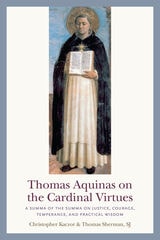
cover of Thomas Aquinas on the Cardinal Virtues: A Summa of the Summa on Prudence, Justice, Temperance, and Courage

Thomas Aquinas on the Cardinal Virtues

A Summa of the Summa on Prudence, Justice, Temperance, and Courage

Christopher Kaczor

Catholic University of America Press, 2020
Thomas Aquinas on the Cardinal Virtues provides essential passages from Thomas's treatment of the cardinal virtues in the Summa theologiae, edited and explained for classroom use or the independent reader. Arranged for beginners, this book contains passages from the Summa theologiae of great historical import, contemporary relevance, or intrinsic interest combined with abundant footnotes aiding the modern reader. Each individual article is arranged so that the question, e.g. “Is capital punishment moral?” is followed directed by Thomas’s answer. Then the first objection is raised, followed immediately by Thomas’s response, the second objection is raised and then Thomas answers it, and so forth. The abundant footnotes help first time readers navigate key theological and philosophical terms which may be unfamiliar. In addition, the notes provide biographical information about key authors cited by Thomas, such as Tully, Vegetius, and Gregory the Great. The footnotes sometimes look back at the sources and philosophical roots of what Thomas teaches. Other notes note how authors after Aquinas including theologians, church councils, and popes developed, synthesized, and sometimes rejected what Thomas teaches. In sum, this book seeks to illuminate Thomas’s teaching on the cardinal virtues such as a teacher might do in the classroom.
[more]
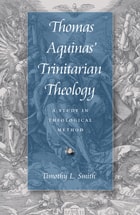
cover of Thomas Aquinas' Trinitarian Theology: A Study in Theological Method

Thomas Aquinas' Trinitarian Theology

A Study in Theological Method

Timothy L Smith

Catholic University of America Press, 2003
Thomas' presentation of Trinitarian doctrine in his Summa Theologiae is an essential text for anyone interested in the great Dominican's theology. One finds here the meeting of a host of philosophical and theological issues.
[more]
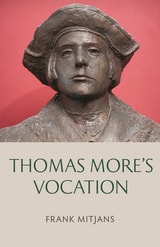
cover of Thomas More's Vocation

Thomas More's Vocation

Frank Mitjans

Catholic University of America Press, 2022
The book considers Thomas More’s early life-choices. An early letter is cited by biographers but most miss More’s reference to the market place. More’s great-grandson, Cresacre, a Londoner, understood it correctly, and that gives reason to trust him on other aspects of More’s youth. This study is based on early testimonies, those of Erasmus, Roper, Harpsfield, Stapleton and Cresacre More, as well as More’s early writings, the Pageant Verses, and his additions / omissions to the Life of Pico; evidence drawn from authors he recommended, like Hilton and Gerson; and finally, his epitaph. Attention is given to his lectures on St Augustine’s City of God, and to St John Chrysostom. It is argued More studied Chrysostom’s Homilies on the Gospel of St Matthew,/i> from a Greek manuscript. Chrysostom, in the introductory homily, spoke of the city and the market place, as the setting in which Christians practice the teaching of Christ. More practiced law and taught it. He was attracted to becoming a Christian humanist alongside Grocyn, Colet, Linacre, and Lily. With them he studied Greek, the classics and Fathers of the Church. Helped by them he became a man of prayer, aware of the need to seek holiness in the midst of the world as a layman. Faced with the dilemma of the humanist in choosing between the contemplative life of the philosopher and an active life of engagement with the world, he deliberately chose the active life in service to society, and the contemplative life of the Christian as a married man. This awareness and choice is what is called vocation, implying determination to persevere throughout life: More saw his life as a pilgrimage towards heaven as described in the last chapter focusing on More’s last work, De tristitia, tedio, pavore, et oratione christi ante captionem eius.
[more]
cover of Three Poems: Concerning His Own Affairs, Concerning Himself and the Bishops, and Concerning His Own Life

Three Poems

Concerning His Own Affairs, Concerning Himself and the Bishops, and Concerning His Own Life

Saint Gregory of Nazianzus

Catholic University of America Press, 1987
No description available
[more]
cover of To Stir a Restless Heart

To Stir a Restless Heart

Jacob W. Wood

Catholic University of America Press, 2019
To Stir a Restless Heart tells for the first time the story of how Thomas Aquinas conversed with his contemporaries about the dynamics of human nature’s longing for God, and documents how he deliberately utilized Greek, Arabic, Hebrew, and Latin sources to develop a version of Aristotelian natural desire that was uniquely Augustinian: natural desire seeks the complete fulfillment of human nature “insofar as is possible,” and so comes to rest in the highest end that God offers to it. Depending on whether God offers the free gift of grace to humanity, one and the same natural desire can come to rest in knowing God through creatures or seeing God directly.
[more]
cover of Tractates on the Gospel of John 55–111

Tractates on the Gospel of John 55–111

Saint Augustine

Catholic University of America Press, 1988
No description available
[more]
cover of Tradition and the Rule of Faith in the Early Church

Tradition and the Rule of Faith in the Early Church

Ronnie J. Rombs

Catholic University of America Press, 2011

Tradition and the rule of faith are particularly apt themes for this collection of studies. The essays are written in honor of Joseph T. Lienhard, S.J., renowned American patristic scholar whose research and writings have focused on this particular theme.
[more]
cover of Tradition in Act: Development and Its Counterfeits After Newman

Tradition in Act

Development and Its Counterfeits After Newman

Reinhard Hütter

Catholic University of America Press, 2027
Tradition in Act addresses the present crisis over a proper understanding of the development of doctrine in contemporary Catholic theology and thus is a critical as well as constructive theological intervention in arguably the most central controversy in contemporary Catholic theology. The concept of “tradition in act” provides an approach that enables a recovered understanding of the development of doctrine for the theologian, and one that avoids the Scylla of antiquarianism and the Charybdis of presentism. The concept of “tradition in act” (drawing on the distinction between act and potency) is understood as the active undergoing of the continuously unfolding of the History of Salvation in the Church by way of the living paradosis of the doctrina evangelii in the Eucharistic liturgy, the life, and teaching of the Church. If doctrine is to develop at all, it must do so as the unfolding of a revelation once delivered to the apostles and entrusted to the Church as a sacred deposit. Hence it is required that subsequent formulations, however diverse in expression or circumstance, remain one with their antecedents—homogeneous with them, cognate to them in meaning and intention. This necessary continuity is identity. Without such identity, development degenerates into alteration and hence corruption; the line of transmission is broken, and the Church no longer hands on what she has herself received. The unfolding argument utilizes both the work and the approach of John Henry Newman to propose the criteria of identity of doctrine understood in terms of St Vincent of Lerins’ second rule, as presented by Newman, as constitutive of authentic development. The notion of authentic development of doctrine understood in terms of “tradition in act” offers a novel approach that avoids entirely the inherent risks in the historical consciousness of how doctrine has developed, in short, it is meant to offer an antidote to the historicism at large. Tradition in Act assays a contemporary Catholic theological articulation of the development of doctrine in the spirit of Gustav Mahler’s famous statement that “Tradition is not the worship of ashes, but the preservation of fire.”
[more]
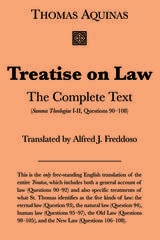
cover of Treatise on Law: The Complete Text

Treatise on Law

The Complete Text

Thomas Aquinas

St. Augustine's Press, 2009

This is a new English translation of St. Thomas Aquinas’s Treatise on Law, found in Questions 90–108 of the First Part of the Second Part of the Summa Theologiae. In fact, it is the only free-standing English translation of the entire Treatise, which includes both a general account of law (Questions 90–92) and also specific treatments of what St. Thomas identifies as the five kinds of law: the eternal law (Question 93), the natural law (Question 94), human law (Questions 95–97), the Old Law (Questions 98–105), and the New Law (Questions 106–108). All other extant editions of Treatise on Law stop with the human law, and are thus approximately one-third the size of the full Treatise.
 St. Thomas’s account of law is firmly embedded within a general moral theory that begins with a rich conception of human flourishing, i.e., the good for human beings (Questions 1–5). This good consists, first and foremost, in our ultimate and intimate union with the Persons of the Blessed Trinity – a union that in our present state we can grasp intellectively and pursue affectively only with God’s supernatural assistance. It is within this framework that we order our loves and pursue the more proximate goals they open up to us as human beings in this life. Given the appropriate goals, the next question is how we can get from where we are, in the grips of the consequences of Original Sin, to where we want to be. The answer is: by means of (a) human actions that are good, i.e., rightly ordered toward our ultimate end and (b) the habits that these actions either engender or flow from. In analyzing human actions (Questions 6–21) and their relation to the passions (Questions 22–48), St. Thomas gives a general account of what he calls the ‘intrinsic principles’ of human actions and their associated habits – both virtues (Questions 49–70) and vices (Questions 71–89). It is only then that he turns to what he calls the ‘extrinsic principles’ of good human actions, viz., law (Questions 90–108) and grace (Questions 109–114).
 According to St. Thomas, law, far from supplanting virtue as a basic principle of action, serves as an independent principle of action that complements virtue and is itself capable of being factored into practical deliberation. The reason is that all of God’s
precepts, prohibitions, and punishments are aimed at promoting the good of the whole universe and, more particularly, the good for human beings, both individually and within the various forms of social life. Because of this, law serves as both a restraint on bad actions and a spur to good action, i.e., a restraint on actions that take us away from virtue and genuine human flourishing and a spur to actions that promote virtue and flourishing.
 There are many benefits of having the whole treatise rather than just the first few questions, as has been the standard practice in previous editions of the Treatise on Law. To mention just a few of these benefits, the question on the moral precepts of the Old Law (question 100) helps to illuminate in many different ways the earlier questions on natural law and human law (questions 94–97). Again, the questions on the ceremonial and judicial precepts of the Old Law (questions 101–105) demon-strate in depth the symbiotic relationship that St. Thomas takes to obtain between the Old Testament and the New Testament. The questions on the New Law provide an introduction to the Christian way of life that will be described in incomparable detail in the Second Part of the Second Part, the bulk of which is structured around the treatment of the three theological virtues and the four cardinal virtues.
[more]
cover of Treatises

Treatises

Saint Cyprian

Catholic University of America Press, 1958
This volume presents several treatises of St. Cyprian (200/10?-258) in translation.
[more]
cover of Treatises on Marriage and Other Subjects

Treatises on Marriage and Other Subjects

Saint Augustine

Catholic University of America Press, 1999
No description available
[more]
cover of Treatises on Various Subjects

Treatises on Various Subjects

Saint Augustine

Catholic University of America Press, 1952
The present volume consists of a collection of minor writings of St. Augustine often classified under the general title of 'Works of Moral and Practical Theology.'
[more]
cover of Trinitarian Ecclesiology: Charles Journet, the Divine Missions, and the Mystery of the Church

Trinitarian Ecclesiology

Charles Journet, the Divine Missions, and the Mystery of the Church

John F. O'Neill

Catholic University of America Press, 2023
Venerable Fulton Sheen once famously said that “There are not one hundred people in the United States who hate the Catholic Church, but there are millions who hate what they wrongly perceive the Catholic Church to be – which is, of course, quite a different thing.” What is the true understanding of the mystery of the Church? In Lumen Gentium, the Church famously identifies herself as the sacrament of salvation, and various attempts have been made at developing an ecclesiology rooted in this idea. Another approach, nevertheless, prominent in the opening chapter of Lumen Gentium, is the relation of the Church to the Trinity in light of the divine missions, especially those of the Incarnation and Pentecost. Trinitarian Ecclesiology is an example of this approach to the mystery of the Church that places the divine missions at the head and the heart of the work. The order of Journet's work is based on the four causes of the Church. Journet situates the treatise on the hierarchy in its proper place as belonging to the efficient cause of the Church in order to treat the more central mystery of the Church in her formal and material causes, namely the sanctifying gift of fully Christic charity and its visible manifestation. While Journet’s magisterial work may already be identified as a Trinitarian Ecclesiology, recent research into the Trinitarian theology of St. Thomas Aquinas has deepened our understanding of his teaching, particularly in the way that creatures can relate to the divine persons in the divine missions. With a clearer understanding of the relation of creatures to the divine persons rooted in grace and its effects, a deeper vision of the mystery of the Church emerges, one that sees the Church as the visible mission of the Holy Spirit, inseparably joined with the visible mission of the Son in the Incarnation. The Great Mystery of Christ and the Church is the unity of the visible missions of the Son and the Spirit who have been sent into the world for our salvation.
[more]
cover of Trinitarian Explorations in Systematic Theology: Unpacking Lonergan's Four-Point Hypothesis

Trinitarian Explorations in Systematic Theology

Unpacking Lonergan's Four-Point Hypothesis

Neil Ormerod

Catholic University of America Press, 2026

In his Latin theological textbook, Bernard Lonergan proposed a way of correlating the four trinitarian relations (paternity, filiation, active spiration and passive spiration) with four distinct participations in the divine nature vis. the Incarnation, the beatific vision, sanctifying grace and the habit of charity. This book uncovers the genetic origins of this hypothesis in Augustine and Aquinas, its significance in terms of the grace-nature debate, and the insights it provides to key Christian doctrines such as Christology, ecclesiology, the nature of holiness, and the beatific vision. The author engages with contemporary theological literature to demonstrate the explanatory power of Lonergan’s construct in relation to competing proposals. Vatican I taught that the role of systematic theology is to understand divine mysteries through analogy and through the nexus between these mysteries. This work argues that Lonergan’s hypothesis perfectly fulfils the second of these tasks and thus provides a needed unification of the diverse topics that confront systematic theologians. Each individual chapter has appeared in leading theological journals: Theological Studies, Irish Theological Quarterly and Louvain Studies. The chapters are ordered here not in terms of publication date, but in such a way as to guide the reader through a more synthetic grasp of the issues involved.
[more]