Results by title
36 books match the query 'Soccer'
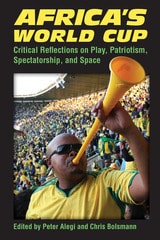
Africa's World Cup
Critical Reflections on Play, Patriotism, Spectatorship, and SpaceEdited by Peter Alegi and Chris Bolsmann
University of Michigan Press, 2013
Africa’s World Cup: Critical Reflections on Play, Patriotism, Spectatorship, and Spacefocuses on a remarkable month in the modern history of Africa and in the global history of football. Peter Alegi and Chris Bolsmann are well-known experts on South African football, and they have assembled an impressive team of local and international journalists, academics, and football experts to reflect on the 2010 World Cup and its broader significance, its meanings, complexities, and contradictions.
The World Cup’s sounds, sights, and aesthetics are explored, along with questions of patriotism, nationalism, and spectatorship in Africa and around the world. Experts on urban design and communities write on how the presence of the World Cup worked to refashion urban spaces and negotiate the local struggles in the hosting cities. The volume is richly illustrated by authors’ photographs, and the essays in this volume feature chronicles of match day experiences; travelogues; ethnographies of fan cultures; analyses of print, broadcast, and electronic media coverage of the tournament; reflections on the World Cup’s private and public spaces; football exhibits in South African museums; and critiques of the World Cup’s processes of inclusion and exclusion, as well as its political and economic legacies.
The volume concludes with a forum on the World Cup, including Thabo Dladla, Director of Soccer at the University of KwaZulu-Natal, Mohlomi Kekeletso Maubane, a well-known Soweto-based writer and a soccer researcher, and Rodney Reiners, former professional footballer and current chief soccer writer for the Cape Argus newspaper in Cape Town. This collection will appeal to students, scholars, journalists, and fans.
Cover illustration: South African fan blowing his vuvuzela at South Africa vs. France, Free State Stadium, Bloemfontein, June 22, 2010. Photo by Chris Bolsmann.
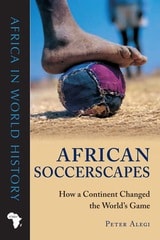
African Soccerscapes
How a Continent Changed the World’s GamePeter Alegi
Ohio University Press, 2010
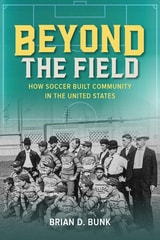
Beyond the Field
How Soccer Built Community in the United StatesBrian D. Bunk
University of Illinois Press, 2025
Played by both migrants and native-born Americans, soccer created communities across the United States. Brian D. Bunk ranges from Pawtucket to Honolulu as he illuminates the deep and diverse origins of the American sport.
Soccer took root as immigration, urbanization, and industrialization triggered immense changes across society. Matches built local pride as teams battled rival neighborhoods and towns. Teammates and supporters shared meals, raised money for fallen players, and attended each other’s weddings and funerals. If sometimes damaged by economic depression or shattered by war, clubs often bounced back to provide a steadying, resilient force in their towns. Bunk follows the story from the 1880s through World War I by profiling the struggles and joys of players while also tracing the overlooked impact of people of African, Chinese, Hawaiian, Jewish, and Filipino descent on American soccer culture.
Engaging and rich in detail, Beyond the Field draws on extensive original research to expand our idea of the people and places that formed the American game.
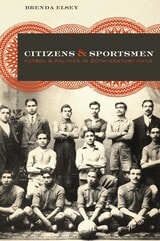
Citizens and Sportsmen
Fútbol and Politics in Twentieth-Century ChileBy Brenda Elsey
University of Texas Press, 2011
Fútbol, or soccer as it is called in the United States, is the most popular sport in the world. Millions of people schedule their lives and build identities around it. The World Cup tournament, played every four years, draws an audience of more than a billion people and provides a global platform for displays of athletic prowess, nationalist rhetoric, and commercial advertising. Fútbol is ubiquitous in Latin America, yet few academic histories of the sport exist, and even fewer focus on its relevance to politics in the region. To fill that gap, this book uses amateur fútbol clubs in Chile to understand the history of civic associations, popular culture, and politics.
In Citizens and Sportsmen, Brenda Elsey argues that fútbol clubs integrated working-class men into urban politics, connected them to parties, and served as venues of political critique. In this way, they contributed to the democratization of the public sphere. Elsey shows how club members debated ideas about class, ethnic, and gender identities, and also how their belief in the uniquely democratic nature of Chile energized state institutions even as it led members to criticize those very institutions. Furthermore, she reveals how fútbol clubs created rituals, narratives, and symbols that legitimated workers' claims to political subjectivity. Her case study demonstrates that the relationship between formal and informal politics is essential to fostering civic engagement and supporting democratic practices.
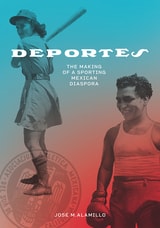
Deportes
The Making of a Sporting Mexican DiasporaJosé M Alamillo
Rutgers University Press, 2020
These sporting achievements were not theirs alone, an entire cadre of supporters—families, friends, coaches, managers, promoters, sportswriters, and fans—rallied around them and celebrated their athletic success. The Mexican nation and community, at home or abroad, elevated Mexican athletes to sports hero status with a deep sense of cultural and national pride. Alamillo argues that Mexican-origin males and females in the United States used sports to empower themselves and their community by developing and sustaining transnational networks with Mexico. Ultimately, these athletes and their supporters created a “sporting Mexican diaspora” that overcame economic barriers, challenged racial and gender assumptions, forged sporting networks across borders, developed new hybrid identities and raised awareness about civil rights within and beyond the sporting world.
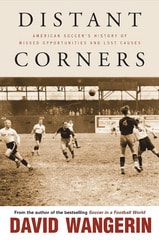
Distant Corners
American Soccer's History of Missed Opportunities and Lost CausesDavid Wangerin
Temple University Press, 2014
In Distant Corners, his follow-up to Soccer in a Football World, David Wangerin details several of the people, places, and events that shaped American soccer history. Despite its struggle for popular acceptance, soccer in the United States has a rich history. Wangerin profiles Tom Cahill, the almost-forgotten "father of American soccer," and writes passionately about the 1979 North American Soccer League season, the high-water mark of the game in the twentieth century.
Wangerin shows how the American appetite for soccer has ebbed and grown over the years, chronicling the game at the college and professional levels and describing the city of St. Louis's unique historic attachment to the sport. Wangerin believes that the time is ripe for American fans to look into their own history and recognize the surprisingly deep connection their country has to soccer.
Egypt’s Football Revolution
Emotion, Masculinity, and Uneasy PoliticsBy Carl Rommel
University of Texas Press, 2021
Both a symbol of the Mubarak government’s power and a component in its construction of national identity, football served as fertile ground for Egyptians to confront the regime’s overthrow during the 2011 revolution. With the help of the state, appreciation for football in Egypt peaked in the late 2000s. Yet after Mubarak fell, fans questioned their previous support, calling for a reformed football for a new, postrevolutionary nation.
In Egypt’s Football Revolution, Carl Rommel examines the politics of football as a space for ordinary Egyptians and state forces to negotiate a masculine Egyptian chauvinism. Basing his discussion on several years of fieldwork with fans, players, journalists, and coaches, he investigates the increasing attention paid to football during the Mubarak era; its demise with the 2011 uprisings and 2012 Port Said massacre, which left seventy-two fans dead; and its recent rehabilitation. Cairo’s highly organized and dedicated Ultras fans became a key revolutionary force through their antiregime activism, challenging earlier styles of fandom and making visible entrenched ties between sport and politics. As the appeal of football burst, alternative conceptions of masculinity, emotion, and politics came to the fore to demand or prevent revolution and reform.
Entre Nous
Between the World Cup and MeGrant Farred
Duke University Press, 2019
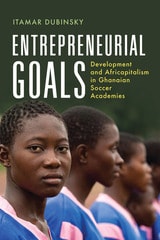
Entrepreneurial Goals
Development and Africapitalism in Ghanaian Soccer AcademiesItamar Dubinsky
University of Wisconsin Press, 2022
Itamar Dubinsky’s extensive ethnographic research offers an innovative theoretical approach by assessing three institutions—Mandela Soccer Academy, Kumasi Sports Academy, and Unistar Soccer Academy—through an Africapitalist prism. He demonstrates that these business endeavors, when viewed from the perspective of local interests, realize many of the educational, financial, and community building ambitions of the region. This pioneering examination of locally owned academies in Ghana reflects Dubinsky’s aim of illuminating the entrepreneurs and programs whose success passes to participating youth and their families, while also exposing the contradictions of for-profit development initiatives that purport to reap collective social benefits.
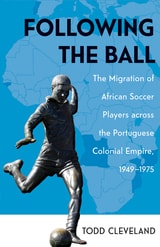
Following the Ball
The Migration of African Soccer Players across the Portuguese Colonial Empire, 1949–1975Todd Cleveland
Ohio University Press, 2017
With Following the Ball, Todd Cleveland incorporates labor, sport, diasporic, and imperial history to examine the extraordinary experiences of African football players from Portugal’s African colonies as they relocated to the metropole from 1949 until the conclusion of the colonial era in 1975. The backdrop was Portugal’s increasingly embattled Estado Novo regime, and its attendant use of the players as propaganda to communicate the supposed unity of the metropole and the colonies.
Cleveland zeroes in on the ways that players, such as the great Eusébio, creatively exploited opportunities generated by shifts in the political and occupational landscapes in the waning decades of Portugal’s empire. Drawing on interviews with the players themselves, he shows how they often assumed roles as social and cultural intermediaries and counters reductive histories that have depicted footballers as mere colonial pawns.
To reconstruct these players’ transnational histories, the narrative traces their lives from the informal soccer spaces in colonial Africa to the manicured pitches of Europe, while simultaneously focusing on their off-the-field challenges and successes. By examining this multi-continental space in a single analytical field, the book unearths structural and experiential consistencies and contrasts, and illuminates the components and processes of empire.
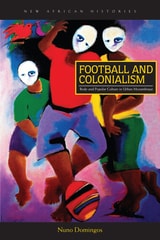
Football and Colonialism
Body and Popular Culture in Urban MozambiqueNuno Domingos
Ohio University Press, 2017
In articles for the newspaper O Brado Africano in the mid-1950s, poet and journalist José Craveirinha described the ways in which the Mozambican football players in the suburbs of Lourenço Marques (now Maputo) adapted the European sport to their own expressive ends. Through gesture, footwork, and patois, they used what Craveirinha termed “malice”—or cunning—to negotiate their places in the colonial state. “These manifestations demand a vast study,” Craveirinha wrote, “which would lead to a greater knowledge of the black man, of his problems, of his clashes with European civilization, in short, to a thorough treatise of useful and instructive ethnography.”
In Football and Colonialism, Nuno Domingos accomplishes that study. Ambitious and meticulously researched, the work draws upon an array of primary sources, including newspapers, national archives, poetry and songs, and interviews with former footballers. Domingos shows how local performances and popular culture practices became sites of an embodied history of Mozambique. The work will break new ground for scholars of African history and politics, urban studies, popular culture, and gendered forms of domination and resistance.

Football in the Americas
FayTbol, Futebol, SoccerEdited by Rory M. Miller and Liz Crolley
University of London Press, 2007

From Football to Soccer
The Early History of the Beautiful Game in the United StatesBrian D. Bunk
University of Illinois Press, 2021
Across North America, native peoples and colonists alike played a variety of kicking games long before soccer's emergence in the late 1800s. Brian D. Bunk examines the development and social impact of these sports through the rise of professional soccer after World War I. As he shows, the various games called football gave women an outlet as athletes and encouraged men to form social bonds based on educational experience, occupation, ethnic identity, or military service. Football also followed young people to college as higher education expanded in the nineteenth century. University play, along with the arrival of immigrants from the British Isles, helped spark the creation of organized soccer in the United States—and the beautiful game's transformation into a truly international sport.
A multilayered look at one game’s place in American life, From Football to Soccer refutes the notion of the U.S. as a land outside of football history.
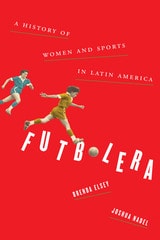
Futbolera
A History of Women and Sports in Latin AmericaBy Brenda Elsey and Joshua Nadel
University of Texas Press, 2019
Latin American athletes have achieved iconic status in global popular culture, but what do we know about the communities of women in sport? Futbolera is the first monograph on women’s sports in Latin America. Because sports evoke such passion, they are fertile ground for understanding the formation of social classes, national and racial identities, sexuality, and gender roles. Futbolera tells the stories of women athletes and fans as they navigated the pressures and possibilities within organized sports.
Futbolera charts the rise of physical education programs for girls, often driven by ideas of eugenics and proper motherhood, that laid the groundwork for women’s sports clubs, which began to thrive beyond the confines of school systems. Futbolera examines how women challenged both their exclusion from national pastimes and their lack of access to leisure, bodily integrity, and public space. This vibrant history also examines women’s sports through comparative case studies of Argentina, Brazil, Chile, Costa Rica, Mexico, and others. Special attention is given to women’s sports during military dictatorships of the 1970s and 1980s as well as the feminist and democratic movements that followed. The book culminates by exploring recent shifts in mindset toward women’s football and dynamic social movements of players across Latin America.
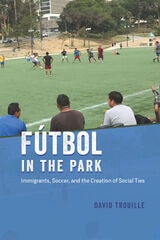
Fútbol in the Park
Immigrants, Soccer, and the Creation of Social TiesDavid Trouille
University of Chicago Press, 2021
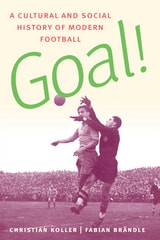
Goal!
Christian Koller
Catholic University of America Press, 2015
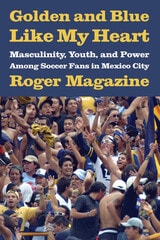
Golden and Blue Like My Heart
Masculinity, Youth, and Power Among Soccer Fans in Mexico CityRoger Magazine
University of Arizona Press, 2007
Roger Magazine takes readers inside Mexico’s soccer stadiums to explore young men’s participation in struggles over the future of that country’s urban society. His firsthand observations of the fan clubs—las porras—yield a unique inside look at confrontations in the stands over group organization, particularly at the emergence of rebel segments within the clubs. His study offers a close-up look at ground-level struggles over social organization in contemporary urban Mexico, showing how young male fans both blindly reproduce and consciously manipulate images of violence and disorder derived from national myths about typical urban Mexican men.
Golden and Blue Like My Heart offers a new way of understanding the dynamics of fandom while shedding new light on larger social processes and youth culture in Mexico. And with its insight into soccer culture, politico-economic transition, and masculinity, it has important and wide-reaching implications for all of Latin America.
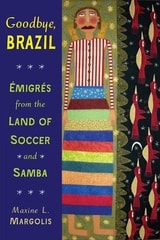
Goodbye, Brazil
Émigrés from the Land of Soccer and SambaMaxine L. Margolis
University of Wisconsin Press, 2013
Goodbye, Brazil is the first book to provide a global perspective on Brazilian emigration. Drawing and synthesizing data from a host of sociological and anthropological studies, preeminent Brazilian immigration scholar Maxine L. Margolis surveys and analyzes this greatly expanded Brazilian diaspora, asking who these immigrants are, why they left home, how they traveled abroad, how the Brazilian government responded to their exodus, and how their host countries received them. Margolis shows how Brazilian immigrants, largely from the middle rungs of Brazilian society, have negotiated their ethnic identity abroad. She argues that Brazilian society abroad is characterized by the absence of well-developed, community-based institutions—with the exception of thriving, largely evangelical Brazilian churches.
Margolis looks to the future as well, asking what prospects at home and abroad await the new generation, children of Brazilian immigrants with little or no familiarity with their parents' country of origin. Do Brazilian immigrants develop such deep roots in their host societies that they hesitate to return home despite Brazil's recent economic boom—or have they become true transnationals, traveling between Brazil and their adopted lands but feeling not quite at home in either one?

Home Team Away
Watching European Football in Urban ChinaYuan Gong
University of Michigan Press, 2026
Home Team Away calls for a rethinking of sport fandom that is divorced from an attachment to location. As the first comprehensive account of the European football fandom in China, this book explores how the Chinese middle class subjectivity is formed through the cross-cultural, digital consumption of the Big Five leagues. Yuan Gong captures the embodied experiences of fans and fan clubs, fan discourses and activities unfolding on digital platforms on Weibo, Weixin, and Hupu, combining fieldwork in Shanghai and virtual ethnography. Gong argues that Chinese fans’ decisions to follow and engage with European football result from their material conditions, ideological contestation, and technology appropriation as a new demographic bloc arising during China’s transition to authoritarian digital capitalism. By engaging with their home teams away, the Chinese middle class fans perform as citizens with a global vision despite the resurgence of the nationalist and anti-Western sentiments.
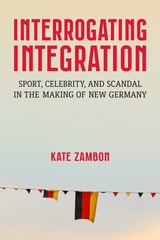
Interrogating Integration
Sport, Celebrity, and Scandal in the Making of New GermanyKate Zambon
University of Michigan Press, 2025
Using touchstones of public memory, including events surrounding men’s World Cup soccer and the record-breaking success of a book blaming Muslims for Germany’s decline, Zambon examines persistent problems in European conceptions of race, where racializing projects take place under an “ideology of racelessness” and the atrocities of historical and transnational racisms are used to deny current local forms of racism.
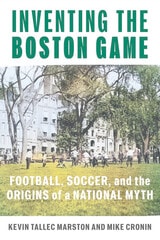
Inventing the Boston Game
Football, Soccer, and the Origins of a National MythKevin Tallec Marston and Mike Cronin
University of Massachusetts Press, 2024
Honorable Mention, 2025 North American Society for Sport History Book Award
On Boston Common stands a monument dedicated to the Oneida Football Club. It honors the site where, in the 1860s, sixteen boys played what was then called the “Boston game”—an early version of football in the United States. The boys were largely the sons of upper-class Boston Brahmins, and they lived through the transformative periods of the Civil War, Reconstruction, and the Gilded Age. Later as they grew old, in the 1920s, a handful of them orchestrated a series of commemorative events about their boyhood game. Benefitting from elite networks developed through the city’s social and educational institutions, including Harvard University, they donated artifacts (such as an oddly shaped, battered black ball) to museums, deposited self-penned histories into libraries and archives, and erected bronze and stone memorials, all to elevate themselves as the inventors of American football (and later, by extension, soccer). But was this origin story of what, by then, had become one of America’s favorite games as straightforward as they made it seem or a myth-making hoax?
In Inventing the Boston Game, Kevin Tallec Marston and Mike Cronin investigate the history of the Oneida Football Club and reveal what really happened. In a compelling, well told narrative that is informed by sports history, Boston history, and the study of memory, they posit that these men engaged in self-memorialization to reinforce their elite cultural status during a period of tremendous social and economic change, and particularly increased immigration. This exploration of the Club’s history provides fascinating insight into how and why origin stories are created in the first place.
Kicking
Jules Boykoff
Duke University Press, 2026
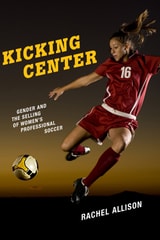
Kicking Center
Gender and the Selling of Women's Professional SoccerAllison, Rachel
Rutgers University Press, 2018
Girls and young women participate in soccer at record levels and the Women’s National Team regularly draws media, corporate, and popular attention. Yet despite increased representation and visibility, gender disparities in opportunity, compensation, training resources, and media airtime persist in soccer, and two professional leagues for women have failed since 2000.
In Kicking Center, Rachel Allison investigates a women’s soccer league seeking to break into the male-dominated center of U.S. professional sport. Through an examination of the challenges and opportunities identified by those working for and with this league, she demonstrates how gender inequality is both constructed and contested in professional sport. Allison details the complex constructions of race, class, gender, and sexuality in the selling and marketing of women’s soccer in a half-changed sports landscape characterized by both progress and backlash, and where professional sports are still understood to be men’s territory.

Long Distance Love
A Passion for FootballGrant Farred
Temple University Press, 2008
Farred shows that issues like race, politics, and war are critical to understanding a sport, especially soccer. And he writes beautifully, with candor and lyricism. Long Distance Love does for soccer what C.L.R. James's Beyond a Boundary did for cricket: it provides poetry and politics in equal measure, along with insights on every page.

Regulating Football
Commodification, Consumption and the LawSteve Greenfield and Guy Osborn
Pluto Press, 2001

Soccer
Jean-Philippe Toussaint
Rutgers University Press, 2019
Soccer takes readers on an idiosyncratic journey that delves deep into the author’s childhood memories, but also transports us to World Cup matches in Japan, Germany, South Africa, and Brazil. Along the way, it kicks around such provocative questions as: How does soccer fandom both support and transcend nationalism? How are our memories of soccer matches both collective and distinctly personal? And how can a game this beautiful and this ephemeral be adequately captured in words?
Part travelogue, part memoir, and part philosophical essay, Soccer is entirely unique, a thrilling departure from the usual clichés of sports writing. Even readers with little knowledge of the game will be enthralled by Touissant’s profound musings and lyrical prose.
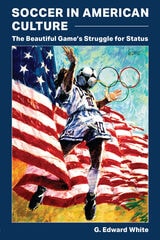
Soccer in American Culture
The Beautiful Game’s Struggle for StatusG. Edward White
University of Missouri Press, 2023
In Soccer in American Culture: The Beautiful Game’s Struggle for Status, G. Edward White seeks to answer two questions. The first is why the sport of soccer failed to take root in the United States when it spread from England around much of the rest of the world in the late nineteenth and twentieth centuries. The second is why the sport has had a significant renaissance in America since the last decade of the twentieth century, to the point where it is now the 4th largest participatory sport in the United States and is thriving, in both men’s and women’s versions, at the high school, college, and professional levels.
White considers the early history of “Association football” (soccer) in England, the persistent struggles by the sport to establish itself in America for much of the twentieth century, the role of public high schools and colleges in marginalizing the sport, the part played by FIFA, the international organization charged with developing soccer around the globe, in encumbering the development of the sport in the United States, and the unusual history of women’s soccer in America, which evolved in the twentieth century from a virtually nonexistent sport to a major factor in the emergence of men’s—as well as women's—soccer in the U.S. in the twentieth century.
Incorporating insights from sociology and economics, White explores the multiple factors that have resulted in the sport of soccer struggling to achieve major status in America and why it currently has nothing like the cultural impact of other popular American sports—baseball and American football— which can be seen by the comparative lack of attention paid to it in sports media, its low television ratings, and virtually nonexistent radio broadcast coverage.
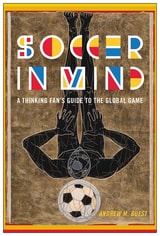
Soccer in Mind
A Thinking Fan's Guide to the Global GameAndrew M. Guest
Rutgers University Press, 2022
This book provides a thinking fan’s guide to the world’s most popular game, proposing a way of engaging soccer that sparks intellectual curiosity and employs critical consciousness. Using stories and data, along with ideas from sociology, psychology, and across the social sciences, it provides readers with new ways of understanding fanaticism, peak performance, talent development, and more. Drawing on concepts ranging from cognitive bias to globalization, it illuminates meanings of the game for players and fans while investigating impacts on our lives and communities. While it considers soccer cultures across the globe, the book also analyzes what makes U.S. soccer culture special, including its embrace of the women’s game.
As a scholar, former minor league player and coach, and fan, Andrew Guest offers a distinctive perspective on soccer in society. Whatever name you call it, and whatever your interest in it, Soccer in Mind will enrich your own view of the one truly global game.
Soccer in a Football World
The Story of America's Forgotten GameDavid Wangerin
Temple University Press, 2008
David Beckham’s arrival in Los Angeles represents the latest attempt to jump-start soccer in the United States where, David Wangerin says, it “remains a minority sport.” With the rest of the globe so resolutely attached to the game, why is soccer still mostly dismissed by Americans?
Calling himself “a soccer fan born in the wrong country at nearly the wrong time,” Wangerin writes with wit and passion about the sport’s struggle for acceptance in Soccer in a Football World. A Wisconsin native, he traces the fragile history of the game from its early capitulation to gridiron on college campuses to the United States’ impressive performance at the 2002 World Cup. Placing soccer in the context of American sport in general, he chronicles its enduring struggle alongside the country’s more familiar pursuits and recounts the shifting attitudes toward the “foreign” game. His story is one that will enrich the perspective of anyone whose heart beats for the sport, and is curious as to where the game has been in America—and where it might be headed.
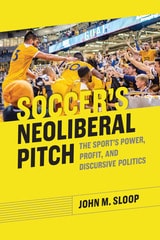
Soccer's Neoliberal Pitch
The Sport's Power, Profit, and Discursive PoliticsJohn M. Sloop
University of Alabama Press, 2023
A powerful cultural critique of soccer’s public rhetoric
American sports agnostics might raise an eyebrow at the idea that soccer represents a staging ground for cultural, social, and political possibility. It is just another game, after all, in a society where mass-audience spectator sports largely avoid any political stance other than a generic, corporate-friendly patriotism. But John M. Sloop picks up on the work of Laurent Dubois and others to see in American soccer—a sport that has achieved immense participation and popularity despite its struggle to establish major league status—a game that permits surprisingly diverse modes of thinking about national identity because of its marginality.
As a rhetorician who draws on both critical theory and culture, Sloop seeks to read soccer as the game intersects with gender, race, sexuality, and class. The result of this engagement is a sense of both enormous possibility and real constraint. If American soccer offers more possibility because of its marginality, looking at how those possibilities are constrained can provide valuable insights into neoliberal logics of power, profit, politics, and selfhood.
In Soccer’s Neoliberal Pitch, Sloop analyzes a host of soccer-adjacent phenomena: the equal pay dispute between the US women’s national team and the US Soccer Federation, the significance of hooligan literature, the introduction of English soccer to American TV audiences, the strange invisibility of the Mexican soccer league despite its consistent high TV ratings, and the reading of US national teams as “underdogs” despite the nation’s quasi-imperial dominance of the Western hemisphere. An invaluable addition to a growing bookshelf on soccer titles, Soccer’s Neoliberal Pitch serves as a model for critical cultural work with sports, with appeal to not only sports studies, but cultural studies, communication, and even gender studies classrooms.
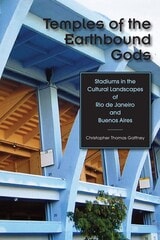
Temples of the Earthbound Gods
Stadiums in the Cultural Landscapes of Rio de Janeiro and Buenos AiresBy Christopher Thomas Gaffney
University of Texas Press, 2008
In Rio de Janeiro, the spiritual home of world football, and Buenos Aires, where a popular soccer club president was recently elected mayor, the game is an integral part of national identity. Using the football stadium as an illuminating cultural lens, Temples of the Earthbound Gods examines many aspects of urban culture that play out within these monumental architectural forms, including spirituality, violence, rigid social norms, anarchy, and also expressions of sexuality and gender.
Tracing the history of the game in Brazil and Argentina through colonial influences as well as indigenous ball courts in Mayan, Aztec, Zapotec, Mixtec, and Olmec societies, Christopher Gaffney's study spans both ancient and contemporary worlds, linking the development of stadiums to urbanization and the consolidation of nation building in two of Latin America's most intriguing megacities.

That Futebol Feeling
Sport and Play in Brazil's HeartlandDavid Faflik
Temple University Press, 2025
That Futebol Feeling captures the region’s enthrallment with “the beautiful game,” and shows us how and why play is central to the human condition. David Faflik profiles members of the most celebrated local team, Clube Atlético Mineiro (CAM), as well as its passionate, never-say-die fans, to show how futebol and fandom shape their everyday lives and perspectives. He discovers bonds of work and play, as well as pride, identity, and community. Additionally, Faflik’s analysis of Brazil’s futebol culture reflects sports fandom worldwide.
CAM stands as a symbol for a way of life in Minas Gerais, the birthplace of Pelé. Faflik interrogates what playing the game means to those who dedicate their lives to the sport. He writes, “The feelings that football inspires are the best of me.” That Futebol Feeling shares that special feeling with the rest of us.
The Persistence of Violence
Colombian Popular CultureToby Miller
Rutgers University Press, 2020
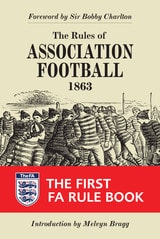
The Rules of Association Football, 1863
The Bodleian Library
Bodleian Library Publishing, 2006
In 1863 a group of Victorian Oxbridge graduates, frustrated by the confusing riot of competing rules that characterized the game of British football, began meeting at the Freemason’s Tavern in Lincoln’s Inn Fields, London, to codify the rules of the game. They quickly drew up the standard set of rules, creating the First Rule Book of the Football Association, reprinted here in its entirety alongside illustrations and drawings of the game.

The World's Game
A HISTORY OF SOCCERBill Murray
University of Illinois Press, 1996
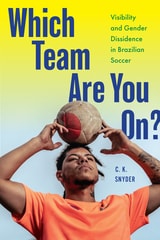
Which Team Are You On?
Visibility and Gender Dissidence in Brazilian SoccerC. K. Snyder
University of Texas Press, 0
Examines how Brazilian soccer’s trailblazers—women, gay men, and trans players—leverage their visibility to fight marginalization and advance gender justice.
In Brazil, national identity is tightly bound up with soccer. In turn, soccer leaves a masculinist and heteronormative mark on what it means to be Brazilian. After all, for much of the twentieth century, the law deemed futbol “incompatible with female nature,” and women were banned from participating. Though the prohibition was lifted in 1979, the national soccer culture continued to serve the reproduction of a gendered society.
Which Team Are You On? develops theoretical and ethnographic insights into the struggle of dissident athletes for recognition and redistribution. By tracing three groundbreaking "firsts"—pioneer women Olympians, the national LGBTQ+ league (LiGay), and Brazil’s first trans team, the Meninos Bons de Bola—C. K. Snyder examines the athletes’ “visibility dilemma,” in which being seen is essential for legitimacy as futebolistas yet dangerously exposes players to violence and backlash. Snyder argues that, today, soccer is a key battleground for gender justice in Brazil, as a surging reactionary movement lays claim to the nation’s proud sporting heritage, placing women, gay, and trans athletes at even greater risk. To fight back, they take to the pitch, continuing to demand not only respect but also a place in the life of their country.