Results by title
917 books match the query 'Economics' and 233 start with t

The Human Condition
Second EditionHannah Arendt
University of Chicago Press, 1998
Hannah Arendt (1906-1975) was one of the leading social theorists in the United States. Her Lectures on Kant's Political Philosophy and Love and Saint Augustine are also published by the University of Chicago Press.

The Human Condition
Second EditionHannah Arendt
University of Chicago Press, 2018
The twenty-first century has seen a resurgence of interest in the political thinker Hannah Arendt, “the theorist of beginnings,” whose work probes the logics underlying unexpected transformations—from totalitarianism to revolution.
A work of striking originality, The Human Condition is in many respects more relevant now than when it first appeared in 1958. In her study of the state of modern humanity, Hannah Arendt considers humankind from the perspective of the actions of which it is capable. The problems Arendt identified then—diminishing human agency and political freedom, the paradox that as human powers increase through technological and humanistic inquiry, we are less equipped to control the consequences of our actions—continue to confront us today. This new edition, published to coincide with the sixtieth anniversary of its original publication, contains Margaret Canovan’s 1998 introduction and a new foreword by Danielle Allen.
A classic in political and social theory, The Human Condition is a work that has proved both timeless and perpetually timely.

The IS-LM Model
Its Rise, Fall, and Strange Persistence, Volume 36Michel De Vroey and Kevin D. Hoover, eds.
Duke University Press, 0
Contributors. Roger E. Backhouse, Mauro Boianovsky, Michael Bordo, David Colander, William Darity Jr., Michel De Vroey, Robert W. Dimand, Kevin D. Hoover, David Laidler, Robert E. Lucas Jr., Edward Nelson, Goulven Rubin, Anna Schwartz, Scott Sumner, Warren Young
The Impact of International Trade on Wages
Edited by Robert C. Feenstra
University of Chicago Press, 2000
This collection brings together innovative new ideas and data sources in order to provide more satisfying alternatives to the trade versus technology debate and to assess directly the specific impact of international trade on U.S. wages. This timely volume offers a thorough appraisal of the wage distribution predicament, examining the continued effects of technology and globalization on the labor market.
The Industrial Organization and Regulation of the Securities Industry
Edited by Andrew W. Lo
University of Chicago Press, 1995
Ten original essays address topics including electronic trading and the "virtual"stock exchange; trading costs and liquidity on the London and Tokyo Stock Exchanges and in the German and Japanese government bond markets; international coordination among regulatory agencies; and the impact of changing margin requirements on stock prices, volatility, and liquidity.
This clear presentation of groundbreaking research will appeal to economists, lawyers, and legislators who seek a refreshingly new perspective on policy issues in the securities industry.
The Insatiability of Human Wants
Economics and Aesthetics in Market SocietyRegenia Gagnier
University of Chicago Press, 2000
The Insatiability of Human Wants begins during a key transitional moment in aesthetic and economic theory, 1871, when both disciplines underwent a turn from production to consumption models. In economics, an emphasis on the theory of value and the social relations between land, labor, and capital gave way to more individualistic models of consumerism. Similarly, in aesthetics, theories of artistic production or creativity soon bowed to models of taste, pleasure, and reception.
Using these developments as a point of departure, Gagnier deftly traces the shift in Western thought from models of production to consumption. From its exploration of early market logic and Kantian thought to its look at the aestheticization of homelessness and our own market boom, The Insatiability of Human Wants invites us to contemplate alternative interpretations of economics, aesthetics, and history itself.
The Invention of Capitalism
Classical Political Economy and the Secret History of Primitive AccumulationMichael Perelman
Duke University Press, 2000
Clearly, they did not go willingly. As Michael Perelman shows, they were forced into the factories with the active support of the same economists who were making theoretical claims for capitalism as a self-correcting mechanism that thrived without needing government intervention. Directly contradicting the laissez-faire principles they claimed to espouse, these men advocated government policies that deprived the peasantry of the means for self-provision in order to coerce these small farmers into wage labor. To show how Adam Smith and the other classical economists appear to have deliberately obscured the nature of the control of labor and how policies attacking the economic independence of the rural peasantry were essentially conceived to foster primitive accumulation, Perelman examines diaries, letters, and the more practical writings of the classical economists. He argues that these private and practical writings reveal the real intentions and goals of classical political economy—to separate a rural peasantry from their access to land.
This rereading of the history of classical political economy sheds important light on the rise of capitalism to its present state of world dominance. Historians of political economy and Marxist thought will find that this book broadens their understanding of how capitalism took hold in the industrial age.
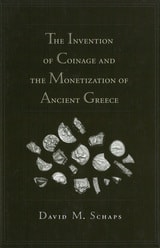
The Invention of Coinage and the Monetization of Ancient Greece
David M. Schaps
University of Michigan Press, 2015
The Japanese Automotive Industry
Model and Challenge for the Future?Robert E. Cole, Editor
University of Michigan Press, 1981
The Japanese Television Cartel
A Study Based on "Matsushita v. Zenith"David Schwartzman
University of Michigan Press, 1993

The Journal of Law and Economics, volume 63 number 4 (November 2020)
The University of Chicago Press
University of Chicago Press Journals, 2020
The Journal of Law and Economics, volume 64 number 1 (February 2021)
The University of Chicago Press
University of Chicago Press Journals, 2021
The Journal of Law and Economics, volume 64 number 2 (May 2021)
The University of Chicago Press
University of Chicago Press Journals, 2021
The Journal of Law and Economics, volume 64 number 3 (August 2021)
The University of Chicago Press
University of Chicago Press Journals, 2021
The Journal of Law and Economics, volume 64 number 4 (November 2021)
The University of Chicago Press
University of Chicago Press Journals, 2021
The Journal of Law and Economics, volume 65 number 1 (February 2022)
The University of Chicago Press
University of Chicago Press Journals, 2022
The Journal of Law and Economics, volume 65 number 2 (May 2022)
The University of Chicago Press
University of Chicago Press Journals, 2022
The Journal of Law and Economics, volume 65 number 3 (August 2022)
The University of Chicago Press
University of Chicago Press Journals, 2022
The Journal of Law and Economics, volume 65 number 4 (November 2022)
The University of Chicago Press
University of Chicago Press Journals, 2022
The Journal of Law and Economics, volume 65 number S1 (February 2022)
The University of Chicago Press
University of Chicago Press Journals, 2022
The Journal of Law and Economics, volume 65 number S2 (November 2022)
The University of Chicago Press
University of Chicago Press Journals, 2022
The Journal of Law and Economics, volume 66 number 1 (February 2023)
The University of Chicago Press
University of Chicago Press Journals, 2023
The Journal of Law and Economics, volume 66 number 2 (May 2023)
The University of Chicago Press
University of Chicago Press Journals, 2023
The Journal of Law and Economics, volume 66 number 3 (August 2023)
The University of Chicago Press
University of Chicago Press Journals, 2023
The Journal of Law and Economics, volume 66 number 4 (November 2023)
The University of Chicago Press
University of Chicago Press Journals, 2023
The Journal of Law and Economics, volume 67 number 1 (February 2024)
The University of Chicago Press
University of Chicago Press Journals, 2024
The Journal of Law and Economics, volume 67 number 2 (May 2024)
The University of Chicago Press
University of Chicago Press Journals, 2024
The Journal of Law and Economics, volume 67 number 3 (August 2024)
The University of Chicago Press
University of Chicago Press Journals, 2024
The Journal of Law and Economics, volume 67 number 4 (November 2024)
The University of Chicago Press
University of Chicago Press Journals, 2024
The Journal of Law and Economics, volume 68 number 1 (February 2025)
The University of Chicago Press
University of Chicago Press Journals, 2025
The Journal of Law and Economics, volume 68 number 2 (May 2025)
The University of Chicago Press
University of Chicago Press Journals, 2025
The Journal of Law and Economics, volume 68 number 3 (August 2025)
The University of Chicago Press
University of Chicago Press Journals, 2025
The Journal of Law and Economics, volume 68 number 4 (November 2025)
The University of Chicago Press
University of Chicago Press Journals, 2025
The Journal of Law and Economics, volume 69 number 1 (February 2026)
The University of Chicago Press
University of Chicago Press Journals, 2026
The Journal of Law and Economics, volume 69 number 2 (May 2026)
The University of Chicago Press
University of Chicago Press Journals, 2026
The Journal of Law and Economics, volume 69 number 3 (August 2026)
The University of Chicago Press
University of Chicago Press Journals, 2026

The Limits of Liberty
Between Anarchy and LeviathanJames M. Buchanan
University of Chicago Press, 1977
James Buchanan offers a strikingly innovative approach to a pervasive problem of social philosophy. The problem is one of the classic paradoxes concerning man's freedom in society: in order to protect individual freedom, the state must restrict each person's right to act. Employing the techniques of modern economic analysis, Professor Buchanan reveals the conceptual basis of an individual's social rights by examining the evolution and development of these rights out of presocial conditions.
The Limits of Market Organization
Richard R. Nelson
Russell Sage Foundation, 2005
The Limits of Money
Three Perceptions of Our Most Comprehensive Value SystemSimon Goudsmit
Eburon Academic Publishers, 2005
The Limits of Money is an intriguing and much-needed study of the role of money in daily life and human societies.
The Lost Forms of Economic Knowledge
On the Balance of Living BeingsArnaud Orain
University of Chicago Press, 2026
Traces the early history of economic knowledge developed by thinkers between the sixteenth and eighteenth centuries.
Starting with the sixteenth century, The Lost Forms of Economic Knowledge investigates the origins and prehistory of economic thought before the emergence of political economy as an autonomous discipline in the late eighteenth century. In this book, the celebrated French historian Arnaud Orain argues that these “lost forms” of economic knowledge represent an important alternative to our modern system of numerical abstraction and market manipulation.
As Orain shows, older approaches to the economy defined it as a relationship between humans and their specific environment. These earlier mindsets sought to advance vernacular knowledge by turning to a variety of figures—naturalists, artisans, farmers, and merchants—to learn how to take advantage of the environment without depleting it. The goal of these inquiries was not to maximize profit but to determine how to allow humans to satisfy basic needs and live in harmony with nature. Now, at a time in which natural resources are fast depleting, Orain argues that we could do worse than consider the alternative approaches to “economics” that lie in our past, and that might still be available in the future.

The Market Comes to Education in Sweden
An Evaluation of Sweden's Surprising School ReformsAnders Bjorklund
Russell Sage Foundation, 2005
The Market and Other Orders
F. A. Hayek
University of Chicago Press, 2013
The Market and Other Orders brings together more than twenty works spanning almost forty years that consider this question. Consisting of speeches, essays, and lectures, including Hayek’s 1974 Nobel lecture, “The Pretense of Knowledge,” the works in this volume draw on a broad range of perspectives, including the philosophy of science, the physiology of the brain, legal theory, and political philosophy. Taking readers from Hayek’s early development of the idea of spontaneous order in economics through his integration of this insight into political theory and other disciplines, the book culminates with Hayek’s integration of his work on these topics into an overarching social theory that accounts for spontaneous order in the variety of complex systems that Hayek studied throughout his career.
Edited by renowned Hayek scholar Bruce Caldwell, who also contributes a masterly introduction that provides biographical and historical context, The Market and Other Orders forms the definitive compilation of Hayek’s work on spontaneous order.
The Market and Other Orders
F. A. Hayek
University of Chicago Press, 2013
In addition to his groundbreaking contributions to pure economic theory, F. A. Hayek also closely examined the ways in which the knowledge of many individual market participants could culminate in an overall order of economic activity. His attempts to come to terms with the “knowledge problem” thread through his career and comprise the writings collected in the fifteenth volume of the University of Chicago Press’s Collected Works of F. A. Hayek series.
The Market and Other Orders brings together more than twenty works spanning almost forty years that consider this question. Consisting of speeches, essays, and lectures, including Hayek’s 1974 Nobel lecture, “The Pretense of Knowledge,” the works in this volume draw on a broad range of perspectives, including the philosophy of science, the physiology of the brain, legal theory, and political philosophy. Taking readers from Hayek’s early development of the idea of spontaneous order in economics through his integration of this insight into political theory and other disciplines, the book culminates with Hayek’s integration of his work on these topics into an overarching social theory that accounts for spontaneous order in the variety of complex systems that Hayek studied throughout his career.
Edited by renowned Hayek scholar Bruce Caldwell, who also contributes a masterly introduction that provides biographical and historical context, The Market and Other Orders forms the definitive compilation of Hayek’s work on spontaneous order.

The Meaning of Money in China and the United States
The 1986 Lewis Henry Morgan LecturesEmily Martin
HAU, 2015
When Emily Martin delivered the annual Lewis Henry Morgan Lectures at the University of Rochester in 1986, she took as her subject the meaning of money in China and the United States. Though the topic is of perennial interest—and never more so than in our era, when economic forecasts of China’s growing economy generate shallow news stories and public fear—the lectures were never edited for publication, so their rich analysis has been unavailable to anthropologists ever since.
With this book—the first volume in a collaboration between Hau Books and the University of Rochester—Martin’s lectures are brought back, fully edited and richly illustrated. A new introduction by Martin herself brings her analysis wholly up to date, while an afterword by Jane I. Guyer and Sidney Mintz discusses Martin’s work, influence, and legacy. The Meaning of Money in China and the United States will instantly assume its rightful place as a classic in the field, with Martin’s insights as germane and productive as they were nearly thirty years ago.
The Means of Prediction
How AI Really Works (and Who Benefits)Maximilian Kasy
University of Chicago Press, 2025
AI is inescapable, from its mundane uses online to its increasingly consequential decision-making in courtrooms, job interviews, and wars. The ubiquity of AI is so great that it might produce public resignation—a sense that the technology is our shared fate.
As economist Maximilian Kasy shows in The Means of Prediction, artificial intelligence, far from being an unstoppable force, is irrevocably shaped by human decisions—choices made to date by the ownership class that steers its development and deployment. Kasy shows that the technology of AI is ultimately not that complex. It is insidious, however, in its capacity to steer results to its owners’ wants and ends. Kasy clearly and accessibly explains the fundamental principles on which AI works, and, in doing so, reveals that the real conflict isn’t between humans and machines, but between those who control the machines and the rest of us.
The Means of Prediction offers a powerful vision of the future of AI: a future not shaped by technology, but by the technology’s owners. Amid a deluge of debates about technical details, new possibilities, and social problems, Kasy cuts to the core issue: Who controls AI’s objectives, and how is this control maintained? The answer lies in what he calls “the means of prediction,” or the essential resources required for building AI systems: data, computing power, expertise, and energy. As Kasy shows, in a world already defined by inequality, one of humanity’s most consequential technologies has been and will be steered by those already in power.
Against those stakes, Kasy offers an elegant framework both for understanding AI’s capabilities and for designing its public control. He makes a compelling case for democratic control over AI objectives as the answer to mounting concerns about AI's risks and harms. The Means of Prediction is a revelation, both an expert undressing of a technology that has masqueraded as more complicated and a compelling call for public oversight of this transformative technology.
The Means of Prediction
How AI Really Works (and Who Benefits)Maximilian Kasy
University of Chicago Press, 2025
An eye-opening examination of how power—not technology—will define life with AI.
AI is inescapable, from its mundane uses online to its increasingly consequential decision-making in courtrooms, job interviews, and wars. The ubiquity of AI is so great that it might produce public resignation—a sense that the technology is our shared fate.
As economist Maximilian Kasy shows in The Means of Prediction, artificial intelligence, far from being an unstoppable force, is irrevocably shaped by human decisions—choices made to date by the ownership class that steers its development and deployment. Kasy shows that the technology of AI is ultimately not that complex. It is insidious, however, in its capacity to steer results to its owners’ wants and ends. Kasy clearly and accessibly explains the fundamental principles on which AI works, and, in doing so, reveals that the real conflict isn’t between humans and machines, but between those who control the machines and the rest of us.
The Means of Prediction offers a powerful vision of the future of AI: a future not shaped by technology, but by the technology’s owners. Amid a deluge of debates about technical details, new possibilities, and social problems, Kasy cuts to the core issue: Who controls AI’s objectives, and how is this control maintained? The answer lies in what he calls “the means of prediction,” or the essential resources required for building AI systems: data, computing power, expertise, and energy. As Kasy shows, in a world already defined by inequality, one of humanity’s most consequential technologies has been and will be steered by those already in power.
Against those stakes, Kasy offers an elegant framework both for understanding AI’s capabilities and for designing its public control. He makes a compelling case for democratic control over AI objectives as the answer to mounting concerns about AI's risks and harms. The Means of Prediction is a revelation, both an expert undressing of a technology that has masqueraded as more complicated and a compelling call for public oversight of this transformative technology.
The Measure of Economies
Measuring Productivity in an Age of Technological ChangeEdited by Marshall B. Reinsdorf and Louise Sheiner
University of Chicago Press, 2024
Innovative new approaches for improving GDP measurement to better gauge economic productivity.
Official measures of gross domestic product (GDP) indicate that productivity growth has declined in the United States over the last two decades. This has led to calls for policy changes from pro-business tax reform to stronger antitrust measures. But are our twentieth-century economic methods actually measuring our twenty-first-century productivity?
The Measure of Economies offers a synthesis of the state of knowledge in productivity measurement at a time when many question the accuracy and scope of GDP. With chapters authored by leading economic experts on topics such as the digital economy, health care, and the environment, it highlights the inadequacies of current practices and discusses cutting-edge alternatives.
Pragmatic and forward-facing, The Measure of Economies is an essential resource not only for social scientists, but also for policymakers and business leaders seeking to understand the complexities of economic growth in a time of rapidly evolving technology.
The Measurement of Durable Goods Prices
Robert J. Gordon
University of Chicago Press, 1990
Robert J. Gordon has written the first full-scale work to treat the extent of quality changes over the entire range of durable goods, from autos to aircraft, computers to compressors, from televisions to tractors. He combines and extends existing methods of measurement, drawing data from industry sources, Consumer Reports, and the venerable Sears catalog.
Beyond his important finding that the American economy is more sound than officially recognized, Gordon provides a wealth of anecdotes tracing the postwar history of technological progress. Bolstering his argument that improved quality must be accurately measured, Gordon notes, for example, that today's mid-range personal computers outperform the multimillion-dollar mainframes of the 1970s. This remarkable book will be essential reading for economists and those in the business community.
The Measurement of Labor Cost
Edited by Jack E. Triplett
University of Chicago Press, 1983
An introductory essay by the editor provides a useful guide to current thought in the analysis of labor cost. Other papers give new insights into problems encountered in accounting for the nonwage elements of labor compensation, the effect of pensions and other benefits, and the wage-measurement questions raised by incomes policies. In addition, there is a wealth of valuable new data on labor costs in the United States.
Labor economists, statisticians, econometric modelers, and advisers to government and industry will welcome this up-to-date and comprehensive treatment of the costs of production.
The Measurement of Saving, Investment, and Wealth
Edited by Robert E. Lipsey and Helen Stone Tice
University of Chicago Press, 1989
Contributors to this volume investigate ways to improve aggregate and sectoral saving and investment estimates and analyze microdata from recent household wealth surveys. They provide analyses of National Income and Product Account (NIPA) and Flow-of-Funds measures and of saving and survey-based wealth estimates. Conceptual and methodological questions are discussed regarding long-term trends in the U.S. wealth inequality, age-wealth profiles, pensions and wealth distribution, and biases in inferences about life-cycle changes in saving and wealth. Some new assessments are offered for investment in human and nonhuman capital, the government contribution to national wealth, NIPA personal and corporate saving, and banking imputation.