Results by title
484 books match the query 'Foreign relations' and 111 start with t
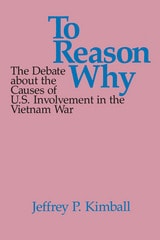
To Reason Why
Jeffrey Kimball
Temple University Press, 1990

To See Ourselves as Others See Us
How Publics Abroad View the United States after 9/11Ole R. Holsti
University of Michigan Press, 2008
"Holsti, the authority on American foreign policy attitudes, investigates others' views of us. It's not pretty. It matters. Read this."
---Bruce Russett, Dean Acheson Professor of International Relations, Yale University, and editor of the Journal of Conflict Resolution
"Clearly and engagingly written, Holsti's book ranks among the most important---and most objective---of the post-9/11 scholarly studies. It deserves a large readership, both within and beyond academe."
---Ralph Levering, Vail Professor of History, Davidson College
In terms of military and economic power, the United States remains one of the strongest nations in the world. Yet the United States seems to have lost the power of persuasion, the ability to make allies and win international support.
Why? Immediately after the terrorist attacks of 9/11, leaders and citizens of foreign nations generally expressed sympathy for the United States. Since then, attitudes have changed. Drawing upon public opinion surveys conducted in 30 nations, Ole R. Holsti documents an increasing anti-American sentiment. His analysis suggests that the war in Iraq, human rights violations, and unpopular international policies are largely responsible. Consequently, the United States can rebuild its repute by adopting an unselfish, farsighted approach to global issues.
Indeed, the United States must restore goodwill abroad, Holsti asserts, because public opinion indirectly influences the leaders who decide whether or not to side with the Americans.
Ole R. Holsti is George V. Allen Professor Emeritus of International Affairs in the Department of Political Science at Duke University and author of Public Opinion and American Foreign Policy.

Transplanting the Great Society
Lyndon Johnson and Food for PeaceKristin L. Ahlberg
University of Missouri Press, 2008
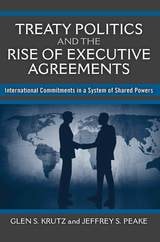
Treaty Politics and the Rise of Executive Agreements
International Commitments in a System of Shared PowersGlen S. Krutz and Jeffrey S. Peake
University of Michigan Press, 2011
"Krutz and Peake's examination of the increase use of executive agreements offers a valuable lesson in how the president and Congress have responded and adjusted to the growth in the complexity of foreign relations to meet the demands of an ever-increasingly complex and interconnected international community."
---Victoria Farrar-Myers, University of Texas, Arlington
"From reading Treaty Politics and the Rise of Executive Agreements, I learned a good deal about a topic that I thought I knew well. This book will be an excellent addition to the literature on the presidency. It will be read and cited by scholars working in this field."
---Benjamin Ginsberg, Johns Hopkins University
"Glen Krutz and Jeffrey Peake's Treaty Politics and the Rise of Executive Agreements offers a provocative analysis of a neglected topic. Their theoretical and empirical challenge to the usual explanation for the growth of executive agreements, their careful analysis of the treaty process in the Senate and when that body can be decisive, and their assessment of the House of Representatives' role in the agreement process provide important new scholarship for students of the presidency, Congress, and foreign policy."
---James M. McCormick, Iowa State University
In foreign relations, U.S. presidents have exercised a growing independence through the use of executive agreements. The U.S. Constitution specifies that two-thirds of the Senate must ratify a proposed treaty but makes no provision for other forms of international agreements. In 1942 the Supreme Court affirmed the legality of executive agreements, and since World War II, they have outnumbered treaties by more than ten to one. Are presidents trampling the Constitution or seeking to streamline the diplomatic process?
Glen S. Krutz and Jeffrey S. Peake argue that the preference for executive agreements is the result of a symbiotic evolution of the executive and the legislative branches and that in order for the United States to survive in a complex, ever-changing global environment and maintain its world power status, it must fulfill international commitments swiftly and confidently. Members of Congress concur that executive agreements allow each branch to function more effectively. At the same time, the House continues to oversee particular policy areas, and presidents still submit the majority of the most significant international commitments to the Senate as treaties.
Krutz and Peake conclude that executive agreements represent a mutual adaptation of the executive and the legislature in a system of shared power.
Glen S. Krutz is Associate Director of the Carl Albert Center and Professor of Political Science at the University of Oklahoma.
Jeffrey S. Peake is Professor and Department Chair, Department of Political Science at Clemson University.

Tropical Zion
General Trujillo, FDR, and the Jews of SosúaAllen Wells
Duke University Press, 2009
Why did a dictator admit these desperate refugees when so few nations would accept those fleeing fascism? Eager to mollify international critics after his army had massacred 15,000 unarmed Haitians, Trujillo sent representatives to Évian, France, in July, 1938 for a conference on refugees from Nazism. Proposed by FDR to deflect criticism from his administration’s restrictive immigration policies, the Évian Conference proved an abject failure. The Dominican Republic was the only nation that agreed to open its doors. Obsessed with stemming the tide of Haitian migration across his nation’s border, the opportunistic Trujillo sought to “whiten” the Dominican populace, welcoming Jewish refugees who were themselves subject to racist scorn in Europe.
The Roosevelt administration sanctioned the Sosúa colony. Since the United States did not accept Jewish refugees in significant numbers, it encouraged Latin America to do so. That prodding, paired with FDR’s overriding preoccupation with fighting fascism, strengthened U.S. relations with Latin American dictatorships for decades to come. Meanwhile, as Jewish organizations worked to get Jews out of Europe, discussions about the fate of worldwide Jewry exposed fault lines between Zionists and Non-Zionists. Throughout his discussion of these broad dynamics, Wells weaves vivid narratives about the founding of Sosúa, the original settlers and their families, and the life of the unconventional beach-front colony.
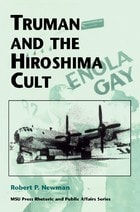
Truman and the Hiroshima Cult
Robert P. Newman
Michigan State University Press, 1995
The United States dropped atomic bombs on Japan in 1945 to end World War II as quickly and with as few casualties as possible. That is the compelling and elegantly simple argument Newman puts forward in his new study of World War II's end, Truman and the Hiroshima Cult. According to Newman: (1) The U.S. Strategic Bombing Survey conclusions that Japan was ready to surrender without "the Bomb" are fraudulent; (2) America’s "unconditional surrender" doctrine did not significantly prolong the war; and (3) President Harry S. Truman’s decision to use atomic weapons on Japanese cities was not a "racist act," nor was it a calculated political maneuver to threaten Joseph Stalin’s Eastern hegemony. Simply stated, Newman argues that Truman made a sensible military decision. As commander in chief, he was concerned with ending a devastating and costly war as quickly as possible and with saving millions of lives.
Yet, Newman goes further in his discussion, seeking the reasons why so much hostility has been generated by what happened in the skies over Hiroshima and Nagasaki in early August, 1945. The source of discontent, he concludes, is a "cult" that has grown up in the United States since the 1960s. It was weaned on the disillusionment spawned by concerns about a military industrial complex, American duplicity and failure in the Vietnam War, and a mistrust of government following Watergate. The cult has a shrine, a holy day, a distinctive rhetoric of victimization, various items of scripture, and, in Japan, support from a powerful Marxist constituency. "As with other cults, it is ahistorical," Newman declares. "Its devotees elevate fugitive and unrepresentative events to cosmic status. And most of all, they believe." Newman’s analysis goes to the heart of the process by which scholars interpret historical events and raises disturbing issues about the way historians select and distort evidence about the past to suit special political agendas.
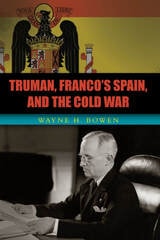
Truman, Franco's Spain, and the Cold War
Wayne H Bowen
University of Missouri Press, 2017
President Harry S. Truman harbored an abiding disdain for Spain and its government. During his presidency (1945–1953), the State Department and the Department of Defense lobbied Truman to form an alliance with Spain to leverage that nation’s geostrategic position, despite Francisco Franco’s authoritarian dictatorship. The eventual alliance between the two countries came only after years of argument for such a shift by nearly the entire U.S. diplomatic and military establishment. This delay increased the financial cost of the 1953 defense agreements with Spain, undermined U.S. planning for the defense of Europe, and caused dysfunction over foreign policy at the height of the Cold War.
Trust and Hedging in International Relations
Kendall W. Stiles
University of Michigan Press, 2018
Tumultuous Years
The Presidency of Harry S. Truman, 1949-1953Robert J. Donovan
University of Missouri Press, 1996
Turbulence Across the Sea
Transatlantic Relations and Strategic CompetitionEdited by Elie Baranets and Andrew Novo
University of Michigan Press, 2024
With a mix of research methodologies applied by scholars from both sides of the Atlantic, Turbulence Across the Sea offers a comprehensive analysis of relations among European and North American actors in the context of strategic competition among the United States, Europe, Russia, and China. In doing so, it demonstrates that a reaffirmation of transatlantic cooperation is necessary to maintain security in the face of aggressive moves by both Russia and China. By analyzing attitudes from the perspective of both the various actors (Britain, France, Germany, and the European Union) and various sectors (intelligence cooperation, foreign direct investments, technology, and the defense industry), this book provides readers with a comprehensive perspective on the challenges and opportunities in the shifting landscape of security in the twenty-first century.

Two NATO Allies at the Threshold of War
Parker T. Hart
Duke University Press, 1990
Hart has relied on his own papers from the period, as well as on United Nations sources from the Lyndon B. Johnson Presidential Library, and on the papers of the other key participants in the Crisis, Ambassador to Greece Phillips Talbot, Ambassador to Cyprus Taylor G. Belcher, and Cyrus Vance, to provide a rare play-by-play analysis of the crisis and its resolution.