Results by title
932 books match the query 'Genres & Styles' and 126 start with t
The Trouble with Wagner
Michael P. Steinberg
University of Chicago Press, 2018
Drawing on decades of engagement with Wagner and of experience teaching opera across disciplines, The Trouble with Wagner is packed with novel insights for experts and interested readers alike.

The Urbanization of Opera
Music Theater in Paris in the Nineteenth CenturyAnselm Gerhard
University of Chicago Press, 1998
"An invaluable look at this fascinating genre."—George W. Loomis, Opera News
The Verdi-Boito Correspondence
Giuseppe Verdi and Arrigo Boito
University of Chicago Press, 1994
This new edition of the landmark Carteggio Verdi/Boito is at once a valuable resource for all students, teachers, and scholars of opera and a fascinating glimpse of the daily life of European art and artists during the fertile last decades of the 19th century.
Embarking on a 20-year collaboration, Verdi and Boito produced a successful revision of Simon Boccanegra, and two new operas, Otello and Falstaff. They created what many consider to be Verdi's greatest operas, thanks both to Boito's poetry and to his handling of the composer. Here are the day-to-day tasks of creation: poet and composer debating problems of dramatic structure, words, phrases, and meters; altering dialogue as, at the same time, they converse about the wider worlds of art and music. The give and take of artistic creation is rendered fascinatingly.
This edition features a new introduction by Marcello Conati, improvements and updatings to the original edition, and an appendix of undated correspondence. William Weaver's translation is characteristically pitch-perfect; he also provides a short closing sketch of Boito's life after the death of his beloved maestro. Explanatory "linking texts" between the letters create a narrative.
The Vinyl Ain't Final
Hip Hop and the Globalization of Black Popular CultureDipannita Basu and Sidney Lemelle
Pluto Press, 2006
From the front lines of hip hop culture and music in the USA, Britain, France, Japan, Germany, Hawaii, Tanzania, Cuba, Samoa and South Africa, academics, poets, practitioners, journalists, and political commentators explore hip hop -- both as a culture and as a commodity. From the political economy of the South African music industry to the cultural resistance forged by Afro-Asian hip hop, this potent mix of contributors provides a unique critical insight into the implications of hip hop globally and locally. Indispensable for fans of hip hop culture and music, this book will also appeal to anyone interested in cultural production, cultural politics and the implications of the huge variety of forms hip hop encompasses.
Dipa Basu is and Associate Professor of Sociology and Black Studies at Pitzer College, Claremont, California. Her recent publications include 'Sociology of the Color Line' in Peter Ratcliffe, ed. The Politics of Social Science Research: Race, Ethnicity and Social Change (Palgrave Press, 2001).
Sidney Lemelle is an Associate Professor of Black Studies at Pomona College, Claremont, California. He has co-edited with Robin D.G Kelley, Imagining Home: Class, Culture and Nationalism in the African Diaspora (Verso, 1994).
The Virtual Haydn
Paradox of a Twenty-First-Century KeyboardistTom Beghin
University of Chicago Press, 2015
With The Virtual Haydn, Tom Beghin—himself a professional keyboard player—delves deeply into eighteenth-century history and musicology to help us hear a properly complex Haydn. Unusually for a scholarly work, the book is presented in the first person, as Beghin takes us on what is clearly a very personal journey into the past. When a discussion of a group of Viennese sonatas, for example, leads him into an analysis of the contemporary interest in physiognomy, Beghin applies what he learns about the role of facial expressions during his own performance of the music. Elsewhere, he analyzes gesture and gender, changes in keyboard technology, and the role of amateurs in eighteenth-century musical culture.
The resulting book is itself a fascinating, bravura performance, one that partakes of eighteenth-century idiosyncrasy while drawing on a panoply of twenty-first-century knowledge.
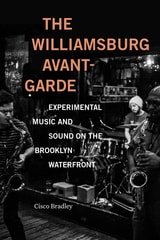
The Williamsburg Avant-Garde
Experimental Music and Sound on the Brooklyn WaterfrontCisco Bradley
Duke University Press, 2023
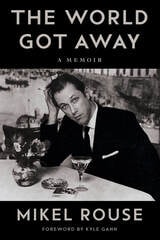
The World Got Away
A MemoirMikel Rouse. Foreward by Kyle Gann
University of Illinois Press, 2024
One of the most innovative composers of his generation, Mikel Rouse is known for a trilogy of operas that includes Dennis Cleveland and a gift for superimposing pop vernaculars onto avant-garde music. This memoir channels Rouse’s high energy personality into an exuberant account of the precarity and pleasures of artistic creation. Raconteur and starving artist, witty observer and acclaimed musician, Rouse emerged from the legendary art world of 1980s New York to build a forty-year career defined by stage and musical successes, inexhaustible creativity, and a support network of famous faces, loyal allies, and high art hustlers. Rouse guides readers through a working artists’ hardscrabble life while illuminating the unromantic truth that a project’s reception may depend on a talented cast and crew but can depend on reliable air conditioning.
Candid and hilarious, The World Got Away is a one-of-a-kind account of a creative life fueled by talent, work, and luck.

The emergence of post-hybrid identities
a comparative analysis of national identity formations in Germany’s hip-hop cultureMarissa Munderloh
University of London Press, 2017
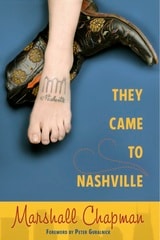
They Came to Nashville
Marshall Chapman
Vanderbilt University Press, 2010
In They Came to Nashville, Chapman records the personal stories of musicians shaping the modern history of music in Nashville, from the mouths of the musicians themselves. The trials, tribulations, and evolution of Music City are on display, as she sits down with influential figures like Kris Kristofferson, Emmylou Harris, and Miranda Lambert, and a dozen other top names, to record what brought each of them to Nashville and what inspired them to persevere. The book culminates in a hilarious and heroic attempt to find enough free time with Willie Nelson to get a proper interview. Instead, she's brought along on his raucous 2008 tour and winds up onstage in Beaumont, Texas singing "Good-Hearted Woman" with Willie.
They Came to Nashville reveals the daily struggle facing newcomers to the music business, and the promise awaiting those willing to fight for the dream.
Co-published with the Country Music Foundation Press
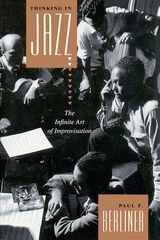
Thinking in Jazz
The Infinite Art of ImprovisationPaul F. Berliner
University of Chicago Press, 1994
The product of more than fifteen years of immersion in the jazz world, Thinking in Jazz combines participant observation with detailed musicological analysis, the author's experience as a jazz trumpeter, interpretations of published material by scholars and performers, and, above all, original data from interviews with more than fifty professional musicians: bassists George Duvivier and Rufus Reid; drummers Max Roach, Ronald Shannon Jackson, and Akira Tana; guitarist Emily Remler; pianists Tommy Flanagan and Barry Harris; saxophonists Lou Donaldson, Lee Konitz, and James Moody; trombonist Curtis Fuller; trumpeters Doc Cheatham, Art Farmer, Wynton Marsalis, and Red Rodney; vocalists Carmen Lundy and Vea Williams; and others. Together, the interviews provide insight into the production of jazz by great artists like Betty Carter, Miles Davis, Dizzy Gillespie, Coleman Hawkins, and Charlie Parker.
Thinking in Jazz overflows with musical examples from the 1920s to the present, including original transcriptions (keyed to commercial recordings) of collective improvisations by Miles Davis's and John Coltrane's groups. These transcriptions provide additional insight into the structure and creativity of jazz improvisation and represent a remarkable resource for jazz musicians as well as students and educators.
Berliner explores the alternative ways—aural, visual, kinetic, verbal, emotional, theoretical, associative—in which these performers conceptualize their music and describes the delicate interplay of soloist and ensemble in collective improvisation. Berliner's skillful integration of data concerning musical development, the rigorous practice and thought artists devote to jazz outside of performance, and the complexities of composing in the moment leads to a new understanding of jazz improvisation as a language, an aesthetic, and a tradition. This unprecedented journey to the heart of the jazz tradition will fascinate and enlighten musicians, musicologists, and jazz fans alike.
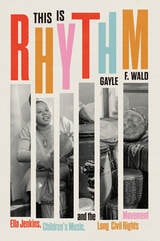
This Is Rhythm
Ella Jenkins, Children’s Music, and the Long Civil Rights MovementGayle F. Wald
University of Chicago Press, 2025
Ella Jenkins was one of the most influential musicians of the twentieth century. Her songs “You’ll Sing a Song and I’ll Sing a Song” and “Who Fed the Chickens?” are classics in the world of children’s music. In a career spanning more than sixty years, she recorded forty albums, won a lifetime-achievement Grammy, and became the best-selling individual artist in the history of Smithsonian Folkways Records, the independent label that played a significant role in the 1960s folk revival movement and introduced listeners to Woody Guthrie and Pete Seeger. During her remarkable career, Jenkins joined forces with twentieth-century luminaries such as Odetta, Big Bill Broonzy, Armando Peraza, Bayard Rustin, and Fred Rogers. Despite her wide-reaching influence on children’s music, Ella Jenkins’s sonic civil rights activism isn’t widely known today.
Based on dozens of interviews and access to Ella Jenkins’s personal archives, Gayle F. Wald’s This Is Rhythm shares how Jenkins, a “rhythm specialist” with no formal musical training, became the most prolific and significant American children’s musician of the twentieth century, creating a beloved catalog of songs grounded in values of community-building, antiracism, and cultural pluralism. Wald traces how the daughter of southern migrants translated the music of her own Black girlhood on the South Side of Chicago into a form of civil rights activism—a musical education that empowered children by introducing them to Black history, African diasporic rhythms, and a participatory, community-centered approach to music. Wald also discusses how, beginning in 1961, Jenkins built a life with a female partner who supported her materially and emotionally. Although Jenkins did not talk publicly about her sixty-three-year relationship, she opened up to Wald, offering insight into how a “private” Black woman in the public eye negotiated sexuality in an era before gay and lesbian liberation movements. Throughout her career, her innovative music found its way into thousands of community centers, classrooms, and concert venues, and her “call-and-response” method has influenced and empowered generations of children and adults.
A beautifully written tribute to Ella Jenkins’s legacy, this biography illustrates her impact on children’s music and expands our understanding of folk music’s relationship with social justice. Jenkins used music to build a new world in which children—and adults—are encouraged to listen to each other’s distinct rhythms.
Thug Life
Race, Gender, and the Meaning of Hip-HopMichael P. Jeffries
University of Chicago Press, 2010
Hip-hop has come a long way from its origins in the Bronx in the 1970s, when rapping and DJing were just part of a lively, decidedly local scene that also venerated b-boying and graffiti. Now hip-hop is a global phenomenon and, in the United States, a massively successful corporate enterprise predominantly controlled and consumed by whites while the most prominent performers are black. How does this shift in racial dynamics affect our understanding of contemporary hip-hop, especially when the music perpetuates stereotypes of black men? Do black listeners interpret hip-hop differently from white fans?
These questions have dogged hip-hop for decades, but unlike most pundits, Michael P. Jeffries finds answers by interviewing everyday people. Instead of turning to performers or media critics, Thug Life focuses on the music’s fans—young men, both black and white—and the resulting account avoids romanticism, offering an unbiased examination of how hip-hop works in people’s daily lives. As Jeffries weaves the fans’ voices together with his own sophisticated analysis, we are able to understand hip-hop as a tool listeners use to make sense of themselves and society as well as a rich, self-contained world containing politics and pleasure, virtue and vice.
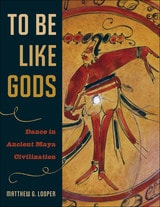
To Be Like Gods
Dance in Ancient Maya CivilizationBy Matthew G. Looper
University of Texas Press, 2009
Winner, Association for Latin American Art Book Award, 2010
The Maya of Mexico and Central America have performed ritual dances for more than two millennia. Dance is still an essential component of religious experience today, serving as a medium for communication with the supernatural. During the Late Classic period (AD 600-900), dance assumed additional importance in Maya royal courts through an association with feasting and gift exchange. These performances allowed rulers to forge political alliances and demonstrate their control of trade in luxury goods. The aesthetic values embodied in these performances were closely tied to Maya social structure, expressing notions of gender, rank, and status. Dance was thus not simply entertainment, but was fundamental to ancient Maya notions of social, religious, and political identity.
Using an innovative interdisciplinary approach, Matthew Looper examines several types of data relevant to ancient Maya dance, including hieroglyphic texts, pictorial images in diverse media, and architecture. A series of case studies illustrates the application of various analytical methodologies and offers interpretations of the form, meaning, and social significance of dance performance. Although the nuances of movement in Maya dances are impossible to recover, Looper demonstrates that a wealth of other data survives which allows a detailed consideration of many aspects of performance. To Be Like Gods thus provides the first comprehensive interpretation of the role of dance in ancient Maya society and also serves as a model for comparative research in the archaeology of performance.
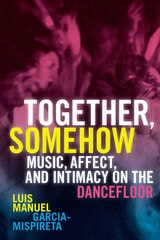
Together, Somehow
Music, Affect, and Intimacy on the DancefloorLuis Manuel Garcia-Mispireta
Duke University Press, 2023
Tomorrow Is the Question
New Directions in Experimental Music StudiesEdited by Benjamin Piekut
University of Michigan Press, 2014
Tomorrow Never Knows
Rock and Psychedelics in the 1960sNick Bromell
University of Chicago Press, 2000
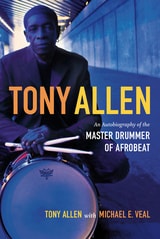
Tony Allen
An Autobiography of the Master Drummer of AfrobeatTony Allen, with Michael E. Veal
Duke University Press, 2013
Allen embraced the drum set, rather than African handheld drums, early in his career, when drum kits were relatively rare in Africa. His story conveys a love of his craft along with the specifics of his practice. It also provides invaluable firsthand accounts of the explosive creativity in postcolonial African music, and the personal and artistic dynamics in Fela's Koola Lobitos and Africa 70, two of the greatest bands to ever play African music.
Top 40 Democracy
The Rival Mainstreams of American MusicEric Weisbard
University of Chicago Press, 2014
In Top 40 Democracy, Eric Weisbard studies the evolution of this multicentered pop landscape, along the way telling the stories of the Isley Brothers, Dolly Parton, A&M Records, and Elton John, among others. He sheds new light on the upheavals in the music industry over the past fifteen years and their implications for the audiences the industry has shaped. Weisbard focuses in particular on formats—constructed mainstreams designed to appeal to distinct populations—showing how taste became intertwined with class, race, gender, and region. While many historians and music critics have criticized the segmentation of pop radio, Weisbard finds that the creation of multiple formats allowed different subgroups to attain a kind of separate majority status—for example, even in its most mainstream form, the R&B of the Isley Brothers helped to create a sphere where black identity was nourished. Music formats became the one reliable place where different groups of Americans could listen to modern life unfold from their distinct perspectives. The centers of pop, it turns out, were as complicated, diverse, and surprising as the cultural margins. Weisbard’s stimulating book is a tour de force, shaking up our ideas about the mainstream music industry in order to tease out the cultural importance of all performers and songs.
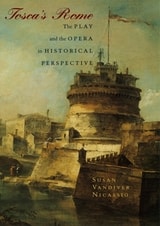
Tosca's Rome
The Play and the Opera in Historical PerspectiveSusan Vandiver Nicassio
University of Chicago Press, 1999
By far the most "historical" opera in the active repertoire, Tosca is set in a very specific time and place: Rome, from June 17 to 18, 1800. But as Nicassio demonstrates, history in Tosca is distorted by nationalism and by the vehement anticlerical perceptions of papal Rome shared by Sardou, Puccini, and the librettists. To provide the historical background necessary for understanding Tosca, Nicassio takes a detailed look at Rome in 1800 as each of Tosca's main characters would have seen it—the painter Cavaradossi, the singer Tosca, and the policeman Scarpia. Finally, she provides a scene-by-scene musical and dramatic analysis of the opera.
"[Nicassio] must be the only living historian who can boast that she once sang the role of Tosca. Her deep knowledge of Puccini's score is only to be expected, but her understanding of daily and political life in Rome at the close of the 18th century is an unanticipated pleasure. She has steeped herself in the period and its prevailing culture-literary, artistic, and musical-and has come up with an unusual, and unusually entertaining, history."—Paul Bailey, Daily Telegraph
"In Tosca's Rome, Susan Vandiver Nicassio . . . orchestrates a wealth of detail without losing view of the opera and its pleasures. . . . Nicassio aims for opera fans and for historians: she may well enthrall both."—Publishers Weekly
"This is the book that ranks highest in my estimation as the most in-depth, and yet highly entertaining, journey into the story of the making of Tosca."—Catherine Malfitano
"Nicassio's prose . . . is lively and approachable. There is plenty here to intrigue everyone-seasoned opera lovers, musical novices, history buffs, and Italophiles."—Library Journal
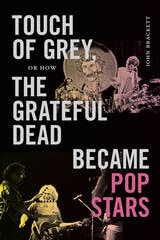
Touch of Grey, or How the Grateful Dead Became Pop Stars
John Brackett
Duke University Press, 2026
Touch of Grey, or How the Grateful Dead Became Pop Stars tells the story of how one song transformed the popular legacy of one of rock’s most iconic musical groups. John Brackett traces the history of the song “Touch of Grey,” beginning with songwriter Robert Hunter’s lyrical sketches and the Grateful Dead’s earliest live arrangements, culminating in the group’s popular renaissance following the release of “Touch of Grey” and the album In the Dark in the summer of 1987. Brackett details how particular recording technologies, notable musical characteristics, modes of attending and listening, and the mechanics of the contemporary music industry shaped this defining moment in the group’s career. Drawing on extensive archival research, Touch of Grey examines how the band and their label worked to produce a hit record, a dynamic music video, and an effective promotional campaign that would propel the Grateful Dead from a group with a devoted cult following to become a pop culture phenomenon.

Trans-Global Punk Scenes
The Punk Reader Volume 2Edited by Russ Bestley, Mike Dines, Alastair "Gords" Gordon, and Paula Guerra
Intellect Books, 2021
International in scope and analytical in perspective, the chapters offer insight into the dissemination of punk scenes and their form, structure, and contemporary cultural significance in New Zealand, Indonesia, Singapore, Ireland, South Africa, Mexico, the UK, the US, Siberia, and the Philippines.
Traveling Home
Sacred Harp Singing and American PluralismKiri Miller
University of Illinois Press, 2010
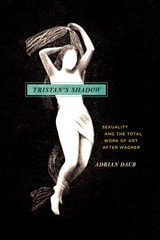
Tristan's Shadow
Sexuality and the Total Work of Art after WagnerAdrian Daub
University of Chicago Press, 2013
Das Rheingold, Die Walküre, and Siegfried. Parsifal. Tristan und Isolde. Both revered and reviled, Richard Wagner conceived some of the nineteenth century’s most influential operas—and created some of the most indelible characters ever to grace the stage. But over the course of his polarizing career, Wagner also composed volumes of essays and pamphlets, some on topics seemingly quite distant from the opera house. His influential concept of Gesamtkunstwerk—the “total work of art”—famously and controversially offered a way to unify the different media of an opera into a coherent whole. Less well known, however, are Wagner’s strange theories on sexuality—like his ideas about erotic acoustics and the metaphysics of sexual difference.
Drawing on the discourses of psychoanalysis, evolutionary biology, and other emerging fields of study that informed Wagner’s thinking, Adrian Daub traces the dual influence of Gesamtkunstwerk and eroticism from their classic expressions in Tristan und Isolde into the work of the generation of composers that followed, including Zemlinsky, d’Albert, Schreker, and Strauss. For decades after Wagner’s death, Daub writes, these composers continued to grapple with his ideas and with his overwhelming legacy, trying in vain to write their way out from Tristan’s shadow.
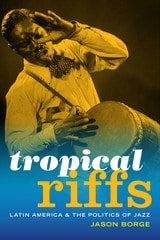
Tropical Riffs
Latin America and the Politics of JazzJason Borge
Duke University Press, 2018

Tween Pop
Children's Music and Public CultureTyler Bickford
Duke University Press, 2020
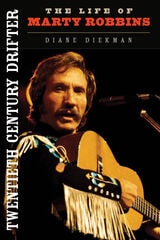
Twentieth Century Drifter
The Life of Marty RobbinsDiane Diekman
University of Illinois Press, 2012
Twentieth Century Drifter: The Life of Marty Robbins is the first biography of this legendary country music artist and NASCAR driver who scored sixteen number-one hits and two Grammy awards. Yet even with fame and fortune, Marty Robbins always yearned for more.
Drawing from personal interviews and in-depth research, biographer Diane Diekman explains how Robbins saw himself as a drifter, a man always searching for self-fulfillment and inner peace. Born Martin David Robinson to a hardworking mother and an abusive alcoholic father, he never fully escaped the insecurities burned into him by a poverty-stricken nomadic childhood in the Arizona desert. In 1947 he got his first gig as a singer and guitar player. Too nervous to talk, the shy young man walked onstage singing. Soon he changed his name to Marty Robbins, cultivated his magnetic stage presence, and established himself as an entertainer, songwriter, and successful NASCAR driver.
For fans of Robbins, NASCAR, and classic country music, Twentieth Century Drifter: The Life of Marty Robbins is a revealing portrait of this well-loved, restless entertainer, a private man who kept those who loved him at a distance.