Results by title
1185 books match the query 'Travel' and 292 start with t
The Indonesia Reader
History, Culture, PoliticsTineke Hellwig and Eric Tagliacozzo, eds.
Duke University Press, 2009
Organized chronologically, the volume addresses early Indonesian civilizations; contact with traders from India, China, and the Arab Middle East; and the European colonization of Indonesia, which culminated in centuries of Dutch rule. Selections offer insight into Japan’s occupation (1942–45), the establishment of an independent Indonesia, and the post-independence era, from Sukarno’s presidency (1945–67), through Suharto’s dictatorial regime (1967–98), to the present Reformasi period. Themes of resistance and activism recur: in a book excerpt decrying the exploitation of Java’s natural wealth by the Dutch; in the writing of Raden Ajeng Kartini (1879–1904), a Javanese princess considered the icon of Indonesian feminism; in a 1978 statement from East Timor objecting to annexation by Indonesia; and in an essay by the founder of Indonesia’s first gay activist group. From fifth-century Sanskrit inscriptions in stone to selections related to the 2002 Bali bombings and the 2004 tsunami, The Indonesia Reader conveys the long history and the cultural, ethnic, and ecological diversity of this far-flung archipelago nation.
The Italian Legacy in Philadelphia
History, Culture, People, and IdeasEdited by Andrea Canepari and Judith Goode
Temple University Press, 2021
Italian arts and culture have been a significant influence on Philadelphia dating back to Thomas Jefferson and colonial times. Throughout the ensuing decades, Italian art and architecture styles flourished, and wealthy Philadelphians traveled to Italy and brought back objects to display in emerging institutions of art and culture. New immigration formed neighborhoods—such as South Philly, home to the Italian Market—and Italian business leaders, politicians, artists, musicians and sports figures came to prominence and became part of the social fabric of the city.
This glorious volume, The Italian Legacy in Philadelphia, celebrates the history, impact, and legacy of this vibrant community, tracing four periods of key transformation in the city’s political, economic, and social structures. The editors and contributors chronicle the changing dynamics of the city as Italian immigrants established themselves and as they continue to have lively interactions with people and institutions in Italy.
Interdisciplinary essays, along with nearly 250 gorgeous images, explore the changing perspectives and styles of those who contributed Italian influences. As settlers and their descendants brought everyday cultural practices, memories, and traditions, they created different Italian-American experiences that became important parts of American culture, a legacy that is thriving in contemporary, globalized Philadelphia.
The Jamaica Reader
History, Culture, PoliticsDiana Paton and Matthew J. Smith, editors
Duke University Press, 2021
The Jersey Shore Uncovered
A Revealing Season on the BeachGenovese, Peter
Rutgers University Press, 2003
This is not your typical Jersey Shore book.
Yes, you'll find the obvious-beaches and boardwalks, lifeguards and lighthouses, fishing and food. But Peter Genovese will also take you off the beaten track for an insider's look at this famous (and infamous) 127-mile stretch from Sandy Hook to Cape May.
Birders, tiki hut builders, beach cleaners, wheel-of-chance operators, she-crab soup makers-they're all here. You'll check out an Airstream-only trailer park and visit a Point Pleasant Beach house where the music of Frank Sinatra plays nearly 24/7. Genovese will introduce you to the owner of the Stone Pony and to participants at the grueling Atlantic City Around-the-Island Swim as they describe their battles with tides, exhaustion, and face-stinging jellyfish. All of that, plus you'll find out why Ocean Grove residents write their names on their flowerpots.
Beach reading just doesn't get any better than this.
Spend a summer with Peter Genovese as he chronicles a typical wild and wacky, kitschy and classy season along the New Jersey coastline.
Lifeguards, surfers, beachgoers, birders, ice cream vendors, seashell sellers, banner pilots-they're all here. You'll be on the scene when Atlantic City's mayor officially begins summer by "unlocking the ocean," get a whiff of the state barbeque championship, watch the nation's longest-running all-women lifeguard competition, and even spend a weekend, Survivor-style, on a Barnegat Bay island.
The Ocean City Baby Parade, Clownfest, the state's hottest bikini contest, and the World Series of Surf Fishing are all covered. You'll also meet the folks at the Diamondback Terrapin Conservation Project, the Cape May Migratory Bird Refuge, and the Marine Mammal Stranding Center.
Genovese introduces you to Little Miss Chaos and the King of Corn, the Jersey Shore Hot Dog Queen, and Lucky Leo. You'll go on patrol with the New Jersey State Marine Police, meet the man behind Big Mike's E-Z Bail Bonds, and find salvation at the Boardwalk Chapel.
The Jersey Shore Uncovered flawlessly depicts the timeless allure of New Jersey beach culture. Along with his stories, Genovese brings readers hundreds of color and black-and-white photos that brilliantly capture exactly what makes this 127-mile stretch of shoreline unique. Whether you've never been to a New Jersey beach or you're a Jersey native who spends your summers "down the Shore," you're certain to learn a thing or two from this book. So get settled in your beach chair, put on some suntan lotion, and enjoy.
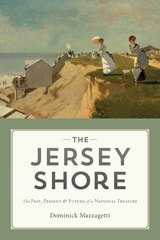
The Jersey Shore
The Past, Present & Future of a National TreasureMazzagetti, Dominick
Rutgers University Press, 2018
Divided into chronological and thematic sections, this book will attract general readers interested in the history of the Shore: how it appeared to early European explorers; how the earliest settlers came to the beaches for the whaling trade; the first attractions for tourists in the nineteenth century; and how the coming of railroads, and ultimately automobiles, transformed the Shore into a major vacation destination over a century later. Mazzagetti also explores how the impact of changing national mores on development, race relations, and the environment, impacted the Shore in recent decades and will into the future. Ultimately, this book is an enthusiastic and comprehensive portrait by a native son, whose passion for the region is shared by millions of beachgoers throughout the Northeast.
The Kindness of Strangers
Tom Lutz
University of Iowa Press, 2021
You may never visit these places, but Tom Lutz will do it for you. And while global media may serve up a steady diet of division, violence, oppression, hatred, and strife, The Kindness of Strangers shows that people the world over are much more likely to meet strangers with interest, empathy, welcome, and compassion.
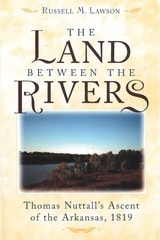
The Land between the Rivers
Thomas Nuttall's Ascent of the Arkansas, 1819Russell M. Lawson
University of Michigan Press, 2004
During the early nineteenth century, Nuttall explored the waters, valleys, plains, and mountains of the Great Lakes, Ohio River, Mississippi River, as well as the Missouri, Arkansas, Red, and Canadian river valleys of the former Louisiana Territory.
In this fascinating account of Nuttall's travels through the wilderness of the middle west, author Russell Lawson-using Nuttall's own journal-captures the sense of excitement of the early wanderer. As much a delight for the mind as the senses, The Land between the Rivers details the unremitting weather and rugged geography of uncharted lands within the Louisiana Territory. A sense of discovery pervades the narrative as Nuttall's odyssey builds to its climax in the prairie wilderness of what is now Oklahoma. Sickened by "ague"-in his case, malaria-Nuttall at times was barely able to go on; yet he continued to search for and catalog plants and animals.
The Land between the Rivers expands our knowledge of the work of one of the country's earliest botanists. We also learn a great deal about the early explorers, the inhabitants of the unsettled land, and about the land and culture of the times.
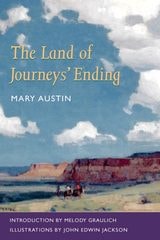
The Land of Journeys' Ending
Mary Austin
University of Illinois Press, 2003
When The Land of Journeys' Ending was first published in 1924, The Literary Reviewwarned, "This book is treacherous, waiting to overwhelm you with its abundant poetry." In it, successful New York author Mary Austin describes the epic journey she undertook in 1923, when left her East Coast home at the age of fifty-five to travel through the southwestern United States, the area where she lived as a child and where she would later retire.
The journey the book describes is a double one. Austin describes her transition from the cosmopolitan North East to the arid and largely unfamiliar land between the Colorado River and the Rio Grande. In telling her own story, Austin also tells the story of those who journeyed there before her-–Native American tribes, Spanish conquistadores, miners, adventurers, and California-bound migrants. The result is both an homage to the magnificence of the desert, mountains, rivers, canyons, plants, and animals of the Southwest and a history of the waves of people who inhabited the region.
Part memoir, part travel narrative, part historical investigation, and part ecological study, The Land of Journeys' Ending is a moving account of a woman coming full circle, finding solace in the broad landscape of her youth.
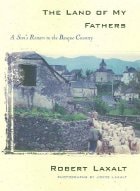
The Land of My Fathers
A Son's Return to the Basque CountryRobert Laxalt
University of Nevada Press, 2024
In 1960, renowned Nevada writer Robert Laxalt moved himself and his family to a small Basque village in the French Pyrenees. The son of Basque emigrants, Laxalt wanted to learn as much as he could about the ancient and mysterious people from which he was descended and about the country from which his parents came. Thanks to his Basque surname and a wide network of family connections, Laxalt was able to penetrate the traditional reserve of the Basques in a way that outsiders rarely can. In the process, he gained rare insight into the nature of the Basques and the isolated, beautiful mountain world where they have lived for uncounted centuries. Based on Laxalt’s personal journals of this and a later sojourn in 1965, The Land of My Fathers is a moving record of a people and their homeland. Through Laxalt’s perceptive eyes and his wife Joyce’s photographs, we observe the Basques’ market days and festivals, join their dove hunts and harvests, share their humor and history, their deep sense of nationalism, their abiding pride in their culture and their homes, and discover the profound sources of the Basques’ strength and their endurance as a people. Photography by Joyce Laxalt.
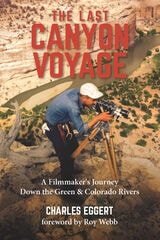
The Last Canyon Voyage
A Filmmaker's Journey Down the Green and Colorado RiversCharles Eggert Foreword by Roy Webb
University of Utah Press, 2020
This book finally brings Eggert’s writings out of the archives and into the public eye. With his keen photographer’s vision and colloquial voice, Eggert describes canyons and towns now deep under water as he tells the story of friendships forged upon the rapids and currents of the rivers. Roy Webb’s foreword provides historical context; river historian Alfred E. Holland Jr. introduces Eggert, the man who transformed into an environmentalist after visiting the West; and Sarah Holcombe’s afterword looks at what transpired in the lives of all eight crew members after the journey. Color and black-and-white illustrations further enliven the text. An engaging read, this is an important piece of river history that also shines light on Eggert’s tremendous influence as a conservation cinematographer.
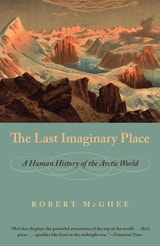
The Last Imaginary Place
A Human History of the Arctic WorldRobert McGhee
University of Chicago Press, 2007
The Arctic of towering icebergs and midnight sun, of flaming auroras and endless winter nights, has long provoked flights of the imagination. Now, in The Last Imaginary Place, renowned archeologist Robert McGhee lifts the veil to reveal the true Arctic world. Based on thirty years of work with native peoples of the Arctic and travel in the region, McGhee’s account dispels notions of the frozen land as an exotic, remote world that exists apart from civilization.
Between the frigid reality and lurid fantasy lies McGhee’s true interest, the people who throughout human history have called the Arctic home. He paints a vivid portrait of Viking farmers, entrepreneurial Inuit, and Western explorers who have been seduced by the natural wealth and haunting beauty of this land. From lively accounts of fur trading, ivory hunting, and whaling to white-knuckle tales of the first, doomed expeditions, McGhee takes the reader on a whirlwind journey across this disorienting, dreamlike terrain that has fascinated mankind for centuries.
“In prose infused by his position as curator of Arctic archaeology at the Canadian Museum of Civilization—which has taken him to sites in several countries—McGhee demolishes some persistent illusions about the white North . . . evocative.”—Times Literary Supplement
“[A] compelling account . . . [McGhee] believes that the Arctic is not so much a region as a dream—what he sees as a dream of a unique, attractive world . . . An archaeologist who has spent thirty years there, the author lets his love for the region shine through on every page.—Booklist
“McGhee displays the powerful attractions of the top of the world . . . [his] prose . . . sparkles like frost in the midnight sun.”—Financial Times
“McGhee has written a sensitive, fascinating and extremely important book.”—Canadian Geographic
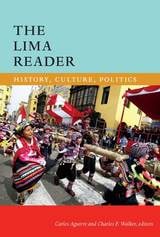
The Lima Reader
History, Culture, PoliticsCarlos Aguirre and Charles F. Walker, editors
Duke University Press, 2017

The Lincoln Highway
Main Street across America, A Tenth Aniversary EditionDrake Hokanson
University of Iowa Press, 1999
Ten years after its original publication, Drake Hokanson's best-selling book continues to inspire readers to leave the interstate for a road less traveled, but one that still fuels the American preoccupation with the open road.
In his new introduction to this tenth anniversary edition, Hokanson revisits the Lincoln Highway and finds it changed—much for the better—since the original publication of this book. Most notably, he calls attention to the reinvigorated Lincoln Highway Association and its efforts to preserve what is left of the old road. Hokanson finds more and more tourists traveling the road—not only Americans but foreigners as well—by car, bus, and motorcycle on journeys not to any particular destination, but simply to see America.
The Liquid Continent
Travels through Alexandria, Venice and IstanbulNicholas Woodsworth
Haus Publishing, 2016

The Literary Guide and Companion to Southern England
Revised EditionRobert M. Cooper
Ohio University Press, 1998
In a series of intriguing routes through the English countryside, Professor Robert Cooper notes those attractions that the casual tourist might unknowingly pass by, such as the house where Dickens wrote A Tale of Two Cities, or the windswept quay where John Fowles’s French Lieutenant’s woman walked. Maps and information about restaurants and accommodations give the traveler the opportunity of having pints of “half and half” where Jane Austen dined or visiting the pub where Blake’s scuffle led to his trial for treason.
This newly revised and updated edition of Robert Cooper’s acclaimed handbook combines the utility of current travel information with the appeal of literary history, biography, and anecdote in a leisurely and flavorful guide to the broad sweep of southern England outside of London. A rich and reliable guide to the landscape that fostered one of our most cherished cultures, The Literary Guide and Companion to Southern England is an indispensable resource for those who wish to experience literature firsthand.
The Lonely Land
Sigurd F. Olson
University of Minnesota Press, 1997
"The lonely land lies a thousand miles northwest of Lake Superior in upper Saskatchewan. Here the Churchill River, famed water trail of such early voyageurs as the Hudson’s Bay fur traders, flows in a wandering course through one of the last great wildernesses of the continent. For 500 miles, the author and five Canadian friends retraced the trail of the voyageurs down the Churchill and the Sturgeon Weir rivers to the Saskatchewan. Sigurd F. Olson has added page after page to the lasting literature of the canoe, and the illustrations by Francis Lee Jaques, the canoe-country artist supreme, perfectly complement the text. Mr. Olson writes sensitively but also straight-forwardly, without heroics."—New York Times Book Review
"His love for the untouched wild and camaraderie of his fellow canoeists shine through in this classic trip story."—Explore Magazine
The Louisiana and Arkansas Expeditions of Clarence Bloomfield Moore
Clarence Bloomfield Moore
University of Alabama Press, 2004
A Dan Josselyn Memorial Publication
The ninth and final volume in the C.B. Moore reprint series that covers archaeological discoveries along North American Waterways.
Clarence B. Moore (1852-1936), a wealthy Philadelphia socialite, paper company heir, and photographer, made the archaeology of the Southeast his passion. Beginning in the 1870s, Moore systematically explored prehistoric sites along the major waterways of the region, from the Ohio River south to Florida and as far west as Texas, publishing his findings, at his own expense, with the Academy of Natural Sciences of Philadelphia.
This volume, the final in a series of nine, includes Moore’s investigations along waterways of Arkansas and Louisiana—the Ouachita, Red, Saline, Black, Tensas, and Atchafalaya Rivers—in three complete field sessions ending in 1909, 1912, and 1913. He located and mapped more than 185 mounds and cemeteries. Artifacts recovered in this territory, such as ceramic effigy pots, earthenware pipes, arrowheads, celts, and projectile points, include some of the most important ones discovered by Moore in his 47 years of excavating. Included in this volume is a CD containing the 69 color illustrations from all the original expedition volumes.
The elaborate earthwork of Poverty Point, located in West Carroll Parish, Louisiana, is perhaps the most remarkable archaeological site presented in the volume. In some cases, Moore documented sites along the tributaries that have since been destroyed by river action or looters. In other cases, the National Register of Historic Sites and concerned landowners in Arkansas and Louisiana have preserved the record of aboriginal peoples and their life ways that was first illuminated by Moore's sophisticated study.
The Lower Mississippi Valley Expeditions of Clarence Bloomfield Moore
Clarence Bloomfield Moore
University of Alabama Press, 1998
A Dan Josselyn Memorial Publication
C. B. Moore's investigations of the Lower Mississippi Valley are here collected in a one-volume facsimile edition.
Like many other natural scientists from the Victorian era, Clarence Bloomfield Moore (1852-1917) lived several lives—adventurer, paper company executive, archaeologist; however, Moore is chiefly remembered for the twenty-five years he spent investigating and documenting archaeological sites along every navigable waterway in the southeastern United States.
Moore's surveys were and are impressive, and he earned lasting respect from archaeological researchers in the South by publishing, mostly at his own expense, all of the data he recovered. This volume includes works that describe data from Moore's expeditions that were key to the early recognition and preservation of major archaeological sites—Toltec, Parkin, Mound City, and Wicklife, among them—in the lower Mississippi River Valley. This and companion volumes stand today as the defining database for every area in which he worked.
The Making of American Resorts
Saratoga Springs, Ballston Spa, and Lake GeorgeCorbett, Theodore
Rutgers University Press, 2001
The Malay Archipelago Through Travellers' Eyes
1800–1900Edited by Judith E. Bosnak and Rick Honings
National University of Singapore Press, 2026
A history of colonial encounters in maritime Southeast Asia, through the lens of an underexplored group of nineteenth-century travelogues.
What did nineteenth-century travellers actually see when they journeyed through the Malay Archipelago—and what did they miss? The travelogues penned by British and Dutch explorers reached a wide readership; they have shaped how we imagine this region with their accounts of island kingdoms, volcanic landscapes, and maritime crossroads. Other voices—Javanese nobles venturing beyond their courts, Eurasian tourists navigating between worlds, French administrators, Scandinavian adventurers, Italian naturalists—remained in the shadows.
The Malay Archipelago through Travellers’ Eyes recovers these overlooked perspectives alongside fresh readings of celebrated figures like James Brooke, the “White Rajah” of Sarawak, and the intrepid Isabella Bird. Here we encounter Purwalelana, whose groundbreaking Javanese travelogue in modern prose abandoned centuries of poetic tradition; Kartini, whose letters became a means of traversing boundaries she could not physically cross; and Dé-Lilah, whose Eurasian heritage gave her writing an unsettling double vision. The naturalist Junghuhn scaling Java’s volcanoes, Raffles burnishing British reputation against Dutch rivals, Italian explorers charting New Guinea's coasts—each constructed not only the lands they described but also themselves.
Travel writing has often claimed to offer transparent windows onto foreign worlds. This collection reveals it as something far more interesting: a literature of encounter where imperial ambition, personal identity, and genuine curiosity intertwine. For anyone captivated by the arts of travel and observation, these essays open new ways of reading a genre we thought we knew.
The Mapping of New Spain
Indigenous Cartography and the Maps of the Relaciones GeograficasBarbara E. Mundy
University of Chicago Press, 1996
"Its contribution to its specific field is both significant and original. . . . It is a pure pleasure to read." —Sabine MacCormack, Isis
"Mundy has done a fine job of balancing the artistic interpretation of the maps with the larger historical context within which they were drawn. . . . This is an important work." —John F. Schwaller, Sixteenth Century Journal
"This beautiful book opens a Pandora's box in the most positive sense, for it provokes the reconsideration of several long-held opinions about Spanish colonialism and its effects on Native American culture." —Susan Schroeder, American Historical Review
The Mass Production of Memory
Travel and Personal Archiving in the Age of the KodakTammy S. Gordon
University of Massachusetts Press, 2020
In 1888, the Eastman Dry Plate and Film Company offered the first portable camera that allowed users to conveniently take photos, using leisure travel as a primary marketing feature to promote it. The combination of portability, ease of use, and mass advertising fed into a national trend of popular photography that drew on Americans' increasing mobility and leisure time. The Kodak Company and the first generation of tourist photographers established new standards for personal archiving that amplified the individual's role in authoring the national narrative. But not everyone had equal access to travel and tourism, and many members of the African American, Native American, and gay and lesbian communities used the camera to counter the racism, homophobia, and classism that shaped public spaces.
In this groundbreaking history, Tammy S. Gordon tells the story of the camera's emerging centrality in leisure travel across the late nineteenth and early twentieth centuries and its role in “the mass production of memory,” a process in which users crafted a visual archive attesting to their experiences, values, and circumstances, setting the stage for the customizable visual culture of the digital age.
The Medieval Invention of Travel
Shayne Aaron Legassie
University of Chicago Press, 2017
Exploring this phenomenon, The Medieval Invention of Travel draws on an impressive array of sources to develop original readings of canonical figures such as Marco Polo, John Mandeville, and Petrarch, as well as a host of lesser-known travel writers. As Shayne Aaron Legassie demonstrates, the Middle Ages inherited a Greco-Roman model of heroic travel, which viewed the ideal journey as a triumph over temptation and bodily travail. Medieval travel writers revolutionized this ancient paradigm by incorporating practices of reading and writing into the ascetic regime of the heroic voyager, fashioning a bold new conception of travel that would endure into modern times. Engaging methods and insights from a range of disciplines, The Medieval Invention of Travel offers a comprehensive account of how medieval travel writers and their audiences reshaped the intellectual and material culture of Europe for centuries to come.
The Men in My Country
Marilyn Abildskov
University of Iowa Press, 2004
The Men in My Country is the story of an American woman living and loving in Japan. Satisfied at first to observe her exotic surroundings, the woman falls in love with the place, with the light, with the curve of a river, with the smell of bonfires during obon, with blue and white porcelain dishes, with pencil boxes, and with small origami birds. Later, struggling for a deeper connection—“I wanted the country under my skin”—Abildskov meets the three men who will be part of her transformation and the one man with whom she will fall deeply in love.
A travel memoir offering an artful depiction of a very real place, The Men in My Country also covers the terrain of a complex emotional journey, tracing a geography of the heart, showing how we move to be moved, how in losing ourselves in a foreign place we can become dangerously—and gloriously—undone.
The Mexico City Reader
Edited by Ruben Gallo
University of Wisconsin Press, 2004
Mexico City is one of Latin America’s cultural capitals, and one of the most vibrant urban spaces in the world. The Mexico City Reader is an anthology of "Cronicas"—short, hybrid texts that are part literary essay, part urban reportage—about life in the capital. This is not the "City of Palaces" of yesteryear, but the vibrant, chaotic, anarchic urban space of the1980s and 1990s—the city of garbage mafias, necrophiliac artists, and kitschy millionaires.
Like the visitor wandering through the city streets, the reader will be constantly surprised by the visions encountered in this mosaic of writings—a textual space brimming with life and crowded with flâneurs, flirtatious students, Indian dancers,
food vendors, fortune tellers, political activists, and peasant protesters.
The essays included in this anthology were written by a panoply of writers, from well-known authors like Carlos Monsiváis and Jorge Ibagüengoitia to younger figures like Fabrizio Mejía Madrid and Juieta García González, all of whom are experienced practitioners of the city. The texts collected in this anthology are among the most striking examples of this concomitant "theory and practice" of Mexico City, that most delirious of megalopolises.
“[An] exciting literary journey . . .”—Carolyn Malloy, Multicultural Review
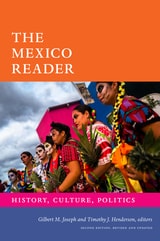
The Mexico Reader
History, Culture, PoliticsGilbert M. Joseph and Timothy J. Henderson, eds.
Duke University Press, 2002
A diverse collection of more than eighty selections, The Mexico Reader brings together poetry, folklore, fiction, polemics, photoessays, songs, political cartoons, memoirs, satire, and scholarly writing. Many pieces are by Mexicans, and a substantial number appear for the first time in English. Works by Octavio Paz and Carlos Fuentes are included along with pieces about such well-known figures as the larger-than-life revolutionary leaders Pancho Villa and Emiliano Zapata; there is also a comminiqué from a more recent rebel, Subcomandante Marcos. At the same time, the book highlights the perspectives of many others—indigenous peoples, women, politicians, patriots, artists, soldiers, rebels, priests, workers, peasants, foreign diplomats, and travelers.
The Mexico Reader explores what it means to be Mexican, tracing the history of Mexico from pre-Columbian times through the country’s epic revolution (1910–17) to the present day. The materials relating to the latter half of the twentieth century focus on the contradictions and costs of postrevolutionary modernization, the rise of civil society, and the dynamic cross-cultural zone marked by the two thousand-mile Mexico-U.S. border. The editors have divided the book into several sections organized roughly in chronological order and have provided brief historical contexts for each section. They have also furnished a lengthy list of resources about Mexico, including websites and suggestions for further reading.
The Mexico Reader
History, Culture, PoliticsGilbert M. Joseph and Timothy J. Henderson, editors
Duke University Press, 2022
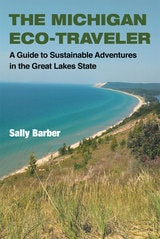
The Michigan Eco-Traveler
A Guide to Sustainable Adventures in the Great Lakes StateSally Barber
University of Michigan Press, 2014
Whether you’re a weekend traveler, extreme adventurer, or family on vacation, The Michigan Eco-Travelerlights the way to a greener getaway. Naturalists, conservationists, and hospitality experts will find the book equally helpful in responding to the ever rising demand for sustainable recreation.
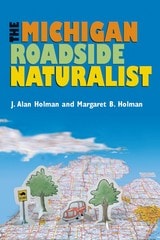
The Michigan Roadside Naturalist
J. Alan Holman and Margaret B. Holman
University of Michigan Press, 2003
Did you know . . . ?
- Michigan is seventeenth in oil production in the United States.
- The Great Lakes are said to be the only glacially produced structures that can be seen from the moon.
- Michigan was once part of a coral reef.
- The wood frog is one of the commonest true frogs of moist woodland floors in Michigan today and is able to freeze solid during the winter without harmful effects.
These and many more amazing facts await the curious traveler in The Michigan Roadside Naturalist, J. Alan and Margaret B. Holman's captivating guide to the natural treasures of Michigan. A perfect accompaniment to the classic Michigan Trees and The Forests of Michigan, this user-friendly guide offers a Who's Who of the geology, biology, and archaeology of the Great Lakes State, as well as highway adventures along the state's major routes.
The book begins with an educational yet accessible tour of important points in Michigan's natural and archaeological history, followed by seven road trips based on commonly traveled state routes, moving from south to north in the Lower Peninsula and east to west in the Upper Peninsula. Readers can proceed directly to the road trips or familiarize themselves with the state's treasure trove of fascinating features before embarking. Either way, an informative and fun odyssey awaits the passionate naturalist, amateur or otherwise.
J. Alan Holman is Curator Emeritus of Vertebrate Paleontology at the Michigan State University Museum and Emeritus Professor of Geology and Zoology at Michigan State University. Margaret B. Holman is Research Associate at Michigan State University Museum and Department of Anthropology, Michigan State University.
The Mirror of the Sea
Joseph Conrad
Northwestern University Press, 1988
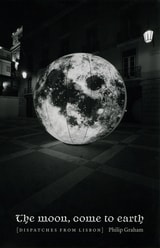
The Moon, Come to Earth
Dispatches from LisbonPhilip Graham
University of Chicago Press, 2009
A dispatch from a foreign land, when crafted by an attentive and skilled writer, can be magical, transmitting pleasure, drama, and seductive strangeness.
In The Moon, Come to Earth, Philip Graham offers an expanded edition of a popular series of dispatches originally published on McSweeney’s, an exuberant yet introspective account of a year’s sojourn in Lisbon with his wife and daughter. Casting his attentive gaze on scenes as broad as a citywide arts festival and as small as a single paving stone in a cobbled walk, Graham renders Lisbon from a perspective that varies between wide-eyed and knowing; though he’s unquestionably not a tourist, at the same time he knows he will never be a local. So his lyrical accounts reveal his struggles with (and love of) the Portuguese language, an awkward meeting with Nobel laureate José Saramago, being trapped in a budding soccer riot, and his daughter’s challenging transition to adolescence while attending a Portuguese school—but he also waxes loving about Portugal’s saudade-drenched music, its inventive cuisine, and its vibrant literary culture. And through his humorous, self-deprecating, and wistful explorations, we come to know Graham himself, and his wife and daughter, so that when an unexpected crisis hits his family, we can’t help but ache alongside them.
A thoughtful, finely wrought celebration of the moment-to-moment excitement of diving deep into another culture and confronting one’s secret selves, The Moon, Come to Earth is literary travel writing of a rare intimacy and immediacy.
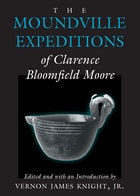
The Moundville Expeditions of Clarence Bloomfield Moore
Clarence Bloomfield MooreClarence Bloomfield Moore, edited and introduced by Vernon James Knight, Jr.
University of Alabama Press, 1996
The two works reprinted in this volume represent the pinnacle of the career of one of the most remarkable American archaeologists of the early 20th century, Clarence Bloomfield Moore.
Moore's Certain Aboriginal Remains of the Black Warrior River (1905) and Moundville Revisited (1907) brought the Moundville site in Alabama to the attention of the scholarly world in dramatic fashion by offering a splendid photographic display and expert commentary on its artifactual richness. Moore was the leading southeastern specialist of his day and the most prolific excavator of southern sites during the early part of the 20th century. Today Moore gives the impression of having been everywhere, having excavated everything, and having published on all of it. Moundville Expeditions contains facsimile reprints of these two classic works, along with a new scholarly introduction by one of the leading authorities on the Moundville archaeological site. Once again these rare materials on Moundville are available both for scholars and for a general audience.
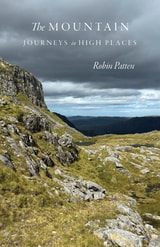
The Mountain
Journeys in High PlacesRobin Patten
University of Utah Press, 2025
Since antiquity, mountains have captured the human imagination. The Mountain takes readers into higher realms, exploring the complex kinship between mountains and human thought, traditions, and ways of being. Told through the author’s own journeys, the narrative ranges across cultures and iconic naturalists to consider how varied ideas and experiences related to mountains—from sacred to scientific, romantic to retreat, to simply home—are all facets of the same intricate topography.
No matter where one starts on the spectrum of understanding, an intimate encounter with a mountain leads to a broader perspective. High places create a simultaneous humbleness at our human insignificance and a sense of belonging within the greater world. That quality of belonging, and the associated commitment of caring for the planet and all that it holds, has never been more important than it is today.
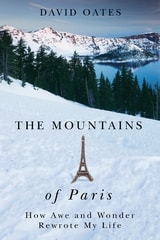
The Mountains of Paris
How Awe and Wonder Rewrote My LifeDavid Oates
Oregon State University Press, 2019
The present tense of the book takes place during the seasons he spends in Paris, sharing an artist’s residency. It is a rare opportunity to consider what it means to be human, through time-stopping moments with music, art, and deep history. The past tense of the book offers memories that intrude into the bustle of Paris life: a Billy Graham crusade at age thirteen, a mountain pass, a love, a loss.
In long years of mountaineering Oates fought the self-loathing which had infused him as the gay kid in the Baptist pew. In The Mountains of Paris, he ascends to a place of wonder through intense, personal narrative encounter with the strangeness of being alive. In his searching, luminous, and inimitable prose, Oates invites readers to share the sense of awe awakened by a Vermeer painting, or the night sky, or the echoing strains of music fading down a Paris street, lifting the curtain on a cosmos filled with a terrifying yet beautiful rightness.
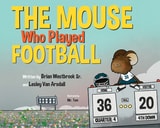
The Mouse Who Played Football
Written by Brian Westbrook Sr. and Lesley Van Arsdall
Temple University Press, 2022
Some folks think Brian the mouse is too small. He may be a tough little fella, but they are not sure Brian has what it takes. The Mouse Who Played Football, by former Philadelphia Eagles running back Brian Westbrook Sr. and sports reporter Lesley Van Arsdall, shows how Brian the mouse proves everyone wrong with unyielding confidence that his small size can be his strength.
This charming children’s book, featuring appealing and dynamic illustrations by Mr. Tom, demonstrates how Brian the mouse overcomes what others see as a “big problem.” His determination—as well as speed and toughness on the gridiron—helps him become a star player in high school, college, and eventually, the MFL, the Mouse Football League.
The Mouse Who Played Football, based on Westbrook’s own experiences,is an inspiring story that encourages young readers to believe in themselves and make their unique differences their strengths.
The New Chicago
A Social and Cultural Analysisedited by John P. Koval, Larry Bennett, Michael I. J. Bennett, Fassil Demissie, Roberta Garner and Kiljoong Kim
Temple University Press, 2006
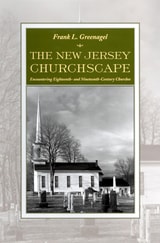
The New Jersey Churchscape
Encountering Eighteenth- and Nineteenth-Century ChurchesFrank L. Greenagel
Rutgers University Press, 2001
Although best known as the Garden State, New Jersey could also be called the Church State. The state boasts thousands of houses of worship, with more than one thousand still standing that were built in the eighteenth and nineteenth centuries. Frank L. Greenagel has photographed more than six hundred. He has selected two hundred of these historic landmarks for an examination of why they are sited where they are and why they look the way they do.
Greenagel has sought out and included images of not only mainstream Christian churches, but also Jewish synagogues as well as the places of worship of religious groups such as the Moravians, the Church of the Brethren, and the Seventh Day Baptists. The photographs are arranged chronologically within sections on three major early settlement regions of the state ¾ the Hudson River, the Delaware River, and the Raritan Valley. For each building, Greenagel details the date of construction, the cultural, historic, and religious influences that shaped it, the architectural details that distinguish it, and what purpose it currently serves.
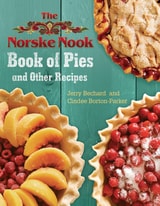
The Norske Nook Book of Pies and Other Recipes
Jerry Bechard and Cindee Borton-Parker
University of Wisconsin Press, 2015
This cookbook features the restaurants’ award-winning baking: Scandinavian specialties, cheesecakes, tortes, cookies, muffins, and more than seventy recipes (and variations) for pie. More than fifty new pie recipes have been created by the Nook bakers since 1990, when Jerry Bechard purchased the Osseo café from founder Helen Myhre. The Norske Nook has won thirty-six blue ribbons at the National Pie Championships in Florida—including three in 2014, for Lemon Cream Cheese, Peaches and Cream, and Jamberry.
Gold Medal Winner, Cookbook, Foreword Reviews IndieFab Book of the Year Awards
Runner-up, Cookbooks/Crafts/Hobbies, Midwest Book Awards
“Outstanding” books for public & secondary school libraries from university presses, American Library Association
“Best of the Best” books for public libraries from university presses, American Library Association

The North Country Trail
The Best Walks, Hikes, and Backpacking Trips on America’s Longest National Scenic TrailRon Strickland with the North Country Trail Association
University of Michigan Press, 2013
The North Country Trail is the longest of America’s eleven congressionally designated National Scenic Trails. Winding through seven states—New York, Pennsylvania, Ohio, Michigan, Wisconsin, Minnesota, and North Dakota—the NCT’s 4,600 miles attract more than one million visitors annually. These hikers are treated to a smorgasbord of Upper Midwest hiking featuring everything from urban strolls to backcountry adventure through mountains, rivers, prairies, and shoreline. This book is the definitive guide for NCT hikers—whether first-timers, seasoned backpackers, or any level in between—who wish to maximize their experience on this splendid trail.
In addition to a full overview of the trail’s tread in each state, the guide describes in detail forty of the NCT’s premier segments, with helpful information including easy-to-read trail descriptions, physical and navigation difficulties, trail highlights, hiking tips, and precise maps incorporating the latest GPS technology.
The Northwest Florida Expeditions of Clarence Bloomfield Moore
Clarence Bloomfield Moore
University of Alabama Press, 1999
A Dan Josselyn Memorial Publication
This comprehensive compilation of Moore's archaeological reports on northwest Florida and southern Alabama and Georgia presents the earliest documented investigations of this region.
When Clarence Bloomfield Moore cruised the rivers of Florida in search of prehistoric artifacts a century ago, he laid the groundwork for archaeological investigations to follow. This volume reflects Moore's fieldwork along the northwest Florida coast, the most archaeologically rich area of the state, as well as Southern Alabama and Georgia.
Here readers will share Moore's first look at the area in 1901-1903 and additional observations made in 1918 during what was to be his last field season. Moore's works reveal ceramics, tools, skeletal remains, and exotic artifacts excavated from the earthen mounds and shell middens built by native peoples over the last two millennia.
In the introduction to this edition, David Brose and Nancy Marie White place Moore's investigations within the context of the science, natural history, and antiquarianism of his day. They document what happened to the sites he explored, tell how his findings fit into the body of his research, and explain how those findings should be interpreted in the context of Southeastern culture history and modern archaeological theory.
Moore was the most knowledgeable Southeastern archaeologist of his time; his writings are a benchmark for anyone studying those areas today.
The Nude Beach Notebook
Barbara J. Scot
Oregon State University Press, 2014
Scot uses long, meditative walks on the “clothing optional” beach of the idyllic Sauvie Island near Portland, Oregon, to explore family responsibility, time’s passage, and faith. She weaves entries from her notebook—a record of the island’s wildlife, descriptions of the “Odd Ones” she encounters on the beach, and stories about the native people who once lived on the river—with the main narrative, tracing her search for her brother, her close friendship with a fellow writer, and daily life on the houseboat moorage where she lives.
The Nude Beach Notebook highlights the importance of place as a means for exploring and interpreting one’s own story. In the end, Scot’s walks on Sauvie Island lead to her own redemptive journey. She considers the uses of fiction and non-fiction in memory and in writing, the brevity and beauty of human existence, and the inscrutable, enduring mystery of death.
The Odyssey of Ibn Battuta
Uncommon Tales of a Medieval AdventurerDavid Waines
University of Chicago Press, 2010
Ibn Battuta was, without doubt, one of the world’s truly great travelers. Born in fourteenth-century Morocco, and a contemporary of Marco Polo, Ibn Battuta left an account in his own words of his remarkable journeys, punctuated by adventure and peril, throughout the Islamic world and beyond. Whether sojourning in Delhi and the Maldives, wandering through the mazy streets of Cairo and Damascus, or contesting with pirates and shipwreck, the indefatigable Ibn Battuta brought to vivid life a medieval world brimming with marvel and mystery. Carefully observing the great diversity of civilizations that he encountered, Ibn Battuta exhibited an omnivorous interest in such matters as food and drink; religious differences among Christians, Hindus, and Shia Muslims; and ideas about purity and impurity, disease, women, and sex.
David Waines offers here a graceful analysis of Ibn Battuta’s travelogue. This is a gripping treatment of the life and times of one of history’s most daring, and at the same time most human, adventurers.
The Other Americans in Paris
Businessmen, Countesses, Wayward Youth, 1880-1941Nancy L. Green
University of Chicago Press, 2014
Nancy L. Green thus introduces us for the first time to a long-forgotten part of the American overseas population—predecessors to today’s expats—while exploring the politics of citizenship and the business relationships, love lives, and wealth (and poverty for some) of Americans who staked their claim to the City of Light. The Other Americans in Paris shows that elite migration is a part of migration tout court and that debates over “Americanization” have deep roots in the twentieth century.
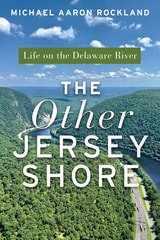
The Other Jersey Shore
Life on the Delaware RiverMichael Aaron Rockland
Rutgers University Press, 2024
The Other Jersey Shore takes readers on a personal tour of the New Jersey portion of the Delaware River and its surroundings. You will learn about the role that the river played in human history, including Washington’s four crossings of the Delaware during the Revolutionary War. And you will also learn about the ecological history of the river itself, once one of the most polluted waterways in the country and now one of the cleanest, providing drinking water for 17 million people. Michael Aaron Rockland, a long-time New Jersey resident, shows readers his very favorite spots along the Delaware, including the pristine waterfalls and wilderness in the Delaware Water Gap recreation area. Along the way, he shares engrossing stories and surprising facts about the river that literally defines western New Jersey.
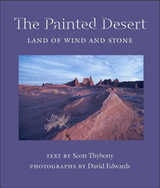
The Painted Desert
Land of Wind and StoneText by Scott Thybony; Photographs by David Edwards
University of Arizona Press, 2006
But this remote pocket of the Arizona desert, sandwiched between the Little Colorado River on one side and bold escarpments on the other, is much more than most tourists ever experience. An ethereal landscape of sculpted rock, wind-fluted cliffs, and elegantly drifting sand, the Painted Desert is a rich storehouse of natural beauty, colorful history, and scientific wonders. Here the strongest winds in Arizona blow across extensive dunefields, where less than ten inches of rain falls each year and only a few desert-savvy Navajo are able to live.
Now, for the first time award-winning writer Scott Thybony and freelance photographer David Edwards offer an intimate look at a place that remains inhospitable and inaccessible to so many. They share insights about the geology, paleontology, anthropology, and human history of the region as well as personal stories that dispel the misconceptions and mysteries that surround this delicate and difficult landscape.
With fifteen stunning photographs gracing the text, this book offers a vibrant portrait of one of the Southwest’s most barren, and most colorful landscapes.
The Painted Forest
Krista Eastman
West Virginia University Press, 2019
Council for Wisconsin Writers, Norbert Blei/August Derleth Nonfiction Book Award winner
In this often-surprising book of essays, Krista Eastman explores the myths we make about who we are and where we’re from. The Painted Forest uncovers strange and little-known “home places”—not only the picturesque hills and valleys of the author’s childhood in rural Wisconsin, but also tourist towns, the “under-imagined and overly caricatured” Midwest, and a far-flung station in Antarctica where the filmmaker Werner Herzog makes an unexpected appearance.
The Painted Forest upends easy narratives of place, embracing tentativeness and erasing boundaries. But it is Eastman’s willingness to play—to follow her curiosity down every odd path, to exude a skeptical wonder—that gives this book depth and distinction. An unlikely array of people, places, and texts meet for close conversation, and tension is diffused with art, imagination, and a strong sense of there being some other way forward. Eastman offers a smart and contemporary take on how we wander and how we belong.
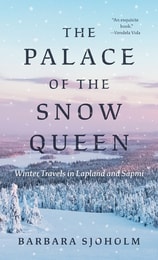
The Palace of the Snow Queen
Winter Travels in Lapland and SápmiBarbara Sjoholm
University of Minnesota Press, 2023
An exploration of the winter wonders and entangled histories of Scandinavia’s northernmost landscapes—now back in print with a new afterword by the author
After many years of travel in the Nordic countries—usually preferring to visit during the warmer months—Barbara Sjoholm found herself drawn to Lapland and Sápmi one winter just as mørketid, the dark time, set in. What ensued was a wide-ranging journey that eventually spanned three winters, captivatingly recounted in The Palace of the Snow Queen.
From observing the annual construction of the Icehotel in Jukkasjärvi, Sweden, to crossing the storied Finnmark Plateau in Norway, to attending a Sámi film festival in Finland, Sjoholm dives deep into the rich traditions and vibrant creative communities of the North. She writes of past travelers to Lapland and contemporary tourists in Sápmi, as well as of her encounters with Indigenous reindeer herders, activists, and change-makers. Her new afterword bears witness to the perseverance of the Sámi in the face of tourism, development, and climate change.
Written with keen insight and humor, The Palace of the Snow Queen is a vivid account of Sjoholm’s adventures and a timely investigation of how ice and snow shape our imaginations and create a vision that continues to draw visitors to the North.
The Palm at the End of the Mind
Relatedness, Religiosity, and the RealMichael Jackson
Duke University Press, 2009
Through sixty-one beautifully crafted essays based on sojourns in Europe, West Africa, the United States, Australia, and New Zealand, and taking his cue from Wallace Stevens’s late poem, “Of Mere Being,” Jackson explores a range of experiences where “the palm at the end of the mind” stands “beyond thought,” on “the edge of space,” “a foreign song.” Moments of crisis as well as everyday experiences in cafés, airports, and offices disclose the subtle ways in which a single life shades into others, the boundaries between cultures become blurred, fate unfolds through genealogical time, elective affinities make their appearance, and different values contend.
The Panama Hat Trail
Tom Miller
University of Arizona Press, 1986
The Paraguay Reader
History, Culture, PoliticsPeter Lambert and Andrew Nickson, eds.
Duke University Press, 2013
Most of the Reader is arranged chronologically. Weighted toward the twentieth century and early twenty-first, it nevertheless gives due attention to major events in Paraguay's history, such as the Triple Alliance War (1864–70) and the Chaco War (1932–35). The Reader's final section, focused on national identity and culture, addresses matters including ethnicity, language, and gender. Most of the selections are by Paraguayans, and many of the pieces appear in English for the first time. Helpful introductions by the editors precede each of the book's sections and all of the selected texts.