Results by title
2285 books match the query 'Women' and 370 start with t
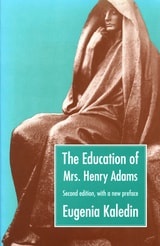
The Education of Mrs. Henry Adams
Eugenia Kaledin
University of Massachusetts Press, 1994
Marian Hooper Adams—Clover, as her friends called her—was an accomplished photographer and a witty, irreverent free spirit who moved easily within the cultural circles of nineteenth-century Boston. Why, then, in 1882, at the age of forty-two, did she swallow a lethal dose of potassium cyanide? And why did her husband of thirteen years fail even to mention her in his autobiography, The Education of Henry Adams?
These and other questions are explored in this first paperback edition of Eugenia Kaledin's pathbreaking biography. The book recreates the intense intellectual, cultural, and moral life of Boston and New England before, during, and after the Civil War and helps us to understand what could drive such a gifted, intelligent, and privileged woman to take her own life. Included is a portfolio of Adams's photographs of her husband and his famous circle.
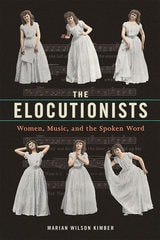
The Elocutionists
Women, Music, and the Spoken WordMarian Wilson Kimber
University of Illinois Press, 2017
Marian Wilson Kimber restores elocution with music to its rightful place in performance history. Gazing through the lenses of gender and genre, Wilson Kimber argues that these female artists transgressed the previous boundaries between private and public domains. Their performances advocated for female agency while also contributing to a new social construction of gender. Elocutionists, proud purveyors of wholesome entertainment, pointedly contrasted their "acceptable" feminine attributes against those of morally suspect actresses. As Wilson Kimber shows, their influence far outlived their heyday. Women, the primary composers of melodramatic compositions, did nothing less than create a tradition that helped shape the history of American music.
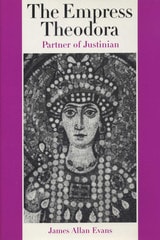
The Empress Theodora
Partner of JustinianBy James Allan Evans
University of Texas Press, 2002
Even by modern standards, the Empress Theodora (?-548) had a remarkable rise to power. Born into the lowest class of Byzantine society, she worked as an actress in burlesque theater. Yet she attracted the love of the future emperor Justinian, who, to the astonishment of proper society, made her not only his wife but also his partner in government. Justinian's respect for and trust in Theodora gave her power in her own right unmatched by almost any other Roman or Byzantine empress.
In this book, James Allan Evans provides a scholarly, yet highly accessible account of the life and times of the Empress Theodora. He follows her from her childhood as a Hippodrome bearkeeper's daughter to her imperial roles as Justinian's most trusted counselor and as an effective and powerful advocate for the downtrodden. In particular, he focuses on the ways in which Theodora worked to improve the lives of women. He also explores the pivotal role Theodora played in the great religious controversy of her time, involving a breach between sects in the Christian church.
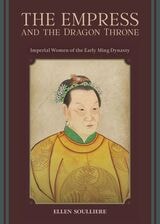
The Empress and the Dragon Throne
Imperial Women of the Early Ming DynastyEllen Soulliere
Hong Kong University Press, 2025
The rulers of the Ming dynasty enacted paradigms of hierarchical order. Like imperial families, households, and courts in earlier Chinese dynasties, they articulated patriarchal, patrilineal, and patrilocal organizational principles as exemplars for families and institutions throughout the empire. Women made indispensable contributions to the development of these paradigms and principles and to the social, cultural, and political fabric of the family and the state. And yet, in the existing literature in Chinese and English women are often burdened with stereotypes, positioned as peripheral, or rendered almost invisible.
Reading available texts “against the grain,” and drawing on a trove of evidence from material culture, Soulliere shows how women defined a place for themselves in the multigenerational Ming imperial family, imperial household, and court. The Empress and the Dragon Throne spans the first Ming century from just before the founding of the dynasty in 1368 to the end of the Tianshun reign in 1465. This richly illustrated volume is a must-read for scholars, students, and anyone interested in learning about women’s lives during the Ming dynasty.
The Erotic as Rhetorical Power
Archives of Romantic Friendship between Women TeachersPamela VanHaitsma
The Ohio State University Press, 2024
Winner, 2025 Marie Hochmuth Nichols Award from the National Communication Association’s Public Address Division
The Erotic as Rhetorical Power offers a queer feminist history of rhetoric that recovers the civic contributions of women teachers in same-sex romantic friendships. Extending perspectives from ancient rhetoric to nineteenth-century progressivism, from Audre Lorde’s Black lesbian feminist theory to its present-day uptakes, Pamela VanHaitsma conceives of the erotic as an interanimation of desires that, in being passionately shared, becomes imbued with the power to forge connection and foment change.
VanHaitsma’s theory of the erotic as rhetorical power emerges from both historiographic and imaginative engagements with more than twenty archives of romantic friendships between women: Sallie Holley and Caroline Putnam, Irene Leache and Anna Wood, Gertrude Buck and Laura Wylie, and Rebecca Primus and Addie Brown. VanHaitsma considers how even as the erotic in these romantic friendships fueled the women’s rhetorical activities toward transformational ends—whether working toward the abolition of slavery, greater educational access, or voting rights—it also energized rhetorical activities that sometimes challenged but also reinforced troubling power dynamics. The Erotic as Rhetorical Power uncovers the erotic’s significance as a conflicted site of power that is central to rhetorical theory and history as well as feminist and LGBTQ+ studies.
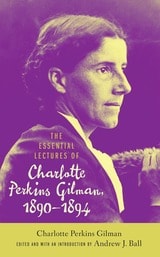
The Essential Lectures of Charlotte Perkins Gilman, 1890–1894
Charlotte Perkins Gilman Edited and with an introduction by Andrew J. Ball
University of Alabama Press, 2024
A foundational archive of Gilman’s early feminist, sociological, and philosophical thought, revealing the origins of a major American intellectual tradition.
The last decades have seen a resurgence of interest in Charlotte Perkins Gilman, now considered among the most important thinkers in US history. She is best known for fiction—such as the classic short story “The Yellow Wall-Paper” (1892)—and nonfiction, including her manifesto Women and Economics (1898), a work of intersectional sociology avant la lettre. Nevertheless, as a young writer, Gilman made her living delivering lectures. One cannot know Gilman without some knowledge of this body of lectures; this book fills that critical gap in Gilman scholarship.
Since the recovery of Charlotte Perkins Gilman began in the late 1960s and continued with the republication of “The Yellow Wall-Paper” in the 1970s, her image in cultural memory has been increasingly celebrated. Andrew J. Ball presents here fifty previously unpublished texts. They trace the development of Gilman’s thoughts on diverse subjects like gender, education, labor, science, theology, and politics—forming an intellectual diary of her growth.
These lectures are not just a testament to Gilman’s personal evolution, but also a crucial contribution to the foundations of American sociology and philosophy. The Essential Lectures of Charlotte Perkins Gilman, 1890–1894 marks a historic moment, unveiling the hidden genius of Gilman's oratory legacy.
The Eve/Hagar Paradigm in the Fiction of Quince Duncan
Dellite Martin-Ogunsola
University of Missouri Press, 2004
The Extraordinary Work of Ordinary Writing
Annie Ray's DiaryJennifer Sinor
University of Iowa Press, 2002
Exciting and beautifully crafted, The Extraordinary Work of Ordinary Writing provides an entirely new way of viewing “ordinary writing,” the everyday writing we typically ignore or dismiss. It takes as its center the diary of Jennifer Sinor's great-great-great-aunt Annie Ray, a woman who homesteaded in the Dakotas in the late nineteenth century. Diaries such as this have long been ignored by scholars, who prefer instead to focus on diaries with literary features. Reading diaries through this lens gives privileged status to those that are coherently crafted and ignores the very diaries that define the form through their relentless inscription of dailiness.
Annie Ray’s diary is not literary. By considering her ordinary writing as a site of complex and strategic negotiations among the writer, the form of writing, and dominant cultural scripts, Sinor makes visible the extraordinary work of the ordinary writer and the sophistication of these texts. In providing a way to read diaries outside the limits and conventions of literature, she challenges our approaches to other texts as well. Furthermore, because ordinary writing is not crafted for aesthetic reception (in contrast to autobiography proper, memoirs, and literary diaries), it is a productive site for investigating how both writing and culture get made every day.
The book is truly original in its form: nontraditional, storied, creative. Sinor, an accomplished creative writer, includes her own memories as extended metaphors in partnership with critical texts along with excerpts from her aunt's diary. The Extraordinary Work of Ordinary Writing will be a fascinating text for students of creative writing as well as of women's studies and diaries.
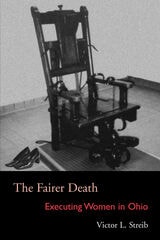
The Fairer Death
Executing Women in OhioVictor L. Streib
Ohio University Press, 2006
Women on death row are such a rarity that, once condemned, they may be ignored and forgotten. Ohio, a typical, middle-of-the-road death penalty state, provides a telling example of this phenomenon. The Fairer Death: Executing Women in Ohio explores Ohio’s experience with the death penalty for women and reflects on what this experience reveals about the death penalty for women throughout the nation.
Victor Streib’s analysis of two centuries of Ohio death penalty legislation and adjudication reveals no obvious exclusion of women or even any recognition of an issue of sex bias. In this respect, Ohio’s justice system exemplifies the subtle and insidious nature of this cultural disparity.
Professor Streib provides detailed descriptions of the cases of the four women actually executed by Ohio since its founding and of the cases of the eleven women sentenced to death in Ohio in the current death penalty era (1973–2005). Some of these cases had a profound impact on death penalty law, but most were routine and drew little attention. A generation later, reversals and commutations have left only one woman on Ohio’s death row.
Although Streib focuses specifically on Ohio, the underlying premise is that Ohio is, in many ways, a typical death penalty state. The Fairer Death provides insight into our national experience, provoking questions about the rationale for the death penalty and the many disparities in its administration.

The Fallen Angel
Chastity, Class and Women's Reading, 1835–1880Sally Mitchell
University of Wisconsin Press, 1981
This book discusses the figure of the unchaste woman in a wide range of fiction written between 1835 and 1880; serious novels by Dickens, Mrs. Gaskell, Meredith, and George Eliot; popular novels that provided light reading for middle-class women (including books by Dinah Craik, Rhoda Broughton, and Ouida); sensational fiction; propaganda for social reform; and stories in cheap periodicals such as the Family Herald and the London Journal, which reached a different and far wider audience than either serious or popular novels.
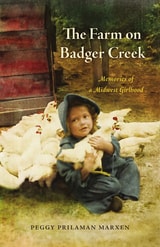
The Farm on Badger Creek
Memories of a Midwest GirlhoodPeggy Prilaman Marxen
Wisconsin Historical Society Press, 2021

The Female Autograph
Theory and Practice of Autobiography from the Tenth to the Twentieth CenturyEdited by Domna C. Stanton
University of Chicago Press, 1987
The Female Complaint
The Unfinished Business of Sentimentality in American CultureLauren Berlant
Duke University Press, 2008
Pairing literary criticism and historical analysis, Berlant explores the territory of this intimate public sphere through close readings of U.S. women’s literary works and their stage and film adaptations. Her interpretation of Uncle Tom’s Cabin and its literary descendants reaches from Harriet Beecher Stowe to Toni Morrison’s Beloved, touching on Shirley Temple, James Baldwin, and The Bridges of Madison County along the way. Berlant illuminates different permutations of the women’s intimate public through her readings of Edna Ferber’s Show Boat; Fannie Hurst’s Imitation of Life; Olive Higgins Prouty’s feminist melodrama Now, Voyager; Dorothy Parker’s poetry, prose, and Academy Award–winning screenplay for A Star Is Born; the Fay Weldon novel and Roseanne Barr film The Life and Loves of a She-Devil; and the queer, avant-garde film Showboat 1988–The Remake. The Female Complaint is a major contribution from a leading Americanist.
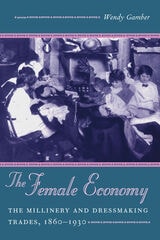
The Female Economy
The Millinery and Dressmaking Trades, 1860-1930Wendy Gamber
University of Illinois Press, 1997
The Female Economy explores that lost world of women's dominance, showing how independent, often ambitious businesswomen and the sometimes imperious consumers they served gradually vanished from the scene as custom production gave way to a largely unskilled modern garment industry controlled by men. Wendy Gamber helps overturn the portrait of wage-earning women as docile souls who would find fulfillment only in marriage and motherhood. She combines labor history, women's history, business history, and the history of technology while exploring topics as wide-ranging as the history of pattern-making and the relationship between entrepreneurship and marriage.
A volume in the series The Working Class in American History, edited by David Brody, Alice Kessler-Harris, David Montgomery, and Sean Wilentz, and in the series Women in American History, edited by Anne Firor Scott, Nancy A. Hewitt, and Stephanie Shaw
The Female in Aristotle's Biology
Reason or RationalizationRobert Mayhew
University of Chicago Press, 2004
Mayhew points out that the tools of modern science and scientific experimentation were not available to the Greeks during Aristotle's time and that, consequently, Aristotle had relied not only on empirical observations when writing about living organisms but also on a fair amount of speculation. Further, he argues that Aristotle's remarks about females in his biological writings did not tend to promote the inferior status of ancient Greek women.
Written with passion and precision, The Female in Aristotle's Biology will be of enormous value to students of philosophy, the history of science, and classical literature.

The Feminization of Famine
Expressions of the Inexpressible?Margaret Kelleher
Duke University Press, 1997
Kelleher begins with a critical reading of the novels and short stories written about the Irish famine over the last 150 years, from the novels of William Carleton and Anthony Trollope to the writings of Liam O’Flaherty and John Banville. She then moves on to unveil a lesser-known body of literature—works written by women. This literature is read in the context of a rich variety of other sources, including eye-witness accounts, memoirs, journalistic accounts, and famine historiography. Concluding with a reading of the twentieth-century accounts of the famine in Bengal, this book reveals how gendered representations have played a crucial role in defining notions of famine.
The Fenwick Letters
A Transnational Feminist Life Reconstructed, Volume I: 1797-1821Eliza Fenwick
University of Delaware Press, 2026
The Fenwick Letters
A Transnational Feminist Life Reconstructed, Volume II: 1822-1840Eliza Fenwick
University of Delaware Press, 2027
The second of this two-volume edition of The Fenwick Letters covers the North American phase of Eliza Fenwick’s transformative, transnational odyssey, from 1822 to 1840. Although no longer the radical author she was in the 1790s, advocating for the rights of women to be educated, or the innovative author of children’s books that she was in the early 1800s, she was still very much a writer. In her North American incarnation, however, she was primarily an educator, a businesswoman running her own school, and a single, working grandmother attempting to find safety as well as economic and domestic stability for herself and her remaining family. Eliza’s letters are consistently riveting, filled with sharply drawn portraits of the people, places, environment, politics, and culture of each community in which she lived. The letters also reveal Eliza’s genius for developing networks of social, political, and cultural connections as she established and sought to support herself and her family in North America.
The Fire-Dwellers
Margaret Laurence
University of Chicago Press, 1993
"Stacey's state of mind is revealed in a swift-flowing stream of dialogue, reaction, reproach, and nostalgia. . . . [Laurence] is the best fiction writer in the Dominion and one of the best in the hemisphere."—Atlantic
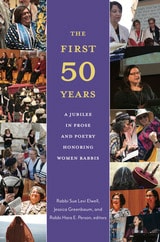
The First Fifty Years
A Jubilee in Prose and Poetry Honoring Women RabbisRabbi Sue Levi Elwell, Jessica Greenbaum, Rabbi Hara E. Person
Central Conference of American Rabbis, 2023
The ordination of Rabbi Sally J. Priesand in 1972 was a watershed moment in Jewish history. In The First Fifty Years, contributors from across the Jewish and gender spectrums reflect on the meaning of this moment and the ensuing decades, both personally and for the Jewish community. In short pieces of new prose, authors—many of them pioneering rabbis—share stories, insights, analysis, and celebrations of women in the rabbinate. These are intertwined with a wealth of poetry that poignantly captures the spirit of this anniversary. The volume is a deep, heartfelt tribute to women rabbis and their indelible impact on all of us.
The First Woman in the Republic
A Cultural Biography of Lydia Maria ChildCarolyn L. Karcher
Duke University Press, 1998
The Fleeing Season
An American Mother’s Migration Toward Safety and JusticeBrooks, Jamie D.
University of Iowa Press, 2026
For generations, migration stories moved in one direction: toward the American Dream. Now, a seismic reversal is underway. For the first time since the Great Depression, more people are leaving the United States than moving in. Jamie D. Brooks and her family are among the many who have fled.
Blending cultural reporting with memoir, The Fleeing Season shares one mother’s story as she considers how and where to raise her family. Brooks recounts her decision to emigrate to the United Kingdom, while reckoning with issues that so many American families face: school shootings, systemic racism, a broken health care system, rising rates of homelessness, and the lack of a social safety net. Intimate and honest, Brooks’s story is not a political polemic. Rather, it maps a path toward reproductive justice.

The Flight Cage
Rebecca Dunham
Tupelo Press, 2010
Using the metaphor of a “flight cage,” where birds are held captive, as physical manifestation of the space from which her speakers address us, Dunham reinvigorates the persona poem. Instead of “performing” historical figures such as Wollstonecraft, Dorothy Wordsworth, Anna Akhmatova, and Charlotte Perkins Gilman, she invites them to inhabit her, flickering in and out of sight, refusing an easy artifice.
A virtuoso of the phrase and image, Dunham displays a daring range of prosody. Drawing upon Wollstonecraft’s experimental travel narrative, the poet creates a threshold upon which the traditional “crown of sonnets” can be opened to the sudden breakage of collaged text, remaking both the received form and the now-conventional contemporary experimental poem.
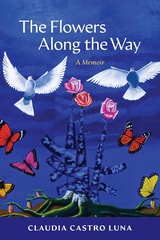
The Flowers Along the Way
A MemoirClaudia Castro Luna
Northwestern University Press, 2026
Passionately demonstrating the dormant trauma of political violence and the redemption waiting beyond it
From El Salvador’s lush countryside to the streets of Oakland, California, a young mother wrestles with the intersecting forces of memory, history, and language in order to chart a new path for herself and her growing family. Fleeing political unrest and civil war violence in El Salvador, fourteen-year-old Claudia Castro Luna arrived in the United States with her family in 1981. Two decades later, holding her two-year-old and pregnant with her second child, she survives a public shooting by hiding behind shrubs in front of her house in Oakland. This event unleashes disorienting and traumatic memories, plunging her into a journey of discovery as she grapples with PTSD, recovers family stories, and begins to make sense of all that was torn asunder within her by the experiences of war and emigration. Beauty, longing, fear, and joy entwine in this powerful story of love, self-determination, and the search for home.
The Forbidden Modern
Civilization and VeilingNilufer Gole
University of Michigan Press, 1997
The Force of Witness
Contra FeminicideRosa-Linda Fregoso
Duke University Press, 2023
The Fortune Tellers of Zenith City
A NovelMary Dupont
University of Minnesota Press, 2027
A fraudulent fortune teller, a society divorcee, and a spirited prostitute caught up in a story of insanity, ambition, and murder in turn-of-the-century Duluth
Please don’t mistake this story for a murder mystery, May Martin warns us as she settles in to tell her tale. The mystery, she says, is that only one of us ended up dead.
The Fortune Tellers of Zenith City plunges readers into the shadows of Gilded Age Duluth, where the rising walls of Glensheen Mansion mask a city built on industry and rife with sin. May Martin, a dubious clairvoyant haunted by her past, finds her survival tethered to Agnes Petre, a true seer and wealthy divorcee. As May and Agnes forge a partnership in fortune telling to weather the conditions of the gritty port city, their malicious ex-husbands, John and Douglas, start romantic affairs with the carefree Ethelwynne Dean. These tangled relationships clash with brothel owner Madame Gain, a notorious criminal with debts to collect, the ruthless tycoons who rule the iron mines, and the working-class residents struggling beneath them. Beside the icy, foreboding depths of Lake Superior, these denizens must navigate a maze of lies, ambition, and even murder while keeping their own secrets hidden. And the greatest mystery isn’t the spirits they summon—it’s who will escape the impending storm.
With scrupulous attention to historical detail, Mary Dupont recreates the lost world of Duluth at the turn of the twentieth century, delivering chicanery, suspense, drama, and humor through May’s wary, witty perspective—with a thrilling twist at the end.
Retail e-book files for this title are screen-reader friendly with image accompanied by short alt text and/or extended description.
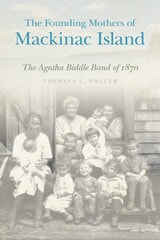
The Founding Mothers of Mackinac Island
The Agatha Biddle Band of 1870Theresa L. Weller
Michigan State University Press, 2021
The Gender Impact of Social Security Reform
Estelle James, Alejandra Cox Edwards, and Rebeca Wong
University of Chicago Press, 2008
The Gender Impact of Social Security Reform compares the gendered outcomes of social security systems in Chile, Argentina, and Mexico, and presents empirical findings from Eastern and Central European transition economies as well as several OECD countries. Women’s positions have improved relative to men in countries where joint pensions have been required, widows who have worked can keep the joint pension in addition to their own benefit, the public benefit has been targeted toward low earners, and women’s retirement age has been raised to equality with that of men. The Gender Impact of Social Security Reform will force economists and policy makers to reexamine the design features that enable social security systems to achieve desirable gender outcomes.
The Gendered Worlds of Latin American Women Workers
From Household and Factory to the Union Hall and Ballot BoxJohn D. French and Daniel James, eds.
Duke University Press, 1997
Widely seen as a hostile sexualized space, the modern factory was considered a threat, not only to the virtue of working women, but also to the survival of the family, and thus, the future of the nation. Yet working-class women continued to labor outside the home and remained highly visible in the expanding world of modern industry. In nine essays dealing with Argentina, Brazil, Chile, Colombia, and Guatemala, the contributors make extensive use of oral histories to describe the contradictory experiences of women whose work defied gender prescriptions but was deemed necessary by working-class families in a world of need and scarcity. The volume includes discussion of previously neglected topics such as single motherhood, women’s struggle against domestic violence, and the role of women as both desiring and desired subjects.
Contributors. Ann Farnsworth-Alvear, Mary Lynn Pedersen Cluff, John D. French, Daniel James, Thomas Miller Klubock, Deborah Levenson-Estrada, Mirta Zaida Lobato, Heidi Tinsman, Theresa R. Veccia, Barbara Weinstein
The Georgia of the North
Black Women and the Civil Rights Movement in New JerseyHettie V. Williams
Rutgers University Press, 2024
The Ghost in the Little House
A Life of Rose Wilder LaneWilliam Holtz
University of Missouri Press, 1995
The Glass Slipper
Women and Love StoriesSusan Ostrov Weisser
Rutgers University Press, 2013
Why is the story of romance in books, magazines, and films still aimed at women rather than at men? Even after decades of feminism, traditional ideas and messages about romantic love still hold sway and, in our “postfeminist” age, are more popular than ever. Increasingly, we have become a culture of romance: stories of all kinds shape the terms of love. Women, in particular, love a love story.
The Glass Slipper is about the persistence of a familiar Anglo-American love story into the digital age. Comparing influential classics to their current counterparts, Susan Ostrov Weisser relates in highly amusing prose how these stories are shaped and defined by and for women, the main consumers of romantic texts. Following a trajectory that begins with Jane Austen and concludes with Internet dating sites, Weisser shows the many ways in which nineteenth-century views of women’s nature and the Victorian idea of romance have survived the feminist critique of the 1970s and continue in new and more ambiguous forms in today’s media, with profound implications for women.
More than a book about romance in fiction and media, The Glass Slipper illustrates how traditional stories about women’s sexuality, femininity, and romantic love have survived as seemingly protective elements in a more modern, feminist, sexually open society, confusing the picture for women themselves. Weisser compares diverse narratives—historical and contemporary from high literature and “low” genres—discussing novels by Jane Austen and Charlotte Brontë, Victorian women’s magazines, and D. H. Lawrence’s Lady Chatterley’s Lover; Disney movies; popular Harlequin romance novels; masochistic love in films; pornography and its relationship to romance; and reality TV and Internet ads as romantic stories.
Ultimately, Weisser shows that the narrative versions of the Glass Slipper should be taken as seriously as the Glass Ceiling as we see how these representations of romantic love are meant to inform women’s beliefs and goals. In this book, Weisser’s goal is not to shatter the Glass Slipper, but to see through it.
The Gospel of Progressivism
Moral Reform and Labor War in Colorado, 1900-1930R. Todd Laugen
University Press of Colorado, 2010
Sharing enemies like the party boss and corporate lobbyist who undermined honest and responsive government, Progressive leaders were determined to root out selfish political action with public exposure. Labor unions defied bosses and rallied for government protection of workers. Women's clubs appealed to other women as mothers, calling for social welfare, economic justice, and government responsiveness. Protestant church congregations formed a core of support for moral reform. Labor relations experts struggled to prevent the outbreak of violence through mediation between corporate employers and organized labor. Persevering through World War I, Colorado reformers faced their greatest challenge in the 1920s, when leaders of the Ku Klux Klan drew upon the rhetoric of Protestant Progressives and manipulated reform tools to strengthen their own political machine. Once in power, Klan legislators turned on Progressive leaders in the state government.
A story of promising alliances never fully realized, zealous crusaders who resisted compromise, and reforms with unexpected consequences, The Gospel of Progressivism will appeal to those interested in Progressive Era reform, Colorado history, labor relations, and women's activism.
The Great Upheaval
Women and Nation in Postwar NigeriaJudith A. Byfield
Ohio University Press, 2021
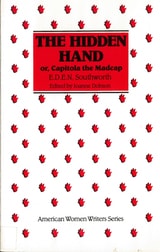
The Hidden Hand
Or, Capitola the Madcap by E. D. E. N. SouthworthDobson, Joanne
Rutgers University Press, 1988
E.D.E.N. Southworth was one of the most popular and prolific writers of the nineteenth century and her Capitola Black, or Black Cap - a cross-dressing, adventure-seeking girl-woman - was so well-loved that the book was serialized three times between 1859 and 1888 and was dramatized in forty different versions.
When we first meet sharp and witty Capitola she is living among beggars and street urchins, and dressed as a boy because a boy can get work and be safe, whereas a girl is left to starve for want of "proper" employment. Unknown to her, Capitola has a very rich elderly guardian who finds her at a providential moment and takes her back to his palatial mansion where she finds herself "decomposing above ground for want of having my blood stirred." But not to fear. There are bandits, true-loves, evil men, long-lost mothers, and sweet women friends in Capitola's future - not to mention thunder storms, kidnap attempts, and duels.
The pace is fast, the action wonderfully unbelievable. This is escape literature at its nineteenth-century best, with a woman at its center who makes you feel strong, daring, and reckless.
The Hidden Hand
Or, Capitola the Madcap by E. D. E. N. SouthworthDobson, Joanne
Rutgers University Press, 1988
The High Middle Ages
Kari Elisabeth Børresen
SBL Press, 2015
An international collection of ecumenical, gender-sensitive interpretations
The latest volume in the Bible and Women series examines the relationship between women and the Bible's reception in the centuries of the High and Late Middle Ages in Europe. Contributors bring a variety of new insights to questions of how women of the Bible were treated in literary, mystical, and doctrinal texts as well as in art and music. Though the Bible was used to legitimize the subordination of women to men and to exclude them from power, during this period women produced works of theology and biblical interpretation. Contributors include Gemma Avenoza, Marina Benedetti, Dinora Corsi, Maria Laura Giordano, Elisabeth Gössmann, Maria Leticia Sánchez Hernández, Hildegund Keul, Linda Maria Koldau, Martina Kreidler-Kos, Rita Librandi, Gary Macy, Constant J. Mews, Magda Motté, Rosa María Parrinello, María Isabel Toro Pascua, Claudia Poggi, Carmel Posa, Marina Santini, Valeria Ferrari Schiefer, Andrea Taschl-Erber, Adriana Valerio, and Paola Vitolo.
Features
- Essays on the treatment of women in commentaries and didactic moral literature written by men
- Close study of women as scholars and interpreters of the Bible from the twelfth through the fifteen centuries
- Twenty-one essays from twenty-three scholars from around the world
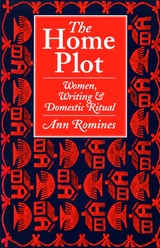
The Home Plot
Women, Writing, and Domestic RitualAnn Romines
University of Massachusetts Press, 1992
By reading domestic ritual as a gendered language, Romines seeks to reclaim one of the oldest female traditions--housekeeping--from trivialization and devaluation. In the process, she brings fresh insight to the work of five important American novelists.
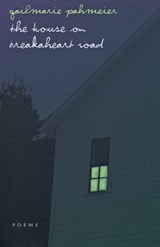
The House On Breakaheart Road
PoemsGailmarie Pahmeier
University of Nevada Press, 1998
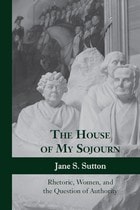
The House of My Sojourn
Rhetoric, Women, and the Question of AuthorityJane S. Sutton
University of Alabama Press, 2010
Employing the trope of architecture, Jane Sutton envisions the relationship between women and rhetoric as a house: a structure erected in ancient Greece by men that, historically, has made room for women but has also denied them the authority and agency to speak from within. Sutton’s central argument is that all attempts to include women in rhetoric exclude them from meaningful authority in due course, and this exclusion has been built into the foundations of rhetoric.
Drawing on personal experience, the spatial tropes of ancient Greek architecture, and the study of women who attained significant places in the house of rhetoric, Sutton highlights a number of decisive turns where women were able to increase their rhetorical access but were not able to achieve full authority, among them the work of Frances Wright, Lucy Stone, and suffragists Mott, Anthony, and Stanton; a visit to the 1893 World’s Columbian Exposition in Chicago, where the busts that became the Portrait Monument were displayed in the Woman’s Building (a sideshow, in essence); and a study of working-class women employed as telephone operators in New York in 1919.
With all the undeniable successes—socially, politically, and financially— of modern women, it appears that women are now populating the house of rhetoric as never before. But getting in the house and having public authority once inside are not the same thing. Sutton argues that women “can only act as far as the house permits.” Sojourn calls for a fundamental change in the very foundations of rhetoric.
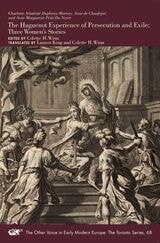
The Huguenot Experience of Persecution and Exile
Three Women’s StoriesCharlotte Arbaleste Duplessis-Mornay, Anne de Chaufepié, and Anne Marguerite Petit Du Noyer
Iter Press, 2019
Edited by Colette H. Winn. Translated by Lauren King and Colette H. Winn
The Other Voice in Early Modern Europe: The Toronto Series, Vol. 68
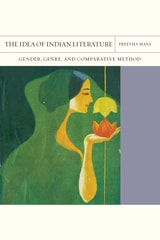
The Idea of Indian Literature
Gender, Genre, and Comparative MethodPreetha Mani
Northwestern University Press, 2022
Indian literature is not a corpus of texts or literary concepts from India, argues Preetha Mani, but a provocation that seeks to resolve the relationship between language and literature, written in as well as against English. Examining canonical Hindi and Tamil short stories from the crucial decades surrounding decolonization, Mani contends that Indian literature must be understood as indeterminate, propositional, and reflective of changing dynamics between local, regional, national, and global readerships. In The Idea of Indian Literature, she explores the paradox that a single canon can be written in multiple languages, each with their own evolving relationships to one another and to English.
Hindi, representing national aspirations, and Tamil, epitomizing the secessionist propensities of the region, are conventionally viewed as poles of the multilingual continuum within Indian literature. Mani shows, however, that during the twentieth century, these literatures were coconstitutive of one another and of the idea of Indian literature itself. The writers discussed here—from short-story forefathers Premchand and Pudumaippittan to women trailblazers Mannu Bhandari and R. Chudamani—imagined a pan-Indian literature based on literary, rather than linguistic, norms, even as their aims were profoundly shaped by discussions of belonging unique to regional identity. Tracing representations of gender and the uses of genre in the shifting thematic and aesthetic practices of short vernacular prose writing, the book offers a view of the Indian literary landscape as itself a field for comparative literature.
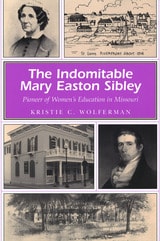
The Indomitable Mary Easton Sibley
Pioneer of Women's Education in MissouriKristie C. Wolferman
University of Missouri Press, 2008
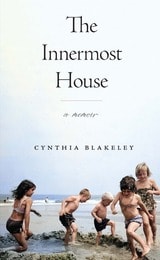
The Innermost House
A MemoirCynthia Blakeley
University of Massachusetts Press, 2024
Finalist, 2025 Georgia Author of the Year Award in Memoir
A stunning account of year-round life on the windswept shores of Cape Cod, threaded with meditations on memory, forgetting, and identity
Raised in a nineteenth-century saltbox house in Wellfleet, Massachusetts, Cynthia Blakeley was both surrounded by generations of immediate and extended family and isolated by the mysteries locked inside her affectionate yet elusive mother and short-fused father. While she and her sisters and cousins roamed the Outer Cape—drinking in the dunes, swimming in kettle ponds, and dancing in Provincetown—Blakeley also turned to the inner world of her journals as she contended with her own secrets and memories.
Over-identifying with her unconventional and artistic mother, Blakeley felt certain that the key to understanding her mother’s drinking and distractions, her generosity and easy forgiveness, was the unexplained absence of two of Blakeley’s half-siblings and their connection to her mother’s unhappy first marriage. Blakeley kept her distance, however, from her disciplinarian father. Though he took his daughters sailing and clamming and beachcombing, he was the chill to their mother’s warmth, the maker, not the breaker, of rules. Slipping through these dynamics in that small house and evocative landscape, Blakeley eventually crossed the bridge and left home, only to return later in search of the family stories that would help her decode her present.
Blakeley’s captivating memoir moves fluidly through time, grappling with the question of who owns a memory or secret and how our narrative choices not only describe but also shape and change us. In this insightful and poignant account of tenacious year-rounders on Cape Cod, Blakeley contends that making sense of ourselves is a collaborative affair, one that begins with understanding those we came from.
The Innermost House
A MemoirCynthia Blakeley
University of Massachusetts Press, 2024
Finalist, 2025 Georgia Author of the Year Award in Memoir
A stunning account of year-round life on the windswept shores of Cape Cod, threaded with meditations on memory, forgetting, and identity
Raised in a nineteenth-century saltbox house in Wellfleet, Massachusetts, Cynthia Blakeley was both surrounded by generations of immediate and extended family and isolated by the mysteries locked inside her affectionate yet elusive mother and short-fused father. While she and her sisters and cousins roamed the Outer Cape—drinking in the dunes, swimming in kettle ponds, and dancing in Provincetown—Blakeley also turned to the inner world of her journals as she contended with her own secrets and memories.
Over-identifying with her unconventional and artistic mother, Blakeley felt certain that the key to understanding her mother’s drinking and distractions, her generosity and easy forgiveness, was the unexplained absence of two of Blakeley’s half-siblings and their connection to her mother’s unhappy first marriage. Blakeley kept her distance, however, from her disciplinarian father. Though he took his daughters sailing and clamming and beachcombing, he was the chill to their mother’s warmth, the maker, not the breaker, of rules. Slipping through these dynamics in that small house and evocative landscape, Blakeley eventually crossed the bridge and left home, only to return later in search of the family stories that would help her decode her present.
Blakeley’s captivating memoir moves fluidly through time, grappling with the question of who owns a memory or secret and how our narrative choices not only describe but also shape and change us. In this insightful and poignant account of tenacious year-rounders on Cape Cod, Blakeley contends that making sense of ourselves is a collaborative affair, one that begins with understanding those we came from.
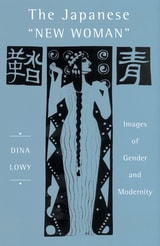
The Japanese 'New Woman'
Images of Gender and ModernityLowy, Dina
Rutgers University Press, 2007
The dawn of the twentieth century in Japan witnessed the rise of a peculiar problem: the “Woman Problem.” This, at least, was the term used in an ongoing debate among the government and various intellectuals over how to define gender roles. While the government worked hard to promote the “good wife, wise mother” paradigm, certain female members of society had other notions about how to engage with their world.
In The Japanese “New Woman,” Dina Lowy focuses on this new female image as it was revealed, discussed, and debated in popular newspapers and magazines in the 1910s, as well as on the lives of a specific group of women—members of the feminist literary organization known as the Seitosha. These women drew on a variety of sources, including Zen training, Western writings and ideas, and Japanese morals and arts as they tried to open up new spaces for female activity beyond the confines of the home. Lowy shows how the Seitosha set a precedent that would be emulated in the decades to follow as Japanese women continued to question the patriarchal order, experiment with alternative visions, and pursue their rights in a variety of forms. This work also provides a context for comparative studies of New Women, gender debates, and the modernizing process.

The Jerrie Mock Story
The First Woman to Fly Solo around the WorldNancy Roe Pimm
Ohio University Press, 2016
A Junior Library Guild selection
Society of Children’s Book Writers and Illustrators Official 2016 Summer Reading List
In this biography for middle-grade readers, Nancy Roe Pimm tells the story of Geraldine “Jerrie” Mock, the first woman to fly solo around the world. In her trusty Cessna, The Spirit of Columbus—also known as Charlie—she traveled from Columbus, Ohio, on an eastward route that totaled nearly twenty-three thousand miles and took almost a month. Overcoming wind, ice, mechanical problems, and maybe even sabotage, Mock persevered.
Mock caught the aviation bug at seven years old, when she rode in a Ford Trimotor plane with her parents. In high school, she displayed a talent for math and science, and she was the only woman in her aeronautical engineering classes at Ohio State University. Although she then settled into domestic life, she never lost her interest in flying. What began as a joking suggestion from her husband to fly around the world prompted her to pursue her childhood dream. But the dream became a race, as another woman, Joan Merriam Smith, also sought to be the first to circle the globe.
Even though Mock beat Smith and accomplished what her heroine Amelia Earhart had died trying to do, her feat was overshadowed by the Vietnam War and other world events. Now, Pimm introduces Mock to a new generation of adventurers.
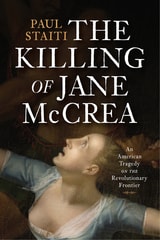
The Killing of Jane McCrea
An American Tragedy on the Revolutionary FrontierPaul Staiti
Westholme Publishing, 2027
FINALIST FOR THE 2026 GEORGE WASHINGTON PRIZE
Winner of the 2026 Book of the Year Award, George Washington American Revolution Round Table, Washington, DC
The killing of Jane McCrea on July 26, 1777, on the outskirts of a village in the northern Hudson Valley, would unexpectedly rupture the British advance from Canada that was meant to crush the American Revolution in one knockout blow. On that day, twenty-five-year-old McCrea, an unremarkable person preparing for an impending marriage, was assaulted, scalped, and killed by a group of Native Americans in the employ of British general John Burgoyne. Though the murder was but one of many civilian deaths in a fierce war zone, McCrea’s killing had far-reaching consequences for each of the three major parties involved in the Northern Campaign of 1777. In America, she became the great cause célèbre of the Revolution, the sympathetic female victim of the war symbolizing the righteousness of The Cause. In Britain, she was a human-rights tragedy that tarnished the polished surface of British honor and galvanized Whig politicians who shouted out her name in Parliament as an example of how low the nation had fallen. For Native peoples, recruited by both the British and the Americans, and caught in the middle of a war staged on ancestral grounds, McCrea’s killing was the opening salvo in a vicious chain of bloody retribution that led to the disintegration of the venerable Iroquois Confederacy and the obliteration of Native homelands. After the war, the nightmarish image of a young Jane McCrea slaughtered on the New York frontier would obsess white Americans who came to fear Native peoples as irredeemable savages. Her murder would help justify the expulsion of Indigenous tribes and open the doors for an expansionary United States that was fully intent on transforming the American continent into its own image.
The Killing of Jane McCrea: An American Tragedy on the Revolutionary Frontier by distinguished historian Paul Staiti undertakes for the first time a comprehensive investigation into McCrea’s life, death, and especially her long and strange afterlife. Using both visual arts and written records, the author reassembles the scattered fragments to illuminate a historical terrain long since shrouded in misinformation, mired in controversy, and relegated to mythology. Coming into view is a major portrait of the persons, cultures, actions, and motives that fatally converged on that hot July morning in 1777.
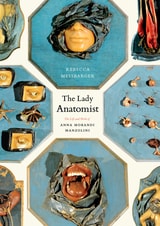
The Lady Anatomist
The Life and Work of Anna Morandi ManzoliniRebecca Messbarger
University of Chicago Press, 2010
Anna Morandi Manzolini (1714-74), a woman artist and scientist, surmounted meager origins and limited formal education to become one of the most acclaimed anatomical sculptors of the Enlightenment. The Lady Anatomist tells the story of her arresting life and times, in light of the intertwined histories of science, gender, and art that complicated her rise to fame in the eighteenth century.
Examining the details of Morandi’s remarkable life, Rebecca Messbarger traces her intellectual trajectory from provincial artist to internationally renowned anatomical wax modeler for the University of Bologna’s famous medical school. Placing Morandi’s work within its cultural and historical context, as well as in line with the Italian tradition of anatomical studies and design, Messbarger uncovers the messages contained within Morandi’s wax inscriptions, part complex theories of the body and part poetry. Widely appealing to those with an interest in the tangled histories of art and the body, and including lavish, full-color reproductions of Morandi’s work, The Lady Anatomist is a sophisticated biography of a true visionary.