Results by title
28167 books match the query 'History' and 6372 start with t
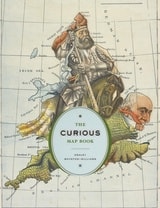
The Curious Map Book
Ashley Baynton-Williams
University of Chicago Press, 2015
Over the centuries, maps have served many varied purposes; far from mere guides for reaching a destination, they are unique artistic forms, aides in planning commercial routes, literary devices for illuminating a story. Accuracy—or inaccuracy—of maps has been the make-or-break factor in countless military battles throughout history. They have graced the walls of homes, bringing prestige and elegance to their owners. They track the mountains, oceans, and stars of our existence. Maps help us make sense of our worlds both real and imaginary—they bring order to the seeming chaos of our surroundings.
With The Curious Map Book, Ashley Baynton-Williams gathers an amazing, chronologically ordered variety of cartographic gems, mainly from the vast collection of the British Library. He has unearthed a wide array of the whimsical and fantastic, from maps of board games to political ones, maps of the Holy Land to maps of the human soul. In his illuminating introduction, Baynton-Williams also identifies and expounds upon key themes of map production, peculiar styles, and the commerce and collection of unique maps. This incredible volume offers a wealth of gorgeous illustrations for anyone who is cartographically curious.
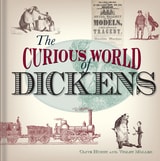
The Curious World of Dickens
Clive Hurst and Violet Moller
Bodleian Library Publishing, 2012
Published to celebrate the twohundredth anniversary of Dickens’s birth, this book brings together quotations from Dickens’s novels and letters with photographs of their original covers and Victorian-era images—among them, prints, posters, and newspaper pieces—that shed light on the topics about which Dickens writes. Ordered by theme, the book covers such topics as schools in Victorian England, domestic entertainment, the introduction of the railroad, and the poor conditions in prisons and workhouses, which loom large in Dickens’s novels—and, indeed, his own childhood. Dickens was also an avid theater enthusiast who arranged productions and public readings of many of his works, and this book explores his role throughout his later years in adroitly adapting his novels for the stage.
The Curious World of Dickens breathes new life on this momentous occasion into the vibrant world inhabited by Dickens and his characters.
The Currency of Truth
Newsmaking and the Late-Socialist Imaginaries of China's Digital EraEmily H. C. Chua
University of Michigan Press, 2023
In The Currency of Truth, Emily H. C. Chua argues that news in China works less as a medium of mass communication than as a kind of currency as industry players make and use news articles to create agreements, build connections, and protect and advance their positions against one another. Looking at the ethical and professional principles that well-intentioned and civically minded journalists strive to uphold, and the challenges and doubts that they grapple with in the process, Chua brings her findings into conversation around “post-truth” news and the “crisis” of professional journalism in the West. The book encourages readers to rethink contemporary news, arguing that rather than setting out from the assumption that news works either to inform or deceive its publics, we should explore the “post-public” social and political imaginaries emerging among today’s newsmakers and remaking the terms of their practice.
The Cut of His Coat
Men, Dress, and Consumer Culture in Britain, 1860–1914Brent Shannon
Ohio University Press, 2006
The English middle class in the late nineteenth century enjoyed an increase in the availability and variety of material goods. With that, the visual markers of class membership and manly behavior underwent a radical change. In The Cut of His Coat: Men, Dress, and Consumer Culture in Britain, 1860–1914, Brent Shannon examines familiar novels by authors such as George Eliot, Anthony Trollope, Thomas Hughes, and H. G. Wells, as well as previously unexamined etiquette manuals, period advertisements, and fashion monthlies, to trace how new ideologies emerged as mass-produced clothes, sartorial markers, and consumer culture began to change.
While Victorian literature traditionally portrayed women as having sole control of class representations through dress and manners, Shannon argues that middle-class men participated vigorously in fashion. Public displays of their newly acquired mannerisms, hairstyles, clothing, and consumer goods redefined masculinity and class status for the Victorian era and beyond.
The Cut of His Coat probes the Victorian disavowal of men’s interest in fashion and shopping to recover men’s significant role in the representation of class through self-presentation and consumer practices.
The Cybernetic Border
Drones, Technology, and IntrusionIván Chaar López
Duke University Press, 2024

The Cybernetic Brain
Sketches of Another FutureAndrew Pickering
University of Chicago Press, 2010
The Cybernetic Brain explores a largely forgotten group of British thinkers, including Grey Walter, Ross Ashby, Gregory Bateson, R. D. Laing, Stafford Beer, and Gordon Pask, and their singular work in a dazzling array of fields. Psychiatry, engineering, management, politics, music, architecture, education, tantric yoga, the Beats, and the sixties counterculture all come into play as Pickering follows the history of cybernetics’ impact on the world, from contemporary robotics and complexity theory to the Chilean economy under Salvador Allende. What underpins this fascinating history, Pickering contends, is a shared but unconventional vision of the world as ultimately unknowable, a place where genuine novelty is always emerging. And thus, Pickering avers, the history of cybernetics provides us with an imaginative model of open-ended experimentation in stark opposition to the modern urge to achieve domination over nature and each other.
The Cycling City
Bicycles and Urban America in the 1890sEvan Friss
University of Chicago Press, 2015
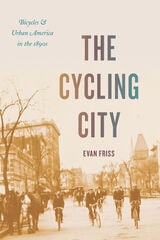
The Cycling City is a sharp history of the bicycle’s rise and fall in the late nineteenth century. In the 1890s, American cities were home to more cyclists, more cycling infrastructure, more bicycle friendly legislation, and a richer cycling culture than anywhere else in the world. Evan Friss unearths the hidden history of the cycling city, demonstrating that diverse groups of cyclists managed to remap cities with new roads, paths, and laws, challenge social conventions, and even dream up a new urban ideal inspired by the bicycle. When cities were chaotic and filthy, bicycle advocates imagined an improved landscape in which pollution was negligible, transportation was silent and rapid, leisure spaces were democratic, and the divisions between city and country were blurred. Friss argues that when the utopian vision of a cycling city faded by the turn of the century, its death paved the way for today’s car-centric cities—and ended the prospect of a true American cycling city ever being built.

The Cycling City
Bicycles and Urban America in the 1890sEvan Friss
University of Chicago Press, 2015
Cycling has experienced a renaissance in the United States, as cities around the country promote the bicycle as an alternative means of transportation. In the process, debates about the nature of bicycles—where they belong, how they should be ridden, how cities should or should not accommodate them—have played out in the media, on city streets, and in city halls. Very few people recognize, however, that these questions are more than a century old.
The Cycling City is a sharp history of the bicycle’s rise and fall in the late nineteenth century. In the 1890s, American cities were home to more cyclists, more cycling infrastructure, more bicycle friendly legislation, and a richer cycling culture than anywhere else in the world. Evan Friss unearths the hidden history of the cycling city, demonstrating that diverse groups of cyclists managed to remap cities with new roads, paths, and laws, challenge social conventions, and even dream up a new urban ideal inspired by the bicycle. When cities were chaotic and filthy, bicycle advocates imagined an improved landscape in which pollution was negligible, transportation was silent and rapid, leisure spaces were democratic, and the divisions between city and country were blurred. Friss argues that when the utopian vision of a cycling city faded by the turn of the century, its death paved the way for today’s car-centric cities—and ended the prospect of a true American cycling city ever being built.
The Cynical Society
The Culture of Politics and the Politics of Culture in American LifeJeffrey C. Goldfarb
University of Chicago Press, 1991
The Cypress and Other Writings of a German Pioneer in Texas
By Hermann Seele
University of Texas Press, 1979
When Hermann Seele anived in New Braunfels in 1845, the raw colony was plagued by poverty, disease, lack of food, and hostile Indians. This personal record of the Germans in Texas shows their evolution from struggling colonists to prosperous citizens.
From his viewpoint of a hardworking yet imaginative pioneer, Seele presents first a history of German immigration and settlement in Texas during the nineteenth century. Next, his autobiographical writings range from a "sentimental recollection" of his first Christmas Eve in Texas to his first day of teaching in New Braunfels, from accounts of the popular singing society to murder and justice along the Comal River. In addition, Seele's romantic novel, The Cypress, is a delightful though improbable tale of a traveling botanist, a chieftain's daughter, and a savage Indian cult.
Hermann Seele—farmer, lawyer, teacher, lay preacher, mayor, state representative, Civil War major, and editor—epitomizes the best of the German immigrants who established their communities as models of respectability and prosperity.
The Czech Reader
History, Culture, PoliticsJan Bazant, Nina Bazantová, and Frances Starn, eds.
Duke University Press, 2010
The Czech and Slovak Republics
Twenty years of Independence, 1993–2013M. Mark Stolarik
Central European University Press, 2017
The DNA Mystique
The Gene as a Cultural IconDorothy Nelkin and M. Susan Lindee
University of Michigan Press, 2004
With a new introduction and conclusion, this edition will continue to be an engaging, accessible, and provocative text for the sociology, anthropology, and bioethics classroom, as well as stimulating reading for those generally interested in science and culture.

The Dada Cyborg
Visions of the New Human in Weimar BerlinMatthew Biro
University of Minnesota Press, 2009
Finding the cyborg in early twentieth-century German art
In an era when technology, biology, and culture are becoming ever more closely connected, The Dada Cyborg explains how the cyborg as we know it today actually developed between 1918 and 1933 when German artists gave visual form to their utopian hopes and fantasies in a fearful response to World War I.
In what could be termed a prehistory of the posthuman, Matthew Biro shows the ways in which new forms of human existence were imagined in Germany between the two world wars through depictions of cyborgs. Examining the work of Hannah Höch, Raoul Hausmann, George Grosz, John Heartfield, Otto Dix, and Rudolf Schlichter, he reveals an innovative interpretation of the cyborg as a representative of hybrid identity, as well as a locus of new modes of awareness created by the impact of technology on human perception. Tracing the prevalence of cyborgs in German avant-garde art, Biro demonstrates how vision, hearing, touch, and embodiment were beginning to be reconceived during the Weimar Republic. Biro’s unique and interdisciplinary analysis offers a substantially new account of the Berlin Dada movement, one that integrates the group’s poetic, theoretical, and performative practices with its famous visual strategies of photomontage, assemblage, and mixed-media painting to reveal radical images of a “new human.”
The Daily Thomas Paine
A Year of Common-Sense Quotes for a Nonsensical AgeThomas Paine
University of Chicago Press, 2020
The Daily Thomas Paine offers a year’s worth of pithy and provocative quotes from this quintessentially American figure. Editor Edward G. Gray argues that we are living in a moment that Thomas Paine might recognize—or perhaps more precisely, a moment desperate for someone whose rhetoric can ignite a large-scale social and political transformation. Paine was a master of political rhetoric, from the sarcastic insult to the diplomatic aperçu, and this book offers a sleek and approachable sampler of some of the sharpest bits from his oeuvre. As Paine himself says in the entry for January 20: “The present state of America is truly alarming to every man who is capable of reflexion.” The Daily Thomas Paine should prove equally incendiary and inspirational for contemporary readers with an eye for politics, even those who prefer the tweet to the pamphlet.
The Daley Show
Inside the Transformative Reign of Chicago's Richard M. DaleyForrest Claypool; Foreword by David Axelrod
University of Illinois Press, 2024
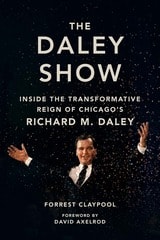
American cities once had mayors who actually governed.
For twenty-two years, Richard M. Daley ran Chicago with the type of authority that is unthinkable today. He reshaped downtown, triggered a jobs boom, delivered the iconic Millennium Park, turned around troubled public schools, and slashed violent crime to 40-year lows. He outfoxed Republican legislators to retain control of O’Hare Airport and expand it into the nation’s premier international aviation hub. Leveraging carefully built national political ties, he sidelined a powerful nemesis to tear down Chicago’s infamous public housing projects.
Rebuilding parts of his father’s legendary political machine through brazen (and illegal) patronage deals, he centralized power to a remarkable degree, cut deals behind closed doors, racked up piles of debt, and made long-term bets whose consequences are still unfolding.
This is not simply a biography. It is a challenge to contemporary urban orthodoxy:
Do cities thrive because of strong, decisive leaders—or despite them?
Through vivid storytelling, this book exposes how Daley consolidated power, aligned business and labor, navigated crises, survived damaging scandals, and imposed discipline on a sprawling city. It dares readers to reconsider what kind of leadership modern American cities truly need.
The Dallas Myth
The Making and Unmaking of an American CityHarvey J. Graff
University of Minnesota Press, 2010
In The Dallas Myth, Harvey J. Graff presents a novel interpretation of a city that has proudly declared its freedom from the past. He scrutinizes the city's origin myth and its governance ideology, known as the "Dallas Way," looking at how these elements have shaped Dallas and served to limit democratic participation and exacerbate inequality. Advancing beyond a traditional historical perspective, Graff proposes an original, integrative understanding of the city's urban fabric and offers an explicit critique of the reactionary political foundations of modern Dallas: its tolerance for right-wing political violence, the endemic racism and xenophobia, and a planning model that privileges growth and monumental architecture at the expense of the environment and social justice.
Revealing the power of myths that have defined the city for so long, Graff presents a new interpretation of Dallas that both deepens our understanding of America's urban landscape and enables its residents to envision a more equitable, humane, and democratic future for all.

The Dallas Story
The North American Aviation Plant and Industrial Mobilization during World War IITerrance Furgerson
University of North Texas Press, 2023
The Dance That Makes You Vanish
Cultural Reconstruction in Post-Genocide IndonesiaRachmi Diyah Larasati
University of Minnesota Press, 2013
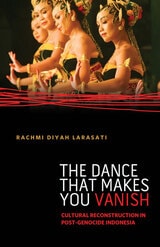
Indonesian court dance, a purportedly pure and untouched tradition, is famed throughout the world for its sublime calm and stillness. Yet this unyieldingly peaceful surface conceals a time of political repression and mass killing. Between 1965 and 1966, some one million Indonesians—including a large percentage of the country’s musicians, artists, and dancers—were killed, arrested, or disappeared as Suharto established a virtual dictatorship that ruled for the next thirty years.
In The Dance That Makes You Vanish, an examination of the relationship between female dancers and the Indonesian state since 1965, Rachmi Diyah Larasati elucidates the Suharto regime’s dual-edged strategy: persecuting and killing performers perceived as communist or left leaning while simultaneously producing and deploying “replicas”—new bodies trained to standardize and unify the “unruly” movements and voices of those vanished—as idealized representatives of Indonesia’s cultural elegance and composure in bowing to autocratic rule. Analyzing this history, Larasati shows how the Suharto regime’s obsessive attempts to control and harness Indonesian dance for its own political ends have functioned as both smoke screen and smoke signal, inadvertently drawing attention to the site of state violence and criminality by constantly pointing out the “perfection” of the mask that covers it.
Reflecting on her own experiences as an Indonesian national troupe dancer from a family of persecuted female dancers and activists, Larasati brings to life a powerful, multifaceted investigation of the pervasive use of culture as a vehicle for state repression and the global mass-marketing of national identity.
The Dance of Freedom
Texas African Americans during ReconstructionBy Barry Crouch
University of Texas Press, 2007
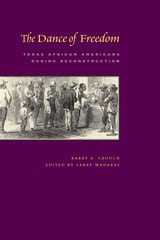
This anthology brings together the late Barry A. Crouch's most important articles on the African American experience in Texas during Reconstruction. Grouped topically, the essays explore what freedom meant to the newly emancipated, how white Texans reacted to the freed slaves, and how Freedmen's Bureau agents and African American politicians worked to improve the lot of ordinary African American Texans. The volume also contains Crouch's seminal review of Reconstruction historiography, "Unmanacling Texas Reconstruction: A Twenty-Year Perspective." The introductory pieces by Arnoldo De Leon and Larry Madaras recapitulate Barry Crouch's scholarly career and pay tribute to his stature in the field of Reconstruction history.
The Dance of Politics
Gender, Performance, and Democratization in MalawiLisa Gilman
Temple University Press, 2011
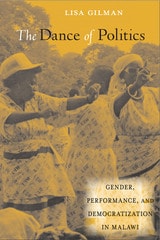
Election campaigns, political events, and national celebration days in Malawi usually feature groups of women who dance and perform songs of praise for politicians and political parties. These lively performances help to attract and energize throngs of prospective voters. However, as Lisa Gilman explains, “praise performing” is one of the only ways that women are allowed to participate in a male-dominated political system.
Although political performances by women are not unique to Malawi, the case in Malawi is complicated by the fact that until 1994 all Malawianwomen were required to perform on behalf of the long-reigning political party and its self-declared “President for Life,” Dr. Hastings Kamuzu Banda+. This is the first book to examine the present-day situation, where issues of gender, economics and politics collide in surprising ways. Along with its solid grounding in the relevant literature, The Dance of Politics draws strength from Gilman’s first-hand observations and her interviews with a range of participants in the political process, from dancers to politicians.
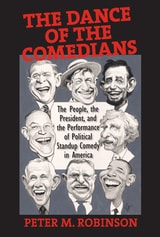
The Dance of the Comedians
The People, the President, and the Performance of Political Standup Comedy in AmericaPeter M. Robinson
University of Massachusetts Press, 2010
Why did Barack Obama court Jon Stewart and trade jokes with Stephen Colbert during the campaign of 2008? Why did Sarah Palin forgo the opportunity to earn votes on the Sunday morning political talk shows but embrace the chance to get laughs on Saturday Night Live? The Dance of the Comedians examines the history behind these questions—the merry, mocking, and highly contested anarchies of standup political comedy that have locked humorists, presidents, and their fellow Americans in an improvisational three-way “dance” since the early years of the American republic.
Peter M. Robinson shows how the performance of political humor developed as a celebration of democracy and an expression of political power, protest, and commercial profit. He places special significance on the middle half of the twentieth century, when presidents and comedians alike—from Calvin Coolidge to Ronald Reagan, from Will Rogers to Saturday Night Live's “Not Ready for Prime Time Players”—developed modern understandings of the power of laughter to affect popular opinion and political agendas, only to find the American audience increasingly willing and able to get in on the act. These years put the long-standing traditions of presidential deference profoundly in play as all three parties to American political humor—the people, the presidents, and the comedy professionals—negotiated their way between reverence for the office of the presidency and ridicule of its occupants.
Although the focus is on humor, The Dance of the Comedians illuminates the process by which Americans have come to recognize that the performance of political comedy has serious and profound consequences for those on all sides of the punch line.
The Dancing Bees
Karl von Frisch and the Discovery of the Honeybee LanguageTania Munz
University of Chicago Press, 2016
The Dancing Bees draws on previously unexplored archival sources in order to reveal von Frisch’s full story, including how the Nazi government in 1940 determined that he was one-quarter Jewish, revoked his teaching privileges, and sought to prevent him from working altogether until circumstances intervened. In the 1940s, bee populations throughout Europe were facing the devastating effects of a plague (just as they are today), and because the bees were essential to the pollination of crops, von Frisch’s research was deemed critical to maintaining the food supply of a nation at war. The bees, as von Frisch put it years later, saved his life. Munz not only explores von Frisch’s complicated career in the Third Reich, she looks closely at the legacy of his work and the later debates about the significance of the bee language and the science of animal communication.
This first in-depth biography of von Frisch paints a complex and nuanced portrait of a scientist at work under Nazi rule. The Dancing Bees will be welcomed by anyone seeking to better understand not only this chapter of the history of science but also the peculiar waggles of our garden visitors.
The Danger of Romance
Truth, Fantasy, and Arthurian FictionsKaren Sullivan
University of Chicago Press, 2018
Yet is it possible that romance is expressing a truth—and a truth unrecognized by realist genres? The Arthurian literature of the Middle Ages, Karen Sullivan argues, consistently ventriloquizes in its pages the criticisms that were being made of romance at the time, and implicitly defends itself against those criticisms. The Danger of Romance shows that the conviction that ordinary reality is the only reality is itself an assumption, and one that can blind those who hold it to the extraordinary phenomena that exist around them. It demonstrates that that which is rare, ephemeral, and inexplicable is no less real than that which is commonplace, long-lasting, and easily accounted for. If romance continues to appeal to audiences today, whether in its Arthurian prototype or in its more recent incarnations, it is because it confirms the perception—or even the hope—of a beauty and truth in the world that realist genres deny.
The Daring Trader
Jacob Smith in the Michigan Territory, 1802-1825Kim Crawford
Michigan State University Press, 2012
A fur trader in the Michigan Territory and confidant of both the U.S. government and local Indian tribes, Jacob Smith could have stepped out of a James Fenimore Cooper novel. Controversial, mysterious, and bold during his lifetime, in death Smith has not, until now, received the attention he deserves as a pivotal figure in Michigan’s American period and the War of 1812. This is the exciting and unlikely story of a man at the frontier’s edge, whose missions during both war and peace laid the groundwork for Michigan to accommodate settlers and farmers moving west. The book investigates Smith’s many pursuits, including his role as an advisor to the Indians, from whom the federal government would gradually gain millions of acres of land, due in large part to Smith’s work as an agent of influence. Crawford paints a colorful portrait of a complicated man during a dynamic period of change in Michigan’s history.
The Dark Abyss of Time
The History of the Earth and the History of Nations from Hooke to VicoPaolo Rossi
University of Chicago Press, 1984
"This book, by a distinguished Italian historian of philosophy, is a worthy successor to the author's important works on Francis Bacon and on technology and the arts. First published in Italian (in 1979), it now makes available to English readers some subtly wrought arguments about the ways in which geology and anthropology challenged biblical chronology and forced changes in the philosophy of history in the early modern era. . . . [Rossi] shows that the search for new answers about human origins spanned many disciplines and involved many fascinating intellects—Bacon, Bayle, Buffon, Burnet, Descartes, Hobbes, Holbach, Hooke, Hume, Hutton, Leibniz, de Maillet, Newton, Pufendorf, Spinoza, Toland, and, most especially, Vico, whose works are impressively and freshly reevaluated here."—Nina Gelbart, American Scientist
The Dark Days of Abraham Lincoln's Widow, as Revealed by Her Own Letters
Myra Helmer Pritchard, edited and annotated by Jason Emerson
Southern Illinois University Press, 2011
Written in 1927 but barred from timely publication by the Lincoln family, The Dark Days of Abraham Lincoln's Widow, as Revealed by Her Own Letters is based on nearly two dozen intimate letters written between Mary Lincoln and her close friend Myra Bradwell mainly during the former's 1875 incarceration in an insane asylum. By the 1920s most accounts of Mrs. Lincoln focused on her negative qualities and dismissed her as "crazy." Bradwell's granddaughter Myra Helmer Pritchard wrote this distinctly sympathetic manuscript at the behest of her mother, who wished to vindicate Mary Lincoln in the public eye by printing the private correspondence. Pritchard fervently defends Mrs. Lincoln's conduct and sanity, arguing that she was not insane but rather the victim of an overzealous son who had his mother committed.
The manuscript and letters were thought to have been destroyed, but fortunately the Lincolns' family lawyer stored copies in a trunk, where historian Jason Emerson discovered them in 2005. While leaving the manuscript intact, Emerson has enhanced it with an introduction and detailed annotations. He fills in factual gaps; provides background on names, places, and dates; and analyzes Pritchard's interpretations, making clear where she was right and where her passion to protect Mrs. Lincoln led to less than meticulous research and incorrect conclusions. This volume features an easy-to-follow format that showcases Pritchard's text on the left-hand pages and Emerson's insightful annotations on the right-hand pages.
Following one of the most revered and reviled, famous and infamous of the First Ladies, this book provides a unique perspective of Mrs. Lincoln's post-White House years, with an emphasis on her commitment to a sanitarium. Emerson's contributions make this volume a valuable addition to the study of the Lincoln family. This fascinating work gives today's Lincoln enthusiasts the chance to read this intriguing interpretation of the former First Lady that predates nearly every other book written about her.
The Dark Tree
Jazz and the Community Arts in Los AngelesSteven L. Isoardi
Duke University Press, 2023
The Darkened Room
Women, Power, and Spiritualism in Late Victorian EnglandAlex Owen
University of Chicago Press, 2004
The hugely popular spiritualist movement, which maintained that women were uniquely qualified to commune with spirits of the dead, offered female mediums a new independence, authority, and potential to undermine conventional class and gender relations in the home and in society.
Using previously unexamined sources and an innovative approach, Alex Owen invokes the Victorian world of darkened séance rooms, theatrical apparitions, and moving episodes of happiness lost and regained. She charts the struggles between spiritualists and the medical and legal establishments over the issue of female mediumship, and provides new insights into the gendered dynamics of Victorian society.
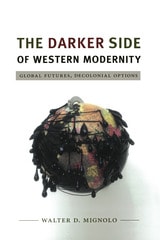
The Darker Side of Western Modernity
Global Futures, Decolonial OptionsWalter D. Mignolo
Duke University Press, 2011
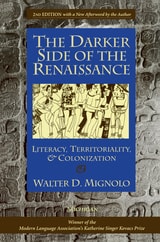
The Darker Side of the Renaissance
Literacy, Territoriality, & Colonization, 2nd EditionWalter D. Mignolo
University of Michigan Press, 2003
Walter D. Mignolo is Professor in the Department of Romance Studies and the Program in Literature, Duke University.
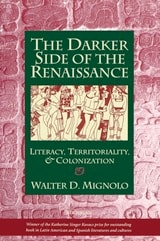
The Darker Side of the Renaissance
Literacy, Territoriality, and ColonizationWalter D. Mignolo
University of Michigan Press, 1995
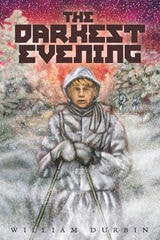
The Darkest Evening
William Durbin
University of Minnesota Press, 2011
Instead of finding the utopia they were promised, Jake and his family encounter only disappointment and hardship. When Stalin’s secret police begin targeting Americans for arrest, his worst fears are confirmed, and Jake leads his family on a daring midwinter escape attempt on cross-country skis, fleeing toward the Finnish border.
The Darwinian Revolution
Science Red in Tooth and ClawMichael Ruse
University of Chicago Press, 1999
For this edition Michael Ruse has written a new afterword that takes into account the research published since his book's first appearance.
"It is difficult to believe that yet another book on Darwin and the Darwinian Revolution could add anything new or contain any surprises. Ruse's book is an exception on all counts. Darwin scholars and the general reader alike can learn from it."—David L. Hull, Nature
"No other account of the Darwinian Revolution provides so detailed and sympathetic an account of the framework within which the scientific debates took place."—Peter J. Bowler, Canadian Journal of History
"A useful and highly readable synthesis. . .skillfully organized and written with verve, imagination, and welcome touches of humor."—John C. Greene, Science
The Daughter's Dilemma
Family Process and the Nineteenth-Century Domestic NovelPaula Marantz Cohen
University of Michigan Press, 1993
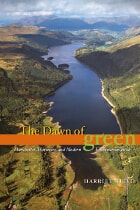
The Dawn of Green
Manchester, Thirlmere, and Modern EnvironmentalismHarriet Ritvo
University of Chicago Press, 2009
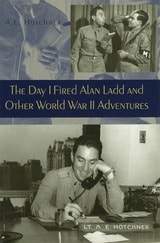
The Day I Fired Alan Ladd and Other World War II Adventures
A. E. Hotchner
University of Missouri Press, 2002
"To perform heroically in a perilous situation is one thing, but I found that, in my case, the real difficulty was in getting myself into a spot where heroism was possible. Nobody on latrine duty ever got the Medal of Honor."
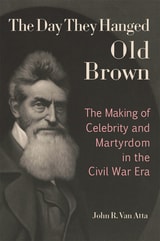
The Day They Hanged Old Brown
The Making of Celebrity and Martyrdom in the Civil War EraJohn R. Van Atta
University of Missouri Press, 2025
Brown’s lifespan covered most of the period between the Revolution and the Civil War, a time of the still-early beginnings of the United States. Only then had his kind of “celebrity” started to matter. From different economic and moral perspectives, politically aware Americans clashed over different visions for the future of the country. At that time, any disruptive figure might be taken as a barometer of the progress or the decline of the republic. A function of the widely varying newspapers and magazines of that day, celebrity offered Americans an angle of vision, happily or not, as to who they were or were becoming or believed themselves to be—as if by a mirror reflection.
In The Day They Hanged Old Brown, John Van Atta examines the creation of celebrity in John Brown’s time and how it differed from modern day perceptions. Yet, as applicable as the concept of celebrity is in this case, the story of Brown’s notoriety represents far more. To his admirers, Brown was not merely a celebrity; he was a hero and, after his sacrificial death, a martyr. Not all celebrities rise to such levels. This book traces the meaning of heroism and martyrdom—as well as the opposite side of that coin, villainy—and suggests that John Brown’s story and legacy helped to redefine these concepts for many Americans during the era of the Civil War, before modern historians began to deliberate him.
The Day is Ours!
An Inside View of the Battles of Trenton and Princeton, November 1776-January 1777Dwyer, William M
Rutgers University Press, 1998
The Day of the Cattleman
Ernest Staples Osgood
University of Minnesota Press, 1929
The Day of the Cattleman was first published in 1929. Minnesota Archive Editions uses digital technology to make long-unavailable books once again accessible, and are published unaltered from the original University of Minnesota Press editions.
The legend of the Wild West, as celebrated in thousands upon thousands of western stories and movies, radio and television programs, has a firm grip on the imaginations of both young and old, not only in America but in many other lands. But, popular though such versions are, they do not tell how the west was really won. Professor Osgood's account sets the record straight for those who want authentic history rather than melodramatic fiction.
"The range cattleman," Professor Osgood writes, "has more solid achievements to his credit than the creation of a legend. He was the first to utilize the semi-arid plains. Using the most available natural resources, the native grasses, as a basis, he built up a great and lucrative enterprise, attracted eastern and foreign capital to aid him in the development of a new economic area, stimulated railroad building in order that the product of the ranges might get to an eastern market, and laid the economic foundation of more than one western commonwealth."
Professor Osgood traces the rise and fall of the range cattle industry, particularly in Montana and Wyoming, from 1845 to the turn of the century. He gives a detailed account of the activities of the stock growers' associations and of the cattlemen's relations with the railroads and with the Federal government.
The book has won critical acclaim both in this country and abroad. The Saturday Review has described it as an "honest, scientific, and thorough examination" of a "semi-epic phase of Western life, now almost completely dead." In England, the Times Literary Supplement called it "the only substantial record of this particular chapter in the history of the West."
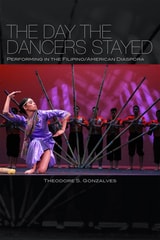
The Day the Dancers Stayed
Performing in the Filipino/American DiasporaTheodore S. Gonzalves
Temple University Press, 2009
Pilipino Cultural Nights at American campuses have been a rite of passage for youth culture and a source of local community pride since the 1980s. Through performances—and parodies of them—these celebrations of national identity through music, dance, and theatrical narratives reemphasize what it means to be Filipino American. In The Day the Dancers Stayed, scholar and performer Theodore Gonzalves uses interviews and participant observer techniques to consider the relationship between the invention of performance repertoire and the development of diasporic identification.
Gonzalves traces a genealogy of performance repertoire from the 1930s to the present. Culture nights serve several functions: as exercises in nostalgia, celebrations of rigid community entertainment, and occasionally forums for political intervention. Taking up more recent parodies of Pilipino Cultural Nights, Gonzalves discusses how the rebellious spirit that enlivened the original seditious performances has been stifled.

The De Soto Chronicles Vol 1
The Expedition of Hernando de Soto to North America in 1539-1543Edited by Lawrence A. Clayton, Vernon James Knight Jr., and Edward C. Moore
University of Alabama Press, 2022
1993 CHOICE OUTSTANDING ACADEMIC BOOK, SPONSORED BY CHOICE MAGAZINE
Unearthing the documents that shaped our earliest understanding of a continent.
The De Soto expedition was the first major encounter of Europeans with indigenous North Americans in the eastern half of the United States. De Soto and his army of over 600 men, including 200 cavalry, spent four years traveling through what is now Florida, Georgia, Alabama, North and South Carolina, Tennessee, Mississippi, Louisiana, Arkansas, and Texas. The De Soto Chronicles Volume 1 and Volume 2 present for the first time all four primary accounts of the De Soto expedition together in English translation.
The four primary accounts are generally referred to as Elvas, Rangel, Biedma (in Volume 1), and Garcilaso, or the Inca (in Volume 2). In this landmark 1993 publication, Clayton’s team presents the four accounts with literary and historical introductions. They further add brief essays about De Soto and the expedition, translations of De Soto documents from the Spanish Archivo General de Indias, two short biographies of De Soto, and bibliographical studies.
For anthropologists, archaeologists, and historians, The De Soto Chronicles are valued for the unique ethnological information they contain. They form the only detailed eyewitness records of the most advanced native civilization in North America—the Mississippian culture—a culture largely lost in the wake of European contact.
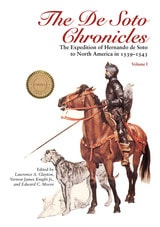
The De Soto Chronicles Vol 1
The Expedition of Hernando de Soto to North America in 1539-1543Lawrence A. Clayton
University of Alabama Press, 1993
1993 CHOICE OUTSTANDING ACADEMIC BOOK, SPONSORED BY CHOICE MAGAZINE
Unearthing the documents that shaped our earliest understanding of a continent.
The De Soto expedition was the first major encounter of Europeans with indigenous North Americans in the eastern half of the United States. De Soto and his army of over 600 men, including 200 cavalry, spent four years traveling through what is now Florida, Georgia, Alabama, North and South Carolina, Tennessee, Mississippi, Louisiana, Arkansas, and Texas. The De Soto Chronicles Volume 1 and Volume 2 present for the first time all four primary accounts of the De Soto expedition together in English translation.
The four primary accounts are generally referred to as Elvas, Rangel, Biedma (in Volume 1), and Garcilaso, or the Inca (in Volume 2). In this landmark 1993 publication, Clayton’s team presents the four accounts with literary and historical introductions. They further add brief essays about De Soto and the expedition, translations of De Soto documents from the Spanish Archivo General de Indias, two short biographies of De Soto, and bibliographical studies.
For anthropologists, archaeologists, and historians, The De Soto Chronicles are valued for the unique ethnological information they contain. They form the only detailed eyewitness records of the most advanced native civilization in North America—the Mississippian culture—a culture largely lost in the wake of European contact.
The De Soto Chronicles Vol 2
The Expedition of Hernando de Soto to North America in 1539-1543Edited by Lawrence A. Clayton, Vernon James Knight Jr., and Edward C. Moore
University of Alabama Press, 2022
A critical expansion of the documentary record of the de Soto expedition.
The De Soto expedition was the first major encounter of Europeans with indigenous North Americans in the eastern half of the United States. De Soto and his army of over 600 men, including 200 cavalry, spent four years traveling through what is now Florida, Georgia, Alabama, North and South Carolina, Tennessee, Mississippi, Louisiana, Arkansas, and Texas. The De Soto Chronicles Volume 1 and Volume 2 present for the first time all four primary accounts of the De Soto expedition together in English translation.
The four primary accounts are generally referred to as Elvas, Rangel, Biedma (in Volume 1), and Garcilaso, or the Inca (in Volume 2). In this landmark 1993 publication, Clayton’s team presents the four accounts with literary and historical introductions. They further add brief essays about De Soto and the expedition, translations of De Soto documents from the Spanish Archivo General de Indias, two short biographies of De Soto, and bibliographical studies.
For anthropologists, archaeologists, and historians, The De Soto Chronicles are valued for the unique ethnological information they contain. They form the only detailed eyewitness records of the most advanced native civilization in North America—the Mississippian culture—a culture largely lost in the wake of European contact.
The De Soto Chronicles Vol 2
The Expedition of Hernando de Soto to North America in 1539-1543Edited by Lawrence A. Clayton, Vernon James Knight Jr., and Edward C. Moore
University of Alabama Press, 1993
A critical expansion of the documentary record of the de Soto expedition.
The De Soto expedition was the first major encounter of Europeans with indigenous North Americans in the eastern half of the United States. De Soto and his army of over 600 men, including 200 cavalry, spent four years traveling through what is now Florida, Georgia, Alabama, North and South Carolina, Tennessee, Mississippi, Louisiana, Arkansas, and Texas. The De Soto Chronicles Volume 1 and Volume 2 present for the first time all four primary accounts of the De Soto expedition together in English translation.
The four primary accounts are generally referred to as Elvas, Rangel, Biedma (in Volume 1), and Garcilaso, or the Inca (in Volume 2). In this landmark 1993 publication, Clayton’s team presents the four accounts with literary and historical introductions. They further add brief essays about De Soto and the expedition, translations of De Soto documents from the Spanish Archivo General de Indias, two short biographies of De Soto, and bibliographical studies.
For anthropologists, archaeologists, and historians, The De Soto Chronicles are valued for the unique ethnological information they contain. They form the only detailed eyewitness records of the most advanced native civilization in North America—the Mississippian culture—a culture largely lost in the wake of European contact.
The De Soto Chronicles, 2 Volume Set
The Expedition of Hernando de Soto to North America in 1539-1543Edited by Lawrence A. Clayton, Vernon James Knight Jr., and Edward C. Moore
University of Alabama Press, 1995
1993 CHOICE OUTSTANDING ACADEMIC BOOK, SPONSORED BY CHOICE MAGAZINE
Unearthing the documents that shaped our earliest understanding of a continent.
The De Soto expedition was the first major encounter of Europeans with indigenous North Americans in the eastern half of the United States. De Soto and his army of over 600 men, including 200 cavalry, spent four years traveling through what is now Florida, Georgia, Alabama, North and South Carolina, Tennessee, Mississippi, Louisiana, Arkansas, and Texas. The De Soto Chronicles Volume 1 and Volume 2 present for the first time all four primary accounts of the De Soto expedition together in English translation.
The four primary accounts are generally referred to as Elvas, Rangel, Biedma (in Volume 1), and Garcilaso, or the Inca (in Volume 2). In this landmark 1993 publication, Clayton’s team presents the four accounts with literary and historical introductions. They further add brief essays about De Soto and the expedition, translations of De Soto documents from the Spanish Archivo General de Indias, two short biographies of De Soto, and bibliographical studies.
For anthropologists, archaeologists, and historians, The De Soto Chronicles are valued for the unique ethnological information they contain. They form the only detailed eyewitness records of the most advanced native civilization in North America—the Mississippian culture—a culture largely lost in the wake of European contact.
The De-Definition of Art
Harold Rosenberg
University of Chicago Press, 1983
The Dead End Kids of St. Louis
Homeless Boys and the People Who Tried to Save ThemBonnie Stepenoff
University of Missouri Press, 2021
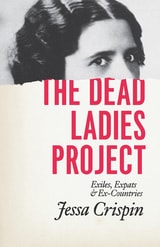
The Dead Ladies Project
Exiles, Expats, and Ex-CountriesJessa Crispin
University of Chicago Press, 2015
The Dead Ladies Project is an account of that journey—but it’s also much, much more. Fascinated by exile, Crispin travels an itinerary of key locations in its literary map, of places that have drawn writers who needed to break free from their origins and start afresh. As she reflects on William James struggling through despair in Berlin, Nora Barnacle dependant on and dependable for James Joyce in Trieste, Maud Gonne fomenting revolution and fostering myth in Dublin, or Igor Stravinsky starting over from nothing in Switzerland, Crispin interweaves biography, incisive literary analysis, and personal experience into a rich meditation on the complicated interactions of place, personality, and society that can make escape and reinvention such an attractive, even intoxicating proposition.
Personal and profane, funny and fervent, The Dead Ladies Project ranges from the nineteenth century to the present, from historical figures to brand-new hangovers, in search, ultimately, of an answer to a bedrock question: How does a person decide how to live their life?

The Dead Sea Scrolls in Scholarly Perspective
A History of ResearchDevorah Dimant
SBL Press, 2016
Now in paperback!
The volume covers Qumran scholarship in separate countries: the USA, Canada, Israel, France, Germany, Spain, the Netherlands, Scandinavia, Italy, and Eastern Europe. Each essay carries a detailed bibliography for the respective country. Biographies of all the major scholars active in the field are briefly given as well. This book thereby exhaustively surveys past and present Qumran research, outlining its particular development in various circumstances and national contexts. For the first time, perspectives and information not recorded in any other publication are highlighted.
Features: