Results by title
3745 books match the query 'Europe' and 973 start with t
The Compensations of Plunder
How China Lost Its TreasuresJustin M. Jacobs
University of Chicago Press, 2020
The Complete Works of Liudprand of Cremona (Medieval Texts in Translation)
Paolo Liudprand of Cremona
Catholic University of America Press, 2007

The Confederate Navy in Europe
Warren F. Spencer
University of Alabama Press, 1983
“A major contribution to Civil War and naval history.” —Journal of Southern History
The Civil War was fought not only on American battlefields but also in the shipyards, diplomatic salons, and ports of Europe. In this sweeping history of the Confederate navy’s operations overseas, Warren Spencer traces the South’s ambitious efforts to build, equip, and deploy a naval force across the Atlantic. Drawing on extensive archival research in the United States, Great Britain, and France, the book reveals how Confederate agents, diplomats, and naval officers pursued international support while attempting to challenge Union power on the seas.
More than a military narrative, this study offers a richly detailed examination of the intersection of naval warfare, diplomacy, and international politics. The author synthesizes scattered research and original documentary evidence to provide a comprehensive account of Confederate naval activity in Europe, illuminating the roles of shipbuilders, foreign governments, intelligence networks, and naval leaders. By engaging both published sources and archival records, the book presents fresh interpretations of controversial episodes and demonstrates how events far from American shores shaped the course of the Civil War.
This volume will appeal to readers of Civil War history, naval history, diplomatic history, and international relations. Scholars, students, and history enthusiasts alike will appreciate its careful research, engaging narrative, and global perspective on a conflict too often viewed solely through a domestic lens. Anyone interested in the maritime dimensions of the Civil War or the Confederacy’s quest for recognition abroad will find this book both enlightening and compelling.
The Conquest of Ruins
The Third Reich and the Fall of RomeJulia Hell
University of Chicago Press, 2019
Hell examines centuries of European empire-building—from Charles V in the sixteenth century and Napoleon’s campaigns of the late seventeenth and early eighteenth centuries to the atrocities of Mussolini and the Third Reich in the 1930s and ’40s—and sees a similar fascination with recreating the Roman past in the contemporary image. In every case—particularly that of the Nazi regime—the ruins of Rome seem to represent a mystery to be solved: how could an empire so powerful be brought so low? Hell argues that this fascination with the ruins of greatness expresses a need on the part of would-be conquerors to find something to ward off a similar demise for their particular empire.

The Constitutional Jurisprudence of the Federal Republic of Germany
Third edition, Revised and ExpandedDonald P. Kommers and Russell A. Miller
Duke University Press, 2012
Compared to previous editions of The Constitutional Jurisprudence of the Federal Republic of Germany, this third edition more closely tracks Germany's Basic Law and, therefore, the systematic approach reflected in the most-respected German constitutional law commentaries. Entirely new chapters address the relationship between German law and European and international law; social and economic rights, including the property and occupational rights cases that have emerged from Reunification; jurisprudence related to issues of equality, particularly gender equality; and the tension between Germany's counterterrorism efforts and its constitutional guarantees of liberty. Kommers and Miller have also updated existing chapters to address recent decisions involving human rights, federalism, European integration, and religious liberty.

The Construction of Gothic Cathedrals
A Study of Medieval Vault ErectionJohn Fitchen
University of Chicago Press, 1981
In The Construction of Gothic Cathedrals, John Fitchen systematically walks readers through the process of erecting the great edifices of the Gothic era. He explains the building equipment and falsework needed, the actual operations undertaken, and the sequence of these operations as specifically as they can be deduced today. In the absence of contemporary accounts of the techniques used by medieval builders, Fitchen's study brilliantly pieces together clues from manuscript illuminations, pictorial representations, and the fabrics of the building themselves. The result is the clearest picture available of the innovations and techniques that enabled these buildings, which still generate awe today, to rise majestically above the low buildings of their surrounding towns. It's a book that will enthrall readers of history, and one that, as Progressive Architecture noted, "no student of architecture should miss."

The Construction of Memory in Interwar France
Daniel J. Sherman
University of Chicago Press, 2000
Sherman shows how a wartime visual culture saturated with images of ordinary foot soldiers, together with contemporary novels, memoirs, and tourist literature, promoted a distinctive notion of combat experience. The contrast between battlefield and home front, soldier and civilian was the basis for memory and collective gratitude. Postwar commemoration, however, also grew directly out of the long and agonized search for the remains of hundreds of thousands of missing soldiers, and the sometimes contentious debates over where to bury them. For this reason, the local monument, with its inscribed list of names and its functional resemblance to tombstones, emerged as the focal point of commemorative practice. Sherman traces every step in the process of monument building as he analyzes commemoration's competing goals—to pay tribute to the dead, to console the bereaved, and to incorporate mourners' individual memories into a larger political discourse.
Extensively illustrated, Sherman's study offers a visual record of a remarkable moment in the history of public art. It is at once a moving account of a culture haunted by war and a sophisticated analysis of the political stakes of memory in the twentieth century.
Winner of the 2000 J. Russell Major Prize of the American Historical Association
The Contemporary Medieval in Practice
Claire A. Lees and Gillian R. Overing
University College London, 2019
Speculative and nontraditional, The Contemporary Medieval in Practice adapts the conventional scholarly essay to reflect its interdisciplinary subject. Creative critical writing encourages the introduction of dialogue, poetry, and short essays within scholarly style, and this, the authors argue, makes it an ideal format for exploring innovative pathways from the contemporary to the medieval. Discussing urgent critical discourses and cultural practices, such as the study of the environment and the ethics of understanding bodies, identities, and histories, this short, accessible book focuses on early medieval British culture, or Anglo-Saxon studies, and its relation with, use of, and reworking in contemporary visual, poetic, and material culture after 1950.
The Contest for Knowledge
Debates over Women's Learning in Eighteenth-Century ItalyMaria Gaetana Agnesi, Diamante Medaglia Faini, Aretafila Savini de' Rossi, and the Accademia de' Ricovrati
University of Chicago Press, 2005
The Contest for Knowledge reveals how these four women used the methods and themes of their male counterparts to add their voices to the vigorous and prolific debate over the education of women during the eighteenth century. In the texts gathered here, the women discuss the issues they themselves thought most urgent for the equality of women in Italian society specifically and in European culture more broadly. Their thoughts on this important subject reveal how crucial the eighteenth century was in the long history of debates about women in the academy.
The Control of the Past
Herbert Butterfield and the Pitfalls of Official HistoryPatrick Salmon
University of London Press, 2021
In 1949, English historian Herbert Butterfield published “Official History: Its Pitfalls and Its Criteria,” a now-famous diatribe against the practice of publishing official history. Butterfield was one of the earliest and strongest critics of what he saw as the British government’s attempts to control the past through the writing of history. But why was Butterfield so hostile to state-sanctioned history, and why do his views still matter today?
This important new book details how successive governments have applied a selective approach to the past in order to tell or retell Britain’s national history. Providing a unique overview of the main trends of official history in Britain since World War II, the book details how Butterfield came to suspect that the British government was trying to suppress vital documents revealing the Duke of Windsor’s dealings with Nazi Germany. This seemed to confirm his long-held belief that all governments would seek to manipulate history if they could and conceal the truth if they could not.
At the beginning of the twenty-first century, official history is still being written. The Control of the Past concludes with an insider’s perspective on the many issues it faces today—on freedom of information, social media, and reengaging with our nation’s colonial legacy. Governments have recently been given many reminders that history matters, and Butterfield’s work reminds us that we must remain vigilant in monitoring how they respond to the challenge.
The Controversy of Renaissance Art
Alexander Nagel
University of Chicago Press, 2011
Many studies have shown that images—their presence in the daily lives of the faithful, the means used to control them, and their adaptation to secular uses—were at the heart of the Reformation crisis in northern Europe. But the question as it affects the art of Italy has been raised only in highly specialized studies.
In this book, Alexander Nagel provides the first truly synthetic study of the controversies over religious images that pervaded Italian life both before and parallel to the Reformation north of the Alps. Tracing the intertwined relationship of artistic innovation and archaism, as well as the new pressures placed on the artistic media in the midst of key developments in religious iconography, The Controversy of Renaissance Art offers an important and original history of humanist thought and artistic experimentation from one of our most acclaimed historians of art.
The Convolutions of Historical Politics
Alexei Miller
Central European University Press, 2012
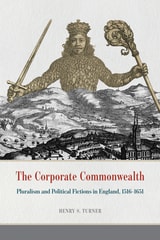
The Corporate Commonwealth
Pluralism and Political Fictions in England, 1516-1651Henry S. Turner
University of Chicago Press, 2016
Henry S. Turner uses the resources of economic and political history, literary analysis, and political philosophy to demonstrate how a number of English institutions with corporate associations—including universities, guilds, towns and cities, and religious groups—were gradually narrowed to the commercial, for-profit corporation we know today, and how the joint-stock corporation, in turn, became both a template for the modern state and a political force that the state could no longer contain. Through innovative readings of works by Thomas More, William Shakespeare, Francis Bacon, and Thomas Hobbes, among others, Turner tracks the corporation from the courts to the stage, from commonwealth to colony, and from the object of utopian fiction to the subject of tragic violence. A provocative look at the corporation’s peculiar character as both an institution and a person, The Corporate Commonwealth uses the past to suggest ways in which today’s corporations might be refashioned into a source of progressive and collective public action.

The Corporation That Changed the World
How the East India Company Shaped the Modern MultinationalNick Robins
Pluto Press, 2012
"Elegantly written and sharply argued, Nick Robins' gripping account of the rise and fall of the English East India Company brings to life a crucial episode in the history of globalization."—Sankar Muthu, University of Chicago
The English East India Company was the mother of the modern multinational. Its trading empire encircled the globe, importing Asian luxuries such as spices, textiles, and teas. But it also conquered much of India with its private army and broke open China's markets with opium. The Company's practices shocked its contemporaries and still reverberate today, offering lessons about unfettered capitalism, corporate responsibility, and the legacy of colonialism.
The Corporation That Changed the World is the first book to reveal the Company's enduring legacy as a corporation. This expanded edition explores how the four forces of scale, technology, finance, and regulation drove its spectacular rise and fall. For decades, the Company was simply too big to fail, and stock market bubbles, famines, drug-running, and even duels between rival executives are to be found in this new account.
Table of Contents:
Introduction
Chronology
1 The Hidden Wound
2 The Imperious Company
3 Out of the Shadows
4 The Bengal Revolution
5 The Great East Indian Crash
6 Regulating the Company
7 Justice Will Be Done
8 The Toxic Exchange
10 The Unfettered Business
Epilogue
For Robins, the Company's story provides vital lessons on both the role of corporations in world history and the steps required to make global business accountable today.
The Correspondence of Johann Amerbach
Early Printing in its Social ContextSelected, Translated, Edited, and with Commentary by Barbara C. Halporn
University of Michigan Press, 2000
Between 1478 and 1513 Amerbach published more than a hundred substantial works. He is best known for his monumental editions of the works of early church fathers. Crucial to his success was the information network he kept through correspondence with scholars, teachers, printers, booksellers, library curators, and other members of the literate community. The letters reveal how books were made, by whom, and for whom. The Correspondence of Johann Amerbach allows us to see the tensions in the new alliance between commerce and the republic of letters. Filling out the scene more fully, letters between the Amerbach children and their parents tell of the daily life, expectations, and aspirations of an intellectual bourgeois family at the end of the fifteenth century.
Barbara C. Halporn is Head of the Collection Development Department, Widener Library, Harvard University.
The Correspondence of John Carroll and Charles Plowden, 1779-1816
Thomas W. Jodziewicz
Catholic University of America Press, 2025
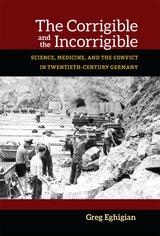
The Corrigible and the Incorrigible
Science, Medicine, and the Convict in Twentieth-Century GermanyGreg Eghigian
University of Michigan Press, 2015
The Court Midwife
Justine Siegemund
University of Chicago Press, 2005
The Courtiers' Anatomists
Animals and Humans in Louis XIV's ParisAnita Guerrini
University of Chicago Press, 2015
Through the stories of Duverney and Perrault, as well as those of Marin Cureau de la Chambre, Jean Pecquet, and Louis Gayant, The Courtiers' Anatomists explores the relationships between empiricism and theory, human and animal, as well as the origins of the natural history museum and the relationship between science and other cultural activities, including art, music, and literature.
The Creation of an Ethnic Identity
Being Swedish American in the Augustana Synod, 1860-1917Dag Blanck
Southern Illinois University Press, 2006
Analyzing the development of a Swedish American identity
The Creation of an Ethnic Identity: Being Swedish American in the Augustana Synod, 1860–1917 analyzes how Swedish American identity was constructed, maintained, and changed in the late nineteenth and early twentieth centuries. The Augustana Synod, the largest religious-based organization created by Swedish immigrants in the United States, played an important role in establishing what it meant to be Swedish American.
In this study, author Dag Blanck poses three fundamental questions: How did an ethnic identity develop in the Augustana Synod? What was that identity? Why was an ethnic identity formed? Based on primary sources formerly unknown or neglected, The Creation of an Ethnic Identity examines the Lutheran Augustana Synod, Augustana College, and the Augustana Book Concern to provide insights into how ethnic identity is constructed within a major religious body, a central educational institution, and a major publishing house.
Starting from the concept of ethnicity as something created or invented, Blanck goes on to explore how it was possible for a white European immigrant group like the Swedes to use its ethnicity as a tool of integration into American society. The nature of their ethnicity, says Blanck, was both determined by their cultural origins and also the values and nature of American society as they perceived it. Becoming Swedish American was also a way of becoming American.
The volume, which is augmented by illustrations, integrates the most critical scholarship on immigration and ethnicity over the past half century and provides a strong argument about how ethnicity is shaped over time within an immigrant group.

The Creature in the Map
A Journey to El DoradoCharles Nicholl
University of Chicago Press, 1997
"Walter Raleigh . . . was one of those Elizabethan all-rounders who still seem staggeringly larger than life. . . . Mr. Nicholl's cogent reconstruction of the journey uses Raleigh's own account, 'The Discoverie of Guiana'—part truth, part advertising, part rhapsody—and much well-found ancillary material."—Anthony Bailey, New York Times
"Like The Reckoning, his brilliant account of the murder of Christopher Marlowe, Nicholl's new book might be called an exercise in historical conjuring. The Creature in the Map is an effort not only to analyse but also to call into presence the lived experience of the voyage Raleigh undertook in 1595 to the Orinoco Delta in what is now Venezuela."—Stephen Greenblatt, Times Literary Supplement
"Charles Nicholl belongs to an elite company, that of historians who know how to make research into arcane matters and distant times as engrossing as In Cold Blood or All the President's Men."—Michael Dirda, Washington Post
The Crisis of German Ideology
Intellectual Origins of the Third ReichGeorge L. Mosse
University of Wisconsin Press, 2021
George L. Mosse (1918–99) was a legendary scholar, teacher, and mentor. A refugee from Nazi Germany, in 1955 he joined the Department of History at the University of Wisconsin–Madison, where he was both influential and popular. Mosse was an early leader in the study of modern European cultural and intellectual history, fascism, and the history of sexuality and masculinity. Over his career he authored more than two dozen books.

The Crisis of Socialism in Europe
Christiane Lemke and Gary Marks, eds.
Duke University Press, 1991
The collection begins with an historical overview of socialism in Western Europe and moves toward the suggestion of a framework for a post-socialist discourse. Among the topics covered are: the birth and death of communism and a regime type in Eastern Europe; how different forms of national communism were smothered by Sovietization in the postwar period; the origins of revolutions in Eastern Europe; the potential for social democracy in Hungary; the role of the Left in a reunified German; and directions for the Left in general.
Contributors. Geoff Eley, Konrad Jarausch, Herbert Kitschelt, Christiane Lemke, Andrei Markovits, Gary Marks, Wolfgang Merkel, Norman Naimark, Iván and Szonja Szelénya, Sharon Wolchik
The Croatian Diaspora in Argentina
From Martyrs to Memory GuardiansNikolina Zidek
Central European University Press, 2026
Drawing on archival research and oral testimonies, Nikolina .idek explores how intergenerational memory shaped identity across time. She shows how the community preserved its origins while adapting to new realities, ultimately transforming into “planetary Croats” who use social media and transnational networks to connect with Croatia and the global diaspora.
The Crooked Stick
A History of the LongbowHugh D. H. Soar
Westholme Publishing, 2004
The Complete Story of a Legendary Weapon
"Spendidly enthusiastic. . . . Soar's book is indispensable."—Bernard Cornwell
"A fascinating study of a forgotten weapon. . . . For centuries the longbow dominated battle, affecting the fates of nations" —Wall Street Journal
"Bowyers, bowhunters, target archers and students of archery history should all find cause for celebration with Hugh Soar's concise but authoritative text." —Traditional BowhunterOn a clear July morning in 1346, a small force approached the walls of Caen for battle. The attackers rode to the field on horseback, banners and pennants fluttering in the light breeze. Behind them marched bowmen in tightly ranked units. At the sound of a crisp battle horn, they halted. A twinge of apprehension rippled through the thousands of Norman defenders as they looked down at the opposing army, for precision archery formation had long since disappeared as a military concept in medieval France. Here was not the expected rabble of unrated bucolics cowed by the might of France; confronting them was a quietly determined group of trained soldiers armed not with the familiar arbalest but with a new and strange weapon of great length. The defenders of Caen were about to meet the English war bow and its deadly battle shaft. For the next 100 years, this weapon, the "crooked stick," would command continental battlefields, etching its fearsome reputation at Crécy, Poitiers, Agincourt, and Verneuil, while establishing England as an international power for the first time.
Although the longbow is best known for its deployment during the Hundred Years' War, its origins lie with ancient Saxon seafighters and Welsh craftsmen, while today the bow is a vibrant part of the traditional archery scene. In The Crooked Stick: A History of the Longbow, historian Hugh D. H. Soar pulls together all of these strings, presenting the engaging story of this most charismatic standoff weapon. After a careful consideration of Neolithic bows and arrows, the author describes the bow's use in the medieval hunt and its associated customs. The longbow made its deepest mark in warfare, however, and the author follows the weapon's development and tactical deployment from the hand-bow of William the Conqueror's campaigns to the continental set-piece battles between England and France. Although soldiers reluctantly gave up the longbow for firearms, its recreational use became immensely popular, particularly during the Regency and Victorian periods. In the twentieth century it appeared as if the longbow would disappear into the fog of legend, but a new interest in traditional craft and expertise gained hold, and the pleasure of using this ancient instrument is now firmly part of archery around the world.
Through a remarkable command of manuscript and printed sources and a judicious use of material evidence, including his own important collection of rare longbows, Hugh Soar establishes the deep connections of this bow to England, Scotland, and Wales. Figures in the past like William Wallace, Edward III, and Henry V appear alongside detailed descriptions of bows, strings, arrows, and arrowheads, while the rise of institutions and craftsmen devoted to the longbow are presented to show how knowledge of this weapon was carried forward across the centuries. Today, those in the sport of archery and military historians will find that The Crooked Stick will enhance their own interests in a weapon of legendary status.
In addition to the illustrated text, the book contains appendices detailing the history and design of bracers, tabs and tips, quivers, and arrowheads associated with the longbow.
The Crosses of Auschwitz
Nationalism and Religion in Post-Communist PolandGeneviève Zubrzycki
University of Chicago Press, 2006
In the summer and fall of 1998, ultranationalist Polish Catholics erected hundreds of crosses outside Auschwitz, setting off a fierce debate that pitted Catholics and Jews against one another. While this controversy had ramifications that extended well beyond Poland’s borders, Geneviève Zubrzycki sees it as a particularly crucial moment in the development of post-Communist Poland’s statehood and its changing relationship to Catholicism.
In The Crosses of Auschwitz, Zubrzycki skillfully demonstrates how this episode crystallized latent social conflicts regarding the significance of Catholicism in defining “Polishness” and the role of anti-Semitism in the construction of a new Polish identity. Since the fall of Communism, the binding that has held Polish identity and Catholicism together has begun to erode, creating unease among ultranationalists. Within their construction of Polish identity also exists pride in the Polish people’s long history of suffering. For the ultranationalists, then, the crosses at Auschwitz were not only symbols of their ethno-Catholic vision, but also an attempt to lay claim to what they perceived was a Jewish monopoly over martyrdom.
This gripping account of the emotional and aesthetic aspects of the scene of the crosses at Auschwitz offers profound insights into what Polishness is today and what it may become.
The Cult of Health and Beauty in Germany
A Social History, 1890-1930Michael Hau
University of Chicago Press, 2003
Hau argues that the obsession with personal health and fitness was often rooted in anxieties over professional and economic success, as well as fears that modern industrialized civilization was causing Germany and its people to degenerate. He also examines how different social groups gave different meanings to the same hygienic practices and aesthetic ideals. What results is a penetrating look at class formation in pre-Nazi Germany that will interest historians of Europe and medicine and scholars of culture and gender.

The Cult of the Saints
Its Rise and Function in Latin ChristianityPeter Brown
University of Chicago Press, 1982
"Brown has an international reputation for his fine style, a style he here turns on to illuminate the cult of the saints. Christianity was born without such a cult; it took rise and that rise needs chronicling. Brown has a gift for the memorable phrase and sees what the passersby have often overlooked. An eye-opener on an important but neglected phase of Western development."—The Christian Century
"Brilliantly original and highly sophisticated . . . . [The Cult of the Saints] is based on great learning in several disciplines, and the story is told with an exceptional appreciation for the broad social context. Students of many aspects of medieval culture, especially popular religion, will want to consult this work."—Bennett D. Hill, Library Journal
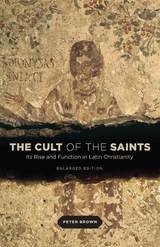
The Cult of the Saints
Its Rise and Function in Latin Christianity, Enlarged EditionPeter Brown
University of Chicago Press, 2014
In this groundbreaking work, Peter Brown explores how the worship of saints and their corporeal remains became central to religious life in Western Europe after the fall of the Roman Empire. During this period, earthly remnants served as a heavenly connection, and their veneration is a fascinating window into the cultural mood of a region in transition.
Brown challenges the long-held “two-tier” idea of religion that separated the religious practices of the sophisticated elites from those of the superstitious masses, instead arguing that the cult of the saints crossed boundaries and played a dynamic part in both the Christian faith and the larger world of late antiquity. He shows how men and women living in harsh and sometimes barbaric times relied upon the holy dead to obtain justice, forgiveness, and power, and how a single sainted hair could inspire great thinkers and great artists.
An essential text by one of the foremost scholars of European history, this expanded edition includes a new preface from Brown, which presents new ideas based on subsequent scholarship.
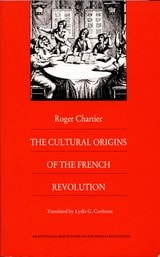
The Cultural Origins of the French Revolution
Roger Chartier
Duke University Press, 1991
Chartier has set himself two important tasks. First, while acknowledging the seminal contribution of Daniel Mornet’s Les origens intellectuelles de la Révolution française (1935), he synthesizes the half-century of scholarship that has created a sociology of culture for Revolutionary France, from education reform through widely circulated printed literature to popular expectations of government and society. Chartier goes beyond Mornet’s work, not be revising that classic text but by raising questions that would not have occurred to its author.
Chartier’s second contribution is to reexamine the conventional wisdom that there is a necessary link between the profound cultural transformation of the eighteenth century (generally characterized as the Enlightenment) and the abrupt Revolutionary rupture of 1789. The Cultural Origins of the French Revolution is a major work by one of the leading scholars in the field and is likely to set the intellectual agenda for future work on the subject.

The Cultural Practice of Immigrant Filmmaking
The Conditions and Practices of Migrant Minor Cinemas in Sweden 1950-1990John Sundholm and Lars Gustaf Andersson
Intellect Books, 2019
Based on a research project funded by the Swedish Research Council, this book examines 40 years of post-war independent immigrant filmmaking in Sweden. John Sundholm and Lars Gustaf Andersson consider the creativity that lies in the state of exile, offering analyses of over 50 rarely seen immigrant films that would otherwise remain invisible and unarchived. They shed light on the complex web of personal, economic, and cultural circumstances that surround migrant filmmaking, discuss associations that became important sites of self-organization for exiled filmmakers, and explore the cultural practice of minor immigrant cinema archiving. The Cultural Practice of Immigrant Filmmaking applies film theory to immigrant filmmaking in a transnational context, exploring how immigrant filmmakers use film to find a place in a new cultural situation.
The Culture and Commerce of Texts
Scribal Publication in Seventeenth-Century EnglandHarold Love
University of Massachusetts Press, 1998
Long after the establishment of printing in England, many writers and composers still preferred to publish their work through handwritten copies. Texts so transmitted included some of the most distinguished poetry and music of the seventeenth century, along with a rich variety of political, scientific, antiquarian, and philosophical writings. While censorship was one reason for this persistence of the older practice, scribal publication remained the norm for texts that were required only in small numbers, or whose authors wished to avoid the “stigma” of print.
This is the first book to consider the trade in manuscripts as an important supplement to that in printed books, and to describe the agencies that met the need for rapid duplication of key texts.
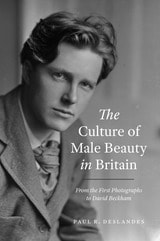
The Culture of Male Beauty in Britain
From the First Photographs to David BeckhamPaul R. Deslandes
University of Chicago Press, 2021
Spanning the decades from the rise of photography to the age of the selfie, this book traces the complex visual and consumer cultures that shaped masculine beauty in Britain, examining the realms of advertising, health, pornography, psychology, sport, and celebrity culture. Paul R. Deslandes chronicles the shifting standards of male beauty in British culture—from the rising cult of the athlete to changing views on hairlessness—while connecting discussions of youth, fitness, and beauty to growing concerns about race, empire, and degeneracy. From earlier beauty show contestants and youth-obsessed artists, the book moves through the decades into considerations of disfigured soldiers, physique models, body-conscious gay men, and celebrities such as David Beckham and David Gandy who populate the worlds of television and social media.
Deslandes calls on historians to take beauty and gendered aesthetics seriously while recasting how we think about the place of physical appearance in historical study, the intersection of different forms of high and popular culture, and what has been at stake for men in “looking good.”
The Culture of Merit
Nobility, Royal Service, and the Making of Absolute Monarchy in France, 1600-1789Jay M. Smith
University of Michigan Press, 1996
Jay M. Smith argues that the early modern nobility instinctively drew a correlation between the meaning of merit and an image of the "sovereign's gaze." In the early seventeenth century, merit meant the qualities traditionally associated with aristocratic values: generosity, fidelity, and honor. Nobles sought to display those qualities before the appreciative gaze of the king himself. But the expansion of the monarchy forced the routinization of the sovereign's gaze, and Louis XIV began to affirm and reward new qualities--talent and application--besides those thought innately noble.
The contradictions implicit within the absolute monarchy's culture of merit are demonstrated by the eighteenth-century French army, which was dominated by the nobility, but also committed to efficiency and expertise. Smith shows that the army's continuous efforts to encourage and reward "merit" led to a clash of principles. The ever-growing emphasis on talent and discipline led reformers--the great majority of them noble--to attack the most egregious examples of privilege and favoritism in the army. Smith's analysis of the long-term evolution in conceptions of royal service suggests a new explanation for the shift in values signified by the French Revolution. The transition away from the "personal" gaze of the king toward the "public" gaze of the monarchy and nation foretold the triumph of a new culture of merit in which noble birth would have no meaning.
The Culture of Merit will interest historians and other social scientists concerned with issues of aristocratic identity, state formation, professionalization, and the changing political culture of pre-Revolutionary France.
Jay M. Smith is Assistant Professor of History, University of North Carolina, Chapel Hill.

The Culture of Property
The Crisis of Liberalism in Modern BritainJordanna Bailkin
University of Chicago Press, 2004
Drawing on court transcripts, gallery archives, exhibition reviews, private correspondence—and a striking series of cartoons and photographs—The Culture of Property traverses the history of gender, material culture, urban life, colonialism, Irish and Scottish nationalism, and British citizenship. This fascinating book challenges recent scholarship in museum studies in light of ongoing culture wars. It should be required reading for cultural policy makers, museum professionals, and anyone interested in the history of art and Britain.
The Culture of San Sepolcro during the Youth of Piero della Francesca
James R. Banker
University of Michigan Press, 2003
Piero della Francesca has remained an enigma because of the contradictions observed in his life and art. Banker's archival research has enabled him to clear away some of the obscurities. This book situates Piero in the earliest social and intellectual worlds within which he moved. Heretofore, writers on Piero have begun his putative formation in Florence in 1439. Banker demonstrates that the young painter's formation began prior to 1439, when he was surrounded by his family and the local artisans' community.
The Culture of San Sepolcro during the Youth of Piero della Francesca integrates social and art history in order to better understand the formation of a Renaissance artist. It will be vital to scholars and historians of the Italian Renaissance city states, as well as to art historians and those interested in the relationship of art and society.
James R. Banker is Professor of History, North Carolina State University.
The Culture of Sensibility
Sex and Society in Eighteenth-Century BritainG. J. Barker-Benfield
University of Chicago Press, 1992
The Culture of Western Europe
The Nineteenth and Twentieth CenturiesGeorge L. Mosse with a critical introduction by Anthony James Steinhoff
University of Wisconsin Press, 2023
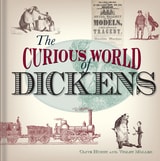
The Curious World of Dickens
Clive Hurst and Violet Moller
Bodleian Library Publishing, 2012
Published to celebrate the twohundredth anniversary of Dickens’s birth, this book brings together quotations from Dickens’s novels and letters with photographs of their original covers and Victorian-era images—among them, prints, posters, and newspaper pieces—that shed light on the topics about which Dickens writes. Ordered by theme, the book covers such topics as schools in Victorian England, domestic entertainment, the introduction of the railroad, and the poor conditions in prisons and workhouses, which loom large in Dickens’s novels—and, indeed, his own childhood. Dickens was also an avid theater enthusiast who arranged productions and public readings of many of his works, and this book explores his role throughout his later years in adroitly adapting his novels for the stage.
The Curious World of Dickens breathes new life on this momentous occasion into the vibrant world inhabited by Dickens and his characters.
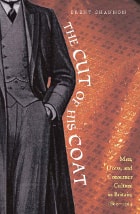
The Cut of His Coat
Men, Dress, and Consumer Culture in Britain, 1860–1914Brent Shannon
Ohio University Press, 2006
The English middle class in the late nineteenth century enjoyed an increase in the availability and variety of material goods. With that, the visual markers of class membership and manly behavior underwent a radical change. In The Cut of His Coat: Men, Dress, and Consumer Culture in Britain, 1860–1914, Brent Shannon examines familiar novels by authors such as George Eliot, Anthony Trollope, Thomas Hughes, and H. G. Wells, as well as previously unexamined etiquette manuals, period advertisements, and fashion monthlies, to trace how new ideologies emerged as mass-produced clothes, sartorial markers, and consumer culture began to change.
While Victorian literature traditionally portrayed women as having sole control of class representations through dress and manners, Shannon argues that middle-class men participated vigorously in fashion. Public displays of their newly acquired mannerisms, hairstyles, clothing, and consumer goods redefined masculinity and class status for the Victorian era and beyond.
The Cut of His Coat probes the Victorian disavowal of men’s interest in fashion and shopping to recover men’s significant role in the representation of class through self-presentation and consumer practices.

The Cybernetic Brain
Sketches of Another FutureAndrew Pickering
University of Chicago Press, 2010
The Cybernetic Brain explores a largely forgotten group of British thinkers, including Grey Walter, Ross Ashby, Gregory Bateson, R. D. Laing, Stafford Beer, and Gordon Pask, and their singular work in a dazzling array of fields. Psychiatry, engineering, management, politics, music, architecture, education, tantric yoga, the Beats, and the sixties counterculture all come into play as Pickering follows the history of cybernetics’ impact on the world, from contemporary robotics and complexity theory to the Chilean economy under Salvador Allende. What underpins this fascinating history, Pickering contends, is a shared but unconventional vision of the world as ultimately unknowable, a place where genuine novelty is always emerging. And thus, Pickering avers, the history of cybernetics provides us with an imaginative model of open-ended experimentation in stark opposition to the modern urge to achieve domination over nature and each other.
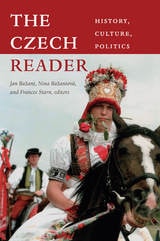
The Czech Reader
History, Culture, PoliticsJan Bazant, Nina Bazantová, and Frances Starn, eds.
Duke University Press, 2010
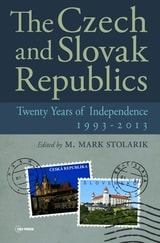
The Czech and Slovak Republics
Twenty years of Independence, 1993–2013M. Mark Stolarik
Central European University Press, 2017

The Dada Cyborg
Visions of the New Human in Weimar BerlinMatthew Biro
University of Minnesota Press, 2009
Finding the cyborg in early twentieth-century German art
In an era when technology, biology, and culture are becoming ever more closely connected, The Dada Cyborg explains how the cyborg as we know it today actually developed between 1918 and 1933 when German artists gave visual form to their utopian hopes and fantasies in a fearful response to World War I.
In what could be termed a prehistory of the posthuman, Matthew Biro shows the ways in which new forms of human existence were imagined in Germany between the two world wars through depictions of cyborgs. Examining the work of Hannah Höch, Raoul Hausmann, George Grosz, John Heartfield, Otto Dix, and Rudolf Schlichter, he reveals an innovative interpretation of the cyborg as a representative of hybrid identity, as well as a locus of new modes of awareness created by the impact of technology on human perception. Tracing the prevalence of cyborgs in German avant-garde art, Biro demonstrates how vision, hearing, touch, and embodiment were beginning to be reconceived during the Weimar Republic. Biro’s unique and interdisciplinary analysis offers a substantially new account of the Berlin Dada movement, one that integrates the group’s poetic, theoretical, and performative practices with its famous visual strategies of photomontage, assemblage, and mixed-media painting to reveal radical images of a “new human.”
The Danger of Romance
Truth, Fantasy, and Arthurian FictionsKaren Sullivan
University of Chicago Press, 2018
Yet is it possible that romance is expressing a truth—and a truth unrecognized by realist genres? The Arthurian literature of the Middle Ages, Karen Sullivan argues, consistently ventriloquizes in its pages the criticisms that were being made of romance at the time, and implicitly defends itself against those criticisms. The Danger of Romance shows that the conviction that ordinary reality is the only reality is itself an assumption, and one that can blind those who hold it to the extraordinary phenomena that exist around them. It demonstrates that that which is rare, ephemeral, and inexplicable is no less real than that which is commonplace, long-lasting, and easily accounted for. If romance continues to appeal to audiences today, whether in its Arthurian prototype or in its more recent incarnations, it is because it confirms the perception—or even the hope—of a beauty and truth in the world that realist genres deny.
The Darkened Room
Women, Power, and Spiritualism in Late Victorian EnglandAlex Owen
University of Chicago Press, 2004
The hugely popular spiritualist movement, which maintained that women were uniquely qualified to commune with spirits of the dead, offered female mediums a new independence, authority, and potential to undermine conventional class and gender relations in the home and in society.
Using previously unexamined sources and an innovative approach, Alex Owen invokes the Victorian world of darkened séance rooms, theatrical apparitions, and moving episodes of happiness lost and regained. She charts the struggles between spiritualists and the medical and legal establishments over the issue of female mediumship, and provides new insights into the gendered dynamics of Victorian society.
The Darker Side of the Renaissance
Literacy, Territoriality, and ColonizationWalter D. Mignolo
University of Michigan Press, 1995

The Dawn of Green
Manchester, Thirlmere, and Modern EnvironmentalismHarriet Ritvo
University of Chicago Press, 2009

The De Soto Chronicles Vol 1
The Expedition of Hernando de Soto to North America in 1539-1543Edited by Lawrence A. Clayton, Vernon James Knight Jr., and Edward C. Moore
University of Alabama Press, 2022
1993 CHOICE OUTSTANDING ACADEMIC BOOK, SPONSORED BY CHOICE MAGAZINE
Unearthing the documents that shaped our earliest understanding of a continent.
The De Soto expedition was the first major encounter of Europeans with indigenous North Americans in the eastern half of the United States. De Soto and his army of over 600 men, including 200 cavalry, spent four years traveling through what is now Florida, Georgia, Alabama, North and South Carolina, Tennessee, Mississippi, Louisiana, Arkansas, and Texas. The De Soto Chronicles Volume 1 and Volume 2 present for the first time all four primary accounts of the De Soto expedition together in English translation.
The four primary accounts are generally referred to as Elvas, Rangel, Biedma (in Volume 1), and Garcilaso, or the Inca (in Volume 2). In this landmark 1993 publication, Clayton’s team presents the four accounts with literary and historical introductions. They further add brief essays about De Soto and the expedition, translations of De Soto documents from the Spanish Archivo General de Indias, two short biographies of De Soto, and bibliographical studies.
For anthropologists, archaeologists, and historians, The De Soto Chronicles are valued for the unique ethnological information they contain. They form the only detailed eyewitness records of the most advanced native civilization in North America—the Mississippian culture—a culture largely lost in the wake of European contact.

The De Soto Chronicles Vol 1
The Expedition of Hernando de Soto to North America in 1539-1543Lawrence A. Clayton
University of Alabama Press, 1993
1993 CHOICE OUTSTANDING ACADEMIC BOOK, SPONSORED BY CHOICE MAGAZINE
Unearthing the documents that shaped our earliest understanding of a continent.
The De Soto expedition was the first major encounter of Europeans with indigenous North Americans in the eastern half of the United States. De Soto and his army of over 600 men, including 200 cavalry, spent four years traveling through what is now Florida, Georgia, Alabama, North and South Carolina, Tennessee, Mississippi, Louisiana, Arkansas, and Texas. The De Soto Chronicles Volume 1 and Volume 2 present for the first time all four primary accounts of the De Soto expedition together in English translation.
The four primary accounts are generally referred to as Elvas, Rangel, Biedma (in Volume 1), and Garcilaso, or the Inca (in Volume 2). In this landmark 1993 publication, Clayton’s team presents the four accounts with literary and historical introductions. They further add brief essays about De Soto and the expedition, translations of De Soto documents from the Spanish Archivo General de Indias, two short biographies of De Soto, and bibliographical studies.
For anthropologists, archaeologists, and historians, The De Soto Chronicles are valued for the unique ethnological information they contain. They form the only detailed eyewitness records of the most advanced native civilization in North America—the Mississippian culture—a culture largely lost in the wake of European contact.