Results by title
1993 books match the query 'Latin America' and 392 start with t
The Invention of the Brazilian Northeast
Durval Muniz de Albuquerque Jr.
Duke University Press, 2014
The Invention of the Colonial Americas
Data, Architecture, and the Archive of the Indies, 1781–1844Byron Ellsworth Hamann
J. Paul Getty Trust, The, 2022
The Invention of the Colonial Americas is an architectural history and media-archaeological study of changing theories and practices of government archives in Enlightenment Spain. It centers on an archive created in Seville for storing Spain’s pre-1760 documents about the New World. To fill this new archive, older archives elsewhere in Spain—spaces in which records about American history were stored together with records about European history—were dismembered. The Archive of the Indies thus constructed a scholarly apparatus that made it easier to imagine the history of the Americas as independent from the history of Europe, and vice versa.
In this meticulously researched book, Byron Ellsworth Hamann explores how building layouts, systems of storage, and the arrangement of documents were designed to foster the creation of new knowledge. He draws on a rich collection of eighteenth-century architectural plans, descriptions, models, document catalogs, and surviving buildings to present a literal, materially precise account of archives as assemblages of spaces, humans, and data—assemblages that were understood circa 1800 as capable of actively generating scholarly innovation.
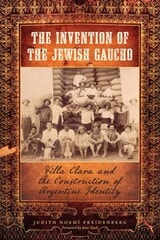
The Invention of the Jewish Gaucho
Villa Clara and the Construction of Argentine IdentityBy Judith Noemí Freidenberg
University of Texas Press, 2009
By the mid-twentieth century, Eastern European Jews had become one of Argentina's largest minorities. Some represented a wave of immigration begun two generations before; many settled in the province of Entre Ríos and founded an agricultural colony. Taking its title from the resulting hybrid of acculturation, The Invention of the Jewish Gaucho examines the lives of these settlers, who represented a merger between native cowboy identities and homeland memories.
The arrival of these immigrants in what would be the village of Villa Clara coincided with the nation's new sense of liberated nationhood. In a meticulous rendition of Villa Clara's social history, Judith Freidenberg interweaves ethnographic and historical information to understand the saga of European immigrants drawn by Argentine open-door policies in the nineteenth century and its impact on the current transformation of immigration into multicultural discourses in the twenty-first century. Using Villa Clara as a case study, Freidenberg demonstrates the broad power of political processes in the construction of ethnic, class, and national identities. The Invention of the Jewish Gaucho draws on life histories, archives, material culture, and performances of heritage to enhance our understanding of a singular population—and to transform our approach to social memory itself.
The Inverted Conquest
The Myth of Modernity and the Transatlantic Onset of ModernismAlejandro Mejias-Lopez
Vanderbilt University Press, 2009
Expanding Bourdieu's concepts of cultural field and symbolic capital beyond national boundaries, The Inverted Conquest shows how modernismo originated in Latin America and traveled to Spain, where it provoked a complete renovation of Spanish letters and contributed to a national identity crisis. In the process, described by Latin American writers as a reversal of colonial relations, modernismo wrested literary and cultural authority away from Spain, moving the cultural center of the Hispanic world to the Americas.
Mejias-Lopez further reveals how Spanish American modernistas confronted the racial supremacist claims and homogenizing force of an Anglo-American modernity that defined the Hispanic as un-modern. Constructing a new Hispanic genealogy, modernistas wrote Spain as the birthplace of modernity and themselves as the true bearers of the modern spirit, moved by the pursuit of knowledge, cosmopolitanism, and cultural miscegenation, rather than technology, consumption, and scientific theories of racial purity.
Bound by the intrinsic limits of neocolonial and postcolonial theories, scholarship has been unwilling or unable to explore modernismo's profound implications for our understanding of Western modernities.
The Japanese in Latin America
Daniel M. Masterson with Sayaka Funada-Classen
University of Illinois Press, 2003
Latin America is home to 1.5 million persons of Japanese descent. Combining detailed scholarship with rich personal histories, Daniel M. Masterson, with the assistance of Sayaka Funada-Classen, presents the first comprehensive study of the patterns of Japanese migration on the continent as a whole.
When the United States and Canada tightened their immigration restrictions in 1907, Japanese contract laborers began to arrive at mines and plantations in Latin America. The authors examine Japanese agricultural colonies in Latin America, as well as the subsequent cultural networks that sprang up within and among them, and the changes that occurred as the Japanese moved from wage labor to ownership of farms and small businesses. They also explore recent economic crises in Brazil, Argentina, and Peru, which, combined with a strong Japanese economy, caused at least a quarter million Latin American Japanese to migrate back to Japan.
Illuminating authoritative research with extensive interviews with migrants and their families, The Japanese in Latin America tells the story of immigrants who maintained strong allegiances to their Japanese roots, even while they struggled to build lives in their new countries.
The Jesuit and the Incas
The Extraordinary Life of Padre Blas Valera, S.J.Sabine Hyland
University of Michigan Press, 2004
This is the tale of Father Blas Valera, the child of a native Incan woman and Spanish father, caught between the ancient world of the Incas and the conquistadors of Spain. Valera, a Jesuit in sixteenth-century Peru, believed in what to his superiors was pure heresy: that the Incan culture, religion, and language were equal to their Christian counterparts.
As punishment for his beliefs he was imprisoned, beaten, and, finally, exiled to Spain, where he died at the hands of English pirates in 1597.
Four centuries later, this Incan chronicler had been all but forgotten, until an Italian anthropologist discovered some startling documents in a private Neapolitan collection. The documents claimed, among other things, that Valera's death had been faked by the Jesuits; that he had returned to Peru; and, intriguingly, while there had taught his followers that the Incas used a secret phonetic quipu-a record-keeping device of the Inca empire-to record history.
Far from settling anything, the documents created an international sensation among scholars and led to bitter disputes over how they should be assessed. Are they forgeries, authentic documents, or something in between? If genuine, they will radically reform our view of Inca culture and Valera. The author insightfully examines the evidence, showing how fact and fiction intertwine, and brings the dimly understood history of this author-priest to light.
The Journey of a Tzotzil-Maya Woman of Chiapas, Mexico
Pass Well over the EarthBy Christine Eber and “Antonia”
University of Texas Press, 2011
Most recent books about Chiapas, Mexico, focus on political conflicts and the indigenous movement for human rights at the macro level. None has explored those conflicts and struggles in-depth through an individual woman's life story. The Journey of a Tzotzil-Maya Woman of Chiapas, Mexico now offers that perspective in one woman's own words. Anthropologist Christine Eber met "Antonia" in 1986 and has followed her life's journey ever since. In this book, they recount Antonia's life story and also reflect on challenges and rewards they have experienced in working together, offering insight into the role of friendship in anthropological research, as well as into the transnational movement of solidarity with the indigenous people of Chiapas that began with the Zapatista uprising.
Antonia was born in 1962 in San Pedro Chenalhó, a Tzotzil-Maya township in highland Chiapas. Her story begins with memories of childhood and progresses to young adulthood, when Antonia began working with women in her community to form weaving cooperatives while also becoming involved in the Word of God, the progressive Catholic movement known elsewhere as Liberation Theology. In 1994, as a wife and mother of six children, she joined a support base for the Zapatista Army of National Liberation. Recounting her experiences in these three interwoven movements, Antonia offers a vivid and nuanced picture of working for social justice while trying to remain true to her people's traditions.
The Juarez Myth In Mexico
Charles A. Weeks
University of Alabama Press, 1987
Like many capitals the city of Mexico is a place of monuments-large monuments, small, ancient monuments, and new, representational monuments, and allegorical monuments—each bearing a message from the past. Among them is the Hemiciclo. It stands in a spacious, old, beautiful park, the Alameda Central, where the young and old of the city still promenade on Sundays and holidays as people do in the plazas throughout the country and, indeed, as people do in many parts of the world. Amid green trees and a great variety of flowers and shrubs and flanked by a semicircle of twelve doric columns of white Carrara marble stands the central pedestal of the Hemiciclo supporting the statues of three figures. One statue represents a former president of the republic, Benito Juarez, who appears solemn and grim as a Roman proconsul administering justice. Juarez the Lawgiver is seated, and surrounding him are two allegorical figures, also of marble, one representing Glory, who is placing a crown on Juarez’s head, and the other, the Republic, who stands behind, resting her sword on the ground to signify the end of a gigantic struggle. The letters of the pedestal read: “Al Benemerito Benito Juarez. La Patria.” Many years have passed since 1910, when the Mexican government built and dedicated the Hemiciclo after a design by the architect Guillermo Heredia.
Like many other such monuments it is the embodiment of a myth. In life Juarez offered little to the mythologizers-he was never able to boast a military career, he often impressed people as reserved or even impassive. he stood a little over five feet; with small hands and feet and dark staring eyes, a coppery complexion that helped disguise a large scar across his face, of Zapotec Indian parentage, he was no striking figure. He did, however, lead Mexican liberals in the I 850s and 1860s in their titanic struggle against formidable opposition, both foreign and domestic, and in the years since his death his worshipers have gathered at the Hemiciclo, at his tomb, or in many other places in Mexico sacred to his memory, usually on anniversaries of his birth or death. For them Juarez is, in agreement with the golden inscription on the central pedestal of the Hemiciclo, “Benemerito de la Patria” or even “Benemerito de las Americas.”
Development of a Juarez myth has had all the classic characteristics of myths and mythmaking, especially the subjective view or image of a reality, whether it be of an historical figure, as in the case of Juarez, an event, an institution, or even a geographical region. Image or meaning ascribed to what is assumed to be a reality constitutes one of the main elements of myth and when manipulated to promote a cause assumes a reality of its own. The apotheosis of Juarez projected a subjective view or image of the historical reality. In all myths, to be sure, the assumed reality is a feature useful to an individual or a group.
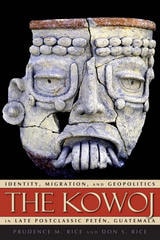
The Kowoj
Identity, Migration, and Geopolitics in Late Postclassic Petén, GuatemalaPrudence M. Rice
University Press of Colorado, 2009
Chapters in The Kowoj address the question "Who are the Kowoj?" from varied viewpoints: archaeological, archival, linguistic, ethnographic, and bioarchaeological. Using data drawn primarily from the peninsular site of Zacpetén, the authors illuminate Kowoj history, ritual components of their self-expressed identity, and their archaeological identification. These data support the Kowoj claim of migration from Mayapán in Yucatán, where they were probably affiliated with the Xiw, in opposition to the Itza. These enmities extended into Petén, culminating in civil warfare by the time of final Spanish conquest in 1697.
The first volume to consider Postclassic Petén from broadly integrative anthropological, archaeological, and historical perspectives, The Kowoj is an important addition to the literature on late Maya culture and history in the southern lowlands. It will be of particular interest to archaeologists, historians, ethnohistorians, art historians, and epigraphers.
The Language of the Inka since the European Invasion
By Bruce Mannheim
University of Texas Press, 1991
The Inka empire, Tawantinsuyu, fell to Spanish invaders within a year's time (1532-1533), but Quechua, the language of the Inka, is still the primary or only language of millions of Inka descendants throughout the southern Andes. In this innovative study, Bruce Mannheim synthesizes all that is currently known about the history of Southern Peruvian Quechua since the Spanish invasion, providing new insights into the nature of language change in general, into the social and historical contexts of language change, and into the cultural conditioning of linguistic change.
Mannheim first discusses changes in the social setting of language use in the Andes from the time of the first European contact in the sixteenth century until today. He reveals that the modern linguistic homogeneity of Spanish and Quechua is a product of the Spanish conquest, since multilingualism was the rule in the Inka empire. He identifies the social and political forces that have influenced the kinds of changes the language has undergone. And he provides the first synthetic history of Southern Peruvian Quechua, making it possible at last to place any literary document or written text in a chronological and social context.
Mannheim also studies changes in the formal structure of Quechua. He finds that changes in the sound system were motivated primarily by phonological factors and also that the changes were constrained by a set of morphological and syntactic conditions. This last conclusion is surprising, since most historical linguists assume that sound change is completely independent of other aspects of language. Thus, The Language of the Inka since the European Invasion makes an empirical contribution to a general theory of linguistic change.
Written in an engaging style that is accessible to the nonlinguist, this book will have a special appeal to readers interested in the history and anthropology of native South America.
The Last Cannibals
A South American Oral HistoryBy Ellen B. Basso
University of Texas Press, 1995
An especially comprehensive study of Brazilian Amazonian Indian history, The Last Cannibals is the first attempt to understand, through indigenous discourse, the emergence of Upper Xingú society. Drawing on oral documents recorded directly from the native language, Ellen Basso transcribes and analyzes nine traditional Kalapalo stories to offer important insights into Kalapalo historical knowledge and the performance of historical narratives within their nonliterate society.
This engaging book challenges the familiar view of biography as a strictly Western literary form. Of special interest are biographies of powerful warriors whose actions led to the emergence of a more recent social order based on restrained behaviors from an earlier time when people were said to be fierce and violent.
From these stories, Basso explores how the Kalapalo remember and understand their past and what specific linguistic, psychological, and ideological materials they employ to construct their historical consciousness. Her book will be important reading in anthropology, folklore, linguistics, and South American studies.
The Last Colonial Massacre
Latin America in the Cold WarGreg Grandin
University of Chicago Press, 2004
Using Guatemala as a case study, Greg Grandin argues that the Cold War in Latin America was a struggle not between American liberalism and Soviet Communism but between two visions of democracy. The main effect of United States intervention in Latin America, Grandin shows, was not the containment of Communism but the elimination of home-grown concepts of social democracy.
Through unprecedented archival research and gripping personal testimonies, Grandin uncovers the hidden history of the Latin American Cold War: of hidebound reactionaries intent on holding on to their own power and privilege; of Mayan Marxists, blending indigenous notions of justice with universal ideas of freedom and equality; and of a United States supporting new styles of state terror throughout the continent. Drawing from declassified U.S. documents, Grandin exposes Washington's involvement in the 1966 secret execution of more than thirty Guatemalan leftists, which, he argues, prefigured the later wave of disappearances in Chile and Argentina.
Impassioned but judicious, The Last Colonial Massacre is history of the highest order—a work that will dramatically recast our understanding of Latin American politics and the triumphal role of the United States in the Cold War and beyond.
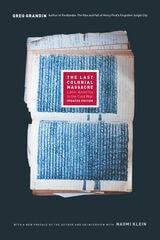
The Last Colonial Massacre
Latin America in the Cold War, Updated EditionGreg Grandin
University of Chicago Press, 2011
After decades of bloodshed and political terror, many lament the rise of the left in Latin America. Since the triumph of Castro, politicians and historians have accused the left there of rejecting democracy, embracing communist totalitarianism, and prompting both revolutionary violence and a right-wing backlash. Through unprecedented archival research and gripping personal testimonies, Greg Grandin powerfully challenges these views in this classic work. In doing so, he uncovers the hidden history of the Latin American Cold War: of hidebound reactionaries holding on to their power and privilege; of Mayan Marxists blending indigenous notions of justice with universal ideas of equality; and of a United States supporting new styles of state terror throughout the region.
With Guatemala as his case study, Grandin argues that the Latin American Cold War was a struggle not between political liberalism and Soviet communism but two visions of democracy—one vibrant and egalitarian, the other tepid and unequal—and that the conflict’s main effect was to eliminate homegrown notions of social democracy. Updated with a new preface by the author and an interview with Naomi Klein, The Last Colonial Massacre is history of the highest order—a work that will dramatically recast our understanding of Latin American politics and the role of the United States in the Cold War and beyond.
“This work admirably explains the process in which hopes of democracy were brutally repressed in Guatemala and its people experienced a civil war lasting for half a century.”—International History Review
“A richly detailed, humane, and passionately subversive portrait of inspiring reformers tragically redefined by the Cold War as enemies of the state.”—Journal of American History
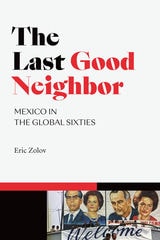
The Last Good Neighbor
Mexico in the Global SixtiesEric Zolov
Duke University Press, 2020
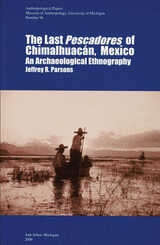
The Last Pescadores of Chimalhuacán, Mexico
An Archaeological EthnographyJeffrey R. Parsons
University of Michigan Press, 2006
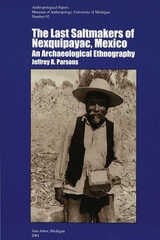
The Last Saltmakers of Nexquipayac, Mexico
An Archaeological EthnographyJeffrey R. Parsons
University of Michigan Press, 2001
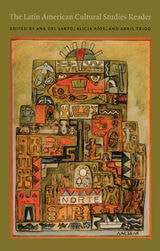
The Latin American Cultural Studies Reader
Ana Del Sarto, Alicia Ríos and Abril Trigo, eds.
Duke University Press, 2004
Divided into sections preceded by brief introductory essays, this volume traces the complex development of Latin American cultural studies from its roots in literary criticism and the economic, social, political, and cultural transformations wrought by neoliberal policies in the 1970s. It tracks the impassioned debates within the field during the early 1990s; explores different theoretical trends, including studies of postcolonialism, the subaltern, and globalization; and reflects on the significance of Latin American cultural studies for cultural studies projects outside Latin America. Considering literature, nationalism, soccer, cinema, postcolonialism, the Zapatistas, community radio, and much more, The Latin American Cultural Studies Reader is an invaluable resource for all those who want to understand the past, present, and future of Latin American cultural studies.
Contributors. Hugo Achugar, Eduardo Archetti, John Beverley, José Joaquín Brunner, Antonio Candido, Debra A. Castillo, Antonio Cornejo Polar, Román de la Campa, Ana Del Sarto, Roberto Fernández Retamar, Juan Flores, Jean Franco, Néstor García Canclini, María Gudelia Rangel Gómez, Adrián Gorelik, John Kraniauskas, Neil Larsen, Ana López, Jesús Martín-Barbero, Francine Masiello, Daniel Mato, Walter D. Mignolo, Carlos Monsiváis, Mabel Moraña, Alberto Moreiras, Renato Ortiz, José Rabasa, Angel Rama, Gustavo A. Remedi, Darcy Ribeiro, Nelly Richard, Alicia Ríos, Beatriz Sarlo, Roberto Schwarz, Irene Silverblatt, Graciela Silvestri, Armando Rosas Solís, Beatriz González Stephan, Abril Trigo, George Yúdice
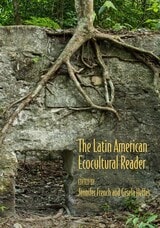
The Latin American Ecocultural Reader
Edited by Jennifer French and Gisela Heffes
Northwestern University Press, 2021
The Latin American Ecocultural Reader is a comprehensive anthology of literary and cultural texts about the natural world. The selections, drawn from throughout the Spanish-speaking countries and Brazil, span from the early colonial period to the present. Editors Jennifer French and Gisela Heffes present work by canonical figures, including José Martí, Bartolomé de las Casas, Rubén Darío, and Alfonsina Storni, in the context of our current state of environmental crisis, prompting new interpretations of their celebrated writings. They also present contemporary work that illuminates the marginalized environmental cultures of women, indigenous, and Afro-Latin American populations. Each selection is introduced with a short essay on the author and the salience of their work; the selections are arranged into eight parts, each of which begins with an introductory essay that speaks to the political, economic, and environmental history of the time and provides interpretative cues for the selections that follow.
The editors also include a general introduction with a concise overview of the field of ecocriticism as it has developed since the 1990s. They argue that various strands of environmental thought—recognizable today as extractivism, eco-feminism, Amerindian ontologies, and so forth—can be traced back through the centuries to the earliest colonial period, when Europeans first described the Americas as an edenic “New World” and appropriated the bodies of enslaved Indians and Africans to exploit its natural bounty.
The Latin American Literary Boom and U.S. Nationalism during the Cold War
Deborah Cohn
Vanderbilt University Press, 2012
The high level of interest in Latin America paradoxically led the U.S. government to restrict these authors' physical presence in the United States through the McCarranWalter Act's immigration blacklist, even as cultural organizations cultivated the exchange of ideas with writers and sought to market translations of their work for the U.S. market.
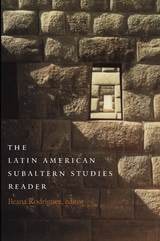
The Latin American Subaltern Studies Reader
Ileana Rodríguez, ed.
Duke University Press, 2001
In addition to an overview by Ranajit Guha, essay topics include nineteenth-century hygiene in Latin American countries, Rigoberta Menchú after the Nobel, commentaries on Haitian and Argentinian issues, the relationship between gender and race in Bolivia, and ungovernability and tragedy in Peru. Providing a radical critique of elite culture and of liberal, bourgeois, and modern epistemologies and projects, the essays included here prove that Latin American Subaltern Studies is much more than the mere translation of subaltern studies from South Asia to Latin America.
Contributors. Marcelo Bergman, John Beverley, Robert Carr, Sara Castro-Klarén, Michael Clark, Beatriz González Stephan, Ranajit Guha, María Milagros López , Walter Mignolo, Alberto Moreiras, Abdul-Karim Mustapha, José Rabasa, Ileana Rodríguez, Josefina Saldaña-Portillo, Javier Sanjinés, C. Patricia Seed, Doris Sommer, Marcia Stephenson, Mónica Szurmuk, Gareth Williams, Marc Zimmerman
The Latin American Voter
Pursuing Representation and Accountability in Challenging ContextsRyan E. Carlin, Matthew M. Singer, and Elizabeth J. Zechmeister
University of Michigan Press, 2015
The Learned Ones
Nahua Intellectuals in Postconquest MexicoKelly S. McDonough
University of Arizona Press, 2014
Not so, according to author Kelly S. McDonough, at least not for native speakers of Nahuatl, one of the most widely spoken and best-documented indigenous languages of the Americas. This book focuses on how Nahuas have been deeply engaged with the written word ever since the introduction of the Roman alphabet in the early sixteenth century. Dipping into distinct time periods of the past five hundred years, this broad perspective allows McDonough to show the heterogeneity of Nahua knowledge and writing as Nahuas took up the pen as agents of their own discourses and agendas.
McDonough worked collaboratively with contemporary Nahua researchers and students, reconnecting the theorization of a population with the population itself. The Learned Ones describes the experience of reading historic text with native speakers today, some encountering Nahua intellectuals and their writing for the very first time. It intertwines the written word with oral traditions and embodied knowledge, aiming to retie the strand of alphabetic writing to the dynamic trajectory of Nahua intellectual work.
The Lettered Barriada
Workers, Archival Power, and the Politics of Knowledge in Puerto RicoJorell A. Meléndez-Badillo
Duke University Press, 2021
Duke University Press Scholars of Color First Book Award recipient
The Lettered City
Angel Rama
Duke University Press, 1996
Starting with the colonial period, Rama undertakes a historical analysis of the hegemonic influences of the written word. He explores the place of writing and urbanization in the imperial designs of the Iberian colonialists and views the city both as a rational order of signs representative of Enlightenment progress and as the site where the Old World is transformed—according to detailed written instructions—in the New. His analysis continues by recounting the social and political challenges faced by the letrados as their roles in society widened to include those of journalist, fiction writer, essayist, and political leader, and how those roles changed through the independence movements of the nineteenth century. The coming of the twentieth century, and especially the gradual emergence of a mass reading public, brought further challenges. Through a discussion of the currents and countercurrents in turn-of-the-century literary life, Rama shows how the city of letters was finally “revolutionized.”
Already crucial in setting the terms for debate concerning the complex relationships among intellectuals, national formations, and the state, this elegantly written and translated work will be read by Latin American scholars in a wide range of disciplines, and by students and scholars in the fields of anthropology, cultural geography, and postcolonial studies.
The Lettered Indian
Race, Nation, and Indigenous Education in Twentieth-Century BoliviaBrooke Larson
Duke University Press, 2024
The Lettered Mountain
A Peruvian Village’s Way with WritingFrank Salomon and Mercedes Niño-Murcia
Duke University Press, 2011
The Lima Inquisition
The Plight of Crypto-Jews in Seventeenth-Century PeruAna E. Schaposchnik
University of Wisconsin Press, 2017
Delving into the records of the tribunal, Schaposchnik brings to light the experiences of individuals on both sides of the process. Some prisoners, she discovers, developed a limited degree of agency as they managed to stall trials or mitigate the most extreme punishments. Training her attention on the accusers, Schaposchnik uncovers the agendas of specific inquisitors in bringing the condemned from the dungeons to the 1639 Auto General de Fe ceremony of public penance and execution. Through this fine-grained study of the tribunal's participants, Schaposchnik finds that the Inquisition sought to discipline and shape culture not so much through frequency of trials or number of sentences as through the potency of individual examples.
The Lima Reader
History, Culture, PoliticsCarlos Aguirre and Charles F. Walker, editors
Duke University Press, 2017
The Limits of Identity
Politics and Poetics in Latin AmericaBy Charles Hatfield
University of Texas Press, 2015
The Limits of Identity is a polemical critique of the repudiation of universalism and the theoretical commitment to identity and difference embedded in Latin American literary and cultural studies. Through original readings of foundational Latin American thinkers (such as José Martí and José Enrique Rodó) and contemporary theorists (such as John Beverley and Doris Sommer), Charles Hatfield reveals and challenges the anti-universalism that informs seemingly disparate theoretical projects.
The Limits of Identity offers a critical reexamination of widely held conceptions of culture, ideology, interpretation, and history. The repudiation of universalism, Hatfield argues, creates a set of problems that are both theoretical and political. Even though the recognition of identity and difference is normally thought to be a form of resistance, The Limits of Identity claims that, in fact, the opposite is true.
The Limits of Racial Domination
Plebeian Society in Colonial Mexico City, 1660–1720R. Douglas Cope
University of Wisconsin Press, 1994
In this distinguished contribution to Latin American colonial history, Douglas Cope draws upon a wide variety of sources—including Inquisition and court cases, notarial records and parish registers—to challenge the traditional view of castas (members of the caste system created by Spanish overlords) as rootless, alienated, and dominated by a desire to improve their racial status. On the contrary, the castas, Cope shows, were neither passive nor ruled by feelings of racial inferiority; indeed, they often modified or even rejected elite racial ideology. Castas also sought ways to manipulate their social "superiors" through astute use of the legal system. Cope shows that social control by the Spaniards rested less on institutions than on patron-client networks linking individual patricians and plebeians, which enabled the elite class to co-opt the more successful castas.
The book concludes with the most thorough account yet published of the Mexico City riot of 1692. This account illuminates both the shortcomings and strengths of the patron-client system. Spurred by a corn shortage and subsequent famine, a plebeian mob laid waste much of the central city. Cope demonstrates that the political situation was not substantially altered, however; the patronage system continued to control employment and plebeians were largely left to bargain and adapt, as before.
A revealing look at the economic lives of the urban poor in the colonial era, The Limits of Racial Domination examines a period in which critical social changes were occurring. The book should interest historians and ethnohistorians alike.
The Limits of Revolution
Worker Citizens in a Bolivian Mining CityElena McGrath
University of Texas Press, 2026
The role of Bolivian mining families in revolution and politics.
In 1952, Bolivia’s Revolutionary Nationalist Movement (MNR) swept into power, promising collective prosperity through class-based nationalism. The heroic symbol of the movement was the worker citizen—the formerly indigenous miner who would fuel economic development in a nationalized mining economy.
The Limits of Revolution explores this history from the worker barrios of the copper mining city of Corocoro. As the state walked back its promises of worker political power at the national level, mining men and women in Corocoro struggled—through protests, court battles, and barfights—to maintain the benefits of worker citizenship locally. After the MNR fell to a military dictatorship in 1964, however, families retreated to defending the nationalized mining company against an increasingly hostile state. In this battle to keep the revolution alive, the expansive potential of worker citizenship disappeared and old racial exclusions resurfaced. Largely forgotten today, Bolivia’s experience of revolution exposes the contradictions of postcolonial nationalism and sheds light on Latin America’s transition from Cold War–era class politics to twenty-first-century Pink Tide politics.
The Lowland Maya Postclassic
Edited by Arlen F. Chase and Prudence M. Rice
University of Texas Press, 1985
This collection represents a major step forward in understanding the era from the end of Classic Maya civilization to the Spanish conquest.
The Macroeconomics of Populism in Latin America
Edited by Rudiger Dornbusch and Sebastian Edwards
University of Chicago Press, 1991
Economists and political scientists from the United States and Latin America detail in this volume how and why such programs go wrong and what leads policymakers to repeatedly adopt these policies despite a history of failure. Authors examine this pattern in Argentina, Brazil, Chile, Mexico, Nicaragua, and Peru—and show how Colombia managed to avoid it. Despite differences in how each country implemented its policies, the macroeconomic consequences were remarkably similar.
Scholars of Latin America will find this work a valuable resource, offering a distinctive macroeconomic perspective on the continuing controversy over the dynamics of populism.
The Magical State
Nature, Money, and Modernity in VenezuelaFernando Coronil
University of Chicago Press, 1997
The Making of the Mexican Border
The State, Capitalism, and Society in Nuevo León, 1848-1910By Juan Mora-Torres
University of Texas Press, 2001
The issues that dominate U.S.-Mexico border relations today—integration of economies, policing of boundaries, and the flow of workers from south to north and of capital from north to south—are not recent developments. In this insightful history of the state of Nuevo León, Juan Mora-Torres explores how these processes transformed northern Mexico into a region with distinct economic, political, social, and cultural features that set it apart from the interior of Mexico.
Mora-Torres argues that the years between the establishment of the U.S.-Mexico boundary in 1848 and the outbreak of the Mexican Revolution in 1910 constitute a critical period in Mexican history. The processes of state-building, emergent capitalism, and growing linkages to the United States transformed localities and identities and shaped class formations and struggles in Nuevo León. Monterrey emerged as the leading industrial center and home of the most powerful business elite, while the countryside deteriorated economically, politically, and demographically. By 1910, Mora-Torres concludes, the border states had already assumed much of their modern character: an advanced capitalist economy, some of Mexico's most powerful business groups, and a labor market dependent on massive migrations from central Mexico.
The Man Who Wrote Pancho Villa
Martin Luis Guzman and the Politics of Life WritingNicholas Cifuentes-Goodbody
Vanderbilt University Press, 2016
The Man Who Wrote Pancho Villa places Guzman's work in a biographical context, shedding light on the immediate motivations behind his writing in a given moment and the subsequent ways in which he rewrote or repackaged the material. Despite his efforts to establish a definitive reading of his life and literature, Guzman was unable to control that interpretation as audiences became less tolerant of the glaring omissions in his self-portrait.

The Many Faces of Sandinista Democracy
Katherine Hoyt
Ohio University Press, 1997
Taking power in Nicaragua in 1979 as a revolutionary party, the Sandinista National Liberation Front (FSLN) was willing to put its fate in the hands of the Nicaraguan people twice, in 1984 and 1990. The party wrote a democratic constitution and then, remarkably, accepted the decision of the majority by relinquishing power upon its defeat in the 1990 election.
The Many Faces of Sandinista Democracy explores the conflicts involving different visions of political and economic democracy, as well as new radical thought on participatory democracy. The latter addresses the problems popular organizations encountered as they moved from subservience to the FSLN in the 1980s to the liberating but disorientating electoral defeat of 1990. Up until the moment of defeat, the Sandinistas saw themselves as the true vanguard of the Nicaraguan people, able to submit themselves to free elections, because they felt they truly represented the general will of the people.
Dr. Hoyt brings to an international audience for the first time a study of the ideas of several Nicaraguan thinkers. She examines the conflicts surrounding the development of ideas within the FSLN, as well as the strengths and weaknesses of its rare combination of democratic and vanguard principles.
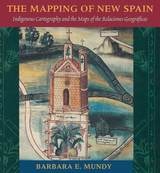
The Mapping of New Spain
Indigenous Cartography and the Maps of the Relaciones GeograficasBarbara E. Mundy
University of Chicago Press, 1996
"Its contribution to its specific field is both significant and original. . . . It is a pure pleasure to read." —Sabine MacCormack, Isis
"Mundy has done a fine job of balancing the artistic interpretation of the maps with the larger historical context within which they were drawn. . . . This is an important work." —John F. Schwaller, Sixteenth Century Journal
"This beautiful book opens a Pandora's box in the most positive sense, for it provokes the reconsideration of several long-held opinions about Spanish colonialism and its effects on Native American culture." —Susan Schroeder, American Historical Review
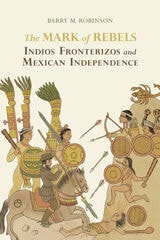
The Mark of Rebels
Indios Fronterizos and Mexican IndependenceBarry M. Robinson
University of Alabama Press, 2016
Explores social and cultural transformations among the indigenous communities of western Mexico, especially the indios fronterizos (Frontier Indians), preceding and during the struggle for independence
In The Mark of Rebels Barry Robinson offers a new look at Mexican Independence from the perspective of an indigenous population caught in the heart of the struggle. During the conquest and settlement of Mexico’s Western Sierra Madre, Spain’s indigenous allies constructed an indio fronterizo identity for their ethnically diverse descendants. These communities used their special status to maintain a measure of autonomy during the colonial era, but the cultural shifts of the late colonial period radically transformed the relationship between these indios fronterizos and their neighbors.
Marshalling an extensive array of archival material from Mexico, the United States, and Spain, Robinson shows that indio fronterizo participation in the Mexican wars of independence grafted into the larger Hidalgo Revolt through alignment with creole commanders. Still, a considerable gulf existed between the aims of indigenous rebels and the creole leadership. Consequently, the privileges that the indios fronterizos sought to preserve continued to diminish, unable to survive either the late colonial reforms of the Spanish regime or creole conceptions of race and property in the formation of the new nation-state.
This story suggests that Mexico’s transition from colony to nation can only be understood by revisiting the origins of the colonial system and by recognizing the role of Spain’s indigenous allies in both its construction and demolition. The study relates events in the region to broader patterns of identity, loyalty, and subversion throughout the Americas, providing insight into the process of mestizaje that is commonly understood to have shaped Latin America. It also foreshadows the popular conservatism of the nineteenth century and identifies the roots of post-colonial social unrest.
This book provides new context for scholars, historians, ethnographers, anthropologists, and anyone interested in the history of Mexico, colonization, Native Americans, and the Age of Revolutions.
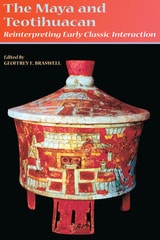
The Maya and Teotihuacan
Reinterpreting Early Classic InteractionEdited by Geoffrey E. Braswell
University of Texas Press, 2003
The contributors to this volume present extensive new evidence from archaeology, iconography, and epigraphy to offer a more nuanced understanding of the interaction between the Early Classic Maya and Teotihuacan.
Winner, Choice Outstanding Academic Book, 2005
Since the 1930s, archaeologists have uncovered startling evidence of interaction between the Early Classic Maya and the great empire of Teotihuacan in Central Mexico. Yet the exact nature of the relationship between these two ancient Mesoamerican civilizations remains to be fully deciphered. Many scholars have assumed that Teotihuacan colonized the Maya region and dominated the political or economic systems of certain key centers—perhaps even giving rise to state-level political organizations. Others argue that Early Classic rulers merely traded with Teotihuacan and skillfully manipulated its imported exotic goods and symbol sets to increase their prestige.
Moving beyond these traditional assumptions, the contributors to this volume present extensive new evidence from archaeology, iconography, and epigraphy to offer a more nuanced understanding of the interaction between the Early Classic Maya and Teotihuacan. Investigating a range of Maya sites, including Kaminaljuyu, Copán, Tikal, Altun Ha, and Oxkintok, they demonstrate that the influence of Teotihuacan on the Maya varied in nature and duration from site to site, requiring a range of models to explain the patterns of interaction. Moreover, they show that the interaction was bidirectional and discuss how the Maya in turn influenced Teotihuacan.
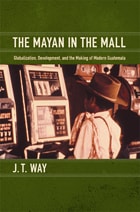
The Mayan in the Mall
Globalization, Development, and the Making of Modern GuatemalaJ. T. Way
Duke University Press, 2012
Using a wide array of historical and contemporary sources, Way explores the multiple intersections of development and individual life, focusing on the construction of social space through successive waves of land reform, urban planning, and economic policy. His explorations move from Guatemala City's poorest neighborhoods and informal economies (run predominantly by women) to a countryside still recovering from civil war and anti-Mayan genocide, and they encompass such artifacts of development as the modernist Pan-American Highway and the postmodern Grand Tikal Futura, a Mayan-themed shopping mall ringed by gated communities and shantytowns. Capitalist development, Way concludes, has dramatically reshaped the country's physical and social landscapes—engendering poverty, ethnic regionalism, and genocidal violence—and positioned Guatemala as a harbinger of globalization's future.
The Measurement of Modernism
A Study of Values in Brazil and MexicoBy Joseph A. Kahl
University of Texas Press, 1968
One of the most interesting questions that can be raised about the twentieth century world concerns the degree to which industrialization created a common culture for all peoples. Reported here are the results of an empirical investigation designed to produce instruments to measure those personal values that have been central variables in the theory of modernization of societies.
The purpose of Joseph Kahl’s research is primarily methodological: to advance the description and measurement of those value orientations used by men to organize their occupational careers. It seeks to delineate and measure a set of values that represents a “modern” view of work and life.
The working laboratory was Brazil and Mexico, two countries undergoing rapid industrialization. More than six hundred men in Brazil and more than seven hundred in Mexico responded to questionnaires. In addition, over twenty-five men in each country were asked to sit beside a tape recorder and talk freely of their worldviews. The respondents were divided between inhabitants of the cities of Rio de Janeiro and Mexico City and those who lived in provincial towns of fewer than ten thousand inhabitants. The samples included manual and nonmanual employees.
The results showed that the main variable predicting whether or not a man would tend toward modernism was his social-class position. Middle-class men were much more modern in outlook than working-class men. Residence in a metropolis rather than in a small town also increased modernism, though to a lesser extent. Differences between Brazil and Mexico (and, indeed, the United States) were found to be surprisingly small, of considerably less weight than position in the social structure in predicting value orientations.
The author addresses himself primarily to sociologists and their students who are themselves studying aspects of socio-economic development. His findings, however, cannot fail to be of interest and benefit to social scientists of various disciplines and to all who are concerned with the process of development—planners at the national and local levels, demographers, and businesspeople.
The Men of Cajamarca
A Social and Biographical Study of the First Conquerors of PeruBy James Lockhart
University of Texas Press, 1972
In November 1532, a group of 168 Spaniards seized the Inca emperor Atahuallpa in the town of Cajamarca, in the northern Peruvian highlands. Their act, quickly taken as a symbol of the conquest of a vast empire, brought them unprecedented rewards in gold and silver; it made them celebrities, gave them first choice of positions of honor and power in the new Peru of the Spaniards, and opened up the possibility of a splendid life at home in Spain, if they so desired. Thus they became men of consequence, at the epicenter of a swift and irrevocable transformation of the Andean region. Yet before that memorable day in Cajamarca they had been quite unexceptional, a reasonable sampling of Spaniards on expeditions all over the Indies at the time of the great conquests.
The Men of Cajamarca is perhaps the fullest treatment yet published of any group of early Spaniards in America. Part I examines general types, characteristics, and processes visible in the group as representative Spanish immigrants, central to the establishment of a Spanish presence in the New World’s richest land. The intention is to contribute to a changing image of the Spanish conqueror, a man motivated more by pragmatic self-interest than by any love of adventure, capable and versatile as often as illiterate and rough. Aiming at permanence more than new landfalls, these men created the governmental units and settlement distribution of much of Spanish America and set lasting patterns for a new society.
Part II contains the men’s individual biographies, ranging from a few lines for the most obscure to many pages of analysis for the best-documented figures. The author traces the lives of the men to their beginnings in Spain and follows their careers after the episode in Cajamarca.
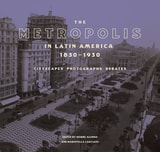
The Metropolis in Latin America, 1830-1930
Cityscapes, Photographs, DebatesIdurre Alonso
J. Paul Getty Trust, The, 2021
In the century between 1830 and 1930, following independence from Spain and Portugal, major cities in Latin America experienced large-scale growth, with the development of a new urban bourgeois elite interested in projects of modernization and rapid industrialization. At the same time, the lower classes were eradicated from old city districts and deported to the outskirts. The Metropolis in Latin America, 1830–1930 surveys this expansion, focusing on six capital cities—Havana, Mexico City, Rio de Janeiro, Buenos Aires, Santiago de Chile, and Lima—as it examines sociopolitical histories, town planning, art and architecture, photography, and film in relation to the metropolis.
Drawing from the Getty Research Institute’s vast collection of books, prints, and photographs from this period, largely unpublished until now, this volume reveals the cities’ changes through urban panoramas, plans depicting new neighborhoods, and photographs of novel transportation systems, public amenities, civic spaces, and more. It illustrates the transformation of colonial cities into the monumental modern metropolises that, by the end of the 1920s, provided fertile ground for the emergence of today’s Latin American megalopolis.
The Mexican Dream
Or, The Interrupted Thought of Amerindian CivilizationsJ. M. G. Le Clézio
University of Chicago Press, 1993
Winner of the 2008 Nobel Prize for Literature, J. M. G. Le Clézio here conjures the consciousness of Mexico, powerfully evoking the dreams that made and unmade an ancient culture. Le Clézio’s haunting book takes us into the dream that was the religion of the Aztecs, a religion whose own apocalyptic visions anticipated the coming of the Spanish conquerors. Here the dream of the conquistadores rises before us, too, the glimmering idea of gold drawing Europe into the Mexican dream. Against the religion and thought of the Aztecs and the Tarascans and the Europeans in Mexico, Le Clézio also shows us those of the “barbarians” of the north, the nomadic Indians beyond the pale of the Aztec frontier.
Finally, Le Clézio’s book is a dream of the present, a meditation on what in Amerindian civilizations—in their language, in their way of telling tales, of wanting to survive their own destruction—moved the poet, playwright, and actor Antonin Artaud and motivates Le Clézio in this book. His own deep identification with pre-Columbian cultures, whose faith told them the wheel of time would bring their gods and their beliefs back to them, finds fitting expression in this extraordinary book, which brings the dream around.
“We are lucky to have in Le Clézio a writer of great quality who brings his particular sensibility and talent here to remind us of the very nature of the rituals and myths of the civilizations of ancient Mexico; he provides us with descriptions as precise as they are mysterious.”—Le Figaro
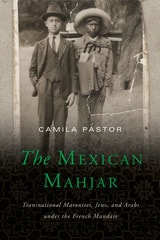
The Mexican Mahjar
Transnational Maronites, Jews, and Arabs under the French MandateBy Camila Pastor
University of Texas Press, 2017
Winner, Khayrallah Migration Studies Prize, Moise Khayrallah Center for Lebanese Diaspora Studies, 2018
Migration from the Middle East brought hundreds of thousands of people to the Americas in the late nineteenth and early twentieth centuries. By the time the Ottoman political system collapsed in 1918, over a third of the population of the Mashriq, i.e. the Levant, had made the transatlantic journey. This intense mobility was interrupted by World War I but resumed in the 1920s and continued through the late 1940s under the French Mandate. Many migrants returned to their homelands, but the rest concentrated in Brazil, Argentina, the United States, Haiti, and Mexico, building transnational lives.
The Mexican Mahjar provides the first global history of Middle Eastern migrations to Mexico. Making unprecedented use of French colonial archives and historical ethnography, Camila Pastor examines how French colonial control over Syria and Lebanon affected the migrants. Tracing issues of class, race, and gender through the decades of increased immigration to Mexico and looking at the narratives created by the Mahjaris (migrants) themselves in both their old and new homes, Pastor sheds new light on the creation of transnational networks at the intersection of Arab, French, and Mexican colonial modernisms. Revealing how migrants experienced mobility as conquest, diaspora, exile, or pilgrimage, The Mexican Mahjar tracks global history on an intimate scale.
The Mexican Transpacific
Nikkei Writing, Visual Arts, and PerformanceIgnacio López-Calvo
Vanderbilt University Press, 2022
This book, a continuation of author Ignacio López-Calvo’s previous research on cultural production by Latin American authors of Asian ancestry, focuses mostly on literature, theater, and visual arts produced by Japanese immigrants in Mexico and their descendants, rather than on the Japanese community as a mere object of study. With this interdisciplinary project, López-Calvo aims to bring to the fore this silenced community’s voice and agency to historicize its own experience.
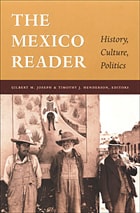
The Mexico Reader
History, Culture, PoliticsGilbert M. Joseph and Timothy J. Henderson, eds.
Duke University Press, 2002
A diverse collection of more than eighty selections, The Mexico Reader brings together poetry, folklore, fiction, polemics, photoessays, songs, political cartoons, memoirs, satire, and scholarly writing. Many pieces are by Mexicans, and a substantial number appear for the first time in English. Works by Octavio Paz and Carlos Fuentes are included along with pieces about such well-known figures as the larger-than-life revolutionary leaders Pancho Villa and Emiliano Zapata; there is also a comminiqué from a more recent rebel, Subcomandante Marcos. At the same time, the book highlights the perspectives of many others—indigenous peoples, women, politicians, patriots, artists, soldiers, rebels, priests, workers, peasants, foreign diplomats, and travelers.
The Mexico Reader explores what it means to be Mexican, tracing the history of Mexico from pre-Columbian times through the country’s epic revolution (1910–17) to the present day. The materials relating to the latter half of the twentieth century focus on the contradictions and costs of postrevolutionary modernization, the rise of civil society, and the dynamic cross-cultural zone marked by the two thousand-mile Mexico-U.S. border. The editors have divided the book into several sections organized roughly in chronological order and have provided brief historical contexts for each section. They have also furnished a lengthy list of resources about Mexico, including websites and suggestions for further reading.
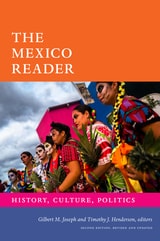
The Mexico Reader
History, Culture, PoliticsGilbert M. Joseph and Timothy J. Henderson, editors
Duke University Press, 2022
The Military and Politics in Postauthoritarian Chile
Gregory Weeks
University of Alabama Press, 2003
"The Military and Politics in Post-Authoritarian Chile should be read by everyone concerned with the relation between democracy and the armed forces. It is a well-researched, well-written volume that should prove both interesting and useful to scholars and students alike." —Perspectives on Politics
Why have political leaders of developing and authoritarian nations run into so many obstacles as they attempt to establish civilian supremacy over armed forces in the democratization of their countries? This is the question Gregory Weeks poses in his study of Chile from 1990 onward. He explains how the Chilean military has maintained a high level of political influence in the tumultuous aftermath of dictatorial rule by Army General Augusto Pinochet, thus confounding a smooth transition to civilian authority.
Even after the reins of power were officially handed over in 1990, Pinochet continued as commander in chief of the army until 1998, when he took a lifetime seat in the Senate and led the military’s efforts to retain its legal and constitutional prerogatives while limiting civilian oversight of military affairs. This assertion of guardianship by the military has produced a political tug-of-war between it and civilian authorities the two contenders for political primacy in Chile. In addition to recounting the historical background of this situation, Weeks’s study examines where conflict between these two contenders has been most productive and accord has been highest. His findings suggest that formal contacts, conducted through formal institutions, have been the most conducive to civil supremacy and, therefore, the consolidation of democracy.
Based on interviews, government documents, military journals, newspapers, and other archival sources, The Military and Politics in Postauthoritarian Chile describes how presidents, military officers, members of Congress, and judges have interacted since the end of the military regime. With implications for conflict resolution studies, this book will be valuable for Chileanists and policymakers and analysts of Latin American regimes, as well as academic libraries, military historians, social scientists, and students and scholars of Latin American history and politics.