Results by title
941 books match the query 'Military' and 248 start with t
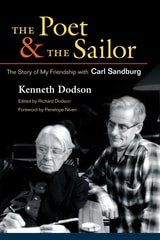
The Poet and the Sailor
The Story of My Friendship with Carl SandburgKenneth Dodson. Edited by Richard Dodson. Foreword by Penelope Niven
University of Illinois Press, 2006
Carl Sandburg first encountered Kenneth Dodson through a letter written at sea during World War II. Though Dodson wrote the letter to his wife, Letha, Sandburg read it in tears and told her, "I've got to meet this man." Composed primarily of their correspondence that continued until Sandburg's death in 1967, The Poet and the Sailor is a chronicle of the deep friendship that followed. Ranging over anything they found important, from writing to health and humor, the letters are arranged by Richard Dodson and are accompanied by a foreword from Sandburg's noted biographer, Penelope Niven.
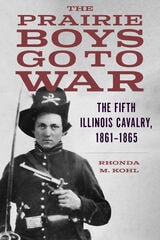
The Prairie Boys Go to War
The Fifth Illinois Cavalry, 1861-1865Rhonda M. Kohl
Southern Illinois University Press, 2013
The regiment’s history unfolds around major events in the Western Theater from 1861 to September 1865, including campaigns at Helena, Vicksburg, Jackson, and Meridian, as well as numerous little-known skirmishes. Although they were led almost exclusively by Northern-born Republicans, the majority of the soldiers in the Fifth Illinois remained Democrats. As Kohl demonstrates, politics, economics, education, social values, and racism separated the line officers from the common soldiers, and the internal friction caused by these cultural disparities led to poor leadership, low morale, disciplinary problems, and rampant alcoholism.
The narrative pulls the Fifth Illinois out of historical oblivion, elucidating the highs and lows of the soldiers’ service as well as their changing attitudes toward war goals, religion, liberty, commanding generals, Copperheads, and alcoholism. By reconstructing the cultural context of Fifth Illinois soldiers, Prairie Boys Go to War reveals how social and economic traditions can shape the wartime experience.

The Privatisation of Israeli Security
Shir Hever
Pluto Press, 2017
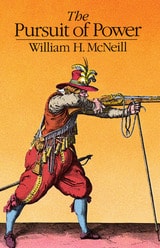
The Pursuit of Power
Technology, Armed Force, and Society since A.D. 1000William H. McNeill
University of Chicago Press, 1982
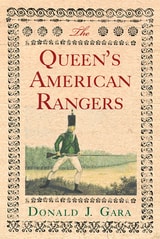
The Queen's American Rangers
Donald J. Gara
Westholme Publishing, 2015
Prior to the British attack on Long Island in August 1776, French and Indian War hero Robert Rogers organized a regiment to join the fight—but not on the side of his native New Hampshire. Named in honor of Queen Charlotte, the wife of King George III, Rogers’s regiment recruited the bulk of its soldiers from the large number of Loyalist refugees on Staten Island who had fled from New York. Rogers’s command of the unit was short-lived, however, after a humiliating defeat in late October by a surprise attack on his headquarters. Under new leadership, the unit played a decisive role and suffered heavy casualties at the battle of Brandywine that brought them their first favorable attention from the British high command. With this performance, and under the able leadership of John Graves Simcoe, the Queen’s American Rangers—sometimes known as “Simcoe’s Rangers”—were frequently assigned to serve alongside British regular troops in many battles, including Monmouth, Springfield, Charleston, and Yorktown. Receiving frequent high praise from Lieutenant General Sir Henry Clinton, the Commander in Chief of the British Army in America, the unit was placed on the American Establishment of the British Army in May 1779, a status conferred on provincial units that had performed valuable services during the war, and was renamed the 1st American Regiment. Before the end of the war, the rangers were fully incorporated into the British regular army, one of only four Loyalist units to be so honored.
The Queen’s American Rangers by historian Donald J. Gara is the first book-length account of this storied unit. Based on extensive primary source research, the book traces the complete movements, command changes, and battle performances of the rangers, from their first muster to their formal incorporation into the British Army and ultimate emigration to Canada on land grants conferred by a grateful British crown.
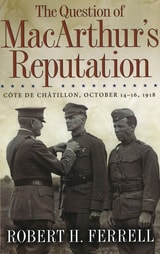
The Question of MacArthur's Reputation
Côte De Châtillon, October 14-16, 1918Robert H. Ferrell
University of Missouri Press, 2008
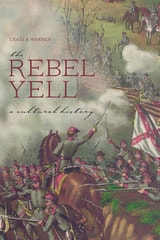
The Rebel Yell
A Cultural HistoryCraig A. Warren
University of Alabama Press, 2014
The first comprehensive history of the fabled Confederate battle cry from its origins and myths through its use in American popular culture.
No aspect of Civil War military lore has received less scholarly attention than the battle cry of the Southern soldier. In The Rebel Yell, Craig A. Warren brings together soldiers' memoirs, little-known articles, and recordings to create a fascinating and exhaustive exploration of the facts and myths about the “Southern screech.”
Through close readings of numerous accounts, Warren demonstrates that the Rebel yell was not a single, unchanging call, but rather it varied from place to place, evolved over time, and expressed nuanced shades of emotion. A multifunctional act, the flexible Rebel yell was immediately recognizable to friends and foes but acquired new forms and purposes as the epic struggle wore on. A Confederate regiment might deliver the yell in harrowing unison to taunt Union troops across the empty spaces of a battlefield. At other times, individual soldiers would call out solo or in call-and-response fashion to communicate with or secure the perimeters of their camps.
The Rebel yell could embody unity and valor, but could also become the voice of racism and hatred. Perhaps most surprising, The Rebel Yell reveals that from Reconstruction through the first half of the twentieth century, the Rebel yell—even more than the Confederate battle flag—served as the most prominent and potent symbol of white Southern defiance of Federal authority. With regard to the late-twentieth and early twenty-first centuries, Warren shows that the yell has served the needs of people the world over: soldiers and civilians, politicians and musicians, re-enactors and humorists, artists and businessmen. Warren dismantles popular assumptions about the Rebel yell as well as the notion that the yell was ever “lost to history.”
Both scholarly and accessible, The Rebel Yell contributes to our knowledge of Civil War history and public memory. It shows the centrality of voice and sound to any reckoning of Southern culture.
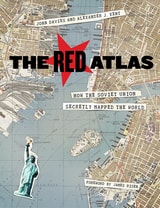
The Red Atlas
How the Soviet Union Secretly Mapped the WorldJohn Davies and Alexander J. Kent
University of Chicago Press, 2017
From 1950 to 1990, the Soviet Army conducted a global topographic mapping program, creating large-scale maps for much of the world that included a diversity of detail that would have supported a full range of military planning. For big cities like New York, DC, and London to towns like Pontiac, MI and Galveston, TX, the Soviets gathered enough information to create street-level maps. What they chose to include on these maps can seem obvious like locations of factories and ports, or more surprising, such as building heights, road widths, and bridge capacities. Some of the detail suggests early satellite technology, while other specifics, like detailed depictions of depths and channels around rivers and harbors, could only have been gained by actual Soviet feet on the ground. The Red Atlas includes over 350 extracts from these incredible Cold War maps, exploring their provenance and cartographic techniques as well as what they can tell us about their makers and the Soviet initiatives that were going on all around us.
A fantastic historical document of an era that sometimes seems less distant, The Red Atlas offers an uncanny view of the world through the eyes of Soviet strategists and spies.
The Remains of War
Bodies, Politics, and the Search for American Soldiers Unaccounted For in Southeast AsiaThomas M. Hawley
Duke University Press, 2005
Hawley combines the theoretical insights of Judith Butler, Michel Foucault, and Emmanuel Levinas with detailed research into the history of the movement to recover the remains of soldiers missing in Vietnam. He examines the practices that constitute the Defense Department’s accounting protocol: the archival research, archaeological excavation, and forensic identification of recovered remains. He considers the role of the American public and the families of missing soldiers in demanding the release of pows and encouraging the recovery of the missing; the place of the body of the Vietnam veteran within the war’s legacy; and the ways that memorials link individual bodies to the body politic. Highlighting the contradictions inherent in the recovery effort, Hawley reflects on the ethical implications of the massive endeavor of the American government and many officials in Vietnam to account for the remains of American soldiers.
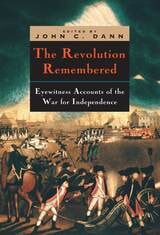
The Revolution Remembered
Eyewitness Accounts of the War for IndependenceJohn C. Dann
University of Chicago Press, 1980
"In a book fairly bursting with feats of daring, perhaps the most spectacular accomplishment of them all is this volume's transformation of its readers into the grandchildren of Revolutionary War soldiers. . . . An amazing gathering of 79 surrogate Yankee grandparents who tell us in their own words what they saw with their own eyes."—Elaine F. Weiss, Christian Science Monitor
"Fascinating. . . . [The soldiers'] details fill in significant shadows of history."—Henry Kisor, Chicago Sun-Times
"It's still good fun two centuries later, overhearing these experiences of the tumult of everyday life and seeing a front-lines view of one of the most unusual armies ever to fight, let alone win."—Richard Martin, Wall Street Journal
"One of the most important primary source discoveries from the era. A unique and fresh perspective."—Paul G. Levine, Los Angeles Times
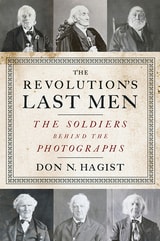
The Revolution's Last Men
The Soldiers Behind the PhotographsDon N. Hagist
Westholme Publishing, 2015
The Stories of the Final Six Surviving Soldiers Who Fought in the American Revolution
During the Civil War that threatened to tear the United States apart came the realization that only a handful of veterans of the American Revolution still survived—men who had fought the war that created the nation. Six of these men were photographed and interviewed for a book by Reverend E. B. Hillard that appeared late in 1864. Their images have captivated generations since then; but—through a combination of faded memories and the interviewer’s patriotic agenda—the biographies accompanying these amazing photographs were garbled and distorted, containing information that ranged from inaccurate to implausible. Now for the first time the military careers of these men have been researched in detail using a wide range of primary sources. The result is a new perspective on the actual service of these soldiers, from enlistment to discharge, along with new details of their relatively quiet postwar lives. The Revolution’s Last Men presents the original biographical interviews published in 1864, pension depositions and other first-hand accounts given by each man later in life, and an up-to-date biography examining each soldier’s service and discussing the inaccuracies and uncertainties of the previously published accounts. To complement the photographs taken in 1864, original drawings depict the men as they may have appeared when they were soldiers, using current research on military artifacts and material culture. Also included are additional photographs of some of the men that were not part of the 1864 collection but taken when their status as the last known survivors of the American Revolution made them celebrities. While the photographs of these aged veterans continue to inspire, this book puts their service into perspective and allows these men to be appreciated for who they really were and for their great and unique service to their country.
The Revolutionary War in the Hackensack Valley
The Jersey Dutch and the Neutral Ground, 1775-1783Leiby, Adrian C.
Rutgers University Press, 1980
Adrian Leiby offers an exciting narrative of the people of Dutch New Jersey and New York during this conflict. Historians will find colorful details about the Revolutionary War, and genealogists will find much previously unpublished material on hundreds of men and women of Dutch New Jersey and New York in the 1700s.
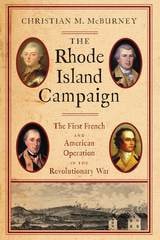
The Rhode Island Campaign
The First French and American Operation in the Revolutionary WarChristian M. McBurney
Westholme Publishing, 2011
The Marquis de Lafayette and the French Navy join Nathanael Green, John Sullivan, and a Continental Army to Attach a British Stronghold in New England
On July 29, 1778, a powerful French naval squadron sailed confidently to the entrance of Narragansett Bay. Its appearance commenced the first joint French and American campaign of the Revolutionary War. The new allies’ goal was to capture the British garrison at Newport, Rhode Island. With British resolve reeling from the striking patriot victory at Saratoga the previous autumn, this French and American effort might just end the war.
As the French moved into the bay, surprised British captains scuttled or burned many of their vessels rather than risk capture, resulting in the most significant loss of warships suffered by the British navy during the war. French Admiral Comte d’Estaing then turned to sea to engage the main British fleet but his ships were scattered and damaged by a huge storm. After his flagship and two other ships were attacked, d’Estaing’s squadron was taken out of the campaign. The American army under General John Sullivan, meanwhile, was stranded on a small island near Newport without the expected French naval support. When they tried to retreat off the island, British and Hessian regulars were sent to destroy Sullivan’s army; instead of a rout, a running battle ensued that lasted for more than six hours. Continentals, brimming with confidence after their training during the winter of Valley Forge, once more proved that they were an effective fighting force. While the Rhode Island Campaign ended in failure for the Americans and French, there were positive signs for the future of the alliance and the Revolution.
The Rhode Island Campaign: The First French and American Operation of the Revolutionary War unravels one of the most complex and multi-faceted events of the war, one which combined land and sea strategies and featured controversial decisions on both sides. Many prominent patriots participated, including Nathanael Greene, Marquis de Lafayette, John Hancock, and Paul Revere. Most important, while the campaign’s failure led to harsh criticism of the French in some quarters, leaders such as Greene, Lafayette, and George Washington steadfastly worked to ensure that the alliance would remain intact, knowing that the next joint operation could well succeed. Relying on in-depth research from American, French, British, and German original sources, author Christian McBurney has written the most authoritative book on this fascinating episode in American history.
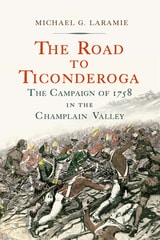
The Road to Ticonderoga
The Campaign of 1758 in the Champlain ValleyMichael G. Laramie
Westholme Publishing, 2027
Based on journals, letters, and accounts of the participants on both sides, The Road to Ticonderoga: The Campaign of 1758 in the Champlain Valley by Michael G. Laramie recounts this unexpected tale of victory and defeat on the North American frontier. Here we learn how the unexpected death of a dynamic leader, George Howe, elder brother of Richard and William, nearly crushed “the soul of General Abercrombie’s army,” leading to misinterpreted orders and hesitation on the part of the British. At the same time, the French commander perilously underestimated the ability of his own forces while overestimating his enemy’s before his fateful and unexpected decision to make his stand at Ticonderoga. With lessons and repercussions for future warfare in North America, The Road to Ticonderoga shows how a series of small mistakes can cascade into a catastrophe under weak leadership—or be exploited by a strong one.
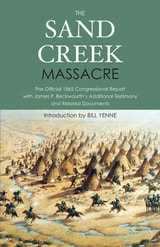
The Sand Creek Massacre
The Official 1865 Congressional Report with James P. Beckwourth's Additional Testimony and Related DocumentsUnited States Congress
Westholme Publishing, 2015
On the morning of November 29, 1864, Colorado state cavalry under the command of Col. John Chivington attacked a peaceful encampment of mostly Cheyenne Indians along the Sand Creek in Colorado, slaughtering perhaps as many as 160 people, mostly women and children. It was one of the most egregious atrocities of the Indian Wars. Even with the country embroiled in a Civil War, the gravity of the situation can be gauged by the fact that within six weeks of the killings, a Joint Committee of Congress conducted a public hearing. Congress vilified Chivington in summarizing his cowardly and racist attack in their published report: “Wearing the uniform of the United States, which should be the emblem of justice and humanity . . . he deliberately planned and executed a foul and dastardly massacre.” The Sand Creek Massacre: The Official 1865 Report contains a facsimile of the “Report of the Joint Committee on the Conduct of the War: Massacre of the Cheyenne Indians” along with unique annotations made by a reader at the time and the attached typescript testimony of the African American pioneer James P. Beckwourth, in which he recounts the atrocity. This edition is introduced by Bill Yenne. who places the Sand Creek Massacre in context within the Civil War and Indian Wars and provides biographical information about the main persons involved.

The Saratoga Campaign
Uncovering an Embattled LandscapeEdited by William A. Griswold and Donald W. Linebaugh
University Press of New England, 2016
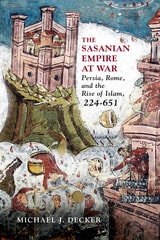
The Sasanian Empire at War
Persia, Rome, and the Rise of Islam, 224–651Michael J. Decker
Westholme Publishing, 2025
A comprehensive military history of one of the most important empires of Late Antiquity
The Sasanian Empire at War: Persia, Rome, and the Rise of Islam, 224–651 is the first comprehensive study in English examining war and society in one of the most important empires in world history: the Persian Empire of 224-651 AD, ruled by the Sasanian clan. At its height the Sasanians governed lands from the Indus River in the east to Egypt and the Mediterranean in the west. Adversaries of Rome, they also faced grave challenges from nomadic powers from Central Asia, notably the Huns and Turks. The Sasanians were able to maintain their empire for hundreds of years through nearly constant warfare, but when their expansion was checked in the north by the Byzantines at Constantinople in 626, and with the Muslim invasions to their south and west beginning in the 630s, the empire could no longer be sustained, and it finally collapsed.
In this book, Michael J. Decker examines Sasanian warfare, including military capabilities, major confrontations, organization and weapons of the Persian army. In addition to providing a comprehensive overview of the conflicts that marked this vital period in the history of Eurasia, The Sasanian Empire at War challenges long cherished notions of the inferiority of Sasanian military capabilities and renders a new image of a sophisticated, confident culture astride the heart of Eurasia at the end of the ancient world and birth of the Silk Road. Persian arms were among the many features of their culture that drew widespread admiration and was one of the keys to the survival of Iranian culture beyond the Arab Conquest and into the present day.
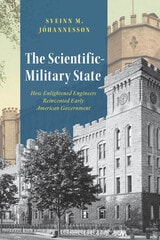
The Scientific-Military State
How Enlightened Engineers Reinvented Early American GovernmentSveinn M. Jóhannesson
University of Chicago Press, 2026
In The Scientific-Military State, Sveinn M. Jóhannesson charts the emergence of a new kind of governance in early-nineteenth-century America: the scientific-military state. Federal officials used mathematics, science, and other forms of enlightened knowledge to launch the nation’s very first experiments in scientific education and expert administration. These figures forged a new intellectual elite that socially elevated itself above ordinary soldiers, workers, and civilians and reshaped the military state itself beyond familiar models of standing army or militia. Originating primarily from the US Military Academy at West Point, these experts, who were often engineers, debated statecraft, analyzed topography, designed fortifications, manufactured weapons, built infrastructure, and exercised military power as the United States spread across the continent. But the even deeper result was a transformed relationship between the government and its citizens, one that echoes today.
The Second Palestinian Intifada
A Chronicle of a People's StruggleRamzy Baroud
Pluto Press, 2006
Ramzy Baroud is a veteran journalist and former producer for Al-Jazeera TV. This is his comprehensive account of the momentous events of the last five years which shaped the political landscape not only of Palestine and Israel but of the entire Middle East region.
Addressing the most controversial issues, including the alarming escalation in suicide bombings, and the construction of the Separation Wall, he reports on the huge rate of unemployment and hunger in the Occupied Territories -- statistics so critical that NGOs compare their magnitude to African nations such as the Congo. From the brutality of the Israeli army to the ever-compromising nature of the Palestinian Authority, few are spared Baroud’s thoughtful critique.
The book is clear and concise, with one chapter dedicated to the major events of each year, and includes a comprehensive timeline.
The Sergeant in the Snow
Mario Rigoni Stern
Northwestern University Press, 1998
The Shiloh Campaign
Edited by Steven E. Woodworth
Southern Illinois University Press, 2009
Some 100,000 soldiers fought in the April 1862 battle of Shiloh, and nearly 20,000 men were killed or wounded; more Americans died on that Tennessee battlefield than had died in all the nation’s previous wars combined. In the first book in his new series, Steven E. Woodworth has brought together a group of superb historians to reassess this significant battleandprovide in-depth analyses of key aspects of the campaign and its aftermath.
The eight talented contributors dissect the campaign’s fundamental events, many of which have not received adequate attention before now. John R. Lundberg examines the role of Albert Sidney Johnston, the prized Confederate commander who recovered impressively after a less-than-stellar performance at forts Henry and Donelson only to die at Shiloh; Alexander Mendoza analyzes the crucial, and perhaps decisive, struggle to defend the Union’s left; Timothy B. Smith investigates the persistent legend that the Hornet’s Nest was the spot of the hottest fighting at Shiloh; Steven E. Woodworth follows Lew Wallace’s controversial march to the battlefield and shows why Ulysses S. Grant never forgave him; Gary D. Joiner provides the deepest analysis available of action by the Union gunboats; Grady McWhineydescribes P. G. T. Beauregard’s decision to stop the first day’s attack and takes issue with his claim of victory; and Charles D. Grear shows the battle’s impact on Confederate soldiers, many of whom did not consider the battle a defeat for their side. In the final chapter, Brooks D. Simpson analyzes how command relationships—specifically the interactions among Grant, Henry Halleck, William T. Sherman, and Abraham Lincoln—affected the campaign and debunks commonly held beliefs about Grant’s reactions to Shiloh’s aftermath.
The Shiloh Campaign will enhance readers’ understanding of a pivotal battle that helped unlock the western theater to Union conquest. It is sure to inspire further study of and debate about one of the American Civil War’s momentous campaigns.
The Shipwreck of Their Hopes
The Battles for ChattanoogaPeter Cozzens
University of Illinois Press, 1994
Civil War enthusiasts will welcome this concluding volume of Peter Cozzens's highly praised trilogy on the Civil War in the West.
The battle around Chattanooga in the late fall of 1863 were among the most decisive of the Civil War, opening the Deep South to the Union and setting the stage for the Atlanta campaign and the March to the Sea. After Chattanooga, the principal Confederate army in the West fought without spirit or hope of victory. Cozzens's comprehensive account details movements of individual regiments, even as it reveals the larger impact of the campaign on the outcome of the war.
In The Shipwreck of Their Hopes, Cozzens draws on his acclaimed storytelling skills and exhaustive research efforts to fully chronicle one of the South's most humiliating defeats. As in his earlier books, he brings to life the officers and enlisted men who fought the war.
The Siege of Tyre
Alexander the Great and the Gateway to EmpireDavid A. Guenther
Westholme Publishing, 2024
The Siege of Tyre: Alexander the Great and the Gateway to Empire by David A. Guenther is the first book-length treatment of this critical and fascinating campaign, featuring catapults, triremes, religious invocations, close combat, and marvels of engineering, including a massive manmade causeway from the mainland to the island. The siege is thoroughly analyzed from the standpoint of what is plausible given the nature of the technology of the time and what we now know of the geology and physical fortifications of ancient Tyre. The book begins with the background leading up to the siege: Alexander’s army, his invasion of Asia Minor, the sieges of Miletus and Halicarnassus, and the battles of the Granicus and Issus. It also describes the culture, people, cities, and economy of ancient Phoenicia to place the story of the siege in a broader context. Critical to the siege were the evolving technologies in the ancient Mediterranean world, including innovations in catapult design, military engineering, and naval architecture. Guenther also takes into account recent scientific discoveries about the geology of the ancient seabed around Tyre and its effect on the siege. Finally, the book points out possible gender-biased views on topics such as sacred temple prostitution among the ancient Phoenicians and the fate of women in besieged cities of the ancient world. An engrossing blend of ancient wonder and historical and technological analysis, The Siege of Tyre is the remarkable story of Alexander the Great’s “masterpiece.”

The Silver Age in Our Home
A Memoir of Russian Literary Life in the 20th CenturySophia Bogatyreva
Central European University Press, 2027
These memoirs read as a significant contribution to scholarship, full of important facts and characterizations. At the same time, they become an original intellectual novel with real-life protagonists seen from the point of view of a child, teenager and young woman. The position of the narrator creates a “defamiliarizing” effect similar to the one about which the Formalists and first and foremost Viktor Shklovsky wrote. However, this powerful effect is “hidden in plain view” – the style of Bogatyreva’s memoirs is strikingly transparent and non-pretentious, which makes her book available even for an unprepared reader.
Mark Lipovetsky, Columbia University
The Sky on Fire
The First Battle of Britain, 1917-1918Raymond H. Fredette
University of Alabama Press, 2005
The forgotten air campaign that gave birth to modern air power.
A fascinating examination of the strategies and uses of air power in the First World War, Sky on Fire covers not only developments in military hardware and tactics but also how public policy and political considerations shaped the ways air power was deployed. Providing an excellent balance of data and statistics as well as human insights, Fredette’s book is essential reading for readers interested in the air power, both historically and in contemporary conflicts.
The Slaves Who Defeated Napoléon
Toussaint Louverture and the Haitian War of Independence, 1801–1804Philippe R. Girard
University of Alabama Press, 2011
A deeply researched and definitive account of the climactic battle at the end of the Haitian Revolution
Among the many rebellions against European colonial empires, the Haitian Revolution against France is among the most dramatic and complex. Having begun in 1791 as France was in the throes of its own young revolution, the conflict reached its dramatic climax when Napoleon dispatched a heavily armed expeditionary force led by his brother-in-law Charles Leclerc to re-establish slavery and the sugar economy that had so enriched France. Philippe Girard’s Slaves Who Defeated Napoleon is a deeply researched and engrossing account of this invasion and its spectacular defeat.
For this ambitious account, Philippe Girard has studied not only primary records in Haiti itself but also rare documents from nineteen public and private archives and research libraries in French, U.S., British, and Spanish collections. His more inclusive approach provides a fuller, more accurate and detailed narrative. He reveals not only key military movements, but also less-known aspects like the activities of U.S. merchants, in-fighting within Napoleon’s government, and communication between both sides and other European powers. Girard fills the work with unforgettable stories of those who led or were caught up in the war, people like poorly armed Black soldiers who ambushed Bonaparte’s columns, French child drummers, Jewish bankers in Kingston, weapon smugglers from Quaker Philadelphia, Polish artillerists, and mixed-raced people struggling to preserve their freedom against both Black and white opponents.
Transcending pat ideological and racial categories, the book brings into focus an Atlantic society at the crossroads of African and European influences, where Haitian rebels fought France while embracing its ideals.
The Soldiers Fell Like Autumn Leaves
The Battle of the Wabash, the United States' Greatest Defeat in the Wars Against Indigenous PeoplesRick M. Schoenfield
Westholme Publishing, 2026
The Soldiers Fell Like Autumn Leaves: The Battle of the Wabash, the United States’ Greatest Defeat in the Wars Against Indigenous Peoples by Rick M. Schoenfield places this important war into its cultural, racial, economic, and political context. For the first time, the ecological impact is explored, for at stake in the clash between Woodland Native Americans and white, agrarian settlement, was the fate of a vast forest eco-system. The issue echoes today in the debate over climate change, deforestation, and indigenous control of forest habitats. Based on primary sources, some of which are consulted here for the first time, including a newly discovered muster roll and the recent archaeological study of the battlefield, the author provides the most accurate description of the battle while capturing the drama of what occurred. He also critically examines the information gathering,planning, and tacticsof both the Maumee Confederation and the United States, from the conception of the campaign through the battlefield decisions. By skillfully weaving together the disparate but related parts of the larger history of this battle,The Soldiers Fell Like Autumn Leaves allows the reader to better understand the motivations and long-term consequences of the war against Native peoples in the Americas.
The Soldiers of Fort Mackinac
An Illustrated HistoryPhil Porter
Michigan State University Press, 2018
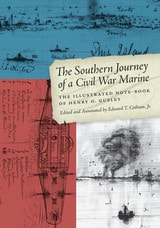
The Southern Journey of a Civil War Marine
The Illustrated Note-Book of Henry O. GusleyEdited and annotated by Edward T. Cotham, Jr.
University of Texas Press, 2006
On September 28, 1863, the Galveston Tri-Weekly News caught its readers' attention with an item headlined "A Yankee Note-Book." It was the first installment of a diary confiscated from U.S. Marine Henry O. Gusley, who had been captured at the Battle of Sabine Pass. Gusley's diary proved so popular with readers that they clamored for more, causing the newspaper to run each excerpt twice until the whole diary was published. For many in Gusley's Confederate readership, his diary provided a rare glimpse into the opinions and feelings of an ordinary Yankee—an enemy whom, they quickly discovered, it would be easy to regard as a friend.
This book contains the complete text of Henry Gusley's Civil War diary, expertly annotated and introduced by Edward Cotham. One of the few journals that have survived from U.S. Marines who served along the Gulf Coast, it records some of the most important naval campaigns of the Civil War, including the spectacular Union success at New Orleans and the embarrassing defeats at Galveston and Sabine Pass. It also offers an unmatched portrait of daily life aboard ship. Accompanying the diary entries are previously unpublished drawings by Daniel Nestell, a doctor who served in the same flotilla and eventually on the same ship as Gusley, which depict many of the locales and events that Gusley describes.
Together, Gusley's diary and Nestell's drawings are like picture postcards from the Civil War—vivid, literary, often moving dispatches from one of "Uncle Sam's nephews in the Gulf."
The Spanish Foreign Legion in the Spanish Civil War, 1936
José E. Alvarez
University of Missouri Press, 2016

The Spear Will Bend
The Tumultuous Life of a Burmese DemocratWin Htein
National University of Singapore Press, 2026
A rare insider’s account of Burmese history, including the nation’s ongoing civil conflicts.
Burma's ongoing travails have been framed by the conflict between former State Counsellor Aung San Suu Kyi and successive military juntas. Win Htein has been closely involved in many of these skirmishes. Involved in the formation of the National League for Democracy (NLD) in 1988, he became a key NLD figure, member of parliament, and one of “The Lady’s” closest confidantes. His detailed insider’s account of the NLD’s twists and turns over decades of military repression and a few brief years of democratic resurgence is unmatched.
In many ways, Htein's life has been intertwined with his country's recent history. Born during the Japanese invasion of British Burma in 1941, he grew up in the tumultuous years of Burma's independence. A military cadet when General Ne Win seized power in 1962, he later took part in the fight against communist and separatist organizations. He reveals several unknown stories from his time inside the military, which ended in 1977 when, in the aftermath of a failed military coup, he began a new career in business. In 1988, he became involved in the pro-democracy movement and joined the personal staff of Suu Kyi. His arrest, torture, and imprisonment the following year after the movement’s suppression and Suu Kyi’s house arrest began decades of detention, release, and political struggle. Following the 2021 coup, once again, he is behind bars.

The Spirits of Bad Men Made Perfect
The Life and Diary of Confederate Artillerist William Ellis JonesConstance Hall Jones
Southern Illinois University Press, 2020
In 1865 Jones returned to his prewar printing trade in Richmond, and his lasting reputation stems from his namesake publishing company’s role in the creation and dissemination of much of the Lost Cause ideology. Unlike the pro-Confederate books and pamphlets Jones published—primary among them the Southern Historical Society Papers—his diary shows the mindset of an unenthusiastic soldier. In a model of contextualization, Constance Hall Jones shows how her ancestor came to embrace an uncritical veneration of the army’s leadership and to promulgate a mythology created by veterans and their descendants who refused to face the amorality of their cause.
Jones brackets the soldier’s diary with rich, biographical detail, profiling his friends and relatives and providing insight into his childhood and post-war years. In doing so, she offers one of the first serious investigations into the experience of a Welsh immigrant family loyal to the Confederacy and makes a significant contribution to our understanding of Civil War–era Richmond and the nineteenth-century publishing industry. Invitingly written, The Spirits of Bad Men Made Perfect is an engaging life-and-times story that will appeal to historians and general readers alike.
The Summer the Archduke Died
On Wars and WarriorsLouis D. Rubin, Jr.
University of Missouri Press, 2008
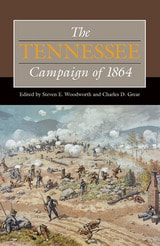
The Tennessee Campaign of 1864
Edited by Steven E. Woodworth and Charles D. Grear
Southern Illinois University Press, 2016
Contributors explore the campaign’s battlefield action, including how Major General Andrew J. Smith’s three aggressive divisions of the Army of Tennessee became the most successful Federal unit at Nashville, how vastly outnumbered Union troops held the Allatoona Pass, why Hood failed at Spring Hill and how the event has been perceived, and why so many of the Army of Tennessee’s officer corps died at the Battle of Franklin, where the Confederacy suffered a disastrous blow. An exciting inclusion is the diary of Confederate major general Patrick R. Cleburne, which covers the first phase of the campaign. Essays on the strained relationship between Ulysses S. Grant and George H. Thomas and on Thomas’s approach to warfare reveal much about the personalities involved, and chapters about civilians in the campaign’s path and those miles away show how the war affected people not involved in the fighting. An innovative case study of the fighting at Franklin investigates the emotional and psychological impact of killing on the battlefield, and other implications of the campaign include how the courageous actions of the U.S. Colored Troops at Nashville made a lasting impact on the African American community and how preservation efforts met with differing results at Franklin and Nashville.
Canvassing both military and social history, this well-researched volume offers new, illuminating perspectives while furthering long-running debates on more familiar topics. These in-depth essays provide an expert appraisal of one of the most brutal and notorious campaigns in Civil War history.
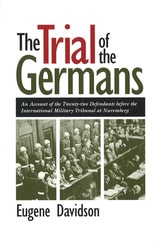
The Trial of the Germans
An Account of the Twenty-two Defendants before the International Military Tribunal at NurembergEugene Davidson
University of Missouri Press, 1997
The "definitive one-volume study of Nuremberg," The Trial of the Germans is now available in paperback. An astute observer of the Nuremberg trial, Eugene Davidson has struggled with the issues it raised: Was it a necessary response to the heinous crimes of the Third Reich? How were Germany and the Germans capable of such extraordinary evil? Was the trial just, given the claims that the defendants were simply serving their country, doing as they had been told to do? And if not just, was it nonetheless necessary as a warning to prevent future crimes against humanity? Davidson's approach to these and other large questions of justice is made through examination of each of the defendants in the trial. His reluctant, but firm, conclusion is: "In a world of mixed human affairs where a rough justice is done that is better than lynching or being shot out of hand, Nuremberg may be defended as a political event if not as a court." Some sentences may have seemed too severe, but none was harsher than the punishments meted out to innocent people by the regime these men served. "In a certain sense," says Davidson, "the trial succeeded in doing what judicial proceedings are supposed to do: it convinced even the guilty that the verdict against them was just."
Faulty as the trial was from the legal point of view, a catharsis of the pent-up emotions of millions of people had to be provided and a record of what had taken place duly preserved for whatever use later generations would make of it.
The U.S. Army Stability Operations Field Manual
U.S. Army Field Manual No. 3-07The United States Army
University of Michigan Press, 2009
Field Manual 3-07, Stability Operations, represents a milestone in Army doctrine.
With a focus on transforming conflict, managing violence when it does occur and maintaining stable peace, The U.S. Army Stability Operations Field Manual (otherwise known as FM 3-07) signals a stark departure from traditional military doctrine. The Army officially acknowledges the complex continuum from conflict to peace, outlines the military's responsibility to provide stability and security, and recognizes the necessity of collaboration, coordination, and cooperation among military, state, commercial, and non-government organizations in nation-building efforts.
The manual reflects a truly unique collaboration between the Army and a wide array of experts from hundreds of groups across the United States Government, the intergovernmental and non-governmental communities, America's allies around the world, and the private sector. All branches of the armed forces, U.S. agencies ranging from the State Department to Homeland Security to Health and Human Services, international agencies from the United Nations to the Red Cross to the World Bank, countries from the United Kingdom to India to South Africa, private think tanks from RAND to the United States Institute of Peace to the Center for New American Security, all took part in the shaping of this document.
The U.S. Army Stability Operations FieldManual, marks just the second time in modern history that the U.S. Army has worked with a private publisher to produce a military doctrinal document.
Lieutenant General William B. Caldwell, IV is Commander of the Combined Arms Center at Fort Leavenworth, Kansas.
Michèle Flournoy, Under Secretary of Defense for Policy
Shawn Brimley, Fellow, Center for a New American Security
Janine Davidson, Deputy Assistant Secretary of Defense for Plans
"It is a roadmap from conflict to peace, a practical guidebook for adaptive, creative leadership at a critical time in our history. It institutionalizes the hard-won lessons of the past while charting a path for tomorrow. This manual postures our military forces for the challenges of an uncertain future, an era of persistent conflict where the unflagging bravery of our Soldiers will continue to carry the banner of freedom, hope, and opportunity to the people of the world."
—From the foreword by Lieutenant General William B. Caldwell, IV, Commander of the Combined Arms Center at Fort Leavenworth, Kansas
The U.S. Army in the War of 1812
Robert Quimby
Michigan State University Press, 1997
This two-volume work by historian Robert Quimby presents a comprehensive and detailed analysis of military strategy, operations, and management during one of America’s most neglected and least understood military campaigns, the War of 1812. With causes that can be traced to the epic contest against Napoleon in Europe beginning in 1803, the war itself was the first conducted by the young Constitutional government of the United States. Quimby demonstrates that failed American initiatives at the beginning of hostilities shattered the unrealistic optimism of the war’s staunchest advocates; and while initial failures were followed by military success in 1813, whatever advantage might have been gained was soon lost to incompetent leadership. Major exceptions occurred in the Old Northwest, and in what was then the Southwest, where U.S. forces finally broke the strength of the long-successful Indian-British alliance.
In retrospect, what occurred during the War of 1812 demonstrated the necessity for gaining citizen support before committing the nation to armed conflict; it also provided a series of object lessons on how not to conduct a military campaign. Finally Quimby argues that, notwithstanding several victories at war’s end, including the fabled Battle of New Orleans, American perceptions that the United States "won" the war are erroneous; at best the struggle ended in a draw. The United States Army in the War of 1812 is an up-to-date and long overdue reassessment of military actions conducted during a pivotal conflict in American history, one that shaped U.S. military doctrine for a half century.
The U.S. Army/Marine Corps Counterinsurgency Field Manual
The United States Army and Marine Corps
University of Chicago Press, 2007
When the U.S. military invaded Iraq, it lacked a common understanding of the problems inherent in counterinsurgency campaigns. It had neither studied them, nor developed doctrine and tactics to deal with them. It is fair to say that in 2003, most Army officers knew more about the U.S. Civil War than they did about counterinsurgency.
The U.S. Army / Marine Corps Counterinsurgency Field Manual was written to fill that void. The result of unprecedented collaboration among top U.S. military experts, scholars, and practitioners in the field, the manual espouses an approach to combat that emphasizes constant adaptation and learning, the importance of decentralized decision-making, the need to understand local politics and customs, and the key role of intelligence in winning the support of the population. The manual also emphasizes the paradoxical and often counterintuitive nature of counterinsurgency operations: sometimes the more you protect your forces, the less secure you are; sometimes the more force you use, the less effective it is; sometimes doing nothing is the best reaction.
An new introduction by Sarah Sewall, director of the Carr Center for Human Rights Policy at Harvard’s Kennedy School of Government, places the manual in critical and historical perspective, explaining the significance and potential impact of this revolutionary challenge to conventional U.S. military doctrine.
An attempt by our military to redefine itself in the aftermath of 9/11 and the new world of international terrorism, The U.S. Army / Marine Corps Counterinsurgency Field Manual will play a vital role in American military campaigns for years to come.
The University of Chicago Press will donate a portion of the proceeds from this book to the Fisher House Foundation, a private-public partnership that supports the families of America’s injured servicemen. To learn more about the Fisher House Foundation, visit www.fisherhouse.org.
The UP Saga
Susan M. Martin
National University of Singapore Press, 2003
The USS Wisconsin
A History of Two BattleshipsRichard H. Zeitlin
Wisconsin Historical Society Press, 1988
Battleships were instrumental in America’s rise to world dominance at the end of the 19th century. Two battleships in particular, the U.S.S. Wisconsin BB-9 and BB-64, participated in wars and conflicts around the globe, demonstrating America’s strength and technological power. The keel of the BB-9 was laid down on the eve of the Spanish-American War, and she sailed with the Great White Fleet on its famous world voyage of 1907-1909. Representing a major advance in American naval technology, the Wisconsin both demonstrated American strength in the Pacific and served as the setting for peace talks between Panama and Colombia when the former gained independence in 1903. Recommissioned during World War I as a training ship, the BB-9 was then decommissioned in 1920. More than twenty years later, on December 7, 1943, the fast battleship Wisconsin (BB-64) was launched in response to Japan’s attack on Pearl Harbor. The BB-64 served in the Pacific to the end of World War II and again in the Korean War. One of the Iowa- class battleships, the BB-64 was one of the fastest and sleekest on the ocean. In 1988, she was refitted and recommissioned for yet another tour of duty. This is the story of two proud vessels and their role in American naval and diplomatic history.
The Union on Trial
The Political Journals of Judge William Barclay Napton, 1829-1883Edited by Christopher Phillips & Jason L. Pendleton. Introduction by Christopher Phillips
University of Missouri Press, 2005
The Vicksburg Assaults, May 19-22, 1863
Edited by Steven E. Woodworth and Charles D. Grear
Southern Illinois University Press, 2019
But due to difficult terrain, strong defenses, and uncoordinated movements, the quick triumph Grant desired was unattainable. On the afternoon of May 19, with little rest, preparation, or reconnaissance, Union forces charged the Confederate lines only to be repulsed. A respite between the assaults allowed both sides to reinforce their positions. Early on May 22 the Union artillery sought to soften the stronghold’s defenses before the general attack, but despite the Union forces’ preparation, the fighting proved even more disorganized and vicious. Again Grant failed to move Pemberton. Not wanting to risk more soldiers in a third attack, Grant conceded to the necessity of laying siege. Confederate morale climbed as the Southerners realized they had held their ground against an overwhelming force.
Editors Steven E. Woodworth and Charles D. Grear have assembled five captivating essays that examine Grant’s unsuccessful assaults against Confederate defensive lines around Vicksburg. Ranging from military to social history, the essays further historical debates on prominent topics, such as the reactions of Midwesterners to the first failures of Grant’s Vicksburg campaign. Two essays from opposing sides analyze the controversial decisions surrounding the Railroad Redoubt, the site of the bloodiest fighting on May 22. Another investigates how the tenacity of Texan reinforcements forced Union soldiers to abandon their gains.
Peppered with first-hand observations and bolstered by an impressive depth of research, this anthology is an invitingly written account and comprehensive assessment. By zeroing in on the two assaults, the contributors offer essential clarity and understanding of these important events within the larger scope of the Civil War’s Vicksburg Campaign.
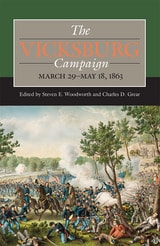
The Vicksburg Campaign, March 29–May 18, 1863
Edited by Steven E. Woodworth and Charles D. Grear
Southern Illinois University Press, 2013
Ulysses S. Grant’s ingenious campaign to capture the last Confederate stronghold on the Mississippi River was one of the most decisive events of the Civil War and one of the most storied military expeditions in American history. The ultimate victory at Vicksburg effectively cut the Confederacy in two, gave control of the river to Union forces, and delivered a devastating blow from which the South never fully recovered. Editors Steven E. Woodworth and Charles D. Grear have assembled essays by prominent and emerging scholars, who contribute astute analysis of this famous campaign’s most crucial elements and colorful personalities.
Encompassed in this first of five planned volumes on the Vicksburg campaign are examinations of the pivotal events that comprised the campaign’s maneuver stage, from March to May of 1863. The collection sheds new light on Grant’s formidable intelligence network of former slaves, Mississippi loyalists, and Union spies; his now legendary operations to deceive and confuse his Confederate counterparts; and his maneuvers from the perspective of classic warfare. Also presented are insightful accounts of Grant’s contentious relationship with John A. McClernand during the campaign; interactions between hostile Confederate civilians and Union army troops; and the planning behind such battles as Grierson’s Raid, Port Gibson, Raymond, Jackson, Champion Hill, and Big Black River Bridge.
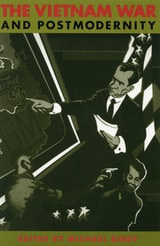
The Vietnam War and Postmodernity
Michael Bibby
University of Massachusetts Press, 1999
The longest war in the nation's history, the American military intervention in Vietnam dominated United States culture and politics from 1965 to 1975. In addition to causing immense devastation in Southeast Asia, the war transformed American society, with effects that continue to be felt today. Yet aside from a few cultural studies of the war's representations, scholars have tended to ignore the relationship between the American war in Vietnam and broader cultural developments in the West. Frederic Jameson once characterized the Vietnam War as “the first terrible postmodernist war,” suggesting that it embodied or reflected the sensibility of an emerging historical epoch. But does it make sense to place a military conflict within a category of cultural and aesthetic periodization? Is it possible to see the Vietnam War as an expression and reflection of postmodernity—what Jameson calls “the cultural logic of late capitalism?” These are some of the questions addressed in this volume. Ranging across a variety of disciplines, including philosophy, cultural studies, literary criticism, and film studies, the essays explore the war's discourses and technologies in relation to the post-modern condition. At the same time, they reinterpret key cultural representations of the war from a postmodern perspective. The result is a book that poses important challenges to both Vietnam War studies and postmodern studies, at once reshaping the ways postmodernity is conceived and reminding us of the war's enduring significance in contemporary cultural history. In addition to Michael Bibby, contributors are Philip D. Beidler, Michael Clark, Cynthia J. Fuchs, Brady Harrison, Tony Williams, Eric Gadzinski, Chris Hables Gray, and Douglas Kellner.
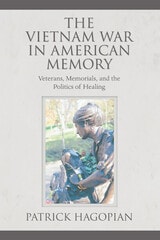
The Vietnam War in American Memory
Veterans, Memorials, and the Politics of HealingPatrick Hagopian
University of Massachusetts Press, 2009
A study of American attempts to come to terms with the legacy of the Vietnam War, this book highlights the central role played by Vietnam veterans in shaping public memory of the war.
Tracing the evolution of the image of the Vietnam veteran from alienated dissenter to traumatized victim to noble warrior, Patrick Hagopian describes how efforts to commemorate the war increasingly downplayed the political divisions it spawned in favor of a more unifying emphasis on honoring veterans and promoting national “healing.”
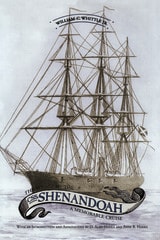
The Voyage of the CSS Shenandoah
A Memorable CruiseWilliam C. Whittle
University of Alabama Press, 2005
The only Confederate ship to circumnavigate the globe
The Confederate cruiser Shenandoah was the last of a group of commerce raiders deployed to prey on Union merchant ships. Ordered to the Pacific Ocean to “greatly damage and disperse” the Yankee whaling fleet in those waters, the Shenandoah’s successful pursuit of her quarry compared favorably with the exploits of the more celebrated Alabama and Florida but has never been as well known because it coincided with the war’s end and the Confederacy’s downfall. It was, however, one of the best documented naval expeditions—from England to the Indian Ocean, Australia and the South Pacific, the Bering Sea, San Francisco, and finally to port in Liverpool—during the Civil War.
The ship’s log and Captain James Waddell’s notes are well preserved, and a number of the Shenandoah’s officers kept detailed journals of the entire voyage. One of the most significant journals, by Lieutenant William Whittle, is presented here, with annotations from other journals, the official records and logs, and newspaper accounts of the Shenandoah’s activities, together bringing to life the history of this remarkable voyage.

The Wake of Wellington
Englishness in 1852Peter W. Sinnema
Ohio University Press, 2006
Soldier, hero, and politician, the Duke of Wellington is one of the best-known figures of nineteenth-century England. From his victory at Waterloo over Napoleon in 1815, he rose to become prime minister of his country. But Peter Sinnema finds equal fascination in Victorian England’s response to the duke’s death.
The Wake of Wellington considers Wellington’s spectacular funeral pageant in the fall of 1852—an unprecedented event that attracted one and a half million spectators to London—as a threshold event against which the life of the soldier-hero and High Tory statesman could be re-viewed and represented.
Canvassing a profuse and dramatically proliferating Wellingtoniana, Sinnema examines the various assumptions behind, and implications of, the Times’s celebrated claim that the Irish-born Wellington “was the very type and model of an Englishman.” The dead duke, as Sinnema demonstrates, was repeatedly caught up in interpretive practices that stressed the quasi-symbolic relations between hero and nation.
The Wake of Wellington provides a unique view of how in death Wellington and his career were promoted as the consummation of a national destiny intimately bound up with Englishness itself, and with what it meant to be English at midcentury.
The War Complex
World War II in Our TimeMarianna Torgovnick
University of Chicago Press, 2005
Marianna Torgovnick argues that we have lived, since the end of World War II, under the power of a war complex—a set of repressed ideas and impulses that stems from our unresolved attitudes toward the technological acceleration of mass death. This complex has led to gaps and hesitations in public discourse about atrocities committed during the war itself. And it remains an enduring wartime consciousness, one most recently animated on September 11.
Showing how different events from World War II became prominent in American cultural memory while others went forgotten or remain hidden in plain sight, The War Complex moves deftly from war films and historical works to television specials and popular magazines to define the image and influence of World War II in our time. Torgovnick also explores the 1961 trial of Adolf Eichmann, the emotional legacy of the Holocaust, and the treatment of World War II's missing history by writers such as W. G. Sebald to reveal the unease we feel at our dependence on those who hold the power of total war. Thinking anew, then, about how we account for war to each other and ourselves, Torgovnick ultimately, and movingly, shows how these anxieties and fears have prepared us to think about September 11 and our current war in Iraq.
The War of 1812 in the West
From Fort Detroit to New OrleansDavid Kirkpatrick
Westholme Publishing, 2019
The spring of 1812 found the young American republic on edge. The British Navy was impressing American seamen with impunity at an alarming rate while vicious attacks on frontier settlements by American Indians armed with British weapons had left a trail of fear and outrage. As calls for a military response increased, Kentucky, the first state west of the Appalachians, urged that only by defeating the British could the nation achieve security. The very thought conjured up embellished memories of the American Revolution, and once war was declared, many soldiers believed that the “Spirit of 76” would lead them to victory. But the conflict quickly transformed from a patriotic parade to a desperate attempt to survive against a major military power. While the War of 1812 is known mostly for later events, including the burning of Washington and the siege of Fort McHenry, much of the first two years of the war was fought in the west, with the British Army and their Indian allies nearly overrunning the Old Northwest and threatening the borders of the original colonies.
In The War of 1812 in the West: From Fort Detroit to New Orleans, David Kirkpatrick chronicles the near catastrophic loss of the Ohio, Indiana, and Illinois Territories, the bitter fight against both Tecumseh’s Confederation and the Creek Nation, and the slow recovery and ultimate victory of American forces—a large portion of which was supplied by Kentucky—from Canada to the Gulf of Mexico. Battles such as River Raisin, Thames River, Fort Meigs, and New Orleans are placed in context to show how they secured America’s frontier and opened territory to the west to new settlement following the war.
The War of 1812, A Short History
Donald R. Hickey
University of Illinois Press, 2012
This abridged edition of Donald R. Hickey's comprehensive and authoritative The War of 1812: A Forgotten Conflict has been thoroughly revised for the 200th anniversary of the historic conflict. A myth-shattering study that will inform and entertain students and general readers alike, The War of 1812: A Short History explores the military, diplomatic, and domestic history of our second war with Great Britain, bringing the study up to date with recent scholarship on all aspects of the war, from the Gulf of Mexico to Canada.