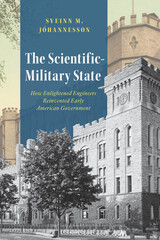
The Scientific-Military State: How Enlightened Engineers Reinvented Early American Government
University of Chicago Press, 2026
Cloth: 978-0-226-84763-4 | Paper: 978-0-226-84765-8 | eISBN: 978-0-226-84764-1 (all)
Library of Congress Classification UG23.J58 2026
See other books on: Enlightenment | History, Military | Influence | Military | Military engineering
See other titles from University of Chicago Press
Cloth: 978-0-226-84763-4 | Paper: 978-0-226-84765-8 | eISBN: 978-0-226-84764-1 (all)
Library of Congress Classification UG23.J58 2026
ABOUT THIS BOOK | AUTHOR BIOGRAPHY | REVIEWS | TOC | REQUEST ACCESSIBLE FILE
ABOUT THIS BOOK
Argues that engineers influenced by French Enlightenment science built much of the machinery of America’s military state while redrawing the line between the federal government and society.
In The Scientific-Military State, Sveinn M. Jóhannesson charts the emergence of a new kind of governance in early-nineteenth-century America: the scientific-military state. Federal officials used mathematics, science, and other forms of enlightened knowledge to launch the nation’s very first experiments in scientific education and expert administration. These figures forged a new intellectual elite that socially elevated itself above ordinary soldiers, workers, and civilians and reshaped the military state itself beyond familiar models of standing army or militia. Originating primarily from the US Military Academy at West Point, these experts, who were often engineers, debated statecraft, analyzed topography, designed fortifications, manufactured weapons, built infrastructure, and exercised military power as the United States spread across the continent. But the even deeper result was a transformed relationship between the government and its citizens, one that echoes today.
In The Scientific-Military State, Sveinn M. Jóhannesson charts the emergence of a new kind of governance in early-nineteenth-century America: the scientific-military state. Federal officials used mathematics, science, and other forms of enlightened knowledge to launch the nation’s very first experiments in scientific education and expert administration. These figures forged a new intellectual elite that socially elevated itself above ordinary soldiers, workers, and civilians and reshaped the military state itself beyond familiar models of standing army or militia. Originating primarily from the US Military Academy at West Point, these experts, who were often engineers, debated statecraft, analyzed topography, designed fortifications, manufactured weapons, built infrastructure, and exercised military power as the United States spread across the continent. But the even deeper result was a transformed relationship between the government and its citizens, one that echoes today.
See other books on: Enlightenment | History, Military | Influence | Military | Military engineering
See other titles from University of Chicago Press