Results by title
584 books match the query 'Short Stories (single author)' and 172 start with t
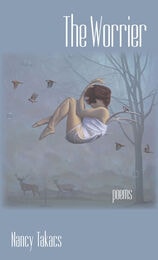
The Worrier
poemsNancy Takacs
University of Massachusetts Press, 2017
What do you know?
How I hide my flaws.
What do you know?
How butterflies
sweeten themselves
opening and closing their wings together
in a little hill
on the beach.
—"The Worrier bed"
The Worrier poems, like a string of worry beads, are dialogues between two interior voices exploring topics as varied as fur coats, marriage, scars, vanishing bees, a silent film star, toads, and volunteers. Strongly imagistic, and often placed in wild landscapes of Utah and Wisconsin, these poems strangely soothe with their surprising offbeat answers to Takacs's worries about intimacy, loss, and turmoil in midlife and beyond; about disappearing wilderness, and compassion, in the world at large. Despite worrying, the poems seem fearless in what they tackle, and in their language and form, creating lightness, promise.

The Year They Gave Women the Priesthood and Other Stories
Michael Fillerup
Signature Books, 2022
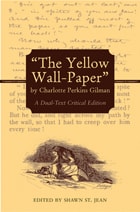
The Yellow Wall-Paper by Charlotte Perkins Gilman
A Dual-Text Critical EditionCharlotte Perkins Gilman
Ohio University Press, 2006
Most editions have been based on the 1892 New England Magazine publication rather than the handwritten manuscript at Radcliffe College. Publication of the unedited manuscript in 1994 sparked controversy over which of the two was definitive. Since then, scholars have discovered half a dozen parent texts for later twentieth-century printings, including William Dean Howells’s version from 1920 and the 1933 Golden Book version.
While traditional critical editions gather evidence and make an argument for adopting one text as preferable to others,“The Yellow Wall-Paper” by Charlotte Perkins Gilman: A Dual-Text Critical Edition, edited by Shawn St. Jean, offers both manuscript and magazine versions, critically edited and printed in parallel for the first time. New significance appears in such facets as the magazine’s accompanying illustrations, its lineation and paragraphing, Gilman’s choice of pronouns, and her original handwritten ending.
This critical edition of “The Yellow Wall-Paper” includes a full and nontraditional apparatus, making it easy for students and scholars to study the more than four hundred variants between the two texts. Four new essays, written especially for this volume, explore the implications of this multitext model.
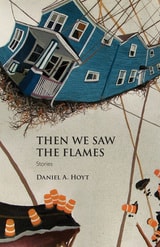
Then We Saw the Flames
StoriesDaniel A. Hoyt
University of Massachusetts Press, 2009
In this freewheeling debut collection, Daniel A. Hoyt takes us from the swamps of Florida to the streets of Dresden, to the skies above America, to the tourist hotels of Acapulco, to the southwest corner of Nebraska. Along the way, we encounter a remarkable group of characters all struggling to find their footing in an unsettling world.
Sometimes magical, sometimes realistic, sometimes absurd, these stories reveal people teetering on the dangerous edge of their lives. In “Amar,” a Turkish restaurant owner deals with skinheads and the specter of violence that haunts his family. In “Boy, Sea, Boy,” a shipwrecked sailor receives a surreal visitor, a version of himself as a child. In “The Collection,” a father and son squander a trove of bizarre and fanciful objects. And in “The Kids,” a suburban couple grasp for meaning after discovering children eating from their trash.
In each of these stories, characters find themselves challenged by the political, cultural, and spiritual forces that define their lives. With a clear eye and a steady hand, Hoyt explores a fragile balance: the flames—fueled by love, loss, hope, and family—shed new light on us. Sometimes we feel warmth, and sometimes we simply burn.

There's Nothing Left for You Here
Allegra Solomon
Four Way Books, 2025
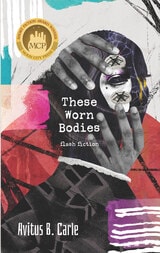
These Worn Bodies
Flash FictionAvitus B. Carle
Moon City Press, 2024

They Die Strangers
By Mohammad Abdul-Wali
University of Texas Press, 2002
They Die Strangers, a novella and thirteen short stories, is the first full-length work of the distinguished Yemeni writer Mohammad Abdul-Wali to appear in English. Abdul-Wali died tragically in an aviation accident, and his stories were collected after his death by the translators Abubaker Bagader and Deborah Akers.
Abdul-Wali was born in Ethiopia of Arab Yemeni parents. His stories, filled with nostalgia and the bitterness of exile, deal with the common experiences of Yemenis like himself who are caught between cultures by the displacements of civil war or labor migration. His characters include women left behind, children raised without fathers, and men returning home after years of absence. He explores the human condition through the eyes of the oppressed and disenfranchised and is particularly sympathetic to the plight of women.
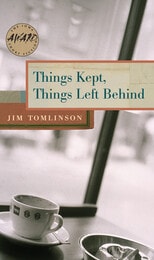
Things Kept, Things Left Behind
Jim Tomlinson
University of Iowa Press, 2006

Thirteen Alabama Ghosts and Jeffrey
Kathryn Tucker Windham
University of Alabama Press, 1987
Jeffrey is the mischievous "something" that has headquarters in the Windham home in Selma, Alabama. He first made his presence known in October 1966, and since then he has continued, at irregular and infrequent intervals, to clump down the hall, slam doors, rock in a chair, frighten the family cat (now deceased, through no fault of Jeffrey), move heavy pieces of furniture, cause electronic equipment to malfunction, and hide objects. He frequently accompanies Mrs. Windham on her travels, and tales of Jeffrey's antics are widely recounted.
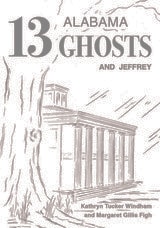
Thirteen Alabama Ghosts and Jeffrey
Commemorative EditionKathryn Tucker Windham
University of Alabama Press, 1969
Step into Alabama’s haunted history—one story at a time.
One of the best-known and widely shared books about the South, Thirteen Alabama Ghosts and Jeffrey has haunted the imaginations of generations of delighted young readers since it was first published in 1969. Written by nationally acclaimed folklorists Kathryn Tucker Windham and Margaret Gillis Figh, the book recounts Alabama’s thirteen most ghoulish and eerie ghost legends.
Curated with loving expertise, these thirteen tales showcase both Windham and Figh’s masterful selection of stories and their artful and suspenseful writing style. In crafting stories treasured by children and adults alike, the authors tell much more than ghost tales. Embedded in each is a wealth of fact and folklore about Alabama history and the old South. “I don’t care whether you believe in ghosts,” Windham was fond of saying. “The good ghost stories do not require that you believe in ghosts.”
Millions of readers cherish memories of being chilled as teachers and parents read them unforgettable stories like “The Unquiet Ghost at Gaineswood,” about the ghost of Evelyn Carter, who fills this Demopolis antebellum mansion with midnight musical lamentations because her body wasn’t returned to her native Virginia, and “The Phantom Steamboat of the Tombigbee,” about the wreck of the steamboat Eliza Battle, which caught fire on the way to Mobile and sank one February night in 1858. People who live along the river say the flaming steamboat wreck still rises on cold nights, its cotton cargo blazing across the waves while its terrified survivors cry for help from the icy water.
The title’s “Jeffrey” refers to a friendly ghost who resides in the Windham home and who served as Windham’s unofficial collaborator in this work and the subsequent books in this popular series, all of which are now available in high-quality reproductions of their spooky originals.
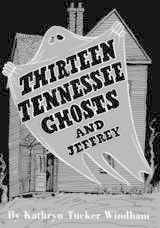
Thirteen Tennessee Ghosts and Jeffrey
Commemorative EditionKathryn Tucker Windham
University of Alabama Press, 2016
A deluxe, commemorative edition of famed southern author and folklorist Kathryn Tucker Windham’s introduction to the Volunteer State’s most enduring ghost stories.
In Thirteen Tennessee Ghosts and Jeffrey, beloved and best-selling folklorist Kathryn Tucker Windham presents a spine-tingling collection of Tennessee’s eeriest ghost tales. Accompanied by her faithful companion, Jeffrey, a friendly spirit who resided in her home, Windham traveled from the mysterious muds of Memphis to the haunted hollow’s of east Tennessee to collect the spookiest collection of Volunteer State revenants ever written.
In these perennial favorites, Windham captures the gentle folk humor of native Tennesseans as well as fascinating facts about the state’s rich history. In “The Dark Legend,” Windham recounts the story of explorer Merriwether Lewis, who met an untimely end on the Natchez Trace 1809 and whose spirit, it is said, still treads through Tennessee’s forests. Windham also visits central Tennessee’s Chapel Hill, where people who know the town say those who stand on the train tracks on dark, lonely nights can often see a disembodied light floating along the tracks. Neighbors say it’s the ghost of a headless flagman who returns to cavort with night-time guests.
High in Tennessee’s Appalachian mountains, Windham encounters Martin, the phantom fiddler of Johnson County. Legend has it that in life Martin’s musical skills so mesmerized the snakes of the Stone Mountains that they would slither from their dens to listen tamely to his fiddling. Intrepid visitors to the rocky tops of northeast Tennessee’s mountains say you can still hear Martin’s ghost fiddling in the hollows.
This handsome, new commemorative hardback edition returns Windham’s suspenseful classic to its original keepsake quality and includes a new afterword by the author’s children.

This Day in History
Anthony Varallo
University of Iowa Press, 2005
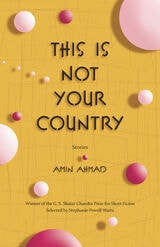
This Is Not Your Country
StoriesAmin Ahmad
BkMk Press, 2021
Stories in This Is Not Your Country have appeared in such places as The Missouri Review, Slice, and Asian American Literary Review.
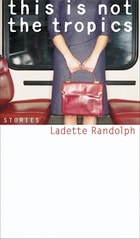
This Is Not the Tropics
StoriesLadette Randolph
University of Wisconsin Press, 2005
The stories collected in This Is Not the Tropics come from the geographic center of a divided nation, and its protagonists evoke a split personality—one half submerged in America’s own diehard mythology, the other half searching to escape tradition. Together they form a portrait of the Plains that is both quirky and poignant. While the themes in this collection are familiar—love and betrayal, loneliness and regret, the needs of the individual versus the needs of the community—the tales themselves are startling and new. Whether it is the story of an eccentric out-of-work accordion player; a woman ending a long marriage against the backdrop of a visit from her failing mother; a young girl who wishes to solve a mystery until real mystery enters her life; or all of the men in a small Nebraska town who annually compete in a hilariously earnest beauty pageant, these are tales that speak of the lives lived in the small towns, the prairie cities, and on the dirt roads off blue highways in the middle of nowhere and everywhere.
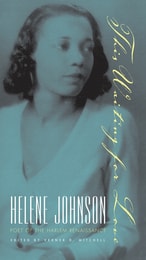
This Waiting for Love
Helene Johnson, Poet of the Harlem RenaissanceVerner D. Mitchell
University of Massachusetts Press, 2000
This volume brings together all of the known poetry and a selection of correspondence by an enormously talented but underappreciated poet of the Harlem Renaissance. Cousin of novelist Dorothy West and friend of Zora Neale Hurston, Helene Johnson (1905–1995) first gained literary prominence when James Weldon Johnson and Robert Frost selected three of her poems for prizes in a 1926 competition. During the late 1920s and early 1930s her poetry appeared in various small magazines, such as the Saturday Evening Quill, Palms, Opportunity, and Harlem. In 1933 Johnson married, and two years later her last published poem, “Let Me Sing My Song,” appeared in Challenge, the journal West had founded to revive the spirit of the Harlem Renaissance.
In his well-researched introduction, Verner D. Mitchell reconstructs Johnson's life, the details of which have long been veiled from public view, and places her in the context of a vital literary tradition. In addition to discussing her relationship with West, Hurston, and other black women writers, he explores the distinctive, at times radical, qualities of her work. Ever willing to defy the genteel conventions that governed women's writing, Johnson wrote poems on erotic themes and engaged the aesthetic, gender, and racial politics of her time.
Cheryl A. Wall's foreword also celebrates Johnson's talent, particularly the ease with which she moved among various verse forms—from the rigor of the sonnet to the improvisational creativity of free black vernacular. “An unexpected and most welcome gift,” This Waiting for Love, Wall writes, is “an enduring tribute” to “the vibrant poetry of Helene Johnson.”
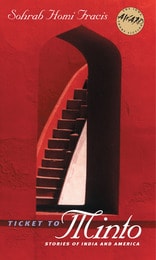
Ticket to Minto
Stories of India and AmericaHomi Sohrab Fracis
University of Iowa Press, 2001
Ticket to Minto, Sohrab Homi Fracis's premier fiction collection, offers readers a passage to an unfamiliar destination-a world suspended between East and West, India and America, home and away.
With piercing insight, Fracis expertly reveals the underlying differences between immersion in India's culture-Hindu, Muslim, or Parsi-and life as an Indian in America. Alternating between East and West, the stories in Ticket to Minto serve as companion pieces, interrelated across continents in both theme and content. A middle-aged man's search for love in Bombay is contrasted with an Indian American family's hopes for the marriage of their westernized daughter. A university student rushes to save the life of a servant in his homeland only to find his own life threatened while attending graduate school in America.
Poignant and daring, Ticket to Minto underlines the harsh realization that the immigrant never truly arrives but is in constant limbo between two worlds. As one character relates, "There's a part of me that's American and a part that's Indian. I'm clear about that and comfortable with it, except that sometimes people want me to be just the one or the other."
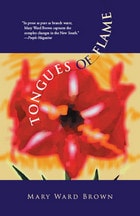
Tongues of Flame
Mary Ward Brown
University of Alabama Press, 1993
Winner of the PEN/Hemingway Foundation Award
These beautifully crafted stories depict the changing relationships between black and white southerners, the impact of the civil rights movement, and the emergence of the New South.
Mary Ward Brown is a storyteller in the tradition of such powerful 20th-century writers as William Faulkner, Harper Lee, Flannery O'Connor, and Eudora Welty-writers who have explored and dramatized the tension between the inherited social structure of the South and its contemporary dissolution. With Tongues of Flame, her first collection of short stories, Brown bares the awkward, sometimes hopeful, and often tragic suffering of people caught in changing times within a timeless setting.
Here we meet such memorable characters as a dying black woman who seeks the advice of a now-alcoholic white doctor whom she knew in better years; a young woman, jilted at the altar, driven crazy by an illuminated cross erected by the church opposite her house; and a 95-year-old woman buying a tombstone for her long-deceased husband only to discover that he had been adulterous throughout their marriage. Brown constructs her characters in a disarmingly plain style while breathing life into them with compassion and honesty as they confront the large moments of their lives.
First published by E. P. Dutton in 1986 to immediate critical acclaim, Tongues of Flame won the 1987 PEN/Ernest Hemingway Foundation Award. The judges commended Brown for "seeing life whole, without prejudice, without sentimentality, without histrionics. Her voice may be quiet-sometimes she speaks in a whisper-but her words are, nevertheless, always forceful, clear, and ultimately lasting." With this new publication of Tongues of Flame and its inclusion in the University of Alabama Press's Deep South Books series, a whole new generation of readers may once more discover Mary Ward Brown's profound stories of pain, loss, and hope.
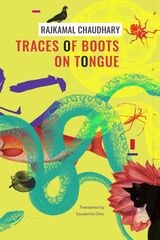
Traces of Boots on Tongue
and Other StoriesRajkamal Chaudhary
Seagull Books, 2023
Drawing influences from Indian folktales, French existentialism, and the Bengali Hungryalist movement, Rajkamal Chaudhary’s œuvre is like a secret back alley in an old city—not completely forgotten but existing only for the few. Even though Chaudhary also wrote in Maithili and Bengali, it was his writings in Hindi that established him as the bold new experimentalist of Indian literature. His India of the 1950 and 60s is populated with hopeless literature professors, scattered alcohol bottles, prostitutes, hysteria patients, and sell-out painters. His unconventional life and writing place him outside the mainstream, and so he remains as uncategorizable as the characters and lives he wrote about. Bringing together twelve of his most representative short stories, translated for the first time in English, Traces of Boots on Tongue and Other Stories allows a glimpse into the early decades of independent India and its weariness, which many readers will find in today’s India as well.
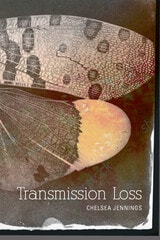
Transmission Loss
Chelsea Jennings
University of Massachusetts Press, 2018
In the study of sound waves and optics, the term transmission loss refers to how a signal grows weaker as it travels across distance and between objects. In this book, Chelsea Jennings reimagines the term in poems that register attenuated signals, mark presence and loss, and treat the body as an instrument sensitive to the weather of immediate experience. Threading together landscapes, abstract paintings, family heirlooms, maps, manuscripts, and photographs, these poems follow the seasons and traverse the spectrum of visible light. Vivid and precise, Transmission Loss brings us to the boundary between inside and outside, “As if what the hand knows / could be held in the hand.”
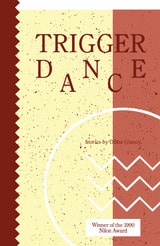
Trigger Dance
Diane Glancy
University of Alabama Press, 1991
1990 Winner of the Mildren P. Nilon Award for Minority Fiction
In Trigger Dance, her first collection of stories, Diane Glancy takes us to uneasy places where both the environment and the characters are at risk, where even the animals grieve. Sometimes the author's voice, sometimes the voices of the characters, tell us about their migrations, symbolic or literal. Diane Glancy's characters walk in two worlds and try to build a middle ground between white and native cultures. They are the offspring of those who survived the Trail of Tears. Some of the young men dance at powwows in tune with the dead. Filo and Parnetta buy a fridge at the Hardware Store on Muskogee Street, in Tahleqah, Oklahoma. Farther west, near Chickasha, Keyo can't read, while Joseph Sink, an Indian hermit, learns a word a day. Anna America remembers her shortcomings as a mother and her hard life as she waits in the Northeastern Cherokee County Shelter for her wings to unfold so she can leave this earth. In the title story, Roan mourns the fact that human beings have the power to destroy the earth. He's astonished that creation and cremation could be so closely linked. Even his father, when he feels death approach, demands to be cremated because "it's autumn in outer space." Roan's final vision in the sweat lodge is of the air red as leaves. He admonishes his people to be strong and responsible, to acknowledge that life is a sizeable endeavor. it.

Trigger Man
More Tales of the Motor CityJim Ray Daniels
Michigan State University Press, 2011
Trigger Man is a superb collection of stories capturing the gritty spirit of Detroit and the sometimes grim circumstances of the characters shaped by its industry and economics. Grounded on the bleak streets of the Motor City, these stories also explore the mythical “Up North,” the idealized country of many Detroit workers’ fantasy—an escape from the concrete and metal reality of their daily lives. Daniels’ characters are resilient and defiant, inhabiting a world that has often placed them on the margins of society, scouring a declining region for spiritual providence. Building on Daniels’ earlier collections of stories, Trigger Man brings vivid life to individuals struggling both to remain in and to flee the city that once sustained them.
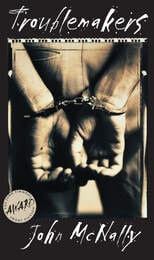
Troublemakers
John McNally
University of Iowa Press, 2000
Troublemakers is an often hilarious, sometimes frightening, occasionally off-the-wall collection of stories about men living on the edge. From the streets of Chicago's southwest side to the rural roads of Nebraska to the small towns of southern Illinois, these men tread a very fine line between right and wrong, love and hate, humor and horror.
Each story is a Pandora's box waiting to be opened: a high school boy with a new driver's license picks his brother up from jail; a UPS driver suspects his wife of having an affair but cannot find any tangible evidence of her indiscretion; an unemployed man's life begins to unravel after he discovers a dead man in a tree in his own backyard; two boys spend Halloween with an older thug; a young college teacher's patience is tested by both his annoying colleagues and the criminals who haunt his neighborhood. In story after story, McNally's troublemakers lead readers to a place no less thrilling or dangerous than the human heart itself.