Results by title
862 books match the query 'Social History' and 182 start with t
The Week the World Heard Gallaudet
Jack R. Gannon
Gallaudet University Press, 2009
The Weight of Gold
Mining and the Environment in Ontario, Canada, 1909-1929Mica Jorgenson
University of Nevada Press, 2023
Mining in North America has long been criticized for its impact on the natural environment. Mica Jorgenson’s The Weight of Gold explores the history of Ontario, Canada’s rise to prominence in the gold mining industry, while detailing a series of environmental crises related to extraction activities. In Ontario in 1909, the discovery of exceptionally rich hard rock gold deposits in the Abitibi region in the north precipitated industrial development modeled on precedents in Australia, South Africa, and the United States. By the late 1920s, Ontario’s mines had reached their maturity, and in 1928, Minister of Mines Charles McRae called Canada “the mineral treasure house to [the] world.”
Mining companies increasingly depended upon their ability to redistribute the burdens of mining onto surrounding communities—a strategy they continue to use today—both at home and abroad. Jorgenson connects Canadian gold mining to its international context, revealing that Ontario’s gold mines informed extractive knowledge which would go on to shape Canada’s mining industry over the next century.

The Whiskey Rebellion
A Distilled History of an American CrisisBrady J. Crytzer
Westholme Publishing, 2024
As the months passed however the people of Western Pennsylvania grew restless with the inadequacy of the government’s response and they soon turned to more violent means of political expression. Treasury officers across the west were targeted for their involvement in the tax collection, and they were brutally attacked by armed bands of disgruntled locals. They were tarred and feathered, burned with hot irons, and whipped; their homes were ransacked and burned. Extralegal courts were established in a direct challenge to federal authority, and the frontier slowly drifted toward a state of rebellion.
In response President George Washington raised an army of 13,000 men, one of the largest forces he ever commanded, to suppress the rebellion. No major battle ever occurred, but weeks of arrests, illegal detentions, and civil rights violations rocked the west. The event polarized the nation, and highlighted the dramatic differences between Washington’s Federalist perspective and Jefferson’s emerging Democratic-Republican Party. Two centuries later the Whiskey Rebellion stands as the second largest domestic rebellion in American History, only outdone by the Confederate States of America in 1861.
In The Whiskey Rebellion: A Distilled History of an American Crisis, historian Brady J. Crytzer takes the reader on a journey through Western Pennsylvania following the routes of both the rebels and the United States Army to place this important event into context for the reader. Complete with images and maps, the author illuminates what visitors can still see from the period while providing a cogent and engrossing account of this crisis unfolded and how it was resolved.
The Wisconsin Story
150 People, Places, and Turning Points that Shaped the Badger StateDennis McCann
Wisconsin Historical Society Press, 2019
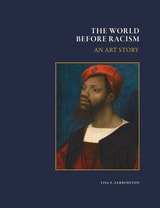
The World Before Racism
An Art StoryLisa E. Farrington
The Artist Book Foundation, 2025
Utilizing works of art as a primary source, Lisa Farrington's research in The World Before Racism conclusively answers the questions: Who invented racism? When? And why?
The term racism is understood to mean that race is the principal determinant of specific human traits and capacities and that due to racial differences, one race is inherently superior to all others. Over time, racism has commonly referenced the notion that the White race is superior to all others, fostering prejudice and discrimination. In The World Before Racism: An Art Story, author and art historian Lisa Farrington meticulously examines the intersection of art, history, and race, using original works of art as primary source materials to support her premise that racism is a construct, invented in the mid-1700s, to support the financial, political, and religious structures of European colonialism.
Using art from ancient Egypt, classical Greece, and the Roman Empire, through Medieval Europe and the colonization of the New World, to the art of the present day—sources that cannot be easily altered, edited, or selectively translated—Farrington expertly examines the intricate interplay between the Black and White races, how they saw and understood each other over the centuries. The artworks serve as powerful voices, precisely conveying the artist’s intended messages. The goal of The World Before Racism is to present irrefutable evidence that the ideology of racism is unfounded, unsupported, unjustified, and destined to fade away like so many other archaic and erroneous ideas.
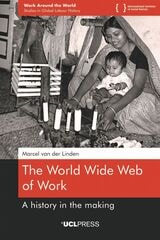
The World Wide Web of Work
A History in the MakingMarcel van der Linden
University College London, 2023
Global labor history is one of the fastest-growing fields of study worldwide today. This volume assembles a group of contributors from around the world to discuss the core concepts “capitalism” and “workers,” and to refine notions such as “coerced labor,” “household strategies,” and “labor markets.” It explores in new ways the connections between laborers in different parts of the world, arguing that both globalization and modern labor management originated in agriculture in the Global South and were only later introduced in Northern industrial settings. It reveals that nineteenth-century chattel slavery was frequently replaced by other forms of coerced labor, and it reconstructs the twentieth-century attempts of the International Labor Organisation to regulate work standards internationally. The book also pays attention to the relational inequality through which workers in wealthy countries benefit from the exploitation of those in poor countries. The final part addresses workers’ resistance and acquiescence: why collective actions often have unanticipated consequences, why and how workers sometimes organize massive flights from exploitation and oppression, and why proletarian revolutions took place in pre-industrial or industrializing countries but never in fully developed capitalist societies.
The World in a Phrase
A Brief History of the Aphorism, Second EditionJames Geary
University of Chicago Press, 2025
Aphorisms are literature’s hand luggage. Light and compact, they contain everything you need to get through a rough day at the office or a dark night of the soul. Aphorisms, the oldest written art form on the planet, have been going viral for thousands of years, delivering the short, sharp shock of old forgotten truths. Today, visual artists are mixing pithy language with compelling imagery and using social media to take the form into the future. In a world of disinformation and deepfakes, aphorisms point to the power of fresh debate over tired dogma and inconvenient truths over comfortable lies.
Starting in ancient China and ending with contemporary meme-makers and street artists, The World in A Phrase tells the story of the aphorism through brief biographies of some of its greatest practitioners: sages like Lao-tzu and the Buddha, philosophers like Schopenhauer and Nietzsche, writers like George Eliot and Marie von Ebner-Eschenbach, humorists like Mark Twain and Dorothy Parker, activists like James Baldwin and Audre Lorde, poets like Langston Hughes and Kay Ryan, and artists like Jenny Holzer and David Byrne.
The World in A Phrase is for lovers of words and seekers of wisdom. This new edition of The New York Times bestseller features 26 additional aphorists and explores the aphorism in the age of social media, showing why these short sentences are the ultimate deep dives in an era when TL;DR has become a cultural catchphrase.
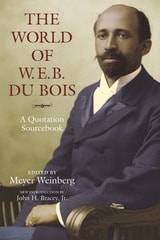
The World of W.E.B. Du Bois
A Quotation SourcebookMeyer Weinberg
University of Massachusetts Press, 2012
Meyer Weinberg created The World of W.E.B. Du Bois to provide a short journey through Du Bois's views on virtually all aspects of twentieth-century life. More than one thousand quotations from his published writings and correspondence are included, arranged into twenty topical chapters. Each quotation begins with a heading designed to summarize its main theme. A subject index provides additional access to the ideas of this complex figure.
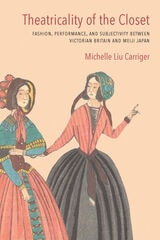
Theatricality of the Closet
Fashion, Performance, and Subjectivity between Victorian Britain and Meiji JapanMichelle Liu Carriger
Northwestern University Press, 2023
Clothing matters. This basic axiom is both common sense and, in another way, radical. It is from this starting point that Michelle Liu Carriger elucidates the interconnected ways in which gender, sexuality, class, and race are created by the everyday act of getting dressed. Theatricality of the Closet: Fashion, Performance, and Subjectivity between Victorian Britain and Meiji Japan examines fashion and clothing controversies of the nineteenth century, drawing on performance theory to reveal how the apparently superficial or frivolous deeply affects the creation of identity.
By interrogating a set of seemingly disparate examples from the same period but widely distant settings—Victorian Britain and Meiji-era Japan—Carriger disentangles how small, local, ordinary practices became enmeshed in a global fabric of cultural and material surfaces following the opening of trade between these nations in 1850. This richly illustrated book presents an array of media, from conservative newspapers and tabloids to ukiyo-e and early photography, that locate dress as a site where the individual and the social are interwoven, whether in the 1860s and 1870s or the twenty-first century.
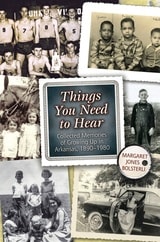
Things You Need to Hear
Collected Memories of Growing Up in Arkansas, 1890–1980Margaret Jones Bolsterli
University of Arkansas Press, 2016
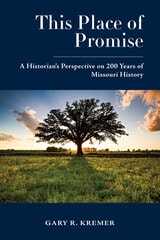
This Place of Promise
A Historian's Perspective on 200 Years of Missouri HistoryGary R. Kremer
University of Missouri Press, 2023
Key elements of the book include the centrality of race to the Missouri experience—from the time Missourians began to seek statehood in 1817 all the way up to the Black Lives Matter movement of the 21st century—as well as ongoing tensions created by the urban-rural divide and struggle to define the proper role of government in society.
Thomas More's Vocation
Frank Mitjans
Catholic University of America Press, 2022
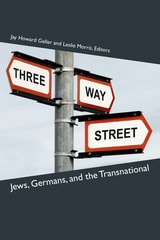
Three-Way Street
Jews, Germans, and the TransnationalJay Howard Geller and Leslie Morris, Editors
University of Michigan Press, 2016
Among the first volumes to focus on German-Jewish transnationalism, this interdisciplinary collection spans the fields of history, literature, film, theater, architecture, philosophy, and theology as it examines the lives of significant emigrants. The individuals whose stories are reevaluated include German Jews Ernst Lubitsch, David Einhorn, and Gershom Scholem, the architect Fritz Nathan and filmmaker Helmar Lerski; and eastern European Jews David Bergelson, Der Nister, Jacob Katz, Joseph Soloveitchik, and Abraham Joshua Heschel—figures not normally associated with Germany. Three-Way Street addresses the gap in the scholarly literature as it opens up critical ways of approaching Jewish culture not only in Germany, but also in other locations, from the mid-nineteenth century to the present.
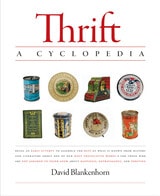
Thrift
A CyclopediaDavid Blankenhorn
Templeton Press, 2008
In today's consumer-driven society, extolling the virtues of thrift might seem like a quaint relic of a bygone era. Americans have embraced the ideas of easy credit, instant gratification, and spending as a tool to combat everything from recessions to the effects of natural disasters and terrorist attacks. In David Blankenhorn's new compendium, Thrift: A Cyclopedia, he reminds readers of a time when thrift was one of America's most cherished cultural values.
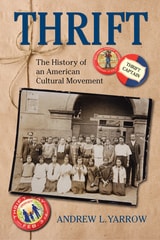
Thrift
The History of an American Cultural MovementAndrew L. Yarrow
University of Massachusetts Press, 2014
In this lively and engaging book, Andrew L. Yarrow tells the story of a national movement that promoted an amalgam of values and practices ranging from self-control, money management, and efficiency to conservation, generosity, and planning for the future—all under the rubric of “thrift.” Emerging in tandem and in tension with the first flowerings of consumer society, the thrift movement flourished during the 1910s and 1920s and then lingered on the outskirts of American culture from the Depression to the prosperous mid-twentieth century.
The movement brought together a diverse array of social actors with widely divergent agendas—the YMCA, the Boy and Girl Scouts, temperance crusaders, and others seeking to strengthen the moral fiber of urban young men and boys in particular, and to tamp down the appeal of radicalism. It also attracted credit union and other progressive activists wanting to empower the working class economically, bankers desiring to broaden their customer base, conservationists and efficiency proponents denouncing “waste,” and government leaders, school teachers, and economists who believed that encouraging saving was in the economic interests of both individuals and the nation.
A post–World War II culture that centered on spending and pleasure made the early-twentieth-century thrift messages seem outdated. Nonetheless, echoes of thrift can be found in currently popular ideas of “sustainability,” “stewardship,” and “simplicity” and in efforts to curtail public and private debt.
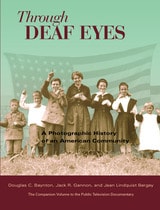
Through Deaf Eyes
A Photographic History of an American CommunityDouglas Baynton
Gallaudet University Press, 2007
In 2001, the Smithsonian Institution presented the landmark photographic exhibition History Through Deaf Eyes, representing nearly 200 years of United States deaf history. Drawing heavily on the extensive archives at Gallaudet University, the curators created an exhibition that drew more than 400,000 people viewed at the Smithsonian and in 12 cities during a five-year national tour. Its popularity prompted the production of a documentary film for national broadcast on the Public Broadcasting System. Now, the photographs, quotes, and stories from this remarkable exhibit and documentary have been assembled in a book of stunning beauty and poignant images, Through Deaf Eyes: A Photographic History of an American Community.
Featuring more than 200 full-color photographs, Through Deaf Eyes depicts the story of Deaf America and also affords readers the opportunity to learn about the nation’s broader history. The values and judgments of society have had an impact on the education, employment, and family life of deaf people, while historical eras often can be illuminated by examination through a Deaf lens. Photographs reveal the character of Deaf people in school settings, the workplace, during wartime, and using their cultural signature, American Sign Language. For both deaf and hearing readers, the Deaf community portrayed in Through Deaf Eyes offers a unique and fascinating perspective on the value of human difference.
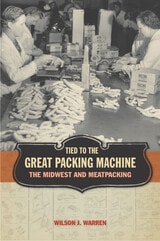
Tied to the Great Packing Machine
The Midwest and MeatpackingWilson J. Warren
University of Iowa Press, 2007
Writing from the vantage point of twenty-five years of extensive research, Warren analyzes the evolution of the packing industry from its early period, dominated by the big terminal markets, through the development of new marketing and technical innovations that transformed the ways animals were gathered, slaughtered, and processed and the final products were distributed. In addition, he concentrates on such cultural impacts as ethnic and racial variations, labor unions, gender issues, and changes in Americans’ attitudes toward the ethics of animal slaughter and patterns of meat consumption and such environmental problems as site-point pollution and microbe contamination, ending with a stimulating discussion of the future of American meatpacking.
Providing an excellent and well-referenced analysis within a regional and temporal framework that ensures a fresh perspective, Tied to the Great Packing Machine is a dynamic narrative that contributes to a fuller understanding of the historical context and contemporary concerns of an extremely important industry.
Time, Work, and Culture in the Middle Ages
Jacques Le Goff
University of Chicago Press, 1980
Times of Upheaval
Four Medievalists in Twentieth-Century Central Europe. Conversations with Jerzy Kloczowski, János M. Bak, František Šmahel, and Herwig WolframPavlína Rychterová
Central European University Press, 2019

To Care for the Sick and Bury the Dead
African American Lodges and Cemeteries in TennesseeLeigh Ann Gardner
Vanderbilt University Press, 2022
These Black cemeteries dot the Tennessee landscape, but few know their history or the societies of care they represent. To Care for the Sick and Bury the Dead is the first book-length look at these cemeteries and the lodges that fostered them.
This book is a must-have for genealogists, historians, and family members of the people buried in these cemeteries.
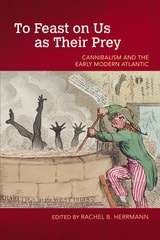
To Feast on Us as Their Prey
Cannibalism and the Early Modern AtlanticRachel B. Herrmann
University of Arkansas Press, 2019
Winner, 2020 Association for the Study of Food and Society Book Award, Edited Volume
Long before the founding of the Jamestown, Virginia, colony and its Starving Time of 1609–1610—one of the most famous cannibalism narratives in North American colonial history—cannibalism played an important role in shaping the human relationship to food, hunger, and moral outrage. Why did colonial invaders go out of their way to accuse women of cannibalism? What challenges did Spaniards face in trying to explain Eucharist rites to Native peoples? What roles did preconceived notions about non-Europeans play in inflating accounts of cannibalism in Christopher Columbus’s reports as they moved through Italian merchant circles?
Asking questions such as these and exploring what it meant to accuse someone of eating people as well as how cannibalism rumors facilitated slavery and the rise of empires, To Feast on Us as Their Prey posits that it is impossible to separate histories of cannibalism from the role food and hunger have played in the colonization efforts that shaped our modern world.
To Heal the Scourge of Prejudice
The Life and Writings of Hosea EastonHosea Easton
University of Massachusetts Press, 1999
How did racial prejudice originate and why has it been so deeply rooted in American culture? What have been the long-term effects of prejudice on the intellectual, communal, and psychological resources of African Americans? How might the nightmare of racial domination be truly brought to an end? Still pertinent today, these were among the key questions addressed more than a century and a half ago by Hosea Easton (1799–1837), an important yet long neglected activist and intellectual.
A black minister from New England, Easton rose to prominence during the 1820s and 1830s by joining in the struggle of free African Americans to resist southern slavery and secure racial equality. From this experience he developed a deep understanding of the problem of "race" in the United States and became a trenchant critic of white supremacy and its devastating consequences. This volume brings back into print the only extended writings of Easton that have survived into our time: his insightful, almost prescient A Treatise on the Intellectual Character, and the Civil and Political Condition of the Colored People of the U. States, first published in 1837; and his passionate 1828 Thanksgiving Day “Address.” The book also provides a biographical portrait of Easton and his family, drawn from primary documents as well as secondary sources in the areas of biography, genealogy, and social history.
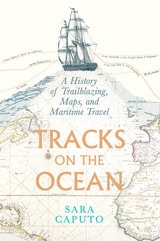
Tracks on the Ocean
A History of Trailblazing, Maps, and Maritime TravelSara Caputo
University of Chicago Press, 2024
Sara Caputo’s Tracks on the Ocean is a sweeping history of how we have understood routes of travel over the ocean and how we came to represent that movement as a cartographical line. Focusing on the representation of sea journeys in the Western world from the early sixteenth century to the present, Caputo deftly argues that the depiction of these lines is inextricable from European imperialism, the rise of modernity, and attempts at mastery over nature. Caputo recounts the history of ocean tracks through an array of lively stories and characters, from the expeditions of Captain James Cook in the eighteenth century to tracks depicted in Moby Dick and popular culture of the nineteenth century to the use of navigational techniques by the British navy. She discusses how tracks evolved from tools of surveying into tools of surveillance and, eventually, into paths of environmental calamity. The impulse to record tracks on the ocean is, Caputo argues, reflective of an ongoing desire for order, schematization, and personal visibility, as well as occupation and permanent ownership—in this case over something that is unoccupiable and impossible to truly possess. Both beautifully written and deeply researched, Tracks on the Ocean shares how the lines drawn on maps tell the audacious and often tragic and violent stories of ocean voyages.
Transforming Places
Lessons from AppalachiaEdited by Stephen L. Fisher and Barbara Ellen Smith
University of Illinois Press, 2012
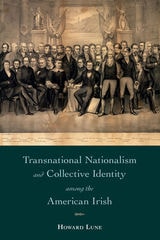
Transnational Nationalism and Collective Identity among the American Irish
Howard Lune
Temple University Press, 2020
In Transnational Nationalism and Collective Identity among the American Irish, Howard Lune considers the development and mobilization of different nationalisms over 125 years of Irish diasporic history (1791–1920) and how these campaigns defined the Irish nation and Irish citizenship.
Lune takes a collective approach to exploring identity, concentrating on social identities in which organizations are the primary creative agent to understand who we are and how we come to define ourselves. As exiled Irishmen moved to the United States, they sought to create a new Irish republic following the American model. Lune traces the construction of Irish American identity through the establishment and development of Irish nationalist organizations in the United States. He looks at how networks—such as societies, clubs, and private organizations—can influence and foster diaspora, nationalism, and nationalist movements.
By separating nationalism from the physical nation, Transnational Nationalism and Collective Identity among the American Irish uniquely captures the processes and mechanisms by which collective identities are constructed, negotiated, and disseminated. Inevitably, this work tackles the question of what it means to be Irish—to have a nationality, a community, or a shared history.

Traveler, Scholar, Political Adventurer
A Transylvanian Baron at the Birth of Albanian Independence: The memoirs of Franz NopcsaFranz Nopcsa
Central European University Press, 2014
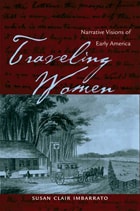
Traveling Women
Narrative Visions of Early AmericaSusan Clair Imbarrato
Ohio University Press, 2006
Susan Clair Imbarrato closely examines women’s accounts of their journeys from 1700 to 1830, including Sarah Kemble Knight’s well-known journal of her trip from Boston to New York in 1704 and many lesser-known accounts, such as Sarah Beavis’s 1779 journal of her travel to Ohio via Kentucky and Susan Edwards Johnson’s account or her 1801–2 journey from Connecticut to North Carolina.
In the women’s keen observations and entertaining wit, readers will find bravado mixed with hesitation, as women set forth on business, to relocate, and for pleasure. These travelers wrote compellingly of crossing rivers and mountains, facing hunger, encountering native Americans, sleeping in taverns, and confronting slavery, expressing themselves in voices that differed in sensibility from male explorers and travelers.
These accounts, as Imbarrato shows, challenge assumptions that such travel was predominately a male enterprise. In addition, Traveling Women provides a more balanced portrait of westward settlement by affirming women’s importance in the settling of early America.
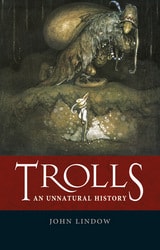
Trolls
An Unnatural HistoryJohn Lindow
Reaktion Books, 2014
To explain why trolls still hold our interest, John Lindow goes back to their first appearances in Scandinavian folklore, where they were beings in nature living beside a preindustrial society of small-scale farming and fishing. He explores reports of actual encounters with trolls—meetings others found plausible in spite of their better judgment—and follows trolls’ natural transition from folktales to other domains in popular culture. Trolls, Lindow argues, would not continue to appeal to our imaginations today if they had not made the jump to illustrations in Nordic books and Scandinavian literature and drama. From the Moomins to Brothers Grimm and Three Billy Goats Gruff to cartoons, fantasy novels, and social media, Lindow considers the panoply of trolls that surround us and their sometimes troubling connotations in the contemporary world.
Taking readers into Norwegian music and film and even Yahoo Finance chat rooms, Trolls is a fun and fascinating book about these strange creatures.
Truth-Spots
How Places Make People BelieveThomas F. Gieryn
University of Chicago Press, 2018
In Truth-Spots, Gieryn gives readers an elegant, rigorous rendering of the provenance of ideas, uncovering the geographic location where they are found or made, a spot built up with material stuff and endowed with cultural meaning and value. These kinds of places—including botanical gardens, naturalists’ field-sites, Henry Ford’s open-air historical museum, and churches and chapels along the pilgrimage way to Santiago de Compostela in Spain—would seem at first to have little in common. But each is a truth-spot, a place that makes people believe. Truth may well be the daughter of time, Gieryn argues, but it is also the son of place.
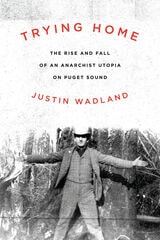
Trying Home
The Rise and Fall of an Anarchist Utopia on Puget SoundJustin Wadland
Oregon State University Press, 2014
The true story of an anarchist colony on a remote Puget Sound peninsula, Trying Home traces the history of Home, Washington, from its founding in 1896 to its dissolution amid bitter infighting in 1921.
As a practical experiment in anarchism, Home offered its participants a rare degree of freedom and tolerance in the Gilded Age, but the community also became notorious to the outside world for its open rejection of contemporary values. Using a series of linked narratives, Trying Home reveals the stories of the iconoclastic individuals who lived in Home, among them Lois Waisbrooker, an advocate of women’s rights and free love, who was arrested for her writings after the assassination of President McKinley; Jay Fox, editor of The Agitator, who defended his right to free speech all the way to the Supreme Court; and Donald Vose, a young man who grew up in Home and turned spy for a detective agency.
Justin Wadland weaves his own discovery of Home—and his own reflections on the concept of home—into the story, setting the book apart from a conventional history. After discovering the newspapers published in the colony, Wadland ventures beyond the documents to explore the landscape, travelling by boat along the steamer route most visitors once took to the settlement. He visits Home to talk with people who live there now.
Meticulously researched and engagingly written, Trying Home will fascinate scholars and general readers alike, especially those interested in the history of the Pacific Northwest, utopian communities, and anarchism.
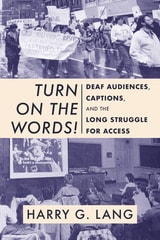
Turn on the Words!
Deaf Audiences, Captions, and the Long Struggle for AccessHarry G. Lang
Gallaudet University Press, 2021
Lang describes the legislation, programs, and people who contributed great ingenuity and passion over decades to realize widespread access to captions, one breakthrough at a time. He also chronicles the resistance to captioned films from Hollywood studios and others, and the Deaf and hearing activists who championed the right to access. Deaf, hard of hearing, disabled, and English-as-a-second-language audiences now experience improved access to the educational, occupational, and cultural benefits of film and television programming. The struggle continues as deaf audiences advocate for equal access in a variety of settings such as movie theaters and online video-sharing platforms. This is a history of technological innovation, as well as a testament to the contributions of the Deaf community to the benefit of society as a whole.
This book has been made possible in part by the National Endowment for the Humanities: Exploring the human endeavor. Any views, findings, conclusions, or recommendations expressed in this book do not necessarily represent those of the National Endowment for the Humanities.
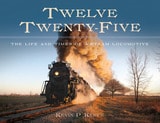
Twelve Twenty-Five
The Life and Times of a Steam LocomotiveKevin P. Keefe
Michigan State University Press, 2016
Pere Marquette 1225 was built in 1941 at the peak of steam locomotive development. The narrative traces the 1225’s regular freight service in Michigan, its unlikely salvation from the scrapyard for preservation at Michigan State University, and the subsequent work to bring it back to steam, first by a student club and later by a railroad museum. Milestones along the way include 1225’s retirement in 1951, its donation to MSU in 1957, its return to steam in 1988, a successful career hauling tens of thousands of excursion riders, and its starring role in the 2004 movie The Polar Express. The massive infrastructure that supported American steam locomotives in their heyday disappeared long ago, forcing 1225’s faithful to make their own spare parts, learn ancient railroad skills, and interpret the entire effort for the public. As such, the continuing career of 1225 is a triumph of historic preservation.