Results by title
28167 books match the query 'History' and 6372 start with t

The Feminization of Famine
Expressions of the Inexpressible?Margaret Kelleher
Duke University Press, 1997
Kelleher begins with a critical reading of the novels and short stories written about the Irish famine over the last 150 years, from the novels of William Carleton and Anthony Trollope to the writings of Liam O’Flaherty and John Banville. She then moves on to unveil a lesser-known body of literature—works written by women. This literature is read in the context of a rich variety of other sources, including eye-witness accounts, memoirs, journalistic accounts, and famine historiography. Concluding with a reading of the twentieth-century accounts of the famine in Bengal, this book reveals how gendered representations have played a crucial role in defining notions of famine.
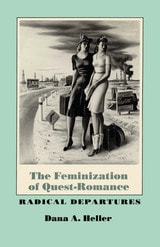
The Feminization of Quest-Romance
Radical DeparturesBy Dana A. Heller
University of Texas Press, 1990
What happens when a woman dares to imagine herself a hero? Questing, she sets out for unknown regions. Lighting a torch, she elicits from the darkness stories never told or heard before. The woman hero sails against the tides of great legends that recount the adventures of heroic men, legends deemed universal, timeless, and essential to our understanding of the natural order that holds us and completes us in its spiral. Yet these myths and rituals do not fulfill her need for an empowering self-image nor do they grant her the mobility she requires to imagine, enact, and represent her quest for authentic self-knowledge.
The Feminization of Quest-Romance proposes that a female quest is a revolutionary step in both literary and cultural terms. Indeed, despite the difficulty that women writers face in challenging myths, rituals, psychological theories, and literary conventions deemed universal by a culture that exalts masculine ideals and universalizes male experience, a number of revolutionary texts have come into existence in the second half of the twentieth century by such American women writers as Jean Stafford, Mary McCarthy, Anne Moody, Marilynne Robinson, and Mona Simpson, all of them working to redefine the literary portrayal of American women's quests. They work, in part, by presenting questing female characters who refuse to accept the roles accorded them by restrictive social norms, even if it means sacrificing themselves in the name of rebellion. In later texts, female heroes survive their "lighting out" experiences to explore diverse alternatives to the limiting roles that have circumscribed female development.
This study of The Mountain Lion, Memories of a Catholic Girlhood, Coming of Age in Mississippi, Housekeeping, and Anywhere but Here identifies transformations of the quest-romance that support a viable theory of female development and offer literary patterns that challenge the male monopoly on transformative knowledge and heroic action.
The Fenwick Letters
A Transnational Feminist Life Reconstructed, Volume I: 1797-1821Eliza Fenwick
University of Delaware Press, 2026
The Fenwick Letters
A Transnational Feminist Life Reconstructed, Volume II: 1822-1840Eliza Fenwick
University of Delaware Press, 2027
The second of this two-volume edition of The Fenwick Letters covers the North American phase of Eliza Fenwick’s transformative, transnational odyssey, from 1822 to 1840. Although no longer the radical author she was in the 1790s, advocating for the rights of women to be educated, or the innovative author of children’s books that she was in the early 1800s, she was still very much a writer. In her North American incarnation, however, she was primarily an educator, a businesswoman running her own school, and a single, working grandmother attempting to find safety as well as economic and domestic stability for herself and her remaining family. Eliza’s letters are consistently riveting, filled with sharply drawn portraits of the people, places, environment, politics, and culture of each community in which she lived. The letters also reveal Eliza’s genius for developing networks of social, political, and cultural connections as she established and sought to support herself and her family in North America.

The Fernando Coronil Reader
The Struggle for Life Is the MatterFernando Coronil
Duke University Press, 2019

The Fertile Earth and the Ordered Cosmos
Reflections on the Newark Earthworks and World HeritageEdited by M. Elizabeth Weiser, Timothy R. W. Jordan, and Richard D. Shiels
The Ohio State University Press, 2023
The lush photos and wide-ranging essays of The Fertile Earth and the Ordered Cosmos honor this significance, not only to the global community but to local individuals and scholars who have developed intimate connections to the Earthworks. In sharing their experiences with this ancient site, public historians, archaeologists, physicists, architects, and others—including local and Indigenous voices—continue the work of nearly two hundred years of citizen efforts to protect and make accessible the Newark Earthworks after centuries of stewardship by Indigenous people. The resulting volume serves as a rich primer on the site for those unfamiliar with its history and a beautifully produced tribute for those who are already acquainted with its wonders.
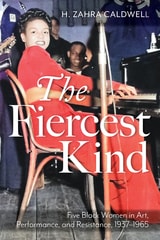
The Fiercest Kind
Five Black Women in Art, Performance, and Resistance, 1937–1965H. Zahra Caldwell
University of Massachusetts Press, 2026
Artists fighting racism and sexism from the end of the Great Depression through the Civil Rights era
In 1943, the production of the Columbia Pictures film The Heat’s On halted for three days due to an on-set protest by featured performer Hazel Scott. Appalled by the racially demeaning and stereotypical depictions of Black women extras and dancers, Scott—one of the top African American performers of the era—forced the studio to relent. But her protest of Hollywood racism angered powerful white men in the industry, and despite her rising career, she was soon banished from American film.
Scott was far from the only Black woman in a creative field to use her professional success as leverage against prejudice. In The Fiercest Kind, cultural historian H. Zahra Caldwell explores the biographical narratives of five Black women at the top of their artistic crafts in the mid-20th century to understand how they pushed back against racism and sexism. From 1937–1965, pianist Hazel Scott, dancer Katherine Dunham, cartoonist Jackie Ormes, multihyphenate fine artist (graphic artist, painter, and sculptor) Elizabeth Catlett, and singer Lena Horne were among the most popular and nationally known Black women in their respective fields, spanning film, television, print media, and fine art. Generating creative works at the end of the Great Depression through the Civil Rights era, they used their professional and personal lives to confront seemingly insurmountable repression through what Caldwell defines as “layered resistance.”
A Black feminist practice, layered resistance consists of four tactics: claiming and adapting cultural spaces for Black women; strategically crafting positive images of Black womanhood that directly challenge white supremacy; combining performance and/or visual representation with social and political activism; and choosing unconventional lifestyles that defy rigid gender and racial norms. These artists also lived in, worked in, and supported important Black spaces such as Harlem and Black Chicago. Using a methodology that combines textual analysis, archival research, and oral history, Caldwell understands this strategy within larger movements for Black freedom and equality that spanned the twentieth century and continue to the present day.
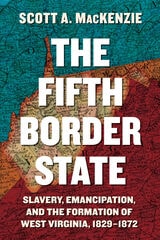
The Fifth Border State
Slavery, Emancipation, and the Formation of West Virginia, 1829–1872Scott A. MacKenzie
West Virginia University Press, 2023
One of the first new interpretations of West Virginia’s origins in over a century—and one that corrects previous histories’ tendency to minimize support for slavery in the state’s founding.
Every history of West Virginia’s creation in 1863 explains the event in similar ways: at the start of the Civil War, political, social, cultural, and economic differences with eastern Virginia motivated the northwestern counties to resist secession from the Union and seek their independence from the rest of the state. In The Fifth Border State, Scott A. MacKenzie offers the first new interpretation of the topic in over a century—one that corrects earlier histories’ tendency to minimize support for slavery in the state’s founding.
Employing previously unused sources and reexamining existing ones, MacKenzie argues that West Virginia experienced the Civil War in the same ways as the border states of Missouri, Kentucky, Maryland, and Delaware. Like these northernmost slave states, northwestern Virginia supported the institution of slavery out of proportion to the actual presence of enslavement there. The people who became West Virginians built a new state first to protect slavery, but radical Unionists and escaping slaves forced emancipation on the statehood movement. MacKenzie shows how conservatives and radicals clashed over Black freedom, correcting many myths about West Virginia’s origins and making The Fifth Border State an important addition to the literature in Appalachian and Civil War history.
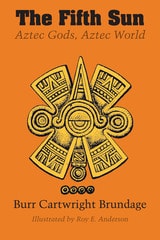
The Fifth Sun
Aztec Gods, Aztec WorldBy Burr Cartwright Brundage
University of Texas Press, 1979
The ancient Aztecs dwelt at the center of a dazzling and complex cosmos. From this position they were acutely receptive to the demands of their gods. The Fifth Sun represents a dramatic overview of the Aztec conception of the universe and the gods who populated it—Quetzalcoatl, the Plumed Serpent; Tezcatlipoca, the Smoking Mirror; and Huitzilopochtli, the Southern Hummingbird. Burr Cartwright Brundage explores the myths behind these and others in the Aztec pantheon in a way that illuminates both the human and the divine in Aztec life.
The cult of human sacrifice is a pervasive theme in this study. It is a concept that permeated Aztec mythology and was the central preoccupation of the aggressive Aztec state. Another particularly interesting belief explored here is the “mask pool,” whereby gods could exchange regalia and, thus, identities.
This vivid and eminently readable study also covers the use of hallucinogens; cannibalism; the calendars of ancient Mexico; tlachtli, the life-and-death ball game; the flower wars; divine transfiguration; and the evolution of the war god of the Mexica. A splendid introduction to Aztec religion, The Fifth Sun also contains insights for specialists in ethnohistory, mythology, and religion.

The Fifty-Year Texas Road Trip
On Assignment from Earth to UncertainRandy Mallory
University of North Texas Press, 2025
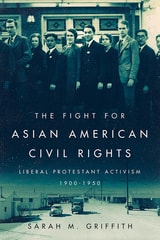
The Fight for Asian American Civil Rights
Liberal Protestant Activism, 1900-1950Sarah M Griffith
University of Illinois Press, 2018
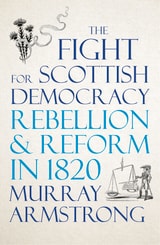
The Fight for Scottish Democracy
Rebellion and Reform in 1820Murray Armstrong
Pluto Press, 2020
This 'Radical War' was the culmination of five years of unsuccessful mass petitioning of Westminster by working people in Scotland and England. The contempt and intransigence of the Tory government forced an escalation in tactics, and on Easter Monday of 1820, the call for a general strike was answered throughout the western counties of Scotland. Their demands were threefold: the vote for all men, annual parliaments and equal constituencies. Coupled with an armed rebellion, the strike was met by the full military might of the British state; hundreds were arrested and imprisoned without trial, while hundreds more fled the country.
This Scottish general strike and insurrection is a little-known chapter of British history and yet remains an immensely important one in the long fight for democracy. In The Fight for Scottish Democracy, Murray Armstrong brings these events dramatically to life.

The Fight to Save Juárez
Life in the Heart of Mexico's Drug WarBy Ricardo C. Ainslie
University of Texas Press, 2013
The city of Juárez is ground zero for the drug war that is raging across Mexico and has claimed close to 60,000 lives since 2007. Almost a quarter of the federal forces that former President Felipe Calderón deployed in the war were sent to Juárez, and nearly 20 percent of the country’s drug-related executions have taken place in the city, a city that can be as unforgiving as the hardest places on earth. It is here that the Mexican government came to turn the tide. Whatever happens in Juárez will have lasting repercussions for both Mexico and the United States.
Ricardo Ainslie went to Juárez to try to understand what was taking place behind the headlines of cartel executions and other acts of horrific brutality. In The Fight to Save Juárez, he takes us into the heart of Mexico’s bloodiest city through the lives of four people who experienced the drug war from very different perspectives—Mayor José Reyes Ferriz, a mid-level cartel player’s mistress, a human rights activist, and a photojournalist. Ainslie also interviewed top Mexican government strategists, including members of Calderón’s security cabinet, as well as individuals within U.S. law enforcement. The dual perspective of life on the ground in the drug war and the “big picture” views of officials who are responsible for the war’s strategy, creates a powerful, intimate portrait of an embattled city, its people, and the efforts to rescue Juárez from the abyss.

The Fight to Save the Redwoods
A History of the Environmental Reform, 1917–1978Susan R. Schrepfer
University of Wisconsin Press, 1983
"This is not a simple or ordinary history of a conservation crusade. Schrepfer very ably traces the changes in scientific wisdom from nineteenth-century romanticism and teleological evolutionism to more current ecological dynamism—and the influence of those intellectual developments on political history. . . . The subject is important—much broader than the title suggests—and so is the book."—American Historical Review
The Figural Jew
Politics and Identity in Postwar French ThoughtSarah Hammerschlag
University of Chicago Press, 2010
The rootless Jew, wandering disconnected from history, homeland, and nature, was often the target of early twentieth-century nationalist rhetoric aimed against modern culture. But following World War II, a number of prominent French philosophers recast this maligned figure in positive terms, and in so doing transformed postwar conceptions of politics and identity.
Sarah Hammerschlag explores this figure of the Jew from its prewar usage to its resuscitation by Jean-Paul Sartre, Emmanuel Levinas, Maurice Blanchot, and Jacques Derrida. Sartre and Levinas idealized the Jew’s rootlessness in order to rethink the foundations of political identity. Blanchot and Derrida, in turn, used the figure of the Jew to call into question the very nature of group identification. By chronicling this evolution in thinking, Hammerschlag ultimately reveals how the figural Jew can function as a critical mechanism that exposes the political dangers of mythic allegiance, whether couched in universalizing or particularizing terms.
Both an intellectual history and a philosophical argument, The Figural Jew will set the agenda for all further consideration of Jewish identity, modern Jewish thought, and continental philosophy.

The Films of Bong Joon Ho
Nam Lee
Rutgers University Press, 2020
Bong Joon Ho won the Oscar® for Best Director for Parasite (2019), which also won Best Picture, the first foreign film to do so, and two other Academy Awards. Parasite was the first Korean film to win the Palme d’Or at Cannes. These achievements mark a new career peak for the director, who first achieved wide international acclaim with 2006’s monster movie The Host and whose forays into English-language film with Snowpiercer (2013) and Okja (2017) brought him further recognition.
As this timely book reveals, even as Bong Joon Ho has emerged as an internationally known director, his films still engage with distinctly Korean social and political contexts that may elude many Western viewers. The Films of Bong Joon Ho demonstrates how he hybridizes Hollywood conventions with local realities in order to create a cinema that foregrounds the absurd cultural anomie Koreans have experienced in tandem with their rapid economic development. Film critic and scholar Nam Lee explores how Bong subverts the structures of the genres he works within, from the crime thriller to the sci-fi film, in order to be truthful to Korean realities that often deny the reassurances of the happy Hollywood ending. With detailed readings of Bong’s films from Barking Dogs Never Bite (2000) through Parasite (2019), the book will give readers a new appreciation of this world-class cinematic talent.
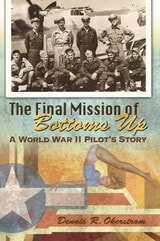
The Final Mission of Bottoms Up
A World War II Pilot's StoryDennis R. Okerstrom
University of Missouri Press, 2011
The Final Mission
A Boy, a Pilot, and a World at WarElizabeth Hoban and Lt. Col. Henry Supchak
Westholme Publishing, 2012
The Inspiring True Story of a World War II Bomber Pilot Who Saved an Austrian Village—and the Incredible Search Across a Lifetime to Repay That Debt
In July 1944, Lt. Henry Supchak was flying his second-to-last mission over Germany when his B-17 bomber, Priority Gal, was hit by antiaircraft fire, disabling two engines and wounding him in the thigh. He attempted to reach neutral Switzerland, but was forced instead to order his eight crewmen to bail out over Austria. As Supchak prepared to abandon his aircraft he saw that it was on a collision course with an Alpine village. He instinctively got back into his seat, adjusted the controls, and barely escaped before the plane exploded at the base of a mountain. He parachuted into a pasture where a shepherd boy and his aunt stared in disbelief at this “man who fell from the sky.” Almost immediately, German infantry surrounded the pilot and took him away to solitary confinement. Although slightly burned by the exploding aircraft, the boy managed to find out where the wounded pilot was being held and snuck food and water to him before Supchak and his crew were taken away to a notorious prison camp for the rest of the war.
Liberated by Patton’s Third Army in April 1945, Supchak remained in the air force after World War II and even advised Gregory Peck during the filming of Twelve O’Clock High. But he carried deep scars from his war experience. Plagued by flashbacks, Supchak attempted to find closure. Opening up to his family and others about his aircombat missions and internment failed to rid him of the nagging dreams as he had hoped. But an inspired quest to find his former crew members before they all passed away put the pilot on a path of peace. A world away, an Austrian entrepreneur was searching for Supchak, the enemy pilot he had seen fall from the sky as a boy and whom he had never forgotten. Despite incredible odds, the pilot and the boy were able to meet again at the spot where Priority Gal had gone down, in a magical, miraculous reunion of closure. Beautifully written with honesty and emotion, The Final Mission: A Boy, a Pilot, and a World at War is a gripping and uplifting story of forgiveness, reconciliation, and healing from the devastation of war.
The Fine Art of Persuasion
Corporate Advertising Design, Nation, and Empire in Modern JapanGennifer Weisenfeld
Duke University Press, 2025

The Fine Arts in America
Joshua C. Taylor
University of Chicago Press, 1979
"[Taylor] describes changing definitions of art as much as he describes art itself, and he shows how the shifting forms of patronage affected the forms of art. He analyzes artists' associations . . . and he shows how museums and schools have expanded the audience for art. In short, he places artists and their work in cultural context. This treatment of the social history of art is the most original and intriguing aspect of Taylor's sketch."—Journal of American History
"This is a brilliantly subtle book. It builds with one insight after another, and suddenly the reader finds that a whole new way of looking at American art is being proposed. . . . After decades of thinking and looking and teaching, Dr. Taylor has written it all down. This work will become a classic interpretation almost overnight."—Peter Marzio, director, Corcoran Gallery of Art
"Interest in American art is unlikely to abate. . . . Mr. Taylor's short book is an invaluable guide through this activity and to its traditions."—Neil Harris, Wall Street Journal
The Fire Ant Wars
Nature, Science, and Public Policy in Twentieth-Century AmericaJoshua Blu Buhs
University of Chicago Press, 2004
With political intrigue, environmental tragedy, and such figures as Rachel Carson and E. O. Wilson, The Fire Ant Wars is a grippingly perceptive tale of changing social attitudes and scientific practices. Tracing the political and scientific eradication campaigns, Joshua Buhs's bracing study uses the saga as a means to consider twentieth-century American concepts of nature and environmental stewardship. In telling the story, Buhs explores how human concepts of nature evolve and how these ideas affect the natural and social worlds.
Spotlighting a particular issue to discuss larger questions of science, public perceptions, and public policy—from pre-environmental awareness to the activist years of the early environmental movement—The Fire Ant Wars will appeal to historians of science, environmentalists, and biologists alike.
The Fires of New England
A Story of Protest and Rebellion in Antebellum AmericaEric J. Morser
University of Massachusetts Press, 2017
Few people embraced the manifesto and its radical message. Nonetheless, as Eric J. Morser illustrates in this eloquently written and deeply researched book, the address matters because it reveals how commercial, cultural, political, and social changes were remaking the lives of the men who drafted and shared it in the 1830s. Using an imaginative range of sources, Morser artfully reconstructs their moving personal tales and locates them in a grander historical context. By doing so, he demonstrates that even seemingly small stories from antebellum America can help us understand the rich complexities of the era.

The First 50 Years of the Department of Industrial and Operations Engineering at the University of Michigan
1955–2005Don Chaffin
Michigan Publishing Services, 2016
The First American Women Architects
Sarah Allaback
University of Illinois Press, 2007
Organized alphabetically as a reference guide, this volume provides a biographical sketch of each architect's life, education, and professional career, and a list of known works and sources for further research. Many of these remarkable women have never before appeared in any other history, making The First American Women Architects a unique and invaluable reference for students and scholars interested in women's history and architecture. As an instructive record of the legacy of women in architectural history, this book will also serve as a stimulating indicator of the broadening potential for women and other minorities within the field of architecture.
The First Anglo-Afghan Wars
A ReaderAntoinette Burton, ed.
Duke University Press, 2014
The First Black Actors on the Great White Way
Susan Curtis
University of Missouri Press, 1998
On April 5, 1917, Three Plays for a Negro Theater by Ridgely Torrence opened at the Garden Theatre in New York City. This performance was a monumental event in American stage history. Not only was this the first dramatic production to portray African American life beyond the cliché, it was also the first production on Broadway to feature an all-black cast. The morning after the three plays were performed, newspapers were filled with praise for the cast, crew, and playwright. Audience member W. E. B. Du Bois declared the show "epoch making." Despite such early critical acclaim, Three Plays for a Negro Theater closed before the end of the month and received little attention thereafter.
Why was a nation, so fascinated with firsts, able to forget these black actors and this production so quickly? It is this question that Susan Curtis addresses in The First Black Actors on the Great White Way.
Set against the backdrop of transforming theater conventions in the early 1900s and the war in 1917, this important study relates the stories of the actors, stage artists, critics, and many others—black and white—involved in this groundbreaking production. Curtis explores in great depth both the progress in race relations that led to this production and the multifaceted reasons for its quick demise.
Three Plays for a Negro Theater opened on the eve of the United States' entrance into World War I. Curtis attributes the early closure of the three plays to this coincidence, but she does not settle for so simple an explanation. Rather, she investigates the heightened national self-consciousness that followed the United States' entry into the war. America was ready to "make the world safe for democracy," but it was not fully ready to accept democracy and equality in its own culture.
The First Black Actors on the Great White Way is not simply a study of African American theater and its entrance into American culture. By focusing on a single event at a critical moment in history, Curtis offers a unique glimpse into race relations in early-twentieth-century American society. The experience of these pioneering artists reveals an unexplored aspect of the painfully slow evolution of racial equality.
A remarkable story about people who waged an extraordinary campaign against racism, The First Black Actors on the Great White Way will be of special interest to scholars of American studies, race relations, and cultural history, as well as the general reader.
The First British Trade Expedition to China
Captain Weddell and the Courteen Fleet in Asia and Late Ming CantonNicholas D. Jackson
Hong Kong University Press, 2022
In The First British Trade Expedition to China, Nicholas D. Jackson explores the pioneering British trade expedition to China launched in the late Ming period by Charles I and the Courteen Association. Utilizing the vivid perspective of its commander Captain John Weddell, this study concentrates on the fleet’s adventures in south China between Portuguese Macao and the provincial capital, Guangzhou. Tracing the obscure origins of Sino-British diplomatic and commercial relations back to the late Ming era, Jackson examines the first episodes of Sino-British interaction, exchange, and collision in the seventeenth century. His analysis constitutes a groundbreaking study of early modern British initiatives and enterprises in the coastal areas of south China.

The First Chouteaus
RIVER BARONS OF EARLY ST. LOUISWilliam E. Foley and C. David Rice
University of Illinois Press, 1983
For more than half a century, Auguste and Pierre Chouteau dominated trade and enterprise in the Mississippi Valley. In their various roles as merchants, Indian traders, bankers, land speculators, governmental advisors, public officials, and community leaders, the Chouteau brothers exerted a tremendous influence on westward expansion. This is the first full account of their lives and illustrious careers.
The First Cold War
The Legacy of Woodrow Wilson in U.S. - Soviet RelationsDonald E. Davis & Eugene P. Trani
University of Missouri Press, 2002
The First Electronic Computer
The Atanasoff StoryAlice R. Burks and Arthur W. Burks
University of Michigan Press, 1989
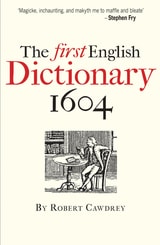
The First English Dictionary 1604
Robert Cawdrey's A Table AlphabeticallRobert Cawdrey
Bodleian Library Publishing, 2007
English is one of the most complicated languages to learn, and its constantly evolving vocabulary certainly doesn’t help matters. For centuries, men and women have striven to chronicle and categorize the expressions of the English language, and Samuel Johnson is usually thought to be their original predecessor. But that lineage is wrong: Robert Cawdrey published his Table Alphabeticall in 1604, 149 years before Johnson’s tome, and it is now republished here for the first time in over 350 years.
This edition, prepared from the sole surviving copy of the first printing, documents Cawdrey’s fascinating selection of 2,543 words and their first-ever definitions. Cawdrey subtitled his dictionary “for the benefit of Ladies, Gentlewomen, and other unskilled folk,” for his aim was not to create a comprehensive catalog, but rather an in-depth guide for the lesser educated who might not know the “hard usual English wordes, borrowed from the Hebrew, Greeke, Latine, or French.” Each entry reveals an intriguing facet of early modern life and the cultural mores of the time. There are familiar terms—“geometrie” was defined as “the art of measuring the earth,” and a “concubine” was described as a “harlot, or light huswife”—and amusingly idiomatic definitions: "prodigall" is "too riotous in spending," while "hecticke" is "inflaming the hart, and soundest parts of the bodie.”
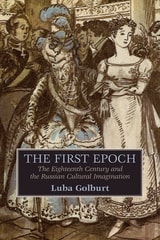
The First Epoch
The Eighteenth Century and the Russian Cultural ImaginationLuba Golburt
University of Wisconsin Press, 2014
Why did nineteenth-century Russians put the eighteenth century so quickly behind them? How does a meaningful present become a seemingly meaningless past? Interpreting texts by Lomonosov, Derzhavin, Pushkin, Viazemsky, Turgenev, Tolstoy, and others, Golburt finds surprising answers, in the process innovatively analyzing the rise of periodization and epochal consciousness, the formation of canon, and the writing of literary history.
Winner, Marc Raeff Book Prize, Eighteenth-Century Russian Studies Association
Winner, Heldt Prize for the Best Book by a Woman in Slavic/Eastern European/Eurasian Studies, Association for Women in Slavic Studies
Winner, Best Book in Literary and Cultural Studies, American Association of Teachers of Slavic and Eastern European Languages
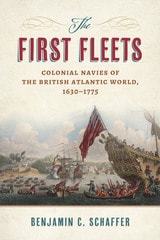
The First Fleets
Colonial Navies of the British Atlantic World, 1630–1775Benjamin C. Schaffer
University of Alabama Press, 2025
A revealing study on the little-known and misunderstood provincial navies established by North American British colonists.
In The First Fleets, Benjamin C. Schaffer reveals how, contrary to widespread beliefs, the American colonies had a long tradition of independent naval defense decades before the Revolution. He demonstrates that Anglo-American governments established and maintained significant provincial naval forces and that the history of provincial navies illuminates broader aspects of colonial history and the colonies’ ultimate break with the British Crown.
Based on meticulous research, Schaffer recounts the sea-borne threats that American colonies faced from the French, Spanish, pirates, and others. He reviews colonial governance and the relationships between colonial governments and Great Britain. Highlighting Britain’s scant naval power in North America, Schaffer demonstrates how the vulnerable coastal colonies undertook their own self-defense.
Schaffer’s readable study offers many fascinating episodes from colonial history. Establishing a navy was controversial in pacifist-minded, Quaker-dominated Pennsylvania. South Carolina deployed its scout-boat navy to pursue enslaved Africans who fled colonial capture. The first paper money issued in North America was an initiative to pay for a naval expedition against French Quebec in 1690. These and other episodes show the intimate connection between these little-known provincial navies and the major sociopolitical developments of their day.
The First Fleets will be of great interest to historians and readers of early American history, particularly colonial maritime and naval activities. Readers interested in the political and military dynamics of pre-Revolutionary America, as well as enthusiasts of naval history and maritime trade, will find The First Fleets both a valuable resource and an engrossing narrative.
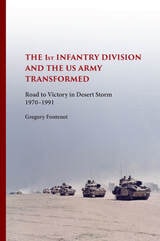
The First Infantry Division and the U.S. Army Transformed
Road to Victory in Desert Storm, 1970-1991Gregory Fontenot
University of Missouri Press, 2017
From the author's introduction:
“My purpose is a narrative history of the 1st Infantry Division from 1970 through the Operation Desert Storm celebration held 4th of July 1991. This story is an account of the revolutionary changes in the late Cold War. The Army that overran Saddam Hussein’s Legions in four days was the product of important changes stimulated both by social changes and institutional reform. The 1st Infantry Division reflected benefits of those changes, despite its low priority for troops and material. The Division was not an elite formation, but rather excelled in the context of the Army as an institution.”
This book begins with a preface by Gordon R. Sullivan, General, USA, Retired. In twelve chapters, author Gregory Fontenot explains the history of the 1st infantry Division from 1970 to 1991. In doing so, his fast-paced narrative includes elements to expand the knowledge of non-military readers. These elements include a glossary, a key to abbreviations, maps, nearly two dozen photographs, and thorough bibliography.
The First infantry Division and the U.S. Army Transformed: Road to Victory in Desert Storm is published with support from the First Division Museum at Cantigny.
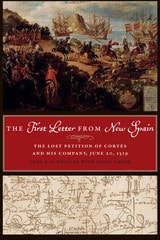
The First Letter from New Spain
The Lost Petition of Cortés and His Company, June 20, 1519By John Schwaller and Helen Nader
University of Texas Press, 2014
The founding of la Villa Rica de la Veracruz (the rich town of the True Cross) is prominently mentioned in histories of the conquest of Mexico, but scant primary documentation of the provocative act exists. During a research session at the Spanish archives, when John Schwaller discovered an early-sixteenth-century letter from Veracruz signed by the members of Cortés’s company, he knew he had found a trove of historical details. Providing an accessible, accurate translation of this pivotal correspondence, along with in-depth examinations of its context and significance, The First Letter from New Spain gives all readers access to the first document written from the mainland of North America by any European, and the only surviving original document from the first months of the conquest.
The timing of Cortés’s Good Friday landing, immediately before the initial assault on the Aztec Empire, enhances the significance of this work. Though the expedition was conducted under the authority of Diego Velázquez, governor of Cuba, the letter reflects an attempt to break ties with Velázquez and form a strategic alliance with Carlos V, the Holy Roman Emperor and King of Spain. Brimming with details about the events surrounding Veracruz’s inception and accompanied by mini-biographies of 318 signers of the document—socially competitive men who risked charges of treason by renouncing Velázquez—The First Letter from New Spain gives evidence of entrepreneurship and other overlooked traits that fueled the conquest.
The First Moderns
Profiles in the Origins of Twentieth-Century ThoughtWilliam R. Everdell
University of Chicago Press, 1997
"This exceptionally wide-ranging history is chock-a-block with anecdotes, factoids, odd juxtapositions, and useful insights. Most impressive. . . . For anyone interested in learning about late 19th- and early 20th- century imaginative thought, this engagingly written book is a good place to start."—Washington Post Book World
"The First Moderns brilliantly maps the beginning of a path at whose end loom as many diasporas as there are men."—Frederic Morton, The Los Angeles Times Book Review
"In this truly exciting study of the origins of modernist thought, poet and teacher Everdell roams freely across disciplinary lines. . . . A brilliant book that will prove useful to scholars and generalists for years to come; enthusiastically recommended."—Library Journal, starred review
"Everdell has performed a rare service for his readers. Dispelling much of the current nonsense about 'postmodernism,' this book belongs on the very short list of profound works of cultural analysis."—Booklist
"Innovative and impressive . . . [Everdell] has written a marvelous, erudite, and readable study."-Mark Bevir, Spectator
"A richly eclectic history of the dawn of a new era in painting, music, literature, mathematics, physics, genetics, neuroscience, psychiatry and philosophy."—Margaret Wertheim, New Scientist
"[Everdell] has himself recombined the parts of our era's intellectual history in new and startling ways, shedding light for which the reader of The First Moderns will be eternally grateful."—Hugh Kenner, The New York Times Book Review
"Everdell shows how the idea of "modernity" arose before the First World War by telling the stories of heroes such as T. S. Eliot, Max Planck, and Georges Serault with such a lively eye for detail, irony, and ambiance that you feel as if you're reliving those miraculous years."—Jon Spayde, Utne Reader
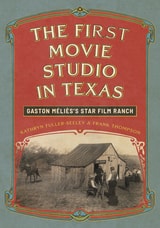
The First Movie Studio in Texas
Gaston Méliès's Star Film RanchKathryn Fuller-Seeley and Frank Thompson
University of Texas Press, 2026
The story of the Star Film Ranch and its pioneering crew, who created the first “authentic” Westerns filmed in Texas.
In 1910, the Méliès Star Film Company of Manhattan set up a moving-picture studio outside San Antonio, the first in Texas. Determined to make the most authentic Westerns possible, the company filmed there for a little over a year. In that brief time, it created more than seventy single-reel films, leaving a lasting mark on moviemaking.
Film historians Kathryn Fuller-Seeley and Frank Thompson return to a moment when on-location filmmaking was emerging as an artform. We meet producer Gaston Méliès, older brother of early-cinema legend Georges Méliès, and his cast and crew of young innovators, old hands, and genuine cowboys—like seventeen-year-old Edith Storey, the tomboy star who helped to ignite modern celebrity culture, and Francis Ford, who learned the art of film directing on the job and mentored his younger brother, Hollywood legend John Ford. The First Movie Studio in Texas traces the company’s trials and accomplishments, its influence on the depiction of race and gender in Western filmmaking, its surviving works, and its crowning achievement: The Immortal Alamo (1911), the earliest cinematic depiction of that famous battle.
Finally recovered from the shadows, the forgotten Méliès brother proves to be one of the key founders of the Western myth on screen.
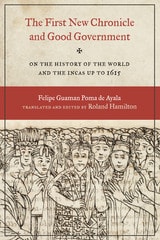
The First New Chronicle and Good Government
On the History of the World and the Incas up to 1615By Felipe Guaman Poma de Ayala
University of Texas Press, 2009
One of the most fascinating books on pre-Columbian and early colonial Peru was written by a Peruvian Indian named Felipe Guaman Poma de Ayala. This book, The First New Chronicle and Good Government, covers pre-Inca times, various aspects of Inca culture, the Spanish conquest, and colonial times up to around 1615 when the manuscript was finished. Now housed in the Royal Library, Copenhagen, Denmark, and viewable online at www.kb.dk/permalink/2006/poma/info/en/frontpage.htm, the original manuscript has 1,189 pages accompanied by 398 full-page drawings that constitute the most accurate graphic depiction of Inca and colonial Peruvian material culture ever done.
Working from the original manuscript and consulting with fellow Quechua- and Spanish-language experts, Roland Hamilton here provides the most complete and authoritative English translation of approximately the first third of The First New Chronicle and Good Government. The sections included in this volume (pages 1–369 of the manuscript) cover the history of Peru from the earliest times and the lives of each of the Inca rulers and their wives, as well as a wealth of information about ordinances, age grades, the calendar, idols, sorcerers, burials, punishments, jails, songs, palaces, roads, storage houses, and government officials. One hundred forty-six of Guaman Poma's detailed illustrations amplify the text.
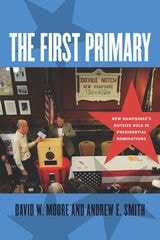
The First Primary
New Hampshire's Outsize Role in Presidential NominationsDavid W. Moore
University of New Hampshire Press, 2015
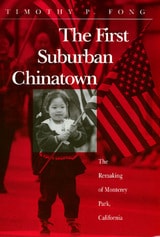
The First Suburban Chinatown
The Remaking of Monterey Park, CaliforniaTimothy P. Fong
Temple University Press, 1994
Monterey Park, California, only eight miles east of downtown Los Angeles, was dubbed by the media as the "First Suburban Chinatown." The city was a predominantly white middle-class bedroom community in the 1970s when large numbers of Chinese immigrants transformed it into a bustling international boomtown. It is now the only city in the United States with a majority Asian American population. Timothy P. Fong examines the demographic, economic, social, and cultural changes taking place there, and the political reactions to the change.
Fong, a former journalist, reports on how pervasive anti-Asian sentiment fueled a series of initiatives intended to strengthen "community control," including a movement to make English the official language. Recounting the internal strife and the beginnings of recovery, Fong explores how race and ethnicity issues are used as political organizing tools and weapons.
In the series Asian American History and Culture, edited by Sucheng Chan, David Palumbo-Liu, Michael Omi, K. Scott Wong, and Linda Trinh Võ.
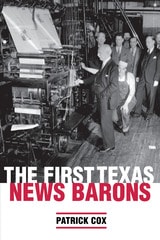
The First Texas News Barons
By Patrick Cox
University of Texas Press, 2005
Newspaper publishers played a crucial role in transforming Texas into a modern state. By promoting expanded industrialization and urbanization, as well as a more modern image of Texas as a southwestern, rather than southern, state, news barons in the early decades of the twentieth century laid the groundwork for the enormous economic growth and social changes that followed World War II. Yet their contribution to the modernization of Texas is largely unrecognized.
This book investigates how newspaper owners such as A. H. Belo and George B. Dealey of the Dallas Morning News, Edwin Kiest of the Dallas Times Herald, William P. Hobby and Oveta Culp Hobby of the Houston Post, Jesse H. Jones and Marcellus Foster of the Houston Chronicle, and Amon G. Carter Sr. of the Fort Worth Star-Telegram paved the way for the modern state of Texas. Patrick Cox explores how these news barons identified the needs of the state and set out to attract the private investors and public funding that would boost the state's civic and military infrastructure, oil and gas industries, real estate market, and agricultural production. He shows how newspaper owners used events such as the Texas Centennial to promote tourism and create a uniquely Texan identity for the state. To balance the record, Cox also demonstrates that the news barons downplayed the interests of significant groups of Texans, including minorities, the poor and underemployed, union members, and a majority of women.
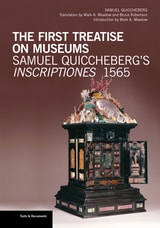
The First Treatise on Museums
Samuel Quiccheberg’s Inscriptiones, 1565Samuel Quiccheberg
J. Paul Getty Trust, The, 2014
Samuel Quiccheberg’s Inscriptiones, first published in Latin in 1565, is an ambitious effort to demonstrate the pragmatic value of curiosity cabinets, or Wunderkammern, to princely collectors in sixteenth-century Europe and, by so doing, inspire them to develop their own such collections. Quiccheberg shows how the assembly and display of physical objects offered nobles a powerful means to expand visual knowledge, allowing them to incorporate empirical and artisanal expertise into the realm of the written word. But in mapping out the collectability of the material world, Quiccheberg did far more than create a taxonomy. Rather, he demonstrated how organizing objects made their knowledge more accessible; how objects, when juxtaposed or grouped, could tell a story; and how such strategies could enhance the value of any single object.
Quiccheberg’s descriptions of early modern collections provide both a point of origin for today’s museums and an implicit critique of their aims, asserting the fundamental research and scholarly value of collections: collections are to be used, not merely viewed. The First Treatise on Museums makes Quiccheberg’s now rare publication available in an English translation. Complementing the translation are a critical introduction by Mark A. Meadow and a preface by Bruce Robertson.
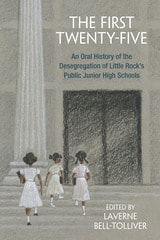
The First Twenty-Five
An Oral History of the Desegregation of Little Rock’s Public Junior High SchoolsLaVerne Bell-Tolliver
University of Arkansas Press, 2018
“It was one of those periods that you got through, as opposed to enjoyed. It wasn’t an environment that . . . was nurturing, so you shut it out. You just got through it. You just took it a day at a time. You excelled if you could. You did your best. You felt as though the eyes of the community were on you.”—Glenda Wilson, East Side Junior High
Much has been written about the historical desegregation of Little Rock Central High School by nine African American students in 1957. History has been silent, however, about the students who desegregated Little Rock’s five public junior high schools—East Side, Forest Heights, Pulaski Heights, Southwest, and West Side—in 1961 and 1962.
The First Twenty-Five gathers the personal stories of these students some fifty years later. They recall what it was like to break down long-standing racial barriers while in their early teens—a developmental stage that often brings emotional vulnerability. In their own words, these individuals share what they saw, heard, and felt as children on the front lines of the civil rights movement, providing insight about this important time in Little Rock, and how these often painful events from their childhoods affected the rest of their lives.
The First Urban Churches 1
Methodological FoundationsJames R. Harrison
SBL Press, 2015
A fresh look at early urban churches
This collection of essays examines the urban context of early Christian churches in the first-century Roman world. A city-by-city investigation of the early churches in the New Testament clarifies the challenges, threats, and opportunities that urban living provided for early Christians. Readers will come away with a better understanding of how scholars assemble an accurate picture of the cities in which the first Christians flourished.
Features:
- Analysis of urban evidence of the inscriptions, papyri, archaeological remains, coins, and iconography
- Discussion of how to use different types of evidence responsibly
- Outline of what constitutes proper methodological use for establishing a nuanced, informed portrait of ancient urban life
The First Urban Churches 2
Roman CorinthJames R. Harrison
SBL Press, 2016
Investigate the challenges, threats, and opportunities experienced by the early church
Volume two of The First Urban Churches focuses on the urban context of Christian churches in first-century Roman Corinth. An investigation of the material evidence of Corinth helps readers today understand properly the challenges, threats, and opportunities that the early Corinthian believers faced in the city. The essays demonstrate decisively the difference that such an approach makes in grappling with the meaning and context of the Corinthian epistles in the New Testament.
Features:
- Analysis of urban evidence of the inscriptions, papyri, archaeological remains, coins, and iconography
- Proposed reeconstructions of the past and its social, religious, and political significance
- A nuanced, informed portrait of ancient urban life in Corinth
The First Urban Churches 3
EphesusJames R. Harrison
SBL Press, 2018
Investigate the challenges, threats, and opportunities experienced by the early church in Ephesus
The third installment of The First Urban Churches focuses on the urban context of Christian churches in first-century Ephesus. As with previous volumes, contributors illustrate how an investigation of the material evidence will help readers understand properly the challenges, threats, and opportunities that the early Ephesian believers faced in that city. Brad Bitner, James R. Harrison, Michael Haxby, Fredrick J. Long, Guy M. Rogers, Michael Theophilos, Paul Trebilco, and Stephan Witetschek demonstrate decisively the difference that such an approach makes in grappling with the meaning and context of the New Testament writings, particularly Ephesians, Acts, and Revelation.
Features
- Analysis of urban evidence of the inscriptions, papyri, archaeological remains, coins, and iconography
- Proposed reconstructions of the past and its social, religious and political significance
- A nuanced, informed portrait of ancient urban life in Ephesus
The First Urban Churches 4
Roman PhilippiJames R. Harrison
SBL Press, 2018
Investigate the challenges and opportunities experienced by the early church
This fourth installment of The First Urban Churches, edited by James R. Harrison and L. L. Welborn, focuses on the urban context of Christian churches in first-century Roman Philippi. The international team of New Testament and classical scholars contributing to the volume present essays that use inscriptions, papyri, archaeological remains, coins, and iconography to examine the rivalries, imperial context, and ecclesial setting of the Philippian church.
Features:
- Analysis of the material and epigraphic evidence relating to first- and second-century CE Roman Philippi
- Examination of important passages from Philippians within their ancient urban context
- Investigation of the social composition and membership of the Philippian church from the archaeological and documentary evidence
The First Urban Churches 6
Rome and OstiaJames R. Harrison
SBL Press, 2021
An examination of early Roman Christianity by New Testament and classical scholars
Building on the methodologies introduced in the first volume of The First Urban Churches and supplementing the in-depth studies of Corinth, Ephesus, Philippi, Colossae, Hierapolis, and Laodicea (vols. 2–5), essays in this volume challenge readers to reexamine what we know about the early church within Rome and the port city of Ostia. In the introductory section of the book, James R. Harrison discusses the material and documentary evidence of both cities, which sets the stage for the essays that follow. In the second section, Mary Jane Cuyler, James R. Harrison, Richard Last, Annelies Moeser, Thomas A. Robinson, Michael P. Theophilos, and L. L. Welborn examine a range of topics, including the Ostian Synagogue, Romans 1:2–4 against the backdrop of Julio-Claudian adoption and apotheosis traditions, and the epistle of 1 Clement. In the final section of this volume, Jutta Dresken-Welland and Mark Reasoner engage Peter Lampe’s magnum opus From Paul to Valentinus; Lampe wraps up the section and the volume with a response. Throughout, readers are provided with a rich demonstration of how the material evidence of the city of Rome illuminates the emergence of Roman Christianity, especially in the first century CE.
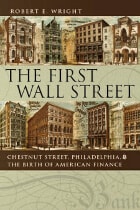
The First Wall Street
Chestnut Street, Philadelphia, and the Birth of American FinanceRobert E. Wright
University of Chicago Press, 2005
The First Wall Street recounts the fascinating history of Chestnut Street and its forgotten role in the birth of American finance. According to Robert E. Wright, Philadelphia, known for its cultivation of liberty and freedom, blossomed into a financial epicenter during the nation's colonial period. The continent's most prodigious minds and talented financiers flocked to Philly in droves, and by the eve of the Revolution, the Quaker City was the most financially sophisticated region in North America. The First Wall Street reveals how the city played a leading role in the financing of the American Revolution and emerged from that titanic struggle with not just the wealth it forged in the crucible of war, but an invaluable amount of human capital as well.
This capital helped make Philadelphia home to the Bank of the United States, the U.S. Mint, an active securities exchange, and several banks and insurance companies—all clustered in or around Chestnut Street. But as the decades passed, financial institutions were lured to New York, and by the late 1820s only the powerful Second Bank of the United States upheld Philadelphia's financial stature. But when Andrew Jackson vetoed its charter, he sealed the fate of Chestnut Street forever—and of Wall Street too.
Finely nuanced and elegantly written, The First Wall Street will appeal to anyone interested in the history of the United States and the origins of its unrivaled economy.
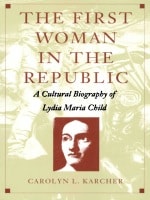
The First Woman in the Republic
A Cultural Biography of Lydia Maria ChildCarolyn L. Karcher
Duke University Press, 1998