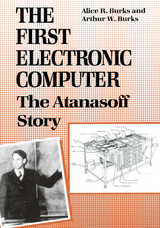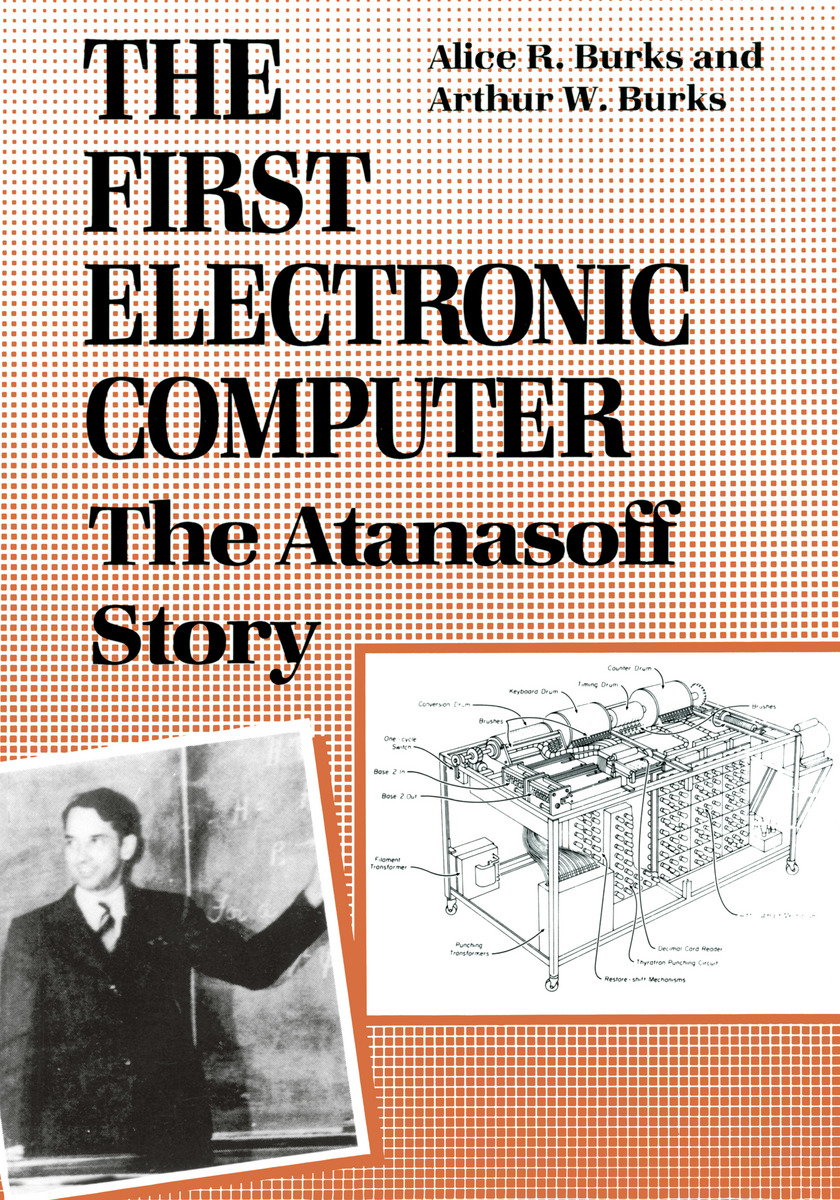
The First Electronic Computer: The Atanasoff Story
by Alice R. Burks and Arthur W. Burks
University of Michigan Press, 1989 Cloth: 978-0-472-10090-3 | Paper: 978-0-472-08104-2 | eISBN: 978-0-472-22535-4 (standard) Library of Congress Classification QA76.5.B825 1988 Dewey Decimal Classification 621.3909
ABOUT THIS BOOK | AUTHOR BIOGRAPHY | REQUEST ACCESSIBLE FILE
ABOUT THIS BOOK
The First Electronic Computer is a groundbreaking historical and technical account of John Vincent Atanasoff’s revolutionary work on the world’s first electronic digital computer. Drawing upon years of meticulous research and firsthand experience, coauthors Alice and Arthur Burks trace the remarkable journey of Atanasoff—from his early life and education to his pivotal innovations at Iowa State College in the late 1930s and early 1940s.Atanasoff’s machine—the Atanasoff-Berry Computer (ABC)—proved the feasibility of electronic computation and introduced key concepts, such as electronic switching and regenerative memory, that became foundational to the digital computers that followed. The authors present detailed narratives of Atanasoff’s collaboration with graduate student Clifford Berry and recount the critical sequence of events that linked his invention to the famous ENIAC, commonly celebrated as the first general-purpose electronic computer.With depth and clarity, the book delves into the technical design, development, and operation of the ABC, while candidly addressing the major controversies surrounding computing history. The Burkses examine the intricate web of correspondence, personal interactions, and legal battles—especially the landmark Honeywell v. Sperry Rand patent case—culminating in the federal court’s recognition of Atanasoff’s precedence over ENIAC.Rich in technical detail and engaging historical narrative, The First Electronic Computer offers readers an unparalleled look at the origins of one of the most significant technological revolutions of the twentieth century, acknowledging Atanasoff’s contributions and clarifying his enduring legacy in computing history.
AUTHOR BIOGRAPHY
Alice R. Burks is a research associate, Electrical Engineering and Computer Science, University of Michigan. A professional writer, she graduated in mathematics from the University of Pennsylvania and worked there and at the Aberdeen Proving Grounds for U.S. Army Ordnance, computing firing tables for which the ENIAC was conceived and built as an automatic means of computing these tables. She is coauthor with Arthur W. Burks of “The ENIAC: The First General-Purpose Electronic Computer” (Annals of the History of Computing, 1981).Arthur W. Burks is Professor, Electrical Engineering and Computer Science, University of Michigan, where he has also been the Russel lecturer. Early in his career he worked with John von Neumann and Herman Goldstine at the Institute lor Advanced Study, Princeton, in developing the logical design of an electronic digital computer. The basic design produced there became the prototype for many other computers built by universities, government research units, and International Business Machine Corporation. He is the author of Chance, Cause, Reason: An Inquiry into the Nature of Scientific Evidence (1977) among many other books and scientific articles. He and Alice Burks were at the Moore School of Electrical Engineering at the time the ENIAC computer was being developed.
REQUEST ACCESSIBLE FILE
If you are a student who cannot use this book in printed form, BiblioVault may be able to supply you
with an electronic file for alternative access.
Please have the accessibility coordinator at your school fill out this form.