Results by title
18284 books match the query 'United States' and 3764 start with t
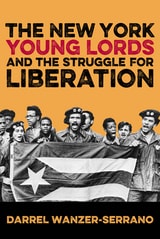
The New York Young Lords and the Struggle for Liberation
Darrel Wanzer-Serrano
Temple University Press, 2015
In The New York Young Lords and the Struggle for Liberation, Darrel Wanzer-Serrano details the numerous community initiatives that advanced decolonial sensibilities in El Barrio and beyond. Using archival research and interviews, he crafts an engaging account of the Young Lords’ discourse and activism. He rescues the organization from historical obscurity and makes an argument for its continued relevance, enriching and informing contemporary discussions about Latino/a politics.
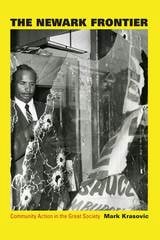
The Newark Frontier
Community Action in the Great SocietyMark Krasovic
University of Chicago Press, 2016
The Newark Frontier shows how, during the Great Society, urban liberalism adapted and grew, defining itself less by centralized programs and ideals than by administrative innovation and the small-scale, personal interactions generated by community action programs, investigative commissions, and police-community relations projects. Paying particular attention to the fine-grained experiences of Newark residents, Krasovic reveals that this liberalism was rooted in an ethic of experimentation and local knowledge. He illustrates this with stories of innovation within government offices, the dynamic encounters between local activists and state agencies, and the unlikely alliances among nominal enemies. Krasovic makes clear that postwar liberalism’s eventual fate had as much to do with the experiments waged in Newark as it did with the violence that rocked the city in the summer of 1967.

The Newbery and Caldecott Awards
A Guide to the Medal and Honor BooksAmerican Library Association, 2014
The News Untold
Community Journalism and the Failure to Confront Poverty in AppalachiaMichael Clay Carey
West Virginia University Press, 2017
Weatherford Award winner, nonfiction
The News Untold offers an important new perspective on media narratives about poverty in Appalachia. It focuses on how small-town reporters and editors in some of the region’s poorest communities decide what aspects of poverty are news, how their audiences interpret those decisions, and how those two related processes help shape broader understandings of economic need and local social responsibility. Focusing on patterns of both media creation and consumption, The News Untold shows how a lack of constructive news coverage of economic need can make it harder for the poor to voice their concerns.
Critical and inclusive news coverage of poverty at the local level, Michael Clay Carey writes, can help communities start to look past old stereotypes and attitudes and encourage solutions that incorporate broader sets of community voices. Such an effort will require journalists and community leaders to reexamine some of the professional traditions and social views that often shape what news looks like in small towns.
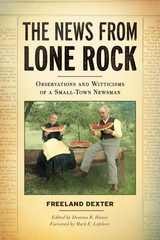
The News from Lone Rock
Observations and Witticisms of a Small-Town NewsmanFreeland Dexter
Wisconsin Historical Society Press, 2016
At the turn of the twentieth century, the bustling railroad town of Lone Rock, Wisconsin, was home to about a thousand residents, and Freeland Dexter seemed to know the business of every single one. Dexter reported all the news from Lone Rock—from the significant to the trivial, the tragic to the comical—for the Weekly Home News of neighboring Spring Green from 1884 to 1912.
This collection of Dexter’s most fascinating, amusing, and poignant stories and observations brings back to life the colorful characters of his time and takes readers on a journey to a world that was both simpler and changing fast. Whether he was reporting who grew the biggest watermelon, teasing the local lovebirds, or taking a side on the ever-controversial question of whether the town should go dry, Dexter wrote with a distinctive wit and an obvious affection for his town and its people. The News from Lone Rock also provides an illuminating window into a time period of rapid technological progress, showing how the introduction of electric light, telephones, and cars changed lives and connected this quaint village more and more to the outside world.
The News from Poems
Essays on the 21st-Century American Poetry of EngagementJeffrey Gray and Ann Keniston
University of Michigan Press, 2016
The News from Poems brings together newly commissioned essays by eminent poets and scholars of poetry and serves as a companion volume to an earlier anthology of engaged poetry compiled by the editors. Essays by Bob Perelman, Steven Gould Axelrod, Tony Hoagland, Eleanor Wilner, and others reveal how recent poetry has redefined our ideas of politics, authorship, identity, and poetics.
The volume showcases the diversity of contemporary American poetry, discussing mainstream and experimental poets, including some whose work has sparked significant controversy. These and other poets of our time, the volume suggests, are engaged not only with public events and topics but also with new ways of imagining subjectivity, otherness, and poetry itself.

The Newspaper Indian
Native American Identity in the Press, 1820-90John M. Coward
University of Illinois Press, 1999
How newspapers shaped the image of Native Americans
John M. Coward looks at how nineteenth-century newspapers and news making practices shaped the contradictory and still persistent representation of Native Americans. As Coward reveals, journalism failed to describe Indigenous people on their own terms. Instead, reporters chose portrayals that adhered to the norms of the majority white, Anglo-Saxon, Protestant society that read their papers. In addition, Coward shows how journalists turned Native Americans into symbolic and ambiguous figures used to measure American progress.
An in-depth look at the power of the press, The Newspaper Indian provides insight into how journalism wove a skewed idea of Native Americans into the fabric of American life.
The Newspapers Of Nevada
A History And Bibliography, 1854-1979Richard E. Lingenfelter
University of Nevada Press, 1984
This new bibliography of Nevada's newspapers supersedes and greatly expands on previous works. More than 800 publications are now included: traditional newspapers, penny shoppers, comic and campaign sheets, entertainment and matrimonial guides, and fictitious newspapers that had life only in the columns of other papers. Also included is a brief appendix of early newspapers from boarder states that reported regularly on Nevada. The authors have provided a brief historical sketch of each publication, together with a list and location of known copies of the original papers, plus current microfilm holdings. The bibliography also documents frequency of publication, proprietorship, title changes, printing locations, and political affiliation. This volume will be of value to historians ranging from scholars to genealogy buffs who need access to the information only newspapers can provide.
The Next Conservatism
Paul M. Weyrich and William S. Lind
St. Augustine's Press, 2009
Since November’s election, conservative columnists have filled the op-ed pages with calls for a new conservative agenda. In The Next Conservatism, two of the conservative movement’s best-known thinkers, Paul M. Weyrich and William S. Lind, offer exactly that. More, they offer a new kind of conservative agenda, one that reaches far beyond politics to grapple with the sources of our nation’s cultural decay.
The Next Conservatism recognizes that culture is more powerful than politics. Nevertheless, it offers an engaging menu of political reforms, all under the rubric of “Restore the Republic!” No enthusiasts of Imperial America at home or abroad, Weyrich and Lind seek limited government, jealous guardianship of civil liberties, and a Washington liberated from the power of the New Class, the interests that feed off our nation’s decay. To these frequent conservative themes, Weyrich and Lind offer something new: a warning of a general crisis of legitimacy of the state itself, which can lead to a Hobbesian state of anarchy. How might we save the state while avoiding the jaws of Leviathan? The Next Conservatism offers innovative ways to thread that needle.
Meanwhile, what of America’s culture? Did its decay over the past half-century “just happen”? Weyrich and Lind argue no; rather, much of our degradation was deliberate, the work of the poisonous ideology of cultural Marxism, aka “Political Correctness.” The Next Conservatism takes the reader on a fascinating historical tour of the origins of Political Correctness in the infamous Frankfurt School, a gathering of heretical Marxists whose goal from the outset was the destruction of Western culture.
Weyrich and Lind then proceed to “deconstruct” the left’s program for America, debunking Feminism, “racism,” and environmentalism along the way. Reflecting the thought of Russell Kirk, The Next Conservatism condemns ideologies left and right, calling instead for a return to traditional ways of living, ways that reflect wisdom accumulated generation by generation. Only thus, they argue, can conservatives win a culture war many regard as hopelessly lost.
Old ways, in turn, lead to a Next Conservatism appropriate for hard times. Virtue, Weyrich and Lind offer, is to be found in modest living, not conspicuous consumption. The Next Conservative agenda rejects environmentalism but includes conservation, the return of the family farm, New Urbanism and the revival of such ‘oldies but goodies” as streetcars and passenger trains. A new theme, Retroculture, sums up a conservatism that recognizes that what worked in the past can work again today, and in the future as well. Our ancestors were no fools, the authors suggest, and “Back to the Future!” can serve as a powerful conservative rallying cry.
Having laid the political and cultural groundwork, The Next Conservatism then turns to conservative governance. In foreign policy, the authors call for minimizing foreign entanglements, though with a strong national defense and a military reform to adapt to face Fourth Generation warfare rather than the Second Generation America adheres to. For the economy, the authors call for repairing and expanding our national infrastructure, sound money, and protecting American industry, seeing labor as a potential ally. In both national security and economic security, the authors insist that good governance include moral security; drawing from the New Urbanism, they offer a “moral transect” that allows everyone to do what he wants, but not always where he wants. The public square, they suggest, should be safe for families.
Respecting the careful limits on government power a restored republic would embody, The Next Conservatism calls for redeeming America not through legislation but through a new conservative movement. Unlike the old movement, the next conservative movement would be a league of people who pledged to live their lives by the old rules. While conservatives would remain engaged in politics, they would rely on a vastly more powerful force of example, the examples of lives lived well in traditional ways. This next conservative movement would appeal far beyond the ranks of political conservatives, to all Americans who know that something has gone tragically wrong in the life of our nation.
The Next Conservatism offers a vision of vast sweep, far beyond anything coming out of Washington. At a time when most Americans find life growing more difficult, it proposes a path to a new America that is also the old America, the good, comfortable America we had and have lost.
The Next Form of Democracy
How Expert Rule Is Giving Way to Shared Governance—and Why Politics Will Never Be the SameMatt Leighninger
Vanderbilt University Press, 2006
The stories of civic experiments in this book can show us the realpolitik of deliberative democracy, and illustrate how the evolution of democracy is already reshaping politics.
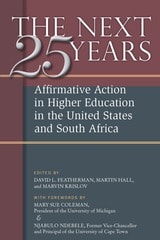
The Next Twenty-five Years
Affirmative Action in Higher Education in the United States and South AfricaDavid L. Featherman, Martin Hall, and Marvin Krislov, editors
University of Michigan Press, 2009
"Ambitious, provocative, and wide-ranging, this rich collection of essays from U.S. and South African perspectives reflects the thinking of thoughtful advocates of affirmative action."
---William G. Bowen, President Emeritus, The Andrew W. Mellon Foundation, and President Emeritus, Princeton University
"Thoughtful commentary from outstanding experts on affirmative action’s future in two countries struggling to overcome a legacy of racial injustice."
---Derek Bok, 300th Anniversary University Research Professor, and President Emeritus, Harvard University
"An enormously important comparative study and reflection on affirmative (U.S.) and corrective (South Africa) action with exhaustive and sensitive treatment of a vital topic."
---Kader Asmal, Professor of Law, University of the Western Cape, Cape Town, and former Minister of Education, South Africa
A penetrating exploration of affirmative action's continued place in 21st-century higher education, The Next Twenty-five Years assembles the viewpoints of some of the most influential scholars, educators, university leaders, and public officials. Its comparative essays span the political spectrum and dissect debates in two nations to elucidate the legal, political, social, economic, and moral dimensions of affirmative action in higher education and its role in contributing to a just, equitable, and vital society.
David L. Featherman is Professor of Sociology and Psychology and Founding Director of the Center for Advancing Research and Solutions for Society at the University of Michigan.
Martin Hall is Vice-Chancellor of the University of Salford, Greater Manchester, and previously was Deputy Vice-Chancellor at the University of Cape Town.
Marvin Krislov is President of Oberlin College and previously was Vice President and General Counsel at the University of Michigan.
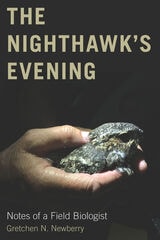
The Nighthawk's Evening
Notes of a Field BiologistGretchen N. Newberry
Oregon State University Press, 2021
This acrobatic, night-flying bird nests on rooftops and flocks in the thousands as it migrates from Alaska to Argentina and back every year. Nighthawks are strange animals, reptiles with feathers, sleepy during the day, but quick, agile, and especially adept at survival. They have the ability to withstand extreme temperatures and adapt to many habitats, but they are struggling for survival in the Anthropocene.
Newberry’s story focuses on the bird itself—its complex conservation status and cultural significance—and the larger, often hidden world of nocturnal animals. Along the way, she gives readers insight into the daily life of a scientist, especially one who works primarily at night. The Nighthawk’s Evening uses one scientist and one species to explore the challenges, disappointments, and successes of scientific research and conservation efforts. An accessible work of science, it will appeal to birders, students, wildlife managers, and anyone who is fascinated by urban wildlife.
The Nigrescent Beyond
Mexico, the United States, and the Psychic Vanishing of BlacknessRicardo A. Wilson II
Northwestern University Press, 2020
Wilson models a practice of reading that honors the disruptive possibilities offered by an ever-present awareness of that which lies, irretrievable, beyond the horizon of vanishing itself. In doing so, he engages with historical accounts detailing maroon activities in early New Spain, contemporary coverage of the push to make legible Afro-Mexican identities, the electronic archives of the Obama presidency, and the work of Carlos de Sigüenza y Góngora, Octavio Paz, Ivan Van Sertima, Miguel Covarrubias, Steven Spielberg, and Colson Whitehead, among others.
The Nixon Memo
Political Respectability, Russia, and the PressMarvin Kalb
University of Chicago Press, 1994
The story begins on March 10, 1992. Nixon had written a private memo critical of president George Bush's policy toward Russia. The memo leaked and exploded on the front page of The New York Times. Why would Nixon attack Bush, a fellow party member fighting for re-election? Why on an issue of foreign affairs, which was Bush's strength? The questions are as intriguing as the answers, and distinguished journalist and scholar Marvin Kalb offers a suspenseful, eye-opening account of how our conventional wisdom on United States foreign policy is shaped by the insider's game of press/politics.
This story of Nixon's Machiavellian efforts to pressure the White House, by way of the press, into helping Boris Yeltsin and Russia sheds new light on the inner workings of the world inside the government of the United States. Marvin Kalb read the documents behind the Nixon memo and interviewed scores of journalists, scholars, and officials in and from Washington and Moscow. Drawing on his years of experience as a diplomatic correspondent, he identifies and illuminates the intersection of press and politics in the fashioning of public policy.
"An absorbing and often compelling argument that Richard Nixon directed his own political rehabilitation on the world stage, using presidents, lesser politicians, and the press as his supporting cast. This is a first-class job of unraveling a complex and usually unseen tapestry."—Ted Koppel
"With Marvin Kalb's captivating account, Richard Nixon continues to fascinate us even in death."—Al Hunt

The Noble Savage in the New World Garden
Notes toward a Syntactics of PlaceGaile McGregor
University of Wisconsin Press, 1988
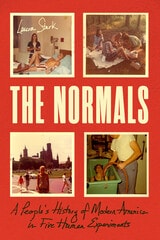
The Normals
A People’s History of Modern America in Five Human ExperimentsLaura Stark
University of Chicago Press, 2027
How healthy control subjects in clinical research transformed the practice and labor of science, as told by the Normals themselves.
In the 1950s, the National Institutes of Health were in search of a large, replenishing stream of healthy people to participate in clinical studies. To establish legal sources of test subjects, the NIH signed unprecedented contracts with American colleges, church organizations, and other government agencies, and in the process gave rise to a new type of test subject: the “normal patient.” Thousands of them eventually moved into the NIH Clinical Center to live in hospital rooms, eat food prepared in a metabolic kitchen, and follow—or flout—the rules.
The Normals is a groundbreaking account of the NIH Normal Volunteer Patient Program, which has lasted into the twenty-first century. This program harnessed outside organizations in all areas of postwar American life—colleges and universities, labor unions, civic groups, federal prisons, and churches—to recruit research subjects for human experiments. Drawing on thousands of pages of unearthed government documents, oral histories, and personal materials shared by the patients themselves (collected in a new archive), Laura Stark follows five experiments and the people involved, delving into their biographies, their time at the Clinical Center, and the thorny problem of determining who counts as “normal.” The “Normals” were not passive objects of study, Stark shows, but active research participants who collaborated with scientists, maintained the laboratories where they served, informed official ethics policies, and bargained to meet their needs.
By taking seriously the pillow fights and the first kisses, the bible clubs and the movie nights that animated the Clinical Center as much as the medical experiments, The Normals brings to life a surprising true story of the origins of our present-day system of human experiment, one that at once explores what it means to work, to serve, to volunteer.
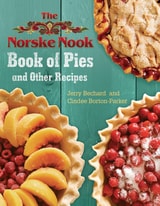
The Norske Nook Book of Pies and Other Recipes
Jerry Bechard and Cindee Borton-Parker
University of Wisconsin Press, 2015
This cookbook features the restaurants’ award-winning baking: Scandinavian specialties, cheesecakes, tortes, cookies, muffins, and more than seventy recipes (and variations) for pie. More than fifty new pie recipes have been created by the Nook bakers since 1990, when Jerry Bechard purchased the Osseo café from founder Helen Myhre. The Norske Nook has won thirty-six blue ribbons at the National Pie Championships in Florida—including three in 2014, for Lemon Cream Cheese, Peaches and Cream, and Jamberry.
Gold Medal Winner, Cookbook, Foreword Reviews IndieFab Book of the Year Awards
Runner-up, Cookbooks/Crafts/Hobbies, Midwest Book Awards
“Outstanding” books for public & secondary school libraries from university presses, American Library Association
“Best of the Best” books for public libraries from university presses, American Library Association

The North Country Trail
The Best Walks, Hikes, and Backpacking Trips on America’s Longest National Scenic TrailRon Strickland with the North Country Trail Association
University of Michigan Press, 2013
The North Country Trail is the longest of America’s eleven congressionally designated National Scenic Trails. Winding through seven states—New York, Pennsylvania, Ohio, Michigan, Wisconsin, Minnesota, and North Dakota—the NCT’s 4,600 miles attract more than one million visitors annually. These hikers are treated to a smorgasbord of Upper Midwest hiking featuring everything from urban strolls to backcountry adventure through mountains, rivers, prairies, and shoreline. This book is the definitive guide for NCT hikers—whether first-timers, seasoned backpackers, or any level in between—who wish to maximize their experience on this splendid trail.
In addition to a full overview of the trail’s tread in each state, the guide describes in detail forty of the NCT’s premier segments, with helpful information including easy-to-read trail descriptions, physical and navigation difficulties, trail highlights, hiking tips, and precise maps incorporating the latest GPS technology.
The Northeast Corridor
The Trains, the People, the History, the RegionDavid Alff
University of Chicago Press, 2024
Traversed by thousands of trains and millions of riders, the Northeast Corridor might be America’s most famous railway, but its influence goes far beyond the right-of-way. David Alff welcomes readers aboard to see how nineteenth-century train tracks did more than connect Boston to Washington, DC. They transformed hundreds of miles of Atlantic shoreline into a political capital, a global financial hub, and home to fifty million people. The Northeast Corridor reveals how freight trains, commuter rail, and Amtrak influenced—and in turn were shaped by—centuries of American industrial expansion, metropolitan growth, downtown decline, and revitalization.
Paying as much attention to Canton, Trenton, New Rochelle, and Providence as to New York City, Philadelphia, and Baltimore, Alff provides narrative thrills for history buffs, train enthusiasts, and adventurers alike. What’s more, he offers a glimpse into the future of the corridor. New infrastructural plans—supported by President Joe Biden, famously Amtrak’s biggest fan—envision ever-faster trains zipping along technologically advanced rails. Yet those tracks will literally sit atop a history that links the life of Frederick Douglass, who fled to freedom by boarding a train in Baltimore, to the Frederick Douglass Tunnel, which is expected to be the newest link in the corridor by 2032.
Trains have long made the places that make America, and they still do.
The Northwest Florida Expeditions of Clarence Bloomfield Moore
Clarence Bloomfield Moore
University of Alabama Press, 1999
A Dan Josselyn Memorial Publication
This comprehensive compilation of Moore's archaeological reports on northwest Florida and southern Alabama and Georgia presents the earliest documented investigations of this region.
When Clarence Bloomfield Moore cruised the rivers of Florida in search of prehistoric artifacts a century ago, he laid the groundwork for archaeological investigations to follow. This volume reflects Moore's fieldwork along the northwest Florida coast, the most archaeologically rich area of the state, as well as Southern Alabama and Georgia.
Here readers will share Moore's first look at the area in 1901-1903 and additional observations made in 1918 during what was to be his last field season. Moore's works reveal ceramics, tools, skeletal remains, and exotic artifacts excavated from the earthen mounds and shell middens built by native peoples over the last two millennia.
In the introduction to this edition, David Brose and Nancy Marie White place Moore's investigations within the context of the science, natural history, and antiquarianism of his day. They document what happened to the sites he explored, tell how his findings fit into the body of his research, and explain how those findings should be interpreted in the context of Southeastern culture history and modern archaeological theory.
Moore was the most knowledgeable Southeastern archaeologist of his time; his writings are a benchmark for anyone studying those areas today.
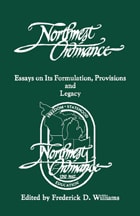
The Northwest Ordinance
Essays on its Formulation, Provisions, and LegacyFrederick D. Williams
Michigan State University Press, 1989
Adoption of the Northwest Ordinance in 1787 ended a long and sometimes acrimonious debate over the question of how to organize and govern the western territories of the United States. Many eastern leaders viewed the Northwest Territory as a colonial possession, while freedom-loving settlers demanded local self- government. These essays address the ambiguities of the Ordinance, balance of power politics in North America, missionary activity in the territory, slavery, and higher education in the Old Northwest.
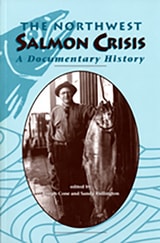
The Northwest Salmon Crisis
A Documentary HistoryJoseph Cone
Oregon State University Press, 1996
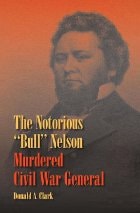
The Notorious "Bull" Nelson
Murdered Civil War GeneralDonald A. Clark
Southern Illinois University Press, 2011
A dynamic figure in the pages of history, Major General William “Bull” Nelson played a formative role in the Union’s success in Kentucky and the Western theater of the Civil War. Now, Donald A. Clark presents a long-overdue examination of this irascible officer, his numerous accomplishments, and his grim fate. More popularly known for his temper than his intrepid endeavors on behalf of the North, Nelson nevertheless dedicated much of his life to his nation and the preservation of the Union.
The child of a privileged family, Nelson was one of the first officers to graduate from the newly formed U.S. Naval Academy. His years in the Navy imbued in him the qualities of bravery, loyalty, and fortitude; however, his term of service also seemed to breed an intolerance of others for which he became infamous, and that ultimately led to his violent downfall. Clark sheds new light upon Nelson’s pre–Civil War years as a naval officer, when he became a hardened veteran of battle, fighting at the siege of Veracruz and the capture of Tabasco during the Mexican War in the 1840s. On the basis of Nelson’s military experience, in 1861 President Lincoln sent him to Kentucky—which was considering secession—and Nelson rallied loyalists and helped the Union prepare to maintain control of the state during the next several years of war.
Nelson went on to prove instrumental in blocking Confederate attempts to subdue Kentucky and the West, serving important roles in the battle of Shiloh, General Henry W. Halleck’s advance against Corinth, and Brigadier General Don Carlos Buell’s movement toward Chattanooga. But while some viewed his bold maneuvers as the saving of the state, many others, including such notables as Ulysses S. Grant and William Tecumseh Sherman, argued that Nelson’s actions merited no praise. Unfortunately for the general, the question of his value to the Union abruptly became moot, as his achievements were shortly overshadowed by ignominious rumors of scandal and abuse.
His involvement in the defense of Louisville gave Nelson a chance to redeem himself and restore his military reputation, but the general’s famous temper soon robbed him of any potential glory. During September of 1862, in a crime that was never prosecuted, fellow Union general Jefferson C. Davis shot and killed Nelson after an argument. Clark explores this remarkable exception in military law, arguing that while the fact of the murder was indisputable, many considered Davis a hero for having dispatched the so-called tyrant. Although Nelson eventually received many posthumous honors for his indispensable role in the war, justice was never sought for his murder.
A comprehensive study of this well-known, yet misunderstood American figure, The Notorious “Bull” Nelson: Murdered Civil War General is an illuminating addition to the history of the Civil War. Through Clark’s impeccable research and richly layered narrative, William “Bull” Nelson springs from the pages as large and volatile as he was in life.
The Novel and the American Left
Critical Essays on Depression-Era FictionJanet Galligani Casey
University of Iowa Press, 2004
The first collection of critical essays to focus specifically on the fiction produced by American novelists of the Depression era, The Novel and the American Left contributes substantially to the newly emerging emphasis on twentieth-century American literary radicalism. Recent studies have recovered this body of work and redefined in historical and theoretical terms its vibrant contribution to American letters. Casey consolidates and expands this field of study by providing a more specific consideration of individual novels and novelists, many of which are reaching new contemporary audiences through reprints.
The Novel and the American Left focuses exclusively on left-leaning fiction of the Depression era, lending visibility and increased critical validity to these works and showing the various ways in which they contributed not only to theorizations of the Left but also to debates about the content and form of American fiction. In theoretical terms, the collection as a whole contributes to the larger reconceptualization of American modernity currently under way. More pragmatically, individual essays suggest specific authors, texts, and approaches to teachers and scholars seeking to broaden and/or complicate more traditional “American modernism” syllabi and research agendas.
The selected essays take up, among others, such “hard-core"” leftist writers as Mike Gold and Myra Page, who were associated with the Communist Party; the popular novels of James M. Cain and Kenneth Fearing, whose works were made into successful films; and critically acclaimed but nonetheless “lost” novelists such as Josephine Johnson, whose Now in November (Pulitzer Prize, 1936) anticipates and complicates the more popular agrarian mythos of Steinbeck’s The Grapes of Wrath.
This volume will be of interest not only to literary specialists but also to historians, social scientists, and those interested in American cultural studies.
The Nuptial Deal
Same-Sex Marriage and Neo-Liberal GovernanceJaye Cee Whitehead
University of Chicago Press, 2011
The Nursing Clio Reader
Histories of Sex, Reproduction, and JusticeJacqueline D. The Nursing Clio Editorial Collective
Rutgers University Press, 2025
The Nursing Clio Reader answers that call, bringing together essays that examine reproductive health through historical research and personal experience. Featuring both new and classic pieces from the Nursing Clio blog, leading historians of reproductive health provide insights that connect past struggles with today’s ongoing battles over bodies, reproductive rights, and health care. This collection offers intimate, urgent scholarship that speaks to the present moment.
A powerful resource for classrooms and individual readers alike, The Nursing Clio Reader invites reflection on how the past informs current debates, urging us to engage deeply with the history of reproductive justice in a time of unprecedented change, underscoring that indeed "the personal is historical."
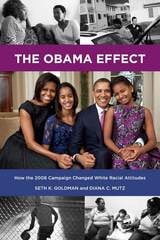
The Obama Effect
How the 2008 Campaign Changed White Racial AttitudesSeth K. Goldman
Russell Sage Foundation, 2014
The Obama Phenomenon
Toward a Multiracial DemocracyEdited by Charles P. Henry, Robert L. Allen, and Robert Chrisman
University of Illinois Press, 2011
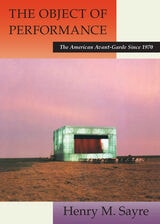
The Object of Performance
The American Avant-Garde since 1970Henry M. Sayre
University of Chicago Press, 1989
"Sayre has written one of the most intelligent, sensible, and readable accounts of the tenents of Postmodern artmaking published to date."—Jeff Abell, New Art Examiner
"No one can read The Object of Performance without gaining a far better idea than before of what has happened to art, and, in some measure, why. . . . I find this book consistently illuminating."—Arthur C. Danto
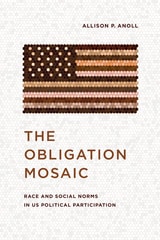
The Obligation Mosaic
Race and Social Norms in US Political ParticipationAllison P. Anoll
University of Chicago Press, 2022
In The Obligation Mosaic, Allison P. Anoll shows that the obligations that bring people into the political world—or encourage them to stay away—vary systematically by race in the United States, with broad consequences for representation. Drawing on a rich mix of interviews, surveys, and experiments with Asian, Black, Latino, and White Americans, the book uncovers two common norms that centrally define concepts of obligation: honoring ancestors and helping those in need. Whether these norms lead different groups to politics depends on distinct racial histories and continued patterns of segregation.
Anoll’s findings not only help to explain patterns of participation but also provide a window into opportunities for change, suggesting how activists and parties might better mobilize marginalized citizens.
The Obligation Toward the Difficult Whole
Postmodernist Long PoemsBrian McHale
University of Alabama Press, 2003
Addressing subjects as wide-ranging as angelology, the court masque, pop art, caricature, the cult of the ruin, hip-hop, Spense’'s Irish policy, and the aesthetics of silence, Brian McHale pulls varied threads together to identify a repertoire of postmodernist elements characteristic of the long poems he examines.
As critic Jed Rasula explains, “McHale is wonderfully resourceful in changing the subject from chapter to chapter to fit the poems discussed, and while his approach adheres to the conventions of textual exegesis, the chapters really shine as orchestrations of issues. For instance, James Merrill’s The Changing Light at Sandover works unexpectedly well in raising the subject of found poetry and procedural composition; Melvin Tolso’'s Harlem Gallery and Edward Dorn's Gunslinger are effectively paired to demonstrate the period flavor of pastiche; Geoffrey Hill’s Mercian Hymns and Armand Schwerner’s The Tablets explode the modernist fixation with depth; John Ashbery’s work is given a nuanced reading as proto-theory; Letter to an Imaginary Friend by Thomas McGrath provides a lucid backdrop to raise the question of political efficacy in approaching language poet Bruce Andrews; and Susan Howe's The Europe of Trusts is explored for its intertextual tapestry.”
McHale shows how elements from these long poems overlap, interfere, pull in different directions, jar against, and even contradict each other; and he demonstrates how they also echo, amplify, and reinforce each other. They do not slot smoothly together like pieces in a jigsaw puzzle, but they do form (what else?) a difficult whole.
The Ocean Is a Wilderness
Atlantic Piracy and the Limits of State Authority, 1688-1856Guy Chet
University of Massachusetts Press, 2014
Chet shows how the traditional focus on the growth of the modern state overlooked the extent to which old attitudes and cultural practices continued to hold sway. Even as the British government extended its naval, legal, and bureaucratic reach, in many parts of the Atlantic world illegal trade was not only tolerated but encouraged. In part this was because Britain's constabulary command of the region remained more tenuous than some have suggested, and in part because maritime insurance and wartime tax policies ensured that piracy and smuggling remained profitable. When Atlantic piracy eventually waned in the early nineteenth century, it had more to do with a reduction in its profitability at port than with forceful confrontation at sea.
Challenging traditional accounts that chronicle forces of civilization taming a wild Atlantic frontier, this book is a valuable addition to a body of borderlands scholarship reevaluating the relationship between the emerging modern state and its imperial frontiers.
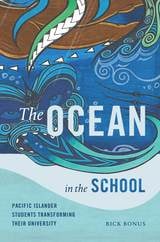
The Ocean in the School
Pacific Islander Students Transforming Their UniversityRick Bonus
Duke University Press, 2020
The Official YALSA Awards Guidebook
American Library Association, 2008
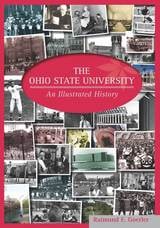
The Ohio State University
An Illustrated HistoryRaimund E. Goerler
The Ohio State University Press, 2011
Raimund E. Goerler, acclaimed archivist and historian, has written the definitive guidebook to the history of The Ohio State University, one of the world's largest universities and a prominent land-grant institution. Using a topical strategy—ranging widely through critical events in OSU's history, vignettes of prominent alumni, and stories of well known campus buildings, historic sites, presidents, student life, traditions, and athletics—The Ohio State University: An Illustrated History is the first one-volume history of the University to appear in more than fifty years.
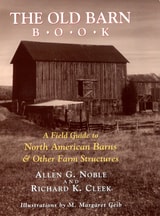
The Old Barn Book
A Field Guide to North American Barns & Other Farm StructuresNoble, Allen G
Rutgers University Press, 1996
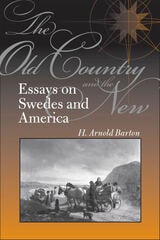
The Old Country and the New
Essays on Swedes and AmericaH. Arnold Barton
Southern Illinois University Press, 2006
Documenting a rich Scandinavian American culture and ethnic perspective
This notable collection of seventeen essays and six editorials by renowned Swedish American historian H. Arnold Barton was compiled from writings published between 1974 and 2005. The result of three decades of extensive research in the United States and Sweden, The Old Country and the New: Essays on Swedes and America, covers Swedish emigration to North America as well as the history and culture of Swedes in their new country.
In this rich mosaic of American ethnicity and cultural history, Barton analyzes the multifaceted Swedish emigration/immigration story. Essays include a survey of the historiography of emigration from the Scandinavian countries and the Scandinavian immigration to North America, Swedish emigration before 1846, and the Eric-Janssonist religious sect and its colony at Bishop Hill, Illinois.
Because Swedish immigrants were highly literate people, they wrote numerous letters describing their experiences to relatives and friends at home. What these letters related—or omitted—is the subject of another essay. Barton discusses Swedish immigrants who returned permanently to their homeland, affecting both the old country and the new. He also traces relations between the United States and Sweden, post—World War II Swedish immigration, and genealogy as history.
Offering a broad Scandinavian American ethnic perspective, The Old Country and the New appeals to both scholars and lay readers. Sixteen illustrations and a complete bibliography of Barton’s publications on Swedish American history and culture enhance the volume.
The Old Federal Road in Alabama
An Illustrated GuideKathryn H. Braund, Gregory A. Waselkov, and Raven M. Christopher
University of Alabama Press, 2019
A concise illustrated guidebook for those wishing to explore and know more about the storied gateway that made possible Alabama's development.
Forged through the territory of the Creek Nation by the United States federal government, the Federal Road was developed as a communication artery linking the east coast of the United States with Louisiana. Its creation amplified already tense relationships between the government, settlers, and the Creek Nation, culminating in the devastating Creek War of 1813–1814, and thereafter it became the primary avenue of immigration for thousands of Alabama settlers.
Central to understanding Alabama’s territorial and early statehood years, the Federal Road was both a physical and symbolic thoroughfare that cut a swath of shattering change through the land and cultures it traversed. The road revolutionized Alabama’s expansion, altering the course of its development by playing a significant role in sparking a cataclysmic war, facilitating unprecedented American immigration, and enabling an associated radical transformation of the land itself.
The first half of The Old Federal Road in Alabama: An Illustrated Guide offers a narrative history that includes brief accounts of the construction of the road, the experiences of historic travelers, and descriptions of major changes to the road over time. The authors vividly reconstruct the course of the road in detail and make use of a wealth of well-chosen illustrations. Along the way they give attention to the very terrain it traversed, bringing to life what traveling the road must have been like and illuminating its story in a way few others have ever attempted.
The second half of the volume is divided into three parts—Eastern, Central, and Southern—and serves as a modern traveler’s guide to the Federal Road. This section includes driving tours and maps, highlighting historical sites and surviving portions of the old road and how to visit them.
The Old South Frontier
Cotton Plantations and the Formation of Arkansas Society, 1819–1861Donald P. Mcneilly
University of Arkansas Press, 2000
The Old-Time Saloon
Not Wet - Not Dry, Just HistoryGeorge Ade
University of Chicago Press, 2016
The Olympics that Never Happened
Denver '76 and the Politics of GrowthAdam Berg
University of Texas Press, 2023
A look back at how powerful politicians, business leaders, and a diverse cast of activists used a thwarted Olympics to shape the state of Colorado and the city of Denver.
If you don’t recall the 1976 Denver Olympic Games, it’s because they never happened. The Mile-High City won the right to host the winter games and then was forced by Colorado citizens to back away from its successful Olympic bid through a statewide ballot initiative. Adam Berg details the powerful Colorado regime that gained the games for Denver and the grassroots activism that brought down its Olympic dreams, and he explores the legacy of this milestone moment for the games and politics in the United States.
The ink was hardly dry on Denver’s host agreement when Mexican American and African American urbanites, white middle-class environmentalists, and fiscally concerned local politicians realized opposition to the Olympics provided them new political openings. The Olympics quickly became a platform for taking stands on a range of issues, from conservation to urban livability to the very idea of growth, which for decades had been unquestioned in Colorado. The Olympics That Never Happened argues that hostility to the Olympics galvanized and empowered diverse citizens in a major US city, with long-term ramifications for Colorado and political activism elsewhere. The Olympics themselves were changed forever, compelling organizers to take seriously competing interests from subgroups within their communities.
The Ongoing Civil War
New Versions of Old StoriesEdited & Intro by Herman Hattaway & Ethan S. Rafuse
University of Missouri Press, 2004
In 1997, John Stanchak, an editor at Cowles Enthusiast Media (now part of Primedia), realized his vision of “a publication that contained the best, most up-to-date scholarship on the [Civil] war, but was edited with the amateur historian in mind,” with the publication of Columbiad: A Quarterly Review of the War between the States. In the four years the journal was published, it strived to lessen the rift between the scholarly world of professional historians and the “popular” history with which the general reader is more familiar. Now, a selection of the essays that best represent the successful balance between “serious scholarship” and a narrative reading style preferred by the educated layman has been collected in The Ongoing Civil War.
The Only Way Out
The Racial and Sexual Performance of EscapeKatherine Brewer Ball
Duke University Press, 2024
The Only Way Through Is Out
Suzette Mullen
University of Wisconsin Press, 2024
Digging into her past, Suzette uncovered a deeply buried truth: she’d been in love with her best friend—a woman—for nearly two decades—and still was. Leaning into these “unspeakable” feelings would put Suzette’s identity, relationships, and life of privilege at risk—but taking this leap might be her only chance to feel fully alive. As Suzette opened herself up to new possibilities, an unexpected visit to a new city helped her discover who she was meant to be.
Introspective, bittersweet, and empowering, The Only Way Through Is Out is both a coming-out and coming-of-age story, as well as a call to action for every human who is longing to live authentically but is afraid of the cost.
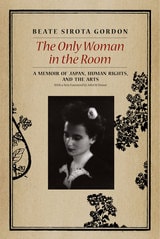
The Only Woman in the Room
A Memoir of Japan, Human Rights, and the ArtsBeate Sirota Gordon
University of Chicago Press, 2014
Sirota was born in Vienna, but in 1929 her family moved to Japan so that her father, a noted pianist, could teach, and she grew up speaking German, English, and Japanese. Russian, French, Italian, Latin, and Hebrew followed, and at fifteen Sirota was sent to complete her education at Mills College in California. The formal declaration of World War II cut Gordon off from her parents, and she supported herself by working for a CBS listening post in San Francisco that would eventually become part of the FCC. Translating was one of Sirota’s many talents, and when the war ended, she was sent to Japan as a language expert to help the American occupation forces. When General MacArthur suddenly created a team that included Sirota to draft the new Japanese Constitution, he gave them just eight days to accomplish the task. Colonel Roest said to Beate Sirota, “You’re a woman, why don’t you write the women’s rights section?”; and she seized the opportunity to write into law guarantees of equality unparalleled in the US Constitution to this day.
But this was only one episode in an extraordinary life, and when Gordon died in December 2012, words of grief and praise poured from artists, humanitarians, and thinkers the world over. Illustrated with forty-seven photographs, The Only Woman in the Room captures two cultures at a critical moment in history and recounts, after a fifty-year silence, a life lived with purpose and courage. This edition contains a new afterword by Nicole A. Gordon and an elegy by Geoffrey Paul Gordon.
The Open Mind
Cold War Politics and the Sciences of Human NatureJamie Cohen-Cole
University of Chicago Press, 2013
The Opinionated University
Academic Freedom, Diversity, and the Myth of Neutrality in American Higher EducationBrian Soucek
University of Chicago Press, 2026
Can a university ever truly be neutral in today’s social and political climate? Pushing against the tide of universities increasingly pledging to stay neutral about contentious issues, law professor Brian Soucek argues that their promises are doomed to fail—universities can’t help being opinionated.
In The Opinionated University, Soucek shows that neutrality is a myth by taking a deep dive into several prominent campus controversies of the day, including diversity, equity, and inclusion (DEI) efforts and restrictions on campus speech and protest. Each issue requires universities to choose a side in what they do, if not also in what they say. In everything from curricular and admissions decisions to their response to outside rankings and their evaluation of faculty, universities express the values at the heart of their mission. Soucek argues that those pushing for neutrality are only preventing universities from standing up for their values, whether in today’s current moment of crisis or in periods of political calm.
Both timely and deeply engaging, The Opinionated University calls on universities to dispense with neutrality as a governing principle and focus instead on what their mission should be, and who should determine it.
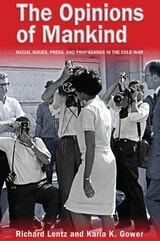
The Opinions of Mankind
Racial Issues, Press, and Propaganda in the Cold WarRichard Lentz and Karla K. Gower
University of Missouri Press, 2011
Throughout this period, the American press provided the foreign media with information about racially charged events in the United States. Such news coverage sometimes put Washington at a disadvantage, making it difficult for government officials to assuage foreign reactions to the injustices occurring on U.S. soil. Yet in other instances, the domestic press helped to promote favorable opinions abroad by articulating themes of racial progress. While still acknowledging racial abuses, these press spokesmen asserted that the situation in America was improving. Such paradoxical messages, both aiding and thwarting the efforts of the U.S. government, are the subject of The Opinions of Mankind: Racial Issues, Press, and Propaganda in the Cold War.
The study, by scholars Richard Lentz and Karla K. Gower, describes and analyzes the news discourse regarding U.S. racial issues from 1946 to 1965. The Opinions of Mankindnot only delves into the dissemination of race-related news to foreign outlets but also explores the impact foreign perceptions of domestic racism had on the U.S. government and its handling of foreign relations during the period. What emerges is an original, insightful contribution to Cold War studies. While other books examine race and foreign affairs during this period of American history, The Opinions of Mankind is the first to approach the subject from the standpoint of press coverage and its impact on world public opinion.
This exhaustively researched and compellingly written volume will appeal to media scholars, political historians, and general readers alike. By taking a unique approach to the study of this period, The Opinions of Mankind presents the workings behind the battles for public opinion that took place between 1946 and 1965.
The Opioid Epidemic and US Culture
Expression, Art, and Politics in an Age of AddictionTravis D. Stimeling
West Virginia University Press, 2020
Written for an audience of people working on the front lines of the opioid crisis, the book is essential reading for social workers, addiction counselors, halfway house managers, and people with opioid use disorder. It will also appeal to the community of scholars interested in understanding how aesthetics shape our engagement with critical social issues, particularly in the fields of literary and film criticism, museum studies, and ethnomusicology.
The Opium Debate and Chinese Exclusion Laws in the Nineteenth-Century American West
Diana L. Ahmad
University of Nevada Press, 2011
America’s current "war on drugs" is not the nation’s first. In the mid-nineteenth century, opium-smoking was decried as a major social and public health problem, especially in the West. Although China faced its own epidemic of opium addiction, only a very small minority of Chinese immigrants in America were actually involved in the opium business. It was in Anglo communities that the use of opium soon spread and this growing use was deemed a threat to the nation’s entrepreneurial spirit and to its growing mportance as a world economic and military power. The Opium Debate examines how the spread of opium-smoking fueled racism and created demands for the removal of the Chinese from American life. This meticulously researched study of the nineteenth-century drug-abuse crisis reveals the ways moral crusaders linked their antiopium rhetoric to already active demands for Chinese exclusion. Until this time, anti-Chinese propaganda had been dominated by protests against the economic and political impact of Chinese workers and the alleged role of Chinese women as prostitutes. The use of the drug by Anglos added another reason for demonizing Chinese immigrants. Ahmad describes the disparities between Anglo-American perceptions of Chinese immigrants and the somber realities of these people’s lives, especially the role that opium-smoking came to play in the Anglo-American community, mostly among middle- and upper-class women. The book offers a brilliant analysis of the evolution of the Chinese Exclusion Act of 1882, plus important insights into the social history of the nineteenth-century West, the culture of American Victorianism, and the rhetoric of racism in American politics.