Results by title
28250 books match the query 'history' and 6388 start with t
The Golden Age of Botanical Art
Martyn Rix
University of Chicago Press, 2012
The Golden Age of Chicago Children's Television
Ted Okuda and Jack Mulqueen
Southern Illinois University Press, 2004
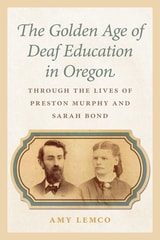
The Golden Age of Deaf Education in Oregon
Through the Lives of Preston Murphy and Sarah BondAmy Lemco
Oregon State University Press, 2027
Preston Murphy and Sarah Bond traveled west to Oregon on separate wagon trains in the 1850s. Both were children of Protestant minister fathers who followed the Oregon Trail to claim land and establish towns and institutions. Preston and Sarah married in 1874 and went on to build their lives in Oregon’s Willamette Valley, running a boot shop and raising six children. They were also both deaf.
The Golden Age of Deaf Education in Oregon is one of the first books to explore Deaf history in the Pacific Northwest. Drawing from primary sources, Amy Lemco explores the history of Deaf culture in early Oregon through the lives of Preston Murphy and Sarah Bond. Their stories offer a glimpse into the growth of Deaf education in the developing American West and provide a unique lens to explore the intertwining of global, national, and regional histories and their effect on Deaf culture at the turn of the century.
While Preston became deaf after a childhood illness in Illinois, Sarah, along with two of her brothers, was born deaf in Iowa. In Oregon their varied deaf experiences would pave the way for the Oregon School for the Deaf but also illuminate how deaf Oregonians navigated daily life and remained closely connected to their hearing communities. It is the hidden experiences of Preston and Sarah’s ordinary lives that make their stories extraordinary.
The Golden Age of Phenomenology at the New School for Social Research, 1954–1973
Lester Embree
Ohio University Press, 2017
This collection focuses on the introduction of phenomenology to the United States by the community of scholars who taught and studied at the New School for Social Research from 1954 through 1973. During those years, Dorion Cairns, Alfred Schutz, and Aron Gurwitsch—all former students of Edmund Husserl—came together in the department of philosophy to establish the first locus of phenomenology scholarship in the country. This founding trio was soon joined by three other prominent scholars in the field: Werner Marx, Thomas M. Seebohm, and J. N. Mohanty. The Husserlian phenomenology that they brought to the New School has subsequently spread through the Anglophone world as the tradition of Continental philosophy.
The first part of this volume includes original works by each of these six influential teachers of phenomenology, introduced either by one of their students or, in the case of Seebohm and Mohanty, by the thinkers themselves. The second part comprises contributions from twelve leading scholars of phenomenology who trained at the New School during this period. The result is a powerful document tracing the lineage and development of phenomenology in the North American context, written by members of the first two generations of scholars who shaped the field.
Contributors: Michael Barber, Lester Embree, Jorge García-Gómez, Fred Kersten, Thomas M. T. Luckmann, William McKenna, J. N. Mohanty, Giuseppina C. Moneta, Thomas Nenon, George Psathas, Osborne P. Wiggins, Matthew M. Seebohm, and Richard M. Zaner.
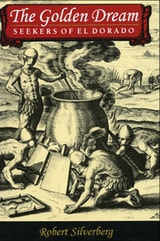
The Golden Dream
Seekers Of El DoradoRobert Silverberg
Ohio University Press, 1996
One of the most persistent legends in the annals of New World exploration is that of the Land of Gold. This mythical site was located over vast areas of South America (and later, North America); the search for it drove some men mad with greed and, as often as not, to their untimely deaths.
In this history of quest and adventure, Robert Silverberg traces the fate of Old World explorers lured westward by the myth of El Dorado. From the German conquistadores licensed by the Spanish king to operate out of Venezuela, to the journeys of Gonzalo Pizarro in the Amazon basin, and to the nearly miraculous voyage of Francisco Orellana to the mouth of the Amazon River, encountering the warlike women who gave the river its name, violence and bloodshed accompanied the determined adventurers. Sir Walter Raleigh and a host of other explorers spent small fortunes and many lives trying to locate Manoa, a city that was rumored to be El Dorado—City of Gold. Celebrated science fiction author Robert Silverberg recreates these legendary quests in The Golden Dream: Seekers of El Dorado.
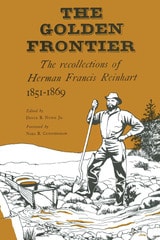
The Golden Frontier
The Recollections of Herman Francis Reinhart, 1851-1869By Herman Francis Reinhart
University of Texas Press, 1962
The gold rush was Herman Francis Reinhart's life for almost twenty years. From the summer of 1851 when, as a boy in his late teens, he traveled the Oregon trail to California, until a January day in 1869 when he climbed aboard an eastbound train at Evanston, Wyoming, he was a part of every gold discovery that stirred the West.
Reinhart dipped his pan in the streams of northern California and western Oregon—in Humbug Creek, Indian Creek, Rogue River, and Sucker Creek. He made the arduous and dangerous overland journey through Indian-occupied western Washington and British Columbia to find the Fraser River gold even more elusive than that farther south. With his teams and wagons he traversed all of the inland mine areas from Walla Walla to Fort Benton, from Boise Basin to South Pass City.
Reinhart's German common sense soon turned him from actual mining to other sources of income, but whatever his labor was, the mines were always the focal point of his activities. When he operated a bakery and saloon it was a business whose customers were miners, whose transactions were more likely to involve gold dust than legal tender, and whose gambling tables saw the exchange of mining fortunes. When he operated a whipsaw mill the timbers cut there were used by miners for sluices and cradles. For a while Reinhart farmed, but planting and harvesting suffered from interruption by frequent expeditions to the mines. And when he prospered as a teamster it was to and from the mining towns that he hauled passengers, supplies, and equipment.
The men who, like Herman Francis Reinhart, hopefully followed the golden frontier were not an articulate group, and the written records of their lives are few and fragmentary. But Reinhart, in his later years, recorded his experiences in five long, narrow, hardback ledgers. Many years after he died his daughter gave the ledgers to a friend in Chanute, Kansas—Nora Cunningham—who read the narrative, became fascinated by it, and typed it for publication.
Reinhart's account, written in a grammar and language all his own, is not a record of the historian's West, but of the West of the individual miner. The pages are filled with the details of day-to-day life of the miners—the subjects that interested them, the problems that plagued them, their fun and feuding, their frustrations and hopes. Edited by an authority of the history of the West, it is a book that will offer exciting reading to casual readers and scholars alike.
The Golden Horde
Revolutionary Italy, 1960–1977Edited by Nanni Balestrini and Primo Moroni
Seagull Books, 2021
An anthology of texts and fragments woven together with an original commentary, The Golden Horde widens our understanding of the full complexity and richness of radical thought and practice in Italy during the 1960s and ’70s. The book covers the generational turbulence of Italy’s postwar period, the transformations of Italian capitalism, the new analyses by worker-focused intellectuals, the student movement of 1968, the Hot Autumn of 1969, the extra-parliamentary groups of the early 1970s, the Red Brigades, the formation of a radical women’s movement, the development of Autonomia, and the build-up to the watershed moment of the spontaneous political movement of 1977. Far from being merely a handbook of political history, The Golden Horde also sheds light on two decades of Italian culture, including the newspapers, songs, journals, festivals, comics, and philosophy that these movements produced. The book features writings by Sergio Bologna, Umberto Eco, Elvio Fachinelli, Lea Melandri, Danilo Montaldi, Toni Negri, Raniero Panzieri, Franco Piperno, Rossana Rossanda, Paolo Virno, and others, as well as an in-depth introduction by translator Richard Braude outlining the work’s composition and development.
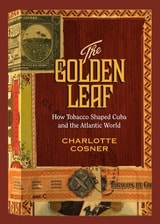
The Golden Leaf
How Tobacco Shaped Cuba and the Atlantic WorldCharlotte Cosner
Vanderbilt University Press, 2015
Through the rise and fall of empires, ideologies, and economies, tobacco grown on the tiny island of Cuba has remained an enduring symbol of pleasure and extravagance. Cultivated as one of the first reliable commodities for those inhabitants who remained after conquistadors moved on in search of a mythical wellspring of gold, tobacco quickly became crucial to the support of the swelling Spanish Empire in the seventeenth and eighteenth centuries. Eventually, however, tobacco became one of the final stabilizing forces in the empire, and it ultimately proved more resilient than the best laid plans of kings and queens. Tobacco, and those whose livelihoods depended on it, shrugged off the Empire's collapse and pressed on into the twentieth century as an economic force any state or political power must reckon with.
Cosner explores the history of this golden leaf through the personal narratives of farmers, bureaucrats, and laborers, all struggling to build an independent and lucrative economic engine. Through conquest, rebellion, colonial and imperial schemes, and the eventual Communist revolution, Cuban tobacco and cigars became a luxury item that commanded loyalty that defied mere borders or embargoes. Ultimately, The Golden Leaf is a story of two carefully cultivated products: Cuban tobacco, and its lofty reputation.
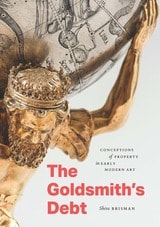
The Goldsmith's Debt
Conceptions of Property in Early Modern ArtShira Brisman
University of Chicago Press, 2026
In the sixteenth century, German goldsmiths played a unique role in articulating property claims and social values. These artisans shaped precious metals into visible expressions of domination, subordination, and obligation. The objects they crafted played a major role in the practices of exchange and inheritance that were reconfiguring a tumultuous economic landscape. Cities commissioned goldsmiths to transform revenue into goblets that could be given as diplomatic gifts or reconverted into currency in times of war, and courts used serving implements as promises of credit.
With The Goldsmith’s Debt, art historian Shira Brisman offers the first book-length study of the Nuremberg goldsmith Christoph Jamnitzer (1563–1618), who created elaborate gilded silver drinking cups that he crafted into unexpected forms, with designs ranging from racialized heads to mining scenes. Considering how works of art can shape a social order, Brisman explores what Jamnitzer’s etchings and goblets reveal about how goldsmiths shared ideas and how their patrons used commissioned works to legitimize their claims over land and the rights of others. Drawing on a range of textual and material evidence—including commentaries on Roman and customary laws, wills and civic statutes, printed designs, and firsthand study of lidded cups in dozens of major European institutions—this unprecedented study places the goldsmith at the heart of the era’s arguments about how people and lands should be subjugated. Brisman reveals the insidious side of these objects that were often used to advance socially conservative agendas, and she presents radical proposals for addressing inequity in the world of ornament prints.
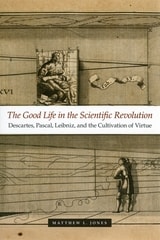
The Good Life in the Scientific Revolution
Descartes, Pascal, Leibniz, and the Cultivation of VirtueMatthew L. Jones
University of Chicago Press, 2006
Amid the unrest, dislocation, and uncertainty of seventeenth-century Europe, readers seeking consolation and assurance turned to philosophical and scientific books that offered ways of conquering fears and training the mind—guidance for living a good life.
The Good Life in the Scientific Revolution presents a triptych showing how three key early modern scientists, René Descartes, Blaise Pascal, and Gottfried Leibniz, envisioned their new work as useful for cultivating virtue and for pursuing a good life. Their scientific and philosophical innovations stemmed in part from their understanding of mathematics and science as cognitive and spiritual exercises that could create a truer mental and spiritual nobility. In portraying the rich contexts surrounding Descartes’ geometry, Pascal’s arithmetical triangle, and Leibniz’s calculus, Matthew L. Jones argues that this drive for moral therapeutics guided important developments of early modern philosophy and the Scientific Revolution.
The Good Men Who Won the War
Army of the Cumberland Veterans and Emancipation MemoryRobert E. Hunt
University of Alabama Press, 2010
Robert Hunt examines how Union veterans of the Army of the Cumberland employed the extinction of slavery in the trans-Appalachian South in their memory of the Civil War. Hunt argues that rather than ignoring or belittling emancipation, it became central to veterans’ retrospective understanding of what the war, and their service in it, was all about. The Army of the Cumberland is particularly useful as a subject for this examination because it invaded the South deeply, encountering numerous ex-slaves as fugitives, refugees, laborers on military projects, and new recruits. At the same time, the Cumberlanders were mostly Illinoisans, Ohioans, Indianans, and, significantly, Kentucky Unionists, all from areas suspicious of abolition before the war.
Hunt argues that the collapse of slavery in the trans-Appalachian theater of the Civil War can be usefully understood by exploring the post-war memories of this group of Union veterans. He contends that rather than remembering the war as a crusade against the evils of slavery, the veterans of the Army of the Cumberland saw the end of slavery as a by-product of the necessary defeat of the planter aristocracy that had sundered the Union; a good and necessary outcome, but not necessarily an assertion of equality between the races.
Some of the most provocative discussions about the Civil War in current scholarship are concerned with how memory of the war was used by both the North and the South in Reconstruction, redeemer politics, the imposition of segregation, and the Spanish-American War. This work demonstrates that both the collapse of slavery and the economic and social post-War experience convinced these veterans that they had participated in the construction of the United States as a world power, built on the victory won against corrupt Southern plutocrats who had impeded the rightful development of the country.
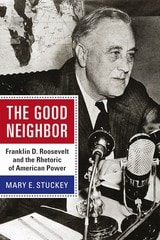
The Good Neighbor
Franklin D. Roosevelt and the Rhetoric of American PowerMary E. Stuckey
Michigan State University Press, 2013
No modern president has had as much influence on American national politics as Franklin D. Roosevelt. During FDR’s administration, power shifted from states and localities to the federal government; within the federal government it shifted from Congress to the president; and internationally, it moved from Europe to the United States. All of these changes required significant effort on the part of the president, who triumphed over fierce opposition and succeeded in remaking the American political system in ways that continue to shape our politics today. Using the metaphor of the good neighbor, Mary E. Stuckey examines the persuasive work that took place to authorize these changes. Through the metaphor, FDR’s administration can be better understood: his emphasis on communal values; the importance of national mobilization in domestic as well as foreign affairs in defense of those values; his use of what he considered a particularly democratic approach to public communication; his treatment of friends and his delineation of enemies; and finally, the ways in which he used this rhetoric to broaden his neighborhood from the limits of the United States to encompass the entire world, laying the groundwork for American ideological dominance in the post–World War II era.
The Good Road
A K’iche’ Revolutionary TheopoliticsCarlota McAllister
Duke University Press, 2026
The Gospel According to This Moment
The Spiritual Message of Henry David ThoreauBarry M. Andrews
University of Massachusetts Press, 2024
Henry David Thoreau is best known as a writer, naturalist, and social critic, but he was also a schoolteacher, surveyor, and pencil-maker. In The Gospel According to This Moment, Unitarian minister Barry M. Andrews reveals how an idiosyncratic and unconventional religious faith was central to Thoreau’s many-faceted life—a dimension that has been largely unexamined.
Through close readings of his writings and a focus on his Unitarian upbringing, Harvard education, mentoring by Ralph Waldo Emerson, and immersion in ancient Eastern and Western philosophies, Andrews explores the nature of Thoreau’s spiritual message, what he called the “Gospel according to this moment,” which enables a flourishing and deliberate life. Today, Thoreau is widely recognized as an advocate for simple living, environmental preservation, and civil disobedience. As Andrews uncovers, Thoreau is also a spiritual guide who can teach us an alternative way of being religious in the world.
The Gospel of Family Planning
An Intimate Global HistoryNicole C. Bourbonnais
University of Chicago Press, 2025
In the twentieth century, the idea that people should consciously plan (and limit) the size of their families became a global cause. Historical accounts of the global family planning movement have largely focused on the most prominent activists and those at the helm of international organizations, philanthropic foundations, and government programs. In The Gospel of Family Planning, however, historian Nicole C. Bourbonnais shifts our attention to frontline workers—doctors, social workers, nurses, fieldworkers, consultants, church groups, and volunteers—who, she compellingly shows, played a central (if complicated) role in preaching contraception around the world.
Through a mix of collective biography and microhistory, Bourbonnais visits clinics, doorsteps, and bedrooms, revealing the everyday, ground-level workings of grassroots family planning campaigns, state population control programs, and the movements for reproductive rights and justice that arose to contest them. Throughout the book, Bourbonnais invites readers to consider how the intertwined histories of missionary work, humanitarianism, feminism, decolonization, and international development shaped intimate interventions into people’s reproductive lives around the world.
The Gospel of John Marrant
Conjuring Christianity in the Black AtlanticAlphonso F. Saville IV
Duke University Press, 2024
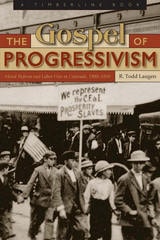
The Gospel of Progressivism
Moral Reform and Labor War in Colorado, 1900-1930R. Todd Laugen
University Press of Colorado, 2010
Sharing enemies like the party boss and corporate lobbyist who undermined honest and responsive government, Progressive leaders were determined to root out selfish political action with public exposure. Labor unions defied bosses and rallied for government protection of workers. Women's clubs appealed to other women as mothers, calling for social welfare, economic justice, and government responsiveness. Protestant church congregations formed a core of support for moral reform. Labor relations experts struggled to prevent the outbreak of violence through mediation between corporate employers and organized labor. Persevering through World War I, Colorado reformers faced their greatest challenge in the 1920s, when leaders of the Ku Klux Klan drew upon the rhetoric of Protestant Progressives and manipulated reform tools to strengthen their own political machine. Once in power, Klan legislators turned on Progressive leaders in the state government.
A story of promising alliances never fully realized, zealous crusaders who resisted compromise, and reforms with unexpected consequences, The Gospel of Progressivism will appeal to those interested in Progressive Era reform, Colorado history, labor relations, and women's activism.
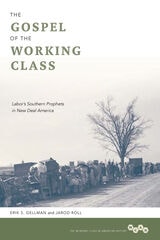
The Gospel of the Working Class
Labor's Southern Prophets in New Deal AmericaErik S. Gellman and Jarod Roll
University of Illinois Press, 2011
In this exceptional dual biography and cultural history, Erik S. Gellman and Jarod Roll trace the influence of two southern activist preachers, one black and one white, who used their ministry to organize the working class in the 1930s and 1940s across lines of gender, race, and geography. Owen Whitfield and Claude Williams, along with their wives Zella Whitfield and Joyce Williams, drew on their bedrock religious beliefs to stir ordinary men and women to demand social and economic justice in the eras of the Great Depression, New Deal, and Second World War.
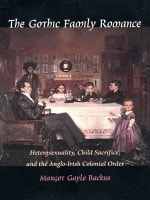
The Gothic Family Romance
Heterosexuality, Child Sacrifice, and the Anglo-Irish Colonial OrderMargot Gayle Backus
Duke University Press, 1999
Backus uses contemporary theory, including that of Michel Foucault and Eve Kosofsky Sedgwick, to analyze texts by authors ranging from Richardson, Swift, Burke, Edgeworth, Stoker, and Wilde to contemporary Irish novelists and playwrights.
By charting the changing relations between the family and the British state, she shows how these authors dramatized a legacy of violence within the family cell and discusses how disturbing themes of child sacrifice and colonial repression are portrayed through irony, satire, “paranoid” fantasy, and gothic romance. In a reconceptualization of the Freudian family romance, Backus argues that the figures of the Anglo-Irish gothic embody the particular residue of childhood experiences within a settler colonial society in which biological reproduction represented an economic and political imperative.
Backus’s bold positioning of the nuclear family at the center of post-Enlightenment class and colonial power relations in England and Ireland will challenge and provoke scholars in the fields of Irish literature and British and postcolonial studies. The book will also interest students and scholars of women’s studies, and it has important implications for understanding contemporary conflicts in Ireland.
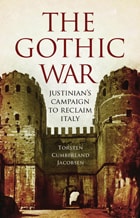
The Gothic War
Justinian's Campaign to Reclaim ItalyTorsten Cumberland Jacobsen
Westholme Publishing, 2009
“Jacobsen brings to the story an intimate knowledge of Italy. The battles took place on terrain Jacobsen knows well. . . Recommended.”—Choice
“Jacobsen provides an operational history of Justinian’s campaign. Throughout he traces the military strategies and tactical intrigues of leaders such as the Roman general Belisarius and the Goth leader Totila.”—Publishers Weekly
“Jacobsen knows the sites he writes about, he has read Procopius diligently . . . and his military reconstruction can be faulted only in attributing to both sides rather better command and control than the ancient armies could generally manage. . . . Jacobsen has offered wargamers a tool they will appreciate.”—The Classical Review
A period of stability in the early sixth century A.D. gave the Eastern Roman emperor Justinian an opportunity to recapture parts of the Western Empire which had been lost to invading barbarians in the preceding centuries. The climactic conflict over Italy between 535 and 554—the Gothic War—decided the political future of Europe, holding in its balance the possibility that the Roman Empire might rise again. While large portions of the original territory of the ancient Roman Empire were recaptured, the Eastern Empire was incapable of retaining much of its hard-won advances, and soon the empire once again retracted. As a result of the Gothic War, Italy was invaded by the Lombards who began their important kingdom, the Franks began transforming Gaul into France, and without any major force remaining in North Africa, that territory was quickly overrun by the first wave of Muslim expansion in the ensuing century. Written as a general overview of this critical period, The Gothic War: Justinian’s Campaign to Reclaim Italy opens with a history of the conflict with Persia and the great Roman general Belisarius’s successful conquest of the Vandals in North Africa. After an account of the Ostrogothic tribe and their history, the campaigns of the long war for Italy are described in detail, including the three sieges of Rome, which turned the great city from a bustling metropolis into a desolate ruin. In addition to Belisarius, the Gothic War featured many of history’s most colorful antagonists, including Rome’s Narses the Eunuch, and the Goths’ ruthless and brilliant tactician, Totila. Two appendices provide information about the armies of the Romans and Ostrogoths, including their organization, weapons, and tactics, all of which changed over the course of the war.
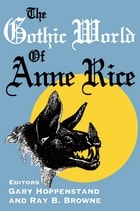
The Gothic World of Anne Rice
Edited by Gary Hoppenstand and Ray B. Browne
University of Wisconsin Press, 1996
This anthology argues for the serious study of the literary oeuvre of Anne Rice, a major figure in today’s popular literature. The essays assert that Rice expands the conventions of the horror genre’s formula to examine important social issues. Like a handful of authors working in this genre, Rice manipulates its otherwise predictable narrative structures so that a larger, more interesting cultural mythology can be developed. Rice searches for philosophical truth, examining themes of good and evil, the influence on people and society of both nature and nurture, and the conflict and dependence of humanism and science.
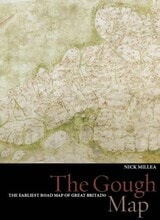
The Gough Map
The Earliest Road Map of Great BritainNick Millea
Bodleian Library Publishing, 2005
Recent digitization of the Gough Map has made it more legible than at any other time since its arrival at the Bodleian Library in 1809. This work utilizes new georectification technology to project a modern map of Britain over the Gough Map, revealing the incredible accuracy of the 700-year-old manuscript. In stunningly detailed reproduction, The Gough Map charts a vast array of cities, routes, and landmarks, including the principal medieval settlements of Bristol, Oxford and Norwich; the Severn, Thames, and Humber rivers; the loop of the Wear at Durham; and routes between towns with distances marked in Roman numerals.
The volume also features a color fold-out print of the Gough map, as well as numerous close-up images of each area. The Gough Map offers an unparalleled opportunity to examine this fascinating example of medieval mapmaking.
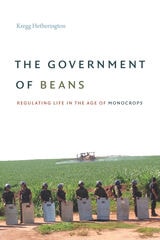
The Government of Beans
Regulating Life in the Age of MonocropsKregg Hetherington
Duke University Press, 2020
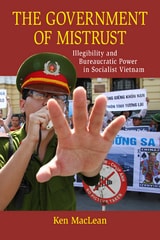
The Government of Mistrust
Illegibility and Bureaucratic Power in Socialist VietnamKen MacLean
University of Wisconsin Press, 2013
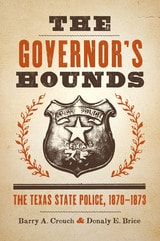
The Governor's Hounds
The Texas State Police, 1870–1873By Barry A. Crouch and Donaly E. Brice
University of Texas Press, 2011
In the tumultuous years following the Civil War, violence and lawlessness plagued the state of Texas, often overwhelming the ability of local law enforcement to maintain order. In response, Reconstruction-era governor Edmund J. Davis created a statewide police force that could be mobilized whenever and wherever local authorities were unable or unwilling to control lawlessness. During its three years (1870–1873) of existence, however, the Texas State Police was reviled as an arm of the Radical Republican party and widely condemned for being oppressive, arrogant, staffed with criminals and African Americans, and expensive to maintain, as well as for enforcing the new and unpopular laws that protected the rights of freed slaves.
Drawing extensively on the wealth of previously untouched records in the Texas State Archives, as well as other contemporary sources, Barry A. Crouch and Donaly E. Brice here offer the first major objective assessment of the Texas State Police and its role in maintaining law and order in Reconstruction Texas. Examining the activities of the force throughout its tenure and across the state, the authors find that the Texas State Police actually did much to solve the problem of violence in a largely lawless state. While acknowledging that much of the criticism the agency received was merited, the authors make a convincing case that the state police performed many of the same duties that the Texas Rangers later assumed and fulfilled the same need for a mobile, statewide law enforcement agency.
The Governors of Arkansas
Essays in Political BiographyJr. Gatewood
University of Arkansas Press, 1995
The Governors of New Jersey
Biographical EssaysBirkner, Michael J
Rutgers University Press, 2014
Rogues, aristocrats, and a future U.S. president. These and other governors are portrayed in this revised and updated edition of the classic reference work on the chief executives of New Jersey. Editors Michael J. Birkner, Donald Linky, and Peter Mickulas present new essays on the governors of the last three decades—Brendan T. Byrne, Thomas Kean, James Florio, Christine Todd Whitman, Donald DiFrancesco, James McGreevey, Richard Codey, and Jon Corzine. The essays included in the original edition are amended, edited, and corrected as necessary in light of new and relevant scholarship.
The authors of each governor’s life story represent a roster of such notable scholars as Larry Gerlach, Stanley Katz, Arthur Link, and Clement Price, as well as many other experts on New Jersey history and politics. As a result, this revised edition is a thorough and current reference work on the New Jersey governorship—one of the strongest in the nation.
Also of Interest:
New Jersey Politics and Government
The Suburbs Come of Age
Fourth Edition
Barbara G. Salmore with Stephen A. Salmore
978-0-8135-6139-4 paper $34.95
A volume in the Rivergate Regionals Collection
Me, Governor?
My Life in the Rough-and-Tumble World of New Jersey Politics
Richard J. Codey
978-0-8135-5045-9 cloth $24.95
The Life and Times of Richard J. Hughes
The Politics of Civility
John B. Wefing
978-0-8135-4641-4 cloth $32.50
Governor Tom Kean
From the New Jersey Statehouse to the 911 Commission
Alvin S. Felzenberg
978-0-8135-3799-3 cloth $29.95
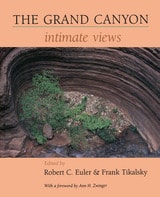
The Grand Canyon
Intimate ViewsEdited by Robert C. Euler and Frank Tikalsky; Foreword by Ann H. Zwinger
University of Arizona Press, 1992
Contents
Foreword, by Ann H. Zwinger
1. The Geologic Record, by Stanley S. Beus
2. The Living Canyon, by Steven W. Carothers
3. Grand Canyon Indians, by Robert C. Euler
4. Historical Explorations, by Robert C. Euler
5. The Canyon by River, by Kim Crumbo
6. Hiking the Canyon, by Frank Tikalsky
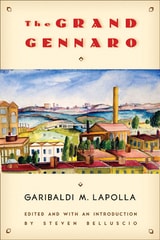
The Grand Gennaro
Belluscio, Steven
Rutgers University Press, 2009
The Grand Gennaro, a riveting saga set at the turn of the last century in Italian American Harlem, reflects on how youthful acts of cruelty and desperation follow many to the grave. A classic in the truest sense, this operatic narrative is alive once again, addressing the question: How does one become an "American"?
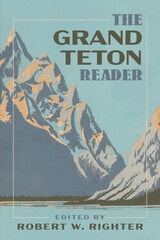
The Grand Teton Reader
Robert W. Righter
University of Utah Press, 2021
Editor Robert Righter has selected thirty-five contributors whose work takes readers from the Tetons’ geological origins to the time of Euro-American encroachment and the park’s politically tumultuous creation. Selections range from Laine Thom’s Shoshone legend of the Snake River and Owen Wister’s essay “Great God! I’ve Just Killed a Bear,” to Grace Gallatin Seton-Thompson’s humorous yet fearful account of crossing the Snake River, and William Owen’s first attempt to climb the Grand Teton. Conservationists, naturalists, and environmentalists are also represented: Terry Tempest Williams chronicles her multiyear encounter with her “Range of Memory,” and Olaus and Mardy Murie recount the difficulties of “park-making” in an often-hostile human environment.
Anyone seeking a deeper understanding of the park’s wild beauty and controversial past will want to read these stories by people who lived it.

The Grateful Dead
THE HISTORY OF A FOLK STORYGordon Hall GerouldIntroduction by Norm Cohen
University of Illinois Press, 2000
Gerould surveys more than a hundred grateful dead stories, tracing their lineages, describing their common traits, and unraveling their variations. Through a close study of secular as well as religious stories, Gerould demonstrates the remarkable durability and adaptability of the grateful dead.
With this book, Gerould established methods that laid the foundations for modern folklore scholarship. Norm Cohen's introduction places Gerould and his legacy in this historical context.
The Gratis Economy
Privately Provided Public GoodsAndrás Kelen
Central European University Press, 2002
The Great Ages of Discovery
How Western Civilization Learned About a Wider WorldStephen J. Pyne
University of Arizona Press, 2021
Historian and MacArthur Fellow Stephen J. Pyne identifies three great ages of discovery in his fascinating new book. The first age of discovery ranged from the early 15th to the early 18th century, sketched out the contours of the globe, aligned with the Renaissance, and had for its grandest expression the circumnavigation of the world ocean. The second age launched in the latter half of the 18th century, spanning into the early 20th century, carrying the Enlightenment along with it, pairing especially with settler societies, and had as its prize achievement the crossing of a continent. The third age began after World War II, and, pivoting from Antarctica, pushed into the deep oceans and interplanetary space. Its grand gesture is Voyager’s passage across the solar system. Each age had in common a galvanic rivalry: Spain and Portugal in the first age, Britain and France—followed by others—in the second, and the USSR and USA in the third.
With a deep and passionate knowledge of the history of Western exploration, Pyne takes us on a journey across hundreds of years of geographic trekking. The Great Ages of Discovery is an interpretive companion to what became Western civilization’s quest narrative, with the triumphs and tragedies that grand journey brought, the legacies of which are still very much with us.
The Great American Transit Disaster
A Century of Austerity, Auto-Centric Planning, and White FlightNicholas Dagen Bloom
University of Chicago Press, 2023
Many a scholar and policy analyst has lamented American dependence on cars and the corresponding lack of federal investment in public transportation throughout the latter decades of the twentieth century. But as Nicholas Dagen Bloom shows in The Great American Transit Disaster, our transit networks are so bad for a very simple reason: we wanted it this way.
Focusing on Baltimore, Atlanta, Chicago, Detroit, Boston, and San Francisco, Bloom provides overwhelming evidence that transit disinvestment was a choice rather than destiny. He pinpoints three major factors that led to the decline of public transit in the United States: municipal austerity policies that denied most transit agencies the funding to sustain high-quality service; the encouragement of auto-centric planning; and white flight from dense city centers to far-flung suburbs. As Bloom makes clear, these local public policy decisions were not the product of a nefarious auto industry or any other grand conspiracy—all were widely supported by voters, who effectively shut out options for transit-friendly futures. With this book, Bloom seeks not only to dispel our accepted transit myths but hopefully to lay new tracks for today’s conversations about public transportation funding.
The Great American Transit Disaster
A Century of Austerity, Auto-Centric Planning, and White FlightNicholas Dagen Bloom
University of Chicago Press, 2023
A potent re-examination of America’s history of public disinvestment in mass transit.
Many a scholar and policy analyst has lamented American dependence on cars and the corresponding lack of federal investment in public transportation throughout the latter decades of the twentieth century. But as Nicholas Dagen Bloom shows in The Great American Transit Disaster, our transit networks are so bad for a very simple reason: we wanted it this way.
Focusing on Baltimore, Atlanta, Chicago, Detroit, Boston, and San Francisco, Bloom provides overwhelming evidence that transit disinvestment was a choice rather than destiny. He pinpoints three major factors that led to the decline of public transit in the United States: municipal austerity policies that denied most transit agencies the funding to sustain high-quality service; the encouragement of auto-centric planning; and white flight from dense city centers to far-flung suburbs. As Bloom makes clear, these local public policy decisions were not the product of a nefarious auto industry or any other grand conspiracy—all were widely supported by voters, who effectively shut out options for transit-friendly futures. With this book, Bloom seeks not only to dispel our accepted transit myths but hopefully to lay new tracks for today’s conversations about public transportation funding.
The Great Beyond
Art in the Age of AnnihilationPhilip D. Beidler
University of Alabama Press, 2022
Essays mapping how modern art confronts mortality in an age of war and annihilation.
While much about modernism remains up for debate, there can be no dispute about the connection between modernist art and death. The long modern moment was and is an age of war, genocide, and annihilation. Two world wars killed perhaps as many as 100 million people, through combat, famine, holocaust, and ghastly attacks on civilians. The ongoing COVID-19 pandemic is the fifth global pandemic since 1918, with more than a half-million American deaths and counting.
It can hardly come as a surprise, then, that many of the touchstones of modernism reflect on death and devastation. In Philip D. Beidler’s exploration of the modernist canon, he illuminates how these singular voices looked extinction in the eye and tried to reckon with our finitude—and their own. The Great Beyond: Art in the Age of Annihilation catalogs through lively prose an eclectic selection of artists, writers, and thinkers. In 16 essays, Beidler takes nuanced and surprising approaches to well-studied figures—the haunting sculpture by Saint-Gaudens commissioned by Henry Adams for his late wife; Luchino Visconti’s adaptation of Mann’s Death in Venice; and the author’s own long fascination with Beckett’s Waiting for Godot.
The threads and recurring motifs that emerge through Beidler’s analysis bridge the different media, genres, and timeframes of the works under consideration. Protomodernists Crane and Twain connect with near-contemporary voices like Sebald and Morrison. Robert MacFarlane’s 21st-century nonfiction about what lies underneath the earth echoes the Furerbunker and the poetry of Gertrud Kolmar. Learned but lively, somber but not grim, The Great Beyond is not a comfortable read, but it is in a way comforting. In tracing how his subjects confronted nothingness, be it personal or global, Beidler draws a brilliant map of how we see the end of the road.
The Great Cat and Dog Massacre
The Real Story of World War Two's Unknown TragedyHilda Kean
University of Chicago Press, 2017
In The Great Cat and Dog Massacre, Hilda Kean unearths the history, piecing together the compelling story of the life—and death—of Britain’s wartime animal companions. She explains that fear of imminent Nazi bombing and the desire to do something to prepare for war led Britons to sew blackout curtains, dig up flower beds for vegetable patches, send their children away to the countryside—and kill the family pet, in theory sparing them the suffering of a bombing raid. Kean’s narrative is gripping, unfolding through stories of shared experiences of bombing, food restrictions, sheltering, and mutual support. Soon pets became key to the war effort, providing emotional assistance and helping people to survive—a contribution for which the animals gained government recognition.
Drawing extensively on new research from animal charities, state archives, diaries, and family stories, Kean does more than tell a virtually forgotten story. She complicates our understanding of World War II as a “good war” fought by a nation of “good” people. Accessibly written and generously illustrated, Kean’s account of this forgotten aspect of British history moves animals to center stage—forcing us to rethink our assumptions about ourselves and the animals with whom we share our homes.
The Great Confusion in Indian Affairs
Native Americans and Whites in the Progressive EraBy Tom Holm
University of Texas Press, 2005
The United States government thought it could make Indians "vanish." After the Indian Wars ended in the 1880s, the government gave allotments of land to individual Native Americans in order to turn them into farmers and sent their children to boarding schools for indoctrination into the English language, Christianity, and the ways of white people. Federal officials believed that these policies would assimilate Native Americans into white society within a generation or two. But even after decades of governmental efforts to obliterate Indian culture, Native Americans refused to vanish into the mainstream, and tribal identities remained intact.
This revisionist history reveals how Native Americans' sense of identity and "peoplehood" helped them resist and eventually defeat the U.S. government's attempts to assimilate them into white society during the Progressive Era (1890s-1920s). Tom Holm discusses how Native Americans, though effectively colonial subjects without political power, nonetheless maintained their group identity through their native languages, religious practices, works of art, and sense of homeland and sacred history. He also describes how Euro-Americans became increasingly fascinated by and supportive of Native American culture, spirituality, and environmental consciousness. In the face of such Native resiliency and non-Native advocacy, the government's assimilation policy became irrelevant and inevitably collapsed. The great confusion in Indian affairs during the Progressive Era, Holm concludes, ultimately paved the way for Native American tribes to be recognized as nations with certain sovereign rights.
The Great Cyclone at St Louis and East St. Louis, May 27, 1896
Compiled and Edited by Julian Curzon. Foreword by Tim O'Neil
Southern Illinois University Press, 1997
Heavily illustrated by photographs of the damage, The Great Cyclone was compiled from stories in the city’s daily newspapers—the Globe-Democrat, the Post-Dispatch, and, most notably, the old St. Louis Republic. O’Neil points out that "the book’s compilers are not identified, but their glowing praise of the ‘superb descriptive composition’ in the Republic provides a good guess about where most of them worked."
The Great Debate
Nietzsche, Culture, and the Scandinavian Welfare SocietyGeorg Brandes and Harald Høffding
University of Wisconsin Press, 2024
Marking the moment at which the uniquely Nordic concept of social democratic welfare was first contested in the public sphere, this debate provides insights into not only Nietzschean philosophy and its immediate reception but also the foundational concept of modern Scandinavian social, cultural, and political organization. This volume presents, for the first time in any language other than Danish, the debate in its entirety: three essays by Brandes and three by Høffding. A critical introduction by editor and translator William Banks explores the exchange in its context and convincingly argues that the principles contested by the two Danish luminaries still very much resonate in Western society today.
The Great Depression in Eastern Europe
Klaus Richter
Central European University Press, 2025
The Great Depression in Latin America
Paulo Drinot and Alan Knight, eds.
Duke University Press, 2014
Contributors. Marcelo Bucheli, Carlos Contreras, Paulo Drinot, Jeffrey L. Gould, Roy Hora, Alan Knight, Gillian McGillivray, Luis Felipe Sáenz, Angela Vergara, Joel Wolfe, Doug Yarrington
The Great Devonian Controversy
The Shaping of Scientific Knowledge among Gentlemanly SpecialistsMartin J. S. Rudwick
University of Chicago Press, 1985
"After a superficial first glance, most readers of good will and broad knowledge might dismiss [this book] as being too much about too little. They would be making one of the biggest mistakes in their intellectual lives. . . . [It] could become one of our century's key documents in understanding science and its history."—Stephen Jay Gould, New York Review of Books
"Surely one of the most important studies in the history of science of recent years, and arguably the best work to date in the history of geology."—David R. Oldroyd, Science
The Great Disappearing Act
Germans in New York City, 1880-1930Christina A. Ziegler-McPherson
Rutgers University Press, 2022
This study examines these questions in relation to the German immigrant community in New York City between 1880-1930, and seeks to understand how German-American New Yorkers assimilated into the larger American society in the early twentieth century.
By the turn of the twentieth century, New York City was one of the largest German-speaking cities in the world and was home to the largest German community in the United States. This community was socio-economically diverse and increasingly geographically dispersed, as upwardly mobile second and third generation German Americans began moving out of the Lower East Side, the location of America’s first Kleindeutschland (Little Germany), uptown to Yorkville and other neighborhoods. New York’s German American community was already in transition, geographically, socio-economically, and culturally, when the anti-German/One Hundred Percent Americanism of World War I erupted in 1917.
This book examines the structure of New York City’s German community in terms of its maturity, geographic dispersal from the Lower East Side to other neighborhoods, and its ultimate assimilation to the point of invisibility in the 1920s. It argues that when confronted with the anti-German feelings of World War I, German immigrants and German Americans hid their culture – especially their language and their institutions – behind closed doors and sought to make themselves invisible while still existing as a German community.
But becoming invisible did not mean being absorbed into an Anglo-American English-speaking culture and society. Instead, German Americans adopted visible behaviors of a new, more pluralistic American culture that they themselves had helped to create, although by no means dominated. Just as the meaning of “German” changed in this period, so did the meaning of “American” change as well, due to nearly 100 years of German immigration.
The Great Encyclopedia of Nineteenth-Century Major League Baseball
David Nemec
University of Alabama Press, 2006

The Great Enrichment
A New History of American Growth and Inequality, 1865–1945Vincent Geloso
University of Chicago Press, 2027
A revelatory economic history of America's Gilded Age—and how it wasn't just the Robber Barons who benefited.
The Gilded Age, spanning the late nineteenth and early twentieth centuries, was when Americans got rich. Or, rather, some Americans got rich. Because as much as the era is synonymous with staggering economic growth, it also doubles as America’s cautionary tale for the perils of leaving rich people and institutions unregulated. It was the time of extractive industrialists, worker exploitation, stifled economic mobility, and racial exclusion—lessons that the United States learned the hard way.
Vincent Geloso contests this traditional narrative by revisiting the math in this new empirical account of the Gilded Age. The Great Enrichment is an economic history of America’s rise to affluence, a period that doubled as a remarkable rise of the country’s economic floor. The conventional contrast of Robber Barons against huddled masses is, in Geloso’s analysis, unsubstantiated by economic data. The Gilded Age was the first egalitarian enrichment that humanity witnessed—a time when both rich and poor benefited in ways that were seismic, albeit unequal. Yet the net result was a great leap forward, not the lamentable birth of modern inequality.
Geloso marshals an expanded set of economic measures to account for factors not typically included in the Gilded Age economic story. The Great Enrichment sets a new standard for empirical history in one of America’s most consequential—and perhaps misunderstood—periods.
The Great Enterprise
Sovereignty and Historiography in Modern KoreaHenry H. Em
Duke University Press, 2013
Surveying historical works written over the course of the twentieth century, Em elucidates the influence of Christian missionaries, as well as the role that Japan's colonial policy played in determining the narrative framework for defining Korea's national past. Em goes on to analyze postcolonial works in which South Korean historians promoted national narratives appropriate for South Korea's place in the U.S.-led Cold War system. Throughout, Em highlights equal sovereignty's creative and productive potential to generate oppositional subjectivities and vital political alternatives.
The Great Famine and the Irish Diaspora in America
Arthur Gribben
University of Massachusetts Press, 1999

The Great Gelatin Revival
Savory Aspics, Jiggly Shots, and Outrageous DessertsKen Albala
University of Illinois Press, 2023
A lighthearted manifesto for the new age of aspics, The Great Gelatin Revival rattles our very understanding of what food can be.
The Great Gypsy Moth War
A History of the First Campaign in Massachusetts to Eradicate the Gypsy Moth, 1890-1901Robert J. Spear
University of Massachusetts Press, 2005
During the Civil War, when the supply of cotton from southern fields was disrupted, the owners of northern textile mills looked elsewhere for raw fiber. One source was silk. Among those experimenting with silkworm production was a Frenchman named Etienne Leopold Trouvelot, who had settled outside of Boston. It was Trouvelot who imported the gypsy moths and inadvertently allowed them to escape. Soon the invasion was on and a counteroffensive was required.
Spear reveals the turbulent undercurrents in the eradication campaign when the enthusiasm of the entomologists in charge turned into desperation upon the discovery that their alien adversary was much tougher than they thought. Fighting a war they could not win and dared not lose, the leaders of the campaign resorted to political maneuvering, cheap tricks, and outright misrepresentation to maintain a façade of success, urging the Commonwealth to continue funding the war long after any chance of victory had faded.
More than just reviewing the important events of this historic episode, Spear tells the story in an engaging way, often through the first-hand accounts of those who were directly involved. Much of what Spear has written is new, the recounting is lively, and the information he presents shows that almost all of the previous beliefs about the campaign to eradicate the gypsy moths are myths. In the process, he also traces the rise of modern economic entomology and the birth of the pesticide industry.