805 books match the query '18th Century' and 209 start with t

cover of Trade and Privateering in Spanish Florida, 1732–1763

Trade and Privateering in Spanish Florida, 1732–1763

Joyce Elizabeth Harman, With a New Introduction by Carl E. Swanson

University of Alabama Press, 2004

A groundbreaking study of commerce, conflict, and survival in colonial Spanish Florida.

Trade and Privateering examines the illegal yet highly profitable and mutually beneficial trade between Spanish Florida and the English colonies on the eastern seaboard in the mid-18th century. In St. Augustine, the arrival of subsidies from Spain was erratic, causing shortages of food and supplies, so authorities ignored the restrictions on trade with foreign colonies and welcomed British goods. Likewise, the British colonists sought Spanish products from Florida, especially oranges.
But when England and Spain became declared enemies in the War of Jenkins’ Ear and the French and Indian Wars, this tacit trade arrangement was threatened, and the result was a rise of privateering in the region. Rather than do without Spanish goods, the English began to attack and capture Spanish vessels with their cargoes at sea. Likewise, the Spaniards resorted to privateering as a means of steadily supplying the Florida colony. Harman concludes that, both willingly and unwillingly, the English colonies helped their Spanish neighbor to sustain its position in the Southeast.
 

[more]
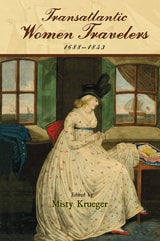
cover of Transatlantic Women Travelers, 1688-1843

Transatlantic Women Travelers, 1688-1843

Misty Krueger

Bucknell University Press, 2021
This important new collection explores representations of late seventeenth- through mid-nineteenth-century transatlantic women travelers across a range of historical and literary works. While at one time transatlantic studies concentrated predominantly on men’s travels, this volume highlights the resilience of women who ventured voluntarily and by force across the Atlantic—some seeking mobility, adventure, knowledge, wealth, and freedom, and others surviving subjugation, capture, and enslavement. The essays gathered here concern themselves with the fictional and the historical, national and geographic location, racial and ethnic identities, and the configuration of the transatlantic world in increasingly taught texts such as The Female American and The Woman of Colour, as well as less familiar material such as Merian’s writing on the insects of Surinam and Falconbridge’s travels to Sierra Leone. Intersectional in its approach, and with an afterword by Eve Tavor Bannet, this essential collection will prove indispensable as it provides fresh new perspectives on transatlantic texts and women’s travel therein across the long eighteenth century.
 
[more]
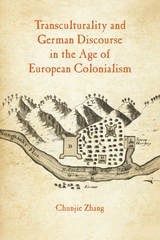
cover of Transculturality and German Discourse in the Age of European Colonialism

Transculturality and German Discourse in the Age of European Colonialism

Chunjie Zhang

Northwestern University Press, 2017
In Transculturality and German Discourse in the Age of European Colonialism, Chunjie Zhang examines the South Pacific travel writings of George Forster and Adelbert von Chamisso, literary works by August von Kotzebue and Johann Joachim Campe, Herder’s philosophy of history, and Kant’s theory of geography from the perspective of non-European impact during the age of Europe’s colonial expansion. She explores what these texts show about German and European superiority, the critique of the slave trade, European moral debauchery, acknowledgments of non-European cultural achievements, and sympathy with colonized peoples. Moving beyond the question of empire versus enlightenment, Zhang’s book diligently detects global connections, offering much to scholars of literature, culture, and intellectual history.
[more]
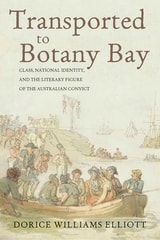
cover of Transported to Botany Bay: Class, National Identity, and the Literary Figure of the Australian Convict

Transported to Botany Bay

Class, National Identity, and the Literary Figure of the Australian Convict

Dorice Williams Elliott

Ohio University Press, 2019

Literary representations of British convicts exiled to Australia were the most likely way that the typical English reader would learn about the new colonies there. In Transported to Botany Bay, Dorice Williams Elliott examines how writers—from canonical ones such as Dickens and Trollope to others who were themselves convicts—used the figure of the felon exiled to Australia to construct class, race, and national identity as intertwined.

Even as England’s supposedly ancient social structure was preserved and venerated as the “true” England, the transportation of some 168,000 convicts facilitated the birth of a new nation with more fluid class relations for those who didn’t fit into the prevailing national image. In analyzing novels, broadsides, and first-person accounts, Elliott demonstrates how Britain linked class, race, and national identity at a key historical moment when it was still negotiating its relationship with its empire. The events and incidents depicted as taking place literally on the other side of the world, she argues, deeply affected people’s sense of their place in their own society, with transnational implications that are still relevant today.
[more]
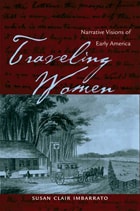
cover of Traveling Women: Narrative Visions of Early America

Traveling Women

Narrative Visions of Early America

Susan Clair Imbarrato

Ohio University Press, 2006

Women’s travel narratives recording journeys north and south along the eastern seaboard and west onto the Ohio frontier enhance our historical understanding of early America. Drawing extensively from primary sources, Traveling Women documents women’s role in westward settlement and emphasizes travel as a culture-building event.

Susan Clair Imbarrato closely examines women’s accounts of their journeys from 1700 to 1830, including Sarah Kemble Knight’s well-known journal of her trip from Boston to New York in 1704 and many lesser-known accounts, such as Sarah Beavis’s 1779 journal of her travel to Ohio via Kentucky and Susan Edwards Johnson’s account or her 1801–2 journey from Connecticut to North Carolina.

In the women’s keen observations and entertaining wit, readers will find bravado mixed with hesitation, as women set forth on business, to relocate, and for pleasure. These travelers wrote compellingly of crossing rivers and mountains, facing hunger, encountering native Americans, sleeping in taverns, and confronting slavery, expressing themselves in voices that differed in sensibility from male explorers and travelers.

These accounts, as Imbarrato shows, challenge assumptions that such travel was predominately a male enterprise. In addition, Traveling Women provides a more balanced portrait of westward settlement by affirming women’s importance in the settling of early America.
[more]
cover of Travels into Print: Exploration, Writing, and Publishing with John Murray, 1773-1859

Travels into Print

Exploration, Writing, and Publishing with John Murray, 1773-1859

Innes M. Keighren, Charles W. J. Withers, and Bill Bell

University of Chicago Press, 2015

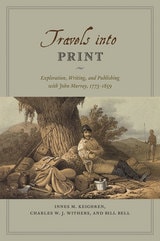
In eighteenth- and nineteenth-century Britain, books of travel and exploration were much more than simply the printed experiences of intrepid authors. They were works of both artistry and industry—products of the complex, and often contested, relationships between authors and editors, publishers and printers. These books captivated the reading public and played a vital role in creating new geographical truths. In an age of global wonder and of expanding empires, there was no publisher more renowned for its travel books than the House of John Murray.

Drawing on detailed examination of the John Murray Archive of manuscripts, images, and the firm’s correspondence with its many authors—a list that included such illustrious explorers and scientists as Charles Darwin and Charles Lyell, and literary giants like Jane Austen, Lord Byron, and Sir Walter Scott—Travels into Print considers how journeys of exploration became published accounts and how travelers sought to demonstrate the faithfulness of their written testimony and to secure their personal credibility. This fascinating study in historical geography and book history takes modern readers on a journey into the nature of exploration, the production of authority in published travel narratives, and the creation of geographical authorship—a journey bound together by the unifying force of a world-leading publisher.
[more]
cover of Treasuring the Gaze: Intimate Vision in Late Eighteenth-Century Eye Miniatures

Treasuring the Gaze

Intimate Vision in Late Eighteenth-Century Eye Miniatures

Hanneke Grootenboer

University of Chicago Press, 2013
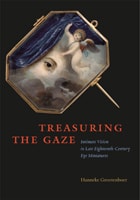
The end of the eighteenth century saw the start of a new craze in Europe: tiny portraits of single eyes that were exchanged by lovers or family members. Worn as brooches or pendants, these minuscule eyes served the same emotional need as more conventional mementoes, such as lockets containing a coil of a loved one’s hair. The fashion lasted only a few decades, and by the early 1800s eye miniatures had faded into oblivion. Unearthing these portraits in Treasuring the Gaze, Hanneke Grootenboer proposes that the rage for eye miniatures—and their abrupt disappearance—reveals a knot in the unfolding of the history of vision.
 
Drawing on Alois Riegl, Jean-Luc Nancy, Marcia Pointon, Melanie Klein, and others, Grootenboer unravels this knot, discovering previously unseen patterns of looking and strategies for showing. She shows that eye miniatures portray the subject’s gaze rather than his or her eye, making the recipient of the keepsake an exclusive beholder who is perpetually watched. These treasured portraits always return the looks they receive and, as such, they create a reciprocal mode of viewing that Grootenboer calls intimate vision. Recounting stories about eye miniatures—including the role one played in the scandalous affair of Mrs. Fitzherbert and the Prince of Wales, a portrait of the mesmerizing eye of Lord Byron, and the loss and longing incorporated in crying eye miniatures—Grootenboer shows that intimate vision brings the gaze of another deep into the heart of private experience.
 
With a host of fascinating imagery from this eccentric and mostly forgotten yet deeply private keepsake, Treasuring the Gaze provides new insights into the art of miniature painting and the genre of portraiture.
[more]
cover of Tropical Freedom: Climate, Settler Colonialism, and Black Exclusion in the Age of Emancipation

Tropical Freedom

Climate, Settler Colonialism, and Black Exclusion in the Age of Emancipation

Ikuko Asaka

Duke University Press, 2017
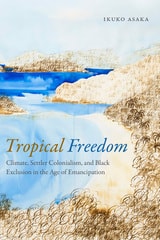
In Tropical Freedom Ikuko Asaka engages in a hemispheric examination of the intersection of emancipation and settler colonialism in North America. Asaka shows how from the late eighteenth century through Reconstruction, emancipation efforts in the United States and present-day Canada were accompanied by attempts to relocate freed blacks to tropical regions, as black bodies were deemed to be more physiologically compatible with tropical climates. This logic conceived of freedom as a racially segregated condition based upon geography and climate. Regardless of whether freed people became tenant farmers in Sierra Leone or plantation laborers throughout the Caribbean, their relocation would provide whites with a monopoly over the benefits of settling indigenous land in temperate zones throughout North America. At the same time, black activists and intellectuals contested these geographic-based controls by developing alternative discourses on race and the environment. By tracing these negotiations of the transnational racialization of freedom, Asaka demonstrates the importance of considering settler colonialism and black freedom together while complicating the prevailing frames through which the intertwined histories of British and U.S. emancipation and colonialism have been understood.
[more]
cover of Tropicopolitans: Colonialism and Agency, 1688–1804

Tropicopolitans

Colonialism and Agency, 1688–1804

Srinivas Aravamudan

Duke University Press, 1999

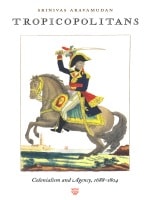
In Tropicopolitans Srinivas Aravamudan reconstructs the colonial imagination of the eighteenth century. By exploring representations of peoples and cultures subjected to colonial discourse, he makes a case for the agency—or the capacity to resist domination—of those oppressed. Aravamudan’s analysis of texts that accompanied European commercial and imperial expansion from the Glorious Revolution through the French Revolution reveals the development of anticolonial consciousness prior to the nineteenth century.
“Tropicalization” is the central metaphor of this analysis, a term that incorporates both the construction of various dynamic tropes by which the colonized are viewed and the site of the study, primarily the tropics. Tropicopolitans, then, are those people who bear and resist the representations of colonialist discourse. In readings that expose new relationships between literary representation and colonialism in the eighteenth century, Aravamudan considers such texts as Behn’s Oroonoko, Defoe’s Robinson Crusoe and Captain Singleton, Addison’s Cato, and Swift’s Gulliver’s Travels and The Drapier’s Letters. He extends his argument to include analyses of Johnson’s Rasselas, Beckford’s Vathek, Montagu’s travel letters, Equiano’s autobiography, Burke’s political and aesthetic writings, and Abbé de Raynal’s Histoire des deux Indes. Offering a radical approach to literary history, this study provides new mechanisms for understanding the development of anticolonial agency.
Introducing eighteenth-century studies to a postcolonial hermeneutics, Tropicopolitans will interest scholars engaged in postcolonial studies, eighteenth-century literature, and literary theory.


[more]