Results by title
805 books match the query '18th century' and 209 start with t
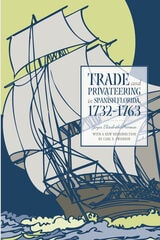
Trade and Privateering in Spanish Florida, 1732–1763
Joyce Elizabeth Harman, With a New Introduction by Carl E. Swanson
University of Alabama Press, 2004
A groundbreaking study of commerce, conflict, and survival in colonial Spanish Florida.
Trade and Privateering examines the illegal yet highly profitable and mutually beneficial trade between Spanish Florida and the English colonies on the eastern seaboard in the mid-18th century. In St. Augustine, the arrival of subsidies from Spain was erratic, causing shortages of food and supplies, so authorities ignored the restrictions on trade with foreign colonies and welcomed British goods. Likewise, the British colonists sought Spanish products from Florida, especially oranges.
But when England and Spain became declared enemies in the War of Jenkins’ Ear and the French and Indian Wars, this tacit trade arrangement was threatened, and the result was a rise of privateering in the region. Rather than do without Spanish goods, the English began to attack and capture Spanish vessels with their cargoes at sea. Likewise, the Spaniards resorted to privateering as a means of steadily supplying the Florida colony. Harman concludes that, both willingly and unwillingly, the English colonies helped their Spanish neighbor to sustain its position in the Southeast.
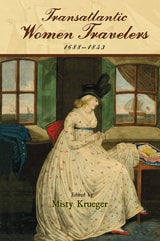
Transatlantic Women Travelers, 1688-1843
Misty Krueger
Bucknell University Press, 2021
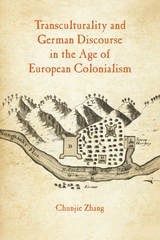
Transculturality and German Discourse in the Age of European Colonialism
Chunjie Zhang
Northwestern University Press, 2017
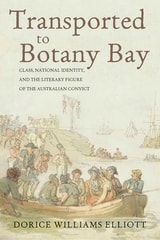
Transported to Botany Bay
Class, National Identity, and the Literary Figure of the Australian ConvictDorice Williams Elliott
Ohio University Press, 2019
Literary representations of British convicts exiled to Australia were the most likely way that the typical English reader would learn about the new colonies there. In Transported to Botany Bay, Dorice Williams Elliott examines how writers—from canonical ones such as Dickens and Trollope to others who were themselves convicts—used the figure of the felon exiled to Australia to construct class, race, and national identity as intertwined.
Even as England’s supposedly ancient social structure was preserved and venerated as the “true” England, the transportation of some 168,000 convicts facilitated the birth of a new nation with more fluid class relations for those who didn’t fit into the prevailing national image. In analyzing novels, broadsides, and first-person accounts, Elliott demonstrates how Britain linked class, race, and national identity at a key historical moment when it was still negotiating its relationship with its empire. The events and incidents depicted as taking place literally on the other side of the world, she argues, deeply affected people’s sense of their place in their own society, with transnational implications that are still relevant today.
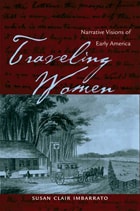
Traveling Women
Narrative Visions of Early AmericaSusan Clair Imbarrato
Ohio University Press, 2006
Susan Clair Imbarrato closely examines women’s accounts of their journeys from 1700 to 1830, including Sarah Kemble Knight’s well-known journal of her trip from Boston to New York in 1704 and many lesser-known accounts, such as Sarah Beavis’s 1779 journal of her travel to Ohio via Kentucky and Susan Edwards Johnson’s account or her 1801–2 journey from Connecticut to North Carolina.
In the women’s keen observations and entertaining wit, readers will find bravado mixed with hesitation, as women set forth on business, to relocate, and for pleasure. These travelers wrote compellingly of crossing rivers and mountains, facing hunger, encountering native Americans, sleeping in taverns, and confronting slavery, expressing themselves in voices that differed in sensibility from male explorers and travelers.
These accounts, as Imbarrato shows, challenge assumptions that such travel was predominately a male enterprise. In addition, Traveling Women provides a more balanced portrait of westward settlement by affirming women’s importance in the settling of early America.
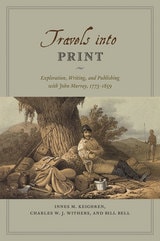
Travels into Print
Exploration, Writing, and Publishing with John Murray, 1773-1859Innes M. Keighren, Charles W. J. Withers, and Bill Bell
University of Chicago Press, 2015
Drawing on detailed examination of the John Murray Archive of manuscripts, images, and the firm’s correspondence with its many authors—a list that included such illustrious explorers and scientists as Charles Darwin and Charles Lyell, and literary giants like Jane Austen, Lord Byron, and Sir Walter Scott—Travels into Print considers how journeys of exploration became published accounts and how travelers sought to demonstrate the faithfulness of their written testimony and to secure their personal credibility. This fascinating study in historical geography and book history takes modern readers on a journey into the nature of exploration, the production of authority in published travel narratives, and the creation of geographical authorship—a journey bound together by the unifying force of a world-leading publisher.
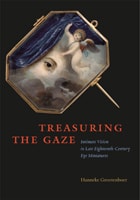
Treasuring the Gaze
Intimate Vision in Late Eighteenth-Century Eye MiniaturesHanneke Grootenboer
University of Chicago Press, 2013
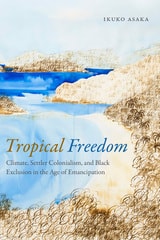
Tropical Freedom
Climate, Settler Colonialism, and Black Exclusion in the Age of EmancipationIkuko Asaka
Duke University Press, 2017
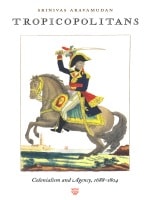
Tropicopolitans
Colonialism and Agency, 1688–1804Srinivas Aravamudan
Duke University Press, 1999
“Tropicalization” is the central metaphor of this analysis, a term that incorporates both the construction of various dynamic tropes by which the colonized are viewed and the site of the study, primarily the tropics. Tropicopolitans, then, are those people who bear and resist the representations of colonialist discourse. In readings that expose new relationships between literary representation and colonialism in the eighteenth century, Aravamudan considers such texts as Behn’s Oroonoko, Defoe’s Robinson Crusoe and Captain Singleton, Addison’s Cato, and Swift’s Gulliver’s Travels and The Drapier’s Letters. He extends his argument to include analyses of Johnson’s Rasselas, Beckford’s Vathek, Montagu’s travel letters, Equiano’s autobiography, Burke’s political and aesthetic writings, and Abbé de Raynal’s Histoire des deux Indes. Offering a radical approach to literary history, this study provides new mechanisms for understanding the development of anticolonial agency.
Introducing eighteenth-century studies to a postcolonial hermeneutics, Tropicopolitans will interest scholars engaged in postcolonial studies, eighteenth-century literature, and literary theory.