Results by title
5159 books match the query 'Biography' and 934 start with t
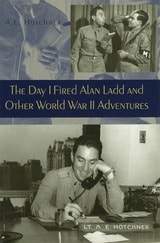
The Day I Fired Alan Ladd and Other World War II Adventures
A. E. Hotchner
University of Missouri Press, 2002
"To perform heroically in a perilous situation is one thing, but I found that, in my case, the real difficulty was in getting myself into a spot where heroism was possible. Nobody on latrine duty ever got the Medal of Honor."
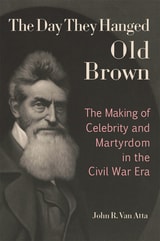
The Day They Hanged Old Brown
The Making of Celebrity and Martyrdom in the Civil War EraJohn R. Van Atta
University of Missouri Press, 2025
Brown’s lifespan covered most of the period between the Revolution and the Civil War, a time of the still-early beginnings of the United States. Only then had his kind of “celebrity” started to matter. From different economic and moral perspectives, politically aware Americans clashed over different visions for the future of the country. At that time, any disruptive figure might be taken as a barometer of the progress or the decline of the republic. A function of the widely varying newspapers and magazines of that day, celebrity offered Americans an angle of vision, happily or not, as to who they were or were becoming or believed themselves to be—as if by a mirror reflection.
In The Day They Hanged Old Brown, John Van Atta examines the creation of celebrity in John Brown’s time and how it differed from modern day perceptions. Yet, as applicable as the concept of celebrity is in this case, the story of Brown’s notoriety represents far more. To his admirers, Brown was not merely a celebrity; he was a hero and, after his sacrificial death, a martyr. Not all celebrities rise to such levels. This book traces the meaning of heroism and martyrdom—as well as the opposite side of that coin, villainy—and suggests that John Brown’s story and legacy helped to redefine these concepts for many Americans during the era of the Civil War, before modern historians began to deliberate him.
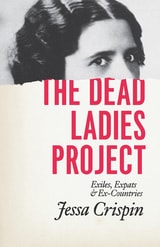
The Dead Ladies Project
Exiles, Expats, and Ex-CountriesJessa Crispin
University of Chicago Press, 2015
The Dead Ladies Project is an account of that journey—but it’s also much, much more. Fascinated by exile, Crispin travels an itinerary of key locations in its literary map, of places that have drawn writers who needed to break free from their origins and start afresh. As she reflects on William James struggling through despair in Berlin, Nora Barnacle dependant on and dependable for James Joyce in Trieste, Maud Gonne fomenting revolution and fostering myth in Dublin, or Igor Stravinsky starting over from nothing in Switzerland, Crispin interweaves biography, incisive literary analysis, and personal experience into a rich meditation on the complicated interactions of place, personality, and society that can make escape and reinvention such an attractive, even intoxicating proposition.
Personal and profane, funny and fervent, The Dead Ladies Project ranges from the nineteenth century to the present, from historical figures to brand-new hangovers, in search, ultimately, of an answer to a bedrock question: How does a person decide how to live their life?
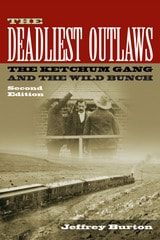
The Deadliest Outlaws
The Ketchum Gang and the Wild Bunch, Second EditionJeffrey Burton
University of North Texas Press, 2009
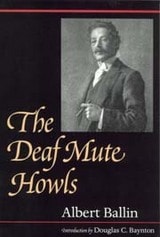
The Deaf Mute Howls
Albert Ballin
Gallaudet University Press, 1998
Originally published in 1930, The Deaf Mute Howls flew in the face of the accepted practice of teaching deaf children to speak and read lips while prohibiting the use of sign language. The sharp observations in Albert Ballin’s remarkable book detail his experiences (and those of others) at a late 19th-century residential school for deaf students and his frustrations as an adult seeking acceptance in the majority hearing society.
The Deaf Mute Howls charts the ambiguous attitudes of deaf people toward themselves at this time. Ballin himself makes matter-of-fact use of terms now considered disparaging, such as “deaf-mute,” and he frequently rues the “atrophying” of the parts of his brain necessary for language acquisition. At the same time, he rails against the loss of opportunity for deaf people, and he commandingly shifts the burden of blame to hearing people unwilling to learn the “Universal Sign Language,” his solution to the communication problems of society. From his lively encounters with Alexander Graham Bell (whose desire to close residential schools he surprisingly supports) to his enthrallment with the film industry, Ballin’s highly readable book offers an appealing look at the deaf world during his richly colored lifetime.
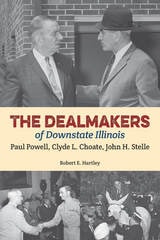
The Dealmakers of Downstate Illinois
Paul Powell, Clyde L. Choate, John H. StelleRobert E. Hartley
Southern Illinois University Press, 2016
Many people are unaware that from 1945 to 1975, downstate lawmakers dominated the Illinois political arena. In The Dealmakers of Downstate Illinois, Robert E. Hartley details the lives and contributions of three influential southern Illinois politicians, Paul Powell, Clyde Choate, and John Stelle. He describes how these “dealmakers” were able to work with Democrats and Republicans throughout the state to bring jobs and facilities to their region. Using a variety of coalitions, they maintained downstate political strength in the face of growing Chicago influence.
Hartley traces the personal histories of Powell, Choate, and Stelle, shows how they teamed up to advance a downstate political agenda, and reviews their challenges and successes. Beginning with an account of early experiences, including the battlefield courage that earned Choate the Medal of Honor as well as Stelle’s World War I experience and later entrepreneurship, the book continues with an exploration of the groundwork for their collaborative legislative agenda and their roles in the growth of Southern Illinois University and the passage of income tax legislation. Hartley reviews the importance of Powell’s relationship with Governor Stratton, Choate’s leadership of the 1972 Democratic National Convention and his relationships with Governor Walker and with Chicago interests.
The Dealmakers of Downstate Illinois is a vivid, straightforward tale of fighting in the legislative chambers, backstabbing behind the scenes, and trading special favors for votes in pursuit of not only personal gain but also the advancement of a regional agenda.
The Death and Life of Malcolm X
Peter Goldman
University of Illinois Press, 2013
The Death of the Child Valerio Marcello
Margaret L. King
University of Chicago Press, 1994
This child, scion of a family of power and privilege at Venice's time of greatness, left his father in a state of despair so profound and so public that it occasioned an outpouring of consoling letters, orations, treatises, and poems. In these documents, we find a firsthand account, richly colored by humanist conventions and expectations, of the life of the fifteenth-century boy, the passionate devotion of his father, the feelings of his brothers and sisters, the striking absence of his mother. The father's story is here as well: the career of a Venetian nobleman and scholar, patron and soldier, a participant in Venice's struggle for dominion in the north of Italy.
Through these sources also King traces the cultural trends that made Marcello's century famous. Her work enlarges our view of the literature of consolation, which had a distinctive tradition in Venice, and shifting attitudes toward death from the late Middle Ages onward.
For the depth and acuity of its insights into political, cultural, and private life in fifteenth-century Venice, this book will be essential reading for students of the Renaissance. For the grace and drama of its storytelling, it will be savored by anyone who wishes to look into life and death in a palace, and a city, long ago.
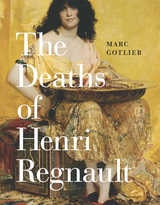
The Deaths of Henri Regnault
Marc Gotlieb
University of Chicago Press, 2016
Gotlieb traces Regnault’s trajectory after he won the prestigious Grand Prix de Rome, a fellowship that provided four years of study in Italy. Arriving in Rome, however, Regnault suffered a profound crisis of originality that led him to flee the city in favor of Spain and Morocco. But the crisis also proved productive: from Rome, Madrid, Tangier, and Paris, Regnault enthralled audiences with a bold suite of strange, seductive, and violent Orientalist paintings inspired by his exotic journey—images that, Gotlieb argues, arose precisely from the crisis that had overtaken Regnault and that in key respects was shared by his more avant-garde counterparts.
Both an in-depth look at Regnault’s violent art and a vibrant essay on historical memory, The Deaths of Henri Regnault lays bare a creative legend who helped shape the collective experience of a generation.
The Deeds of Louis the Fat
Abbot of Saint Denis, Suger
Catholic University of America Press, 1992
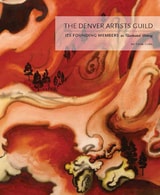
The Denver Artists Guild
Its Founding Members; An Illustrated HistoryStan Cuba
University Press of Colorado, 2015
In 1928, the newly organized Denver Artists Guild held its inaugural exhibition in downtown Denver. Little did the participants realize that their initial effort would survive the Great Depression and World War II—and then outlive all of the group’s fifty-two charter members.
The guild’s founders worked in many media and pursued a variety of styles. In addition to the oils and watercolors one would expect were masterful pastels by Elsie Haddon Haynes, photographs by Laura Gilpin, sculpture by Gladys Caldwell Fisher and Arnold Rönnebeck, ceramics by Anne Van Briggle Ritter and Paul St. Gaudens, and collages by Pansy Stockton. Styles included realism, impressionism, regionalism, surrealism, and abstraction. Murals by Allen True, Vance Kirkland, John E. Thompson, Louise Ronnebeck, and others graced public and private buildings—secular and religious—in Colorado and throughout the United States. The guild’s artists didn’t just contribute to the fine and decorative arts of Colorado; they enhanced the national reputation of the state.
Then, in 1948, the Denver Artists Guild became the stage for a great public debate pitting traditional against modern. The twenty-year-old guild split apart as modernists bolted to form their own group, the Fifteen Colorado Artists. It was a seminal moment: some of the guild’s artists became great modernists, while others remained great traditionalists.
Enhanced by period photographs and reproductions of the founding members’ works, The Denver Artists Guild chronicles a vibrant yet overlooked chapter of Colorado’s cultural history. The book includes a walking tour of guild members’ paintings and sculptures viewable in Denver and elsewhere in Colorado, by Leah Naess and author Stan Cuba.
In honor of the book’s release, the Byers-Evans House Gallery will showcase a collection of founding guild members’ works starting June 26, 2015. The exhibit, also titled The Denver Artists Guild: Its Founding Members, contains paintings from artists such as the famed Paschal Quackenbush, Louise Ronnebeck, Albert Byron Olson, Elisabeth Spalding, Waldo Love and Vance Kirkland. The show will be on display through September 26, 2015.
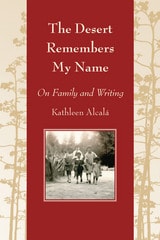
The Desert Remembers My Name
On Family and WritingKathleen Alcalá
University of Arizona Press, 2007
Thus begins a lyrical and entirely absorbing collection of personal essays by esteemed Chicana writer and gifted storyteller Kathleen Alcalá. Loosely linked by an exploration of the many meanings of “family,” these essays move in a broad arc from the stories and experiences of those close to her to those whom she wonders about, like Andrea Yates, a mother who drowned her children. In the process of digging and sifting, she is frequently surprised by what she unearths. Her family, she discovers, were Jewish refugees from the Spanish Inquisition who took on the trappings of Catholicism in order to survive.
Although the essays are in many ways personal, they are also universal. When she examines her family history, she is encouraging us to inspect our own families, too. When she investigates a family secret, she is supporting our own search for meaning. And when she writes that being separated from our indigenous culture is “a form of illiteracy,” we know exactly what she means.
After reading these essays, we find that we have discovered not only why Kathleen Alcalá is a writer but also why we appreciate her so much. She helps us to find ourselves.
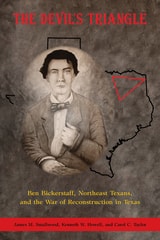
The Devil's Triangle
Ben Bickerstaff, Northeast Texans, and the War of Reconstruction in TexasJames M. Smallwood
University of North Texas Press, 2007
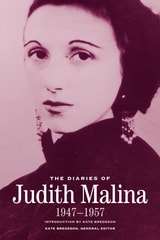
The Diaries of Judith Malina
1947-1957Judith Malina, Kate Bredeson
Northwestern University Press, 2026
Judith Malina’s newly restored diaries from a critical early decade in her personal, artistic, and political development
Judith Malina’s diaries from 1947 to 1957 are brought back into print in this volume, which charts her cofounding of The Living Theatre with husband and lifelong artistic partner Julian Beck. In these diaries, she narrates her developing political commitments and her expansive collaborations and personal relationships, as well as a moving account of her time in prison with activist Dorothy Day. This new edition features Kate Bredeson’s comprehensive introduction, which offers a detailed examination of Malina’s life and work in this period, along with additional historical context of these years and never-before-published photographs from Malina’s personal archives.
The Diaries of Judith Malina is a four-volume set that publishes for the first time together the edited diaries of radical theater director, actor, and activist Judith Malina from 1947 to 1971, the most influential period of her remarkable and storied career. A committed anarchist and pacifist, Malina made theater as a way to stoke revolutionary action. Her diaries showcase her political and social observations, cultural commentary, self-reflection, and wit. This expertly prepared set invites us to recognize Malina for her accomplishments not only as an artist and an activist but as one of the great literary diarists.

The Dictionary of Nineteenth-Century British Scientists
Edited by Bernard Lightman
University of Chicago Press, 2004
While the Dictionary of Nineteenth-Century British Scientists covers those working in traditional scientific areas such as physics, astronomy, chemistry, mathematics, and biology, it also acknowledges those working in the human sciences such as anthropology, sociology, psychology, and medicine. In addition, areas often overlooked by historians of science—such as phrenology, mesmerism, spiritualism, scientific illustration, scientific journalism and publishing, instrument making, and government policy—are included here, as are the important roles of neglected "amateurs," such as women and members of the working class. By including those who worked in nontraditional areas and by considering the social and cultural context in which they lived, the dictionary reflects a richer picture of nineteenth-century science than has ever been seen before.
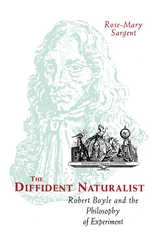
The Diffident Naturalist
Robert Boyle and the Philosophy of ExperimentRose-Mary Sargent
University of Chicago Press, 1995
Sargent examines the philosophical, legal, experimental, and religious traditions—among them English common law, alchemy, medicine, and Christianity—that played a part in shaping Boyle's experimental thought and practice. The roots of his philosophy in his early life and education, in his religious ideals, and in the work of his predecessors—particularly Bacon, Descartes, and Galileo—are fully explored, as are the possible influences of his social and intellectual circle. Drawing on the full range of Boyle's published works, as well as on his unpublished notebooks and manuscripts, Sargent shows how these diverse influences were transformed and incorporated into Boyle's views on and practice of experiment.

The Disabled Child
Memoirs of a Normal FutureAmanda Apgar
University of Michigan Press, 2023
The Disappearances
A Story of Exploration, Murder, and Mystery in the American WestScott Thybony
University of Utah Press, 2016
Intrigued by this unusual string of coincidental disappearances, Scott Thybony set out to learn what happened. His investigations took him from Island in the Sky to Skeleton Mesa, from Texas to Tucson, and from the Green River to the Red. He traced the journey of Lucy Garrett from the murder of her father to her dramatic courtroom testimony. Using the pages of an old journal he followed the route of Dan Thrapp as he crossed an expanse of wildly rugged country with a pair of outlaws. Thrapp’s story of survival in an unforgiving land is a poignant counterpoint to the fate of the artist Everett Ruess, which the New York Times has called “one of the most enduring mysteries of the modern West.” Thybony draws on extensive research and a lifetime of exploration to create a riveting story of these three lives.
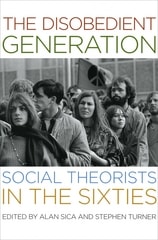
The Disobedient Generation
Social Theorists in the SixtiesEdited by Alan Sica and Stephen Turner
University of Chicago Press, 2005
The Disobedient Generation collects newly written autobiographies by an international cross-section of well-known sociologists, all of them "children of the '60s." It illuminates the human experience of living through that decade as apprentice scholars and activists, encountering the issues of class, race, the Establishment, the decline of traditional religion, feminism, war, and the sexual revolution. In each case the interlinked crises of young adulthood, rapid change, and nascent professional careers shaped this generation's private and public selves. This is an intensely personal collective portrait of a generation in a time of struggle.
The Divided North
Black and White Families in the Age of SlaveryCarol Gardner
University of Massachusetts Press, 2025
Winner, 2026 New England Historical Association James P. Hanlan Book Prize
Finalist, 2026 New England Society Book Award in Nonfiction
Reuben Ruby and Nathaniel Gordon II were born eleven months apart in 1798 and 1799 and spent much of their boyhoods roaming the noisy, bustling waterfront of Portland, Maine. They lived just blocks from one another, attended school together, and went to the same church with their families. But they were worlds apart, separated by family, culture, and race. Reuben Ruby was Black and Nathaniel Gordon was White.
The Rubys became prominent antislavery activists, equal rights advocates, and operatives on the Underground Railroad. Their neighbors, the Gordons, became well-to-do ship masters, owners, and merchants: among them, the most notorious American slave ship captain of the century, Nathaniel Gordon III. As activists, sea captains, businessmen, prospectors, and politicians, members of these two families traveled to New York, California, Texas, Louisiana, Africa, Haiti, and Brazil, where their experiences were shaped by their racial identities. At home in the “Free North,” they faced social and political divisions nearly as sharp as those they encountered elsewhere.
To understand the issues that divided nineteenth-century America—and, in many ways, still divide the nation—few have looked to the far North. In this compelling narrative history and intimate dual-family biography, Carol Gardner traces the Rubys and Gordons as they navigate the turbulent 1800s. As families and individuals, they demonstrate that the North was a critical proving ground for American notions of freedom and equality, as telling as any town, plantation, or battlefield in the South. Their experiences help reveal what it meant to live in a free state during the age of slavery, with all the promise, disappointment, irony, and hope that the notion entailed.
The Doctor Who Would Be King
Guillaume Lachenal
Duke University Press, 2022
The Donigers of Great Neck
A Mythologized MemoirWendy Doniger
Brandeis University Press, 2019
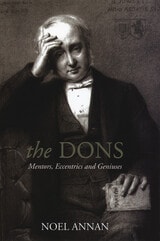
The Dons
Mentors, Eccentrics and GeniusesNoel Annan
University of Chicago Press, 1999
In this entertaining, informative book, Noel Annan is at his incisive best. Displaying his customary mastery of his subject, he describes the great dons in all their glory and eccentricities: who they were, what they were like, why they mattered, and what their legacy is. Written with love and wisdom, the great minds of the past—figures such as John Henry Newman, John Sparrrow, and Isaiah Berlin—are brought alive. In addition, Annan's often quoted article "The Intellectual Aristocracy" is included in this book.
No other work has ever explained so precisely and so intimately the significance of the dons and their important role in shaping higher education—at a time when the nature of learning is ever more the subject of dissension and uncertainty.
"With a charming mixture of analyses and anecdotes, Annan builds up a picture of the changing Oxbridge scene that keeps a reader's imagination. . . . [T]he comical-satirical narrative of which he was a master is a joy to read, and The Dons will deservedly be enjoyed as a bedside book by those who treasure English eccentricity."—Stephen Toulmin, Los Angeles Times Book Review
"[A]n affectionate elegy for a class that has largely expired."—Robert Fulford, National & Financial Post
"[A] wonderfully gifted and energetic writer. . . . Noel was one of the few figures in English public life known simply by his first name. There was no mistaking him for anyone else."—Jonathan Mirsky, New Yorker
"A sparkling collection of essays."—Michael Davie, Times Literary Supplement
"[A] highly affectionate . . . look at some of the more remarkable academic personages to distinguish-and sometimes dumbfound-Oxford and Cambridge over the last two centuries. . . . For all that it cherishes eccentricity and abounds in Oxbridge gossip, The Dons is at heart a deeply serious book, one dedicated to a conception of learning and culture that is at once increasingly rare . . . yet very far from being outmoded."—Mark Feeney, Boston Globe
"Annan writes elegantly and winningly throughout his book. . . . Leaving arguably the best for last, Annan ends The Dons with a reprinting of his celebrated essay 'The Intellectual Aristocracy,' . . . [B]oth a dazzling tour de force and a clever jeu d'esprit."—Michael Dirda, Washington Post Book World
"A witty, erudite, insider account-exactly what one would expect from the best of their type."—Andrew Lycett, Sunday Times
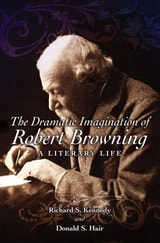
The Dramatic Imagination of Robert Browning
A Literary LifeRichard S. Kennedy & Donald S. Hair
University of Missouri Press, 2007

The Drums of the 47th
Robert J. Burdette
University of Illinois Press, 2000
From Peoria to Corinth, from Corinth to Vicksburg, up the Red River country, down to Mobile and Fort Blakely, and back to Tupelo and Selma, the 47th marched three thousand miles during Burdette's tour, from March 1862 to December 1864.
In a literate voice rare in war memoirs, Burdette speaks of comradeship built and tested, the noise and confusion of the battlefield, the conflicting feelings of witnessing a military execution. Both nostalgic and piercingly immediate, his remembrances evoke the sights, sounds, smells, and above all the inner feelings stirred up by war, from exuberance to terror and from patriotic fervor to compassion for a fallen enemy.
Originally published--on the eve of another great conflict--in 1914, The Drums of the 47th is a moving depiction of the inner life of the common soldier. Like Stephen Crane's The Red Badge of Courage, Burdette's book puts a human face on the war and his words speak to all who have served or imagined serving under fire. The introduction by John E. Hallwas provides a biographical sketch of Burdette and a commentary on his engaging Civil War memoir.
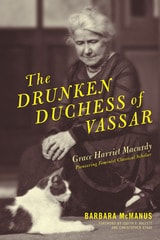
The Drunken Duchess of Vassar
Grace Harriet Macurdy, Pioneering Feminist Classical ScholarBarbara McManus
The Ohio State University Press, 2017
In this biography, Barbara McManus recovers the intriguing life story of Grace Harriet Macurdy (1866–1946), Professor of Greek at Vassar College and the first woman classicist to focus her scholarship on the lives of ancient Greco-Roman women. Fondly known as “the Drunken Duchess,” although she never drank alcohol, Macurdy came from a poor family with no social, economic, or educational advantages. Moreover, she struggled with disability for decades after becoming almost totally deaf in her early fifties. Yet she became an internationally known Greek scholar with a long list of publications and close friends as renowned as Gilbert Murray and John Masefield.
Through Macurdy’s eyes and experiences, McManus examines significant issues and developments from the late nineteenth to the mid-twentieth century, such as the opening of higher education to women, the erosion of gender and class barriers in the professions, the delicate balancing act between personal and professional life required of women, the marginalized role of women’s colleges in academic politics, and changes in the discipline and profession of Classics in response to the emerging role of women and new social conditions.
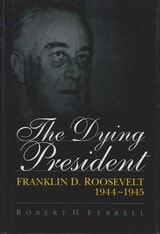
The Dying President
Franklin D. Roosevelt, 1944-1945Robert H. Ferrell
University of Missouri Press, 1998
In this authoritative account, Robert H. Ferrell shows how the treatment of President Franklin D. Roosevelt's illness in 1944- 1945 was managed by none other than the president himself. Although this powerful American president knew that he suffered from cardiovascular disease, he went to great lengths to hide that fact—both from his physician and from the public. Why Roosevelt disguised the nature of his illness may be impossible to discern fully. He was a secretive man who liked to assign only parts of tasks to his assistants so that he, the president, would be the only one who knew the whole story. The presidency was his life, and he did not wish to give it up.
The president's duplicity, though not easily measurable, had a critical effect on his performance. Placed on a four-hour-a-day schedule by his physicians, Roosevelt could apply very little time to his presidential duties. He took long vacations in South Carolina, Warm Springs, the Catoctin Mountains, and Hyde Park, as well as lengthy journeys to Hawaii, Canada, and Yalta. Important decisions were delayed or poorly made. America's policy toward Germany was temporarily abandoned in favor of the so-called Morgenthau Plan, which proposed the "pastoralization" of Germany, turning the industrial heart of Europe into farmland. Roosevelt nearly ruined the choice of Senator Harry S. Truman as his running mate in 1944 by wavering in the days prior to the party's national convention. He negotiated an agreement with Winston Churchill on sharing postwar development of nuclear weapons but failed to let the State Department know. And, in perhaps the most profoundly unwise decision, Roosevelt accepted a fourth term when he could not possibly survive it.
In his final year, a year in which he faced crucial responsibility regarding World War II and American foreign policy, Franklin D. Roosevelt failed to serve the nation as a healthy president would have. Reading like a mystery story, The Dying President clears up many of the myths and misunderstandings that have surrounded Roosevelt's last year, finally revealing the truth about this missing chapter in FDR's life.
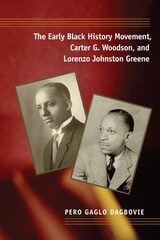
The Early Black History Movement, Carter G. Woodson, and Lorenzo Johnston Greene
Pero Gaglo Dagbovie
University of Illinois Press, 2007
The Early Poetry of Robert Graves
The Goddess BeckonsBy Frank L. Kersnowski
University of Texas Press, 2002
Like many men of his generation, poet Robert Graves was indelibly marked by his experience of trench warfare in World War I. The horrific battles in which he fought and his guilt over surviving when so many perished left Graves shell-shocked and disoriented, desperately seeking a way to bridge the rupture between his conventional upbringing and the uncertainties of postwar British society.
In this study of Graves's early poetry, Frank Kersnowski explores how his war neurosis opened a door into the unconscious for Graves and led him to reject the essential components of the Western idea of reality—reason and predictability. In particular, Kersnowski traces the emergence in Graves's early poems of a figure he later called "The White Goddess," a being at once terrifying and glorious, who sustains life and inspires poetry. Drawing on interviews with Graves's family, as well as unpublished correspondence and drafts of poems, Kersnowski argues that Graves actually experienced the White Goddess as a real being and that his life as a poet was driven by the purpose of celebrating and explaining this deity and her matriarchy.

The Earps Invade Southern California
Bootlegging Los Angeles, Santa Monica, and the Old Soldiers' HomeDon Chaput
University of North Texas Press, 2020
The Eclipse I Call Father
Essays on AbsenceDavid Axelrod
Oregon State University Press, 2019
The essays in this collection grew from a ten-year period when the author found himself periodically living and working abroad, wondering why foreign landscapes haunted him more than the familiar landscapes of the inland Pacific Northwest he called home. Each place had a long history of habitation, but at home he was blind, unable to see past the surfaces of things. Axelrod examines many aspects of that phenomenon in these pages, framing surface realities and imagining the scale and scope of that surface, but also trying to sense what is absent or changed, and how, despite its absence, the unseen accretes to ever-greater densities and persists as something uncanny.
Curious, alert, and keenly observant, these essays probe the boundaries between what is here and what is gone, what is present and what is past, in elegant prose. Readers familiar with Axelrod’s poetry will find a new facet of his lyrical gifts, while those encountering his work for the first time will be richly rewarded by the discovery of this Northwest literary talent.
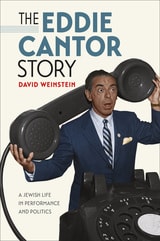
The Eddie Cantor Story
A Jewish Life in Performance and PoliticsDavid Weinstein
Brandeis University Press, 2017
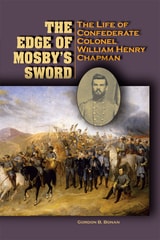
The Edge of Mosby’s Sword
The Life of Confederate Colonel William Henry ChapmanGordon B. Bonan
Southern Illinois University Press, 2009
The Edge of Mosby’s Sword is the first scholarly volume to delve into the story of one of John Singleton Mosby’s most trusted and respected officers, Colonel William Henry Chapman. Presenting both military and personal perspectives of Chapman’s life, Gordon B. Bonan offers an in-depth understanding of a man transformed by the shattering of his nation. This painstakingly researched account exposes a soldier and patriot whose convictions compelled him to battle fiercely for Southern independence; whose quest for greatness soured when faced with the brutal realities of warfare; and who sought to heal his wounded nation when the guns of war were silenced.
Born into a wealthy slave-owning family, Chapman was a student of the fiery secessionist rhetoric of antebellum Virginia who eagerly sought glory and adventure on the battlefields of the Civil War. Bonan traces Chapman’s evolution from an impassioned student at the University of Virginia to an experienced warrior and leader, providing new insight into the officer’s numerous military accomplishments. Explored here are Chapman’s previously overlooked endeavors as a student warrior, leader of the Dixie Artillery, and as second-in-command to Mosby, including his participation in the capture of Harpers Ferry, the battering of Union forces at Second Manassas, and his ferocious raids during the 1864 Shenandoah Valley campaign. Bonan reveals fresh perspectives on the intrepid maneuvers of Mosby’s Rangers, the hardships of war, and Chapman’s crucial role as the right hand of the “Gray Ghost.” But while Mosby recognized him for his bravery and daring, the fame Chapman sought always eluded him. Instead, with his honors and successes came disillusionment and sorrow, as he watched comrades and civilians alike succumb to the terrible toll of the war.
The end of the struggle between North and South saw Chapman accept defeat with dignity, leading the Rangers to their official surrender and parole at Winchester. With the horrors of the war behind him, he quickly moved to embrace the rebuilding of his country, joining the Republican party and beginning a forty-two-year career at the IRS enforcing Federal law throughout the South. In the end, Chapman’s life is a study in contradictions: nationalism and reconciliation; slavery and liberty; vengeance and chivalry.
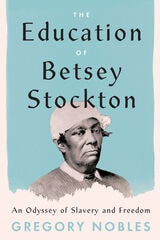
The Education of Betsey Stockton
An Odyssey of Slavery and FreedomGregory Nobles
University of Chicago Press, 2022
The life of Betsey Stockton (ca. 1798–1865) is a remarkable story of a Black woman’s journey from slavery to emancipation, from antebellum New Jersey to the Hawai‘ian Islands, and from her own self-education to a lifetime of teaching others—all told against the backdrop of the early United States’ pervasive racism. It’s a compelling chronicle of a critical time in American history and a testament to the courage and commitment of a woman whose persistence grew into a potent form of resistance.
When Betsey Stockton was a child, she was “given, as a slave” to the household of Rev. Ashbel Green, a prominent pastor and later the president of what is now Princeton University. Although she never went to school, she devoured the books in Green’s library. After being emancipated, she used that education to benefit other people of color, first in Hawai‘i as a missionary, then Philadelphia, and, for the last three decades of her life, Princeton—a college town with a genteel veneer that never fully hid its racial hostility. Betsey Stockton became a revered figure in Princeton’s sizeable Black population, a founder of religious and educational institutions, and a leader engaged in the day-to-day business of building communities.
In this first book-length telling of Betsey Stockton’s story, Gregory Nobles illuminates both a woman and her world, following her around the globe, and showing how a determined individual could challenge her society’s racial obstacles from the ground up. It’s at once a revealing lesson on the struggles of Stockton’s times and a fresh inspiration for our own.
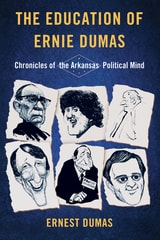
The Education of Ernie Dumas
Chronicles of the Arkansas Political MindErnest Dumas
Butler Center for Arkansas Studies, 2019
Beginning with the defeat of Governor Francis Cherry by the son of a hillbilly socialist at the end of the Joe McCarthy era, Dumas traces the development of a modernist political cast that eventually produced Arkansas’s first president of the United States. It follows the seed from 1978 that would germinate into the second impeachment of an American president.
Dumas has written for newspapers and about politics for sixty-three years, since 1954, the year that the stolid Cherry fell to Orval Eugene Faubus. The book is a political memoir that describes not only his education in the ways of politicians but the politicians’ own education and miseducation in how you win voters and then how you get things done.
It is mostly a collection of untold stories, often deeply personal, that reveal the inner struggles and sometimes the tribulations of the state’s leaders—Cherry, Faubus, Winthrop Rockefeller, Dale Bumpers, David Pryor, John McClellan, J. William Fulbright, Bill Clinton, Jim Guy Tucker, and others.
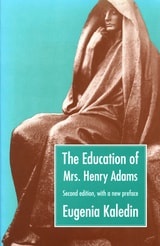
The Education of Mrs. Henry Adams
Eugenia Kaledin
University of Massachusetts Press, 1994
Marian Hooper Adams—Clover, as her friends called her—was an accomplished photographer and a witty, irreverent free spirit who moved easily within the cultural circles of nineteenth-century Boston. Why, then, in 1882, at the age of forty-two, did she swallow a lethal dose of potassium cyanide? And why did her husband of thirteen years fail even to mention her in his autobiography, The Education of Henry Adams?
These and other questions are explored in this first paperback edition of Eugenia Kaledin's pathbreaking biography. The book recreates the intense intellectual, cultural, and moral life of Boston and New England before, during, and after the Civil War and helps us to understand what could drive such a gifted, intelligent, and privileged woman to take her own life. Included is a portfolio of Adams's photographs of her husband and his famous circle.
The Education of a Radical
An American Revolutionary in Sandinista NicaraguaBy Michael Johns
University of Texas Press, 2012
“I went to Nicaragua with nothing but a tourist visa, $1,500 in cash, the name of someone at the Agrarian Reform Ministry, and the idea of being a revolutionary intellectual. . . . The idea took hold in a simple character flaw: wanting to believe that I knew better than everyone else.” —From the preface
When Michael Johns joined a Sandinista militia in 1983, a fellow revolutionary dubbed him a rábano, a radish: red on the outside but white on the inside. Now, more than twenty-five years later, Johns appreciates the wisdom of that label as he revisits the questions of identity he tried to resolve by working with the Sandinistas at that point in his life. In The Education of a Radical, Johns recounts his immersion in Marxism and the Nicaraguan sojourn it led to, with a painful maturation process along the way.
His conversion began in college, where he joined a student group called the Latin American Solidarity Association and traveled to Chiapas, Mexico, for research on his senior thesis. Overwhelmed by the poverty he witnessed (and fascinated by a new friend named Maricela who was trying to turn peasants into revolutionaries and who carried a heavily highlighted copy of Late Capitalism), he experienced an ideological transformation. When a Marxist professor later encouraged him to travel to Nicaragua, the real internal battle began for him, a battle that was intensified by the U.S. invasion of Grenada and its effect on the Sandinistas, who believed they were the next target for an imminent American invasion. Before he knew it, Johns was digging trenches and learning how to use an AK-47. His intellectual ideals came face-to-face with revolutionary facts, and the results would perplex him for years to come.
Bringing to life a vivid portrait of the sometimes painful process of reconciling reality with romanticized principles, The Education of a Radical encapsulates a trove of truths about humanity, economics, and politics in one man’s memorable journey.
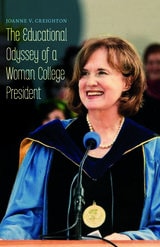
The Educational Odyssey of a Woman College President
Joanne V. Creighton
University of Massachusetts Press, 2018
In her autobiography, The Educational Odyssey of a Woman College President, Creighton situates her tenure at Mount Holyoke within a life and career that have traversed breathtaking changes in higher education and social life. Having held multiple roles in academia spanning undergraduate, professor, and president, Creighton served at small colleges and large public universities and experienced the dramatic changes facing women across the academy. From her girlhood in Wisconsin to the presidency of a storied women's college, she bears witness to the forces that have reshaped higher education for women and continues to advocate for the liberal arts and sciences.
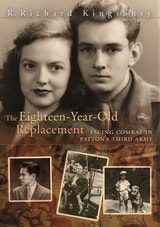
The Eighteen-Year-Old Replacement
Facing Combat in Patton's Third ArmyR. Richard Kingsbury
University of Missouri Press, 2008
When the United States entered the Second World War, eighteen-year-old enlistees were routinely assigned temporary duties and not sent into battle until they turned nineteen. But as the fighting dragged on, America was eventually forced to draft younger men into combat to replace wounded troops—and following the Battle of the Bulge, more than 300,000 eighteen-year-olds were sent as replacements to the army’s decimated divisions.
In The Eighteen-Year-Old Replacement, Richard Kingsbury brings an often-overlooked perspective to the annals of World War II. Torn from an ordinary teenager’s life in the Midwest, young Dick was drafted six weeks after D-Day and rushed with other eighteen-year-olds to the Siegfried Line to bolster Patton’s 94th Infantry Division. His reminiscence provides a moving, diarylike account of what he endured both physically and emotionally—and tells how he went from boyhood to manhood almost overnight.
In prose that is both succinct and evocative, Kingsbury recounts his experiences as a rifleman during the final bloody battles in Germany, giving readers a real feel for what combat was like for a raw recruit. He recalls his first night in a foxhole on the front line and the “unbelievable luxury” of sleeping in a barn’s hayloft. He relives freezing cold at the Bulge, which permanently damaged his legs, and the pounding of enemy artillery during Patton’s breakthrough of the German West Wall, which affected his hearing for life.
More poignantly, Kingsbury shares his anxieties over killing—as well as the distinct possibility of being killed as Wehrmacht tanks mercilessly blasted individual foxholes at Bannholz Woods. He vividly recalls Patton’s attack on Ludwigshafen, on the west bank of the Rhine, where he took a German bullet in his chest—and where three of the six newly arrived eighteen-year-olds were killed.
Interspersed with the accounts of battle are letters between Dick and Mary Jo, his sweetheart back home, capturing the blossoming of romance that transcended both distance and bloodshed. His book casts a new light on war—and courtship—in an era when boys were rushed from the home front to the front lines. By showing how crucial the contribution of these young men was to the war effort, this book gives the eighteen-year-old replacements the recognition they have long deserved.
The Eleventh House
MemoirsHudson Strode, Introduction by Don Noble
University of Alabama Press, 1975
Why should Hudson Strode matter to readers today? Because his life was a masterclass in reinvention and a backstage pass to the Jazz Age’s wittiest salons. Strode wasn’t just a professor in Tuscaloosa; he was a cultural impresario who turned a modest Southern life into a global adventure. He taught generations of writers, staged Shakespeare with bravura, and wrote travel books that earned him a knighthood from the King of Sweden.
But the real allure? The gossip. Strode dined with Lady Astor, traded quips with H. L. Mencken, and sipped cocktails with Zelda and Scott Fitzgerald when they were the incandescent couple of the 1920s. He met Hemingway in Cuba, Robinson Jeffers in Carmel, and Isak Dinesen in Denmark—then wrote about them with candor and charm. His memoir brims with stories of literary giants, royal encounters, and the occasional eyebrow-raising escapade (ask him about the brothel in Birmingham).
For contemporary readers, The Eleventh House is both a captivating autobiography and a time capsule of ambition, art, and audacity. Strode’s world—where Southern gentility collided with European modernism and Jazz Age excess—feels startlingly relevant in an era obsessed with reinvention and celebrity culture. If you’ve ever wondered what it was like to gossip with the Fitzgeralds or watch the devil admire himself in a porch mirror, this memoir delivers.
Step inside Hudson Strode’s The Eleventh House. It’s witty, worldly, and just scandalous enough to keep you turning pages.
The Emperor's Clothes
A Personal Viewpoint of Politics and Administration in the Imperial Ethiopian Government, 1941-1974Gaitachew Bekele
Michigan State University Press, 1993
. . . An engaging personal account of a public service career n the period leading to the 1974 revolution. It ...persuades and provides real insight into the genuine noblesse oblige of the first generation of technocrats drawn from the social elite of the post- war period.
-James McCann, Boston University
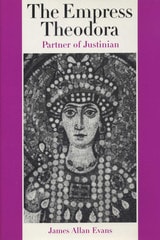
The Empress Theodora
Partner of JustinianBy James Allan Evans
University of Texas Press, 2002
Even by modern standards, the Empress Theodora (?-548) had a remarkable rise to power. Born into the lowest class of Byzantine society, she worked as an actress in burlesque theater. Yet she attracted the love of the future emperor Justinian, who, to the astonishment of proper society, made her not only his wife but also his partner in government. Justinian's respect for and trust in Theodora gave her power in her own right unmatched by almost any other Roman or Byzantine empress.
In this book, James Allan Evans provides a scholarly, yet highly accessible account of the life and times of the Empress Theodora. He follows her from her childhood as a Hippodrome bearkeeper's daughter to her imperial roles as Justinian's most trusted counselor and as an effective and powerful advocate for the downtrodden. In particular, he focuses on the ways in which Theodora worked to improve the lives of women. He also explores the pivotal role Theodora played in the great religious controversy of her time, involving a breach between sects in the Christian church.
The Encyclopedia of Native Music
More Than a Century of Recordings from Wax Cylinder to the InternetBrian Wright-McLeod
University of Arizona Press, 2005
In addition to the widely heard sounds of Carlos Nakai’s flute, Native music embraces a wide range of forms: country and folk, jazz and swing, reggae and rap. Brian Wright-McLeod, producer/host of Canada’s longest-running Native radio program, has gathered the musicians and their music into this comprehensive reference, an authoritative source for biographies and discographies of hundreds of Native artists.
The Encyclopedia of Native Music recognizes the multifaceted contributions made by Native recording artists by tracing the history of their commercially released music. It provides an overview of the surprising abundance of recorded Native music while underlining its historical value.
With almost 1,800 entries spanning more than 100 years, this book leads readers from early performers of traditional songs like William Horncloud to artists of the new millennium such as Zotigh. Along the way, it includes entries for jazz and blues artists never widely acknowledged for their Native roots—Oscar Pettiford, Mildred Bailey, and Keely Smith—and traces the recording histories of contemporary performers like Rita Coolidge and Jimmy Carl Black, “the Indian of the group” in the original Mothers of Invention. It also includes film soundtracks and compilation albums that have been instrumental in bringing many artists to popular attention. In addition to music, it lists spoken-word recordings, including audio books, comedy, interviews, poetry, and more.
With this unprecedented breadth of coverage and extensively cross-referenced, The Encyclopedia of Native Music is an essential guide for enthusiasts and collectors. More than that, it is a gateway to the authentic music of North America—music of the people who have known this land from time immemorial and continue to celebrate it in sound.
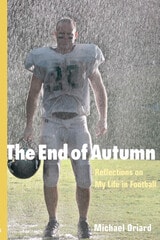
The End of Autumn
Reflections on My Life in FootballMichael Oriard
University of Illinois Press, 2009
After graduating, he signed with the Kansas City Chiefs and head coach Hank Stram. There he learned what it meant to be "owned." He rediscovered the game as it was played by grown men with families who were still treated like children and who dreaded nothing more than the end of their football careers. And without their fully realizing the consequences, every hard tackle inflicted its injury, some gradually growing into chronic conditions, some suddenly cutting a player's career short and ushering him off the field to be soon forgotten.
In this thoughtful narrative, Oriard describes the dreams of glory, the game day anxieties, the brutal training camps and harsh practices, his starry-eyed experience at Notre Dame, and the cold-blooded business of professional football. Told from the inside, the book leaves aside the hype and the pathos of the game to present a direct and honest account of the personal rewards but also the costs players paid to make others rich and entertained.
Originally published in 1982, The End of Autumn recounts the experiences of an ordinary player in a bygone era--before ESPN, before the Bowl Championship Series, before free agency and million-dollar salaries for NFL players. In a new afterword, Oriard reflects on the process of writing the book and how the game has changed in the thirty years since his "retirement" from football at the age of twenty-six.
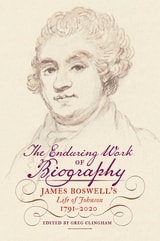
The Enduring Work of Biography
James Boswell’s Life of Johnson, 1791–2020Greg Clingham
University of Delaware Press, 2026
The Enduring Work of Biography seeks to revitalize appreciation of Boswell’s great biography for a new generation of scholars, students, and general readers. Engaging accessibly and informatively with biographical, historical, critical, and textual matters and drawing on the Yale Edition of the Private Papers of James Boswell, Enduring Work discusses Boswell’s collaboration with others (both alive and dead) in researching, writing, revising, proofing, publishing, and promoting his biography of Johnson. Central to Boswell’s concept of life writing is memory, and Enduring Work highlights both its dynamic and collaborative force in the Life of Johnson. This collection is book-ended by an introduction that considers the critical reception of the Life of Johnson and an epilogue that suggests its continuing critical insight and relevance. A closing chapter and two appendixes survey the history of the Life of Johnson as a best-selling book for over two centuries, an extraordinary collaboration between readers and publishers and between Boswell and Johnson themselves that is still evolving.

The Environmental Justice
William O. Douglass and American ConservationAdam M. Sowards
Oregon State University Press, 2009
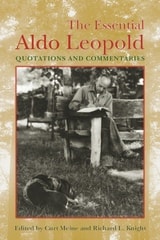
The Essential Aldo Leopold
Quotations and CommentariesEdited by Curt D. Meine and Richard L. Knight
University of Wisconsin Press, 1999
For the first time, the most important quotations of the great conservationist Aldo Leopold, author of A Sand County Almanac, are gathered in one volume. From conservation education to wildlife ecology, from wilderness protection to soil and water conservation, the writings of Aldo Leopold continue to have profound influence on those seeking to understand the earth and its care. Leopold biographer Curt Meine and noted conservation biologist Richard Knight have assembled this comprehensive collection of quotations from Leopold’s extensive and diverse writings, selected and organized to capture the richness and depth of the North American conservation movement.
Prominent biologists, conservationists, historians, and philosophers provide introductory commentaries describing Leopold’s contributions in varied fields and reflecting upon the significance of his work today.
Contributors:
J. Baird Callicott
David Ehrenfeld
Susan L. Flader
Eric T. Freyfogle
Wes Jackson
Paul W. Johnson
Joni L. Kinsey
Richard L. Knight
Gary K. Meffe
Curt Meine
Gary Paul Nabhan
Richard Nelson
Bryan G. Norton
David W. Orr
Edwin P. Pister
Donald Snow
Stanley A. Temple
Jack Ward Thomas
Charles Wilkinson
Terry Tempest Williams
Donald Worster
Joy B. Zedler
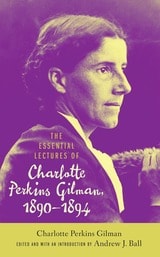
The Essential Lectures of Charlotte Perkins Gilman, 1890–1894
Charlotte Perkins Gilman Edited and with an introduction by Andrew J. Ball
University of Alabama Press, 2024
A foundational archive of Gilman’s early feminist, sociological, and philosophical thought, revealing the origins of a major American intellectual tradition.
The last decades have seen a resurgence of interest in Charlotte Perkins Gilman, now considered among the most important thinkers in US history. She is best known for fiction—such as the classic short story “The Yellow Wall-Paper” (1892)—and nonfiction, including her manifesto Women and Economics (1898), a work of intersectional sociology avant la lettre. Nevertheless, as a young writer, Gilman made her living delivering lectures. One cannot know Gilman without some knowledge of this body of lectures; this book fills that critical gap in Gilman scholarship.
Since the recovery of Charlotte Perkins Gilman began in the late 1960s and continued with the republication of “The Yellow Wall-Paper” in the 1970s, her image in cultural memory has been increasingly celebrated. Andrew J. Ball presents here fifty previously unpublished texts. They trace the development of Gilman’s thoughts on diverse subjects like gender, education, labor, science, theology, and politics—forming an intellectual diary of her growth.
These lectures are not just a testament to Gilman’s personal evolution, but also a crucial contribution to the foundations of American sociology and philosophy. The Essential Lectures of Charlotte Perkins Gilman, 1890–1894 marks a historic moment, unveiling the hidden genius of Gilman's oratory legacy.

The Ethics of Autobiography
Replacing the Subject in Modern SpainAngel G. Loureiro
Vanderbilt University Press, 2000
To address this oversight, Loureiro draws from his own experiences as well as from a wide range of previous theoretical works on autobiography, especially from the writings of Emmanuel Levinas, who believed that the self does not begin as a self-positing consciousness but as a response to an address from the other. On this basis, Loureiro then brilliantly traces the complex interplays between the political, discursive, rhetorical, and ethical dimensions of autobiography.
After laying out these theoretical foundations, Loureiro puts them to work in analyzing four of the most fascinating autobiographies written by Spanish exiles: The Life of Joseph Blanco White, who lived from 1775 to 1841, Memoria de la Melancolia by Maria Teresa Leon (1904-1988), Coto vedado and En los reinos de taifa by Juan Goytisolo (born 1931), and Literature or Life by Jorge Semprun (born 1923). The lives of these authors, all of whom were exiled for political reasons, were disrupted by some of the most crucial events in Spain's tortuous road to modernity and democracy.
The book closes with a discussion of why there have been so few critical examinations of autobiographies written in modern Spain. Loureiro proposes that, even in today's Spain, stifling social and political forces smother ethical responsibility, which is an essential ingredient in creating autobiographies that dare to be more than a humdrum inventory of personal recollections. Only in exile have Spanish authors seemed able to find the conditions to write their lives in a truly responsible manner. This answer to a call that grounds the subject in an other is ultimately the only form of truth available in autobiography.
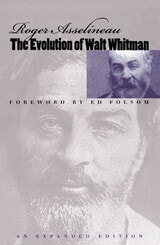
The Evolution of Walt Whitman
Roger Asselineau
University of Iowa Press, 1999
Now, nearly forty years after its original translation into English, Roger Asselineau's complete and magisterial biography of Walt Whitman will remind readers of the complex weave of traditions in Whitman scholarship. It is startling to recognize how much of our current understanding of Whitman was already articulated by Asselineau nearly half a century ago. Throughout its eight hundred pages, The Evolution of Walt Whitman speaks with authority on a vast range of topics that define both Whitman the man and Whitman the mythical personage. Remarkably, most of these discussions remain fresh and relevant, and that is in part because they have been so influential.
In particular, The Evolution of Walt Whitman inaugurated the study of Leaves of Grass as a lifelong work in progress, and it marked the end of the habit of talking about Leaves as if it were a single unified book. Asselineau saw Whitman's poetry “not as a body of static data but as a constantly changing continuum whose evolution must be carefully observed.” Throughout Evolution, Asselineau placed himself in the role of the observer, analyzing Whitman's development with a kind of scientific detachment. But behind this objective persona burned the soul of a risk taker who was willing to rewrite Whitman studies by bravely proposing what was then a controversial biographical source for Whitman's art—his homosexual desires.
The Evolution of Walt Whitman is a reminder that extraordinary works of criticism never exist in and of themselves. In this expanded edition, Roger Asselineau has provided a new essay summarizing his own continuing journey with Whitman. A foreword by Ed Folsom, editor of the Walt Whitman Quarterly, regards Evolution as the genesis of contemporary Whitman studies.