917 books match the query 'Economics' and 233 start with t
cover of The Stolper-Samuelson Theorem: A Golden Jubilee

The Stolper-Samuelson Theorem

A Golden Jubilee

Alan V. Deardorff and Robert M. Stern, Editors

University of Michigan Press, 1994

In celebration of the fiftieth anniversary of the Stolper-Samuelson Theorem, this volume collects in one place the original Stolper-Samuelson articles as well as the most significant later contributions that interpret, extend, and test the basic result. It also includes reflective papers by both Wolfgang F. Stolper and Paul A. Samuelson, an overview of the literature, and an annotated bibliography. Contributors to the volume, either in reprints of their original articles or in new commentary, are Robert E. Baldwin, Sundari R. Baru, Jagdish N. Bhagwati, John S. Chipman, Alan V. Deardorff, Wilfred Ethier, Ronald W. Jones, Murray C. Kemp, Ulrich Kohli, Paul R. Krugman, Edward E. Leamer, Stephen P. Magee, Lloyd A. Metzler, Ronald Rogowski, Paul A. Samuelson, Jose A. Scheinkman, Robert M. Stern, Wolfgang F. Stolper, and Leon Wegge.
[more]
cover of The Street Porter and the Philosopher: Conversations on Analytical Egalitarianism

The Street Porter and the Philosopher

Conversations on Analytical Egalitarianism

Sandra J. Peart and David M. Levy, editors

University of Michigan Press, 2009

Adam Smith, asserting the common humanity of the street porter and the philosopher, articulated the classical economists' model of social interactions as exchanges among equals. This model had largely fallen out of favor until, recently, a number of scholars in the avant-garde of economic thought rediscovered it and rechristened it "analytical egalitarianism." In this volume, Sandra J. Peart and David M. Levy bring together an impressive array of authors to explore the ramifications of this analytical ideal and to discuss the ways in which an egalitarian theory of individuality can enable economists to reconcile ideas from opposite ends of the political spectrum.

"The analytical egalitarianism project that Peart and Levy have advanced has come to occupy a prominent place in the current agenda of historians of economic thought."
---Ross Emmett, Associate Professor of Economics and Co-Director of the Michigan Center for Innovation and Economic Prosperity, Michigan State University

"These essays and dialogs from the Summer Institute would make Adam Smith, economist and moral philosopher, proud."
---J. Daniel Hammond, Hultquist Family Professor of Economics, Wake Forest University

With essays by:

  • James M. Buchanan, Alfred Nobel Memorial Prize in Economic Sciences recipient (1985) and Professor Emeritus, George Mason University and Virginia Polytechnic and State University
  • Juan Pablo Couyoumdijian, Universidad del Desearrollo, Chile
  • Tyler Cowen, George Mason University
  • Eric Crampton, University of Canterbury, New Zealand
  • Andrew Farrant, Dickinson College
  • Samuel Hollander, Professor Emeritus, University of Toronto
  • M. Ali Khan, Johns Hopkins University
  • Thomas Leonard, Princeton University
  • Deirdre McCloskey, University of Illinois, Chicago
  • Leonidas Montes, Dean of School of Government, Universidad Adolfo Ibañez, Chile
  • Maria Pia Paganelli, Yeshiva University and New York University
  • Warren J. Samuels, Professor Emeritus, Michigan State University
  • Eric Schliesser, VENI post-doctoral research fellow, Leiden University, and University of Amsterdam
  • Gordon Tullock, George Mason University

Sandra J. Peart is Dean of the Jepson School of Leadership Studies, University of Richmond, Virginia.

David M. Levy is Professor of Economics at George Mason University (GMU) and Research Associate at the Center for Study of Public Choice at GMU.

They are Co-Directors of George Mason University's Summer Institute for the Preservation of the History of Economics.
[more]
cover of The Structure of World History: From Modes of Production to Modes of Exchange

The Structure of World History

From Modes of Production to Modes of Exchange

Kojin Karatani

Duke University Press, 2014
In this major, paradigm-shifting work, Kojin Karatani systematically re-reads Marx's version of world history, shifting the focus of critique from modes of production to modes of exchange. Karatani seeks to understand both Capital-Nation-State, the interlocking system that is the dominant form of modern global society, and the possibilities for superseding it. In The Structure of World History, he traces different modes of exchange, including the pooling of resources that characterizes nomadic tribes, the gift exchange systems developed after the adoption of fixed-settlement agriculture, the exchange of obedience for protection that arises with the emergence of the state, the commodity exchanges that characterize capitalism, and, finally, a future mode of exchange based on the return of gift exchange, albeit modified for the contemporary moment. He argues that this final stage—marking the overcoming of capital, nation, and state—is best understood in light of Kant's writings on eternal peace. The Structure of World History is in many ways the capstone of Karatani's brilliant career, yet it also signals new directions in his thought.
[more]
cover of The Surprising Design of Market Economies

The Surprising Design of Market Economies

By Alex Marshall

University of Texas Press, 2012

The “free market” has been a hot topic of debate for decades. Proponents tout it as a cure-all for just about everything that ails modern society, while opponents blame it for the very same ills. But the heated rhetoric obscures one very important, indeed fundamental, fact—markets don’t just run themselves; we create them.

Starting from this surprisingly simple, yet often ignored or misunderstood fact, Alex Marshall takes us on a fascinating tour of the fundamentals that shape markets and, through them, our daily economic lives. He debunks the myth of the “free market,” showing how markets could not exist without governments to create the structures through which we assert ownership of property, real and intellectual, and conduct business of all kinds. Marshall also takes a wide-ranging look at many other structures that make markets possible, including physical infrastructure ranging from roads and railroads to water systems and power lines; mental and cultural structures such as common languages and bodies of knowledge; and the international structures that allow goods, services, cash, bytes, and bits to flow freely around the globe.

Sure to stimulate a lively public conversation about the design of markets, this broadly accessible overview of how a market economy is constructed will help us create markets that are fairer, more prosperous, more creative, and more beautiful.
[more]
cover of The Technology of Transition: Science and Technology Policies for Transition Countries

The Technology of Transition

Science and Technology Policies for Transition Countries

David A. Dyker

Central European University Press, 1997
This book addresses the crucial question of how countries which have suffered losses in productivity levels and innovatory momentum over perhaps twenty-thirty years can rediscover their dynamism. Because the contributors have the immediate experience of tackling such complex problems and possess first-hand knowledge of a wide range of developmental patterns, each is well-placed to advise on the search for comprehensive solutions. The book not only focuses on the problems of innovation and technology transfer as they are reflected in the experience of the transition period to date, but also develops conceptual and strategic approaches to problems which will take a generation or more to resolve.
[more]
cover of The Theory of Linear Economic Models

The Theory of Linear Economic Models

David Gale

University of Chicago Press, 1989

In the past few decades, methods of linear algebra have become central to economic analysis, replacing older tools such as the calculus. David Gale has provided the first complete and lucid treatment of important topics in mathematical economics which can be analyzed by linear models. This self-contained work requires few mathematical prerequisites and provides all necessary groundwork in the first few chapters. After introducing basic geometric concepts of vectors and vector spaces, Gale proceeds to give the main theorems on linear inequalities—theorems underpinning the theory of games, linear programming, and the Neumann model of growth. He then explores such subjects as linear programming; the theory of two-person games; static and dynamic theories of linear exchange models, including problems of equilibrium prices and dynamic stability; and methods of play, optimal strategies, and solutions of matrix games. This book should prove an invaluable reference source and text for mathematicians, engineers, economists, and those in many related areas.
[more]
cover of The Theory of Peasant Economy

The Theory of Peasant Economy

A. V. Chayanov

University of Wisconsin Press, 1986

The work of A. V. Chayanov is today drawing more attention among Western scholars than ever before. Largely ignored in his native Russia because they differed from Marxist-Leninist theory, and neglected in the West for more than forty years, Chayanov’s sophisticated theories were at last published in English in 1966. That trenchant is reprinted in this Wisconsin paperback edition, which includes a new introduction by the sociologist Teodor Shanin, of the University of Manchester, one of the world’s leading Chayanov scholars. The Wisconsin edition will be essential reading for political scientists, anthropologists, and all whose interests include peasant studies, Third World development, and women’s studies.

"The past two decades have seen the emergence of a whole new field called 'peasant studies' and, along with those of Karl Marx, Chayanov's ideas have been central to its development. . . . The publishers are to be commended for re-issuing the book with both old and new introductions and making it available as an affordable paperback for students. The work is a classic."—Times Higher Education Supplement
[more]
cover of The Theory of Public Choice-II

The Theory of Public Choice-II

James M. Buchanan and Robert D. Tollison, Editors

University of Michigan Press, 1984

The Theory of Public Choice is a landmark volume that brings together key essays and articles charting the rapid evolution of public choice theory during its most formative decade. Edited by James M. Buchanan and Robert D. Tollison—leading figures in the “Virginian School” of political economy—this collection synthesizes the major advances of public choice as it applies the tools of economic analysis to the workings of democratic and political institutions.The volume begins with overviews of the field’s development, highlighting public choice’s foundational challenge to “romantic” notions of government and its turn toward a more realistic, empirical understanding of collective decision-making. Renowned contributors—including Buchanan, Dennis Mueller, Gordon Tullock, and many others—explore subjects from voting theory and constitutional economics to rent-seeking, bureaucracy, and the political economy of welfare and regulation.Organized into topical sections covering theoretical advances, applications, empirical studies, and philosophical issues, The Theory of Public Choice illuminates how economics, political science, and policy analysis intersect. Whether addressing topics like political resource allocation, the logic of majority rule, or the emergence of tax and spending limitations, these essays demonstrate how public choice theory has reshaped the way scholars, policymakers, and citizens think about government.Accessible yet rigorous, this collection is essential for anyone seeking insight into the mechanisms of collective action, constitutional design, and the ongoing challenge of ensuring accountability and efficiency in public institutions. It stands as a vital resource for students and scholars in economics, political science, public policy, and related fields.
[more]
cover of The Total Incomes System of Accounts

The Total Incomes System of Accounts

Robert Eisner

University of Chicago Press, 1989

Conventional measures of national income and product and its components have proved enormously useful as indexes of economic activity and as the empirical foundations of much of macroeconomic analysis. Robert Eisner's The Total Incomes System of Accounts (TISA) brings critical new dimensions to those measures. It offers systematic extensions and expansions in an effort to count all of the output that goes into economic well-being, now and in the future.

Eisner counts nonmarket as well as market production, including vast amounts of services produced by housewives and others in the home, capital formation by government and households as well as business, human and intangible capital invested in education, R&D, and health care, as well as tangible capital. He offers measures of net revaluations of tangible assets, redefines the critical boundaries between final and intermediate outputs, and presents separate sector accounts for business, nonprofit institutions, government, government enterprises and households, which make clear the major contributions of nonbusiness sectors to our total national income.

For these and other extensions, Eisner's TISA offers detailed and comprehensive income and product accounts in current dollars and product accounts in constant dollars for all of the years from 1946 to 1981, along with measures of capital stocks. Estimates of consumption, investment, and production functions with the new data sets, a review of other sets of extended accounts, and a detailed description of sources and methods are also provided.
[more]
cover of The Tragic Science: How Economists Cause Harm (Even as They Aspire to Do Good)

The Tragic Science

How Economists Cause Harm (Even as They Aspire to Do Good)

George F. DeMartino

University of Chicago Press, 2022

A forceful critique of the social science that has ruled—and damaged—the modern world. 

The practice of economics, as economists will tell you, is a powerful force for good. Economists are the guardians of the world’s economies and financial systems. The applications of economic theory can alleviate poverty, reduce disease, and promote sustainability. 

While this narrative has been successfully propagated by economists, it belies a more challenging truth: economic interventions, including those economists deem successful, also cause harm. Sometimes the harm is manageable and short-lived. But just as often the harm is deep, enduring, and even irreparable. And too often the harm falls on those least able to survive it. 

In The Tragic Science, George F. DeMartino says what economists have too long repressed: that economists do great harm even as they aspire to do good. Economist-induced harm, DeMartino shows, results in part from economists’ “irreparable ignorance”—from the fact that they know far less than they tend to believe they know—and from disciplinary training that treats the human tolls of economic policies and interventions as simply the costs of promoting social betterment. DeMartino details the complicated nature of economic harm, explores economists’ frequent failure to recognize it, and makes a sobering case for professional humility and for genuine respect for those who stand to be harmed by economists’ practice.

At a moment in history when the economics profession holds enormous power, DeMartino’s work demonstrates the downside of its influence and the responsibility facing those who practice the tragic science.
[more]
cover of The U.S. National Income and Product Accounts: Selected Topics

The U.S. National Income and Product Accounts

Selected Topics

Murray F. Foss

University of Chicago Press, 1983
The main topics treated in this conference volume are problems of deflation and quality change, the adequacy of the data used to construct the U.S. national accounts, and the broad theoretical evolution of the U.S. national income and product accounts. As these topics suggest, this volume represents a new stage in the study of national income and product accounts in that emphasis is placed on the information content of the system rather than on the structure of the accounts. This new emphasis is highlighted by the inclusion of a discussion among prominent users of the national accounts—Lawrence Klein, Otto Eckstein, Alan Greenspan, and Arthur Okun—that indicates the difficulties that confront those who utilize this information.
[more]
cover of The United States in the World Economy

The United States in the World Economy

Edited by Martin Feldstein

University of Chicago Press, 1988
The United States in the World Economy offers the results of a conference organized by the National Bureau of Economics in 1987. The volume includes background papers prepared by nine academic economists, personal statements by individuals prominent in government and business, and summaries of the discussion that followed the presentations. Among the topics considered are foreign competition in Latin America and the Asian Pacific Rim, Third World debts, innovations in international financial markets, changing patterns of international investment, international capital flows, and international competition in goods, services, and agriculture. Prepared for a sophisticated but non-technical audience, these papers present complicated economic issues clearly, indicating the many ways in which the American economy influences and is influenced by economic events and conditions around the world.
[more]
cover of The Voluntary City: Choice, Community, and Civil Society

The Voluntary City

Choice, Community, and Civil Society

David T. Beito, Peter Gordon, and Alexander Tabarrok, Editors

University of Michigan Press, 2002
The rise and decline of American civic life has provoked wide-ranging responses from all quarters of society. Unfortunately, many proposals for improving our communities rely on renewed governmental efforts without a similar recognition that the inflexibility and poor accountability of governments have often worsened society's ills. The Voluntary City investigates the history of large-scale, private provision of social services, the for-profit provision of urban infrastructure and community governance, and the growing privatization of residential life in the United States to argue that most decentralized, competitive markets can contribute greatly to community renewal.
Among the fascinating topics covered are: how mutual-aid societies in America, Great Britain, and Australia provided their members with medical care, unemployment insurance, sickness insurance, and other social services before the welfare state; how private law, known historically as the law merchant, is returning in the form of arbitration; and why the rise of neighborhood associations represents the most comprehensive privatization occurring in the United States today.
The volume concludes with an epilogue that places the discoveries of The Voluntary City within the theory of market and government failure and discusses the implications of these discoveries for theories about the private provision of public goods. A refreshing challenge to the position that insists government alone can improve community life, The Voluntary City will be of special interest to students of history, law, urban life, economics, and government.
David T. Beito is Associate Professor of History, University of Alabama. Peter Gordon is Professor in the School of Policy, Planning, and Development and Department of Economics, University of Southern California. Alexander Tabarrok is Vice President and Research Director, the Independent Institute.
[more]
cover of The Walrasian Vision of the Microeconomy: An Elementary Exposition of the Structure of Modern General Equilibrium Theory

The Walrasian Vision of the Microeconomy

An Elementary Exposition of the Structure of Modern General Equilibrium Theory

Donald W. Katzner

University of Michigan Press, 1990

The Walrasian Vision of the Microeconomy articulates the traditional vision that is conjured up in the minds of most contemporary economists as they contemplate the microeconomy. It does so by setting out a very simple general-equilibrium model containing 1 produced consumer good, 1 produced capital good, 2 factors, 2 consumers, and 2 firms. Most of the basic theoretical ingredients of perfect competition taught in microeconomic theory courses are geometrically developed in this context: market equilibrium, the derivation of consumer demand for goods and supply of factors from constrained utility maximization, the relation between cost and production functions, the derivation of firm output supply and input demand from profit maximization, and the connections between competitive equilibrium, Pareto optimality, and welfare maximization. Also included is an elementary geometric proof of the existence and uniqueness of competitive equilibrium. The underlying premise is that these elements are all components of a larger picture and, as a result, fit together into a unified whole. The book is ideally suited to accompany the fuller and more detailed expositions of standard microeconomic theory texts.
[more]
cover of The World Bank: A Critical Primer

The World Bank

A Critical Primer

Eric Toussaint

Pluto Press, 2007

The World Bank is a controversial organisation. It is widely viewed with suspicion, as the international economic arm of the US, in thrall to the President who is responsible for appointing the head of the Bank.

Eric Toussaint gives a highly readable account of just why the World Bank has become so powerful. In short, clear chapters he shows how the bank operates, who funds it, and what it sets out to promote.

The Bank's main purpose is to grant loans to all the newly independent states of the developing world, to help them on their journey to recovery after colonial occupation. In reality, the conditions imposed on these states -- including enforced privatisation of all public services, and enforced neo-liberal rules on trade -- mean that the Bank has become the new colonial authority in everything but name.

This is a perfect book for anyone looking for a critical introduction to the history of the Bank and its role in world affairs.

[more]
cover of The World Bank: Lending on a Global Scale

The World Bank

Lending on a Global Scale

Jo Marie Griesgraber

Pluto Press, 1996

[more]
cover of Themes in the Economics of Aging

Themes in the Economics of Aging

Edited by David A. Wise

University of Chicago Press, 2001

In the past few years, the economic ramifications of aging have garnered close attention from a group of NBER researchers led by David A. Wise. In this volume, Wise and his collaborators continue to analyze a nexus of age-related issues.

This volume begins by looking at the implications of private and public personal retirement plans, focusing in particular on the impact of 401(k) programs on retirement strategies in light of potential social security reform and factors such as annuitization and on asset accumulation. Next, the often-observed relationship between health and wealth is dissected from two different perspectives and correlated with striking increases in health-care spending over the past two decades, despite the improved health of older populations. The volume concludes with an investigation of the retirement effects of various social security provisions in both U.S. and German systems.

This carefully developed collection expands the current investigative focus and broadens the dialogue on a rapidly growing area of social and economic concern.

[more]
cover of Things Worth Keeping: The Value of Attachment in a Disposable World

Things Worth Keeping

The Value of Attachment in a Disposable World

Christine Harold

University of Minnesota Press, 2020

A timely examination of the attachments we form to objects and how they might be used to reduce waste

Rampant consumerism has inundated our planet with pollution and waste. Yet attempts to create environmentally friendly forms of consumption are often co-opted by corporations looking to sell us more stuff. In Things Worth Keeping, Christine Harold investigates the attachments we form to the objects we buy, keep, and discard, and explores how these attachments might be marshaled to create less wasteful practices and balance our consumerist and ecological impulses. 

Although all economies produce waste, no system generates as much or has become so adept at hiding its excesses as today’s mode of global capitalism. This book suggests that managing the material excesses of our lives as consumers requires us to build on, rather than reject, our desire for and attraction to objects. Increasing environmental awareness on its own will be ineffective at reversing ecological devastation, Harold argues, unless it is coupled with a more thorough understanding of how and why we love the things that imbue our lives with pleasure, meaning, and utility. 

From Marie Kondo’s method for decluttering that asks whether the things in our lives “spark joy” to the advent of emotionally durable design, which seeks to reduce consumption and waste by increasing the meaningfulness of the relationship between user and product, Harold explores how consumer psychology and empathetic design can transform our perception of consumer products from disposable to interconnected. An urgent call for rethinking consumerism, Things Worth Keeping shows that by recognizing our responsibility for the things we produce, we can become better stewards of the planet.
[more]
cover of Time and Decision: Economic and Psychological Perspectives of Intertemporal Choice

Time and Decision

Economic and Psychological Perspectives of Intertemporal Choice

George Loewenstein

Russell Sage Foundation, 2003

How do people decide whether to sacrifice now for a future reward or to enjoy themselves in the present? Do the future gains of putting money in a pension fund outweigh going to Hawaii for New Year's Eve? Why does a person's self-discipline one day often give way to impulsive behavior the next? Time and Decision takes up these questions with a comprehensive collection of new research on intertemporal choice, examining how people face the problem of deciding over time. Economists approach intertemporal choice by means of a model in which people discount the value of future events at a constant rate. A vacation two years from now is worth less to most people than a vacation next week. Psychologists, on the other hand, have focused on the cognitive and emotional underpinnings of intertemporal choice. Time and Decision draws from both disciplinary approaches to provide a comprehensive picture of the various layers of choice involved. Shane Frederick, George Loewenstein, and Ted O'Donoghue introduce the volume with an overview of the research on time discounting and focus on how people actually discount the future compared to the standard economic model. Alex Kacelnik discusses the crucial role that the ability to delay gratification must have played in evolution. Walter Mischel and colleagues review classic research showing that four year olds who are able to delay gratification subsequently grow up to perform better in college than their counterparts who chose instant gratification. The book also delves into the neurobiology of patience, examining the brain structures involved in the ability to withstand an impulse. Turning to the issue of self-control, Klaus Wertenbroch examines the relationship between consumption and available resources, showing, for example, how a high credit limit can lead people to overspend. Ted O'Donoghue and Matthew Rabin show how people's awareness of their self-control problems affects their decision-making. The final section of the book examines intertemporal choice with regard to health, drug addiction, dieting, marketing, savings, and public policy. All of us make important decisions every day-many of which profoundly affect the quality of our lives. Time and Decision provides a fascinating look at the complex factors involved in how and why we make our choices, so many of them short-sighted, and helps us understand more precisely this crucial human frailty.
[more]
cover of Time, Ignorance, and Uncertainty in Economic Models

Time, Ignorance, and Uncertainty in Economic Models

Donald W. Katzner

University of Michigan Press, 1998

Emerging from the tradition of Marshall, Knight, Keynes, and Shackle, Time, Ignorance, and Uncertainty in Economic Models is concerned with the character of formal economic analysis when the notions of logical or mechanical time and probabilistic uncertainty and the relatively complete knowledge basis it requires, are replaced, respectively, by historical time, and nonprobabilistic uncertainty and ignorance. Examining that analytical character by constructing and exploring particular models, this book emphasizes doing actual economic analysis in a framework of historical time, nonprobabilistic uncertainty, and ignorance.
Donald W. Katzner begins with an extensive investigation of the distinction between potential surprise and probability. He presents a modified version of Shackle's model of decision-making in ignorance and examines in considerable detail its "comparative statics" and operationality properties. The meaning of aggregation and simultaneity under these conditions is also explored, and Shackle's model is applied to the construction of models of the consumer, the firm, microeconomics, and macroeconomics. Katzner concludes with discussions of the roles of history, hysteresis, and empirical investigation in economic inquiry.
Time, Ignorance, and Uncertainty in Economic Models will be of interest to economists and others engaged in the study of uncertainty, probability, aggregation, and simultaneity. Those interested in the microeconomics of consumer and firm behavior, general equilibrium, and macroeconomics will also benefit from this book.
Donald W. Katzner is Professor of Economics, University of Massachusetts.

[more]
cover of Tissue Economies: Blood, Organs, and Cell Lines in Late Capitalism

Tissue Economies

Blood, Organs, and Cell Lines in Late Capitalism

Catherine Waldby and Robert Mitchell

Duke University Press, 2006

As new medical technologies are developed, more and more human tissues—such as skin, bones, heart valves, embryos, and stem cell lines—are stored and distributed for therapeutic and research purposes. The accelerating circulation of human tissue fragments raises profound social and ethical concerns related to who donates or sells bodily tissue, who receives it, and who profits—or does not—from the transaction. Catherine Waldby and Robert Mitchell survey the rapidly expanding economies of exchange in human tissue, explaining the complex questions raised and suggesting likely developments. Comparing contemporary tissue economies in the United Kingdom and United States, they explore and complicate the distinction that has dominated practice and policy for several decades: the distinction between tissue as a gift to be exchanged in a transaction separate from the commercial market and tissue as a commodity to be traded for profit.

Waldby and Mitchell pull together a prodigious amount of research—involving policy reports and scientific papers, operating manuals, legal decisions, interviews, journalism, and Congressional testimony—to offer a series of case studies based on particular forms of tissue exchange. They examine the effect of threats of contamination—from HIV and other pathogens—on blood banks’ understandings of the gift/commodity relationship; the growth of autologous economies, in which individuals bank their tissues for their own use; the creation of the United Kingdom’s Stem Cell bank, which facilitates the donation of embryos for stem cell development; and the legal and financial repercussions of designating some tissues “hospital waste.” They also consider the impact of different models of biotechnology patents on tissue economies and the relationship between experimental therapies to regenerate damaged or degenerated tissues and calls for a legal, for-profit market in organs. Ultimately, Waldby and Mitchell conclude that scientific technologies, the globalization of tissue exchange, and recent anthropological, sociological, and legal thinking have blurred any strict line separating donations from the incursion of market values into tissue economies.

[more]
cover of Titles, Conflict, and Land Use: The Development of Property Rights and Land Reform on the Brazilian Amazon Frontier

Titles, Conflict, and Land Use

The Development of Property Rights and Land Reform on the Brazilian Amazon Frontier

Lee J. Alston, Gary D. Libecap, and Bernardo Mueller

University of Michigan Press, 1999
The Amazon, the world's largest rain forest, is the last frontier in Brazil. The settlement of large and small farmers, squatters, miners, and loggers in this frontier during the past thirty years has given rise to violent conflicts over land as well as environmental duress. Titles, Conflict, and Land Use examines the institutional development involved in the process of land use and ownership in the Amazon and shows how this phenomenon affects the behavior of the economic actors. It explores the way in which the absence of well-defined property rights in the Amazon has led to both economic and social problems, including lost investment opportunities, high costs in protecting claims, and violence. The relationship between land reform and violence is given special attention.
The book offers an important application of the New Institutional Economics by examining a rare instance where institutional change can be empirically observed. This allows the authors to study property rights as they emerge and evolve and to analyze the effects of Amazon development on the economy. In doing so they illustrate well the point that often the evolution of economic institutions will not lead to efficient outcomes.
This book will be important not only to economists but also to Latin Americanists, political scientists, anthropologists, and scholars in disciplines concerned with the environment.
Lee Alston is Professor of Economics, University of Illinois, and Research Associate for the National Bureau of Economic Research. Gary Libecap is Professor of Economics and Law, University of Arizona, and Research Associate for the National Bureau of Economic Research. Bernardo Mueller is Assistant Professor, Universidade de Brasilia.
[more]
cover of Topics in the Economics of Aging

Topics in the Economics of Aging

Edited by David A. Wise

University of Chicago Press, 1992
The original essays and commentary in this volume—the third in a series reporting the results of the NBER Economics of Aging Program—address issues that are of particular importance to the well-being of individuals as they age and to a society at large that is composed increasingly of older persons. The contributors examine social security reform, including an analysis of the Japanese system; present the startling finding that the vast majority of people choose the wrong accumulation strategies for their pension plans; explore the continuing consequences of the decline in support of parents by children in the postwar period; investigate the relation between nursing home stays and the source of payment for the care; and offer initial findings on the implications of differences between developed and developing countries for understanding aging issues and determining appropriate directions for research.
[more]
cover of Towards a Cognitive Mode in Global Finance?: The Governance of a Knowledge-Based Financial System

Towards a Cognitive Mode in Global Finance?

The Governance of a Knowledge-Based Financial System

Edited by Torsten Strulik and Helmut Willke

Campus Verlag, 2007
The global finance system has been the subject of hot debate for several years. Major players such as the International Monetary Fund and the World Bank have come under fire for their financial practices, while the role of epistemic authorities, including rating agencies, remains unclear. This book systematically analyzes the role knowledge plays in global finance reform by considering its influence in the empirical areas of finance (banking, accounting, and bond rating, for example). As the contributors demonstrate, current institutional management strategies reflect a shift toward “cognitive,” or learning-based modes of managing financial and political risks—and this cognitive thinking has its own consequences for the global marketplace.
[more]
cover of Trade-Offs: An Introduction to Economic Reasoning

Trade-Offs

An Introduction to Economic Reasoning

Harold Winter

University of Chicago Press, 2023

The highly engaging introduction to thinking like an economist, updated for a new generation of readers.

When economists wrestle with any social issue—be it unemployment, inflation, healthcare, or crime and punishment—they do so impersonally. The big question for them is: what are the costs and benefits, or trade-offs, of the solutions to such matters? These trade-offs constitute the core of how economists see the world—and make the policies that govern it.

Trade-Offs is an introduction to the economic approach of analyzing controversial policy issues. A useful introduction to the various factors that inform public opinion and policymaking, Trade-Offs is composed of case studies on topics drawn from across contemporary law and society.

Intellectually stimulating yet accessible and entertaining, Trade-Offs will be appreciated by students of economics, public policy, health administration, political science, and law, as well as by anyone following current social policy debates.

[more]
cover of Trade-Offs: An Introduction to Economic Reasoning

Trade-Offs

An Introduction to Economic Reasoning

Harold Winter

University of Chicago Press, 2023

This is an auto-narrated audiobook edition of this book.

The highly engaging introduction to thinking like an economist, updated for a new generation of readers.

When economists wrestle with any social issue—be it unemployment, inflation, healthcare, or crime and punishment—they do so impersonally. The big question for them is: what are the costs and benefits, or trade-offs, of the solutions to such matters? These trade-offs constitute the core of how economists see the world—and make the policies that govern it.

Trade-Offs is an introduction to the economic approach of analyzing controversial policy issues. A useful introduction to the various factors that inform public opinion and policymaking, Trade-Offs is composed of case studies on topics drawn from across contemporary law and society.

Intellectually stimulating yet accessible and entertaining, Trade-Offs will be appreciated by students of economics, public policy, health administration, political science, and law, as well as by anyone following current social policy debates.
[more]
cover of Trade-Offs: An Introduction to Economic Reasoning and Social Issues

Trade-Offs

An Introduction to Economic Reasoning and Social Issues

Harold Winter

University of Chicago Press, 2005

When economists wrestle with issues such as unemployment, inflation, or budget deficits, they do so by incorporating an impersonal, detached mode of reasoning. But economists also analyze issues that, to others, do not typically fall within the realm of economic reasoning, such as organ transplants, cigarette addiction, smoking in public, and product safety. Trade-Offs is an introduction to the economic approach to analyzing these controversial public policy issues.

Harold Winter provides readers with the analytical tools needed to identify and understand the trade-offs associated with these topics. By considering both the costs and benefits of potential policy solutions, Winter stresses that real-world policy decision making is best served by an explicit recognition of as many trade-offs as possible.

Intellectually stimulating yet accessible and entertaining, Trade-Offs will be appreciated by students of economics, public policy, health administration, political science, and law, as well as by anyone who follows current social policy debates.

[more]
cover of Trade-Offs: An Introduction to Economic Reasoning and Social Issues, Second Edition

Trade-Offs

An Introduction to Economic Reasoning and Social Issues, Second Edition

Harold Winter

University of Chicago Press, 2013

When economists wrestle with issues such as unemployment, inflation, or budget deficits, they do so by incorporating an impersonal, detached mode of reasoning. But economists also analyze issues that, to others, typically do not fall within the realm of economic reasoning, such as organ transplants, cigarette addiction, overeating, and product safety. Trade-Offs is an introduction to the economic approach to analyzing these controversial public policy issues.
 
Harold Winter provides readers with the analytical tools needed to identify and understand the trade-offs associated with these topics. By considering both the costs and benefits of potential policy solutions, Winter stresses that real-world decision making is best served by an explicit recognition of as many trade-offs as possible. This new edition incorporates recent developments in policy debates, including the rise of “new paternalism,” or policies designed to protect people from themselves; alternative ways to increase the supply of organs available for transplant; and economic approaches to controlling infectious disease.
 
Intellectually stimulating yet accessible and entertaining, Trade-Offs will be appreciated by students of economics, public policy, health administration, political science, and law, as well as by anyone who follows current social policy debates.
[more]
cover of Transnational Capitalism in East Central Europe's Heavy Industry: From Flagship Enterprises to Subsidiaries

Transnational Capitalism in East Central Europe's Heavy Industry

From Flagship Enterprises to Subsidiaries

Aleksandra Sznajder Lee

University of Michigan Press, 2016

Focusing on the steel industry during the post-communist transition from 1989 through 2009, Aleksandra Sznajder Lee traces the transformation of flagship state enterprises in the Czech Republic, Poland, Romania, and Slovakia into the subsidiaries of large, international corporations. By analyzing this transformation at the three levels of enterprise, sector, and national-international nexus, she identifies the players—from international investors and European Union members to national labor unions and local industry managers—in the political economy of reform. Even in the midst of the transition to a capitalist, democratic system, Sznajder Lee finds, the state plays a key role in mediating between domestic vested interests and external pressures from international financial markets and institutions, on the one hand, and regional institutions on the other. Whereas state power may be employed to require domestic firms to operate as capitalists in the international market, it may also be used to shield enterprises from market pressures in order to promote the political and personal preferences of the elite.

This book has broad implications for the political economy of reform because it illuminates the political determinants of privatization and the resources used to resist it. In addition, Sznajder Lee sheds new light on why some countries are more likely than others to be subject to external constraints, such as IMF conditionality, and how some allegedly pro-market reformers manage to maintain public ownership over certain industry sectors.
[more]
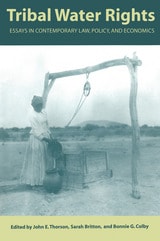
cover of Tribal Water Rights: Essays in Contemporary Law, Policy, and Economics

Tribal Water Rights

Essays in Contemporary Law, Policy, and Economics

Edited by John E. Thorson, Sarah Britton, and Bonnie G. Colby

University of Arizona Press, 2006
The settlement of Indian water rights cases remains one of the thorniest legal issues in this country, particularly in the West. In a previous book, Negotiating Tribal Water Rights, Colby, Thorson, and Britton presented a general overview of the processes involved in settling such cases; this volume provides more in-depth treatment of the many complex issues that arise in negotiating and implementing Indian water rights settlements. Tribal Water Rights brings together practicing attorneys and leading scholars in the fields of law, economics, public policy, and conflict resolution to examine issues that continue to confront the settlement of tribal claims. With coverage ranging from the differences between surface water and groundwater disputes to the distinctive nature of Pueblo claims, and from allotment-related problems to the effects of the Endangered Species Act on water conflicts, the book presents the legal aspects of tribal water rights and negotiations along with historical perspectives on their evolution.
[more]
cover of Trust and Distrust In Organizations: Dilemmas and Approaches

Trust and Distrust In Organizations

Dilemmas and Approaches

Roderick M. Kramer

Russell Sage Foundation, 2004

The effective functioning of a democratic society—including social, business, and political interactions—largely depends on trust. Yet trust remains a fragile and elusive resource in many of the organizations that make up society's building blocks. In their timely volume, Trust and Distrust in Organizations, editors Roderick M. Kramer and Karen S. Cook have compiled the most important research on trust in organizations, illuminating the complex nature of how trust develops, functions, and often is thwarted in organizational settings. With contributions from social psychologists, sociologists, political scientists, economists, and organizational theorists, the volume examines trust and distrust within a variety of settings—from employer-employee and doctor-patient relationships, to geographically dispersed work teams and virtual teams on the internet. Trust and Distrust in Organizations opens with an in-depth examination of hierarchical relationships to determine how trust is established and maintained between people with unequal power. Kurt Dirks and Daniel Skarlicki find that trust between leaders and their followers is established when people perceive a shared background or identity and interact well with their leader. After trust is established, people are willing to assume greater risks and to work harder. In part II, the contributors focus on trust between people in teams and networks. Roxanne Zolin and Pamela Hinds discover that trust is more easily established in geographically dispersed teams when they are able to meet face-to-face initially. Trust and Distrust in Organizations moves on to an examination of how people create and foster trust and of the effects of power and betrayal on trust. Kimberly Elsbach reports that managers achieve trust by demonstrating concern, maintaining open communication, and behaving consistently. The final chapter by Roderick Kramer and Dana Gavrieli includes recently declassified data from secret conversations between President Lyndon Johnson and his advisors that provide a rich window into a leader's struggles with problems of trust and distrust in his administration. Broad in scope, Trust and Distrust in Organizations provides a captivating and insightful look at trust, power, and betrayal, and is essential reading for anyone wishing to understand the underpinnings of trust within a relationship or an organization. A Volume in the Russell Sage Foundation Series on Trust
[more]
cover of Trust, Ethnicity, and Identity: Beyond the New Institutional Economics of Ethnic Trading Networks, Contract Law, and Gift-Exchange

Trust, Ethnicity, and Identity

Beyond the New Institutional Economics of Ethnic Trading Networks, Contract Law, and Gift-Exchange

Janet Tai Landa

University of Michigan Press, 1995

Trust, Ethnicity, and Identity deals with the economic role of laws and institutions in achieving social order in a decentralized economy. Specifically, this book considers the coordinating role of three major nonprice institutions--ethnic trading networks, contract law, and gift-exchange--in economizing on transaction costs and thus facilitating the process of exchange in decentralized economies in different historical contexts.

The major unifying theme of the book is this: identity matters when traders operate in an environment characterized by contract uncertainty, where the legal framework for the enforcement of contracts is not well developed. This in turn points out the importance of trust embedded in particularistic exchange relations such as kinship or ethnicity.

One unique facet of this book is that the author uses a property rights--public choice approach--part of the New Institutional Economics--to provide a unifying theoretical framework to explain such diverse exchange institutions as contract law, ethnic trading networks, and gift-exchange, In addition, it goes beyond the New Institutional Economics paradigm by incorporating some crucial concepts from sociology, anthropology, and bioeconomics, such as social structure, social norms, culture, reciprocity, and kin-related altruism. This broad interdisciplinary framework gives Landa's work a relevance beyond economics to law, political science, sociology, anthropology, and bioeconomics.
[more]
cover of Tyranny of the Market: A Critique of Theoretical Foundations

Tyranny of the Market

A Critique of Theoretical Foundations

Douglas Vickers

University of Michigan Press, 1995

This book critically reviews and evaluates a number of central theoretical concepts that have shaped economists' analysis of markets. In a rigorous discussion of the demand and supply sides of the market, Douglas Vickers questions the cogency of many of the established ideas and tools of economic analysis. The critique relies considerably on the significance of real historical time and the epistemic uniqueness of individuals in decision making. The author identifies deficiencies in the concepts of utility and its cognate -- preference orderings on the demand side of the market, and in marginal productivity and the related theory of income distribution on the supply side. Setting the critique of received traditions in historical perspective, The Tyranny of the Market reviews the bequests to contemporary theory of classical and neoclassical economics. The analytical problem of the place and significance of money in economic argument is addressed and the nonneutrality and substantial endogeneity of money are clarified. The book's analysis of macromarket failure, or the failure of the market system to provide automatically for the full employment of economic resources, incorporates a monetary-flow model of the macroeconomy. Economic theorists and scholars in related disciplines will appreciate the originality of the book's critique of the neoclassical and competing systems of thought.
[more]