Results by title
1049 books match the query 'English, Irish, Scottish, Welsh' and 234 start with t
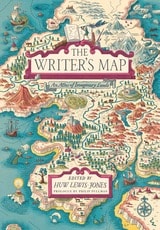
The Writer's Map
An Atlas of Imaginary LandsEdited by Huw Lewis-Jones
University of Chicago Press, 2018
Philip Pullman recounts the experience of drawing a map as he set out on one of his early novels, The Tin Princess. Miraphora Mina recalls the creative challenge of drawing up ”The Marauder’s Map” for the Harry Potter films. David Mitchell leads us to the Mappa Mundi by way of Cloud Atlas and his own sketch maps. Robert Macfarlane reflects on the cartophilia that has informed his evocative nature writing, which was set off by Robert Louis Stevenson and his map of Treasure Island. Joanne Harris tells of her fascination with Norse maps of the universe. Reif Larsen writes about our dependence on GPS and the impulse to map our experience. Daniel Reeve describes drawing maps and charts for The Hobbit film trilogy. This exquisitely crafted and illustrated atlas explores these and so many more of the maps writers create and are inspired by—some real, some imagined—in both words and images.
Amid a cornucopia of 167 full-color images, we find here maps of the world as envisaged in medieval times, as well as maps of adventure, sci-fi and fantasy, nursery rhymes, literary classics, and collectible comics. An enchanting visual and verbal journey, The Writer’s Map will be irresistible for lovers of maps, literature, and memories—and anyone prone to flights of the imagination.
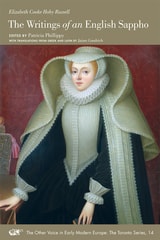
The Writings of an English Sappho
Elizabeth Cooke Hoby Russell
Iter Press, 2011
—Jane Donawerth
Professor of English and affiliate faculty in women’s studies
University of Maryland
Theaters of Translation
Cosmopolitan Vernaculars in Shakespeare's EnglandAndrew S. Keener
University of Alabama Press, 2025
Explores the profound influence of multilingual dictionaries, dialogues, and grammars on English Renaissance playwrights
In Theaters of Translation, Andrew S. Keener offers a fascinating account of the ways that plays by Thomas Kyd, Mary Sidney Herbert, Ben Jonson, and their fellow English contemporaries were shaped by and part of a multilingual Europe where dictionaries, grammars, and language-learning materials circulated widely. He proposes a fresh, multilingual approach to English Renaissance drama that challenges the histories of early modern European languages as sites of national and linguistic cohesion.
Covering the period between 1570 and 1640, when England’s drama and the English language itself were evolving, Keener uses the term “cosmopolitan vernaculars” to examine how nonclassical European languages modeled transnational forms of belonging for playgoers, readers, and authors in Renaissance England. Combining recent contributions to cosmopolitan theory and transnational studies of early modern literature and culture, Keener highlights both the ways in which cosmopolitanism manifests through Europe’s vernacular languages—in print and performance—and the ways languages themselves can exhibit cosmopolitanism for those who encounter them on the page or on the stage.
Theaters of Translation opens up new transnational interpretations of English Renaissance plays and casts fresh light on historical anecdotes, such as Jonson inscribing a copy of Pietro Aretino’s scandalous Italian dialogues or Shakespeare’s First Folio being advertised for sale in Germany before its London publication. It offers much of interest to readers and scholars of Renaissance Europe, early modern drama, and the development of national European languages.
Theology and Literature in the Age of Johnson
Resisting SecularismMelvyn New
University of Delaware Press, 2012
Published by University of Delaware Press. Distributed worldwide by Rutgers University Press.
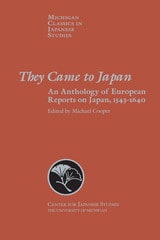
They Came to Japan
An Anthology of European Reports on Japan, 1543-1640Michael Cooper, Editor
University of Michigan Press, 1995
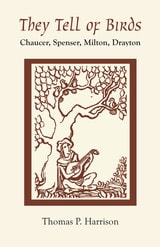
They Tell of Birds
Chaucer, Spenser, Milton, DraytonBy Thomas P. Harrison
University of Texas Press, 1956
Thomas P. Harrison here combines a lifelong interest in birds with a professional study of literature. This book, a study of birds as they are presented by four great English poets, inquires into the extent and sources of their knowledge of birds and analyzes the methods by which they adapted that knowledge for poetic purposes. The interrelationships of their poetry are also discussed, providing a new basis for comparison of four poets whose work is closely linked on other grounds remote from natural history.
The first chapter reviews representative figures and works of the centuries preceding the Renaissance and illustrates the medieval poetic conventions about birds that influenced the four poets. The remaining chapters treat each poet and his works in detail, comparing their use of this area of the natural world. The book concludes with an index of bird allusions in the works of the four poets, with occasional quotations illustrating the manner in which the traditional or observed habits of particular birds were put to poetic use. The book is illustrated with medieval and Renaissance illustrations of birds.
In this careful treatment of an important element of the poets’ works, Harrison has indicated the larger picture of their attitudes toward and use of the natural world about them. Accordingly, it might be said to constitute a chapter on the relationship of poetry and science at a crucial period in the history of thought.
For much of his material, Harrison journeyed to England, where, among other research activities, he visited museums of natural history and bird sanctuaries throughout the country.
Primarily intended for students of literature, They Tell of Birds will also be of interest to ornithologists in its presentation of the beliefs of antiquity and the Middle Ages about particular birds. For, as the distinguished ornithologist E. M. Nicholson has said: “We owe to poets a wealth of records of living wild birds long before scientific ornithology had started.”
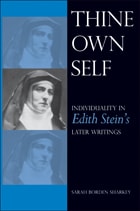
Thine Own Self
Individuality in Edith Stein's Later WritingsSarah Borden Sharkey
Catholic University of America Press, 2010

Thinking in Cases
Fiction, Law, and the Case HistoryPeter Brooks
University of Chicago Press, 2027
How the form of the case history became an important way of studying the individual as an exemplary case in medicine, psychoanalysis, law, and the novel.
What does it mean when we address ourselves to a specific problem and treat it as a “case” that needs resolution, a resolution that may in turn offer us more general lessons? The “case history” has become a central form of thought and analysis in our culture, but rarely has it been studied on its own. In Thinking in Cases, the distinguished critic Peter Brooks zeroes in on a kind of thinking that we all know—and often use—without understanding its dimensions and its history.
This book ponders what we do and mean when we think in cases—when we take up specific instances with a view to making them exemplary. Brooks brings to this study decades of reflection on the psychoanalytic case history, on the rhetoric of the legal case, and on novels that unfold as cases seeking solutions. Brooks focuses on the case-history’s emergence in the late nineteenth century: first, he examines how Henry James’s uses of narrative parallel case-study methods in law, medicine, and psychoanalysis. Elsewhere, he traces the case history from Hippocratic medicine through Sir Arthur Conan Doyle’s detective fiction to a startling legal case from Victorian England involving shipwreck and cannibalism. Other chapters discuss a tale of madness by Balzac and Freud’s most speculative works, especially Moses and Monotheism. A final chapter examines recent novels—Duras’s The Ravishing of Lol Stein, Coetzee’s Disgrace, Modiano’s Dora Bruder, and Erpenbeck’s Kairos—as case studies.
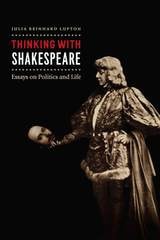
Thinking with Shakespeare
Essays on Politics and LifeJulia Reinhard Lupton
University of Chicago Press, 2011
Third Wave
The New Russian PoetryKent Johnson and Stephen M. Ashby, Editors. Introduction by Alexei Parshchikov and Andrew Wachtel. Afterword by Mikhail Epstein
University of Michigan Press, 1992
Thomas De Quincey
British Rhetoric's Romantic TurnLois Peters Agnew
Southern Illinois University Press, 2012
This wide-ranging volume gives proper attention to the views on rhetoric and style set forth by British literary figure Thomas De Quincey (1785–1859), whose contributions to the history of rhetoric are often overlooked. Lois Peters Agnew presents an overview of this theorist’s life and provides cultural context for his time and place, with particular emphasis on the significance of his rhetoric as both an alternative strain of rhetorical history and a previously unrealized example of rhetoric’s transformation in nineteenth-century Britain.
Agnew presents an extensive discussion of De Quincey’s ideas on rhetoric, his theory and practice of conversation, his theory of style and its role in achieving rhetoric’s dialogic potential, and his strategic use of humor and irony in such works as Confessions of an English Opium Eater. Synthesizing previous treatments of De Quincey’s rhetoric and connecting his unusual perspectives on language to the biographical details of his life, Agnew helps readers understand his intellectual development while bringing to light the cultural contexts that prompted radical changes in the ways nineteenth-century British intellectuals conceived of the role of language and the imagination in public and private discourse.
Agnew presents an alternative vision of rhetoric that departs from many common assumptions about rhetoric’s civic purpose and offers insights into the topic of rhetoric and technological change. The result is an accessible and thorough explanation of De Quincey’s complex ideas on rhetoric and the first work to fully show the reach of his ideas across multiple texts written during his lifetime.

Thomas Hardy from Serial to Novel
Mary Chase
University of Minnesota Press, 1927
Thomas Hardy's Brains
Psychology, Neurology, and Hardy's ImaginationSuzanne Keen
The Ohio State University Press, 2014
This study reveals how Hardy made sense of diverse sources of an affective human psychology, a discipline that expanded significantly during Hardy’s working life. From the 1870s to the turn of the twentieth century, the tools and techniques for studying the structures and function of the nervous system developed rapidly. Simultaneously, Hardy moved steadily toward realizing a more physiologically accurate rendering of brains and nerves.
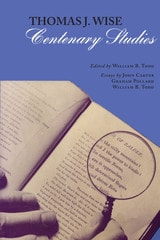
Thomas J. Wise
Centenary StudiesEdited by William B. Todd
University of Texas Press, 1959
Thomas James Wise (1859–1937), though destined to receive in his own lifetime practically every honor the world of letters could bestow, is remembered today as perhaps the greatest malefactor in all of literary history. From 1934 to 1957 various enquiries have implicated him first in the manufacture of more than fifty predated "original" editions of eminent Victorian authors, then in seven additional forgeries, later in countless piracies of other nineteenth-century work, and finally in repeated acts of vandalism upon forty-one seventeenth-century plays. It is fitting that Wise himself appears as a contributor to this volume. Included are his original introduction to the Browning Library, his letters to bookseller J. E. Cornish, his extraordinary letter to Sir Edmund Gosse, and a note to H. Buxton Forman.
These Centenary Studies review the course of research over twenty-five years, designate topics requiring further investigation, and assess new evidence of Wise's villainies. One more forgery is identified, the provenance of others reexamined, the forger's method of purveying his wares closely appraised, his association with H. Buxton Forman and Sir Edmund Gosse more precisely defined, and the range of his activities summarized in an annotated handlist. The record includes at least 400 printings directly attributed to Wise, as well as 23 suppressed or abortive issues, and 29 others in which he seems to be somewhat involved. Through these perspectives the culprit appears even more contemptible and, possibly for this very reason, ever more intriguing as a cause célèbre in literary scholarship.
The illustration on the cover of this book reproduces, through a magnifying glass, the peculiar question mark appearing in certain forgeries printed for Wise by the firm of Richard Clay & Sons. The mark may also implicate Wise in other irregular printings, including The Death of Balder.
To Scorch or Freeze
Poems about the SacredDonald Davie
University of Chicago Press, 1988
"Few modern poets have managed to achieve Donald Davie's sense of human worth."—Times Higher Educational Supplement
Today the Struggle
Literature and Politics in England during the Spanish Civil WarBy Katharine Bail Hoskins
University of Texas Press, 1969
Many writers, from Aristophanes to Joseph Heller, have written about politics. But at certain periods in history, often at times of conflict and turmoil, writers have consciously used their literary talents to support or oppose a specific cause. The 1930s, a decade of widespread social and political breakdown, was such a period.
Today the Struggle examines the political involvement of those leading British writers who dedicated their talents to the defense of Nationalists or Loyalists during the Spanish Civil War and who saw that war as symbolic of their own Right-Left dialogue.
Conservatives like William Butler Yeats and T. S. Eliot and Roman Catholics like Evelyn Waugh were passionately anti-Communist. They viewed fascism as a bulwark against communism but were unwilling to support the Franco cause actively. Other pro-Nationalists were not so hesitant: Roy Campbell and Wyndham Lewis were ardent participants in the fight against the British left wing.
Pro-Loyalists, united only in their antifascism, ranged from conservative to anarchist in political commitment. Their literary contributions included fine poems by W. H. Auden and Stephen Spender, experimental drama by Auden and Christopher Isherwood, and impassioned prose by Rex Warner, George Orwell, and Aldous Huxley.
Katharine Hoskins’s principal interest in Today the Struggle is to discover how and why certain writers supported specific political actions, to ascertain the effectiveness of their efforts, and to evaluate the influence of these efforts on their work.
Tolkien, Philosopher of War
Graham McAleer
Catholic University of America Press, 2024
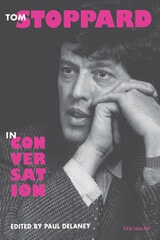
Tom Stoppard in Conversation
Paul Delaney, Editor
University of Michigan Press, 1994
This collection of interviews with British playwright Tom Stoppard, author of such well-known comedies as Travesties, Jumpers, and Rosencrantz and Guildenstern Are Dead, brings together for the first time Stoppard's most significant assessments of his own work.
A wide range of discussions are featured, from extensive conversations with the editors of Theatre Quarterly and Gambit to important interviews in lesser-known periodicals. The interviews include the playwright's unguarded comments to the daily press, from those of a dazzled young Stoppard the morning after the triumphant opening of Rosencrantz and Guildenstern to those of a veteran playwright still smarting from caustic reviews 36 hours after the opening of Hapgood. The interviews cover the full range of Stoppard's work, from his adaptations for the stage to his increasing involvement in film, and this volume makes many of them available for the first time. Also appearing for the first time in print are transcripts of radio interviews and an informal lecture by Stoppard called "The Event and the Text."
Tom Stoppard's conversations about his work shed light on questions of authorial intent and the creative process. Debates over interpretations of the plays will be enhanced by this record of Stoppard's own perceptions and insights. The collection also includes the most extensive bibliography and discography ever compiled of Stoppard's print interviews, broadcast interviews, and lectures.
Witty, illuminating, and informative, Tom Stoppard in Conversation will be of interest to scholars, students, directors, actors, and fans of Stoppard's work.
Tough Love
Amazon Encounters in the English RenaissanceKathryn Schwarz
Duke University Press, 2000
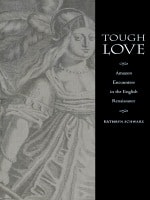
Despite seeming to function as signs for what is outside the social—the alien, the exotic, the other—Amazons in sixteenth- and seventeenth-century texts were often represented in conventionally domestic roles, as mothers and lovers, wives and queens, Schwarz demonstrates. She traces this pattern in works by Shakespeare, Spenser, Sidney, Raleigh, and Jonson, as well as in such materials as conduct manuals, explorers’ accounts, court spectacles, and political tracts. Through readings of these texts, Schwarz shows that the Amazon myth provided a language both for setting forth and for challenging the terms of social logic. In representations of Amazon encounters, she argues, homosocial bonds became indistinguishable from heterosexual desires, masculine agency attached itself as logically to women as it did to men, and sexual difference was made nearly impossible to sustain or define. Schwarz’s analysis unveils the Amazon as a theoretical term, one that illuminates the tensions and paradoxes through which ideologies of the domestic take shape.
Tough Love contributes to the ongoing discussion of gendered identity and sexual desire in the early modern period. It will interest students of queer theory, cultural studies, early modern history, feminism, and literature.
Tourists with Typewriters
Critical Reflections on Contemporary Travel WritingPatrick Holland and Graham Huggan
University of Michigan Press, 2000
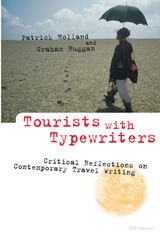
The book maps new terrain in a growing area of critical study. Although critical of travel writing's complacency and its often unacknowledged ethnocentrism, the book recognizes its importance as both a literary and cultural form. While travel writing at its worst emerges as a crude expression of economic advantage, at its best it becomes a subtle instrument of cultural self-perception, a barometer for changing views of "other" (i.e., foreign, non-Western) cultures, and a trigger for the information circuits that tap us into the wider world.
Tourists with Typewriters gauges both the best and worst in contemporary travel writing, capturing the excitement of this most volatile--and at times infuriating--of literary genres. The book will appeal to general readers interested in a closer examination of travel writing and to academic readers in disciplines such as literary/cultural studies, geography, history, anthropology, and tourism studies.
"An eminently readable and informative study. It breathes tolerance and intelligence. It is critically perceptive and very au courant. It raises issues (coloniality, postmodernity, gender. . . ) and discusses books that readers of many different stripes will want to find out about." --Ross Chambers, University of Michigan
Patrick Holland, Associate Professor of English, University of Guelph, was born in New Zealand and educated in England, Australia, and Canada. Graham Huggan, Professor of English, University of Munich, was born in Hong Kong and educated in England and in British Columbia.
Towards Reading Freud
Self-Creation in Milton, Wordsworth, Emerson, and Sigmund FreudMark Edmundson
University of Chicago Press, 2007
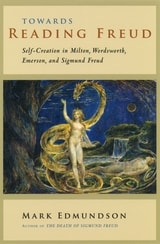
“Marvelous. . . . Edmundson’s book offers an extraordinary challenge both to practicing analysts and to a scholarly community which all too uncomplainingly inhabits and reinforces the Freudian paradigm of interpretation. Edmundson reinvents an adventurous and dissident Freud as an antidote to . . . weary psychoanalytic commonplaces.”—Malcolm Bowie, Raritan
“This book takes a distinguished place in the ongoing effort to recontextualize Freud by stressing the literary, rather than the scientific roots and character of his theory.”—Virginia Quarterly Review
Transatlantic Dialogue
Selected American Correspondence of Edmund GosseEdited by Paul F. Mattheisen and Michael Millgate
University of Texas Press, 1965
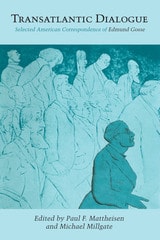
The mauve life and times of Edmund Gosse glow warmly in these letters, delightful to even the most casual reader, engrossing to one with an interest in the distinguished correspondents or in the late-Victorian and Edwardian eras.
An obscure figure today to all but literary connoisseurs, Gosse was, in his day, a near giant in both England and the United States. Max Beerbohm, that discriminating man, in a mural of prominent figures who were also his friends, sketched Edmund Gosse large among George Bernard Shaw, John Masefield, G. K. Chesterton, John Galsworthy, and Lytton Strachey.
This volume consists primarily of a selection of the letters exchanged between Gosse and a number of American writers, notably William Dean Howells, Edmund Clarence Stedman, Oliver Wendell Holmes, Richard Watson Gilder, Edith Wharton, and Henry James. The letters, most of them previously unpublished, contain much of biographical and general historical interest, but the main theme of the book is the exploration of Anglo-American literary relations during the last quarter of the nineteenth century and the early years of the twentieth.
The letters that passed between Gosse and Stedman provide valuable evidence for the study of literary taste on the two sides of the Atlantic and also show how each man sought to enhance the other's transatlantic reputation; the correspondence between Gosse and Gilder, particularly during the period when Gosse was London editor of Gilder's Century magazine, is especially revealing of cultural attitudes and antagonisms. A central thread is provided by the warm and long-sustained friendship between Gosse and Howells, the leading American man of letters of his day.
The long introduction to the book deals with such topics as Gosse's American reputation, his immensely successful visit to the United States in the winter of 1884–1885 (based on the manuscript diary that Gosse kept during the visit), and his American friendships, with particular attention to the relationship with Howells. The thoroughness and vitality of the annotation are extremely effective in familiarizing the reader with the people and events in the book.
Transatlantic Women Travelers, 1688-1843
Misty Krueger
Bucknell University Press, 2021
Translation Effects
Language, Time, and Community in Medieval EnglandMary Kate Hurley
The Ohio State University Press, 2021
Transmedia Adaptation in the Nineteenth Century
Lissette Lopez Szwydky
The Ohio State University Press, 2020
In Transmedia Adaptation in the Nineteenth Century, Lissette Lopez Szwydky convincingly historicizes the practice of adaptation, drawing on multiple disciplines to illustrate narrative mobility across time, culture, and geography. Case studies from stage plays, literature, painting, illustration, chapbooks, and toy theaters position adaptation as a central force in literary history that ensures continued cultural relevance, accessibility, and survival. The history of these forms helps to inform and put into context our contemporary obsessions with popular media. Finally, in upending a traditional understanding of canon by arguing that adaptation creates canon and not the other way around, Szwydky provides crucial bridges between nineteenth-century literary scholarship, adaptation studies, and media studies, thus identifying new stakes for all.
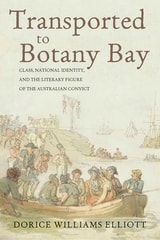
Transported to Botany Bay
Class, National Identity, and the Literary Figure of the Australian ConvictDorice Williams Elliott
Ohio University Press, 2019
Literary representations of British convicts exiled to Australia were the most likely way that the typical English reader would learn about the new colonies there. In Transported to Botany Bay, Dorice Williams Elliott examines how writers—from canonical ones such as Dickens and Trollope to others who were themselves convicts—used the figure of the felon exiled to Australia to construct class, race, and national identity as intertwined.
Even as England’s supposedly ancient social structure was preserved and venerated as the “true” England, the transportation of some 168,000 convicts facilitated the birth of a new nation with more fluid class relations for those who didn’t fit into the prevailing national image. In analyzing novels, broadsides, and first-person accounts, Elliott demonstrates how Britain linked class, race, and national identity at a key historical moment when it was still negotiating its relationship with its empire. The events and incidents depicted as taking place literally on the other side of the world, she argues, deeply affected people’s sense of their place in their own society, with transnational implications that are still relevant today.
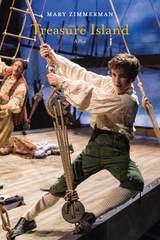
Treasure Island
A PlayMary Zimmerman
Northwestern University Press, 2019
In Treasure Island, Tony Award winner and inventive adapter-director Mary Zimmerman has penned a spirited, energetic adaptation of Robert Louis Stevenson’s most beloved novel, proving again that “a strong story full of larger-than-life characters and the quest for filthy lucre has no age barrier” (Chicago Sun-Times).
Enlivened by rum, mutiny, and buried treasure, Treasure Island is the classic pirates’ tale, widely regarded as the forerunner of this genre. After discovering a treasure map, young Jim Hawkins sets off to sea as cabin boy aboard the Hispaniola, where he encounters one of the most unforgettable characters in literary history—peg-legged buccaneer Long John Silver, a malicious mutineer and charismatic father figure.
Trollope and Comic Pleasure
Christopher Herbert
University of Chicago Press, 1987
The comic mode as Herbert describes it was antagonistic to the repressive moral ethos widely prevalent in Victorian England. Herbert shows how Trollope, under a mask of self-proclaimed conventionality, employed this mode in a steady, sometimes scandalous critique of the Victorian subversion of pleasure. Drawing on Trollope's unpublished notes on seventeenth-century drama and bringing to light many instances in the novels of direct borrowings from old plays, Herbert demonstrates the inventiveness and subtlety of Trollope's deployment of comic materials. Thematically organized around such subjects as Trollope's investigations of sex, his formal structures, and his principles of "realism," Herbert's study includes detailed readings of two of the nineteenth century's most ambitious exercises in comedy: The Way We Live Now and Trollope's neglected masterpiece, Ayala's Angel.
Of primary importance for readers of Trollope and students of comedy, Herbert's study will also prove valuable to those interested more generally in Victorian and modern fiction and the cultural history of the Victorian age.
Tropes, Parables, and Performatives
J. Hillis Miller
Duke University Press, 1991
Throughout these essays Miller is fascinated with the tropological dimension of literary language, with the way figures of speech turn aside the telling of a story or the presentation of a literary theme. The exploration of this turning leads to the recognition that all works of literature are parabolic, “thrown beside” their real meaning. They tell one story but call forth something else.
Miller further agrees that all parables are fundamentally performative. They do not merely name something or give knowledge, but rather use words to make something happen, to get the reader from here to there. Each essay here attempts to formulate what, in a given case, the reader perfomatively enters by way of parabolic trope.
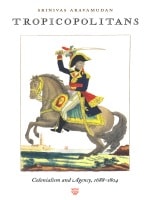
Tropicopolitans
Colonialism and Agency, 1688–1804Srinivas Aravamudan
Duke University Press, 1999
“Tropicalization” is the central metaphor of this analysis, a term that incorporates both the construction of various dynamic tropes by which the colonized are viewed and the site of the study, primarily the tropics. Tropicopolitans, then, are those people who bear and resist the representations of colonialist discourse. In readings that expose new relationships between literary representation and colonialism in the eighteenth century, Aravamudan considers such texts as Behn’s Oroonoko, Defoe’s Robinson Crusoe and Captain Singleton, Addison’s Cato, and Swift’s Gulliver’s Travels and The Drapier’s Letters. He extends his argument to include analyses of Johnson’s Rasselas, Beckford’s Vathek, Montagu’s travel letters, Equiano’s autobiography, Burke’s political and aesthetic writings, and Abbé de Raynal’s Histoire des deux Indes. Offering a radical approach to literary history, this study provides new mechanisms for understanding the development of anticolonial agency.
Introducing eighteenth-century studies to a postcolonial hermeneutics, Tropicopolitans will interest scholars engaged in postcolonial studies, eighteenth-century literature, and literary theory.

Troubled Mirror
A Study Of Yeats's "The Tower"David Young
University of Iowa Press, 1987
Despite the extensive critical attention that has been paid to the work of W. B. Yeats, we are still very much in the process of understanding both the greatness and the modernity of this poet. The assessment of his poetry has rested primarily on the scope, intensity, and memorability of his lyrics, but his romantic beginnings have made it problematic to acknowledge him as a modernist, while his failure to produce a long poem has for some time raised questions about his greatness. Don’t major poets, the argument runs, produce major poems?
In this meticulous analysis of The Tower, David Young addresses both these issues, showing that this powerful volume represents Yeats at his best and most modern, and that its careful construction makes it the deliberate equivalent to the long poems of tradition.
By tracing the careful ordering of the poems in The Tower, Young demonstrates the volume’s overall vision, giving careful readings of each poem and illustrating the growing repetition of images that create a whole which is both emotionally and dramatically greater than the sum of its parts. Young contends that the best way to read Yeat’s lyrics is through attention to the context he created for them. Their interdependence, he asserts, is the true key to their modernity.
This eminently readable study appears at a time when most readers are in danger of losing touch with the particular achievement of Yeat’s individual volumes as he conceived them. Most students and readers now encounter Yeats in anthologies, in a volume of selected poems, or in a somewhat misleadingly presented complete Poems. Young convinces us that by persisting in this approach we will lose sight of a significant aspect of a foremost modern poet and the very elements that make him a true modern.
Tudor Autobiography
Listening for InwardnessMeredith Anne Skura
University of Chicago Press, 2008
In the past such texts have not been called autobiographies because they do not reveal much of the inwardness of their subject, a requisite of most modern autobiographies. But, according to Meredith Anne Skura, writers reveal themselves not only by what they say but by how they say it. Borrowing methods from affective linguistics, narratology, and psychoanalysis, Skura shows that a writer’s thoughts and feelings can be traced in his or her language. Rejecting the search for “the early modern self” in life writing, Tudor Autobiography instead asks what authors said about themselves, who wrote about themselves, how, and why. The result is a fascinating glimpse into a range of lived and imagined experience that challenges assumptions about life and autobiography in the early modern period.
Twelfth Night
William Shakespeare
Arizona Center for Medieval and Renaissance Studies, 2023
Shakespeare’s Twelfth Night centers on power and love. One of the most perennially produced of Shakespeare’s comedies, it talks about shipwrecked twins, gender-bending romance, and a bumper crop of fools, from the wise to the ridiculous. Modernizing the language of the play, Alison Carey’s translation revives the joy of this comedy, taking the archaic humor and renewing it for a contemporary audience.
This translation of Twelfth Night was written as part of the Oregon Shakespeare Festival’s Play On! project, which commissioned new translations of thirty-nine Shakespeare plays. These translations present the work of “The Bard” in language accessible to modern audiences while never losing the beauty of Shakespeare’s verse. Enlisting the talents of a diverse group of contemporary playwrights, screenwriters, and dramaturges from diverse backgrounds, this project reenvisions Shakespeare for the twenty-first century. These volumes make these works available for the first time in print—a new First Folio for a new era.
Twisted Words
Torture and Liberalism in Imperial BritainKatherine Judith Anderson
The Ohio State University Press, 2022