Results by title
1228 books match the query 'Library & Information Science' and 234 start with t

The Sustainable Library's Cookbook
Raymond Pun
Assoc of College & Research Libraries, 2019
The Teaching with Primary Sources Cookbook
Julie M. Porterfield
Assoc of College & Research Libraries, 2021

The Top Technologies Every Librarian Needs to Know
Kenneth J. Varnum
American Library Association, 2014
The Transformed Library
Jeannette Woodward
American Library Association, 2013
The Virtual Reference Service
From Competencies to Assessment - Neal-Schuman PublishersAmerican Library Association, 2008
The Weeding Handbook
A Shelf-by-Shelf GuideRebecca Vnuk
American Library Association, 2015
The Weeding Handbook
A Shelf-by-Shelf GuideRebecca Vnuk
American Library Association, 2022
"Manages to be a thorough and informative source on weeding library collections and yet also an easy, engaging read ... Recommended." That rave review from Technicalities sums up the acclaim and appeal of this bestselling resource’s first edition. Now Vnuk has revised and updated her text to keep pace with libraries’ longer-term shifts in collection development and access, such as a growing emphasis on digital collections and managing duplicate physical materials. She demonstrates how weeding helps a library thrive by focusing its resources on those parts of the collection that are the most useful to its users. Walking collections staff through the proverbial stacks shelf by shelf, this book
- includes a new “Tales from the Front” feature, providing real-life case studies of librarians working on weeding projects;
- explains why weeding is important for a healthy library and how it can positively affect library budgets;
- systematically walks readers through a library's shelves, with recommended weeding criteria and call-outs in each area for the different considerations of large collections and smaller collections;
- offers easily adaptable, updated sample development plans which reflect the latest thinking in collection development;
- advises readers on weeding problematic materials, such as those that include racist themes and depictions;
- presents updated and expanded guidance on special considerations for youth collections;
- addresses reference, media, magazines and newspapers, e-books, and other special materials;
- shares guidance for determining how to delegate responsibility for weeding, plus pointers for getting other staff members on board; and
- gives advice for educating the community about the process, how to head off PR disasters, and what to do with weeded materials.
The Whole Library Handbook 5
Current Data, Professional Advice, and CuriosaGeorge M. Eberhart
American Library Association, 2013
The Whole Library Handbook
Teen ServicesHeather Booth
American Library Association, 2014
The Whole School Library Handbook 2
Blanche Woolls
American Library Association, 2013
Theory Development in the Information Sciences
Edited by Diane H. Sonnenwald
University of Texas Press, 2016
Emerging as a discipline in the first half of the twentieth century, the information sciences study how people, groups, organizations, and governments create, share, disseminate, manage, search, access, evaluate, and protect information, as well as how different technologies and policies can facilitate and constrain these activities. Given the broad span of the information sciences, it is perhaps not surprising that there is no consensus regarding its underlying theory—the purposes of it, the types of it, or how one goes about developing new theories to talk about new research questions.
Diane H. Sonnenwald and the contributors to this volume seek to shed light on these issues by sharing reflections on the theory-development process. These reflections are not meant to revolve around data collection and analysis; rather, they focus on the struggles, challenges, successes, and excitement of developing theories. The particular theories that the contributors explore in their essays range widely, from theories of literacy and reading to theories of design and digital search. Several chapters engage with theories of the behavior of individuals and groups; some deal with processes of evaluation; others reflect on questions of design; and the rest treat cultural and scientific heritage. The ultimate goal, Sonnenwald writes in her introduction, is to “encourage, inspire, and assist individuals striving to develop and/or teach theory development.”
Thriving as a Mid-Career Librarian
Identity, Advocacy, and PathwaysBrandon West
Assoc of College & Research Libraries, 2023
In four sections, Thriving as a Mid-Career Librarian collects the experiences of mid-career librarians as they grapple with these questions and the roles that marginalized perspectives, intersectionality, and privilege have played in their careers:
- Section 1: Staying Engaged in Your Career
- Section 2: The Role of Identity in Shaping Mid-career Librarianship
- Section 3: Being Your Own Advocate
- Section 4: To Lead or Not to Lead?
It can feel like everything gets harder, more political, and further under-resourced with each passing year. Thriving as a Mid-Career Librarian offers strategies of community, support, and advocacy that can help make it possible for us to thrive and help others to thrive. At mid-career, we may not have the same bright-eyed enthusiasm we possessed as new information professionals, but we have other things: the contributions we make to our communities and the wealth of experience we have built up since those days.
Through the Archival Looking Glass
A Reader on Diversity and InclusionMary Caldera
American Library Association, 2017
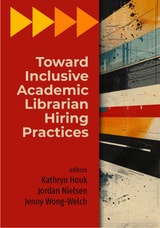
Toward Inclusive Academic Librarian Hiring Practices
Kathryn Houk
Assoc of College & Research Libraries, 2024
Toward Inclusive Academic Librarian Hiring Practices, rather than focusing just on how to diversify applicant pools, breaks down the many considerations involved in hiring and the intentional, thoughtful preparation and self-examination that leads to successful recruitment and retention in three parts.
- Training for Search Committees and Stakeholders
- Removing Barriers for Candidates
- Transforming the Process for All
Throughout are practical solutions for emphasizing inclusivity and accessibility throughout the hiring process, including instructions and examples for developing the position description and job postings, tips for creating diversity statements, interview instructions and preparation lists, interview itineraries, sample candidate emails and feedback forms, evaluation rubrics, ideas for onboarding and mentorship, and more.
While you are evaluating potential hires, they are evaluating you. Toward Inclusive Academic Librarian Hiring Practices can help you center equity in your hiring, attract job seekers, and support both candidates and search committees through these time-intensive, laborious, and crucial processes.
Toxic Dynamics
Disrupting, Dismantling, and Transforming Academic Library CultureRussell Michalak
Assoc of College & Research Libraries, 2024
Toxic Dynamics: Disrupting, Dismantling, and Transforming Academic Library Culture provides practical solutions for confronting these complex issues and innovative ways to promote a healthy and sustainable work culture. It addresses critical and timely challenges such as faculty versus staff or us versus them mentality, unionization, gendered labor, organizational change, self-care, tenure, and promotion. Authors from all sizes and types of academic libraries provide evidence-based solutions to mitigate the negative effects of toxicity, change management strategies, and ways to confront and challenge values that harm library workers and their well-being.
By understanding the root causes of toxic cultures, recognizing their impact, and implementing solutions, leaders can create a more supportive and positive work environment and improve morale, retention, and productivity. Toxic Dynamics is an important resource for anyone interested in improving workplace culture and addressing issues related to toxicity and inequity, and for library leaders at all levels.
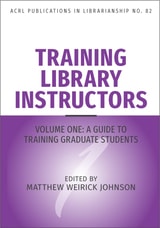
Training Library Instructors
Vol 1: A Guide to Training Graduate StudentsMatthew Weirick Johnson
Assoc of College & Research Libraries, 2024
In two volumes, Training Library Instructors collects examples of how we train our colleagues to teach, whether they’re student workers, non-librarian staff, new or experienced librarians, or something else entirely. Volume 1, A Guide to Training Graduate Students, focuses on teacher training for graduate students in LIS programs and in academic libraries. It presents existing literature and theories, approaches to teaching library school students to teach, and critical reflections from librarians about their varied experiences receiving teacher training.
A Guide to Training Graduate Students provides a useful introduction, detailed examples, and salient reflections to help us better train library instructors during their time as graduate students through coursework and work experience. You’ll discover ideas for designing courses, internships, and other programs and ways to mentor graduate students who are interested in becoming library instructors.
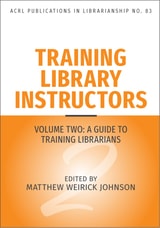
Training Library Instructors
Vol 2: A Guide to Training LibrariansMatthew Weirick Johnson
Assoc of College & Research Libraries, 2024
In two volumes, Training Library Instructors collects examples of how we train our colleagues to teach, whether they’re student workers, non-librarian staff, new or experienced librarians, or something else entirely. In Volume 2, A Guide to Training Librarians, librarians share their knowledge about teaching, learning, and pedagogy through a variety of replicable activities: formal and informal workshops, courses, communities of practice, peer observation, and more. Programs include mock instruction, nano-teaching, and other feedback and homework mechanisms; happen at the individual, institutional, or consortial level; and can involve collaborations across library or university departments.
So many librarians value lifelong learning and the opportunity to learn from each other. A Guide to Training Librarians provides a starting point for readers considering their own teach-the-teacher programs and various approaches to learning together, exploring library instruction for the first time, or expanding existing knowledge through continued education.
Training Library Instructors
Volume 1 and 2Matthew Weirick Johnson
Assoc of College & Research Libraries, 2024
In two volumes, Training Library Instructors collects examples of how we train our colleagues to teach, whether they’re student workers, non-librarian staff, new or experienced librarians, or something else entirely. Volume 1, A Guide to Training Graduate Students, focuses on teacher training for graduate students in LIS programs and in academic libraries. It presents existing literature and theories, approaches to teaching library school students to teach, and critical reflections from librarians about their varied experiences receiving teacher training. In Volume 2, A Guide to Training Librarians, librarians share their knowledge about teaching, learning, and pedagogy through a variety of replicable activities: formal and informal workshops, courses, communities of practice, peer observation, and more.
Training Library Instructors provides detailed, easily implemented and modified plans for courses, internships, teach-the-teacher programs, and other instructional methods and opportunities for graduate students and library workers at all levels of teaching experience.
Training Paraprofessionals for Reference Service
Pamela J. Morgan
American Library Association, 2009
Training Research Consultants
Jennifer Torreano
Assoc of College & Research Libraries, 2021
Transfer Student Success
Academic Library Outreach and EngagementNancy Fawley
American Library Association, 2021
Transforming Information Literacy Instruction Using Learner-Centered Teaching
Joan R. Kaplowitz
American Library Association, 2011
Transforming Information Literacy Programs
Intersecting Frontiers of Self, Library Culture, and Campus CommunityCarroll Wetzel Wilkinson
Assoc of College & Research Libraries, 2012
Transforming Information Literacy Programs
Intersecting Frontiers of Self, Library Culture, and Campus CommunityCarroll Wetzel Wilkinson
Assoc of College & Research Libraries, 2012
Transforming Libraries To Serve Graduate Students
Crystal Renfro
Assoc of College & Research Libraries, 2018
Transforming Library Service through Information Commons
American Library Association, 2008
Transforming Preschool Storytime
A Modern Vision and a Year of ProgramsBetsy Diamant-Cohen
American Library Association, 2013
Transforming Young Adult Services
Anthony Bernier
American Library Association, 2013
Transforming Young Adult Services
Anthony Bernier
American Library Association, 2019
Foreword by John M. Budd; with contributions from Denise E. Agosto, Jeanie Austin, Michael Cart, Mary K. Chelton, Karen Coats, Kate McDowell, Cherie Givens, Mary Ann Harlan, Kafi D. Kumasi, Wendy Schaetzel Lesko, Mike Males, Paulette Rothbauer, Lucia Cedeira Serantes
How should LIS envision its young adult users? Now showcasing an even more rigorous debate about the theory and practice of YA librarianship than its first edition, this "provocative presentation of diverse viewpoints by leaders in the field" (Catholic Library World) has been updated and expanded to incorporate recent advances in critical youth studies. A comprehensive, evidence-based treatment that offers LIS instructors, students, and practitioners a valuable tool for aligning YA services to more fully reflect our diverse populations of young people, this collection delves deeply into such topics as
- the historical roots for current theories and practice;
- how intellectual freedom, storytelling, library collections, and other service topics can connect with the library's notion and vision of young adults;
- diverse YA identities, including critical race theory;
- competing perspectives on young adults’ rights in libraries;
- envisaging YA librarianship from a teen-centered perspective;
- youth identities and the school library; and
- moving beyond coaching to copilot with young adults.
Transforming the Authority of the Archive
Undergraduate Pedagogy and Critical Digital ArchivesAndi Gustavson and Charlotte Nunes, Editors
Lever Press, 2023
Contributions to this volume represent a range of institutions including small liberal arts colleges, HBCUs, Ivy Leagues, large research institutions, and community-based collections. The assignments, projects, and initiatives described across this volume are fundamentally concerned with the challenge to model digital archival collections so as to center individual and community voices that are historically under-engaged in the archives. To address this challenge, contributors describe various approaches to substantively, often radically, redistribute archival resources and authority. The chapters within Transforming the Authority of the Archive offer thoughtful and creative pedagogical approaches to counter the presumed neutrality of the archive and advocate a shared understanding of the contingency of archival collections. This book is a must-read for liberal arts faculty, graduate students, archivists (both community- and institutionally-affiliated), information-studies professionals, librarians, and other professionals working and teaching in archives, museums, libraries, and other cultural heritage institutions.
True Stories of Censorship Battles in America's Libraries
Valerie Nye
American Library Association, 2012
Intellectual freedom is a core value of librarianship, but fighting to keep controversial materials on the shelves can sometimes feel like a lonely battle. And not all censorship controversies involve the public objecting to a book in the collection—libraries are venues for displays and meetings, and sometimes library staff themselves are tempted to preemptively censor a work. Those facing censorship challenges can find support and inspiration in this book, which compiles dozens of stories from library front lines. Edifying and enlightening, this collection
- Tells the stories of librarians who withstood difficult circumstances to champion intellectual freedom
- Touches on prickly issues such as age-appropriateness, some librarians' temptation to preemptively censor, sensitive cultural expressions, and criminality in the library
- Presents case studies of defenses that were unsuccessful, so librarians facing similar challenges can learn from these defeats
There are fewer situations more stressful in a librarian's professional life than being personally confronted with a demand to remove a book from the shelves or not knowing how to respond to other kinds of censorship challenges. Reading this book will help fortify and inform those in the fray.
Twenty Tellable Tales
Audience Participation Folktales for the Beginning StorytellerMargaret Read MacDonald
American Library Association, 2005
Twenty-First-Century Access Services
On the Front Line of Academic Librarianship, Second EditionTrevor A. Dawes
Assoc of College & Research Libraries, 2023
This thoroughly revised edition of 2013’s seminal Twenty-First-Century Access Services highlights the expanded duties of these departments; the roles these services continue to play in the success of the library, students, and faculty; and the knowledge, skills, and abilities these library workers need. In four parts it explores:
- Facilitating Access
- Leading Access Services
- Assessing Access Services
- Developing Access Services Professionals
Twenty-First-Century Access Services demonstrates access services’ value, defines their responsibilities and necessary skills, and explores how access services departments are evolving new and traditional services to support the academic mission of their institutions. It is geared toward both access services practitioners and library and information science graduate students and faculty.
Twenty-First-Century Kids, Twenty-First-Century Librarians
Virginia A. Walter
American Library Association, 2009