Results by title
28167 books match the query 'History' and 6372 start with t
The Imprisoned Traveler
Joseph Forsyth and Napoleon's ItalyKeith Crook
Bucknell University Press, 2020
Published by Bucknell University Press. Distributed worldwide by Rutgers University Press.

The Improbable First Century of Cosmopolitan Magazine
James Landers
University of Missouri Press, 2010

The Improbable Life of the Arkansas Democrat
An Oral HistoryJerry McConnell
University of Arkansas Press, 2016
The Improbable Life of the Arkansas Democrat is based on more than one hundred interviews with employees of the Democrat, including editors, reporters, feature writers, cartoonists, circulation managers, business managers, salespeople, typesetters and others, from the 1930s through the early 1990s, when the Democrat took over the more prominent Arkansas Gazette after an aggressive newspaper war.
This new addition to Arkansas journalism history provides vivid details about what it was like to work at the Democrat. August Engel, who led the paper with focused devotion for forty-two years, was famous for his thrift, creating austere conditions that included no air conditioning in the newsroom and sub-par wages. In spite of these drawbacks, the paper was still home to many dedicated journalism professionals endeavoring to do good work.
Readers who remember the ultimate acrimony between the two papers may be surprised to learn that for many years the Democrat and the Gazette owners operated under a tacit agreement of civility. The papers didn’t raid each other’s staff, for example, and when a fire broke out in the Gazette pressroom, Democrat management offered to loan the use of its press. Staffers recall that when the Gazette struggled with an advertising boycott and reduced circulation during the Little Rock Central High crisis because of its perceived progressive editorial stance, which infuriated many Arkansans, the Democrat did less than it might have to capitalize. The eventual newspaper war that combined the two rivals saw the end of any semblance of civility when the Democrat hired an aggressive and infamous managing editor named John Robert Starr.
Through these firsthand stories of those who lived it, The Improbable Life of the Arkansas Democrat tells the story of how the second-place paper overtook the oldest newspaper west of the Mississippi, forever changing not only Arkansas journalism but also Arkansas history.
The Impulse of Victory
Ulysses S. Grant at ChattanoogaDavid A. Powell
Southern Illinois University Press, 2020
Union soldiers in the Army of the Cumberland, who were trapped and facing starvation or surrender in the fall of 1863, saw the arrival of Major General Ulysses S. Grant in Tennessee as an impetus to reverse the tides of war. David A. Powell’s sophisticated strategic and operational analysis of Grant’s command decisions and actions shows how his determined leadership relieved the siege and shattered the enemy, resulting in the creation of a new strategic base of Union operations and Grant’s elevation to commander of all the Federal armies the following year.
Powell’s detailed exploration of the Union Army of the Cumberland’s six-week-long campaign for Chattanooga is complemented by his careful attention to the personal issues Grant faced at the time and his relationships with his superiors and subordinates. Though unfamiliar with the tactical situation, the army, and its officers, Grant delivered another resounding victory. His success, explains Powell, was due to his tactical flexibility, communication with his superiors, perseverance despite setbacks, and dogged determination to win the campaign. Through attention to postwar accounts, Powell reconciles the differences between what happened and the participants’ memories of the events. He focuses throughout on Grant’s controversial decisions, showing how they were made and their impact on the campaign. As Powell shows, Grant’s choices demonstrate how he managed to be a thoughtful, deliberate commander despite the fog of war.
The Inattention Economy
How Women of Color Built the InternetLisa Nakamura
University of Minnesota Press, 2026
Revealing the unheralded contributions of women of color to the foundation and development of the digital economy
The Inattention Economy challenges the widespread myth that the internet was born from the labor of a handful of white male entrepreneurs, recovering the uncredited and unpaid contributions of women of color. Focusing on three key inflection points in computing—the microchip era of the 1960s and ’70s, the rise of social media in the 2000s, and A.I.-fueled virtual reality in the 2020s—Lisa Nakamura illuminates these women’s instrumental roles in building new technologies and making them coherent to users.
From the Navajo women who manufactured the first semiconductor circuits in New Mexico to Tila Tequila, the queer Vietnamese American refugee who became the first true internet influencer in the MySpace age, to Black virtual reality creators, Nakamura highlights how women’s gendered and racialized identities have uniquely positioned them to mediate the development and proliferation of new technologies. She exposes how these women have been structurally excluded from racial capitalism’s benefits while their labor is considered as exploitable and inexhaustible as that of machines. Confronting this injustice, she focuses our attention on their work, which undergirds and makes possible the platforms ingrained in our daily lives.
Arguing for both recognition and material compensation for these women’s labor, The Inattention Economy is a powerful counterhistory of Silicon Valley and a persuasive call to imagine a different kind of internet.
Retail e-book files for this title are screen-reader friendly with images accompanied by short alt text and/or extended descriptions.
The Incas
Nigel Davies
University Press of Colorado, 1995
In this classic work, Nigel Davies offers a clear view into Inca political history, economy, governance, religion, art, architecture, and daily life. The Incas has become a classic in its many years in print; readers and scholars interested in ancient American cultures will relish this paperback edition.
The Inconstancy of the Indian Soul
The Encounter of Catholics and Cannibals in 16-century BrazilEduardo Viveiros de Castro
Prickly Paradigm Press, 2011
In the mid-sixteenth century, Jesuit missionaries working in what is now Brazil were struck by what they called the inconstancy of the people they met, the indigenous Tupi-speaking tribes of the Atlantic coast. Though the Indians appeared eager to receive the Gospel, they also had a tendency to forget the missionaries’ lessons and “revert” to their natural state of war, cannibalism, and polygamy. This peculiar mixture of acceptance and rejection, compulsion and forgetfulness was incorrectly understood by the priests as a sign of the natives’ incapacity to believe in anything durably.
In this pamphlet, world-renowned Brazilian anthropologist Eduardo Viveiros de Castro situates the Jesuit missionaries’ accounts of the Tupi people in historical perspective, and in the process draws out some startling and insightful implications of their perceived inconstancy in relation to anthropological debates on culture and religion.
The Inconvenient Indian
A Curious Account of Native People in North AmericaThomas King
University of Minnesota Press, 2013
In The Inconvenient Indian, Thomas King offers a deeply knowing, darkly funny, unabashedly opinionated, and utterly unconventional account of Indian–White relations in North America since initial contact. Ranging freely across the centuries and the Canada–U.S. border, King debunks fabricated stories of Indian savagery and White heroism, takes an oblique look at Indians (and cowboys) in film and popular culture, wrestles with the history of Native American resistance and his own experiences as a Native rights activist, and articulates a profound, revolutionary understanding of the cumulative effects of ever-shifting laws and treaties on Native peoples and lands.
Suffused with wit, anger, perception, and wisdom, The Inconvenient Indian is at once an engaging chronicle and a devastating subversion of history, insightfully distilling what it means to be “Indian” in North America. It is a critical and personal meditation that sees Native American history not as a straight line but rather as a circle in which the same absurd, tragic dynamics are played out over and over again. At the heart of the dysfunctional relationship between Indians and Whites, King writes, is land: “The issue has always been land.” With that insight, the history inflicted on the indigenous peoples of North America—broken treaties, forced removals, genocidal violence, and racist stereotypes—sharpens into focus. Both timeless and timely, The Inconvenient Indian ultimately rejects the pessimism and cynicism with which Natives and Whites regard one another to chart a new and just way forward for Indians and non-Indians alike.
The Increasingly United States
How and Why American Political Behavior NationalizedDaniel J. Hopkins
University of Chicago Press, 2018
With The Increasingly United States, Daniel J. Hopkins explores this trend and its implications for the American political system. The change is significant in part because it works against a key rationale of America’s federalist system, which was built on the assumption that citizens would be more strongly attached to their states and localities. It also has profound implications for how voters are represented. If voters are well informed about state politics, for example, the governor has an incentive to deliver what voters—or at least a pivotal segment of them—want. But if voters are likely to back the same party in gubernatorial as in presidential elections irrespective of the governor’s actions in office, governors may instead come to see their ambitions as tethered more closely to their status in the national party.

The Incredible Scream Machine
A History of the Roller CoasterRobert Cartmell
University of Wisconsin Press, 1987
The Independent Republic of Arequipa
Making Regional Culture in the AndesBy Thomas F. Love
University of Texas Press, 2017
Arequipa, Peru’s second largest city, has the most intense regional culture in the central Andes. Arequipeños fiercely conceive of themselves as exceptional and distinctive, yet also broadly representative of the nation’s overall hybrid nature—a blending of coast (modern, “white”) and sierra (traditional, “indigenous”). The Independent Republic of Arequipa investigates why and how this regional identity developed in a boom of cultural production after the War of the Pacific (1879–1884) through the mid-twentieth century.
Drawing on decades of ethnographic fieldwork, Thomas F. Love offers the first anthropological history of southwestern Peru’s distinctive regional culture. He examines both its pre-Hispanic and colonial altiplano foundations (anchored in continuing pilgrimage to key Marian shrines) and the nature of its mid-nineteenth century “revolutionary” identity in cross-class resistance to Lima’s autocratic control of nation-building in the post-Independence state. Love then examines Arequipa’s early twentieth-century “mestizo” identity (an early and unusual case of “browning” of regional identity) in the context of raging debates about the “national question” and the “Indian problem,” as well as the post-WWII development of extravagant displays of distinctive bull-on-bull fighting that now constitute the very performance of regional identity. Love’s research reveals that Arequipa’s “traditional” local culture, symbolically marked by populist, secular, and rural elements, was in fact a project of urban-based, largely middle-class cultural entrepreneurs, invented to counter continuing Limeño autocratic power, marked by nostalgia, and anxious about the inclusion of the nation’s indigenous majority as full modern citizens.
The Indescribable and the Undiscussable
Reconstructing Human Discourse after TraumaDan Bar-On
Central European University Press, 1998
The Indian Craze
Primitivism, Modernism, and Transculturation in American Art, 1890–1915Elizabeth Hutchinson
Duke University Press, 2009
Illustrating her argument with images culled from late-nineteenth- and early-twentieth-century publications, Hutchinson revises the standard history of the mainstream interest in Native American material culture as “art.” While many locate the development of this cross-cultural interest in the Southwest after the First World War, Hutchinson reveals that it began earlier and spread across the nation from west to east and from reservation to metropolis. She demonstrates that artists, teachers, and critics associated with the development of American modernism, including Arthur Wesley Dow and Gertrude Käsebier, were inspired by Native art. Native artists were also able to achieve some recognition as modern artists, as Hutchinson shows through her discussion of the Winnebago painter and educator Angel DeCora. By taking a transcultural approach, Hutchinson transforms our understanding of the role of Native Americans in modernist culture.
The Indian History of an American Institution
Native Americans and DartmouthColin G. Calloway
Dartmouth College Press, 2010
The Indian Militia and Description of the Indies
Captain Bernardo de Vargas Machuca, Edited with an introduction by Kris Lane
Duke University Press, 2008
Containing advice on curing rattlesnake bites with amethysts and making saltpeter for gunpowder from concentrated human urine, The Indian Militia is a manual in four parts, the first of which outlines the ideal qualities of the militia commander. Addressing the organization and outfitting of conquest expeditions, Book Two includes extended discussions of arms and medicine. Book Three covers the proper behavior of soldiers, providing advice on marching through peaceful and bellicose territories, crossing rivers, bivouacking in foul weather, and carrying out night raids and ambushes. Book Four deals with peacemaking, town-founding, and the proper treatment of conquered peoples. Appended to these four sections is a brief geographical description of all of Spanish America, with special emphasis on the indigenous peoples of New Granada (roughly modern-day Colombia), followed by a short guide to the southern coasts and heavens. This first English-language edition of The Indian Militia includes an extensive introduction, a posthumous report on Vargas Machuca’s military service, and a selection from his unpublished attack on the writings of Fray Bartolomé de Las Casas.
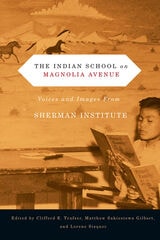
The Indian School on Magnolia Avenue
Voices and Images from Sherman InstituteEdited by Clifford E. Trafzer, Matthew Sakiestewa, and Lorene Sisquoc
Oregon State University Press, 2012
In 1902, the federal government opened Sherman Institute in Riverside, California, to transform American Indian students into productive farmers, carpenters, homemakers, nurses, cooks, and seamstresses. Indian students helped build the school and worked daily at Sherman; teachers provided vocational education and placed them in employment through the Outing Program.
Contributors to The Indian School on Magnolia Avenue have drawn on documents held at the Sherman Indian Museum to explore topics such as the building of Sherman, the school’s Mission architecture, the nursing program, the Special Five-Year Navajo Program, the Sherman cemetery, and a photo essay depicting life at the school.
Despite the fact that Indian boarding schools—with their agenda of cultural genocide— prevented students from speaking their languages, singing their songs, and practicing their religions, most students learned to read, write, and speak English, and most survived to benefit themselves and contribute to the well-being of Indian people.
Scholars and general readers in the fields of Native American studies, history, education, public policy, and historical photography will find
The Indian School on Magnolia Avenue an indispensable volume.

The Indians of Hungry Hollow
Bill Dunlop and Marcia Fountain-Blacklidge
University of Michigan Press, 2004
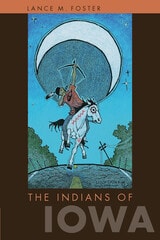
The Indians of Iowa
Foster, Lance M.
University of Iowa Press, 2009
Foster begins with a history of Lewis and Clark’s travels along the Missouri River adjacent to western Iowa. Next, he focuses on the tribes most connected to Iowa from prehistoric times to the present day: the Ioway, Meskwaki, Sauk, Omaha and Ponca, Otoe and Missouria, Pawnee and Arikara, Potawatomi, Illinois Confederacy, Santee and Yankton Sioux, and Winnebago. In between each tribal account, “closer look” essays provide details on Indian women in Iowa, traditional ways of life, Indian history and spirituality, languages and place-names, archaeology, arts and crafts, and houses and landscapes. Finally, Foster brings readers into the present with chapters called “Going to a Powwow,” “Do You Have Indian Blood?” and “Indians in Iowa Today.” The book ends with information about visiting Native American museums, historic sites, and communities in Iowa as well as tribal contacts and a selection of published and online resources.
The story of the Indians of Iowa is long and complicated. Illustrated with maps and stunning original art, Lance Foster’s absorbing, accessible overview of Iowa’s Indian tribes celebrates the rich native legacy of the Hawkeye State. It is essential reading for students, teachers, and everyone who calls Iowa home.
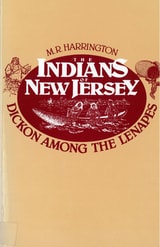
The Indians of New Jersey
Dickon Among the LenapesHarrington, M. R
Rutgers University Press, 1963
In presenting the lore and heritage of the Lenapes, Dr. M.R. Harrington does so through the eyes of a shipwrecked English boy who became a captive of the Indians, and was eventually adopted into the tribe. The narrative is lively reading, and the facts on which it is based are accurate. With the accompanying Clarence Ellsworth line drawings, the reader can understand and even reproduce many of the objects the author describes: the Lenape bows and arrows, muccasins and mats, baskets and bowls.
This new edition is a reissue of an often asked for an unavailable New Jersey classic, first published in 1938.

The Indians of Point of Pines, Arizona
A Comparative Study of Their Physical CharacteristicsKenneth A. Bennett
University of Arizona Press, 1973
The Indians of the Western Great Lakes, 1615 to 1760
W. Vernon Kinietz
University of Michigan Press, 1940

The Indians of the Western Great Lakes, 1615-1760
W. Vernon Kinietz
University of Michigan Press, 1965

The Indies Diaspora in the Netherlands
Essays on Race, Whiteness, and Identity in Dutch LiteratureAlfred Birney; Translated by Annemarie Toebosch and Marjolein van Pagee
Michigan Publishing Services, 2021
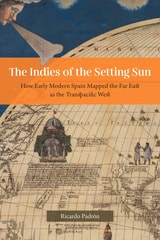
The Indies of the Setting Sun
How Early Modern Spain Mapped the Far East as the Transpacific WestRicardo Padrón
University of Chicago Press, 2020
Narratives of Europe’s westward expansion often tell of how the Americas came to be known as a distinct landmass, separate from Asia and uniquely positioned as new ground ripe for transatlantic colonialism. But this geographic vision of the Americas was not shared by all Europeans. While some imperialists imagined North and Central America as undiscovered land, the Spanish pushed to define the New World as part of a larger and eminently flexible geography that they called las Indias, and that by right, belonged to the Crown of Castile and León. Las Indias included all of the New World as well as East and Southeast Asia, although Spain’s understanding of the relationship between the two areas changed as the realities of the Pacific Rim came into sharper focus. At first, the Spanish insisted that North and Central America were an extension of the continent of Asia. Eventually, they came to understand East and Southeast Asia as a transpacific extension of their empire in America called las Indias del poniente, or the Indies of the Setting Sun.
The Indies of the Setting Sun charts the Spanish vision of a transpacific imperial expanse, beginning with Balboa’s discovery of the South Sea and ending almost a hundred years later with Spain’s final push for control of the Pacific. Padrón traces a series of attempts—both cartographic and discursive—to map the space from Mexico to Malacca, revealing the geopolitical imaginations at play in the quest for control of the New World and Asia.

The Indigenous Anti-Colonial
A Palestinian Resistance Tradition and a World Beyond Settler ColonialismLinda Tabar
Duke University Press, 2026
The Indissolubility of Marriage and the Council of Trent
E. Christian Brugger
Catholic University of America Press, 2017
The Individual Education Planning Committee
A Step in the History of Special EducationWilliam M. Cruickshank, Ph.D., William C. Morse, Ph.D., and James O. Grant, Ph.D.
University of Michigan Press, 1990
The Individual and the Cosmos in Renaissance Philosophy
Ernst Cassirer
University of Chicago Press, 2010
This provocative volume, one of the most important interpretive works on the philosophical thought of the Renaissance, has long been regarded as a classic in its field. Ernst Cassirer here examines the changes brewing in the early stages of the Renaissance, tracing the interdependence of philosophy, language, art, and science; the newfound recognition of individual consciousness; and the great thinkers of the period—from da Vinci and Galileo to Pico della Mirandola and Giordano Bruno. The Individual and the Cosmos in Renaissance Philosophy discusses the importance of fifteenth-century philosopher Nicholas Cusanus, the concepts of freedom and necessity, and the subject-object problem in Renaissance thought.
“This fluent translation of a scholarly and penetrating original leaves little impression of an attempt to show that a ‘spirit of the age’ or ‘spiritual essence of the time’ unifies and expresses itself in all aspects of society or culture.”—Philosophy
The Individual in History
Essays in Honor of Jehuda ReinharzEdited by ChaeRan Y. Freeze, Sylvia Fuks Fried, and Eugene R. Sheppard
Brandeis University Press, 2015

The Individual, Society, and Education
A HISTORY OF AMERICAN EDUCATIONAL IDEASClarence J. Karier
University of Illinois Press, 1986
and Education, which focuses on the concepts of human nature and community
throughout American educational history. For the new edition, Karier has
added chapters on the major movements in American education from World
War II to the present and on the major Supreme Court cases involving educational
policy during the same period.
"This classic volume remains a remarkable study in the history of
ideas into which the implications for American schooling have been deftly
woven. It is balanced, thorough, and intelligently challenging."
--- Ann M. Keppel, College of Education, University of Hawaii at
Manoa
"This new edition should have great use as a primary text at the
graduate and advanced undergraduate levels."
--- Peter A. Sola, School of Education, Howard University

The Individuality of Portugal
A Study in Historical-Political GeographyBy Dan Stanislawski
University of Texas Press, 1959
Many map users have wondered why Portugal, sharing with Spain the Iberian Peninsula, ever became a separate nation. That question is answered with remarkable clarity by Dan Stanislawski. This book also presents an analysis of the factors that produce separate nations and offers a study of the evolution of national cultures generally, especially as they apply to Portugal.
The Indomitable Mary Easton Sibley
Pioneer of Women's Education in MissouriKristie C. Wolferman
University of Missouri Press, 2008
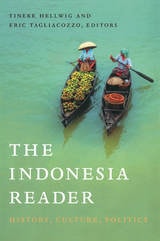
The Indonesia Reader
History, Culture, PoliticsTineke Hellwig and Eric Tagliacozzo, eds.
Duke University Press, 2009
Organized chronologically, the volume addresses early Indonesian civilizations; contact with traders from India, China, and the Arab Middle East; and the European colonization of Indonesia, which culminated in centuries of Dutch rule. Selections offer insight into Japan’s occupation (1942–45), the establishment of an independent Indonesia, and the post-independence era, from Sukarno’s presidency (1945–67), through Suharto’s dictatorial regime (1967–98), to the present Reformasi period. Themes of resistance and activism recur: in a book excerpt decrying the exploitation of Java’s natural wealth by the Dutch; in the writing of Raden Ajeng Kartini (1879–1904), a Javanese princess considered the icon of Indonesian feminism; in a 1978 statement from East Timor objecting to annexation by Indonesia; and in an essay by the founder of Indonesia’s first gay activist group. From fifth-century Sanskrit inscriptions in stone to selections related to the 2002 Bali bombings and the 2004 tsunami, The Indonesia Reader conveys the long history and the cultural, ethnic, and ecological diversity of this far-flung archipelago nation.
The Industrialist and the Mountaineer
The Eastham-Thompson Feud and the Struggle for West Virginia's Timber FrontierRONALD L. LEWIS
West Virginia University Press, 2017
The Eastham-Thompson feud pitted a former Confederate against a member of the new business elite who was, as a northern Republican, his cultural and political opposite. For Lewis, their clash was one flashpoint in a larger phenomenon central to US history in the second half of the nineteenth century: the often violent imposition of new commercial and legal regimes over holdout areas stretching from Appalachia to the trans-Missouri West. Taking a ground-level view of these so-called “wars of incorporation,” Lewis’s powerful microhistory shows just how strongly local communities guarded traditional relationships to natural resources. Modernizers sought to convict Eastham of murder, but juries drawn from the traditionalist population refused to comply. Although the resisters won the courtroom battle, the modernizers eventually won the war for control of the state’s timber frontier.

The Industrialization of São Paulo, 1800-1945
By Warren Dean
University of Texas Press, 1969
São Paulo is one of the few places in the underdeveloped world where an advanced industrial system has grown out of a tropical raw-material-exporting economy. By 1960 there were 830,000 industrial workers in the state, producing $3.3 billion worth of goods. It had become Latin America’s largest industrial center.
This is a study of the early years of manufacturing in São Paulo: how it was influenced by the growth and decline of the coffee trade; where it found its markets, its credit, and its labor force; and how it confronted the competition of imports. The principal focus, however, is on the manufacturers themselves, whose perceptions of their opportunities determined how industrialization was brought about. Warren Dean discusses their social origins, their connections with other sectors of the elite, their attitudes toward workers and consumers, and their view of the potentialities of economic development. He analyzes the political activities of the manufacturers, to discover both how they promoted their interests and how they confronted the larger challenge of social and political transformation.
Paradoxically, the industrialization of São Paulo is not a “success story” of private entrepreneurship. Until after World War II manufacturing grew quite slowly, and its hallmarks were always low productivity, technical backwardness, and consumer hostility. More than half of the state’s present large-scale factory production and nearly all of its heavy industry was built by foreign capital or state enterprise, not by privately owned firms. Dean shows that this outcome is partly a consequence of the historical experience of domestic manufacture.
Throughout the book the author points out the “peculiar articulations” of the industrial system of São Paulo—the significant social and political interests that determined what kinds of development were possible. The result is an exposition of an unusual case study in twentieth-century economic development.

The Infamous Harry Hayward
A True Account of Murder and Mesmerism in Gilded Age MinneapolisShawn Francis Peters
University of Minnesota Press, 2018
A fascinating tale of seduction, murder, fraud, coercion—and the trial of the “Minneapolis Monster”
On a winter night in 1894, a young woman’s body was found in the middle of a road near Lake Calhoun on the outskirts of Minneapolis. She had been shot through the head. The murder of Kittie Ging, a twenty-nine-year-old dressmaker, was the final act in a melodrama of seduction and betrayal, petty crimes and monstrous deeds that would obsess reporters and their readers across the nation when the man who likely arranged her killing came to trial the following spring. Shawn Francis Peters unravels that sordid, spellbinding story in his account of the trial of Harry Hayward, a serial seducer and schemer whom some deemed a “Svengali,” others a “Machiavelli,” and others a “lunatic” and “man without a soul.”
Dubbed “one of the greatest criminals the world has ever seen” by the famed detective William Pinkerton, Harry Hayward was an inveterate and cunning plotter of crimes large and small, dabbling in arson, insurance fraud, counterfeiting, and illegal gambling. His life story, told in full for the first time here, takes us into shadowy corners of the nineteenth century, including mesmerism, psychopathy, spiritualism, yellow journalism, and capital punishment. From the horrible fate of an independent young businesswoman who challenged Victorian mores to the shocking confession of Hayward on the eve of his execution (which, if true, would have made him a serial killer), The Infamous Harry Hayward unfolds a transfixing tale of one of the most notorious criminals in America during the Gilded Age.
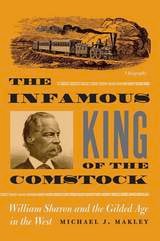
The Infamous King Of The Comstock
William Sharon And The Gilded Age In The WestMichael J. Makley
University of Nevada Press, 2009
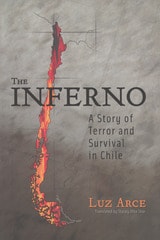
The Inferno
A Story of Terror and Survival in ChileLuz Arce; Translated by Stacey Alba Skar
University of Wisconsin Press, 2004
As a member of Salvador Allende’s Personal Guards (GAP), Luz Arce worked with leaders of the Socialist Party during the Popular Unity Government from 1971 to1973. In the months following the coup, Arce served as a militant with others from the Left who opposed the military junta led by Augusto Pinochet, which controlled the country from 1973 to1990. Along with thousands of others in Chile, Arce was detained and tortured by Chile’s military intelligence service, the DINA, in their attempt to eliminate alternative voices and ideologies in the country. Arce’s testimonial offers the harrowing story of the abuse she suffered and witnessed as a survivor of detention camps, such as the infamous Villa Grimaldi.
But when faced with threats made to her family, including her young son, and with the possibility that she could be murdered as thousands of others had been, Arce began to collaborate with the Chilean military in their repression of national resistance groups and outlawed political parties. Her testimonial thus also offers a unique perspective from within the repressive structures as she tells of her work as a DINA agent whose identifications even lead to the capture of some of her former friends and compañeros.
During Chile’s return to democracy in the early 1990s, Arce experienced two fundamental changes in her life that led to the writing of her story. The first was a deep spiritual renewal through her contacts with the Catholic Church whose Vicariate of Solidarity had fought for human rights in the country during the dictatorship. The second was her decision to participate within the legal system to identify and bring to justice those members of the military who were responsible for the crimes committed from 1973 to1990. Luz Arce’s book invites readers to rethink the definition of testimonial narrative in Latin America through the unique perspective of a survivor-witness-confessor.

The Information Master
Jean-Baptiste Colbert's Secret State Intelligence SystemJacob Soll
University of Michigan Press, 2011
"Colbert has long been celebrated as Louis XIV's minister of finance, trade, and industry. More recently, he has been viewed as his minister of culture and propaganda. In this lively and persuasive book, Jake Soll has given us a third Colbert, the information manager."
---Peter Burke, University of Cambridge
"Jacob Soll gives us a road map drawn from the French state under Colbert. With a stunning attention to detail Colbert used knowledge in the service of enhancing
royal power. Jacob Soll's scholarship is impeccable and his story long
overdue and compelling."
---Margaret Jacob, University of California, Los Angeles
"Nowadays we all know that information is the key to power, and that the masters of information rule the world. Jacob Soll teaches us that Jean-Baptiste Colbert had grasped this principle three and a half centuries ago, and used it to construct a new kind of state. This imaginative, erudite, and powerfully written book re-creates the history of libraries and archives in early modern Europe, and ties them in a novel and convincing way to the new statecraft of Europe's absolute monarchs."
---Anthony Grafton, Princeton University
"Brilliantly researched, superbly told, and timely, Soll's story is crucial for the history of the modern state."
---Keith Baker, Stanford University
When Louis XIV asked his minister Jean-Baptiste Colbert---the man who was to oversee the building of Versailles and the Royal Academy of Sciences, as well as the navy, the Paris police force, and French industry---to build a large-scale administrative government, Colbert created an unprecedented information system for political power. In The Information Master, Jacob Soll shows how the legacy of Colbert's encyclopedic tradition lies at the very center of the rise of the modern state and was a precursor to industrial intelligence and Internet search engines.
Soll's innovative look at Colbert's rise to power argues that his practice of collecting knowledge originated from techniques of church scholarship and from Renaissance Italy, where merchants recognized the power to be gained from merging scholarship, finance, and library science. With his connection of interdisciplinary approaches---regarding accounting, state administration, archives, libraries, merchant techniques, ecclesiastical culture, policing, and humanist pedagogy---Soll has written an innovative book that will redefine not only the history of the reign of Louis XIV and information science but also the study of political and economic history.
Jacob Soll is Associate Professor of History at Rutgers University and the author of Publishing The Prince: History, Reading, and the Birth of Political Criticism (University of Michigan Press, 2005), and winner of the 2005 Jacques Barzun Prize from the American Philosophical Society and a 2009 Guggenheim Fellowship. Soll edited a special issue of Journal of the History of Ideas titled "The Uses of Historical Evidence in Early Modern Europe"; has cofounded the online journal Republics of Letters; and is editor, along with Anthony Grafton and Ann Blair, of the series Cultures of Knowledge in the Early Modern World.

The Information Process
Reporting To Twentieth CenturyRobert W. Desmond
University of Iowa Press, 1978

The Infrastructures of Security
Technologies of Risk Management in JohannesburgMartin J. Murray
University of Michigan Press, 2022
In The Infrastructures of Security, author Martin J. Murray concentrates on not only the turn toward technological solutions to managing the risk of crime through digital (and software-based) surveillance and automated information systems, but also the introduction of somewhat bizarre and fly-by-night experimental “answers” to perceived risk and danger. Digitalized surveillance is significant for two reasons: first, it enables monitoring to take place across wide "geographical distances with little time delay"; and second, it allows for the active sorting, identification, and "tracking of bodies, behaviors, and characteristics of subject populations on a continuous, real-time basis." These new software-based surveillance technologies represent monitoring, tracking, and information gathering without walls, towers, or guards.
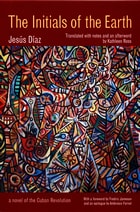
The Initials of the Earth
Jesús Díaz
Duke University Press, 2006
Originally written in the 1970s, then rewritten and published simultaneously in Havana and Madrid in 1987, The Initials of the Earth spans the tumultuous years from the 1950s until the 1970s, encompassing the Revolution and its immediate aftermath. The novel opens as the protagonist, Carlos Pérez Cifredo, sits down to fill out a questionnaire for readmission to the Cuban Communist Party. It closes with Carlos standing before a panel of Party members charged with assessing his merit as an “exemplary worker.” The chapters between relate Carlos’s experiences of the pre- and postrevolutionary era. His family is torn apart as some members reject the Revolution and flee the country while others, including Carlos, choose to stay. He witnesses key events including the Bay of Pigs invasion, the Cuban missile crisis, and the economically disastrous sugar harvest of 1970. Throughout the novel, Díaz vividly renders Cuban culture through humor, slogans, and slang; Afro-Cuban religion; and references to popular music, movies, and comics.
This edition of The Initials of the Earth includes a bibliography and filmography of Diaz’s works and a timeline of the major events of the Cuban revolutionary period. In his epilogue, the Cuban writer Ambrosio Fornet reflects on Díaz’s surprising 1992 renunciation of the Revolution, their decades-long friendship, and the novel’s reception, structure, and place within Cuban literary history.
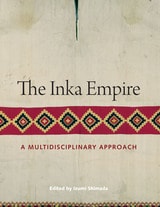
The Inka Empire
A Multidisciplinary ApproachEdited by Izumi Shimada
University of Texas Press, 2015
Massive yet elegantly executed masonry architecture and andenes (agricultural terraces) set against majestic and seemingly boundless Andean landscapes, roads built in defiance of rugged terrains, and fine textiles with orderly geometric designs—all were created within the largest political system in the ancient New World, a system headed, paradoxically, by a single, small minority group without wheeled vehicles, markets, or a writing system, the Inka. For some 130 years (ca. A.D. 1400 to 1533), the Inka ruled over at least eighty-six ethnic groups in an empire that encompassed about 2 million square kilometers, from the northernmost region of the Ecuador–Colombia border to northwest Argentina.
The Inka Empire brings together leading international scholars from many complementary disciplines, including human genetics, linguistics, textile and architectural studies, ethnohistory, and archaeology, to present a state-of-the-art, holistic, and in-depth vision of the Inkas. The contributors provide the latest data and understandings of the political, demographic, and linguistic evolution of the Inkas, from the formative era prior to their political ascendancy to their post-conquest transformation. The scholars also offer an updated vision of the unity, diversity, and essence of the material, organizational, and symbolic-ideological features of the Inka Empire. As a whole, The Inka Empire demonstrates the necessity and value of a multidisciplinary approach that incorporates the insights of fields beyond archaeology and ethnohistory. And with essays by scholars from seven countries, it reflects the cosmopolitanism that has characterized Inka studies ever since its beginnings in the nineteenth century.

The Inner Conflict of Tradition
Essays in Indian Ritual, Kingship, and SocietyJ. C. Heesterman
University of Chicago Press, 1985
The Inner Life of Race
Souls, Bodies, and the History of Racial PowerLeerom Medovoi
Duke University Press, 2024
The Inner Lives of Medieval Inquisitors
Karen Sullivan
University of Chicago Press, 2011
There have been numerous studies in recent decades of the medieval inquisitions, most emphasizing larger social and political circumstances and neglecting the role of the inquisitors themselves. In this volume, Karen Sullivan sheds much-needed light on these individuals and reveals that they had choices—both the choice of whether to play a part in the orthodox repression of heresy and, more frequently, the choice of whether to approach heretics with zeal or with charity.
In successive chapters on key figures in the Middle Ages—Bernard of Clairvaux, Dominic Guzmán, Conrad of Marburg, Peter of Verona, Bernard Gui, Bernard Délicieux, and Nicholas Eymerich—Sullivan shows that it is possible to discern each inquisitor making personal, moral choices as to what course of action he would take. All medieval clerics recognized that the church should first attempt to correct heretics through repeated admonitions and that, if these admonitions failed, it should then move toward excluding them from society. Yet more charitable clerics preferred to wait for conversion, while zealous clerics preferred not to delay too long before sending heretics to the stake. By considering not the external prosecution of heretics during the Middles Ages, but the internal motivations of the preachers and inquisitors who pursued them, as represented in their writings and in those of their peers, The Inner Lives of Medieval Inquisitors explores how it is that the most idealistic of purposes can lead to the justification of such dark ends.
The Inner World of Abraham Lincoln
Michael Burlingame
University of Illinois Press, 1994
The Inquisition in Hollywood
Politics in the Film Community, 1930-60Larry Ceplair and Steven Englund
University of Illinois Press, 1979
The definitive work on the Hollywood blacklist era
The Inquisition in Hollywood examines the suppression of radical political activity in the film industry from the days of the Great Depression through the tumultuous House Un-American Activities Commission era to the waning days of the infamous blacklist.
Although this thirty-year period of American history is marked by widespread targeting of leftists in all areas of life, those in the film industry–-predominately screenwriters–-were considered to be in positions of great potential indoctrinating power, and found themselves under intense scrutiny as the Cold War hysteria mounted.
Ceplair and Englund trace the history of political struggle in Hollywood back to the formation of the Screen Writers Guild in 1933. Many of the blacklisted filmmakers were members of the Communist Party and all of the graylisted filmmakers had expressed their sympathy with progressive (mainly anti-fascist) causes.
Although no Hollywood Communist has ever been linked to espionage or sabotage, and charges of subversive indoctrination have no basis in documented fact, this book powerfully shows how devastating a mere suspicion or insinuation of guilt could be during the era of the Red Menace.
Twenty-two years after its initial publication, The Inquisition in Hollywood remains the definitive work on the blacklist era, and this new edition features a new introduction by the authors.

The Inquisition of Francisca
A Sixteenth-Century Visionary on TrialFrancisca de los Apóstoles
University of Chicago Press, 2005
This book contains what little is known about Francisca—the several letters she wrote as well as the transcript of her trial—and offers modern readers a perspective on the unique role and status of religious women in sixteenth-century Spain. Chronicling the drama of Francisca's interrogation and her spirited but ultimately unsuccessful defense, The Inquisition of Francisca—transcribed from more than three hundred folios and published for the first time in any language—will be a valuable resource for both specialists and students of the history and religion of Spain in the sixteenth century.
The Inquisitor's Tongue
A NovelAlan Singer
University of Alabama Press, 2012
Alan Singer’s riveting new novel, The Inquisitor’s Tongue, reimagines the Spanish Inquisition as a world in which spiritual horrors and acts of violence are the birth pangs of otherwise unimaginable identities.