Results by title
4030 books match the query 'Language Arts & Disciplines' and 760 start with t

The First-year Experience Cookbook
Raymond Pun
Assoc of College & Research Libraries, 2017
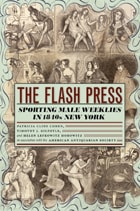
The Flash Press
Sporting Male Weeklies in 1840s New YorkPatricia Cline Cohen, Timothy J. Gilfoyle, Helen Lefkowitz Horowitz, in association with the American Antiquarian Society
University of Chicago Press, 2008
The Force of Fantasy
Restoring the American DreamErnest G. Borman
Southern Illinois University Press, 2000
In this book, first published in 1985, Ernest G. Bormann explores mass persuasion in America from 1620 to 1860, examining closely four rhetorical communities: the revivals of 1739–1740, the hot gospel of the postrevolutionary period, the evangelical revival and reform of the 1830s, and the Free Soil and Republican parties. Each community varies greatly, but Bormann asserts that each succeeding community shares a rhetorical vision of restoring the “American Dream” that is essentially a modification of the previous visions. Thus, they form a family of rhetorical visions that constitutes a rhetorical tradition of importance in nineteenth-century American popular culture.

The Frugal Librarian
Carol American Library Association
American Library Association, 2011
The Fun Of Motivation
Crossing The Threshold Concepts-Pub#71Mary Francis
American Library Association, 2017
The Future Academic Librarians Toolkit
FindingMegan Hodge
Assoc of College & Research Libraries, 2019
The Future of Memory
A History of Lossless Format Standards in the Moving Image ArchiveJimi Jones and Marek Jancovic
University of Illinois Press, 2025
Drawing on interviews with archivists and developers, Jones and Jancovic reveal the archive as a dynamic space where deeply entrenched social practices produce disagreements but also resourceful collaborations. They contrast the unprecedented rise of archivist-driven standardization and controversies around non-standard technology with the historical dominance of the film and broadcast industries. Throughout, the authors clarify the role of tech companies, software developers, film pirates, hackers, and other players with poorly understood roles in the process.
A timely look at the state of audiovisual preservation, The Future of Memory provides a history of recent innovations alongside a snapshot of a field in the midst of profound technological change.
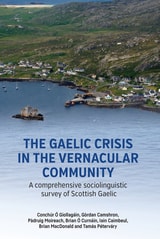
The Gaelic Crisis in the Vernacular Community
A Comprehensive Sociolinguistic Survey of Scottish GaelicConchúr Ó Giollagáin, Gòrdan Camshron, Pàdruig Moireach, Brian Ó Curnáin, Iain Caimbeul, Brian MacDonald and Tamás Péterváry
Aberdeen University Press, 2020
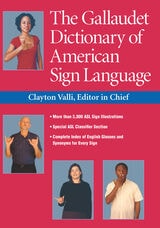
The Gallaudet Dictionary of American Sign Language
Clayton Valli
Gallaudet University Press, 2021
Created by an unparalleled board of experts led by renowned ASL linguist and poet Clayton Valli, The Gallaudet Dictionary of American Sign Language contains over 3,000 illustrations. Each sign illustration, including depictions of fingerspelling when appropriate, incorporates a complete list of English synonyms. A full, alphabetized English index enables users to cross-reference words and signs throughout the entire volume.
The comprehensive introduction lays the groundwork for learning ASL by explaining in plain language the workings of ASL syntax and structure. It also offers examples of idioms and describes the antecedents of ASL, its place in the Deaf community, and its meaning in Deaf culture. This extraordinary reference also provides a special section on ASL classifiers and their use. Readers will find complete descriptions of the various classifiers and examples of how to use these integral facets of ASL. The Gallaudet Dictionary of American Sign Language is an outstanding ASL reference for all instructors, students, and users of ASL.
*Please note that this paperback edition does not include the DVD found in the hardcover edition.
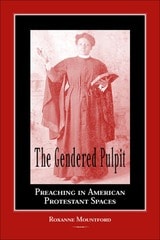
The Gendered Pulpit
Preaching in American Protestant SpacesRoxanne Mountford
Southern Illinois University Press, 2005
In this feminist investigation into the art of preaching—one of the oldest and least studied rhetorical traditions—Roxanne Mountford explores the relationship between bodies, space, race, and gender in rhetorical performance and American Protestant culture. Refiguring delivery and physicality as significant components of the rhetorical situation, The Gendered Pulpit: Preaching in American Protestant Spaces examines the strategies of three contemporary women preachers who have transgressed traditions, rearranged rhetorical space, and conquered gender bias to establish greater intimacy with their congregations.
Mountford’s examinations of the rhetoric inherent in preaching manuals from 1850 to the present provide insight into how “manliness” has remained a central concept in American preaching since the mid-nineteenth century. The manuals illustrate that the character, style, method of delivery, and theological purpose of preachers focused on white men and their cultural standing, leaving contemporary women preachers searching for ways to accommodate themselves to the physicality of preaching.
Three case studies of women preachers who have succeeded or failed in rearranging rhetorical space provide the foundation for the volume. These contemporary examples have important implications for feminist theology and also reveal the importance of gender, space, and bodies to studies of rhetoric in general. Mountford explores the geographies of St. John’s Lutheran Church and the preaching of Rev. Patricia O’Connor who reformed rhetorical space through the delivery of her sermons. At Eastside United Church of Christ, Mountford shows, Rev. Barbara Hill employed narrative style and prophetic utterance in the tradition of black preaching to address gender bias and institute change in her congregation. The final case study details the experiences of Pastor Janet Moore and her struggles at Victory Hills United Methodist Church, where the fractured congregation could not be united even with Pastor Moore’s focus on theological purpose and invention strategies.
The Genealogical Imagination
Two Studies of Life over TimeMichael Jackson
Duke University Press, 2021
The Generic Book
The Semantics of GenericsEdited by Gregory N. Carlson and Francis Jeffry Pelletier
University of Chicago Press, 1995
The Geometry of Visual Phonology
Linda Ann N. Uyechi
CSLI, 1996
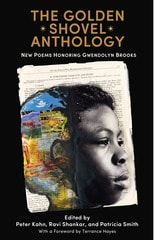
The Golden Shovel Anthology
New Poems Honoring Gwendolyn BrooksPeter Kahn
University of Arkansas Press, 2019
—Claudia Rankine in the New York Times
The Golden Shovel Anthology celebrates the life and work of poet and civil rights icon Gwendolyn Brooks through a dynamic new poetic form, the Golden Shovel, created by National Book Award–winner Terrance Hayes.
An array of writers—including winners of the Pulitzer Prize, the T. S. Eliot Prize, and the National Book Award, as well as a couple of National Poets Laureate—have written poems for this exciting new anthology: Rita Dove, Billy Collins, Danez Smith, Nikki Giovanni, Sharon Olds, Tracy K. Smith, Mark Doty, Sharon Draper, Richard Powers, and Julia Glass are just a few of the contributing poets.
This second edition includes Golden Shovel poems by two winners and six runners-up from an international student poetry competition judged by Nora Brooks Blakely, Gwendolyn Brooks’s daughter. The poems by these eight talented high school students add to Ms. Brooks’s legacy and contribute to the depth and breadth of this anthology.
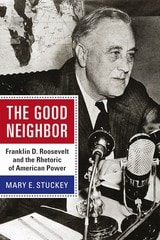
The Good Neighbor
Franklin D. Roosevelt and the Rhetoric of American PowerMary E. Stuckey
Michigan State University Press, 2013
No modern president has had as much influence on American national politics as Franklin D. Roosevelt. During FDR’s administration, power shifted from states and localities to the federal government; within the federal government it shifted from Congress to the president; and internationally, it moved from Europe to the United States. All of these changes required significant effort on the part of the president, who triumphed over fierce opposition and succeeded in remaking the American political system in ways that continue to shape our politics today. Using the metaphor of the good neighbor, Mary E. Stuckey examines the persuasive work that took place to authorize these changes. Through the metaphor, FDR’s administration can be better understood: his emphasis on communal values; the importance of national mobilization in domestic as well as foreign affairs in defense of those values; his use of what he considered a particularly democratic approach to public communication; his treatment of friends and his delineation of enemies; and finally, the ways in which he used this rhetoric to broaden his neighborhood from the limits of the United States to encompass the entire world, laying the groundwork for American ideological dominance in the post–World War II era.
The Good, the Great, and the Unfriendly
A Librarian's Guide to Working with Friends GroupsSally Gardner Reed
American Library Association, 2017
The Grammar of Negation
Jong-Bok Kim
CSLI, 2000
The Grammatical Structures of English and Spanish
Robert P. Stockwell, J. Donald Bowen, and John W. Martin
University of Chicago Press, 1965

The Grand Old Man and the Great Tradition
Essays on Tanizaki Jun’ichiro in Honor of Adriana BoscaroLuisa Bienati and Bonaventura Ruperti, Editors
University of Michigan Press, 2009
The Great Eskimo Vocabulary Hoax and Other Irreverent Essays on the Study of Language
Geoffrey K. Pullum
University of Chicago Press, 1991
Geoffrey K. Pullum's writings began as columns in Natural Language and Linguistic Theory in 1983. For six years, in almost every issue, under the banner "TOPIC. . .COMMENT," he published a captivating mélange of commentary, criticism, satire, whimsy, and fiction. Those columns are reproduced here—almost exactly as his friends and colleagues originally warned him not to publish them—along with new material including a foreword by James D. McCawley, a prologue, and a new introduction to each of these clever pieces. Whether making a sneak attack on some sacred cow, delivering a tongue-in-cheek protest against current standards, or supplying a caustic review of some recent development, Pullum remains in touch with serious concerns about language and society. At the same time, he reminds the reader not to take linguistics too seriously all of the time.
Pullum will take you on an excursion into the wild and untamed fringes of linguistics. Among the unusual encounters in store are a conversation between Star Trek's Commander Spock and three real earth linguists, the strange tale of the author's imprisonment for embezzling funds from the Campaign for Typographical Freedom, a harrowing account of a day in the research life of four unhappy grammarians, and the true story of how a monograph on syntax was suppressed because the examples were judged to be libelous. You will also find a volley of humorous broadsides aimed at dishonest attributional practices, meddlesome copy editors, mathematical incompetence, and "cracker-barrel philosophy of science." These learned and witty pieces will delight anyone who is fascinated by the quirks of language and linguists.

The Great Reporters
David Randall
Pluto Press, 2005
This unique book is the first to try and answer this question. Author David Randall searched nearly two centuries of newspapers and magazines, consulted editors and journalism experts worldwide, and the result is The Great Reporters---13 in-depth profiles of the best journalists who ever lived. They include nine Americans and four Britons, ten men and three women, whose lives were full of adventure, wit, and the considerable ingenuity required to bring the story home. Among chapters are those on the reporter who:
Booked himself onto a ship likely to be sunk by the Germans so he could report its torpedoing Was called out to a multiple shooting, who interviewed 50 witnesses, went back to the office, and wrote a Pulitzer Prize-winning story of 4,000 words in two and a half hours Was deemed useless by her teacher but who went on to become the greatest crime reporter in history Wrote a story that changed the map of Europe Out-bluffed a top Soviet official to get into Russia so he could cover the appalling famine there Feigned madness to get herself locked up in an asylum so she could expose its terrible conditions Was the best ever to apply words to newsprint Became a national hero in America because he stood up for the little guy and his war reporting told it like it really was At the age of 63, and after three major operations, went under-cover in Iran so she could report on the regime's repression Was nearly fired for fouling up his first major assignment, but went on to shock his nation with his courageous war reporting Wrote faster than anyone who could write better and better than anyone who could write faster Single-handedly took on the tobacco industry Said no to William Randolph Hearst
Each profile tells of the reporter's life and his or her major stories, how they were obtained, and their impact. Packed with anecdotes, and inspiring accounts of difficulties overcome, the book quotes extensively from each reporter's work. It also includes an essay on the history of reporting, charting the technologies, economics, and attitudes that made it the way it is---from the invention of the telegraph to the Internet. The Great Reporters is not just the story of 13 remarkable people, it is the story of how society's information hunter-gatherers succeed in bringing us all what we need to know.
The Greening of America’s Libraries
LEEDing the WayMary M. Carr
Assoc of College & Research Libraries, 2013
The Greening of America’s Libraries
LEEDing the WayMary M. Carr
Assoc of College & Research Libraries, 2013
The Grounded Instruction Librarian
Participating in The Scholarship of Teaching and LearningMelissa Mallon
Assoc of College & Research Libraries, 2019
The Handbook for Storytellers
Judy Freeman
American Library Association, 2015
The Handbook for Storytime Programs
Judy Freeman
American Library Association, 2015
The Haunted West
Memory and Commemoration at the Buffalo Bill Center of the WestGreg Dickinson, Eric Aoki, and Brian L. Ott
University of Alabama Press, 2024
Through incisive analysis of the museum’s five institutions, Greg Dickinson and his coauthors reveal how narratives of Native American heritage, violent colonial settlement, Western art, natural history, and ever‑present gun culture collide to shape a haunted sense of American identity. By tracing the tensions between what is memorialized, what is mythologized, and what is suppressed, the authors expose the ghosts that linger in contemporary understandings of the West and offer a compelling rethinking of how memory and commemoration continue to influence the nation’s cultural imagination.
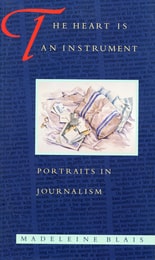
The Heart Is an Instrument
Portraits in JournalismMadeleine Blais
University of Massachusetts Press, 1992
From the Foreword by Geneva Overholser
What is it about really fine writers, how they delight, intrigue, compel us?
Style, you say. But style is not something you begin with. Rather, it's what you end up with, a result of far more fundamental traits. Traits such as an ear and an eye and a heart, traits that Madeleine Blais has honed superbly well.
This is a book well named: The Heart Is an Instrument: Portraits in Journalism. The heart is surely first among Blais's gifts. Whether she is writing about the famous—playwright Tennessee Williams, novelist Mary Gordon—or about the least elevated among us—a teenage prostitute infected with the AIDS virus, a homeless schizophrenic—she brings to her subjects an incomparable empathy.
The Heart of Librarianship
Attentive, Positive, and Purposeful ChangeMichael Stephens
American Library Association, 2016
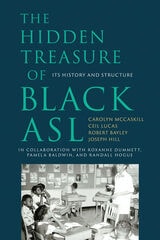
The Hidden Treasure of Black ASL
Its History and StructureCarolyn McCaskill
Gallaudet University Press, 2020
Black ASL has long been recognized as a distinct variety of American Sign Language based on abundant anecdotal evidence. The Hidden Treasure of Black ASL, originally published in 2011, presents the first sociohistorical and linguistic study of this language variety. Based on the findings of the Black ASL Project, which undertook this unprecedented research, Hidden Treasure documents the stories and language of the African American Deaf community. With links to online supplemental video content that includes interviews with Black ASL users (formerly on DVD), this volume is a groundbreaking scholarly contribution and a powerful affirmation for Black Deaf people.
This paperback edition includes an updated foreword by Glenn B. Anderson, a new preface that reflects on the impact of this research, and an expanded list of references and resources on Black ASL.
The supplemental video content is available online at the Gallaudet University Press YouTube Channel. Under Playlists, click “The Hidden Treasure of Black ASL: Companion Video to the Book.” The original Black ASL Project research videos are also available.
Featured in the film Signing Black in America: The Story of Black ASL, produced by The Language and Life Project at North Carolina State University (Dr. Walt Wolfram, Executive Producer). Look for it on PBS.
The High-Impact Digital Library
Innovative Approaches for Outreach and InstructionAnna Neatrour, Jeremy Myntti, Rachel Jane Wittmann, Rebekah Cummings, Jane Monson, and Megan Myres McMillan, in collaboration with Core Publishing
American Library Association, 2025
- discusses the results of a unique survey that provides new and structured information on digital library outreach and instruction;
- presents outreach case studies illustrating uses of social media promotion, integration of digital collections into teaching and instruction activities, partnerships with external campus units or community organizations, and other activities;
- explores many types of instruction, from drop-in class sessions and training to course-integrated instruction and ways that digital library practitioners can contribute to the Open Educational Resources (OER) and open pedagogy movements;
- details the digital humanities and digital scholarship programs developed at the University of Utah by many of the authors through cross-departmental collaboration;
- describes the ways in which the pandemic spurred many institutions to use rapid response collecting to practice community engagement; and
- speculates on future directions for outreach and instruction for digital libraries.
The Hipster Librarian's Guide to Teen Craft Projects
Tina Coleman
American Library Association, 2009
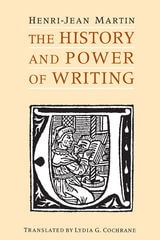
The History and Power of Writing
Henri-Jean Martin
University of Chicago Press, 1994
Traversing four millennia, Martin offers a chronicle of writing as a cultural system, a means of communication, and a history of technologies. He shows how the written word originated, how it spread, and how it figured in the evolution of civilization. Using as his center the role of printing in making the written way of thinking dominant, Martin examines the interactions of individuals and cultures to produce new forms of "writing" in the many senses of authorship, language rendition, and script.
Martin looks at how much the development of writing owed to practical necessity, and how much to religious and social systems of symbols. He describes the precursors to writing and reveals their place in early civilization as mnemonic devices in service of the spoken word. The tenacity of the oral tradition plays a surprisingly important part in this story, Martin notes, and even as late as the eighteenth century educated individuals were trained in classical rhetoric and preferred to rely on the arts of memory. Finally, Martin discusses the changes to writing wrought by the electronic revolution, offering invaluable insights into the influence these new technologies have had on children born into the computer age.
The History of Tense/Aspect/Mood/Voice in the Mayan Verbal Complex
By John S. Robertson
University of Texas Press, 1992
Mayan civilization, renowned for its mathematics, writing, architecture, religion, calendrics, and agriculture, fascinates scholars and a wide lay public as archaeology and glyphic decipherment reveal more of its secrets. In this pathfinding study of the Mayan language family, John S. Robertson explores major changes that have occurred in the core of Mayan grammar from the earliest, reconstructed ancestral language down through the colonial languages to the modern languages that are spoken today.
Building on groundwork already laid in phonological studies and in the study of the pronominal system, Robertson's examination of tense/ aspect/ mood/voice is the next logical step in the general linguistic study of Mayan. Robertson offers careful consideration of all the major subgroups of Mayan, from Yucatecan to Quichean, as they are spoken today. He also draws extensively on colonial documents assembled by bilingual Spanish-Mayan speaking clerics. These documents provide a check on the accuracy of both the reconstructed ancient language, Common Mayan, and the theoretical evolution of the modern languages from this ancestor. The study will also be of value to students of the Maya glyphs, since it discusses the grammatical system that most probably underlies the glyphic representations.
Beyond its obvious interest for Mayan linguistics, the study proposes a theory of language change that will be important for all students of comparative linguistics. Robertson's work sets forth the basic, universal assumptions that provide for an appropriate description of the grammatical systems of all languages. It will be a significant reference for future researchers.
The Holiday Handbook
700+ Storytime Activities from Arbor Day to Yom Kippur…from Diwali to Kwanzaa to RamadanBarbara A. Scott
American Library Association, 2012
The Holocaust & the Exile of Yiddish
A History of the Algemeyne EntsiklopedyeBarry Trachtenberg
Rutgers University Press, 2022
The Holocaust & the Exile of Yiddish untangles the complicated saga of the Algemeyne entsiklopedye and its editors. The editors continued to publish volumes and revise the encyclopedia’s mission while their primary audience, Eastern European Jews, faced persecution and genocide under Nazi rule, and the challenge of reestablishing themselves in the first decades after World War II. Historian Barry Trachtenberg reveals how, over the course of the middle decades of the twentieth century, the project sparked tremendous controversy in Jewish cultural and political circles, which debated what the purpose of a Yiddish encyclopedia should be, as well as what knowledge and perspectives it should contain. Nevertheless, this is not only a story about destruction and trauma, but also one of tenacity and continuity, as the encyclopedia’s compilers strove to preserve the heritage of Yiddish culture, to document its near-total extermination in the Holocaust, and to chart its path into the future.
The Homesick Phone Book
Addressing Rhetorics in the Age of Perpetual ConflictCynthia Haynes
Southern Illinois University Press, 2016
Terrorist attacks, war, and mass shootings by individuals occur on a daily basis all over the world. In The Homesick Phone Book, author Cynthia Haynes examines the relationship of rhetoric to such atrocities. Aiming to disrupt conventional modes of rhetoric, logic, argument, and the teaching of writing, Haynes illuminates rhetoric’s ties to horrific acts of violence and the state of perpetual conflict around the world, both in the Holocaust era and more recently.
Each chapter, marked by a physical address, functions as a kind of expanded phone book entry, with a discussion of violent events at a particular location giving way to explorations of larger questions related to rhetoric and violence. At the core of the work is Haynes’s call for a writing pedagogy based on abstraction that would allow students to appeal to emotional and ethical grounds in composing arguments. Written in a lyrical style, the book weaves rhetorical theories, poetics, philosophy, works of art, and personal experience into a complex, compelling, and innovative mode of writing.
Ultimately, The Homesick Phone Book demonstrates how scholars of rhetoric and writing studies can break their dependence on conventional argument and logic to discover what might be possible if we dive into and become lost within the very concepts and events that frighten and terrorize us.
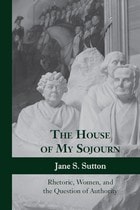
The House of My Sojourn
Rhetoric, Women, and the Question of AuthorityJane S. Sutton
University of Alabama Press, 2010
Employing the trope of architecture, Jane Sutton envisions the relationship between women and rhetoric as a house: a structure erected in ancient Greece by men that, historically, has made room for women but has also denied them the authority and agency to speak from within. Sutton’s central argument is that all attempts to include women in rhetoric exclude them from meaningful authority in due course, and this exclusion has been built into the foundations of rhetoric.
Drawing on personal experience, the spatial tropes of ancient Greek architecture, and the study of women who attained significant places in the house of rhetoric, Sutton highlights a number of decisive turns where women were able to increase their rhetorical access but were not able to achieve full authority, among them the work of Frances Wright, Lucy Stone, and suffragists Mott, Anthony, and Stanton; a visit to the 1893 World’s Columbian Exposition in Chicago, where the busts that became the Portrait Monument were displayed in the Woman’s Building (a sideshow, in essence); and a study of working-class women employed as telephone operators in New York in 1919.
With all the undeniable successes—socially, politically, and financially— of modern women, it appears that women are now populating the house of rhetoric as never before. But getting in the house and having public authority once inside are not the same thing. Sutton argues that women “can only act as far as the house permits.” Sojourn calls for a fundamental change in the very foundations of rhetoric.
The Iconoclastic Imagination
Image, Catastrophe, and Economy in America from the Kennedy Assassination to September 11Ned O'Gorman
University of Chicago Press, 2015
In The Iconoclastic Imagination, Ned O’Gorman approaches each of these moments as an image of icon-destruction that give us distinct ways to imagine social existence in American life. He argues that the Cold War gave rise to crises in political, aesthetic, and political-aesthetic representations. Locating all of these crises within a “neoliberal imaginary,” O’Gorman explains that since the Kennedy assassination, the most powerful way to see “America” has been in the destruction of representative American symbols or icons. This, in turn, has profound implications for a neoliberal economy, social philosophy, and public policy. Richly interwoven with philosophical, theological, and rhetorical traditions, the book offers a new foundation for a complex and innovative approach to studying Cold War America, political theory, and visual culture.
The Idea of a Writing Laboratory
Neal Lerner
Southern Illinois University Press, 2009
The Idea of a Writing Laboratory is a book about possibilities, about teaching and learning to write in ways that can transform both teachers and students.
Author Neal Lerner explores higher education’s rich history of writing instruction in classrooms, writing centers and science laboratories. By tracing the roots of writing and science educators’ recognition that the method of the lab––hands-on student activity—is essential to learning, Lerner offers the hope that the idea of a writing laboratory will be fully realized more than a century after both fields began the experiment.
Beginning in the late nineteenth century, writing instructors and science teachers recognized that mass instruction was inadequate for a burgeoning, “non-traditional” student population, and that experimental or laboratory methods could prove to be more effective. Lerner traces the history of writing instruction via laboratory methods and examines its successes and failures through case studies of individual programs and larger reform initatives. Contrasting the University of Minnesota General College Writing Laboratory with the Dartmouth College Writing Clinic, for example, Lerner offers a cautionary tale of the fine line between experimenting with teaching students to write and “curing” the students of the disease of bad writing.
The history of writing within science education also wends its way through Lerner’s engaging work, presenting the pedagogical origins of laboratory methods to offer educators in science in addition to those in writing studies possibilities for long-sought after reform. The Idea of a Writing Laboratory compels readers and writers to “don those white coats and safety glasses and discover what works” and asserts that “teaching writing as an experiment in what is possible, as a way of offering meaning-making opportunities for students no matter the subject matter, is an endeavor worth the struggle.”
The Imposter's Guide to Writing About Literature
Suzanne Manizza Roszak
Rutgers University Press, 0
A handbook for students of literature with particular attention to all those who have ever been made to feel like outsiders in our field, The Imposter’s Guide to Writing About Literature democratizes access to the knowledge necessary for successful professionalization—and especially publication—within literary studies.
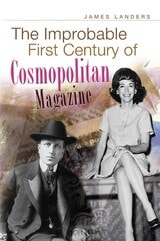
The Improbable First Century of Cosmopolitan Magazine
James Landers
University of Missouri Press, 2010

The Improbable Life of the Arkansas Democrat
An Oral HistoryJerry McConnell
University of Arkansas Press, 2016
The Improbable Life of the Arkansas Democrat is based on more than one hundred interviews with employees of the Democrat, including editors, reporters, feature writers, cartoonists, circulation managers, business managers, salespeople, typesetters and others, from the 1930s through the early 1990s, when the Democrat took over the more prominent Arkansas Gazette after an aggressive newspaper war.
This new addition to Arkansas journalism history provides vivid details about what it was like to work at the Democrat. August Engel, who led the paper with focused devotion for forty-two years, was famous for his thrift, creating austere conditions that included no air conditioning in the newsroom and sub-par wages. In spite of these drawbacks, the paper was still home to many dedicated journalism professionals endeavoring to do good work.
Readers who remember the ultimate acrimony between the two papers may be surprised to learn that for many years the Democrat and the Gazette owners operated under a tacit agreement of civility. The papers didn’t raid each other’s staff, for example, and when a fire broke out in the Gazette pressroom, Democrat management offered to loan the use of its press. Staffers recall that when the Gazette struggled with an advertising boycott and reduced circulation during the Little Rock Central High crisis because of its perceived progressive editorial stance, which infuriated many Arkansans, the Democrat did less than it might have to capitalize. The eventual newspaper war that combined the two rivals saw the end of any semblance of civility when the Democrat hired an aggressive and infamous managing editor named John Robert Starr.
Through these firsthand stories of those who lived it, The Improbable Life of the Arkansas Democrat tells the story of how the second-place paper overtook the oldest newspaper west of the Mississippi, forever changing not only Arkansas journalism but also Arkansas history.
The Inclusive Work of Global Rhetorics
Moushumi Biswas
Utah State University Press, 2026
Envisioning the next step in the ongoing scholarly movement advocating inclusion of global rhetorics in the composition curriculum, The Inclusive Work of Global Rhetorics demonstrates that the question of why or whether to incorporate tenets of global/non-Western rhetorics into writing is long past. The focus has shifted to how to make this change—and to the best practices of such inclusion.
This book showcases the latest scholarship on rethinking the borders of traditional rhetorical studies, which are typically drawn within Greco-Roman and Euro-American confines, with the objective of incorporating non-Eurocentric rhetorical tenets into rhetoric and composition. This work fosters a spirit of inclusivity in the writing classroom by incorporating the many ways of rhetorical thinking gleaned from global/non-Western communication practices while also reflecting on their situatedness and intersectionalities.
Sitting at the crossroads of theory, methodology, and pedagogy, The Inclusive Work of Global Rhetoric puts in perspective a landmark moment in rhetorical studies, a time when it has become imperative to acknowledge the proliferation of non-Western rhetorical traditions in rhetorical practices and communication. Providing heuristics for creating inclusive composition/rhetoric pedagogy, this book serves students, teachers, scholars, and researchers of rhetoric, writing, and communication as both a classroom guide and a reference at the undergraduate and graduate level
The Indispensable Academic Librarian
Teaching and Collaborating for ChangeMichelle Reale
American Library Association, 2018
The Indo-European Dialects
Antoine Meillet
University of Alabama Press, 1967
The Indo‑European Dialects is a foundational work of historical linguistics that investigates how the Indo‑European language family diversified into its major regional branches. Originally delivered as lectures and first published in the early twentieth century, the book remains essential reading for understanding how phonological, morphological, and lexical evidence reveals ancient patterns of language contact, migration, and cultural development. Including Indo‑European, Indo‑Iranian, Greek, Italic (including Latin), Celtic, Germanic, Baltic, Slavic, Armenian, Albanian, Anatolian, and Tocharian, Meillet’s comparative approach situates dialect differences within a broader historical framework, making this volume a lasting contribution to Indo‑European studies and to the methods of linguistic reconstruction more generally.
The author, Antoine Meillet, was one of the most influential linguists of the twentieth century and a central figure in the development of Indo‑European comparative grammar. This edition is expertly translated by Samuel N. Rosenberg, whose careful scholarship preserves Meillet’s analytical precision while making the work accessible to modern English‑language readers. The volume is further enhanced by scholarly notes, bibliographical references, and indexes that increase its usefulness for research and teaching.
This book will be of interest to linguists, philologists, classicists, and historians of language, as well as graduate and advanced undergraduate students studying historical linguistics. It will also appeal to readers interested in how language evidence informs the study of prehistoric societies and cultural connections across Europe and Asia.
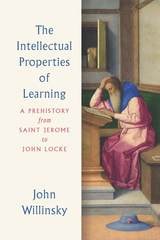
The Intellectual Properties of Learning
A Prehistory from Saint Jerome to John LockeJohn Willinsky
University of Chicago Press, 2017
Willinsky begins with Saint Jerome in the fifth century, then traces the evolution of reading, writing, and editing practices in monasteries, schools, universities, and among independent scholars through the medieval period and into the Renaissance. He delves into the influx of Islamic learning and the rediscovery of classical texts, the dissolution of the monasteries, and the founding of the Bodleian Library before finally arriving at John Locke, whose influential lobbying helped bring about the first copyright law, the Statute of Anne of 1710. Willinsky’s bravura tour through this history shows that learning gave rise to our idea of intellectual property while remaining distinct from, if not wholly uncompromised by, the commercial economy that this concept inspired, making it clear that today’s push for marketable intellectual property threatens the very nature of the quest for learning on which it rests.
The Interaction of Tone with Voicing and Foot Structure
Evidence from Kera Phonetics and PhonologyMary D. Pearce
CSLI, 2013
This book investigates the topics of tone, vowel harmony, and metrical structure, with special reference to Kera, a Chadic language spoken in Chad and Cameroon. Kera is a tone language where a change in the pitch of the word can make a difference to its meaning. Drawing on a decade of experience living and working with the Kera, Mary D. Pearce looks at both the phonetics and phonology to examine how tone interacts with the vowel quality and rhythm of the language. The implications arising from this research are relevant for phonologists and Africanists far beyond the boundaries of Chad and should be useful to anyone working on languages with interesting tonal and rhythmic properties.
The International Student's Guide to Writing a Research Paper
Janine Carlock, Maeve Eberhardt, Jaime Horst, Peter Kolenich
University of Michigan Press, 2017
Each section of the book includes a discrete task called a Building Block, which requires students to apply the skills learned toward the development of their own paper. This step-by-step approach allows students to construct knowledge as they become more familiar with the process, making writing a research paper a less intimidating task.
Special features:
- This guide uses simple direct language for those for whom writing a research paper is new.
- Most example writing is from international students in an ESL program or first-year writing class, including two sample papers—one in APA and one in MLA.
- A section on responding to instructor feedback to provide students with the tools to read and understand comments and use them to improve the first draft.
- A subsection dedicated to constructing clear and cohesive paragraphs and sentences.
- The guide includes citation and style examples in MLA 8th edition.
The Interpretation of Dialogue
Edited by Tulio Maranhão
University of Chicago Press, 1990