Results by title
8812 books match the query 'Political Science' and 1911 start with t
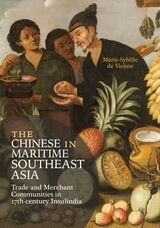
The Chinese in Maritime Southeast Asia
Trade and Merchant Communities in 17th-century InsulindiaMarie-Sybille de Vienne
National University of Singapore Press, 2025
Connections between Asian and European markets increased dramatically in the seventeenth century, indicating a turning point in the global history of trade. The Dutch East-India Company (or VOC) was central to this process; however, counter to the VOC’s aims, the winners of the game in maritime Southeast Asia were often Chinese merchants. As this book shows, at the time, these merchants were the only economic agents capable of trading both in major Southeast Asian commercial hubs and developing exchanges with China and Japan. The Chinese operated with a flexibility of means and a fluidity of management that allowed them to react rapidly and quickly gain returns on investment. In Batavia, as in other Southeast Asian emporiums, the increasingly numerous and diverse Chinese elites assumed direct responsibility for the management of their community; this made them the most important non-European free community in the city during the second half of the seventeenth century.
The Chinese in Maritime Southeast Asia tells this remarkable story through an examination of the VOC’s abundant sources, which record relations between the Chinese minority and the Dutch rulers who relied upon them.
The Choice-of-Law Process
David F. Cavers
University of Michigan Press, 1981
The Christ Child Goes to Court
Wayne R. Swanson
Temple University Press, 1992
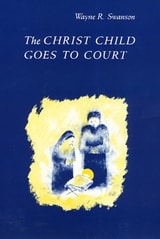
In December 1981, when the American Civil Liberties Union challenged the Nativity scene in the Christmas display put on by the city of Pawtucket, Rhode Island, an emotional controversy erupted. Two federal courts disallowed the crèche because its religious impact in the taxpayer-supported display overstepped the constitutional boundary between church and state. In March 1984, the United States Supreme Court by a 5-4 vote in Lynch V. Donnelly overruled the lower courts, deciding that in the predominantly secular context of Pawtucket’s display, the purpose and effect of the Nativity scene was not to promote religion, but only to acknowledge the spirit of the holiday season. The Christ Child Goes to Court traces the judicial history of a case that lasted more than two years and explores its implications for future issues concerning the relationship between religion and government.
Wayne R. Swanson describes how this compelling constitutional issue polarized public opinion in Rhode Island and generated "unimaginable vilification" of the Roman Catholic judge who first ordered the crèche removed. He reports the reactions of local citizens, which echoed the national debate on this issue. By carefully documenting the case’s trek through the judiciary, Swanson illustrates the workings of the judicial process in the United States, the political nature of the courts, and how their interpretation of the Constitution helps to shape the development of public policy.
An important conclusion of this critical examination of the courts’ approach to a controversial church-state question is that judicial decisions are usually interim in nature and often lead to imperfect solutions. Lynch V. Donnelly did not solve the problems posed by government-supported Nativity scenes or other religious symbols. The controversy lives on and the courts continue to struggle with one of the most difficult First Amendment problems.

The Church and the Left
Adam Michnik
University of Chicago Press, 1992
Years in advance of the collapse of communism in Eastern Europe, Poland underwent one of the most radical and painful social and political upheavals of our century. Through a wide body of writing and an unswerving political commitment that took him from prison to parliament, Adam Michnik was a central figure in these events—culminating in 1989 with his role in formulating the political deal that brought Solidarity to power. Michnik's writings, most of them smuggled out of prison, have been translated into many languages; but until now, only isolated essays have appeared in English.
In The Church and the Left, Michnik gives full expression to the ideas that have shaped the drama of Poland and of our time. The unlikely alliance of the Catholic Church and the dissident Left is one of the most fascinating and confusing features of the Polish revolutionary movement. No other book better explains the logic of this powerful coalition—or its future implications. In superb discussions of liberalism and nationalism, of secularism and clericalism, Michnik illuminates the unique makeup and direction of Poland's social revolution and, at the same time, offers unparalleled insight into the internal struggles still present in Eastern Europe.
Today, as religious revivals proliferate and secular progress, whether liberal or communist, comes under suspicion, the relationship of religion to politics has become a pressing issue far beyond the boundaries of Poland. As none has done before, Michnik's clear and thoughtful book gives us the means to understand this volatile mix as it has transformed Poland and as it figures in the future we see taking shape.
The Church in Brazil
The Politics of ReligionBy Thomas C. Bruneau
University of Texas Press, 1982
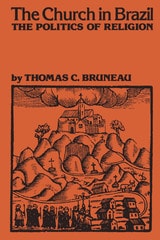
In 1980, Brazil was the largest Roman Catholic country in the world, with 90 percent of its more than 120 million people numbered among the faithful. The Church hierarchy became aware, however, that the religion practiced by the majority of its members was not that promoted by the institution, a point dramatized by the rapid growth of other religious movements in Brazil—particularly Protestant sects and spirit-possession cults. In response, the Church created and assumed new roles. The Church in Brazil is a case study of the changes within the Church and their impact on Brazilian society.
In an original and illuminating discussion, Thomas Bruneau combines institutional analysis and survey data to explore the relationship between structural changes in the Church and evolving patterns of practice and belief. His discussion displays the richness and variety of devotion in Brazil—characteristics recognized by many observers—and examines the Church's potential for influencing the people's religious life.
Moving from the historical and national to the regional, Bruneau analyzes and compares changes among eight dioceses. He concludes that the Church is actively promoting a progressive social role for itself and, by backing its statements with actions, is perceived as being socially effective by both supporters and opponents.
The first study in which the national and diocesan levels of the Church are analyzed together, it is also the first to inspect systematically the Basic Christian Communities, thought by some to be the most significant grass-roots movement in the Catholic world of that time.
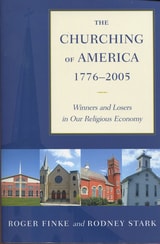
The Churching of America, 1776-2005
Winners and Losers in Our Religious EconomyFinke, Roger
Rutgers University Press, 2005
But, as Finke and Stark show, not all denominations benefited. They explain how and why the early nineteenth-century churches began their descent, while two newcomer sects, the Baptists and the Methodists, gained ground. They also analyze why the Methodists then began a long, downward slide, why the Baptists continued to succeed, how the Catholic Church met the competition of ardent Protestant missionaries, and why the Catholic commitment has declined since Vatican II. The authors also explain why ecumenical movements always fail
In short, Americans are not abandoning religion; they have been moving away from established denominations. A "church-sect process" is always under way, Finke and Stark argue, as successful churches lose their organizational vigor and are replaced by less worldly groups.
Some observers assert that the rise in churching rates indicates increased participation, not increased belief. Finke and Stark challenge this as well. They find that those groups that have gained the greatest numbers have demanded that their followers accept traditional doctrines and otherworldliness. They argue that religious organizations can thrive only when they comfort souls and demand sacrifice. When theology becomes too logical, or too secular, it loses people.
The Ciceronian Tradition in Political Theory
Edited by Daniel J. Kapust and Gary Remer
University of Wisconsin Press, 2021
Individual chapters examine the ways thinkers throughout history, specifically Augustine, John of Salisbury, Thomas More, Machiavelli, Montaigne, Hobbes, Locke, Adam Smith, and Edmund Burke, have engaged with and been influenced by Cicero. A final chapter surveys the impact of Cicero’s ideas on political thought in the second half of the twentieth century. By tracing the long reception of these ideas, the collection demonstrates not only Cicero’s importance to both medieval and modern political theorists but also the comprehensive breadth and applicability of his philosophy.
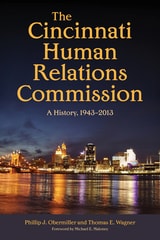
The Cincinnati Human Relations Commission
A History, 1943–2013Phillip J. Obermiller
Ohio University Press, 2018
In the summer of 1943, as World War II raged overseas, the United States also faced internal strife. Earlier that year, Detroit had erupted in a series of race riots that killed dozens and destroyed entire neighborhoods. Across the country, mayors and city councils sought to defuse racial tensions and promote nonviolent solutions to social and economic injustices. In Cincinnati, the result of those efforts was the Mayor’s Friendly Relations Committee, later renamed the Cincinnati Human Relations Commission (CHRC).
The Cincinnati Human Relations Commission: A History, 1943–2013, is a decade-by-decade chronicle of the agency: its accomplishments, challenges, and failures. The purpose of municipal human relations agencies like the CHRC was to give minority groups access to local government through internal advocacy, education, mediation, and persuasion—in clear contrast to the tactics of lawsuits, sit-ins, boycotts, and marches adopted by many external, nongovernmental organizations.
In compiling this history, Phillip J. Obermiller and Thomas E. Wagner have drawn on an extensive base of archival records, reports, speeches, and media sources. In addition, archival and contemporary interviews provide first-person insight into the events and personalities that shaped the agency and the history of civil rights in this midwestern city.
The City on the Hill From Below
The Crisis of Prophetic Black PoliticsAuthored by Stephen Marshall
Temple University Press, 2012
Within the discipline of American political science and the field of political theory, African American prophetic political critique as a form of political theorizing has been largely neglected. Stephen Marshall, in The City on the Hill from Below, interrogates the political thought of David Walker, Frederick Douglass, W. E. B. DuBois, James Baldwin, and Toni Morrison to reveal a vital tradition of American political theorizing and engagement with an American political imaginary forged by the City on the Hill.
Originally articulated to describe colonial settlement, state formation, and national consolidation, the image of the City on the Hill has been transformed into one richly suited to assessing and transforming American political evil. The City on the Hill from Below shows how African American political thinkers appropriated and revised languages of biblical prophecy and American republicanism.
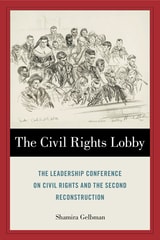
The Civil Rights Lobby
The Leadership Conference on Civil Rights and the Second ReconstructionShamira Gelbman
Temple University Press, 2021
As the lobbying arm of the civil rights movement, the Leadership Conference on Civil Rights (LCCR)—which has operated since the early 1950s—was instrumental in the historic legislative breakthroughs of the Second Reconstruction. The Civil Rights Lobby skillfully recounts the LCCR’s professional and grassroots lobbying that contributed to these signature civil rights policy achievements in the 1950s and ’60s.
Shamira Gelbman explains how the diversity of this interest group coalition both hindered and enabled lobbyists to generate broad-based support for reforms that often seemed risky to legislators. They coordinated their efforts by identifying common ground among member organizations, developing coalitional positions on substantive and strategic questions, and exhorting organizations to mobilize professional and grassroots lobbying resources accordingly. The result was to “speak with one booming voice” to ultimately help secure the passage of the Civil Rights Act of 1964.
The Civil Rights Lobby concludes by reprising key lessons from the LCCR’s organizational development and participation in civil rights policymaking. Gelbman suggests new directions for research on interest group coalitions and explores how the Leadership Conference’s experience sheds light on the politics of the Second Reconstruction.
The Civil Society Reader
Virginia Hodgkinson
University Press of New England, 2003

The Civilian Conservation Corps in Wisconsin
Nature’s Army at WorkJerry Apps
Wisconsin Historical Society Press, 2019
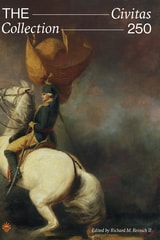
The Civitas Collection 250
Edited by Richard M. Reinsch II
University of Texas Press, 2026
Twenty-five leading scholars examine the Declaration of Independence on its 250th anniversary.
On July 4, 1776, the Second Continental Congress approved a document that would change the world. Drawing on natural rights, moral philosophy, natural and biblical theology, and classical virtue, the Declaration of Independence did not merely announce a political separation—it established the principles upon which a new republic would stand or fall.
As America marks the 250th anniversary of that founding act, The Civitas Collection 250 brings together 25 of the nation's leading scholars to examine the Declaration in depth. These essays resist the temptation to flatten the founding into a simple story. They probe what the Declaration meant in 1776, what it meant to Abraham Lincoln and Martin Luther King, Jr., and what it demands of us now—on questions of liberty and equality, self-government, executive power, religion, race, and the persistent effort to diminish what the founders established.
To read the Declaration as a whole is to discover not a relic but a living challenge. The Civitas Collection 250, featuring essays by scholars from leading universities and research institutions across the country, including from the newly established schools of civic thought, is essential reading for citizens, students, and scholars who take the American founding seriously.
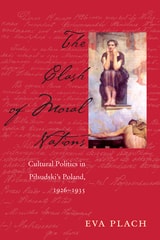
The Clash of Moral Nations
Cultural Politics in Pilsudski’s Poland, 1926–1935Eva Plach
Ohio University Press, 2006
The Clifton-Morenci Strike
Labor Difficulty in Arizona, 1915–1916James R. Kluger
University of Arizona Press, 1970
Coming at a time when western labor was purging itself of radicalism and recharting its goals, the Clifton-Morenci strike may well have been that "milestone" in organized labor's groping for recognition in the West. Violence did not erupt- this notable absence of bloodshed thereby making the strike unique in that time of industrial turbulence.
Kluger's answer to the question of why and how peace prevailed is significant reading. Strikers and managers hurled charges at each other, but both sides showed restraint when it came to action. When negotiations reached an impasse, Gov. George W. P. Hunt moved to prevent the managers from importing strike-breakers. At the same time, the Department of Labor entered the situation, and the rise in copper prices and loss of wages made a settlement desirable for both sides.
When the mine whistles blew on January 26, 1916, to signal the end of the strike, the repercussions of the events of 1915 were still to be felt. Author Kluger traces how the strike affected working conditions, wages, and the cause of unionism in the district. Overall, he provides insight into feelings concerning the fears of management regarding unionism, and labor's manner of making itself heard during these years.
Western historians, labor historians, and all those concerned with labor relations will recognize the importance of this highly readable work.
The Clinton Riddle
Perspectives on the Forty-second PresidentTodd G. Shields
University of Arkansas Press, 2004
The Clinton Wars
The Constitution, Congress, and War PowersRyan C. Hendrickson
Vanderbilt University Press, 2002
Ryan Hendrickson examines the behavior of the Clinton administration and Congress in dealing with the range of American military operations that occurred during the Clinton presidency. He uses a case-study approach, laying out the foreign background and domestic political controversies in separate chapters on Somalia, Haiti, Bosnia, Kosovo, and Iraq. Of special interest after the World Trade Center attacks is the chapter "Terrorism: Usama Bin Laden."
The author analyzes a number of factors that influence the domestic decision-making process. We see the president relying on congressional consultation and approval during periods of political or personal weakness, and, conversely, in better times we see a president with a freer hand. Also influential is the ability of the public to comprehend and support the reasons for a particular action, with troops in Bosnia requiring more explanation than cruise missiles over Baghdad. Consideration is given to the relevance and effectiveness of the War Powers Resolution of 1973, a Watergate-era attempt by Congress to restore what it perceived to be its legitimate constitutional role in the decision to use force abroad.
The Closing Door
Conservative Policy and Black OpportunityGary Orfield and Carole Ashkinaze
University of Chicago Press, 1991
"The Closing Door is a crucial breath of fresh air . . . an important and timely text which will help to alter the 'underclass' debate in favor of reconsidering race-specific policies. Orfield and Ashkinaze construct a convincing argument with which those who favor 'race-neutrality' will have to contend. In readable prose they make a compelling case that economic growth is not enough."—Preston H. Smith II, Transition

The Cold War and After
Capitalism, Revolution and Superpower PoliticsRichard Saull
Pluto Press, 2007
Saull argues that US-Soviet antagonism was part of a wider conflict between capitalism and communism involving states and social forces other than the superpowers. The US was committed to containing revolutionary and communist movements that emerged out of uneven capitalist development.
In highlighting the socio-economic and ideological dimensions of the Cold War, Saull not only provides a richer history of the Cold War than mainstream approaches, but is also able to explain why revolutionary domestic transformations caused international crises. Tracing the origins of new resistance to American global power, Saull's book provides an ideal alternative perspective on the Cold War and its end.

The Collected Works of William Howard Taft, Volume I
Four Aspects of Civic Duty and Present Day ProblemsDavid H. Burton
Ohio University Press, 2001
The inaugural volume of The Collected Works of William Howard Taft is composed of two of his earliest books, Four Aspects of Civic Duty and Present Day Problems. Based on a series of lectures delivered at Yale in 1906, Four Aspects of Civic Duty is an attempt by then Secretary of War Taft to bring to the attention of his audience the importance of civic duty from the perspective of the university graduate, the judge on the bench, the colonial administrator, and the national executive branch of government. His remarks were drawn from his own experience, while at the same time he laid down the principles of citizenship with which all people could identify. In Present Day Problems, William Howard Taft demonstrates the depth of his knowledge and the seriousness of his reflections on a wide range of topics including Sino-American relations and the ongoing contest between capital and labor in America’s increasingly industrial socioeconomy. The problems he takes up are met head-on and discussed in a fashion likely to persuade his audience that he is well prepared to tackle the burdens of the presidency.
The Collected Works of William Howard Taft, in eight volumes, will include Taft’s complete published works as well as his presidential and state addresses and selected court opinions from his days as chief justice of the Supreme Court.
The Collected Works of William Howard Taft, Volume II
Political Issues and Outlooks: Speeches Delivered Between August 1908 and February 1909David H. Burton
Ohio University Press, 2001
The second volume of The Collected Works of William Howard Taft is dedicated to the speeches and writings that displayed his thinking in the autumn of 1908 and the following winter.
At this time he was campaigning for the presidency against the well-known William Jennings Bryan, and in Taft’s writings is evidence of the contrast in style between Taft and Bryan and between Taft and his predecessor, Teddy Roosevelt. as well. Although uncomfortable with campaigning, he thoughtfully addresses the concerns of the day that framed the election, including race, the Philippines, and socialism.
Political Issues and Outlooks also contains speeches made after the election and leading up to his inauguration as the twenty-seventh president of the United States. Introduced by a commentary from the general series editor Professor David H. Burton, the second volume of The Collected Works of William Howard Taft is a revealing look at the machinations of United States politics at the beginning of the twentieth century and a glimpse into the mind of one of the century’s most influential political architects.
The Collected Works of William Howard Taft, Volume III
Presidential Addresses and State PapersDavid H. Burton
Ohio University Press, 2001
The third volume of The Collected Works of William Howard Taft imparts an appreciation of the range of the twenty-seventh president’s interests. Beginning with his inaugural address and concluding with a detailed exposition of governmental expenses and needed economies, President William Howard Taft showed himself willing to tackle the routine as well as the rarified responsibilities of executive rule.
Whether he was addressing the issue of strikes and labor unions or conservation, President Taft consistently demonstrated that, in word and action, he was prepared to be a modern president. What impresses the reader of these remarks is Taft’s willingness to administer to virtually every part of the nation, thereby proving that he was not a mere figurehead but a chief executive truly concerned about problems across the country. Perhaps, as his words here indicate, Taft was not a good politician after all but a kind man who saw himself as president of all the people. As the first of two volumes directly related to Taft’s tenure as president, Presidential Addresses and State Papers documents a pivotal time in the public life of this man from Ohio. Introduced by a commentary from the general series editor Professor David H. Burton, the third volume of The Collected Works of William Howard Taft underscores the presidential stature of William Howard Taft.
The Collected Works of William Howard Taft, Volume IV
Presidential Messages to CongressDavid H. Burton
Ohio University Press, 2002
“A time when panics seem far removed is the best time to prepare our financial system to withstand a storm. The most crying need this country has is a proper banking and currency system. The existing one is inadequate, and everyone who has studied the question admits it.”—William Howard Taft
The interaction between President William Howard Taft and the Congress provides a window on his leadership. Volume IV of The Collected Works of William Howard Taft is devoted to his messages to the legislative branch and concerns some of the pressing issues of the day, issues that have relevance still.
Oftentimes President Taft was at odds with a somewhat reactionary Congress, causing him to veto legislation that he thought unwise. For example, his commitment to the independence of elected judges led him to reject statehood for Arizona until its constitution was altered to address his objection.
His messages also touched on subjects for which he led the way over the objections of Congress, such as his recommendation of a federal law to protect resident aliens against denial of their civil rights and his advocacy of free trade with Canada.
In his commentary to the volume, Professor Burton points out: “There is exhibited time after time concern for the American people, for men and women from different walks of life. Taft comes across less as a judge, which he had been, or the chief justice he was to become, and more as a sitting president of all the people.”
Taft’s Presidential Messages to Congress provides the documentary evidence to support that claim.
The Collected Works of William Howard Taft, Volume V
Popular Government and The Anti-trust Act and the Supreme CourtDavid H. Burton
Ohio University Press, 2003
The fifth volume of The Complete Works of William Howard Taft presents two publications Taft wrote as Kent Professor of Constitutional Law at Yale University, the position he assumed in 1913 after he was defeated in his bid for re-election as U.S. president. The first, Popular Government, was prepared for a series of lectures, but was motivated by Taft’s passion over the issue of constitutional interpretation, which had been hotly contested during the campaign. Organized around the preamble of the Constitution, the lectures and later the book were opportunities for Taft to restate his opposition to the direct democracy movement and to reveal the workings of a conservative mind.
In the second, The Anti-trust Act and the Supreme Court, Taft articulates his position in the ongoing debate over the conventional nineteenth-century notion of “laissez faire” and the provisions of the Sherman Antitrust Act. Taft had pursued a policy of vigorous antitrust enforcement during his presidency. In this book he intended to demonstrate that restraint of trade was part of the common law, thereby arguing to good effect in favor of reasonable restraint of trade in his own time.
Taft's careful distinction between predatory monopolistic practices and the reasonable business practices of well-behaved corporations continues to inform today's chambers of government.
The Collected Works of William Howard Taft, Volume VI
The President and His Powers and The United States and PeaceDavid H. Burton
Ohio University Press, 2003
Volume VI of The Collected Works of William Howard Taft follows the career of William Howard Taft upon his leaving the White House. It consists of two short publications from 1914 and 1915.
The first, The President and His Powers, is based on a series of lectures delivered at Columbia University and draws on Taft’s experience in the presidency and the executive branch. It speaks particularly to the nature of executive power and its place in the American system and is rooted in his disagreement with Theodore Roosevelt regarding presidential power. Taft believed all presidential power must be traced to some specific grant of power or be necessary to its exercise, while Roosevelt saw the presidency as a position of “steward of the people” limited only by some express provision of the Constitution.
The second, The United States and Peace, reflects Taft’s interest in foreign policy, which was intensified by his years as governor of the Philippines and as secretary of war, as well as by his presidency. Originally four lectures delivered in 1914, The United States and Peace discusses the Monroe Doctrine, the threat to peace presented by incidents of violence to foreigners in the United States, the maintenance of peace through international arbitration, and the trend toward federation in international affairs. Taft hoped to see the latter result in the establishment of an independent judiciary to resolve international disputes.
Taft’s reasoned arguments, supplemented by the commentaries of Professors McWilliams and Gerrity, will stimulate interest among historians, lawmakers, political activists, and the general public.
The Collected Works of William Howard Taft, Volume VII
Taft Papers on League of NationsFrank X. Gerrity
Ohio University Press, 2003
Eager to turn the congressional election of 1918 into a confirmation of his foreign policy, President Woodrow Wilson was criticized for abandoning the spirit of the popular slogan “Politics adjourned!”
His predecessor, William Howard Taft, found Wilson difficult to deal with and took issue with his version of the League of Nations, which Taft felt was inferior to the model proposed by the League to Enforce Peace. Rather than join the massive Republican opposition to the Treaty of Versailles, however, Taft instead supported Wilson’s controversial decision to travel to Paris as the head of the American peace delegation, and he defended the critical tenth article in the covenant, which detractors saw as a surrender of American sovereignty. He also counseled Wilson to insert a clause concerning the Monroe Doctrine that would pacify the Senate’s group of “reservationists,” whose votes were essential to approval of the treaty.
Volume VII in The Collected Works of William Howard Taft consists of the Taft Papers on League of Nations originally published in 1920. This is a collection ofTaft’s speeches, newspaper articles, and complementary documents that reflect his consistent support for a league of nations and, eventually, for the Covenant of the League of Nations emanating from the Paris Peace Conference.
Although the failure of the treaty and its League of Nations can probably be laid at the feet of an obstinate Wilson and a wily Henry Cabot Lodge, William Howard Taft can be credited with rising above partisanship to emerge as the League’s most consistent supporter.
As in the rest of the Collected Works, Taft Papers on League of Nations provides a window on the machinations surrounding some of the most significant decisions of the era.
The Collected Works of William Howard Taft, Volume VIII
“Liberty under Law” and Selected Supreme Court OpinionsFrancis Graham Lee
Ohio University Press, 2004
William Howard Taft’s presidency (1909-1913), succeeding Theodore Roosevelt’s, was mired in bitter partisan fighting, and Taft sometimes blundered politically. However, this son of Cincinnati assumed his true calling when President Warren G. Harding appointed him to the U.S. Supreme Court in 1921. Taft remains the only person to have served both as president of the United States and as chief justice of the Supreme Court.
The Collected Works of William Howard Taft, Volume VIII, consists of “Liberty under Law” and selected Supreme Court opinions, among the most instructive accomplishments of Taft’s ten years at the helm of the court. The writings reveal the sober judgments of a federalist who viewed state regulation with suspicion, championed national government, and saw an independent and powerful judiciary as the bulwark protecting the “vested rights” that the framers of the U.S. Constitution sought to guarantee.
Whatever his failings as a politician, Taft was an intellectual powerhouse who knew how to use the law as a lever to encourage society to move toward more stable and productive ends. Although Taft is considered an average president at best, historians and political scientists rank him among fifteen “near greats” who have served on the high court. His ability and his love for the law shine through in Volume VIII, the concluding volume of The Collected Works of William Howard Taft. As Taft reportedly said to President Harding upon his appointment as chief justice, “I love judges and I love courts. They are my ideals on earth of what we shall meet afterward in heaven under a just God.”
The Collectivization of Agriculture in Communist Eastern Europe
Comparison and EntanglementsConstantin Iordachi
Central European University Press, 2014
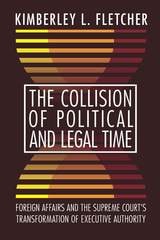
The Collision of Political and Legal Time
Foreign Affairs and the Supreme Court's Transformation of Executive AuthorityKimberley L. Fletcher
Temple University Press, 2018
How does the U.S. Supreme Court shape constitutional and political development? In The Collision of Political and Legal Time, Kimberley Fletcher answers this question by analyzing the key role the Court has played in interpreting presidential decision-making in the area of foreign affairs since 1936. She reconsiders the Curtiss-WrightCourt, which instituted a new constitutional order that established plenary powers independent of congressional delegation. Fletcher also reexamines Japanese internment and detainee cases, demonstrating the entrenchment of the new constitutional order and how presidential ascendency becomes institutionalized. Other cases, such as Youngstown, illustrate how the Court, during a time of war, will check Executive power and authority.
The Collision of Political and Legal Time examines these cases and controversies in foreign policymaking through the twentieth and into the twenty-first centuries to show that the Court is not passive or constrained; it does not merely follow politics or the majority coalition. Through her nuanced analysis, Fletcher makes a larger argument about the role of the U.S. Supreme Court as an agent of change, which ultimately transforms power, shapes politics, and redirects history.
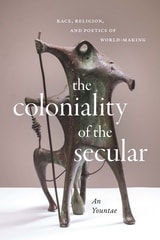
The Coloniality of the Secular
Race, Religion, and Poetics of World-MakingAn Yountae
Duke University Press, 2024
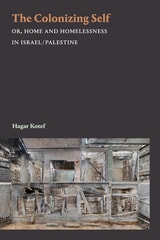
The Colonizing Self
Or, Home and Homelessness in Israel/PalestineHagar Kotef
Duke University Press, 2020
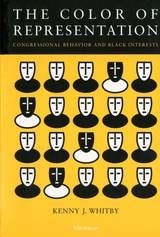
The Color of Representation
Congressional Behavior and Black InterestsKenny J. Whitby
University of Michigan Press, 2000
The Colorado General Assembly, Second Edition
John A. Straayer
University Press of Colorado, 2000
The Colorado General Assembly is based on years of author John Straayer's first-hand observations, his review of original documents and secondary sources, and hundred of conversations with lawmakers, lobbyists, members of the legislative staff, executive branch personnel, and journalists.
In this lively, informative book, Straayer describes the formal structure of the Legislature, as well as the all-important process by which bills become or do not become law, and how the power center within the institution can move or kill legislative initiatives. He also examines the clout of the lobby corps, which outnumbers the elected lawmakers five to one; the way the Legislature dominates the budget process; and the manner by which divisions between the two parties, the two houses, and the legislative and executive branches impact the conduct of the public's business under Colorado's gold dome.
The Colorado General Assembly fills a major gap in our knowledge of state government. It will appeal to students and practitioners of politics as well as to those with general interest in civic life.
The Coming Health Crisis
Who Will Pay for Care for the Aged in the 21st Century?John R. Wolfe
University of Chicago Press, 1993
In previous decades, when younger Americans far outnumbered older ones, retirees could depend on financial support through taxes from the population at large. But as "Boomers" retire and the work force begins to shrink, there will be a disproportionately large population of retirees to workers. With such a big jump in the percentage of older Americans in the population, fewer workers will be able to to transfer funds, through taxes, to retirees. Moreover, other traditionally reliable sources of financial assistance—Social Security, Medicare, and Medicaid—have faced serious financial difficulties in recent years. Who will the aged turn to for assistance?
The Coming Health Crisis suggests that as funds from all quarters dwindle, older Americans will have to look to alternative programs for financial assistance. Wolfe urges immediate action to develop new saving programs and increase existing transfer schemes to head off an imminent crisis. Although tax increases might provide some resources, he demonstrates that it is more important to accumulate capital to create solid reserves for the future. Wolfe also explores two roles for government: prefunding new or existing social insurance programs and promoting private insurance options. By exempting insurance fund income from corporate taxation and permitting people at all income levels to defer income tax on accounts earmarked for long-term care, he shows how government could greatly encourage and expand personal saving.
Finally, this work assesses the value of other recent health and long-term-care innovations: social/health maintenance organizations, long-term-care individual retirement accounts, and reverse annuity mortgages, in addition to vouchers, care rationing, mandatory public insurance, and expanded private coverage. Through this wide-ranging survey, Wolfe demonstrates that, through a combination of these programs, we can care for the aging "Baby Boom" generation by anticipating their needs and saving now.
The Committee
A Study of Policy, Power, Politics and Obama's Historic Legislative Agenda on Capitol HillBryan W. Marshall and Bruce C. Wolpe
University of Michigan Press, 2018
The Committee
A Study of Policy, Power, Politics and Obama’s Historic Legislative Agenda on Capitol HillBryan W. Marshall and Bruce C. Wolpe
University of Michigan Press, 2021
For three years while serving as a senior adviser to Rep. Henry A. Waxman (D-CA), chairman of the House Committee on Energy and Commerce—one of the most powerful committees in Congress—Bruce C. Wolpe kept a diary, a senior staffer’s look at how committees develop and promote legislation. With its insider’s view of the rough-and-tumble politics of cap-and-trade, healthcare reform, tobacco, oversight, and the debt ceiling agreement, The Committee uniquely melds the art of politics and policymaking with the theory and literature of political science. The authors engage with the important questions that political science asks about committee power, partisanship, and the strategies used to build winning policy coalitions both in the Committee and on the floor of the House. In this new edition, the authors revisit the relationship between the executive and Congress in the wake of the sweeping changes wrought by the Trump administration, as well as thoughts about how that relationship will change again as President Biden faces a 117th Congress that is strikingly similar to Obama’s 111th. The insider politics and strategies about moving legislation in Congress, from internal and external coalition building to a chairman’s role in framing policy narratives, will captivate both novice and die-hard readers of politics.
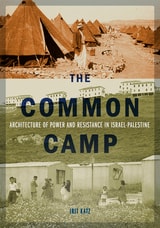
The Common Camp
Architecture of Power and Resistance in Israel–PalestineIrit Katz
University of Minnesota Press, 2022
Seeing the camp as a persistent political instrument in Israel–Palestine and beyond
The Common Camp underscores the role of the camp as a spatial instrument employed for reshaping, controlling, and struggling over specific territories and populations. Focusing on the geopolitical complexity of Israel–Palestine and the dramatic changes it has experienced during the past century, this book explores the region’s extensive networks of camps and their existence as both a tool of colonial power and a makeshift space of resistance.
Examining various forms of camps devised by and for Zionist settlers, Palestinian refugees, asylum seekers, and other groups, Irit Katz demonstrates how the camp serves as a common thread in shaping lands and lives of subjects from across the political spectrum. Analyzing the architectural and political evolution of the camp as a modern instrument engaged by colonial and national powers (as well as those opposing them), Katz offers a unique perspective on the dynamics of Israel–Palestine, highlighting how spatial transience has become permanent in the ongoing story of this contested territory.
The Common Camp presents a novel approach to the concept of the camp, detailing its varied history as an apparatus used for population containment and territorial expansion as well as a space of everyday life and subversive political action. Bringing together a broad range of historical and ethnographic materials within the context of this singular yet versatile entity, the book locates the camp at the core of modern societies and how they change and transform.
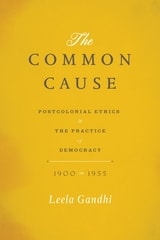
The Common Cause
Postcolonial Ethics and the Practice of Democracy, 1900-1955Leela Gandhi
University of Chicago Press, 2014
Reframing the way we think about some of the most consequential political events of the era, Gandhi presents moral imperfectionism as the lost tradition of global democratic thought and offers it to us as a key to democracy’s future. In doing so, she defends democracy as a shared art of living on the other side of perfection and mounts a postcolonial appeal for an ethics of becoming common.
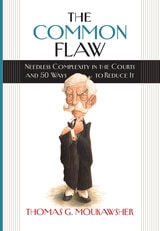
The Common Flaw
Needless Complexity in the Courts and 50 Ways to Reduce ItThomas Moukawsher
Brandeis University Press, 2023
Americans are losing faith in their courts. After long delays, judges often get rid of cases for technical reasons, or force litigants to settle rather than issue a decision. When they do decide cases, we can't understand why.
The Common Flaw seeks to rid the American lawsuit of this needless complexity. The book proposes fifty changes from the filing of a complaint in court to the drafting of appellate decisions to replace the legal system’s formalism with a kind of humanism. Thomas G. Moukawsher calls for courts that decide cases promptly based more on the facts than the law, that prioritize the parties involved over lawyers, that consider the consequences for the people and the public, and that use words we can all understand. Sure to spark an important conversation about court reform, The Common Flaw makes the case for a more effective and credible legal system with warmth and humor, incorporating cartoons alongside insightful reflection.
The Common Good of Constitutional Democracy
Essays in Political Philosophy and on Catholic Social TeachingMartin Rhonheimer
Catholic University of America Press, 2013
The Communal Experience
Anarchist and Mystical Communities in Twentieth Century AmericaLaurence R. Veysey
University of Chicago Press, 1978
Veysey compares the history of secular communities such as the early Ferrer Colony and Modern School, of Shelton, New Jersey, with contemporary anarchist communities in New York, Vermont, and New Mexico. Religious communes—"Communities of Discipline"—such as the Vedanta monasteries of the early twentieth century are compared with contemporary mystical communities in New Mexico. Distinctions between the anarchist and the mystical groups are most obvious from their approach to communal life. As Veysey shows, anarchist communities are loose, unstructured, voluntaristic; the mystics establish more rigid life-styles, focus on spiritual leaders, and hold community a secondary goal to self-realization. In a new preface written for this Phoenix Edition, he describes his return to a New Mexican mystical community and the changes that have occurred in the six years since his last visit.
The Communist Party in Maryland, 1919-57
Vernon L. Pedersen
University of Illinois Press, 2001
Bolsheviks in Baltimore charts the uneven transformation of Baltimore's fledgling Communists into underground revolutionaries in the 1920s. Pedersen documents the mercurial careers of local organizers, their devotion to the Soviet cause, and their efforts to convert the Party from a hodgepodge of ethnic groups to an effective instrument of class interests. He also tracks the public's changing perception of the Communists, from amused unconcern to alarm, and details how the Ober antisubversive law and the HUAC hearings of the 1950s dismantled the Party from without while planting seeds of paranoia that destroyed it from within.
Behind the public fear of a Communist conspiracy against the U.S. government, Pedersen finds a party fractured by conflicting agendas, ineffectual leadership, and unstable membership. However, he also uncovers new evidence that Communists in the United States, acting on Soviet orders, used their influence in unions and front groups to sway American foreign policy in ways that benefited the Soviet Union. He documents the consolidation of an espionage apparatus in Baltimore and demonstrates that while espionage activities may have involved only a few individuals, all Party members shared an attitude of willing support for the activities of the Soviet Union that made these covert practices possible.
Paying tribute to the fervor and the effort dedicated by the Maryland Communists, often at the expense of their own physical and financial well-being, to a cause that ultimately failed them, Bolsheviks in Baltimore assesses an ambiguous legacy of admirable social vision, haphazard international conspiracy, and fierce internal conflict.
The Community Economic Development Movement
Law, Business, and the New Social PolicyWilliam H. Simon
Duke University Press, 2001
In this book William H. Simon provides the first comprehensive examination of the evolution of Community Economic Development, complete with an analysis of its operating premises and strategies. He describes the profusion of new institutional forms that have arisen from the movement, amalgamations that cut across conventional distinctions—such as those between private and public—and that encompass the efforts of nonprofits, cooperatives, churches, business corporations, and public agencies. Combining local political mobilization with entrepreneurial initiative and electoral accountability with market competition, this phenomenon has catalyzed new forms of property rights designed to motivate investment and civic participation while curbing the dangers of speculation and middle-class flight.
With its examination of many localities and its appraisal of the strengths and weaknesses of the prevailing approach to Community Economic Development, this book will be a valuable resource for local housing, job, and business development officials; community activists; and students of law, business, and social policy.

The Community of Nuchi Du Takara ("Life Is the Ultimate Treasure") in Postwar Okinawa
Local Subjectivity within and against EmpireMasamichi (Marro) Inoue
University of Michigan Press, 2025
The Community of Rights
Alan Gewirth
University of Chicago Press, 1997
The Complete Anti-Federalist
Edited by Herbert J. Storing
University of Chicago Press, 2007
The Complete Anti-Federalist, first published in 1981, contains an unprecedented collection of all the significant pamphlets, newspaper articles and letters, essays, and speeches that were written in opposition to the Constitution during the ratification debate. Storing’s work includes introductions to each entry, along with his own consideration of the Anti-Federalist thought.
This new three-volume set includes all the contents of the original seven-volume publication in a convenient, manageable format.
“A work of magnificent scholarship. Publication of these volumes is a civic event of enduring importance.”—Leonard W. Levy, New York Times Book Review
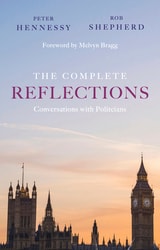
The Complete Reflections
Conversations with PoliticiansPeter Hennessy and Robert Shepherd
Haus Publishing, 2020
In The Complete Reflections, Peter Hennessy and Robert Shepherd provide not only an overview of the past three decades of British politics but also delve into the minds of those at the forefront of public life during times of great change. Hennessy’s deep knowledge and understanding of the lives and motivations of his interviewees, along with the obvious esteem in which they hold their interlocutor, leads to frank and revealing conversations in which the subject is not an object but an equal, giving these exchanges a unique veracity. The results are portraits of high authority, in which interviews become the chronicles that endure above all others—nothing less than the first draft of history.
The Complete Writings and Selected Correspondence of John Dickinson
Volume 1Jane E. Calvert
University of Delaware Press, 2011
The Complete Writings and Selected Correspondence of John Dickinson
Volume 2Jane E. Calvert
University of Delaware Press, 2021
Dickinson’s hard work on behalf of his clients brought him success in other areas of his public life. In October 1759, he was elected to his first public position as a representative for Kent County, Del., the following year he was elevated to the position of speaker, and in 1762, he became a representative for Philadelphia County, Pa. As a legislator in two colonies, learning his craft as a global war unfolded, he contributed to bills on military and defense, Indian relations, infrastructure improvements and city management, and served on various committees. The death of George II occasioned debates over laws and judges, in which Dickinson participated. This era concludes with Dickinson playing a central role in managing the unfolding Paxton Riots, in which frontiersmen massacred peaceful Indians and threatened the Quaker leadership of Pennsylvania.
In private, Dickinson lost the two most prominent male figures in his life in 1760, his father, Samuel, and soon thereafter, his mentor, colleague, and friend, John Moland. In honor of Moland, Dickinson published a poem and became a proxy head to Moland’s large family. Though his extant correspondence during this period is small, he exchanged letters with Mary Cadwalader Dickinson, Israel Pemberton, William Allason, George Read, Thomas McKean, and others. Perhaps most significant, he wrote a lengthy, unpublished essay on the flag-of-truce trade and also maintained commonplace books as he considered his place within the British Empire, opening up the next phase in Dickinson’s life as a leader of the resistance against Britain.
Published by the University of Delaware Press. Distributed worldwide by Rutgers University Press.
The Complete Writings and Selected Correspondence of John Dickinson
Volume 3Jane E. Calvert
University of Delaware Press, 2024