Results by title
967 books match the query 'Theater' and 260 start with t
Toward a Theater of the Oppressed
The Dramaturgy of John ArdenJaved Malick
University of Michigan Press, 1995
Malick situates Arden's dramaturgy in the wider context of the radical alternative tradition in Western drama, drawing connections to Brecht, Piscator, the radical playwrights of the 1960s. He then explores the formal structure, ideological implications, and historical significance of Arden's work, treating his stage plays as one dramaturgically coherent opus- from the early Waters of Babylon to his and Margaretta D'Arcy's ambitious trilogy, The Island of the Mighty. Finally, he discusses the last phase of Arden and D'Arcy's political and artistic development, which led them to turn their backs on the professional theater circuit. He argues that Arden's rejection of the institutional stage was the logical outcome of his persistent search for alternative forms of political theater.
Toward a Theater of the Oppressed will be invaluable reading for those interested in modern drama, political theater, and popular performance, as well as students of contemporary British drama.
Javed Malick is Reader in English, Khalsa College, University of Delhi, India.

Tragic Muse
Rachel of the Comédie-FrançaiseRachel M. Brownstein
Duke University Press, 1995
Born to itinerant Jewish peddlers in 1821, Rachel arrived on the Paris stage at the age of fifteen. She became both a symbol of her culture’s highest art and a clue to its values and obsessions. Fascinated with all things Napoleonic, she was the mother of Napoleon’s grandson and the lover of many men connected to the emperor. Her story—the rise from humble beginnings to queen of the French state theater—echoes and parodies Napoleon’s own. She decisively controlled her career, her time, and finances despite the actions and claims of managers, suitors, and lovers. A woman of exceptional charisma, Rachel embodied contradiction and paradox. She captured the attention of her time and was memorialized in the works of Matthew Arnold, Charlotte Brontë, George Eliot, and Henry James.
Richly illustrated with portraits, photographs, and caricatures, Tragic Muse combines brilliant literary analysis and exceptional historical research. With great skill and acuity, Rachel M. Brownstein presents Rachel—her brief intense life and the image that was both self-fashioned and, outliving her, fashioned by others. First published by Knopf (1993), this book will attract a broad audience interested in matters as wide ranging as the construction of character, the cult of celebrity, women’s lives, and Jewish history. It will also be of enduring interest to readers concerned with nineteenth-century French culture, history, literature, theater, and Romanticism. Tragic Muse won the 1993 George Freedley Award presented by the Theater Library Association.
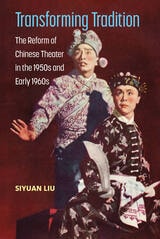
Transforming Tradition
The Reform of Chinese Theater in the 1950s and Early 1960sSiyuan Liu
University of Michigan Press, 2021
Shortly after the establishment of the People’s Republic of China in 1949, the PRC launched a reform campaign that targeted traditional song and dance theater encompassing more than a hundred genres, collectively known as xiqu. Reformers censored or revised xiqu plays and techniques; reorganized star-based private troupes; reassigned the power to create plays from star actors to the newly created functions of playwright, director, and composer; and eliminated market-oriented functionaries such as agents. While the repertoire censorship ended in the 1980s, major reform elements have remained: many traditional scripts (or parts of them) are no longer in performance; actors whose physical memory of repertoire and acting techniques had been the center of play creation, have been superseded by directors, playwrights, and composers. The net result is significantly diminished repertoires and performance techniques, and the absence of star actors capable of creating their own performance styles through new signature plays that had traditionally been one of the hallmarks of a performance school. Transforming Tradition offers a systematic study of the effects of the comprehensive reform of traditional theater conducted in the 1950s and ’60s, and is based on a decade’s worth of exhaustive research of official archival documents, wide-ranging interviews, and contemporaneous publications, most of which have never previously been referenced in scholarly research.
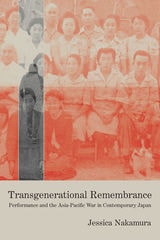
Transgenerational Remembrance
Performance and the Asia-Pacific War in Contemporary JapanJessica Nakamura
Northwestern University Press, 2020
In Transgenerational Remembrance, Jessica Nakamura investigates the role of artistic production in the commemoration and memorialization of the Asia-Pacific War (1931–1945) in Japan since 1989. During this time, survivors of Japanese aggression and imperialism, previously silent about their experiences, have sparked contentious public debates about the form and content of war memories.
The book opens with an analysis of the performance of space at Yasukuni Shinto Shrine, which continues to promote an anachronistic veneration of the war. After identifying the centrality of performance in long-standing dominant narratives, Transgenerational Remembrance offers close readings of artistic performances that tackle subject matter largely obscured before 1989: the kamikaze pilot, Japanese imperialism, comfort women, the Battle of Okinawa, and Japanese American internment. These case studies range from Hirata Oriza’s play series about Japanese colonial settlers in Korea and Shimada Yoshiko’s durational performance about comfort women to Kondo Aisuke’s videos and gallery installations about Japanese American internment.
Working from theoretical frameworks of haunting and ethics, Nakamura develops an analytical lens based on the Noh theater ghost. Noh emphasizes the agency of the ghost and the dialogue between the dead and the living. Integrating her Noh-inflected analysis into ethical and transnational feminist queries, Nakamura shows that performances move remembrance beyond current evidentiary and historiographical debates.
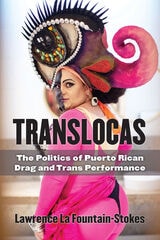
Translocas
The Politics of Puerto Rican Drag and Trans PerformanceLawrence La Fountain-Stokes
University of Michigan Press, 2021
Translocas focuses on drag and transgender performance and activism in Puerto Rico and its diaspora. Arguing for its political potential, Lawrence La Fountain-Stokes explores the social and cultural disruptions caused by Latin American and Latinx “locas” (effeminate men, drag queens, transgender performers, and unruly women) and the various forms of violence to which queer individuals in Puerto Rico and the U.S. are subjected. This interdisciplinary, auto-ethnographic, queer-of-color performance studies book explores the lives and work of contemporary performers and activists including Sylvia Rivera, Nina Flowers, Freddie Mercado, Javier Cardona, Jorge Merced, Erika Lopez, Holly Woodlawn, Monica Beverly Hillz, Lady Catiria, and Barbra Herr; television programs such as RuPaul’s Drag Race; films such as Paris Is Burning, The Salt Mines, and Mala Mala; and literary works by authors such as Mayra Santos-Febres and Manuel Ramos Otero. Lawrence La Fountain-Stokes, a drag performer himself, demonstrates how each destabilizes (and sometimes reifies) dominant notions of gender and sexuality through drag and their embodied transgender expression. These performances provide a means to explore and critique issues of race, class, poverty, national identity, and migratory displacement while they posit a relationship between audiences and performers that has a ritual-like, communal dimension. The book also analyzes the murders of Jorge Steven López Mercado and Kevin Fret in Puerto Rico, and invites readers to challenge, question, and expand their knowledge about queer life, drag, trans performance, and Puerto Rican identity in the Caribbean and the diaspora. The author also pays careful attention to transgender experience, highlighting how trans activists and performers mold their bodies, promote social change, and create community in a context that oscillates between glamour and abjection.
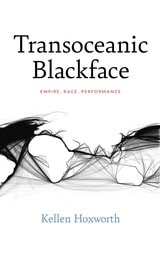
Transoceanic Blackface
Empire, Race, PerformanceKellen Hoxworth
Northwestern University Press, 2024
A material history of racialized performance throughout the Anglophone imperial world, Transoceanic Blackface: Empire, Race, Performance revises prevailing understandings of blackface and minstrelsy as distinctively US American cultural practices. Tracing intertwined histories of racialized performance from the mid-eighteenth through the early twentieth century across the United States and the British Empire, this study maps the circulations of blackface repertoires in theatrical spectacles, popular songs, visual materials, comic operas, closet dramas, dance forms, and Shakespearean burlesques.
Kellen Hoxworth focuses on overlooked performance histories, such as the early blackface minstrelsy of T. D. Rice’s “Jump Jim Crow” and the widely staged blackface burlesque versions of Othello, as traces of the racial and sexual anxieties of empire. From the nascent theatrical cultures of Australia, Britain, Canada, India, Jamaica, South Africa, and the United States, Transoceanic Blackface offers critical insight into the ways racialized performance animated the imperial “common sense” of white supremacy on a global scale.
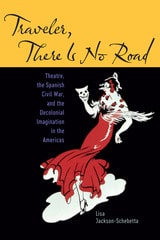
Traveler, There Is No Road
Theatre, the Spanish Civil War, and the Decolonial Imagination in the AmericasLisa Jackson-Schebetta
University of Iowa Press, 2017
This book offers a unique perspective on 1930s theatre and performance, encompassing the theatrical work of the Cuban, Puerto Rican, and Spanish diasporas in the United States, as well as the better-known Anglophone communities. Jackson-Schebetta situates well-known figures, such as Langston Hughes and Clifford Odets, alongside lesser-known ones, such as Erasmo Vando, Franca de Armiño, and Manuel Aparicio. The milicianas, female soldiers of the Spanish Republic, stride on stage alongside the male fighters of the Lincoln Brigade. They and many others used the multiple visions of Spain forged during the civil war to foment decolonial practices across the pasts, presents, and futures of the Americas. Traveler conclusively demonstrates that theatre and performance scholars must position US performances within the Americas writ broadly, and in doing so they must recognize the centrality of the hemisphere’s longest-lived colonial power, Spain.
Travesty Actors
Self and Theater in Stalinist CultureBoris Wolfson, edited by Simon Morrison
Northwestern University Press, 2026
Talk of Joseph Stalin’s “show trials,” the public prosecutions in Moscow’s Hall of Columns in the late 1930s, is so familiar as to obscure the relationship between actual shows—in the Soviet Union’s major theaters—and politics. Travesty Actors: Self and Theater in Stalinist Culture examines theatrical performance within the context of the Soviet cultural establishment’s fashioning of a “genuine Soviet person.” Boris Wolfson focuses on prominent and controversial plays by artists including Aleksandr Afinogenov, Mikhail Bulgakov, Yuri Olesha, and Natalia Sats and the efforts of theater companies, like the Moscow Arts Theater, the Meyerhold Theater, and the Central Children’s Theater, to adhere to this cultural mandate while grappling with repression, censorship, and conflicting interpretations of its aims. Drawing on archival materials, diaries and memoirs and eyewitness accounts, Wolfson greatly illuminates the achievements of Soviet theater during this harsh period and the cultural significance of artistic theories and practices for articulating and enacting ideological programs.
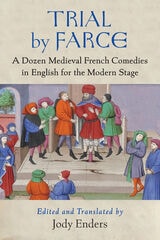
Trial by Farce
A Dozen Medieval French Comedies in English for the Modern StageEdited and Translated by Jody Enders
University of Michigan Press, 2023
Was there more to comedy than Chaucer, the Second Shepherds’ Play, or Shakespeare? Of course! But, for a real taste of medieval and Renaissance humor and in-your-face slapstick, one must cross the Channel to France, where over two hundred extant farces regularly dazzled crowds with blistering satires. Dwarfing all other contemporaneous theatrical repertoires, the boisterous French corpus is populated by lawyers, lawyers everywhere. No surprise there. The lion’s share of mostly anonymous farces was written by barristers, law students, and legal apprentices. Famous for skewering unjust judges and irreligious ecclesiastics, they belonged to a 10,000-member legal society known as the Basoche, which flourished between 1450 and 1550. What is more, their dramatic send-ups of real and fictional court cases were still going strong on the eve of Molière, resilient against those who sought to censor and repress them. The suspenseful wait to see justice done has always made for high drama or, in this case, low drama. But, for centuries, the scripts for these outrageous shows were available only in French editions gathered from scattered print and manuscript sources.
In Trial by Farce, prize-winning theater historian Jody Enders brings twelve of the funniest legal farces to English-speaking audiences in a refreshingly uncensored but philologically faithful vernacular. Newly conceived as much for scholars as for students and theater practitioners, this repertoire and its familiar stock characters come vividly to life as they struggle to negotiate the limits of power, politics, class, gender, and, above all, justice. Through the distinctive blend of wit, social critique, and breathless boisterousness that is farce, we gain a new understanding of comedy itself as form of political correction. In ways presciently modern and even postmodern, farce paints a different cultural picture of the notoriously authoritarian Middle Ages with its own vision of liberty and justice for all. Theater eternally offers ways for new generations to raise their voices and act.
Trumpets in the Mountains
Theater and the Politics of National Culture in CubaLaurie A. Frederik
Duke University Press, 2012
Campesinos inhabit some of the island's most isolated areas, including the mountainous regions in central and eastern Cuba where Laurie A. Frederik conducted research among rural communities and professional theater groups. Analyzing the ongoing dialogue of cultural officials, urban and rural artists, and campesinos, Frederik provides an on-the-ground account of how visions of the nation are developed, manipulated, dramatized, and maintained in public consciousness. She shows that cubanía is defined, and redefined, in the interactive movement between intellectual, political, and everyday worlds.