Results by title
2194 books match the query 'Women's Studies' and 323 start with t

The Woman Detective
GENDER AND GENREViola Klein
University of Illinois Press, 1995
This new edition adds sixty new female private eyes to the roster and includes an afterword that assesses the current state of the genre's new and old novels. A comprehensive bibliography and a character list update the field through mid-1994.
"A highly intelligent analysis." -- Ms.
"Well-researched and well-written. . . . Traces the evolution of sexist boundaries in popular detective fiction from a feminist viewpoint and documents the parallels in social history and the women's rights movement." -- Ronald C. Miller, The Armchair Detective
"Identifies dozens of good novels whose titles are not well known, its promise of good reading extending well beyond its own covers." -- Jane Bakerman, Belles Lettres

The Woman Who Knew Too Much
Alice Stewart and the Secrets of RadiationGayle Greene
University of Michigan Press, 2001
This biography illuminates the life and achievements of the remarkable woman scientist who revolutionized the concept of radiation risk.
In the 1950s Alice Stewart began research that led to her discovery that fetal X rays double a child's risk of developing cancer. Two decades later---when she was in her seventies---she again astounded the scientific world with a study showing that the U.S. nuclear weapons industry is about twenty times more dangerous than safety regulations permit. This finding put her at the center of the international controversy over radiation risk. In 1990, the New York Times called Stewart "perhaps the Energy Department's most influential and feared scientific critic."
The Woman Who Knew Too Much traces Stewart's life and career from her early childhood in Sheffield to her medical education at Cambridge to her research positions at Oxford University and the University of Birmingham.
Gayle Greene is Professor of Women's Studies and Literature, Scripps College.
The Woman in the Violence
Gender, Poverty, and Resistance in PeruM. Cristina Alcalde
Vanderbilt University Press, 2010
Focusing on the experiences of women who are predominantly poor, nonwhite, rural-to-urban migrants with little or no formal education, The Woman in the Violence addresses a range of serious concerns. What types of violence do women experience at different stages in their lives? Which identities and roles are manifested throughout their lives, and do some of these increase their vulnerability to different forms of violence? What strategies do women employ to gain some power and control in these situations, and how can we conceptualize these strategies?
In examining these questions, The Woman in the Violence contributes to our understanding of violence, gender, race, resistance, and urbanism as it exposes and analyzes systemic violence against women. The everyday forms of resistance these women employ provide significant insight for students, scholars, and health professionals.
The Woman in the Zoot Suit
Gender, Nationalism, and the Cultural Politics of MemoryCatherine S. Ramírez
Duke University Press, 2009
Two events in wartime Los Angeles thrust young Mexican American zoot suiters into the media spotlight. In the Sleepy Lagoon incident, a man was murdered during a mass brawl in August 1942. Twenty-two young men, all but one of Mexican descent, were tried and convicted of the crime. In the Zoot Suit Riots of June 1943, white servicemen attacked young zoot suiters, particularly Mexican Americans, throughout Los Angeles. The Chicano movement of the 1960s–1980s cast these events as key moments in the political awakening of Mexican Americans and pachucos as exemplars of Chicano identity, resistance, and style. While pachucas and other Mexican American women figured in the two incidents, they were barely acknowledged in later Chicano movement narratives. Catherine S. Ramírez draws on interviews she conducted with Mexican American women who came of age in Los Angeles in the late 1930s, 1940s, and 1950s as she recovers the neglected stories of pachucas. Investigating their relative absence in scholarly and artistic works, she argues that both wartime U.S. culture and the Chicano movement rejected pachucas because they threatened traditional gender roles. Ramírez reveals how pachucas challenged dominant notions of Mexican American and Chicano identity, how feminists have reinterpreted la pachuca, and how attention to an overlooked figure can disclose much about history making, nationalism, and resistant identities.
The Woman's Club of Evanston
A HistoryErin Hvizdak with an epilogue by Kathy Rocklin
Northwestern University Press, 2019
An exemplar of the women’s club movement, over the course of its long history the Woman’s Club has redirected its efforts in service and philanthropy and adjusted its organization in response to the changing needs of its community. The Charitable Foundation of the Woman’s Club of Evanston was established to support programs that provide a continuity of care and education and address gaps in funding for families in need. In 2010, the Harbert Society was created to recognize individuals who support the Woman’s Club of Evanston and to encourage and document planned gifts.

The Wombs of Women
Race, Capital, FeminismFrançoise Vergès
Duke University Press, 2020
The Women Who Reconstructed American Jewish Education, 1910-1965
Edited by Carol K. Ingall
Brandeis University Press, 2010
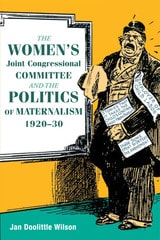
The Women's Joint Congressional Committee and the Politics of Maternalism, 1920-30
Jan Doolittle Wilson
University of Illinois Press, 2006
Jan Doolittle Wilson offers the first comprehensive history of the umbrella organization founded by former suffrage leaders in order to coordinate activities around women's reform. Encompassing nearly every major national women's organization of its time, the Women's Joint Congressional Committee (WJCC) evolved into a powerful lobbying force for the legislative agendas of more than twelve million women. Critics and supporters alike came to recognize it as "the most powerful lobby in Washington."
Examining the WJCC's most consequential and contentious campaigns, Wilson traces how the group's strategies, rhetoric, and success generated congressional and grassroots support for their far-reaching, progressive reforms. But the committee's early achievements sparked a reaction by big business that challenged and ultimately limited the programs these women envisioned. Using the WJCC as a lens, Wilson analyzes women's political culture during the 1920s. She also sheds new light on the initially successful ways women lobbied for social legislation, the limitations of that process for pursuing class-based reforms, and the enormous difficulties the women soon faced in trying to expand public responsibility for social welfare.
A volume in the series Women in American History, edited by Anne Firor Scott, Susan Armitage, Susan K. Cahn, and Deborah Gray White
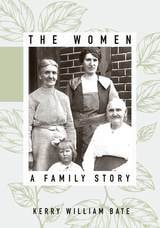
The Women
A Family StoryKerry William Bate
University of Utah Press, 2016
Kerry Bate proceeds on the premise that a story centering on the women of the clan could provide fresh perspective and insight. He portrays real people with well-rounded, flawed characters; builds from deep research; writes with a bit of style; and includes the rich context and detail of these lives. His main subjects are four generations of impressive women: the pioneer Catherine Campbell Steele; her daughter Young Elizabeth, the first Mormon child born in Utah; Kate, an accomplished community leader; and Sarah, a gifted seamstress trapped in an unhappy marriage. To enter their hardscrabble lives in small southern Utah communities is to meet women who pioneered in their own modest but determined ways.
Winner of the Mormon History Association's Best Personal History/Memoir Award.
Interview with Tom Williams on Access Utah
The Work of Mothering
Globalization and the Filipino DiasporaHarrod Suarez
University of Illinois Press, 2017
Harrod J. Suarez's innovative readings of this cultural production explores issues of diaspora, gender, and labor. He details the ways literature and cinema play critical roles in encountering, addressing, and problematizing what we think we know about overseas Filipina workers. Though often seen as compliant subjects, the Filipina mother can also destabilize knowledge production that serves the interests of global empire, capitalism, and Philippine nationalism. Suarez examines canonical writers like Nick Joaquín, Carlos Bulosan, and Jessica Hagedorn to explore this disruption and understand the maternal specificity of the construction of overseas Filipina workers. The result is a series of readings that develop new ways of thinking through diasporic maternal labor that engages with the sociological imaginary.
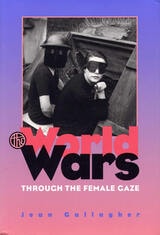
The World Wars Through the Female Gaze
Jean Gallagher
Southern Illinois University Press, 1998
For some women writers and photographers during the two world wars—Edith Wharton, Mildred Aldrich, Martha Gellhorn, Lee Miller, H.D., and Gertrude Stein—the construction of the female subject as an observer of combat became a vital concern. Their explorations of vision took place against the backdrop of a larger shift in Western culture's understanding of what "seeing" meant in common practice and philosophical discourse alike. The role of visuality in their lives was massively transformed not only by the rigid gender roles of war but by the introduction of new combat practices and technologies such as aerial surveillance, trench warfare, and civilian bombardment.
In The World Wars Through the Female Gaze, Jean Gallagher maps one portion of the historicized, gendered territory of what Nancy K. Miller calls the "gaze in representation." Expanding the notion of the gaze in critical discourse, Gallagher situates a number of visual acts within specific historic contexts to reconstruct the wartime female subject. She looks at both the female observer's physical act of seeing—and the refusal to see—for example, a battlefield, a wounded soldier, a torture victim, a national flag, a fashion model, a bombed city, or a wartime hallucination.
The book begins with two instances of wartime propaganda written by American women in France in 1915. Both Edith Wharton's Fighting France and Mildred Aldrich's A Hilltop on the Marne offer a complex and often contradictory sense of a woman writer's struggles with authority, resistance, and killing. In the process, Gallagher teases out the role of specular vision and the impossibility of "directly" seeing the war.
Gallagher then turns to literary and visual texts produced by two female journalists between 1940 and 1945. Martha Gellhorn's 1940 novel A Stricken Field exhibits a range of gendered seeing positions within and in opposition to the visual ideologies of fascism during the Nazi occupation of Czechoslovakia. Lee Miller's war correspondence and photography for Vogue show how Miller constructed herself and her predominantly female American audience as antifascist observers of war by working with and against some of the conventions of surrealist fashion photography.
Gallagher concludes by focusing on the experimental autobiographical prose of H.D. and Gertrude Stein to explore the functions of vision on two World War II "homefronts"—London during the Blitz and Vichy France.
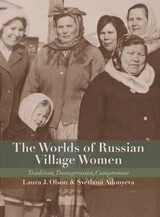
The Worlds of Russian Village Women
Tradition, Transgression, CompromiseLaura J. Olson and Svetlana Adonyeva
University of Wisconsin Press, 2012
Based upon nearly three decades of fieldwork, from 1983 to 2010, The Worlds of Russian Rural Women follows three generations of Russian women and shows how they alternately preserve, discard, and rework the cultural traditions of their forebears to suit changing needs and self-conceptions. In a major contribution to the study of folklore, Laura J. Olson and Svetlana Adonyeva document the ways that women’s tales of traditional practices associated with marriage, childbirth, and death reflect both upholding and transgression of social norms. Their romance songs, satirical ditties, and healing and harmful magic reveal the complexity of power relations in the Russian villages.
The Worth of Women
Wherein Is Clearly Revealed Their Nobility and Their Superiority to MenModerata Fonte
University of Chicago Press, 1997
Moderata Fonte was the pseudonym of Modesta Pozzo (1555–92), a Venetian woman who was something of an anomaly. Neither cloistered in a convent nor as liberated from prevailing codes of decorum as a courtesan might be, Pozzo was a respectable, married mother who produced literature in genres that were commonly considered "masculine"—the chivalric romance and the literary dialogue. This work takes the form of the latter, with Fonte creating a conversation among seven Venetian noblewomen. The dialogue explores nearly every aspect of women's experience in both theoretical and practical terms. These women, who differ in age and experience, take as their broad theme men's curious hostility toward women and possible cures for it.
Through this witty and ambitious work, Fonte seeks to elevate women's status to that of men, arguing that women have the same innate abilities as men and, when similarly educated, prove their equals. Through this dialogue, Fonte provides a picture of the private and public lives of Renaissance women, ruminating on their roles in the home, in society, and in the arts.
A fine example of Renaissance vernacular literature, this book is also a testament to the enduring issues that women face, including the attempt to reconcile femininity with ambition.
The Wounded Woman
Healing the Father-Daughter RelationshipLinda Schierse Leonard
Ohio University Press, 1982
This book is an invaluable key to self-understanding. Using examples from her own life and the lives of her clients, as well as from dreams, fairy tales, myths, films, and literature, Linda Schierse Leonard, a Jungian analyst, exposes the wound of the spirit that both men and women of our culture bear—a wound that is grounded in a poor relationship between masculine and feminine principles.
Leonard speculates that when a father is wounded in his own psychological development, he is not able to give his daughter the care and guidance she needs. Inheriting this wound, she may find that her ability to express herself professionally, intellectually, sexually, and socially is impaired. On a broader scale, Leonard discusses how women compensate for cultural devaluation, resorting to passive submission (“the Eternal Girl”), or a defensive imitation of the masculine (“the Armored Amazon”).
The Wounded Woman shows that by understanding the father-daughter wound and working to transform it psychologically, it is possible to achieve a fruitful, caring relationship between men and women, between fathers and daughters, a relationship that honors both the mutuality and the uniqueness of the sexes.
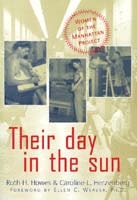
Their Day In The Sun
Ruth Howes
Temple University Press, 1999
The Manhattan Project also included women in every capacity. During World War II the manpower shortages opened the laboratory doors to women and they embraced the opportunity to demonstrate that they, too, could do "creative science." Although women participated in all aspects of the Manhattan Project, their contributions are either omitted or only mentioned briefly in most histories of the project. It is this hidden story that is presented in Their Day in the Sun through interviews, written records, and photographs of the women who were physicists, chemists, mathematicians, biologists, and technicians in the labs.
Authors Ruth H. Howes and Caroline L. Herzenberg have uncovered accounts of the scientific problems the women helped solve as well as the opportunities and discrimination they faced. Their Day in the Sun describes their abrupt recruitment for the war effort and includes anecdotes about everyday life in these clandestine improvised communities. A chapter about what happened to the women after the war and about their attitudes now, so many years later, toward the work they did on the bomb is included.

Their Day In The Sun
Women Of The Manhattan ProjectRuth H. Howes
Temple University Press, 2003

Their Sisters' Keepers
Women's Prison Reform in America, 1830-1930Estelle B. Freedman
University of Michigan Press, 1984
Theorizing NGOs
States, Feminisms, and NeoliberalismVictoria Bernal and Inderpal Grewal, eds.
Duke University Press, 2014
Contributors. Sonia E. Alvarez, Victoria Bernal, LeeRay M. Costa, Inderpal Grewal, Laura Grünberg, Elissa Helms, Julie Hemment, Saida Hodžic, Lamia Karim, Sabine Lang, Lauren Leve, Kathleen O'Reilly, Aradhana Sharma
Theorizing Self in Samoa
Emotions, Genders, and SexualitiesJeannette Marie Mageo
University of Michigan Press, 1998
There She Goes Again
Gender, Power, and Knowledge in Contemporary Film and Television FranchisesAviva Dove-Viebahn
Rutgers University Press, 2024
They Used to Call Me Snow White . . . But I Drifted
Women’s Strategic Use of HumorGina Barreca
University Press of New England, 2013
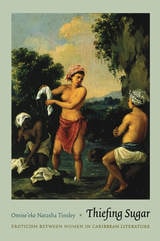
Thiefing Sugar
Eroticism between Women in Caribbean LiteratureOmise eke Natasha Tinsley
Duke University Press, 2010

Thinking Outside the Girl Box
Teaming Up with Resilient Youth in AppalachiaLinda Spatig
Ohio University Press, 2014
Thinking Outside the Girl Box is a true story about a remarkable youth development program in rural West Virginia. Based on years of research with adolescent girls—and adults who devoted their lives to working with them—Thinking Outside the Girl Box reveals what is possible when young people are challenged to build on their strengths, speak and be heard, and engage critically with their world.
Based on twelve years of field research, the book traces the life of the Lincoln County Girls’ Resiliency Program (GRP), a grassroots, community nonprofit aimed at helping girls identify strengths, become active decision makers, and advocate for social change. In the late 1990s and early 2000s, the GRP flourished. Its accomplishments were remarkable: girls recorded their own CDs, published poetry, conducted action research, opened a coffeehouse, performed an original play, and held political rallies at West Virginia’s State Capitol. The organization won national awards, and funding flowed in. Today, in 2013, the programming and organization are virtually nonexistent.
Thinking Outside the Girl Box raises pointed questions about how to define effectiveness and success in community-based programs and provides practical insights for anyone working with youth. Written in an accessible, engaging style and drawing on collaborative ethnographic research that the girls themselves helped conduct, the book tells the story of an innovative program determined to challenge the small, disempowering “boxes” girls and women are so often expected to live in.
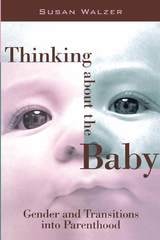
Thinking about the Baby
Gender and Transitions into ParenthoodSusan Walzer
Temple University Press, 1998
How do new mothers and fathers think about babies, and what is the influence of parental consciousness in reproducing motherhood and fatherhood as different experiences? The reports of new parents in this book illustrate the power of gendered cultural imagery in how women and men think about their roles and negotiate their parenting arrangement.
New parents talk about what it means to them to be a "good" mother or father and how this plays out in their working arrangements and their everyday interactions over child care. The author carefully unravels the effects of social norms, personal relationships, and social institutions in channeling parents toward gender-differentiated approaches to parenting.
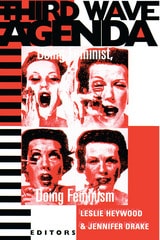
Third Wave Agenda
Being Feminist, Doing FeminismLeslie Heywood
University of Minnesota Press, 1997
Discusses the challenges and pleasures of creating a new feminism.
Young feminists have grown up with a plethora of cultural choices and images-in the distance from Gloria Steinem to Courtney Love, a chasm has been traversed and an entire history made. In Third Wave Agenda, feminists born between the years 1964 and 1973 discuss the things that matter now, both in looking back at the accomplishments and failures of the past and in planning for the challenges of the future.
The women and men writing here are activists, teachers, cultural critics, artists, and journalists. They distinguish themselves from a group of young, conservative feminists, including Naomi Wolf and Katie Roiphe, who criticize second wave feminists and are regularly called on to speak for the “next generation” of feminism. In contrast, Third Wave Agenda seeks to complicate our understanding of feminism by not only embracing the second wave critique of beauty culture, sexual abuse, and power structures, but also emphasizing ways that desires and pleasures such as beauty and power can be used to enliven activist work, even while recognizing the importance of maintaining a critique of them.Combining research, theory, and social practice with an autobiographical style, these writers are hard at work creating a new feminism that draws on the submerged histories of other feminisms-black feminism, “womanism,” and working-class feminism, among others. Some topics explored in Third Wave Agenda include feminism in popular music, interracial coalitions, and tensions between individual ambitions and collective action. Contributors: Barry Baldridge, Ana Marie Cox, Ophira Edut, Tali Edut, Carol Guess, Freya Johnson, Melissa Klein, Dyann Logwood, Annalee Newitz, Jeff Niesel, Jennifer Reed, Jillian Sandel, Leigh Shoemaker, Michelle Sidler, Deborah L. Siegel, Jen Smith, Carolyn Sorisio, and Lidia Yukman.
This Is Called Moving
A Critical Poetics of FilmAbigail Child, with a foreword by Tom Gunning
University of Alabama Press, 2005
A pioneering exploration of how poetry and experimental cinema intersect to reconstruct meaning across visual and linguistic forms.
As the writer, director, producer, and cinematographer of almost all her 30 films, videos, and shorts, Abigail Child has been recognized as a major and influential practitioner of experimental cinema since the early 1970s. Hallmarks of her style are the appropriation and reassembly of found footage and fragments from disparate visual sources, ranging from industrial films and documentaries to home movies, vacation photography, and snippets of old B movies.
The resulting collages and montages are cinematic narratives that have been consistently praised for their beauty and sense of wonder and delight in the purely visual. At the same time, Child's films are noted for their incisive political commentary on issues such as gender and sexuality, class, voyeurism, poverty, and the subversive nature of propaganda.
In the essays of This Is Called Moving, Child draws on her long career as a practicing poet as well as a filmmaker to explore how these two language systems inform and cross-fertilize her work. For Child, poetry and film are both potent means of representation, and by examining the parallels between them—words and frames, lines and shots, stanzas and scenes—she discovers how the two art forms re-construct and re-present social meaning, both private and collective.
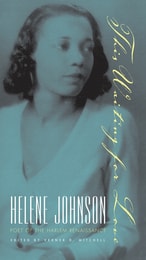
This Waiting for Love
Helene Johnson, Poet of the Harlem RenaissanceVerner D. Mitchell
University of Massachusetts Press, 2000
This volume brings together all of the known poetry and a selection of correspondence by an enormously talented but underappreciated poet of the Harlem Renaissance. Cousin of novelist Dorothy West and friend of Zora Neale Hurston, Helene Johnson (1905–1995) first gained literary prominence when James Weldon Johnson and Robert Frost selected three of her poems for prizes in a 1926 competition. During the late 1920s and early 1930s her poetry appeared in various small magazines, such as the Saturday Evening Quill, Palms, Opportunity, and Harlem. In 1933 Johnson married, and two years later her last published poem, “Let Me Sing My Song,” appeared in Challenge, the journal West had founded to revive the spirit of the Harlem Renaissance.
In his well-researched introduction, Verner D. Mitchell reconstructs Johnson's life, the details of which have long been veiled from public view, and places her in the context of a vital literary tradition. In addition to discussing her relationship with West, Hurston, and other black women writers, he explores the distinctive, at times radical, qualities of her work. Ever willing to defy the genteel conventions that governed women's writing, Johnson wrote poems on erotic themes and engaged the aesthetic, gender, and racial politics of her time.
Cheryl A. Wall's foreword also celebrates Johnson's talent, particularly the ease with which she moved among various verse forms—from the rigor of the sonnet to the improvisational creativity of free black vernacular. “An unexpected and most welcome gift,” This Waiting for Love, Wall writes, is “an enduring tribute” to “the vibrant poetry of Helene Johnson.”
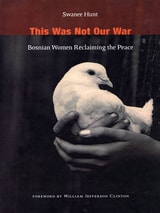
This Was Not Our War
Bosnian Women Reclaiming the PeaceSwanee Hunt
Duke University Press, 2004
This Was Not Our War shares amazing first-person accounts of twenty-six Bosnian women who are reconstructing their society following years of devastating warfare. A university student working to resettle refugees, a paramedic who founded a veterans’ aid group, a fashion designer running two nonprofit organizations, a government minister and professor who survived Auschwitz—these women are advocates, politicians, farmers, journalists, students, doctors, businesswomen, engineers, wives, and mothers. They are from all parts of Bosnia and represent the full range of ethnic traditions and mixed heritages. Their ages spread across sixty years, and their wealth ranges from expensive jewels to a few chickens. For all their differences, they have this much in common: all survived the war with enough emotional strength to work toward rebuilding their country. Swanee Hunt met these women through her diplomatic and humanitarian work in the 1990s. Over the course of seven years, she conducted multiple interviews with each one. In presenting those interviews here, Hunt provides a narrative framework that connects the women’s stories, allowing them to speak to one another.
The women describe what it was like living in a vibrant multicultural community that suddenly imploded in an onslaught of violence. They relate the chaos; the atrocities, including the rapes of many neighbors and friends; the hurried decisions whether to stay or flee; the extraordinary efforts to care for children and elderly parents and to find food and clean drinking water. Reflecting on the causes of the war, they vehemently reject the idea that age-old ethnic hatreds made the war inevitable. The women share their reactions to the Dayton Accords, the end of hostilities, and international relief efforts. While they are candid about the difficulties they face, they are committed to rebuilding Bosnia based on ideals of truth, justice, and a common humanity encompassing those of all faiths and ethnicities. Their wisdom is instructive, their courage and fortitude inspirational.

Three Cartesian Feminist Treatises
François Poullain de la Barre
University of Chicago Press, 2002
Poullain published three books (anonymously) on this topic in the 1670s, all of which are included in English translation in this volume. In On the Equality of the Two Sexes he argued that the supposedly "natural" inferiority of women was culturally produced. To help women recognize and combat this prejudice, Poullain advocated a modern, enlightened feminine education in On the Education of Ladies. Finally, since his contemporaries largely ignored Poullain's writings, he offered a rebuttal to his own arguments in On the Excellence of Men—a rebuttal that he promptly countered, strengthening his original positions.
A truly modern feminist, Poullain laid the intellectual groundwork for the women's liberation movement centuries before it happened.
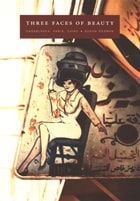
Three Faces of Beauty
Casablanca, Paris, CairoSusan Ossman
Duke University Press, 2002
By examining how images from fashion magazines, film, and advertising are enacted in beauty salons, Ossman demonstrates how embodiment is able to display and rework certain hierarchies. While offering the possibility of freedom from the tethers of status, nation, religion, and nature, beauty is created by these very categories and values, Ossman shows. Drawing on hundreds of interviews, she documents the various rituals of welcome, choice-making, pricing practices, and spatial arrangements in multiple salons . She also reveals ways in which patrons in all three cities imagine and co-opt looks they believe are fashionable in the other cities. By observing salons as scenes of instruction, Ossman reveals that beautiful bodies evolve within the intertwining contexts of media, modernity, location, time, postcolonialism, and male expectation.
Through Words and Deeds
Polish and Polish American Women in HistoryEdited by John Bukowczyk
University of Illinois Press, 2021
A valuable and enlightening resource, Through Words and Deeds offers an introduction to the many facets of Polish and Polish American womanhood.
Contributors: Laura Anker, Robert Blobaum, Anna Brzezińska, John J. Bukowczyk, Halina Filipowicz, William J. Galush, Rita Gladsky, Thaddeus V. Gromada, Bożena Karwowska, Grażyna Kozaczka, Lynn Lubamersky, Karen Majewski, Nameeta Mathur, Lori A. Matten, Jan Molenda, James S. Pula, Władysław Roczniak, and Robert Szymczak
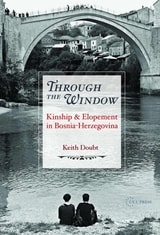
Through the Window
Kinship and Elopement in Bosnia-HerzegovinaKeith Doubt
Central European University Press, 2014
This book is not about war crimes, crimes against humanity, genocide, evil, or the killing of a society. It is about a cultural heritage, something vital to a society as a society, something that was not killed in the previous war, something that is resilient.
Through the Window brings an original perspective to folklore of Bosnians at a certain period of time and the differences and similarities of the three main ethnic groups in Bosnia and Herzegovina. It examines the transethnic character of cultural heritage, against divisions that dominate their tragic recent past.
The monograph focuses in particular on customs shared by different ethnic groups, specifically elopement, and affinal visitation. The elopement is a transformative rite of passage where an unmarried girl becomes a married woman. The affinal visitation, which follows, is a confirmatory ceremony where ritualized customs between families establish in-lawships These customs reflect a transethnic heritage shared by people in Bosnia as a national group, including Bosniaks, Serbs and Croats.
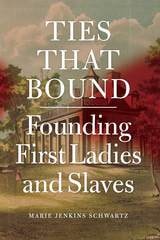
Ties That Bound
Founding First Ladies and SlavesMarie Jenkins Schwartz
University of Chicago Press, 2017
Unlike other histories that treat the stories of the First Ladies’ slaves as separate from the lives of their mistresses, Ties That Bound closely examines the relationships that developed between the First Ladies and their slaves. For elite women and their families, slaves were more than an agricultural workforce; slavery was an entire domestic way of life that reflected and reinforced their status. In many cases slaves were more constant companions to the white women of the household than were their husbands and sons, who often traveled or were at war. By looking closely at the complicated intimacy these women shared, Schwartz is able to reveal how they negotiated their roles, illuminating much about the lives of slaves themselves, as well as class, race, and gender in early America.
By detailing the prevalence and prominence of slaves in the daily lives of women who helped shape the country, Schwartz makes it clear that it is impossible to honestly tell the stories of these women while ignoring their slaves. She asks us to consider anew the embedded power of slavery in the very earliest conception of American politics, society, and everyday domestic routines.

Tight Spaces
Kesho Scott
University of Iowa Press, 1999
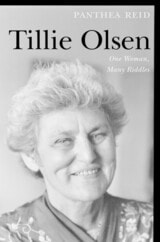
Tillie Olsen
One Woman, Many RiddlesReid, Panthea
Rutgers University Press, 2011
Born in Omaha, Nebraska, Tillie Olsen spent her young adulthood there, in Kansas City, and in Faribault, Minnesota. She relocated to California in 1933 and lived most of her life in San Francisco. From 1962 on, she sojourned frequently in Massachusetts, New Hampshire, Santa Cruz, and Soquel, California. She was a 1920s "hell-cat"; a 1930s revolutionary; an early 1940s crusader for equal pay for equal work and a war-relief patriot; an ex-GI's ideal wife in the later 1940s; a victim of FBI surveillance in the 1950s;a civil rights and antiwar advocate during the 1960s and 1970s; and a life-long orator for universal human rights.
The enigma of Tillie Olsen is intertwined with that of the twentieth century. From the rebellions in Czarist Russia, through the terrors of the Depression and the hopes of the New Deal, to World War II, the Nuremberg Trials, and the United Nations' founding, to the cold war and House Un-American Activities Committee hearings, to later progressive and repressive movements, the story of Olsen's life brings remote events into focus.
In her classic short story "I Stand Here Ironing" and her groundbreaking Tell Me a Riddle, Yonnondido, and Silences, Olsen scripted powerful, moving prose about ordinary people's lives, exposing the pervasive effects of sexism, racism, and classism and elevating motherhood and women's creativity into topics of study. Popularly referred to as "Saint Tillie," Olsen was hailed by many as the mother of modern feminism.
Based on diaries, letters, manuscripts, private documents, resurrected public records, and countless interviews, Reid's artfully crafted biography untangles some of the puzzling knots of the last century's triumphs and failures and speaks truth to legend, correcting fabrications and myths about and also by Tillie Olsen.

Time Travels
Feminism, Nature, PowerElizabeth Grosz
Duke University Press, 2005
Grosz’s reflections on how rethinking time might generate new understandings of nature, culture, subjectivity, and politics are wide ranging. She moves from a compelling argument that Charles Darwin’s notion of biological and cultural evolution can potentially benefit feminist, queer, and antiracist agendas to an exploration of modern jurisprudence’s reliance on the notion that justice is only immanent in the future and thus is always beyond reach. She examines Henri Bergson’s philosophy of duration in light of the writings of Gilles Deleuze, Maurice Merleau-Ponty, and William James, and she discusses issues of sexual difference, identity, pleasure, and desire in relation to the thought of Deleuze, Friedrich Nietzsche, Michel Foucault, and Luce Irigaray. Together these essays demonstrate the broad scope and applicability of Grosz’s thinking about time as an undertheorized but uniquely productive force.
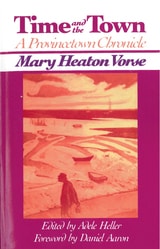
Time and the Town
A Provincetown ChronicleAdele Heller
Rutgers University Press, 1991
Time and the Town was the last of Mary Heaton Vorse's books. It is about many things —a town and its people, the author, a certain kind of idyllic life. As much as anything else, it is the biography of the house Vorse bought in 1907 and lived in, off and on, for the next thirty-six years. The moods of the house mirrored her own. "Our houses," she wrote, "are our biographies, the stories of our defeats and victories."
Tinged with nostalgia and disenchantment, the book describes a Provincetown that has changed, a place on the verge of modernity. It is no longer a major fishing port. It has become a place whose business is tourism. Contrasting the old and the new, Vorse celebrates the enduring character of the town itself. She tells stories that are engaging and charming, droll and fabulous. The wrinkled Mrs. Mary Mooncusser who, though drunk and stark naked, conducts herself with great decorum when Vorse pays her a call, might have stepped out of the pages of Sherwood Anderson or Eudora Welty. In another anecdote, the townspeople scour the beaches for cases of booze dumped into the sea by rumrunners and are briefly inflated with the spirit of ancestral smugglers and buccaneers.
Vorse herself remained something of an outsider in Provincetown, despite her evident affection for the place and its inhabitants. They surely regarded her as simply another of those artist-intellectuals--many of whom appear in the pages of this book. The "off-Cape" outsiders put the town in the national limelight but took no interest in local matters. Vorse here ponders local matters exclusively, almost, one suspects, as a way of forgetting the more complex matters that occupied her--her agonies of parental guilt, her resentment of domestic obligations, her third marriage, her depressions and breakdowns. The town is in that sense beyond time.
Times of Mobility
Transnational Literature and Gender in TranslationJasmina Lukic
Central European University Press, 2020
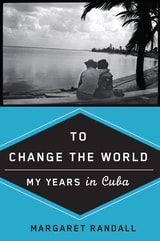
To Change the World
My Years in CubaRandall, Margaret
Rutgers University Press, 2009
Randall gives readers an inside look at her children's education, the process through which new law was enacted, the ins and outs of healthcare, employment, internationalism, culture, and ordinary people's lives. She explores issues of censorship and repression, describing how Cuban writers and artists faced them. She recounts one of the country's last beauty pageants, shows us a night of People's Court, and takes us with her when she shops for her family's food rations. Key figures of the revolution appear throughout, and Randall reveals aspects of their lives never before seen.
More than fifty black and white photographs, most by the author, add depth and richness to this astute and illuminating memoir. Written with a poet's ear, depicted with a photographer's eye, and filled with a feminist vision, To Change the Worldùneither an apology nor gratuitous attackùadds immensely to the existing literature on revolutionary Cuba.
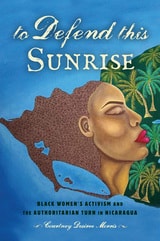
To Defend This Sunrise
Black Women’s Activism and the Authoritarian Turn in NicaraguaCourtney Desiree Morris
Rutgers University Press, 2023
To Exist is to Resist
Black Feminism in EuropeEdited by Akwugo Emejulu and Francesca Sobande
Pluto Press, 2019
Deeply aware that they are constructed as 'Others' living in a racialised and hierarchical continent, the contibutors explore gender, class, sexuality and legal status to show that they are both invisible - presumed to be absent from and irrelevant to European societies - and hyper-visible - assumed to be passive and sexualised, angry and irrational.
Through imagining a future outside the neocolonial frames and practices of contemporary Europe, this book explores a variety of critical spaces including motherhood and the home, friendships and intimate relationships, activism and community, and literature, dance and film.
To Live Here, You Have to Fight
How Women Led Appalachian Movements for Social JusticeJessica Wilkerson
University of Illinois Press, 2019
Jessica Wilkerson tells their stories within the larger drama of efforts to enact change in the 1960s and 1970s. She shows white Appalachian women acting as leaders and soldiers in a grassroots war on poverty--shaping and sustaining programs, engaging in ideological debates, offering fresh visions of democratic participation, and facing personal political struggles. Their insistence that caregiving was valuable labor clashed with entrenched attitudes and rising criticisms of welfare. Their persistence, meanwhile, brought them into unlikely coalitions with black women, disabled miners, and others to fight for causes that ranged from poor people's rights to community health to unionization.
Inspiring yet sobering, To Live Here, You Have to Fight reveals Appalachian women as the indomitable caregivers of a region--and overlooked actors in the movements that defined their time.
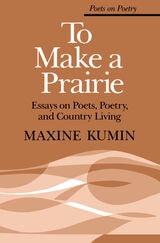
To Make a Prairie
Essays on Poets, Poetry, and Country LivingMaxine Kumin
University of Michigan Press, 1980
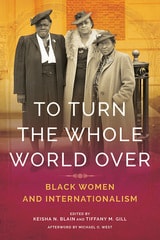
To Turn the Whole World Over
Black Women and InternationalismEdited by Keisha N. Blain and Tiffany M. Gill
University of Illinois Press, 2019
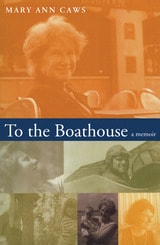
To the Boathouse
A MemoirMary Ann Caws
University of Alabama Press, 2008
From Southern roots to scholarly heights—one woman’s journey to find peace, purpose, and her place in the world.
A neat and lavish, if constricting, childhood in the lush landscapes of North Carolina. Summers at a calm, remote beach house. A proper and religiously influenced prep school in Washington. Years at Bryn Mawr, an impulsive study trip to Paris, further education at Yale, married life, and divorced life. These are the settings for Mary Ann Caws’s passionate memoir, in which she recounts the highs and lows of her journey through life. Marked by complicated relationships and a passion for learning, Caws’s story is one that resonates not only with writers like herself, but with all who have struggled with determining their path within the surrounding world.
Caws writes of her formal, stylish parents, her rebellious and deeply admired sister, and her artistic grandmother, whom she respected and idolized more than anyone else. She describes her marriage and subsequent divorce, her bouts with therapy, her children, and her growth as a student and writer. Throughout the memoir is evidence of her love for writing, teaching, art, and poetry as well as her deep respect for the people in her life that ultimately guided her into her career.
The author describes Southern society and her own life with fondness, nostalgia, and a tinge of honest criticism. The carefully selected details and delicate balance of sentiment and fact bring readers into the fascinating, complicated, and all-too-real world of Caws’s—and our own—past.
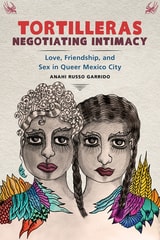
Tortilleras Negotiating Intimacy
Love, Friendship, and Sex in Queer Mexico CityAnahi Russo Garrido
Rutgers University Press, 2020

Tough Enough
Arbus, Arendt, Didion, McCarthy, Sontag, WeilDeborah Nelson
University of Chicago Press, 2017
Tough Enough traces the careers of these women and their challenges to the pre-eminence of empathy as the ethical posture from which to examine pain. Their writing and art reveal an adamant belief that the hurts of the world must be treated concretely, directly, and realistically, without recourse to either melodrama or callousness. As Deborah Nelson shows, this stance offers an important counter-tradition to the familiar postwar poles of emotional expressivity on the one hand and cool irony on the other. Ultimately, in its insistence on facing reality without consolation or compensation, this austere “school of the unsentimental” offers new ways to approach suffering in both its spectacular forms and all of its ordinariness.
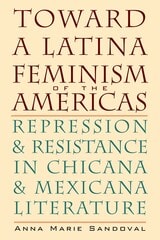
Toward a Latina Feminism of the Americas
Repression and Resistance in Chicana and Mexicana LiteratureBy Anna Marie Sandoval
University of Texas Press, 2008
Weaving strands of Chicana and Mexicana subjectivities, Toward a Latina Feminism of the Americas explores political and theoretical agendas, particularly those that undermine the patriarchy, across a diverse range of Latina authors. Within this range, calls for a coalition are clear, but questions surrounding the process of these revolutionary dialogues provide important lines of inquiry. Examining the works of authors such as Sandra Cisneros, Laura Esquivel, Carmen Boullosa, and Helena María Viramontes, Anna Sandoval considers resistance to traditional cultural symbols and contemporary efforts to counteract negative representations of womanhood in literature and society.
Offering a new perspective on the oppositional nature of Latina writers, Sandoval emphasizes the ways in which national literatures have privileged male authors, whose viewpoint is generally distinct from that of women—a point of departure rarely acknowledged in postcolonial theory. Applying her observations to the disciplinary, historical, and spatial facets of literary production, Sandoval interrogates the boundaries of the Latina experience. Building on the dialogues begun with such works as Sonia Saldivar-Hull's Feminism on the Border and Ellen McCracken's New Latina Narrative, this is a concise yet ambitious comparative approach to the historical and cultural connections (as well as disparities) found in Chicana and Mexicana literature.
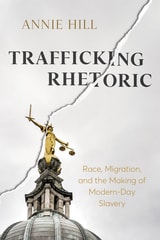
Trafficking Rhetoric
Race, Migration, and the Making of Modern-Day SlaveryAnnie Hill
The Ohio State University Press, 2024
Honorable Mention, 2025 NCA Public Address Division’s Marie Hochmuth Nichols Award
Human trafficking has generated intense global concern, with stories of sex slavery and images of women forced into prostitution so persuasive that states have raced to respond ahead of empirical data and clear definitions of the crime. In Trafficking Rhetoric, Annie Hill analyzes the entanglement of state veneration and state violence by tracking how the United Kingdom points to the alleged crimes of others in order to celebrate itself and conceal its own aggression. Hill compares the UK’s acclaimed rescue approach to human trafficking with its hostile approach to migration, arguing that they are two sides of the same coin—one that relies on rhetorical constructions of “trafficked women” and “illegal migrants” to materialize the UK as an Anglo-white space.
Drawing from official estimates, policy papers, NGO reports, news stories, and awareness campaigns and situating them in the broader EU context, Hill accounts for why the UK’s antitrafficking agenda emerged with such rhetorical force in the early twenty-first century. Trafficking Rhetoric reframes controversies over labor, citizenship, and migration while challenging the continued traction of race-baiting and gender bias in determining who has the right to live, work, and belong in the nation.
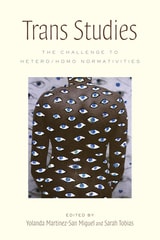
Trans Studies
The Challenge to Hetero/Homo NormativitiesMartínez-San Miguel, Yolanda
Rutgers University Press, 2016
From Caitlyn Jenner to Laverne Cox, transgender people have rapidly gained public visibility, contesting many basic assumptions about what gender and embodiment mean. The vibrant discipline of Trans Studies explores such challenges in depth, building on the insights of queer and feminist theory to raise provocative questions about the relationships among gender, sexuality, and accepted social norms.