Results by title
18284 books match the query 'United States' and 3764 start with t

The Third Door
The Autobiography of an American Negro WomanEllen Tarry
University of Alabama Press, 1992
Tarry relates her life against the background of a changing American society
In pursuit of her dream of becoming a writer, Tarry moved to New York, where she worked for black newspapers and became acquainted with some of the prominent black artists and writers of the day, particularly Claude McKay and James Weldon Johnson. Her devotion to the church found expression in social work activities, first in Harlem, then in Chicago, and, during World War II, in Anniston, Alabama, where she directed a USO for black soldiers stationed at Fort McClellan. Tarry wrote several books for young readers, including biographies of James Weldon Johnson and Pierre Toussaint. She continued her social work career after the war and now lives in New York.
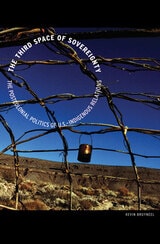
The Third Space of Sovereignty
The Postcolonial Politics of U.S.–Indigenous RelationsKevin Bruyneel
University of Minnesota Press, 2007
The imposition of modern American colonial rule has defined U.S.–indigenous relations since the time of the American Civil War. In resistance, Kevin Bruyneel asserts, indigenous political actors work across American spatial and temporal boundaries, demanding rights and resources from the government while also challenging the imposition of colonial rule over their lives. This resistance engenders what he calls a “third space of sovereignty,” which resides neither inside nor outside the U.S. political system but rather exists on its boundaries, exposing both the practices and limitations of American colonial rule.
The Third Space of Sovereignty offers fresh insights on such topics as the crucial importance of the formal end of treaty-making in 1871, indigenous responses to the prospect of U.S. citizenship in the 1920s, native politics during the tumultuous civil rights era of the 1960s, the question of indigenousness in the special election of California’s governor in 2003, and the current issues surrounding gaming and casinos.
In this engaging and provocative work, Bruyneel shows how native political actors have effectively contested the narrow limits that the United States has imposed on indigenous people’s ability to define their identity and to develop economically and politically on their own terms.
Kevin Bruyneel is assistant professor of politics at Babson College.
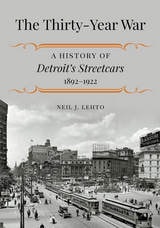
The Thirty-Year War
A History of Detroit's Streetcars, 1892–1922Neil J. Lehto
Michigan State University Press, 2017
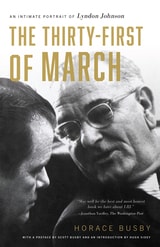
The Thirty-first of March
An Intimate Portrait of Lyndon JohnsonHorace Busby, with a Preface by Scott Busby and an Introduction by Hugh Sidey
University of Texas Press, 2023
An intimate retelling of Lyndon B. Johnson’s politics and presidency by one of his closest advisors.
Horace Busby was one of LBJ’s most trusted advisors; their close working and personal relationship spanned twenty years. In The Thirty-First of March he offers an indelible portrait of a president and a presidency at a time of crisis. From the aftereffects of the Kennedy assassination, when Busby was asked by the newly sworn-in president to sit by his bedside during his first troubled nights in office, to the concerns that defined the Great Society—civil rights, the economy, social legislation, housing, and the Vietnam War—Busby not only articulated and refined Johnson's political thinking, he also helped shape the most ambitious, far-reaching legislative agenda since FDR's New Deal.
Here is Johnson the politician, Johnson the schemer, Johnson who advised against JFK’s choice of an open limousine that fateful day in Dallas, and Johnson the father, sickened by the deaths of young men fighting and dying in Vietnam on his orders. The Thirty-first of March is a rare glimpse into the inner sanctum of Johnson's presidency, as seen through the eyes of one of the people who understood him best.
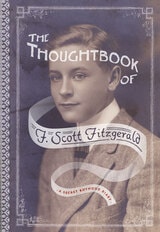
The Thoughtbook of F. Scott Fitzgerald
A Secret Boyhood DiaryF. Scott Fitzgerald
University of Minnesota Press, 2013
When F. Scott Fitzgerald was fourteen and living in the Crocus Hill neighborhood of St. Paul, he began keeping a short diary of his exploits among his friends, friendly rivals, and crushes. He gave the journal a title page—Thoughtbook of Francis Scott Key Fitzgerald of St. Paul Minn. U.S.A.—and kept it securely locked in a box under his bed. He would later use The Thoughtbook as the basis for “The Book of Scandal” in his Basil Lee Duke stories, and brief sections were copied over the years for use by scholars and even published in Life magazine.“Are you going to the Ordways’? the Herseys’? the Schultzes’?” Here, for the first time, is a complete transcription of this charming, twenty-seven-page diary highlighting Fitzgerald’s escapades among the children of some of St. Paul’s most influential families—models for the families described in The Great Gatsby. Presented in a simple format for both scholars and general readers alike, The Thoughtbook of F. Scott Fitzgerald includes a new introduction by Dave Page that covers the history and provenance of the diary, its place and meaning in Fitzgerald’s literary development, and its revelations about his life and writing process.
One of the earliest known works by F. Scott Fitzgerald, The Thoughtbook provides a unique glimpse of Fitzgerald as a young boy and his social circle as they played among the grand homes of Summit Avenue, making up games, starting secret societies, competing with rivals, and (at all times) staying up-to-date on who exactly is vying for whose attention.
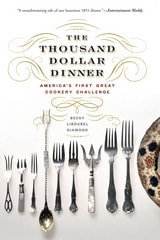
The Thousand Dollar Dinner
America's First Great Cookery ChallengeBecky Libourel Diamond
Westholme Publishing, 2015
In 1851, fifteen wealthy New Yorkers wanted to show a group of Philadelphia friends just how impressive a meal could be and took them to Delmonico’s, New York’s finest restaurant. They asked Lorenzo Delmonico to “astonish our Quaker City friends with the sumptuousness of our feast,” and assured him that money was no object, as the honor of New York was at stake. They were treated to a magnificent banquet, enjoyed by all. However, not to be outdone, the Philadelphia men invited the New Yorkers to a meal prepared by James W. Parkinson in their city. In what became known as the “Thousand Dollar Dinner,” Parkinson successfully rose to the challenge, creating a seventeen-course extravaganza featuring fresh salmon, baked rockfish, braised pigeon, turtle steaks, spring lamb, out-of-season fruits and vegetables, and desserts, all paired with rare wines and liquors. Midway through the twelve-hour meal, the New Yorkers declared Philadelphia the winner of their competition, and at several times stood in ovation to acknowledge the chef ’s mastery. In The Thousand Dollar Dinner: America’s First Great Cookery Challenge, research historian Becky Libourel Diamond presents the entire seventeen-course meal, course by course, explaining each dish and its history. A gastronomic turning point, Parkinson’s luxurious meal helped launch the era of grand banquets of the gilded age and established a new level of American culinary arts to rival those of Europe.

The Thousand-Year Flood
The Ohio-Mississippi Disaster of 1937David Welky
University of Chicago Press, 2011
In the early days of 1937, the Ohio River, swollen by heavy winter rains, began rising. And rising. And rising. By the time the waters crested, the Ohio and Mississippi had climbed to record heights. Nearly four hundred people had died, while a million more had run from their homes. The deluge caused more than half a billion dollars of damage at a time when the Great Depression still battered the nation.
Timed to coincide with the flood's seventy-fifth anniversary, The Thousand-Year Flood is the first comprehensive history of one of the most destructive disasters in American history. David Welky first shows how decades of settlement put Ohio valley farms and towns at risk and how politicians and planners repeatedly ignored the dangers. Then he tells the gripping story of the river's inexorable rise: residents fled to refugee camps and higher ground, towns imposed martial law, prisoners rioted, Red Cross nurses endured terrifying conditions, and FDR dispatched thousands of relief workers. In a landscape fraught with dangers—from unmoored gas tanks that became floating bombs to powerful currents of filthy floodwaters that swept away whole towns—people hastily raised sandbag barricades, piled into overloaded rowboats, and marveled at water that stretched as far as the eye could see. In the flood's aftermath, Welky explains, New Deal reformers, utopian dreamers, and hard-pressed locals restructured not only the flood-stricken valleys, but also the nation's relationship with its waterways, changes that continue to affect life along the rivers to this day.
A striking narrative of danger and adventure—and the mix of heroism and generosity, greed and pettiness that always accompany disaster—The Thousand-Year Flood breathes new life into a fascinating yet little-remembered American story.
The Three Cs of Higher Education
Competition, Collaboration and ComplementarityMark O'Hara
Central European University Press, 2019
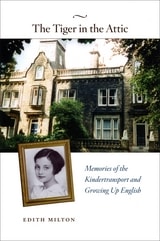
The Tiger in the Attic
Memories of the Kindertransport and Growing Up EnglishEdith Milton
University of Chicago Press, 2006
In this illuminating chronicle, Edith describes how she struggled to fit in and to conquer self-doubts about her German identity. Her realistic portrayal of the seemingly mundane yet historically momentous details of daily life during World War II slowly reveals istelf as a hopeful story about the kindness and generosity of strangers. She paints an account rich with colorful characters and intense relationships, uncanny close calls and unnerving bouts of luck that led to survival. Edith's journey between cultures continues with her final passage to America—yet another chapter in her life that required adjustment to a new world—allowing her, as she narrates it here, to visit her past as an exile all over again.
The Tiger in the Attic is a literary gem from a skilled fiction writer, the story of a thoughtful and observant child growing up against the backdrop of the most dangerous and decisive moment in modern European history. Offering a unique perspective on Holocaust studies, this book is both an exceptional and universal story of a young German-Jewish girl caught between worlds.
“Milton is brilliant at the small stroke . . . as well as broader ones.”—Alana Newhouse, New York Times Book Review

The Tillamook
A Created Forest Comes of AgeGail Wells
Oregon State University Press, 1999
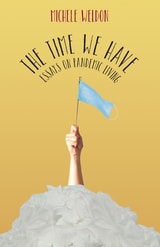
The Time We Have
Essays on Pandemic LivingMichele Weldon
Northwestern University Press, 2024
At a time when so many are dealing with collective and personal grief, award-winning author and journalist Michele Weldon’s new collection of essays navigates the revelatory and upending nature of this extraordinary pandemic era through a lens of love and connection. Weldon explores pain and pleasure alike with emotional texture, empathy, wisdom, vulnerability, and humor. She interrogates moments of joy, despair, and triumph, offering readers the possibility for a richly cathartic experience. With honesty and agility, Weldon creates poignant intersections of her narrative with popular culture, history, media, news, consumerism, family traditions, and healthcare. Employing honest and daring language, Weldon examines the concepts of safety, importance of beloved objects, power of words, shift to remote relationships, concepts of feminism, betrayal of public lies, and more. Ultimately, with grace and heart, Weldon offers in these essays useful pathways toward framing this swath of time so that we might arrive at a sense of understanding, belonging, and peace with our new realities.
The Time between Places
Stories That Weave In and Out of Egypt and AmericaPauline Kaldas
University of Arkansas Press, 2010
The Timeline of Presidential Elections
How Campaigns Do (and Do Not) MatterRobert S. Erikson and Christopher Wlezien
University of Chicago Press, 2012
The Tizard Mission
The Top-Secret Operation That Changed the Course of World War IIStephen Phelps
Westholme Publishing, 2010
Alone Against Germany, Britain Gave America Its Most Astonishing Secrets
In August 1940, a German invasion of Britain looked inevitable. Luftwaffe bombers were pounding British cities, France had surrendered, and the Low Countries were under German control. Although sympathetic to Britain’s plight, the United States remained staunchly neutral. Unknown to the rest of the world, Britain’s brightest scientific and military minds had been working on futuristic technology for a decade, including radar and jet propulsion. While the great value of radar to locate and identify objects at long distance and at night or in bad weather was appreciated, at the time it was thought that practical radar required a room-sized device for generating an effective signal. Now, suddenly, British scientists had something extraordinary—the cavity magnetron, a generator hundreds of times more powerful than any other in use and small enough to be held in the hand. With the British economy and industry reeling from the war, Winston Churchill gambled on an unorthodox plan: a team of scientists and engineers would travel under cover to the United States and give the still-neutral Americans the best of Britain’s military secrets. It was hoped that in exchange the United States would provide financial and manufacturing support—which might even lead to their official entry into the war.
The Tizard Mission, named for its leader Sir Henry Tizard, steamed across the Atlantic carrying a suitcase-sized metal deed box. Designed to sink in the event the ship was torpedoed by a U-boat, the box contained details of the Whittle jet engine, research for an atomic bomb, and a precious cavity magnetron. The Americans proved to be astonished, receptive, and efficient: Bell Telephone produced the first thirty magnetrons in October 1940, and over a million by the end of the war. With this device, both warships and aircraft could carry war-winning radar. But Britain did not only give America military secrets, these same technologies would produce a fortune for postwar commercial industries, with the magnetron being the key component to the microwave oven. In The Tizard Mission: The Top-Secret Operation That Changed the Course of World War II, Stephen Phelps reveals how the Tizard Mission was the turning point in the technological war, giving Britain the weapons it desperately needed and laying the groundwork for both the Special Relationship and much of the United States’s postwar economic boom, an effect that still resonates today.
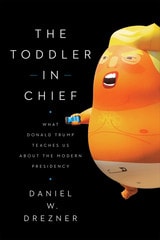
The Toddler in Chief
What Donald Trump Teaches Us about the Modern PresidencyDaniel W. Drezner
University of Chicago Press, 2020
Every president faces criticism and caricature. Donald Trump, however, is unique in that he is routinely characterized in ways more suitable for a toddler. What’s more, it is not just Democrats, pundits, or protestors who compare the president to a child; Trump’s staffers, subordinates, and allies on Capitol Hill also describe Trump like a small, badly behaved preschooler.
In April 2017, Daniel W. Drezner began curating every example he could find of a Trump ally describing the president like a toddler. So far, he’s collected more than one thousand tweets—a rate of more than one a day. In The Toddler-in-Chief, Drezner draws on these examples to take readers through the different dimensions of Trump’s infantile behavior, from temper tantrums to poor impulse control to the possibility that the President has had too much screen time. How much damage can really be done by a giant man-baby? Quite a lot, Drezner argues, due to the winnowing away of presidential checks and balances over the past fifty years. In these pages, Drezner follows his theme—the specific ways in which sharing some of the traits of a toddler makes a person ill-suited to the presidency—to show the lasting, deleterious impact the Trump administration will have on American foreign policy and democracy.
The “adults in the room” may not be able to rein in Trump’s toddler-like behavior, but, with the 2020 election fast approaching, the American people can think about whether they want the most powerful office turned into a poorly run political day care facility. Drezner exhorts us to elect a commander-in-chief, not a toddler-in-chief. And along the way, he shows how we must rethink the terrifying powers we have given the presidency.
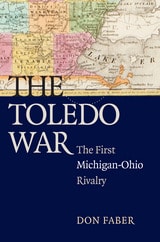
The Toledo War
The First Michigan-Ohio RivalryDon Faber
University of Michigan Press, 2008
Most are familiar with the Michigan-Ohio football rivalry, an intense but usually good-natured contest that stretches back over one hundred years. Yet far fewer may know that in the early nineteenth century Michigan and Ohio were locked in a different kind of battle---one that began before Michigan became a state.
The conflict started with a long-simmering dispute over a narrow wedge of land called the Toledo Strip. Early maps were famously imprecise, adding to the uncertainty of the true boundary between the states. When Ohio claimed to the mouth of the Maumee River, land that according to the Northwest Ordinance of 1787 fell in the territory of Michigan, the "Toledo War" began.
Today the fight may bring a smile to Michiganians and Ohioans because both states benefited: Ohioans won the war and Michigan got the Upper Peninsula. But back then passions about rightful ownership ran high, and it would take many years---and colorful personalities all the way up to presidents---to settle the dispute. The Toledo War: The First Michigan-Ohio Rivalry gives a well-researched and fascinating account of the famous war.

The Tolerance Generation
Growing Up Online in the Anti-Bullying EraSarah Miller
University of Chicago Press, 2026
Draws directly on insights from teens to reframe our understanding of bullying in the age of social media and why anti-bullying campaigns have been unsuccessful in combating it.
Fitting in and standing out is an eternal rite of passage for teenagers. Increasingly, their struggles to establish hierarchies and regulate social norms are labeled under the umbrella of “bullying.” This phenomenon is considered such a significant problem that all fifty states have passed anti-bullying legislation, and many schools now engage prevention programs that promote tolerance, kindness, and active bystander interventions. Despite these efforts, bullying remains as widespread as ever. Why is that? The answer lies in a unique challenge faced by teens today: social media.
In The Tolerance Generation, sociologist Sarah Miller explores how youth grapple with bullying in the digital age alongside the anti-bullying industry. Drawing on two school years with students at a Northeastern high school, Miller reveals how institutional efforts to curb bullying are no match for the many online interactions in which bullying thrives. She charts teens’ experiences as they confront not only bullying, but also sexting exposures, school shooting threats, and viral cancel culture, illustrating the escalating pressures social media places on youth. Yet the school’s anti-bullying campaigns are a mismatch. They are engineered to address individual instances of explicit conflict, not to change the culture that contributes to bullying, nor to help marginalized students who are most likely to be targeted. Miller captures how exclusion and harm spread through the interplay of teens’ on and offline lives and shows how this is due, in part, to school practices that both reinforce—and fail to address—bullying as a systemic problem.
But while social media can foster conflict, it can also be a tool for building a youth culture of care. Miller shows how many teens harness digital culture to develop their own prevention strategies, going beyond tolerance to use social media as a site for education, conflict resolution, and resistance. Ultimately, Miller argues that the anti-bullying movement is an inadequate training ground for youth to learn how to deal with American inequalities. However, by addressing the structural factors that produce bullying, and by listening to teens’ wisdom on how best to handle it, schools can create a more effective curriculum.
The Tolerant Populists, Second Edition
Kansas Populism and NativismWalter Nugent
University of Chicago Press, 2013
Historians wrote approvingly of the Populists up into the 1950s. But with time and new voices, led by historian Richard Hofstadter, the Populists were denigrated, depicted as demagogic, conspiratorial, and even anti-Semitic.
In a landmark study, Walter Nugent set out to uncover the truth of populism, focusing on the most prominent Populist state, Kansas. He focused on primary sources, looking at the small towns and farmers that were the foundation of the movement. The result, The Tolerant Populists, was the first book-length, source-based analysis of the Populists. Nugent’s work sparked a movement to undo the historical revisionism and ultimately found itself at the center of a controversy that has been called “one of the bloodiest episodes in American historiography.”
This timely re-release of The Tolerant Populists comes as the term finds new currency—and new scorn—in modern politics. A definitive work on populism, it serves as a vivid example of the potential that political movements and popular opinion can have to change history and affect our future.
The Tombigbee Watershed in Southeastern Prehistory
Ned J. Jenkins
University of Alabama Press, 1986
Representing the synthesis of approximately ten years of archaeological research along the central Tombigbee River, this book offers new theoretical and interpretive contributions to the study of human activity in the Tombigbee River Valley from 1000 B.C. to A.D. 1450. The authors have devised a new taxonomic approach that allows them to portray cultures as they gathered momentum and peaked in their potential as social, economic, and political structures. The data acquired for this study are from the massive cultural resource management program that accompanied the construction of the Tennessee-Tombigbee Waterway.
The Toni Morrison Book Club
Juda Bennett
University of Wisconsin Press, 2020
Framing their book club around collective secrets, the group bears witness to how Morrison’s works and words can propel us forward while we sit with uncomfortable questions about race, gender, and identity. How do we make space for black vulnerability in the face of white supremacy and internalized self-loathing? How do historical novels speak to us now about the delicate seams that hold black minds and bodies together?
This slim and brilliant confessional offers a radical vision for book clubs as sites of self-discovery and communal healing. The Toni Morrison Book Club insists that we find ourselves in fiction and think of Morrison as a spiritual guide to our most difficult thoughts and ideas about American literature and life.
The Torture Letters
Reckoning with Police ViolenceLaurence Ralph
University of Chicago Press, 2019
In The Torture Letters, Laurence Ralph chronicles the history of torture in Chicago, the burgeoning activist movement against police violence, and the American public’s complicity in perpetuating torture at home and abroad. Engaging with a long tradition of epistolary meditations on racism in the United States, from James Baldwin’s The Fire Next Time to Ta-Nehisi Coates’s Between the World and Me, Ralph offers in this book a collection of open letters written to protesters, victims, students, and others. Through these moving, questing, enraged letters, Ralph bears witness to police violence that began in Burge’s Area Two and follows the city’s networks of torture to the global War on Terror. From Vietnam to Geneva to Guantanamo Bay—Ralph’s story extends as far as the legacy of American imperialism. Combining insights from fourteen years of research on torture with testimonies of victims of police violence, retired officers, lawyers, and protesters, this is a powerful indictment of police violence and a fierce challenge to all Americans to demand an end to the systems that support it.
With compassion and careful skill, Ralph uncovers the tangled connections among law enforcement, the political machine, and the courts in Chicago, amplifying the voices of torture victims who are still with us—and lending a voice to those long deceased.

The Torture Letters
Reckoning with Police ViolenceLaurence Ralph
University of Chicago Press, 2020
In The Torture Letters, Laurence Ralph chronicles the history of torture in Chicago, the burgeoning activist movement against police violence, and the American public’s complicity in perpetuating torture at home and abroad. Engaging with a long tradition of epistolary meditations on racism in the United States, from James Baldwin’s The Fire Next Time to Ta-Nehisi Coates’s Between the World and Me, Ralph offers in this book a collection of open letters written to protesters, victims, students, and others. Through these moving, questing, enraged letters, Ralph bears witness to police violence that began in Burge’s Area Two and follows the city’s networks of torture to the global War on Terror. From Vietnam to Geneva to Guantanamo Bay—Ralph’s story extends as far as the legacy of American imperialism. Combining insights from fourteen years of research on torture with testimonies of victims of police violence, retired officers, lawyers, and protesters, this is a powerful indictment of police violence and a fierce challenge to all Americans to demand an end to the systems that support it.
With compassion and careful skill, Ralph uncovers the tangled connections among law enforcement, the political machine, and the courts in Chicago, amplifying the voices of torture victims who are still with us—and lending a voice to those long deceased.
The Total Black Experience
A History of Television’s Positively BlackRonald Bishop
Rutgers University Press, 2026
The Total Black Experience is the first book to chronicle the history and social significance of Positively Black, one of the longest-running public affairs shows in the history of television. Spurred on by the findings of the Kerner Commission, executives at WNBC-TV greenlit the show and turned production over to a small but dedicated team of storytellers who quickly made it their mission to carve out a space for serious and nuanced discussion of issues important to the Black community and to celebrate all aspects of Black culture. They believed that accurate representation of their experiences was a right, not a privilege. The show’s first cohosts included the well-known Harlem-based activist Rev. Eugene Callender and Gus Heningburg, activist, successful consultant and mediator, and advocate for organized labor. Callender had founded Harlem Prep to equip young Black people for college, while Heningburg played a key role in stabilizing life in Newark following the rebellion there in the late 1960s. Both were adept at using the media to reach their constituencies. Combining in-depth interviews with painstaking archival research, The Total Black Experience introduces readers to key members of the Positively Black production team and analyzes thematic shifts in the show’s content. The book celebrates Positively Black’s longevity and challenges readers to explore the current state of Black representation on television.
The Total Incomes System of Accounts
Robert Eisner
University of Chicago Press, 1989
Eisner counts nonmarket as well as market production, including vast amounts of services produced by housewives and others in the home, capital formation by government and households as well as business, human and intangible capital invested in education, R&D, and health care, as well as tangible capital. He offers measures of net revaluations of tangible assets, redefines the critical boundaries between final and intermediate outputs, and presents separate sector accounts for business, nonprofit institutions, government, government enterprises and households, which make clear the major contributions of nonbusiness sectors to our total national income.
For these and other extensions, Eisner's TISA offers detailed and comprehensive income and product accounts in current dollars and product accounts in constant dollars for all of the years from 1946 to 1981, along with measures of capital stocks. Estimates of consumption, investment, and production functions with the new data sets, a review of other sets of extended accounts, and a detailed description of sources and methods are also provided.
The Toughest Kid We Knew
The Old New West: A Personal HistoryFrank Bergon
University of Nevada Press, 2020
The Trail Drivers of Texas
Interesting Sketches of Early Cowboys...Compiled and edited by J. Marvin Hunter
University of Texas Press, 1993
These are the chronicles of the trail drivers of Texas—those rugged men and, sometimes, women who drove cattle and horses up the trails from Texas to northern markets in the late 1800s. Gleaned from members of the Old Time Trail Drivers' Association, these hundreds of real-life stories—some humorous, some chilling, some rambling, all interesting—form an invaluable cornerstone to the literature, history, and folklore of Texas and the West. First published in the 1920s and reissued by the University of Texas Press in 1985, this classic work is now available in a handsome paperback edition that contains the full text, historical illustrations, and name index of the hardcover edition.
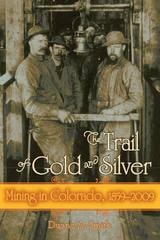
The Trail of Gold and Silver
Mining in Colorado, 1859-2009Duane A. Smith
University Press of Colorado, 2009
Written in a lively manner by one of Colorado's preeminent historians, this book honors the 2009 sesquicentennial of Colorado's gold rush. Smith's narrative will appeal to anybody with an interest in the state's fascinating mining history over the past 150 years.
The Trans Midwest
Trans Feminist Coalition Building Since World War IIJoy Ellison
University of Chicago Press, 2027
A revelatory regional history of trans feminist coalition-building between feminist, queer, and Black communities.
In the face of heightened transphobia and rising fascism in the United States, Joy Ellison’s TheTrans Midwest recounts the history of Midwestern trans women and femmes as a force in the larger feminist movement in the United States. Facing repression and geographic isolation, trans feminine Midwesterners built, and continue to build, vibrant coalitions with feminist, queer, and Black organizations.
Drawing on a vast range of archives and oral histories, Ellison shares a detailed and intersectional description of trans life and politics. These historical figures range from the Black trans women who worked in drag shows to the student coalitions that led to the passage of the country’s first trans-inclusive anti-discrimination ordinance and transsexual lesbian feminist activism in the 1990s. Ellison examines community networks and support groups, newsletters and advertisements, and Midwestern cities from Detroit to Kansas City to elucidate how trans regional groups found common interests across different races, classes, abilities, and sexualities, a marked difference from existing historical accounts of similar movements elsewhere.
Contributing to our understanding of trans history and the impact of intersectional organizing, The Trans Midwest presents new possibilities and critical lessons for trans feminist movements today.
The Transatlantic Collapse of Urban Renewal
Postwar Urbanism from New York to BerlinChristopher Klemek
University of Chicago Press, 2011
The Transatlantic Collapse of Urban Renewal examines how postwar thinkers from both sides of the Atlantic considered urban landscapes radically changed by the political and physical realities of sprawl, urban decay, and urban renewal. With a sweep that encompasses New York, London, Berlin, Philadelphia, and Toronto, among others, Christopher Klemek traces changing responses to the challenging issues that most affected the lives of the world’s cities.
In the postwar decades, the principles of modernist planning came to be challenged—in the grassroots revolts against the building of freeways through urban neighborhoods, for instance, or by academic critiques of slum clearance policy agendas—and then began to collapse entirely. Over the 1960s, several alternative views of city life emerged among neighborhood activists, New Left social scientists, and neoconservative critics. Ultimately, while a pessimistic view of urban crisis may have won out in the United States and Great Britain, Klemek demonstrates that other countries more successfully harmonized urban renewal and its alternatives. Thismuch anticipated book provides one of the first truly international perspectives on issues central to historians and planners alike, making it essential reading for anyone engaged with either field.
The Transatlantic Materials of American Literature
Publishing US Writing in Britain, 1830–1860Katie McGettigan
University of Massachusetts Press, 2023
Winner, Transatlantic Studies Association and Cambridge University Press Book Prize, 2023
During the antebellum period, British publishers increasingly brought out their own authorized and unauthorized editions of American literary works as the popularity of print exploded and literacy rates grew. Playing a formative role in the shaping of American literature, the industry championed the work of US-based writers, highlighted the cultural value of American literary works, and intervened in debates about the future of American literature, authorship, and print culture.
The Transatlantic Materials of American Literature examines the British editions of American fiction, poetry, essays, and autobiographies from writers like Edgar Allan Poe, Harriet Beecher Stowe, Frederick Douglass, and Hannah Flagg Gould. Putting these publications into historical context, Katie McGettigan considers key issues of the day, including developments in copyright law, changing print technologies, and the financial considerations at play for authors and publishers. This innovative study also uncovers how the transatlantic circulation of these works exposed the racial violence and cultural nationalism at the heart of the American experiment, producing overlapping and competing visions of American nationhood in the process.
The Transatlantic Zombie
Slavery, Rebellion, and Living DeathSarah Juliet Lauro
Rutgers University Press, 2015
The Transformation of Authorship in America
Grantland S. Rice
University of Chicago Press, 1997
Rice shows that the rigorous censorship practiced by Puritan authorities conferred an implicit prestige on texts as civic interventions, helping to foster a vigorous and indigenous tradition of sociopolitical criticism. With special attention to the sudden emergence of the novel in post-revolutionary America, Rice reveals how the emergence of economic liberalism undermined the earlier tradition of political writing by transforming American authorship from an expression of individual civic conscience to a market-oriented profession.
Includes discussions of the writings of Benjamin Franklin, Michel-Guillaume-Jean de Crèvecoeur, and Hugh Henry Brackenridge.
The Transformation of Family Law
State, Law, and Family in the United States and Western EuropeMary Ann Glendon
University of Chicago Press, 1989
"Glendon is generally acknowledged to be the premier comparative law scholar in the area of family law. This volume, which offers an analytical survey of the changes in family law over the past twenty-five years, will burnish that reputation. Essential reading for anyone interested in evaluating the major changes that occurred in the law of the family. . . . [And] of serious interest to those in the social sciences as well."—James B. Boskey, Law Books in Review
"Poses important questions and supplies rich detail."—Barbara Bennett Woodhouse, Texas Law Review
"An impressive scholarly documentation of the legal changes that comprise the development of a conjugally-centered family system."—Debra Friedman, Contemporary Sociology
"She has painted a portrait of the family in which we recognize not only ourselves but also unremembered ideological forefathers. . . . It sends our thoughts out into unexpected adventures."—Inga Markovits, Michigan Law Review
The Transformation of Old Age Security
Class and Politics in the American Welfare StateJill Quadagno
University of Chicago Press, 1988
The Transformation of the Avant-Garde
The New York Art World, 1940-1985Diana Crane
University of Chicago Press, 1989
Crane's account is built around discussions of seven styles: Abstract Expressionism in the forties; Pop art and Minimalism in the sixties; Figurative painting, Photorealism, and Pattern painting in the early seventies; and Neo-Expressionism in the early eighties. Demonstrating that the New York art world moved toward increasing acceptance of dominant American cultural trends, Crane offers a fascinating look not only at the intricacies of New York's artistic inner circle but also at the sociology of work and professions, the economics of culture markets such as "dealing art," and the sociology of culture.
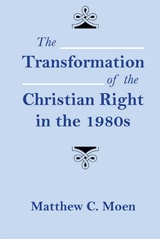
The Transformation of the Christian Right in the 1980s
Matthew C. Moen
University of Alabama Press, 2008
The Transformation of the Christian Right chronicles and analyzes the remarkable changes that have occurred in the Christian Right from its emergence in the late 1970s to the present. It documents the rapid turnover of Christian-Right organizations and explains the forces driving that kaleidoscopic change. Moen also traces the strategic shift of the movement’s leaders, away from lobbying the Congress and toward mobilizing conservative activists in the grass roots; he demonstrates the substitution of liberal language (with its emphasis on “equality, rights, and freedom”) for moralistic language (with its focus on “right and wrong”). Much has been written about the Christian Right’s impact on politics but little about how years of political activism have shaped and influenced the Christian Right. Moen addresses that neglected side of the issue.

The Transit of Empire
Indigenous Critiques of ColonialismJodi A. Byrd
University of Minnesota Press, 2011
In 1761 and again in 1768, European scientists raced around the world to observe the transit of Venus, a rare astronomical event in which the planet Venus passes in front of the sun. In The Transit of Empire, Jodi A. Byrd explores how indigeneity functions as transit, a trajectory of movement that serves as precedent within U.S. imperial history. Byrd argues that contemporary U.S. empire expands itself through a transferable “Indianness” that facilitates acquisitions of lands, territories, and resources.
Examining an array of literary texts, historical moments, and pending legislations—from the Cherokee Nation of Oklahoma’s vote in 2007 to expel Cherokee Freedmen to the Native Hawaiian Government Reorganization bill—Byrd demonstrates that inclusion into the multicultural cosmopole does not end colonialism as it is purported to do. Rather, that inclusion is the very site of the colonization that feeds U.S. empire.
Byrd contends that the colonization of American Indian and indigenous nations is the necessary ground from which to reimagine a future where the losses of indigenous peoples are not only visible and, in turn, grieveable, but where indigenous peoples have agency to transform life on their own lands and on their own terms.
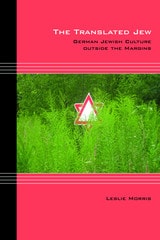
The Translated Jew
German Jewish Culture outside the MarginsLeslie Morris
Northwestern University Press, 2018
The Translated Jew brings together an eclectic set of literary and visual texts to reimagine the transnational potential for German Jewish culture in the twenty-first century. Departing from scholarship that has located the German Jewish text as an object that can be defined geographically and historically, Leslie Morris challenges national literary historiography and redraws the maps by which transnational Jewish culture and identity must be read.
Morris explores the myriad acts of translation, actual and metaphorical, through which Jewishness leaves its traces, taking as a given the always provisional nature of Jewish text and Jewish language. Although the focus is on contemporary German Jewish literary cultures, The Translated Jew also turns its attention to a number of key visual and architectural projects by American, British, and French artists and writers, including W. G. Sebald, Anne Blonstein, Hélène Cixous, Ulrike Mohr, Daniel Blaufuks, Paul Celan, Raymond Federman, and Rose Ausländer.
In thus realigning German Jewish culture with European and American Jewish culture and post-Holocaust aesthetics, this book explores the circulation of Jewishness between the United States and Europe. The insistence on the polylingualism of any single language and the multidirectionality of Jewishness are at the very center of The Translated Jew.
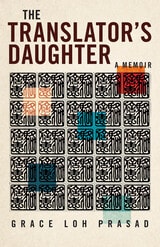
The Translator's Daughter
A MemoirGrace Loh Prasad
The Ohio State University Press, 2024
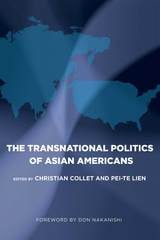
The Transnational Politics of Asian Americans
edited by Christian Collet and Pei-te Lien, foreword by Don Nakanishi
Temple University Press, 2009
As America’s most ethnically diverse foreign-born population, Asian Americans can puzzle political observers. This volume’s multidisciplinary team of contributors employ a variety of methodologies— including quantitative, ethnographic, and historical—to illustrate how transnational ties between the U.S. and Asia have shaped, and are increasingly defining, Asian American politics in our multicultural society.
Original essays by U.S.- and Asian-based scholars discuss Cambodian, Chinese, Filipino, Indian, Japanese, Korean, and Vietnamese communities from Boston to Honolulu. The volume also shows how the grassroots activism of America's "newest minority" both reflects and is instrumental in broader processes of political change throughout the Pacific. Addressing the call for more global approaches to racial and ethnic politics, contributors describe how Asian immigrants strategically navigate the hurdles to domestic incorporation and equality by turning their political sights and energies toward Asia. These essays convincingly demonstrate that Asian American political participation in the U.S. does not consist simply of domestic actions with domestic ends.
Contributors include: Eiichiro Azuma, Augusto Espiritu, Hiroko Furuya, Peter Kiang, Ikumi Koakutsu, Michel Laguerre, Sangay Mishra, Hiromi Monobe, Shirley Tang, Tritia Toyota, Janelle Wong, and the editors.
The Transparent Traveler
The Performance and Culture of Airport SecurityRachel Hall
Duke University Press, 2015
The Trashing of Margaret Mead
Anatomy of an Anthropological ControversyPaul Shankman; Foreword by Paul S. Boyer
University of Wisconsin Press, 2009
In The Trashing of Margaret Mead, Paul Shankman explores the many dimensions of the Mead-Freeman controversy as it developed publicly and as it played out privately, including the personal relationships, professional rivalries, and larger-than-life personalities that drove it. Providing a critical perspective on Freeman’s arguments, Shankman reviews key questions about Samoan sexuality, the alleged hoaxing of Mead, and the meaning of the controversy. Why were Freeman’s arguments so readily accepted by pundits outside the field of anthropology? What did Samoans themselves think? Can Mead’s reputation be salvaged from the quicksand of controversy? Written in an engaging, clear style and based on a careful review of the evidence, The Trashing of Margaret Mead illuminates questions of enduring significance to the academy and beyond.

The Travels of Increase Joseph
A Historical Novel about a Pioneer PreacherJerry Apps
University of Wisconsin Press, 2010
Link Lake, Wisconsin, 1852: Preacher Increase Link and the Standalone Fellowship settle near a lake that they name in his honor. Increase’s gifted tongue calls people to his mission to protect the land: “Unless we take care of the land we shall all perish.” To finance the fellowship activities, Increase sells his special cure-all tonic—fifty cents per bottle!
Inspired by actual events that took place in upstate New York and Wisconsin in the mid-nineteenth century, The Travels of Increase Joseph is the first in Jerry Apps’s series set in fictional Ames County, Wisconsin. The four novels in the series—which also includes In a Pickle, Blue Shadows Farm, and the forthcoming Cranberry Red—all take place around Link Lake at different points in history. They convey Apps’s deep knowledge of rural life and his own concern for land stewardship.
The Tree That Bends
Discourse, Power, and the Survival of Maskoki PeoplePatricia Riles Wickman
University of Alabama Press, 1999
In her compelling and controversial arguments, Wickman rejects the myths that erase Native Americans from Florida through the agency of Spaniards and diseases and make the area an empty frontier awaiting American expansion. Through research on both sides of the Atlantic and extensive oral history interviews among the Seminoles of Florida and Oklahoma, Wickman shatters current theories about the origins of the people encountered by the Spaniards and presents, for the first time ever, the Native American perspective. She describes the genesis of the groups known today as Creek, Seminole, and Miccosukee—the Maskoki peoples—and traces their common Mississippian heritage, affirming their claims to continuous habitation of the Southeast and Florida. Her work exposes the rhetoric of conquest and replaces it with the rhetoric of survival.
An important cross-disciplinary work, The Tree That Bends reveals the flexibility of the Maskoki people and the sociocultural mechanisms that allowed them to survive the pressures introduced at contact. Their world was capable of incorporating the New without destroying the Old, and their descendants not only survive today but also succeed as a discrete culture as a result.
The Trial Lawyer's Art
Sam Schrager
Temple University Press, 2000
Drawn from fieldwork in the Philadelphia courts and at the Smithsonian Institution's American Trial Lawyers program, The Trial Lawyer's Art gives a remarkable, in-depth look at this craft of performance. It examines how lawyers exploit a case's dramatic potential, how they enact mythically potent themes, how they project personal authority, and how they use cultural identity -- their own and their opponents' racial, gender, class, and local affiliations -- all to make themselves and their stories persuasive to a jury. Schrager depicts the performance styles of some of the nation's most artful criminal and civil advocates: in Philadelphia, prosecutor Roger King, defender Robert Mozenter, and the legendary Cecil B. Moore; from around the country, such litigating stars as Roy Barrera, Penny Cooper, Jo Ann Harris, Tony Serra, and Michael Tigar. These lawyers reflect candidly on their courtroom calculations and share revealing "war stories" about their work.
Integrating performance insights with evocative portrayals of unfolding trials, The Trial Lawyer's Art offers a no-holds-barred analysis of the place of skill versus evidence in the American justice system. In doing so, it raises vital questions about the moral challenges that legal and other professions now face and sheds new light on the role of stories in American life.
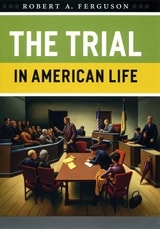
The Trial in American Life
Robert A. Ferguson
University of Chicago Press, 2006
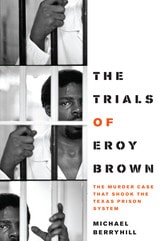
The Trials of Eroy Brown
The Murder Case That Shook the Texas Prison SystemBy Michael Berryhill
University of Texas Press, 2011
In April 1981, two white Texas prison officials died at the hands of a black inmate at the Ellis prison farm near Huntsville. Warden Wallace Pack and farm manager Billy Moore were the highest-ranking Texas prison officials ever to die in the line of duty. The warden was drowned face down in a ditch. The farm manager was shot once in the head with the warden's gun. The man who admitted to killing them, a burglar and robber named Eroy Brown, surrendered meekly, claiming self-defense.
In any other era of Texas prison history, Brown's fate would have seemed certain: execution. But in 1980, federal judge William Wayne Justice had issued a sweeping civil rights ruling in which he found that prison officials had systematically and often brutally violated the rights of Texas inmates. In the light of that landmark prison civil rights case, Ruiz v. Estelle, Brown had a chance of being believed.
The Trials of Eroy Brown, the first book devoted to Brown's astonishing defense, is based on trial documents, exhibits, and journalistic accounts of Brown's three trials, which ended in his acquittal. Michael Berryhill presents Brown's story in his own words, set against the backdrop of the chilling plantation mentality of Texas prisons. Brown's attorneys—Craig Washington, Bill Habern, and Tim Sloan—undertook heroic strategies to defend him, even when the state refused to pay their fees. The Trials of Eroy Brown tells a landmark story of prison civil rights and the collapse of Jim Crow justice in Texas.
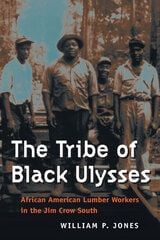
The Tribe of Black Ulysses
African American Lumber Workers in the Jim Crow SouthWilliam P. Jones
University of Illinois Press, 2005
The lumber industry employed more African American men than any southern economic sector outside agriculture. Yet little scholarship exists on these workers and their times.
William P. Jones merges interviews with archival sources to explore black men and women's changing relationship to industrial work in the southern sawmill communities of Elizabethtown, North Carolina; Chapman, Alabama; and Bogalusa, Louisiana. By placing black lumber workers within the history of southern industrialization, Jones reveals that industrial employment was another facet of the racial segregation and political disfranchisement that defined black life in the Jim Crow South. He also examines an older tradition of southern sociology that viewed industrialization as socially disruptive and morally corrupting to African American social and cultural traditions rooted in agriculture.
The Tribe of Pyn
Literary Generations in the Postmodern PeriodDavid Cowart
University of Michigan Press, 2015
The Triumph of Uncertainty
Science and Self in the Postmodern AgeAlfred I. Tauber
Central European University Press, 2022
Tauber, a leading figure in history and philosophy of science, offers a unique autobiographical overview of how science as a discipline of thought has been characterized by philosophers and historians over the past century. He frames his account through science’s – and his own personal – quest for explanatory certainty.
During the 20th century, that goal was displaced by the probabilistic epistemologies required to characterize complex systems, whether in physics, biology, economics, or the social sciences. This “triumph of uncertainty” is the inevitable outcome of irreducible chance and indeterminate causality. And beyond these epistemological limits, the interpretative faculties of the individual scientist (what Michael Polanyi called the “personal” and the “tacit”) invariably affects how data are understood. Whereas positivism had claimed radical objectivity, post-positivists have identified how a web of non-epistemic values and social forces profoundly influence the production of knowledge.
Tauber presents a case study of these claims by showing how immunology has incorporated extra-curricular social elements in its theoretical development and how these in turn have influenced interpretive problems swirling around biological identity, individuality, and cognition. The correspondence between contemporary immunology and cultural notions of selfhood are strong and striking. Just as uncertainty haunts science, so too does it hover over current constructions of personal identity, self knowledge, and moral agency. Across the chasm of uncertainty, science and selfhood speak.