Results by title
22279 books match the query 'Social Science' and 4007 start with t
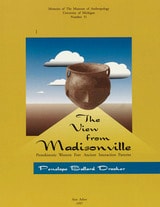
The View from Madisonville
Protohistoric Western Fort Ancient Interaction PatternsPenelope Ballard Drooker
University of Michigan Press, 1997
Madisonville was one of the key settlements of the Ohio Valley Fort Ancient people and was the subject of James Griffin’s 1943 classic, The Fort Ancient Aspect. It is a site rich in burials and artifacts documenting the earliest European influences. Drooker re-explores a century of excavation to explain how Contact Period events affected Madisonville inhabitants and their links to eastern Fort Ancient, northern Ohio, Iroquoian, Oneota, and Mississipian groups.
The View from Somewhere
Undoing the Myth of Journalistic ObjectivityLewis Raven Wallace
University of Chicago Press, 2019
In The View from Somewhere, Lewis Raven Wallace dives deep into the history of “objectivity” in journalism and how its been used to gatekeep and silence marginalized writers as far back as Ida B. Wells. At its core, this is a book about fierce journalists who have pursued truth and transparency and sometimes been punished for it—not just by tyrannical governments but by journalistic institutions themselves. He highlights the stories of journalists who question “objectivity” with sensitivity and passion: Desmond Cole of the Toronto Star; New York Times reporter Linda Greenhouse; Pulitzer Prize-winner Rachel Kaadzi Ghansah; Peabody-winning podcaster John Biewen; Guardian correspondent Gary Younge; former Buzzfeed reporter Meredith Talusan; and many others. Wallace also shares his own experiences as a midwestern transgender journalist and activist who was fired from his job as a national reporter for public radio for speaking out against “objectivity” in coverage of Trump and white supremacy.
With insightful steps through history, Wallace stresses that journalists have never been mere passive observers. Using historical and contemporary examples—from lynching in the nineteenth century to transgender issues in the twenty-first—Wallace offers a definitive critique of “objectivity” as a catchall for accurate journalism. He calls for the dismissal of this damaging mythology in order to confront the realities of institutional power, racism, and other forms of oppression and exploitation in the news industry.
The View from Somewhere is a compelling rallying cry against journalist neutrality and for the validity of news told from distinctly subjective voices.
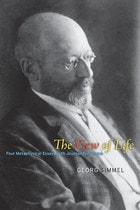
The View of Life
Four Metaphysical Essays with Journal AphorismsGeorg Simmel
University of Chicago Press, 2010
Published in 1918, The View of Life is Georg Simmel’s final work. Famously deemed “the brightest man in Europe” by George Santayana, Simmel addressed diverse topics across his essayistic writings, which influenced scholars in aesthetics, epistemology, and sociology. Nevertheless, certain core issues emerged over the course of his career—the genesis, structure, and transcendence of social and cultural forms, and the nature and conditions of authentic individuality, including the role of mindfulness regarding mortality. Composed not long before his death, The View of Life was, Simmel wrote, his “testament,” a capstone work of profound metaphysical inquiry intended to formulate his conception of life in its entirety.
Now Anglophone readers can at last read in full the work that shaped the argument of Heidegger’s Being and Time and whose extraordinary impact on European intellectual life between the wars was extolled by Jürgen Habermas. Presented alongside these seminal essays are aphoristic fragments from Simmel’s last journal, providing a beguiling look into the mind of one of the twentieth century’s greatest thinkers.
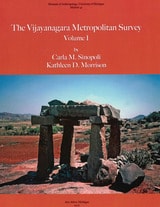
The Vijayanagara Metropolitan Survey, Vol. 1
Carla M. Sinopoli, Kathleen D. Morrison
University of Michigan Press, 2007
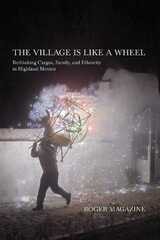
The Village Is Like a Wheel
Rethinking Cargos, Family, and Ethnicity in Highland MexicoRoger Magazine
University of Arizona Press, 2012
According to Magazine, where Western anthropologists often assume that persons are individuals capable of acting on their own to produce things, rural highland Mexicans see persons as inherently interdependent and in need of others even to act. He utilizes the term “active subjectivity” to denote the fact that what they produce in others is not simply action but also a subjective state or attitude of willingness to perform the action.
The author’s goals are to improve understandings of rural highland Mexicans’ lives and to contribute to a broader disciplinary effort aimed at revealing the cultural specificity or ethnocentricity of our supposedly universally applicable concepts and theories.

The Village Project
Rural Revitalization in Contemporary BulgariaSarah Craycraft
University of Wisconsin Press, 2026
Since the collapse of socialism, Bulgaria’s population has been on the move—out of rural regions and into cities, or out of the country altogether. Yet today there is a countermovement of young, urban Bulgarians, born around 1989, seeking to repopulate rural villages and reclaim traditional Bulgarian folklife. Though many of these young Bulgarians have no direct experience with a rural lifestyle nor memories of thriving village life, their actions and movements are inspired by a nostalgic vision of the past. And so, beyond a spatial return, this rural revitalization movement speaks to visions of an alternate future, one sparked by dismay with the conditions of contemporary life.
Using ethnographic and folkloristic methods, Sarah Craycraft paints a complex, detailed picture of responses to Europeanization, carried out through neoliberal folklife projects as they collide with ongoing efforts to build a revitalized rural Bulgaria in the ruins of the past. Contextualized within a particular Southeast European nation, the study speaks to broader questions of rural revival, public-facing culture work, intergenerational folklore, and the imbrication of folklore with politics and culture.
The Village and the Class War
Anti-Kulak Campaign in Estonia 1944-49Anu Mai Kõll
Central European University Press, 2013

The Violate Man
Male/Male Rape in the American ImaginationAaron C. Thomas
Vanderbilt University Press, 2025
From the punchline of bro comedies to the vengeance arc of prison dramas, Thomas argues that male/male rape narratives are used by writers, filmmakers, and comedians to make sense of the changing landscape of American masculinity, and that these narratives have shifted widely since the 1960s, reflecting masculinity’s varying anxieties and concerns.

The Violence of Protection
Policing, Immigration Law, and Asian American WomenLee Ann S. Wang
Duke University Press, 2026
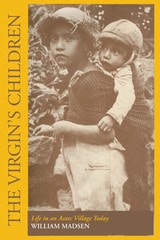
The Virgin's Children
Life in an Aztec Village TodayBy William Madsen
University of Texas Press, 1960
An absorbing account of the descendants of the ancient Aztecs and of the survival of their culture into the twentieth century in the Valley of Mexico is presented in this fascinating volume. Focusing on San Francisco Tecospa—a village of some eight hundred Indians who still spoke Nahuatl, whose lives were dominated by supernaturalism, and who observed with only slight modification much of their Aztec heritage—this story bears out the anthropological principle that innovations are most likely to be accepted when they are useful, communicable, and compatible with established tradition.
Nowhere is the Indian genius for combining the old and the new better exemplified than in the story of how the Virgin of Guadalupe came to fulfill the role formerly played by the pagan goddess Tonantzin and of how Christian saints replaced the Aztec gods. At the time of this study, the Tecospans still called the Catholic Virgin Tonantzin, but their concept of the mother goddess had changed profoundly since Aztec times.
Tonantzin the Pagan, a hideous goddess with claws on her hands and feet and with snakes entwining her face, wore a necklace of hearts, hands, and skulls to represent her insatiable appetite for corpses. Tonantzin the Catholic—also called Guadalupe—is a beautiful and benevolent mother deity who repeatedly stays God’s anger against her Mexican children and answers the prayers of the poorest Indian, with no thought of return.
In Tecospa the road to social recognition lay in the performance of religious works, and the neglect of ritual obligation subjected both the individual and the community to the anger of supernaturals who punished with illness or other misfortune. Religion was inextricably a part of every phase of life, and it is the whole life of the Aztecan that is recorded here: fiesta, clothing, food, agricultural practices, courtship, marriage, pregnancy and childbirth, death, witchcraft and its cures, medical practices and attitudes, houses and home life, ethics, and the hot-cold complex that classifies everything in the Tecospan universe from God to Bromo-Seltzer.
With a marked simplicity of style and language William Madsen has produced a profoundly significant anthropological study that is delightful reading from the first sentence to the last. The drawings, the work of a ten-year-old Tecospan lad, are remarkable for their penetrating insight into the culture.

The Virtuous and Violent Women of Seventeenth-Century Massachusetts
Emily C.K. Romeo
University of Massachusetts Press, 2020
Dismantling the image of the peaceful and serene colonial goodwife and countering the assumption that New England was inherently less violent than other regions of colonial America, Emily C. K. Romeo offers a revealing look at acts of violence by Anglo-American women in colonial Massachusetts, from the everyday to the extraordinary. Using Essex County as a case study, Romeo deftly utilizes seventeenth- and eighteenth-century sources to demonstrate that Puritan women, both “virtuous” and otherwise, learned to negotiate the shifting boundaries between acceptable and unacceptable violence in their daily lives and communities.
The Virtuous and Violent Women of Seventeenth-Century Massachusetts shows that more dramatic violence by women—including infanticide, the scalping of captors during the Indian Wars, and even witchcraft accusations—was not necessarily intended to challenge the structures of authority but often sprung from women's desire to protect property, safety, and standing for themselves and their families. The situations in which women chose to flout powerful social conventions and resort to overt violence expose the underlying, often unspoken, priorities and gendered expectations that shaped this society.
The Virus Touch
Theorizing Epidemic MediaBishnupriya Ghosh
Duke University Press, 2023

The Visibility Bind
Being Seen, Getting Paid, and Paying the Price of Social Media SuccessBrooke Erin Duffy
University of Chicago Press, 0
A revelatory look at the people, platforms, and power struggles shaping work in the creator economy.
More than two decades after YouTube first invited scrappy amateurs to “broadcast yourself,” social media content creation has transformed into one of the fastest growing labor markets. Today, some two hundred million people work as platform-dependent content creators, influencers, or streamers. Social media platforms boldly tout the rewards of the digital creator economy: independence, flexibility, and the chance to convert one’s ingenuity into cash. Yet the image of work in this entrepreneurial Promised Land conceals a starker reality—one marked by labor precarity, exploitation, and entrenched structural inequalities.
In this essential work, award-winning communication scholar Brooke Erin Duffy analyzes the paradox of the “visibility bind.” On the one hand, labor devaluation and algorithmic suppression—where unseen forces and so-called “shadowbans” bury worker output—threaten to render creators invisible. On the other, excessive visibility introduces harms of its own, from scrutiny and surveillance to networked harassment. For creators at the margins—among them, creators of color, LGBTQ+ voices, and disability advocates—the bind is especially pronounced, belying the promise of a talent meritocracy.
Drawing on extensive, in-depth interviews and more than a decade of insight, Duffy situates creators’ experiences within the broader landscapes of self-commodification and platform capitalism. But while platforms hold immense power to structure the pathways to success, creators and influencers wield newfound sway in this high-stakes visibility game. They are organizing, building solidarity, and experimenting with new forms of labor consciousness.
Refuting conventional wisdom about creator careers, Duffy illuminates the hidden labor dynamics for a class of workers shaping everything from culture and commerce to civil liberties and geopolitical conflict. The Visibility Bind reveals the price and perils for anyone who “puts themselves out there.”

The Visual Afterlife of Abdelkader Bennahar
Robert Desjarlais
Duke University Press, 2025
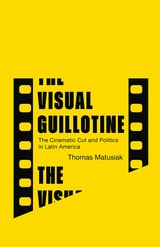
The Visual Guillotine
The Cinematic Cut and Politics in Latin AmericaThomas Matusiak
University of Minnesota Press, 2026
The violence of the cinematic cut in twentieth-century Latin American film
Splice, montage, close-up: modern cinema routinely presents bodies in pieces. Not unlike the guillotine, argues Thomas Matusiak, these techniques have served both overt and symbolic political ends as they accomplish and project the efficient production of severed bodies. In The Visual Guillotine, Matusiak traces the use of cinematic tools of dismemberment in twentieth-century Latin American film to theorize the symbolic and material violence of the cut.
A robust genealogy of Latin American cinematic politics, The Visual Guillotine encompasses national filmmaking traditions; radical and reactionary political registers; and the proliferated aesthetics of narrative, documentary, experimental, and expanded cinema through an innovative critical viewing practice. From the national cinemas of the 1930s to the decapitation videos produced in the Mexican narco-conflict and beyond, Matusiak shows how the cinematic cut has been employed to inspire terror as well as invoke and critique a range of political programs.
A refreshing dialogue between film theory and Latin American cultural studies, The Visual Guillotine offers a new way for film to conceptualize politics. In our present political moment, with rapidly generated and circulated visual media central to a resurgent leftist-populist battle against oligarchy and authoritarianism, this book calls for readers to reassess their viewing position when confronted with violent imagery.
Retail e-book files for this title are screen-reader friendly with images accompanied by short alt text and/or extended descriptions.
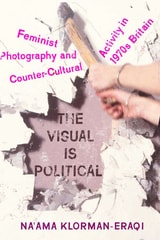
The Visual Is Political
Feminist Photography and Countercultural Activity in 1970s BritainNa'ama Klorman-Eraqi
Rutgers University Press, 2019

The Vital Realities for 2020 and Beyond
Writings on Water Wars, Nuclear Devastation, Endless War, Economic Revolution, and Surveillance Versus FreedomRoger Armbrust
Parkhurst Brothers, Inc., 2019
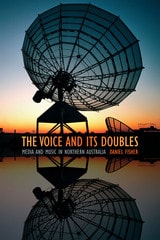
The Voice and Its Doubles
Media and Music in Northern AustraliaDaniel Fisher
Duke University Press, 2016
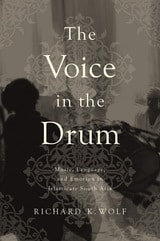
The Voice in the Drum
Music, Language, and Emotion in Islamicate South AsiaRichard K. Wolf
University of Illinois Press, 2014
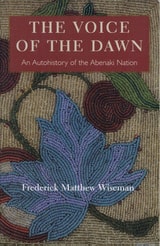
The Voice of the Dawn
An Autohistory of the Abenaki NationFrederick Matthew Wiseman
University Press of New England, 2001
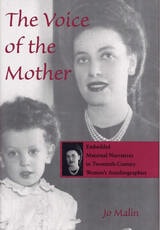
The Voice of the Mother
Embedded Maternal Narratives in Twentieth-Century Women's AutobiographiesJo Malin
Southern Illinois University Press, 2000
Every woman autobiographer is a daughter who writes and establishes her identity through her autobiographical narrative. In The Voice of the Mother, Jo Malin argues that many twentieth-century autobiographies by women contain an intertext, an embedded narrative, which is a biography of the writer/daughter’s mother.
Analyzing this narrative practice, Malin examines ten texts by women who seem particularly compelled to tell their mothers’ stories: Virginia Woolf, Sara Suleri, Kim Chernin, Drusilla Modjeska, Joan Nestle, Carolyn Steedman, Dorothy Allison, Adrienne Rich, Cherríe Moraga, and Audre Lorde. Each author is, in fact, able to write her own autobiography only by using a narrative form that contains her mother’s story at its core. These texts raise interesting questions about autobiography as a genre and about a feminist writing practice that resists and subverts the dominant literary tradition.
Malin theorizes a hybrid form of autobiographical narrative containing an embedded narrative of the mother. The textual relationship between the two narratives is unique among texts in the auto/biographical canon. This alternative narrative practice—in which the daughter attempts to talk both to her mother and about her—is equally an autobiography and a biography rather than one or the other. The technique is marked by a breakdown of subject/object categories as well as auto/biographical dichotomies of genre. Each text contains a “self” that is more plural than singular, yet neither.
In addition to being a theoretical and textual analysis, Malin’s book is also a mother-daughter autobiography and biography itself. She shares her own story and her mother’s story as a way to connect directly with readers and as a way to bridge the gap between theory and practice.
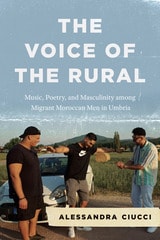
The Voice of the Rural
Music, Poetry, and Masculinity among Migrant Moroccan Men in UmbriaAlessandra Ciucci
University of Chicago Press, 2022
Umbria is known to most Americans for its picturesque rolling hills and medieval villages, but to the many migrant Moroccan men who travel there, Umbria is better known for the tobacco fields, construction sites, small industries, and the outdoor weekly markets where they work. Marginalized and far from their homes, these men turn to Moroccan traditions of music and poetry that evoke the countryside they have left— l-‘arubiya, or the rural. In this book, Alessandra Ciucci takes us inside the lives of Moroccan workers, unpacking the way they share a particular musical style of the rural to create a sense of home and belonging in a foreign and inhospitable nation. Along the way, she uncovers how this culture of belonging is not just the product of the struggles of migration, but also tied to the reclamation of a noble and virtuous masculine identity that is inaccessible to Moroccan migrants in Italy.
The Voice of the Rural allows us to understand the contemporary experiences of migrant Moroccan men by examining their imagined relationship to the rural through sound, shedding new light on the urgent issues of migration and belonging.
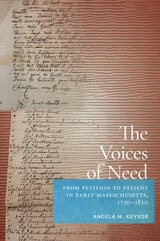
The Voices of Need
From Petition to Patient in Early Massachusetts, 1730–1820Angela M. Keysor
University of Massachusetts Press, 2027
Revealing how people in need advocated for and negotiated their own care until the development of standardized medicine
The Voices of Need uncovers how men and women in Charlestown, Massachusetts, who turned to municipal authorities for aid, actively shaped how their need was understood and addressed. Through a close examination of Charlestown’s care networks, Angela Keysor shows how town selectmen relied on sufferers themselves to articulate what would relieve their distress, while local women—paid by town authorities—provided hands-on care in homes and neighborhoods. These networks flourished in the early and mid-eighteenth century, but their flexibility and responsiveness were increasingly strained by crisis and change. A devastating smallpox epidemic in 1763, followed by racialized debates over belonging after the legal end of enslavement in Massachusetts in 1783, exposed the limits of community-based care.
After the American Revolution, rising numbers of aid requests prompted town officials to reorganize care through a contract system in which paid caregivers attended to multiple dependents at once. As care became centralized and standardized, the space for individuals to define their own needs—and to influence how those needs were met—steadily narrowed. By 1819, with the founding of Massachusetts General Hospital, sufferers were fully redefined as patients, expected to submit to professional authority rather than participate in decisions about their own care.
Tracing this transition from negotiated assistance to institutional medicine, The Voices of Need illuminates a largely forgotten history of agency among the poor and infirm. In doing so, Keysor challenges conventional narratives of early American health care and shows how the rise of standardized medicine fundamentally reshaped the meaning of need, care, and authority.
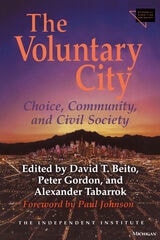
The Voluntary City
Choice, Community, and Civil SocietyDavid T. Beito, Peter Gordon, and Alexander Tabarrok, Editors
University of Michigan Press, 2002

The Voyage In
Fictions of Female DevelopmentEdited by Elizabeth Abel, Marianne Hirsch, and Elizabeth Langland
Dartmouth College Press, 1983
The Vulnerable Age Phenomenon
Michael Inbar
Russell Sage Foundation, 1976

The Vulnerable Empowered Woman
Feminism, Postfeminism, and Women's HealthDubriwny, Tasha N
Rutgers University Press, 2012
Winner of the Organization for the Study of Communication, Language, and Gender 2013 Outstanding Book Award
Winner of the 2013 Bonnie Ritter Book Award from the Feminist and Women's Division of the National Communication Association
The feminist women’s health movement of the 1960s and 1970s is credited with creating significant changes in the healthcare industry and bringing women’s health issues to public attention. Decades later, women’s health issues are more visible than ever before, but that visibility is made possible by a process of depoliticization
The Vulnerable Empowered Woman assesses the state of women’s healthcare today by analyzing popular media representations—television, print newspapers, websites, advertisements, blogs, and memoirs—in order to understand the ways in which breast cancer, postpartum depression, and cervical cancer are discussed in American public life. From narratives about prophylactic mastectomies to young girls receiving a vaccine for sexually transmitted disease, the representations of women’s health today form a single restrictive identity: the vulnerable empowered woman. This identity defuses feminist notions of collective empowerment and social change by drawing from both postfeminist and neoliberal ideologies. The woman is vulnerable because of her very femininity and is empowered not to change the world, but to choose from among a limited set of medical treatments.
The media’s depiction of the vulnerable empowered woman’s relationship with biomedicine promotes traditional gender roles and affirms women’s unquestioning reliance on medical science for empowerment. The book concludes with a call to repoliticize women’s health through narratives that can help us imagine women—and their relationship to medicine—differently.
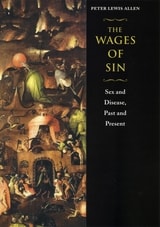
The Wages of Sin
Sex and Disease, Past and PresentPeter Lewis Allen
University of Chicago Press, 2000
Throughout history, Western society has often viewed sickness as a punishment for sin. It has failed to prevent and cure diseases—especially diseases tied to sex—that were seen as the retribution of a wrathful God. The Wages of Sin, the remarkable history of these diseases, shows how society's views of particular afflictions often heightened the suffering of the sick and substituted condemnation for care. Peter Allen moves from the medieval diseases of lovesickness and leprosy through syphilis and bubonic plague, described by one writer as "a broom in the hands of the Almighty, with which He sweepeth the most nasty and uncomely corners of the universe." More recently, medical and social responses to masturbation in the eighteenth and nineteenth centuries and AIDS in the twentieth round out Allen's timely and erudite study of the intersection of private morality and public health. The Wages of Sin tells the fascinating story of how ancient views on sex and sin have shaped, and continue to shape, religious life, medical practice, and private habits.

The Wagon and Other Stories from the City
Martin Preib
University of Chicago Press, 2010
Martin Preib is an officer in the Chicago Police Department—a beat cop whose first assignment as a rookie policeman was working on the wagon that picks up the dead. Inspired by Preib’s daily life on the job, The Wagon and Other Stories from the City chronicles the outer and inner lives of both a Chicago cop and the city itself.
The book follows Preib as he transports body bags, forges an unlikely connection with his female partner, trains a younger officer, and finds himself among people long forgotten—or rendered invisible—by the rest of society. Preib recounts how he navigates the tenuous labyrinths of race and class in the urban metropolis, such as a domestic disturbance call involving a gang member and his abused girlfriend or a run-in with a group of drunk yuppies. As he encounters the real and imagined geographies of Chicago, the city reveals itself to be not just a backdrop, but a central force in his narrative of life and death. Preib’s accounts, all told in his breathtaking prose, come alive in ways that readers will long remember.

The Wake of Wellington
Englishness in 1852Peter W. Sinnema
Ohio University Press, 2006
Soldier, hero, and politician, the Duke of Wellington is one of the best-known figures of nineteenth-century England. From his victory at Waterloo over Napoleon in 1815, he rose to become prime minister of his country. But Peter Sinnema finds equal fascination in Victorian England’s response to the duke’s death.
The Wake of Wellington considers Wellington’s spectacular funeral pageant in the fall of 1852—an unprecedented event that attracted one and a half million spectators to London—as a threshold event against which the life of the soldier-hero and High Tory statesman could be re-viewed and represented.
Canvassing a profuse and dramatically proliferating Wellingtoniana, Sinnema examines the various assumptions behind, and implications of, the Times’s celebrated claim that the Irish-born Wellington “was the very type and model of an Englishman.” The dead duke, as Sinnema demonstrates, was repeatedly caught up in interpretive practices that stressed the quasi-symbolic relations between hero and nation.
The Wake of Wellington provides a unique view of how in death Wellington and his career were promoted as the consummation of a national destiny intimately bound up with Englishness itself, and with what it meant to be English at midcentury.

The Walking Wounded
Festering and Ricocheting Trauma After Gun ViolenceJooyoung Lee
University of Chicago Press, 2026
Gun violence is a plague in the United States; even survivors experience suffering that wreaks havoc on their lives and our communities. Although excellent emergency trauma care means that 80 percent of shooting victims do not die from their injuries, surviving is only the first step. Most survivors then find themselves trapped in health care and judicial systems that only amplify their pain, trauma, and uncertainty.
In The Walking Wounded, Jooyoung Lee invites readers into the hospitals, courtrooms, and homes where gunshot victims struggle to rebuild their lives. Drawing from years of fieldwork in Philadelphia, Lee shows how victims’ injuries fester into new problems over time in the absence of meaningful follow-up care. Attempting routine tasks with a wounded body reminds survivors that they are no longer who they used to be—both physically and socially. Lee shows how trauma ricochets through victims’ worlds as their injuries also affect their family and friends. To make matters worse, Lee argues, existing government safety nets place victims into ever more precarious circumstances that compound their suffering.
In the face of health care and judicial systems that fail wounded people, Lee urges a sensible and sensitive rehabilitative process aimed at equipping the walking wounded with ongoing care that aspires for more than mere survival: the regaining of independent lives.
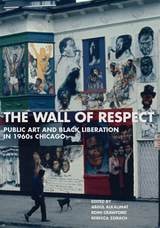
The Wall of Respect
Public Art and Black Liberation in 1960s ChicagoEdited by Abdul Alkalimat, Romi Crawford, and Rebecca Zorach
Northwestern University Press, 2017
The Wall of Respect received national critical acclaim when it was unveiled on the side of a building at Forty-Third and Langley in Chicago’s Bronzeville neighborhood. Painters and photographers worked side by side on the mural's seven themed sections, which featured portraits of Black heroes and sheroes, among them John Coltrane, Nina Simone, Billie Holiday, Malcolm X, Muhammad Ali, and W. E. B. Du Bois. The Wall became a platform for music, poetry, and political rallies. Over time it changed, reflecting painful controversies among the artists as well as broader shifts in the Civil Rights and Black Liberation Movements.
At the intersection of African American culture, politics, and Chicago art history, The Wall of Respect offers, in one keepsake-quality work, an unsurpassed collection of images and essays that illuminate a powerful monument that continues to fascinate artists, scholars, and readers in Chicago and across the United States.

The Walls of Jericho
Rudolph Fisher
University of Michigan Press, 1994
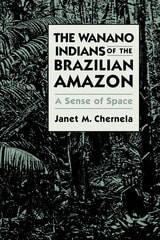
The Wanano Indians of the Brazilian Amazon
A Sense of SpaceBy Janet M. Chernela
University of Texas Press, 1996
The Wanano Indians of the northwest Amazon have a social system that differs from those of most tropical forest tribes. Neither stratified by wealth nor strictly egalitarian, Wanano society is "ranked" according to rigidly bound descent groups. In this pioneering ethnographic study, Janet M. Chernela decodes the structure of Wanano society.
In Wanano culture, children can be "grandparents," while elders can be "grandchildren." This apparent contradiction springs from the fact that descent from ranked ancestors, rather than age or accumulated wealth, determines one's standing in Wanano society. But ranking's impulse is muted as senior clans, considered to be succulent (referring to both seniority and resource abundance), must be generous gift-givers. In this way, resources are distributed throughout the society.
In two poignant chapters aptly entitled "Ordinary Dramas," Chernela shows that rank is a site of contest, resulting in exile, feuding, personal shame, and even death. Thus, Chernela's account is dynamic, placing rank in historic as well as personal context.
As the deforestation of the Amazon continues, the Wanano and other indigenous peoples face growing threats of habitat destruction and eventual extinction. If these peoples are to be saved, they must first be known and valued. The Wanano Indians of the Brazilian Amazon is an important step in that direction.

The War Machines
Young Men and Violence in Sierra Leone and LiberiaDanny Hoffman
Duke University Press, 2011
Hoffman argues that in contemporary West Africa, space, sociality, and life itself are organized around making young men available for all manner of dangerous work. Drawing on his ethnographic research over the past nine years, as well as the anthropology of violence, interdisciplinary security studies, and contemporary critical theory, he maintains that the mobilization of West African men exemplifies a global trend in the outsourcing of warfare and security operations. A similar dynamic underlies the political economy of violence in Iraq, Afghanistan, and a growing number of postcolonial spaces. An experienced photojournalist, Hoffman integrates more than fifty of his photographs of young West Africans into The War Machines.

The War against Catholicism
Liberalism and the Anti-Catholic Imagination in Nineteenth-Century GermanyMichael B. Gross
University of Michigan Press, 2005
---Helmut Walser Smith, Vanderbilt University
"A marvelously original account of how the Kulturkampf emerged from the cultural, social, and gendered worlds of German liberalism. While not neglecting the 1870s, Gross's analysis directs historians' attention to the under-researched 1850s and 1860s-decades in which liberals' anti-Catholic arguments were formulated against a backdrop of religious revival, democratic innovation, national ambition, and the articulation of new roles for women in society, politics, and the church. The drama of these decades resonates in every chapter of Gross's fine study."
---James Retallack, University of Toronto
"Michael Gross has put the culture back into the Kulturkampf! Integrating social and political analysis with illuminating interpretations of visual and linguistic evidence, Gross explores the work of religious cleavage in defining German national identity. An emerging women's movement, liberal virtues, and Catholic difference come together to explain why, in a century of secularization, Germany's Catholics experienced a religious revival, and why its liberals responded with enmity and frustration. Vividly written and a pleasure to read, this groundbreaking study offers real surprises."
---Margaret Lavinia Anderson, University of California, Berkeley
An innovative study of the relationship between the two most significant, equally powerful, and irreconcilable movements in Germany, Catholicism and liberalism, in the decades following the 1848 Revolution.
After the defeat of liberalism in the Revolution of 1848, and in the face of the dramatic revival of popular Catholicism, German middle-class liberals used anti-Catholicism to orient themselves culturally in a new age. Michael B. Gross's study shows how anti-Catholicism and specifically the Kulturkampf, the campaign to break the power of the Catholic Church, were not simply attacks against the church nor were they merely an attempt to secure state autonomy. Gross shows that the liberal attack on Catholicism was actually a complex attempt to preserve moral, social, political, and sexual order during a period of dramatic pressures for change.
Gross argues that a culture of anti-Catholicism shaped the modern development of Germany including capitalist economics, industrial expansion, national unification, and gender roles. He demonstrates that images of priests, monks, nuns, and Catholics as medieval, backward, and sexually deviant asserted the liberal middle-class claim to social authority after the Revolution of 1848. He pays particular attention to the ways anti-Catholicism, Jesuitphobia, and antimonastic hysteria were laced with misogyny and expressed deeper fears of mass culture and democracy in the liberal imagination. In doing so, he identifies the moral, social, and cultural imperatives behind the Kulturkampf in the 1870s.
By offering a provocative reinterpretation of liberalism and its relationship to the German anti-Catholic movement, this work ultimately demonstrates that in Germany, liberalism itself contributed to a culture of intolerance that would prove to be a serious liability in the twentieth century. It will be of particular interest to students and scholars of culture, ideology, religion, and politics.

The War for the Heart and Soul of a Highland Maya Town
Revised EditionBy Robert S. Carlsen, with a contribution by Martín Prechtel
University of Texas Press, 2011
This compelling ethnography explores the issue of cultural continuity and change as it has unfolded in the representative Guatemala Mayan town Santiago Atitlán. Drawing on multiple sources, Robert S. Carlsen argues that local Mayan culture survived the Spanish Conquest remarkably intact and continued to play a defining role for much of the following five centuries. He also shows how the twentieth-century consolidation of the Guatemalan state steadily eroded the capacity of the local Mayas to adapt to change and ultimately caused some factions to reject—even demonize—their own history and culture. At the same time, he explains how, after a decade of military occupation known as la violencia, Santiago Atitlán stood up in unity to the Guatemalan Army in 1990 and forced it to leave town.
This new edition looks at how Santiago Atitlán has fared since the expulsion of the army. Carlsen explains that, initially, there was hope that the renewed unity that had served the town so well would continue. He argues that such hopes have been undermined by multiple sources, often with bizarre outcomes. Among the factors he examines are the impact of transnational crime, particularly gangs with ties to Los Angeles; the rise of vigilantism and its relation to renewed religious factionalism; the related brutal murders of followers of the traditional Mayan religion; and the apocalyptic fervor underlying these events.
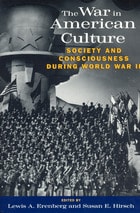
The War in American Culture
Society and Consciousness during World War IIEdited by Lewis A. Erenberg and Susan E. Hirsch
University of Chicago Press, 1996
World War II posed a crisis for American culture: to defeat the enemy, Americans had to unite across the class, racial and ethnic boundaries that had long divided them. Exploring government censorship of war photography, the revision of immigration laws, Hollywood moviemaking, swing music, and popular magazines, these essays reveal the creation of a new national identity that was pluralistic, but also controlled and sanitized. Concentrating on the home front and the impact of the war on the lives of ordinary Americans, the contributors give us a rich portrayal of family life, sexuality, cultural images, and working-class life in addition to detailed consideration of African Americans, Latinos, and women who lived through the unsettling and rapidly altered circumstances of wartime America.
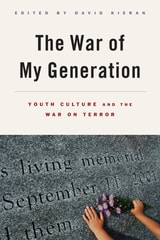
The War of My Generation
Youth Culture and the War on TerrorKieran, David
Rutgers University Press, 2015
The War of My Generation is the first essay collection to focus specifically on how the terrorist attacks and their aftermath have shaped these new generations of Americans. Drawing from a variety of disciplines, including anthropology, sociology, cultural studies, and literary studies, the essays cover a wide range of topics, from graphic war images in the classroom to computer games designed to promote military recruitment to emails from parents in the combat zone. The collection considers what cultural factors and products have shaped young people's experience of the 9/11 attacks, the wars that have followed, and their experiences as emerging citizen-subjects in that moment. Revealing how young people understand the War on Terror—and how adults understand the way young people think—The War of My Generation offers groundbreaking research on catastrophic events still fresh in our minds.
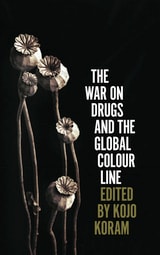
The War on Drugs and the Global Colour Line
Edited by Kojo Koram
Pluto Press, 2019
While laws prohibiting the production, sale and use of particular drugs are presented as politically neutral and objective, this collection reveals the racist impact of the War on Drugs across multiple continents and in numerous situations. From racialised drugs policing at festivals in the UK to the necropolitical wars in Juarez, Mexico and from the exchange of drug policing programs between the United States and Israel to the management of black bodies in Brazil, this collection proves that the regulation of drugs and race is an international, and intentional, disaster.
Pushing forward the debate and activism led by groups such as Black Lives Matter and calling for radical changes in drug policy legislation and prison reform, both nationally and internationally, this collection cuts deep and rings true for all people fighting racism today.

The War on Sex
David M. Halperin and Trevor Hoppe, editors
Duke University Press, 2017

The War on Slums in the Southwest
Public Housing and Slum Clearance in Texas, Arizona, and New Mexico, 1935-1965Robert B Fairbanks
Temple University Press, 2016
In The War on Slums in the Southwest, Robert Fairbanks provides compelling and probing case studies of economic problems and public housing plights in Albuquerque, Dallas, Houston, Phoenix and San Antonio. He provides brief histories of each city--all of which expanded dynamically between 1935 and 1965--and how they responded to slums under the Housing Acts of 1937, 1949, and 1954.
Despite being a region where conservative politics has ruled, these Southwestern cities often handled population growth, urban planning, and economic development in ways that closely followed the national account of efforts to eliminate slums and provide public housing for the needy. The War on Slums in the Southwest therefore corrects some misconceptions about the role of slum clearance and public housing in this region as Fairbanks integrates urban policy into the larger understanding of federal and state-based housing policies.
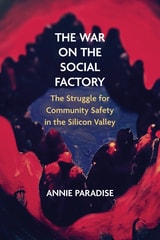
The War on the Social Factory
The Struggle for Community Safety in the Silicon ValleyAnnie Paradise
Northwestern University Press, 2024
A collective ethnography of grassroots mobilizations for community safety across the Silicon Valley
This is a narrative of struggle and solidarity and a collective toolkit for grassroots opposition to militarization, policing, and ongoing conditions of war in the current conjuncture of racial patriarchal capitalism. Grassroots researcher Annie Paradise presents here a collective ethnography of the mothers and community matriarchs whose children have been murdered by police across the San Francisco Bay Area as they develop and practice autonomous, creative forms of resistance.
The War on the Social Factory: The Struggle for Community Safety in the Silicon Valley maps local families’ struggles to reclaim their households and their communities—to create a social infrastructure of care, justice, and safety outside state- and market-determined modes of “security.” Practices such as sustained vigil, testimony, and the production and circulation of insurgent knowledges are shown here to be part of interconnected justice efforts to demilitarize and decarcerate communities in the face of the multiple forms of violence enacted under late racial patriarchal capitalism. Paradise examines the expanding carceral processes of enclosure, criminalization, dispossession, expropriation, and disposability that mark the neoliberal "security” regime across the Silicon Valley and offers counter-counterinsurgent strategies and practices of co-generative, dynamic resistance.

The Wardell Buffalo Trap 48 SU 301
Communal Procurement in the Upper Green River Basin, WyomingGeorge C. Frison
University of Michigan Press, 1973
The Wars We Inherit
Military Life, Gender Violence, and MemoryAuthored by Lori E. Amy
Temple University Press, 2010
By combining personal memoir and critical analysis, Lori Amy links the violence we live in our homes to the violence that structures our larger culture. The Wars We Inherit brings insights from memory and trauma studies to the story of violence in the author’s own family.
In this brave, fascinating and compelling book, Amyconcerns herself with the violence associated with the military, and how this institution of public, cultural violence, with its hypermasculinity, pervades society with physical, verbal, emotional and sexual aggression. She uses her war-veteran father to represent the chaotic and dehumanizing impact of war to show how violence is experienced and remembered.
Amy provides examples that support the relationship between military structures and domestic violence, or how the sexual violence that permeates her family prompts debates about the nature of trauma and memory. In addition, Amy employs feminist psychoanalytic theory, cultural and trauma studies, and narrative theory, to explain how torture in Abu Ghraib is on a direct continuum with the ordinary violence inherent in our current systems of gender and nation.
Placing individual experience in cultural context, Amy argues that “if we can begin, in our own lives, to transform the destructive ways that we have been shaped by violence, then we might begin to transform the cultural conditions that breed violence.”
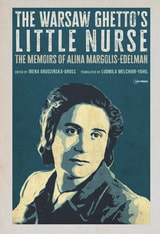
The Warsaw Ghetto's Little Nurse
The Memoirs of Alina Margolis-EdelmanAlina Margolis-Edelman
Central European University Press, 2026
The stories told in her book illuminate issues of anti-Semitism, Holocaust, and Jewish resistance to oppression. She writes about solidarity in times of great danger, resilience in dire situations, dignity of love and care.

The Washing Away of Wrongs
Forensic Medicine in Thirteenth-Century ChinaSung Tz’u; Translated by Brian E. McKnight
University of Michigan Press, 1981
The Way to Hell
Machiavelli for Catastrophic TimesNathan Crick
University of Alabama Press, 2024
An incisive and erudite survey of Machiavelli, the catastrophes of his times and ours, and his counsel for responding to an era of constant crises.
Catastrophe looms. Political, environmental, epidemic, and military crises arrive with increasing frequency. In The Way to Hell, Nathan Crick argues that our perilous times call for the strongest medicine in the Western canon: Machiavelli. Crick reminds contemporary readers about the Florentine master’s advice—that one must learn the road to Hell precisely to avoid taking it.
Like a knowledgeable friend, Crick offers contemporary readers a guide to Machiavelli’s world, work, and warnings. He takes in the sweep of Western history, comparing Machiavelli’s work with ancient sources such as Cicero and Thucydides. And as Machiavelli has never stopped provoking comment, Crick treats readers to a feast of responses to Machiavelli’s work—caustic, learned, and humorous—in the five centuries since he lived.
Including both Machiavelli’s best-known works, The Prince and Discourses on Livy, as well as his personal correspondence and comic plays, Crick asks anew the questions that bedeviled Machiavelli’s beloved Florentine republic: When is force necessary? When are lies justified? Is cruelty defensible? When does social protest slip into violent revolution? What is the correct response to catastrophe?
Like Machiavelli himself, The Way to Hell is witty, stimulating, and challenging. In a world seemingly on the road to Hell, Machiavelli offers an alternative route. His bracing vision exhorts readers to see the dangers in their path and to take action with vigor and determination. Far from a vision of cynicism, Machiavelli offers a beacon of hope for a world that seems on the brink.
The Weather in Proust
Eve Kosofsky Sedgwick
Duke University Press, 2012
The Weavers of Trautenau
Jewish Female Forced Labor in the HolocaustJanine P. Holc
Brandeis University Press, 2023
Beginning in late 1940, over three thousand Jewish girls and young women were forced from their family homes in Sosnowiec, Poland, and its surrounding towns to worksites in Germany. Believing that they were helping their families to survive, these young people were thrust into a world where they labored at textile work for twelve hours a day, lived in barracks with little food, and received only periodic news of events back home. By late 1943, their barracks had been transformed into concentration camps, where they were held until liberation in 1945.
Using a fresh approach to testimony collections, Janine P. Holc reconstructs the forced labor experiences of young Jewish females, as told by the women who survived and shared their testimony. Incorporating new source material, the book carefully constructs survivors’ stories while also taking a theoretical approach, one alert to socially constructed, intersectional systems of exploitation and harm. The Weavers of Trautenau elucidates the limits and possibilities of social relations inside camps and the challenges of moral and emotional repair in the face of indescribable loss during the Holocaust.