Results by title
1441 books match the query 'Great Britain' and 342 start with t
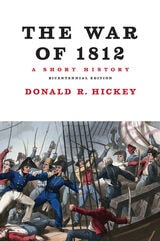
The War of 1812, A Short History
Donald R. Hickey
University of Illinois Press, 2012
This abridged edition of Donald R. Hickey's comprehensive and authoritative The War of 1812: A Forgotten Conflict has been thoroughly revised for the 200th anniversary of the historic conflict. A myth-shattering study that will inform and entertain students and general readers alike, The War of 1812: A Short History explores the military, diplomatic, and domestic history of our second war with Great Britain, bringing the study up to date with recent scholarship on all aspects of the war, from the Gulf of Mexico to Canada.
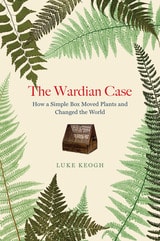
The Wardian Case
How a Simple Box Moved Plants and Changed the WorldLuke Keogh
University of Chicago Press, 2020
Roses, jasmine, fuchsia, chrysanthemums, and rhododendrons bloom in gardens across the world, and yet many of the most common varieties have roots in Asia. How is this global flowering possible? In 1829, surgeon and amateur naturalist Nathaniel Bagshaw Ward placed soil, dried leaves, and the pupa of a sphinx moth into a sealed glass bottle, intending to observe the moth hatch. But when a fern and meadow grass sprouted from the soil, he accidentally discovered that plants enclosed in glass containers could survive for long periods without watering. After four years of experimentation in his London home, Ward created traveling glazed cases that would be able to transport plants around the world. Following a test run from London to Sydney, Ward was proven correct: the Wardian case was born, and the botanical makeup of the world’s flora was forever changed.
In our technologically advanced and globalized contemporary world, it is easy to forget that not long ago it was extremely difficult to transfer plants from place to place, as they often died from mishandling, cold weather, and ocean salt spray. In this first book on the Wardian case, Luke Keogh leads us across centuries and seas to show that Ward’s invention spurred a revolution in the movement of plants—and that many of the repercussions of that revolution are still with us, from new industries to invasive plant species. From the early days of rubber, banana, tea, and cinchona cultivation—the last used in the production of the malaria drug quinine—to the collecting of beautiful and exotic flora like orchids in the first great greenhouses of the United States Botanic Garden in Washington, DC, and England’s Royal Botanic Gardens, Kew, the Wardian case transformed the world’s plant communities, fueled the commercial nursery trade and late nineteenth-century imperialism, and forever altered the global environment.
The Wars of Archibald Forbes
W. Hamish Fraser
Aberdeen University Press, 2015
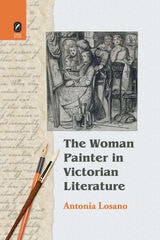
The Woman Painter in Victorian Literature
Antonia Losano
The Ohio State University Press, 2008
The nineteenth century saw a marked rise both in the sheer numbers of women active in visual art professions and in the discursive concern for the woman artist in fiction, the periodical press, art history, and politics. The Woman Painter in Victorian Literature argues that Victorian women writers used the controversial figure of the woman painter to intervene in the discourse of aesthetics. These writers were able to assert their own status as artistic producers through the representation of female visual artists.
Women painters posed a threat to the traditional heterosexual erotic art scenarios—a male artist and a male viewer admiring a woman or feminized art object. Antonia Losano traces an actual movement in history in which women writers struggled to rewrite the relations of gender and art to make a space for female artistic production. She examines as well the disruption female artists caused in the socioeconomic sphere. Losano offers close readings of a wide array of Victorian writers, particularly those works classified as noncanonical—by Anne Thackeray Ritchie, Margaret Oliphant, Anne Brontë, and Mrs. Humphrey Ward—and a new look at better-known novels such as Jane Eyre and Daniel Deronda, focusing on the pivotal social and aesthetic meanings of female artistic production in these texts. Each of the novels considered here is viewed as a contained, coherent, and complex aesthetic treatise that coalesces around the figure of the female painter.
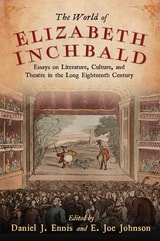
The World of Elizabeth Inchbald
Essays on Literature, Culture, and Theatre in the Long Eighteenth CenturyDaniel J. Ennis
University of Delaware Press, 2022
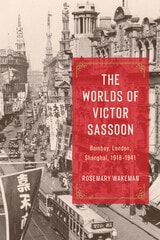
The Worlds of Victor Sassoon
Bombay, London, Shanghai, 1918–1941Rosemary Wakeman
University of Chicago Press, 2024
In this book, historian Rosemary Wakeman brings to life the frenzied, crowded streets, markets, ports, and banks of Bombay, London, and Shanghai. In the early twentieth century, these cities were at the forefront of the sweeping changes taking the world by storm as it entered an era of globalized commerce and the unprecedented circulation of goods, people, and ideas. Wakeman explores these cities and the world they helped transform through the life of Victor Sassoon, who in 1924 gained control of his powerful family’s trading and banking empire. She tracks his movements between these three cities as he grows his family’s fortune and transforms its holdings into a global juggernaut. Using his life as its point of entry, The Worlds of Victor Sassoon paints a broad portrait not just of wealth, cosmopolitanism, and leisure but also of the discrimination, exploitation, and violence wreaked by a world increasingly driven by the demands of capital.
The Worm in the Apple
A History of the Conservative Party and Europe from Churchill to CameronChristopher Tugendhat
Haus Publishing, 2022
The Conservative Party has been in power for 47 of the 65 years since the end of World War II. During that time the division within the party over Europe has been the enduring drama of British politics—from Churchill’s decision not to join the original European Coal and Steel Community in 1951 to Cameron’s decision to hold the Brexit referendum in 2016. Other leaders came and went, but the issue was always there—sometimes center-stage, at others behind the scenes—destabilizing foreign policy, corroding the body politic, and destroying several of the party’s leaders. These questions, and how they panned out, created a deep, grumbling discontent—the worm in the apple—that, over time, turned the Conservative Party and, by extension, a significant section of the electorate, against British membership of the EU. By telling the story of the arguments and divisions within the Conservative Party, The Worm in the Apple helps to explain why Britain voted to leave the European Union in 2016.
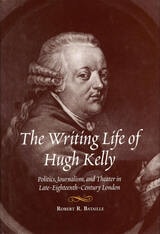
The Writing Life of Hugh Kelly
Politics, Journalism, and Theatre in Late-Eighteenth-Century LondonRobert R. Bataille
Southern Illinois University Press, 2000
Robert R. Bataille demonstrates convincingly that between 1767 and 1777, Anglo-Irish writer Hugh Kelly made major contributions in three areas of British culture: politics, journalism, and theater. Bataille shows how all three activities were integrated in Kelly’s life, suggesting that such interrelationships often existed in the rough and ready London culture during the early reign of King George III.
When he discovered several newspaper campaigns that Kelly orchestrated as a paid political propagandist for George III and his ministers, Bataille understood in part how important Kelly was to his era. In his capacity as propagandist, Kelly defended Hanoverian colonial policies on the eve of the American Revolution, served as a key opponent of the radical Wilkites, and promoted the acceptance of the 1774 Quebec Bill, which established, among other things, the right of the recently defeated French citizens of Quebec to maintain the French language.
A belletristic journalist, Kelly published theater reviews and essays that played a major role in shaping the taste of his era. He wrote in defense of the controversial sentimental drama, and whenever he could, he promoted the major theatrical figure of the age, David Garrick. Under his editorship, the newspaper Public Ledger became a leading source of theater information. Seeking to raise the status of the profession of journalism, he wrote essays and articles that provided his middle-class readers with an insider’s view of the operations of the journalist.
Assessing Kelly’s contributions to the novel and drama, Bataille argues that this powerful journalist stands in the vanguard in the larger struggle against traditional attitudes supporting male superiority and aristocratic privilege. Kelly wrote in favor of gender equality and middle-class respectability, striving to inculcate what modern scholars refer to as the values of sensibility. Bataille also argues, however, that Kelly knew his audience. Instrumental in the rise of professional writing and popular culture, he understood that he had to observe the needs of his audience, detecting cultural trends and using the skills of the rhetorician.
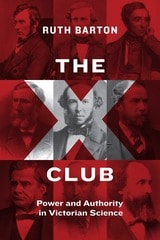
The X Club
Power and Authority in Victorian ScienceRuth Barton
University of Chicago Press, 2018
These six ambitious professionals and three wealthy amateurs—J. D. Hooker, T. H. Huxley, John Tyndall, John Lubbock, William Spottiswoode, Edward Frankland, George Busk, T. A. Hirst, and Herbert Spencer—wanted to guide the development of science and public opinion on issues where science impinged on daily life, religious belief, and politics. They formed a private dining club, which they named the X Club, to discuss and further their plans. As Ruth Barton shows, they had a clear objective: they wanted to promote “scientific habits of mind,” which they sought to do through lectures, journalism, and science education. They devoted enormous effort to the expansion of science education, with real, but mixed, success.
For twenty years, the X Club was the most powerful network in Victorian science—the men succeeded each other in the presidency of the Royal Society for a dozen years. Barton’s group biography traces the roots of their success and the lasting effects of their championing of science against those who attempted to limit or control it, along the way shedding light on the social organization of science, the interactions of science and the state, and the places of science and scientific men in elite culture in the Victorian era.
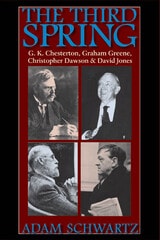
The third spring
G.K. Chesterton, Graham Greene, Christopher Dawson, and David JonesAdam Schwartz
Catholic University of America Press, 2005
Theaters of Translation
Cosmopolitan Vernaculars in Shakespeare's EnglandAndrew S. Keener
University of Alabama Press, 2025
Explores the profound influence of multilingual dictionaries, dialogues, and grammars on English Renaissance playwrights
In Theaters of Translation, Andrew S. Keener offers a fascinating account of the ways that plays by Thomas Kyd, Mary Sidney Herbert, Ben Jonson, and their fellow English contemporaries were shaped by and part of a multilingual Europe where dictionaries, grammars, and language-learning materials circulated widely. He proposes a fresh, multilingual approach to English Renaissance drama that challenges the histories of early modern European languages as sites of national and linguistic cohesion.
Covering the period between 1570 and 1640, when England’s drama and the English language itself were evolving, Keener uses the term “cosmopolitan vernaculars” to examine how nonclassical European languages modeled transnational forms of belonging for playgoers, readers, and authors in Renaissance England. Combining recent contributions to cosmopolitan theory and transnational studies of early modern literature and culture, Keener highlights both the ways in which cosmopolitanism manifests through Europe’s vernacular languages—in print and performance—and the ways languages themselves can exhibit cosmopolitanism for those who encounter them on the page or on the stage.
Theaters of Translation opens up new transnational interpretations of English Renaissance plays and casts fresh light on historical anecdotes, such as Jonson inscribing a copy of Pietro Aretino’s scandalous Italian dialogues or Shakespeare’s First Folio being advertised for sale in Germany before its London publication. It offers much of interest to readers and scholars of Renaissance Europe, early modern drama, and the development of national European languages.
Theatre of the Real
Yeats, Beckett, and SondheimGina Masucci MacKenzie
The Ohio State University Press, 2008
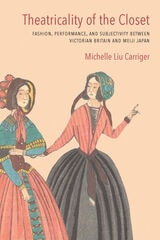
Theatricality of the Closet
Fashion, Performance, and Subjectivity between Victorian Britain and Meiji JapanMichelle Liu Carriger
Northwestern University Press, 2023
Clothing matters. This basic axiom is both common sense and, in another way, radical. It is from this starting point that Michelle Liu Carriger elucidates the interconnected ways in which gender, sexuality, class, and race are created by the everyday act of getting dressed. Theatricality of the Closet: Fashion, Performance, and Subjectivity between Victorian Britain and Meiji Japan examines fashion and clothing controversies of the nineteenth century, drawing on performance theory to reveal how the apparently superficial or frivolous deeply affects the creation of identity.
By interrogating a set of seemingly disparate examples from the same period but widely distant settings—Victorian Britain and Meiji-era Japan—Carriger disentangles how small, local, ordinary practices became enmeshed in a global fabric of cultural and material surfaces following the opening of trade between these nations in 1850. This richly illustrated book presents an array of media, from conservative newspapers and tabloids to ukiyo-e and early photography, that locate dress as a site where the individual and the social are interwoven, whether in the 1860s and 1870s or the twenty-first century.

Theorizing Anglo-Saxon Stone Sculpture
CATHERINE E. KARKOV
West Virginia University Press, 2003
Theorizing Anglo-Saxon Stone Sculpture significantly advances the complex study of Anglo-Saxon carved monuments, such as the Ruthwell Cross, by adopting more explicit theoretical approaches to the subject. Scholars included here are explicit in describing how their approaches complement (or, more often, contradict) the work of others. This book comes as a shot across the bow of these vessels. Contributors include the best scholars on this subject matter in England, Ireland, and America.
Theory And The Premodern Text
Paul Strohm
University of Minnesota Press, 2000
A major reconsideration of relations between new theories and old texts.
Medieval Studies/Literary Theory
A major reconsideration of relations between new theories and old texts. The work of Paul Strohm allies the most distinguished traditions of medieval study with the most challenging and innovative of theoretical approaches. These features, working together to revise and expand our understanding of both medieval texts and contemporary critical practice, are apparent in full and compelling force in this collection of essays, most now in print for the first time. In a range of theoretical engagements with late medieval texts, dealing with social practice, time, and narrative, this volume proposes a "practical" relation between the text and the theory that illuminates it.Insisting on the imaginative multiplicity of the text, Strohm finds in theory an augmentation of interpretive possibilities-an augmentation that sometimes requires respectful disagreement with what a work says-or seems to want known-about itself. He thus defines theory as "any standpoint from which we might challenge a text’s self-understanding." Coupled with this strategic disrespect is a new and amplified form of respect-for the text as a meaning-making system, for its unruly power and its unpredictable effects in the world.In this spirit, Strohm offers new and illustrative readings of Hoccleve’s "Male Regle" and Regiment of Princes, Ricardian coronation documents, Chaucer’s "Cook’s Tale," Capgrave’s chronicle, the Gesta Henrici Quinti, records of the king’s bench, Malory’s "Knight of the Cart," and other later medieval texts. Throughout, Strohm traverses categories of "literary" and "non-literary" in the service of a more comprehensive understanding of texts and the resourcefulness with which they accomplish their social work.Medieval Cultures Series, volume 26Translation Inquiries: University of Minnesota Press
These Islands
A Letter to BritainAli M. Ansari
Haus Publishing, 2018
With These Islands, Ali M. Ansari considers the idea of Britain as a political entity. This idea of Britain considers some nationalists as suppressed minorities in need of attention, and others as bigoted throwbacks to a more divisive age. Arguing the case for Great Britain from the perspective of the political mythology of the British state—with an emphasis on culture, ideas and narrative constructions—Ansari makes the claim that Britain’s strength lies in its ability to shape the popular imagination, both at home and abroad. He concludes that an “excess of enthusiasm” may yet do untold damage to the fabric of a state and society that has been carefully constructed over the centuries and may not be easily repaired.

These Valiant Dead
Past Shakespeare'S HistoriesRobert C. Jones
University of Iowa Press, 1991
Thinking While Black
Translating the Politics and Popular Culture of a Rebel GenerationDaniel McNeil
Rutgers University Press, 2023
Listen along with this Spotify playlist inspired by the book!
For copyright reasons, this book is available in the U.S.A only.
Thomas De Quincey
British Rhetoric's Romantic TurnLois Peters Agnew
Southern Illinois University Press, 2012
This wide-ranging volume gives proper attention to the views on rhetoric and style set forth by British literary figure Thomas De Quincey (1785–1859), whose contributions to the history of rhetoric are often overlooked. Lois Peters Agnew presents an overview of this theorist’s life and provides cultural context for his time and place, with particular emphasis on the significance of his rhetoric as both an alternative strain of rhetorical history and a previously unrealized example of rhetoric’s transformation in nineteenth-century Britain.
Agnew presents an extensive discussion of De Quincey’s ideas on rhetoric, his theory and practice of conversation, his theory of style and its role in achieving rhetoric’s dialogic potential, and his strategic use of humor and irony in such works as Confessions of an English Opium Eater. Synthesizing previous treatments of De Quincey’s rhetoric and connecting his unusual perspectives on language to the biographical details of his life, Agnew helps readers understand his intellectual development while bringing to light the cultural contexts that prompted radical changes in the ways nineteenth-century British intellectuals conceived of the role of language and the imagination in public and private discourse.
Agnew presents an alternative vision of rhetoric that departs from many common assumptions about rhetoric’s civic purpose and offers insights into the topic of rhetoric and technological change. The result is an accessible and thorough explanation of De Quincey’s complex ideas on rhetoric and the first work to fully show the reach of his ideas across multiple texts written during his lifetime.
Thomas Frederick Tout (1855–1929)
refashioning history for the twentieth centuryEdited by Joel T. Rosenthal and Caroline M. Barron
University of London Press, 2019

Tides and Floods
New Research on London and the Tidal Thames from the Middle Ages to the Twentieth CenturyJames Galloway
University of London Press, 2010
Tides of History
Ocean Science and Her Majesty's NavyMichael S. Reidy
University of Chicago Press, 2008
Analyzing the economic, political, social, and scientific changes on which the British sailed to power, Tides of History shows how the British Admiralty collaborated closely not only with scholars, such as William Whewell, but also with the maritime community —sailors, local tide table makers, dockyard officials, and harbormasters—in order to systematize knowledge of the world’s oceans, coasts, ports, and estuaries. As Michael S. Reidy points out, Britain’s security and prosperity as a maritime nation depended on its ability to maneuver through the oceans and dominate coasts and channels. The practice of science and the rise of the scientist became inextricably linked to the process of European expansion.
Tiger Duff
India, Madeira and Empire in Eighteenth-Century ScotlandAlistair Mutch
Aberdeen University Press, 2017
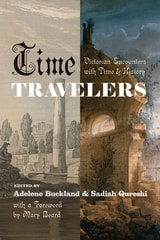
Time Travelers
Victorian Encounters with Time and HistoryEdited by Adelene Buckland and Sadiah Qureshi
University of Chicago Press, 2020
Out of their discoveries, new histories emerged, giving rise to fresh debates, while seemingly well-known histories were thrown into confusion by novel tools and methods of scrutiny. If in the eighteenth century the study of the past had been the province of a handful of elites, new technologies and economic development in the nineteenth century meant that the past, in all its brilliant detail, was for the first time the property of the many, not the few. Time Travelers is a book about the myriad ways in which Victorians approached the past, offering a vivid picture of the Victorian world and its historical obsessions.
Tissue Economies
Blood, Organs, and Cell Lines in Late CapitalismCatherine Waldby and Robert Mitchell
Duke University Press, 2006
Waldby and Mitchell pull together a prodigious amount of research—involving policy reports and scientific papers, operating manuals, legal decisions, interviews, journalism, and Congressional testimony—to offer a series of case studies based on particular forms of tissue exchange. They examine the effect of threats of contamination—from HIV and other pathogens—on blood banks’ understandings of the gift/commodity relationship; the growth of autologous economies, in which individuals bank their tissues for their own use; the creation of the United Kingdom’s Stem Cell bank, which facilitates the donation of embryos for stem cell development; and the legal and financial repercussions of designating some tissues “hospital waste.” They also consider the impact of different models of biotechnology patents on tissue economies and the relationship between experimental therapies to regenerate damaged or degenerated tissues and calls for a legal, for-profit market in organs. Ultimately, Waldby and Mitchell conclude that scientific technologies, the globalization of tissue exchange, and recent anthropological, sociological, and legal thinking have blurred any strict line separating donations from the incursion of market values into tissue economies.
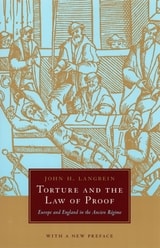
Torture and the Law of Proof
Europe and England in the Ancien RégimeJohn H. Langbein
University of Chicago Press, 2006
The book has recently taken on an eerie relevance as a consequence of controversial American and British interrogation practices in the Iraq and Afghanistan wars. In a new introduction, Langbein contrasts the "new" law of torture with the older European law and offers some pointed lessons about the difficulty of reconciling coercion with accurate investigation. Embellished with fascinating illustrations of torture devices taken from an eighteenth-century criminal code, this crisply written account will engage all those interested in torture's remarkable grip on European legal history.
Toward a Deaf Translation Norm
Christopher A. Stone
Gallaudet University Press, 2009
As access to deaf people grows around the world, a new profession has begun to emerge as well, that of Deaf translators and interpreters (T/Is). In his new study Toward a Deaf Translation Norm, Christopher Stone explores this innovation, including its antecedents and how it is manifested in public places. Most importantly, Stone investigates whether or not a translation norm has evolved for Deaf T/Is as increasing numbers of them work in the mainstream translating for websites, public services, government literature, and television media.
For his study, the sixth volume in the Studies in Interpretation series, Stone concentrated his research in the United Kingdom. Specifically, he examined the rendering of English broadcast television news into British Sign Language (BSL) by both Deaf and hearing T/Is. Segments of the data feature simultaneous Deaf and hearing in-vision T/I broadcasts. Recording these broadcasts produced a controlled product that enabled direct comparison of the Deaf and hearing T/Is. Close analysis of these examples revealed to Stone that Deaf T/s not only employ a Deaf translation norm, they take labors to shape their BSL text into a stand-alone product rather than a translation. Ultimately, Toward a Deaf Translation Norm opens up engrossing new vistas on current deliberation about neutrality in translation and interpretation.
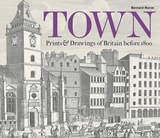
Town
Prints & Drawings of Britain before 1800Bernard Nurse
Bodleian Library Publishing, 2020
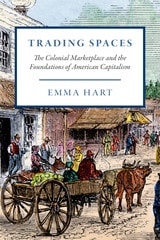
Trading Spaces
The Colonial Marketplace and the Foundations of American CapitalismEmma Hart
University of Chicago Press, 2019
When we talk about the economy, “the market” is often just an abstraction. While the exchange of goods was historically tied to a particular place, capitalism has gradually eroded this connection to create our current global trading systems. In Trading Spaces, Emma Hart argues that Britain’s colonization of North America was a key moment in the market’s shift from place to idea, with major consequences for the character of the American economy.
Hart’s book takes in the shops, auction sites, wharves, taverns, fairs, and homes of seventeenth- and eighteenth-century America—places where new mechanisms and conventions of trade arose as Europeans re-created or adapted continental methods to new surroundings. Since those earlier conventions tended to rely on regulation more than their colonial offspring did, what emerged in early America was a less-fettered brand of capitalism. By the nineteenth century, this had evolved into a market economy that would not look too foreign to contemporary Americans. To tell this complex transnational story of how our markets came to be, Hart looks back farther than most historians of US capitalism, rooting these markets in the norms of seventeenth- and eighteenth-century Britain. Perhaps most important, this is not a story of specific commodity markets over time but rather is a history of the trading spaces themselves: the physical sites in which the grubby work of commerce occurred and where the market itself was born.
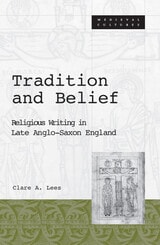
Tradition And Belief
Religious Writing in Late Anglo-Saxon EnglandClara A. Lees
University of Minnesota Press, 1999
Looks at early religious texts and their influence on medieval literature and culture.
Looks at early religious texts and their influence on medieval literature and culture.
In this major study of Anglo-Saxon religious texts-sermons, homilies, and saints’ lives written in Old English-Clare A. Lees reveals how the invention of preaching transformed the early medieval church, and thus the culture of medieval England. By placing Anglo-Saxon prose within a social matrix, her work offers a new way of seeing medieval literature through the lens of culture.To show how the preaching mission of the later Anglo-Saxon church was constructed and received, Lees explores the emergence of preaching from the traditional structures of the early medieval church-its institutional knowledge, genres, and beliefs. Understood as a powerful rhetorical, social, and epistemological process, preaching is shown to have helped define the sociocultural concerns specific to late Anglo-Saxon England.The first detailed study of traditionality in medieval culture, Tradition and Belief is also a case study of one cultural phenomenon from the past. As such-and by concentrating on the theoretically problematic areas of history, religious belief, and aesthetics-the book contributes to debates about the evolving meaning of culture.ISBN 0-8166-3002-X Cloth £34.50 $49.95xxISBN 0-8166-3003-8 Paper £14.00 $19.95x232 Pages 5 7/8 x 9 NovemberMedieval Cultures Series, volume 19Translation inquiries: University of Minnesota Press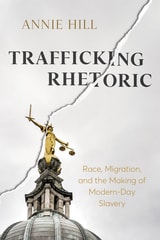
Trafficking Rhetoric
Race, Migration, and the Making of Modern-Day SlaveryAnnie Hill
The Ohio State University Press, 2024
Honorable Mention, 2025 NCA Public Address Division’s Marie Hochmuth Nichols Award
Human trafficking has generated intense global concern, with stories of sex slavery and images of women forced into prostitution so persuasive that states have raced to respond ahead of empirical data and clear definitions of the crime. In Trafficking Rhetoric, Annie Hill analyzes the entanglement of state veneration and state violence by tracking how the United Kingdom points to the alleged crimes of others in order to celebrate itself and conceal its own aggression. Hill compares the UK’s acclaimed rescue approach to human trafficking with its hostile approach to migration, arguing that they are two sides of the same coin—one that relies on rhetorical constructions of “trafficked women” and “illegal migrants” to materialize the UK as an Anglo-white space.
Drawing from official estimates, policy papers, NGO reports, news stories, and awareness campaigns and situating them in the broader EU context, Hill accounts for why the UK’s antitrafficking agenda emerged with such rhetorical force in the early twenty-first century. Trafficking Rhetoric reframes controversies over labor, citizenship, and migration while challenging the continued traction of race-baiting and gender bias in determining who has the right to live, work, and belong in the nation.
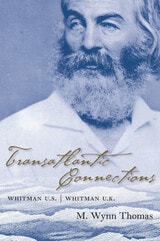
Transatlantic Connections
Whitman U.S., Whitman U.K.Thomas, M. Wynn
University of Iowa Press, 2005
The book’s contrasting sections reflect the two locations studied: the first shows Whitman in his time and place, while the second repositions him within the cultures of England and Wales from the late 19th to the late 20th century. In the opening chapter he is placed against the vivid, outrageous background of the New York of his time; the second finds evidence in his poetry of a critique of the new urban politics of the emerging city boss; the third radically redefines Whitman's relationship to his famous contemporary Longfellow. Other chapters deal with the Civil War poet, exploring the ways in which his poetic responses were in part shaped by his relationship to his soldier brother George, and his use of the meteorological discoveries of his day to fashion metaphors for imaging the different phases of the conflict.
The second section ponders the paradox that this Whitman, who was so much the product of his specific time and limited “local” culture, should come to be accepted as an international visionary. The United Kingdom is taken as offering striking instances of this phenomenon, and his transatlantic admirers are shown to have been engaged in an unconscious process of “translating” Whitman into the terms of their own culturally specific social, political, and sexual preoccupations. Some of the connections explored are those between Whitman and Edward Carpenter, the so-called English Whitman; between Whitman and perhaps his greatest English critic, D. H. Lawrence; and between Whitman and the Welsh poets Ernest Rhys, Amanwy (David Rees Griffiths), Niclas y Glais (T. E. Nicholas), Waldo Williams, Glyn Jones, Dylan Thomas, and R. S. Thomas.
This bold and original study, offering new points of entry into understanding Whitman as the product of his time and place as well as understanding the reception of Whitman in the U.K. as a process of cultural translation, should fascinate scholars of Whitman and students of comparative literature.
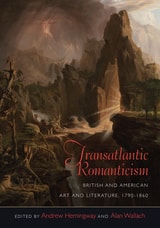
Transatlantic Romanticism
British and American Art and Literature, 1790-1860Andrew Hemingway
University of Massachusetts Press, 2014
In the book's introduction, Andrew Hemingway—building on the theoretical work of Michael Lowy and Robert Sayre—proposes that we need to remobilize the concept of Weltanschauung, or comprehensive worldview, in order to develop the kind of synthetic history of arts and ideas the phenomenon of Romanticism demands. The essays that follow focus on the London and New York art worlds and such key figures as Benjamin West, Thomas Bewick, John Vanderlyn, Washington Allston, John Martin, J. M. W. Turner, Thomas Cole, James Fenimore Cooper, George Catlin, Edgar Allan Poe, Harriet Beecher Stowe, and Herman Melville. Taken together, these essays plot the rise of a romantic anti-capitalist Weltanschauung as well as the dialectic between Romanticism's national and international manifestations.
In addition to the volume editors, contributors include Matthew Beaumont, David Bindman, Leo Costello, Nicholas Grindle, Wayne Franklin, Janet Koenig, William Pressly, Robert Sayre, William Truettner, Dell Upton, and William Vaughan.

Transatlantic Women
Nineteenth-Century American Women Writers and Great BritainBeth L. Lueck
University of New Hampshire Press, 2012
Travel Behaviour Reconsidered in an Era of Decarbonisation
David Metz
University College London, 2024
Transport systems are central to daily life, but simultaneously have a salient impact on our environment. However, this perspective has little influence on conventional economic analysis and transport investments, creating dissonance between traditional investment goals and the need to reduce carbon emissions to net zero by 2050. For fifty years, public road and railway expenditures were justified by claims to improve travel time. On the contrary, the average time of travel never changed. Travel Behaviour Reconsidered in an Era of Decarbonisation argues that this outdated economic analysis is misconceived and that fresh perspectives on transport networks are imperative.
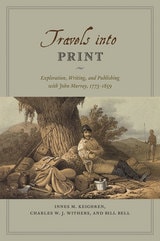
Travels into Print
Exploration, Writing, and Publishing with John Murray, 1773-1859Innes M. Keighren, Charles W. J. Withers, and Bill Bell
University of Chicago Press, 2015
Drawing on detailed examination of the John Murray Archive of manuscripts, images, and the firm’s correspondence with its many authors—a list that included such illustrious explorers and scientists as Charles Darwin and Charles Lyell, and literary giants like Jane Austen, Lord Byron, and Sir Walter Scott—Travels into Print considers how journeys of exploration became published accounts and how travelers sought to demonstrate the faithfulness of their written testimony and to secure their personal credibility. This fascinating study in historical geography and book history takes modern readers on a journey into the nature of exploration, the production of authority in published travel narratives, and the creation of geographical authorship—a journey bound together by the unifying force of a world-leading publisher.
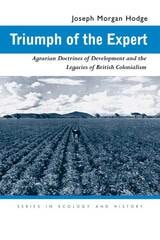
Triumph of the Expert
Agrarian Doctrines of Development and the Legacies of British ColonialismJoseph Morgan Hodge
Ohio University Press, 2007
The most striking feature of British colonialism in the twentieth century was the confidence it expressed in the use of science and expertise, especially when joined with the new bureaucratic capacities of the state, to develop natural and human resources of the empire.
Triumph of the Expert is a history of British colonial doctrine and its contribution to the emergence of rural development and environmental policies in the late colonial and postcolonial period. Joseph Morgan Hodge examines the way that development as a framework of ideas and institutional practices emerged out of the strategic engagement between science and the state at the climax of the British Empire. Hodge looks intently at the structural constraints, bureaucratic fissures, and contradictory imperatives that beset and ultimately overwhelmed the late colonial development mission in sub-Saharan Africa, south and southeast Asia, and the Caribbean.
Triumph of the Expert seeks to understand the quandaries that led up to the important transformation in British imperial thought and practice and the intellectual and administrative legacies it left behind.
Trollope in the Post Office
R. H. Super
University of Michigan Press, 1981
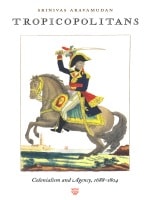
Tropicopolitans
Colonialism and Agency, 1688–1804Srinivas Aravamudan
Duke University Press, 1999
“Tropicalization” is the central metaphor of this analysis, a term that incorporates both the construction of various dynamic tropes by which the colonized are viewed and the site of the study, primarily the tropics. Tropicopolitans, then, are those people who bear and resist the representations of colonialist discourse. In readings that expose new relationships between literary representation and colonialism in the eighteenth century, Aravamudan considers such texts as Behn’s Oroonoko, Defoe’s Robinson Crusoe and Captain Singleton, Addison’s Cato, and Swift’s Gulliver’s Travels and The Drapier’s Letters. He extends his argument to include analyses of Johnson’s Rasselas, Beckford’s Vathek, Montagu’s travel letters, Equiano’s autobiography, Burke’s political and aesthetic writings, and Abbé de Raynal’s Histoire des deux Indes. Offering a radical approach to literary history, this study provides new mechanisms for understanding the development of anticolonial agency.
Introducing eighteenth-century studies to a postcolonial hermeneutics, Tropicopolitans will interest scholars engaged in postcolonial studies, eighteenth-century literature, and literary theory.
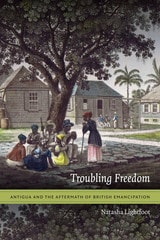
Troubling Freedom
Antigua and the Aftermath of British EmancipationNatasha Lightfoot
Duke University Press, 2016
Truth and Tales
Cultural Mobility and Medieval MediaEdited by Fiona Somerset and Nicholas Watson
The Ohio State University Press, 2015
Truth and Tales includes fourteen essays by medieval literary scholars and historians. Some essays focus on written artifacts that convey high or popular learning in unexpected ways. Others address a social problem of concern to all, demonstrating the genres and media through which it was negotiated. Still others are centered on one or more texts, detailing their investments in popular as well as learned knowledge, in performance as well as writing. This collective archaeology of medieval media provides fresh insight for medieval scholars and media theorists alike.
Twisted Words
Torture and Liberalism in Imperial BritainKatherine Judith Anderson
The Ohio State University Press, 2022