Results by title
22279 books match the query 'Social Science' and 4007 start with t
The Ait Ndhir of Morocco
A Study of the Social Transformation of a Berber TribeAmal Rassam Vinogradov
University of Michigan Press, 1974

The Alabama Folk Lyric
A Study in Origins and Media of DisseminationCollected and Edited with an Introduction and Notes by Ray B. Browne
University of Wisconsin Press, 1979
Alabamians have always been a singing people. The settlers who moved into the various sections of the state brought with them songs which reflected their national origins and geographical backgrounds, and as they spread into the hills and over the lowlands they created new songs out of the conditions under which they lived. Also, they absorbed songs from outside sources whenever these pieces could be adapted to their sentiments and ways of life. Thus, by a process of memory, composition and recreation they developed a rich body of folk songs. The following collection a part of the effort to discover and preserve these songs.
The Alaska Native Reader
History, Culture, PoliticsMaria Shaa Tláa Williams, ed.
Duke University Press, 2009
The Alaska Native Reader describes indigenous worldviews, languages, arts, and other cultural traditions as well as contemporary efforts to preserve them. Several pieces examine Alaska Natives’ experiences of and resistance to Russian and American colonialism; some of these address land claims, self-determination, and sovereignty. Some essays discuss contemporary Alaska Native literature, indigenous philosophical and spiritual tenets, and the ways that Native peoples are represented in the media. Others take up such diverse topics as the use of digital technologies to document Native cultures, planning systems that have enabled indigenous communities to survive in the Arctic for thousands of years, and a project to accurately represent Dena’ina heritage in and around Anchorage. Fourteen of the volume’s many illustrations appear in color, including work by the contemporary artists Subhankar Banerjee, Perry Eaton, Erica Lord, and Larry McNeil.
The Albuquerque Navajos
William H. Hodge
University of Arizona Press, 1969
The Alchemy of Meth
A DecompositionJason Pine
University of Minnesota Press, 2019
Meth cooks practice late industrial alchemy—transforming base materials, like lithium batteries and camping fuel, into gold
Meth alchemists all over the United States tap the occulted potencies of industrial chemical and big pharma products to try to cure the ills of precarious living: underemployment, insecurity, and the feeling of idleness. Meth fires up your attention and makes repetitive tasks pleasurable, whether it’s factory work or tinkering at home. Users are awake for days and feel exuberant and invincible. In one person’s words, they “get more life.”
The Alchemy of Meth is a nonfiction storybook about St. Jude County, Missouri, a place in decomposition, where the toxic inheritance of deindustrialization meets the violent hope of this drug-making cottage industry. Jason Pine bases the book on fieldwork among meth cooks, recovery professionals, pastors, public defenders, narcotics agents, and pharmaceutical executives. Here, St. Jude is not reduced to its meth problem but Pine looks at meth through materials, landscapes, and institutions: the sprawling context that makes methlabs possible. The Alchemy of Meth connects DIY methlabs to big pharma’s superlabs, illicit speed to the legalized speed sold as ADHD medication, uniquely implicating the author’s own story in the narrative.
By the end of the book, the backdrop of St. Jude becomes the foreground. It could be a story about life and work anywhere in the United States, where it seems no one is truly clean and all are complicit in the exploitation of their precious resources in exchange for a livable present—or even the hope of a future.
The Alienated Subject
On the Capacity to HurtJames A. Tyner
University of Minnesota Press, 2022
A timely and provocative discussion of alienation as an intersectional category of life under racial capitalism and white supremacy
From the divisiveness of the Trump era to the Covid-19 pandemic, alienation has become an all-too-familiar contemporary concept. In this groundbreaking book, James A. Tyner offers a novel framework for understanding the alienated subject, situating it within racial capitalism and white supremacy. Directly addressing current economic trends and their rhetoric of xenophobia, discrimination, and violence, The Alienated Subject exposes the universal whitewashing of alienation.
Drawing insight from a variety of sources, including Marxism, feminism, existentialism, and critical race theory, Tyner develops a critique of both the liberal subject and the alienated subject. Through an engagement with the recent pandemic and the Black Lives Matter movement, he demonstrates how the alienated subject is capable of both compassion and cruelty; it is a sadomasochist. Tyner goes on to emphasize the importance of the particular places we find the alienated subject and how the revolutionary transformation of alienation is inherently a spatial struggle. Returning to key interlocutors from Sartre to Fromm, he examines political notions of distance and the spatial practices of everyday life as well as the capitalist conditions that give rise to the alienated subject.
For Tyner, the alienated subject is not the iconic, romanticized image of Marx’s proletariat. Here he calls for an affirmation of love as a revolutionary concept, necessary for the transformation of a society marred by capitalism into an emancipated, caring society conditioned by socially just relations.
The Aliites
Race and Law in the Religions of Noble Drew AliSpencer Dew
University of Chicago Press, 2019
In The Aliites, Spencer Dew traces the history and impact of Ali’s radical fusion of law and faith. Dew uncovers the influence of Ali’s teachings, including the many movements they inspired. As Dew shows, Ali’s teachings demonstrate an implicit yet critical component of the American approach to law: that it should express our highest ideals for society, even if it is rarely perfect in practice. Examining this robustly creative yet largely overlooked lineage of African American religious thought, Dew provides a window onto religion, race, citizenship, and law in America.
The Alphabet in My Hands
A Writing LifeAgosín, Marjorie
Rutgers University Press, 1999
Marjorie Agosín writes of a beloved childhood nanny: "Since I was Jewish she baptized me with holy water brought forth from the fonts of nearby churches. She told me to stay very still so I wouldn't sprout horns. . . . I was somewhere between taciturn and happy gazing into the mirror as if approaching the edge of a cliff . . . and I watched myself in the deep, transparent veil of this night of all nights." Many of the themes expressed in this vignette—cultural dissonance, family, and community—are poetically intertwined throughout The Alphabet in My Hands. Agosín takes us on a personal journey of discovery that is as much internal reflection as it is an exodus across continents and decades.
Agosín's childhood and early adolescence were spent with her Jewish family in Chile. While her family raised her to regard her Jewish heritage with loving awareness, they also participated in the dominant Catholic culture—an aunt organized Easter egg hunts and her mother admired the beauty of Chile's Catholic churches. The young Agosín became keenly aware of her dual identity in her country, both as a participant and an outsider.
The second half of The Alphabet in My Hands recounts the events that forced her family to emigrate to America: the overthrow of Salvador Allende by General Augusto Pinochet. Agosín writes of her new life in Athens, Georgia, of the sudden loss of all that was familiar. Ostracized as an emigrant—a "non-white" with a strange foreign accent—her high school years were made even more painful by the news from Chile: prisoners taken and classmates disappearing or shot.
Years later, Agosín goes back to Chile and she travels there with her own children. As she stares down at her old homeland from the plane, she writes: "Why do I love this place that forced us into exile, that punished my father for being a Jew?" And in the final chapter of The Alphabet in My Hands, this award-winning poet addresses two important topics: her current residence in New England and the central role of writing and literature in her life.
The Amalgamation Waltz
Race, Performance, and the Ruses of MemoryTavia Nyong’o
University of Minnesota Press, 2009
Does racial hybridity offer a future beyond racial difference?
At a time when the idea of a postracial society has entered public discourse, The Amalgamation Waltz investigates the practices that conjoined blackness and whiteness in the nineteenth and twentieth centuries. Scrutinizing widely diverse texts—archival, musical, visual, and theatrical—Tavia Nyong’o traces the genealogy of racial hybridity, analyzing how key events in the nineteenth century spawned a debate about interracialism that lives on today.
Deeply interested in how discussions of racial hybridity have portrayed the hybrid as the recurring hope for a distant raceless future, Nyong’o is concerned with the ways this discourse deploys the figure of the racial hybrid as an alibi for a nationalism that reinvents the racist logics it claims to have broken with. As Nyong’o demonstrates, the rise of a pervasive image of racially anomalous bodies responded to the appearance of an independent black public sphere and organized politics of black uplift. This newfound mobility was apprehended in the political imaginary as a bodily and sexual scandal, and the resultant amalgamation discourse, he argues, must be recognized as one of the earliest and most enduring national dialogues on sex and sexuality. Nyong’o tracks the emergence of the concept of the racial hybrid as an ideological modernization of the older concept of the mongrel and shows how this revision brought race-thinking in line with new understandings of sex and gender, providing a racial context for the shift toward modern heterosexuality, the discourse on which postracial metaphors so frequently rely. A timely rebuttal to our contemporary fascination with racial hybridity, The Amalgamation Waltz questions the vision of a national future without racial difference or conflict.
The Ambiguity of Taste
Freedom and Food in European RomanticismJocelyne Kolb
University of Michigan Press, 1995
In The Ambiguity of Taste, Jocelyne Kolb attempts to define changes in genre and metaphorical usage by undertaking close readings of six authors. She looks first at Molière and Fielding, whose culinary allusions herald poetic revolution but whose works do not themselves escape the limits of a neoclassical aesthetic. Byron and Heine, known as renegades, are treated in separate chapters and in the greatest detail. The penultimate chapter joins Goethe and Hugo as champions of poetic freedom, and in the final chapter Kolb briefly considers Thomas Mann and Proust, whose works display the gains of poetic revolution.
This book will be savored by students of comparative literature and European Romanticism. Its accessible style will tempt nonspecialists and food enthusiasts as well.
Jocelyne Kolb is Professor of German Studies, Smith College. This book was the winner of the 1995 American Conference on Romanticism Book Prize.
The Ambitious Elementary School
Its Conception, Design, and Implications for Educational EqualityElizabeth McGhee Hassrick, Stephen W. Raudenbush, and Lisa Rosen
University of Chicago Press, 2017
Drawing on an in-depth study of real schools on the South Side of Chicago, Elizabeth McGhee Hassrick, Stephen W. Raudenbush, and Lisa Rosen argue that effectively meeting the challenge of educational inequality requires a complete reorganization of institutional structures as well as wholly new norms, values, and practices that are animated by a relentless commitment to student learning. They examine a model that pulls teachers out of their isolated classrooms and places them into collaborative environments where they can share their curricula, teaching methods, and assessments of student progress with a school-based network of peers, parents, and other professionals. Within this structure, teachers, school leaders, social workers, and parents collaborate to ensure that every child receives instruction tailored to his or her developing skills. Cooperating schools share new tools for assessment and instruction and become sites for the training of new teachers. Parents become respected partners, and expert practitioners work with researchers to evaluate their work and refine their models for educational organization and practice. The authors show not only what such a model looks like but the dramatic results it produces for student learning and achievement.
The result is a fresh, deeply informed, and remarkably clear portrait of school reform that directly addresses the real problems of educational inequality.
The Ambivalence of Scarcity and Other Essays
Paul Dumouchel
Michigan State University Press, 2014
The American 1890s
A Cultural ReaderSusan Harris Smith and Melanie Dawson, eds.
Duke University Press, 2000
To depict the many changes taking place in the United States at this time, Susan Harris Smith and Melanie Dawson have drawn from an eclectic range of periodicals: elite monthlies such as Scribner’s, Harper’s, and the Atlantic Monthly; political magazines such as the North American Review and Forum; magazines for general readers such as Cosmopolitan and McClures; and specialized publications including the Chatauquan, Outing, and Colored American Magazine. Authors represented in the collection include Andrew Carnegie, Edith Wharton, Theodore Roosevelt, Susan B. Anthony, Booker T. Washington, Stephen Crane,
W. E. B. DuBois, Jacob Riis, and Frederick Jackson Turner. A general introduction to the period, a brief contextualizing essay for each selection, and a comprehensive bibliography of secondary sources are provided as well. In examining and debating the decade’s momentous political and social developments, the essays, editorials, and stories in this anthology reflect a constantly shifting culture at a time of internal turmoil, unprecedented political expansion, and a renaissance of modern ideas and new technologies.
Bringing together a carefully chosen selection of primary sources, The American 1890s presents a remarkable variety of views—nostalgic, protective, imperialist, progressive, egalitarian, and democratic—held by American citizens a century ago.
The American Automobile Industry
Rebirth or Requiem?Robert E. Cole, Editor
University of Michigan Press, 1984
The American Child
A Cultural Studies ReaderLevander, Caroline F
Rutgers University Press, 2003
Although the volume is grounded heavily in the literary, it draws on other disciplines, revealing that representations of children and childhood are not isolated artifacts but cultural productions that in turn affect the social climates around them. Essayists look at games, pets, adolescent sexuality, death, family relations, and key texts such as The Adventures of Huckleberry Finn and the movie Pocahontas; they reveal the ways in which the figure of the child operates as a rich vehicle for writers to consider evolving ideas of nation and the diverse role of citizens within it.
The American College Town
Blake Gumprecht
University of Massachusetts Press, 2008
In this highly readable book—the first work published on the subject—Blake Gumprecht identifies the distinguishing features of college towns, explains why they have developed as they have in the United States, and examines in depth various characteristics that make them unusual. In eight thematic chapters, he explores some of the most interesting aspects of college towns—their distinctive residential and commercial districts, their unconventional political cultures, their status as bohemian islands, their emergence as high-tech centers, and more. Each of these chapters focuses on a single college town as an example, while providing additional evidence from other towns.
Lively, richly detailed, and profusely illustrated with original maps and photographs, as well as historical images, this is an important book that firmly establishes the college town as an integral component of the American experience.
The American Colonial State in the Philippines
Global PerspectivesJulian Go and Anne L. Foster, eds.
Duke University Press, 2003
Written by social scientists and historians, these essays investigate various aspects of American colonial government through comparison with and contextualization within colonial regimes elsewhere in the world—from British Malaysia and Dutch Indonesia to Japanese Taiwan and America's other major overseas colony, Puerto Rico. Contributors explore the program of political education in the Philippines; constructions of nationalism, race, and religion; the regulation of opium; connections to politics on the U.S. mainland; and anticolonial resistance. Tracking the complex connections, circuits, and contests across, within, and between empires that shaped America's colonial regime, The American Colonial State in the Philippines sheds new light on the complexities of American imperialism and turn-of-the-century colonialism.
Contributors. Patricio N. Abinales, Donna J. Amoroso, Paul Barclay, Vince Boudreau, Anne L. Foster, Julian Go, Paul A. Kramer
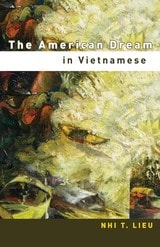
The American Dream in Vietnamese
Nhi T. Lieu
University of Minnesota Press, 2010
Lieu examines how live music variety shows and videos, beauty pageants, and Web sites created by and for Vietnamese Americans contributed to the shaping of their cultural identity. She shows how popular culture forms repositories for conflicting expectations of assimilation, cultural preservation, and invention, alongside gendered and classed dimensions of ethnic and diasporic identity.
The American Dream in Vietnamese demonstrates how the circulation of images manufactured by both Americans and Vietnamese immigrants serves to produce these immigrants’ paradoxical desires. Within these desires and their representations, Lieu finds the dramatization of the community’s struggle to define itself against the legacy of the refugee label, a classification that continues to pathologize their experiences in American society.
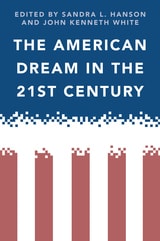
The American Dream in the 21st Century
Edited by Sandra Hanson and John White
Temple University Press, 2011
The American Dream has long been a dominant theme in U.S. culture, one with enduring significance, but these are difficult times for dreamers. The editors of and contributors to The American Dream in the 21st Century examine the American Dream historically, socially, and economically and consider its intersection with politics, religion, race, gender, and generation.
The conclusions presented in this short, readable volume provide both optimism for the faith that most Americans have in the possibility of achieving the American Dream and a realistic assessment of the cracks in the dream. The last presidential election offered hope, but the experts here warn about the need for better programs and policies that could make the dream a reality for a larger number of Americans.
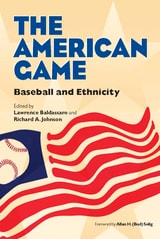
The American Game
Baseball and EthnicityEdited by Lawrence Baldassaro and Richard A. Johnson. Foreword by Allan (Bud) Selig
Southern Illinois University Press, 2002
These nine essays selected by Lawrence Baldassaro and Richard A. Johnson present for the first time in a single volume an ethnic and racial profile of American baseball. These essayists show how the gradual involvement by various ethnic and racial groups reflects the changing nature of baseball—and of American society as a whole—over the course of the twentieth century.
Although the sport could not truly be called representative of America until after Jackie Robinson broke the color line in 1947, fascination with the ethnic backgrounds of the players began more than a century ago when athletes of German and Irish descent entered the major leagues in large numbers. In the 1920s, commentators noted the influx of ballplayers of Italian and Slavic origins and wondered why there were not more Jewish players in the big leagues. The era following World War II, however, saw the most dramatic ethnographic shift with the belated entry of African American ballplayers. The pattern of ethnic succession continues as players of Hispanic and Asian origin infuse fresh excitement and renewal into the major leagues.

The American Girl Goes to War
Women and National Identity in U.S. Silent FilmLiz Clarke
Rutgers University Press, 2022
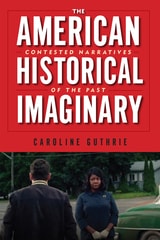
The American Historical Imaginary
Contested Narratives of the PastCaroline Guthrie
Rutgers University Press, 2023
The American Irish
A Political and Social PortraitWilliam V. Shannon
University of Massachusetts Press, 1989

The American Jeremiad
Sacvan Bercovitch
University of Wisconsin Press, 1978
When Sacvan Bercovitch’s The American Jeremiad first appeared in 1978, it was hailed as a landmark study of dissent and cultural formation in America, from the Puritans’ writings through the major literary works of the antebellum era. For this long-awaited anniversary edition, Bercovitch has written a deeply thoughtful and challenging new preface that reflects on his classic study of the role of the political sermon, or jeremiad, in America from a contemporary perspective, while assessing developments in the field of American studies and the culture at large.
The American Jewish Story through Cinema
By Eric A. Goldman
University of Texas Press, 2013
Like the haggadah, the traditional “telling” of the story of the Israelites’ exodus from Egypt that is read at the Passover seder, cinema offers a valuable text from which to gain an understanding of the social, political, and cultural realities of Jews in America. In an industry strongly influenced by Jewish filmmakers who made and continue to make the decisions as to which films are produced, the complex and evolving nature of the American Jewish condition has had considerable impact on American cinema and, in particular, on how Jews are reflected on the screen. This groundbreaking study analyzes select mainstream films from the beginning of the sound era to today to provide an understanding of the American Jewish experience over the last century.
In the first half of the twentieth century, Hollywood’s movie moguls, most of whom were Jewish, shied away from asserting a Jewish image on the screen for fear that they might be too closely identified with that representation. Over the next two decades, Jewish moviemakers became more comfortable with the concept of a Jewish hero and with an overpowered, yet heroic, Israel. In time, the Holocaust assumed center stage as the single event with the greatest effect on American Jewish identity. Recently, as American Jewish screenwriters, directors, and producers have become increasingly comfortable with their heritage, we are seeing an unprecedented number of movies that spotlight Jewish protagonists, experiences, and challenges.
The American Literature Scholar in the Digital Age
Edited by Amy E. Earhart and Andrew Jewell
University of Michigan Press, 2010
"By casting the collection explicitly as an outreach to the larger community of Americanists---not primarily those who self-identify as 'digital scholars'---Earhart and Jewell have made an important choice, and one that will likely make this a landmark publication."
---Andrew Stauffer, University of Virginia
The American Literature Scholar in the Digital Age, which features a wide range of practitioner-scholars, is the first of its kind: a gathering of people who are expert in American literary studies and in digital technologies, scholars uniquely able to draw from experience with building digital resources and to provide theoretical commentary on how the transformation to new technologies alters the way we think about and articulate scholarship in American literature. The volume collects articles from those who are involved in tool development, usability testing, editing and textual scholarship, digital librarianship, and issues of race and ethnicity in digital humanities, while also situating digital humanities work within the larger literary discipline. In addition, the volume examines the traditional structures of the fields, including tenure and promotion criteria, modes of scholarly production, the skill sets required for scholarship, and the training of new scholars.
The American Literature Scholar in the Digital Age will attract practitioners of digital humanities in multiple fields, Americanists who utilize digital materials, and those who are intellectually curious about the new movement and materials.
Amy E. Earhart is Assistant Professor in the Department of English at Texas A&M University.
Andrew Jewell is Associate Professor of Digital Projects, University Libraries, at the University of Nebraska–Lincoln.
Cover art: Book background ©iStockphoto.com/natashika
digitalculturebooks is an imprint of the University of Michigan Press and the Scholarly Publishing Office of the University of Michigan Library dedicated to publishing innovative and accessible work exploring new media and their impact on society, culture, and scholarly communication. Visit the website at www.digitalculture.org.
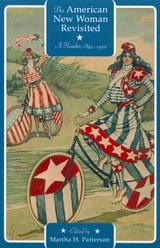
The American New Woman Revisited
A Reader, 1894-1930Patterson, Martha H
Rutgers University Press, 2008
In North America between 1894 and 1930, the rise of the “New Woman” sparked controversy on both sides of the Atlantic and around the world. As she demanded a public voice as well as private fulfillment through work, education, and politics, American journalists debated and defined her. Who was she and where did she come from? Was she to be celebrated as the agent of progress or reviled as a traitor to the traditional family? Over time, the dominant version of the American New Woman became typified as white, educated, and middle class: the suffragist, progressive reformer, and bloomer-wearing bicyclist. By the 1920s, the jazz-dancing flapper epitomized her. Yet she also had many other faces.
Bringing together a diverse range of essays from the periodical press of the late nineteenth and early twentieth centuries, Martha H. Patterson shows how the New Woman differed according to region, class, politics, race, ethnicity, and historical circumstance. In addition to the New Woman’s prevailing incarnations, she appears here as a gun-wielding heroine, imperialist symbol, assimilationist icon, entrepreneur, socialist, anarchist, thief, vamp, and eugenicist. Together, these readings redefine our understanding of the New Woman and her cultural impact.
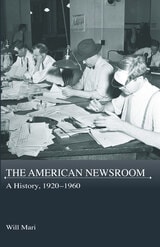
The American Newsroom
A History, 1920-1960Will Mari
University of Missouri Press, 2023

The American Non-Dilemma
Racial Inequality Without RacismNancy DiTomaso
Russell Sage Foundation, 2013
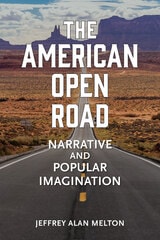
The American Open Road
Narrative and Popular ImaginationJeffrey Alan Melton
University of Alabama Press, 2025
WINNER OF THE ELIZABETH AGEE PRIZE IN AMERICAN LITERATURE
The rearview mirror perspective of a road trip across the American “open road.”
The American Open Road: Narrative and Popular Imagination offers a rich exploration of how the mythos of the open road has shaped, and been shaped by, American culture. Beginning with the post–World War II boom that solidified car culture as central to American life, Melton reflects on how roads, automobiles, and landscapes have been represented in literature, film, and other cultural texts, highlighting the interplay between mobility and narrative.
Drawing on a wide range of cultural texts, from traditional classic road novels and cinematic presentations, to advertisements, poetry, and prose, Melton examines how the open road functions as a symbol of autonomy, reinvention, and resistance. He highlights how road narratives have also exposed deeper tensions in American life—especially around race, gender, and power—and how historically marginalized voices have used the road to reclaim space and tell new stories.
From the romanticism of Route 66 to the political edge of modern road films, The American Open Road offers a thoughtful, engaging analysis of the narratives that continue to define American identity and longing. For readers interested in cultural history, travel literature, or the enduring pull of the highway, this book offers a compelling view from the passenger seat of America’s most iconic journeys.
The American People
Census 2000Reynolds Farley
Russell Sage Foundation, 2005
The American School Counselor
A Case Study in the Sociology of ProfessionsDavid J. Armor
Russell Sage Foundation, 1969
The American Southeast at the End of the Ice Age
Edited by D. Shane Miller, Ashley M. Smallwood, and Jesse W. Tune
University of Alabama Press, 2022
Synthesizes archaeological and environmental evidence to reinterpret how early human populations adapted to dynamic climatic changes during the Late Pleistocene, reshaping our understanding of Paleoindian lifeways and migration in the Southeastern United States.
The 1996 benchmark volume The Paleoindian and Early Archaic Southeast, edited by David G. Anderson and Kenneth E. Sassaman, was the first study to summarize what was known of the peoples who lived in the Southeast when ice sheets covered the northern part of the continent and mammals such as mammoths, saber-toothed cats, and ground sloths roamed the landscape.
The American Southeast at the End of the Ice Age provides an updated, definitive synthesis of current archaeological research gleaned from an array of experts in the region. It is organized in three parts: state records, the regional perspective, and reflections and future directions. Chapters survey a diversity of topics including the distribution of the earliest archaeological sites in the region, chipped-stone tool technology, the expanding role of submerged archaeology, hunter-gatherer lifeways, past climate changes and the extinction of megafauna on the transitional landscape, and evidence of demographic changes at the end of the Ice Age. Discussion of the ethical responsibilities regarding the use of private collections and the relationship of archaeologists and the avocational community, insight from outside the Southeast, and considerations for future research round out the volume.
The American Synagogue
A Sanctuary TransformedEdited by Jack Wertheimer
Brandeis University Press, 1995
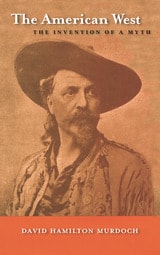
The American West
The Invention Of A MythDavid Hamilton Murdoch
University of Nevada Press, 2001
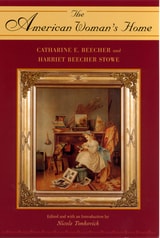
The American Woman's Home
Beecher, Catharine E
Rutgers University Press, 2002
The American Womans Home, originally published in 1869, was one of the late nineteenth centurys most important handbooks of domestic advice. The result of a collaboration by two of the eras most important writers, this book represents their attempt to direct womens acquisition and use of a dizzying variety of new household consumer goods available in the postCivil War economic boom. It updates Catharine Beechers influential Treatise on Domestic Economy (1841) and incorporates domestic writings by Harriet Beecher Stowe first published in The Atlantic in the 1860s.
Today, the book can be likened to an anthology of household hints, with articles on cooking, decorating, housekeeping, child-rearing, hygiene, gardening, etiquette, and home amusements. The American Womans Home, almost a bible on domestic topics for Victorian women, illuminates womens roles a century and a half ago and can be used for comparison with modern theories on the role of women in the home and in society. Illustrated with the original engravings, this completely new edition offers a lively introduction by Nicole Tonkovich and notes linking the text to important historical, social, and cultural events of the late nineteenth century
The American and Japanese Auto Industries in Transition
Report of the Joint U.S.–Japan Automotive StudyRobert E. Cole and Taizo Yakushiji, Editors
University of Michigan Press, 1984

The Americanization of Social Science
Intellectuals and Public Responsibility in the Postwar United StatesDavid Paul Haney
Temple University Press, 2008
A highly readable introduction to and overview of the postwar social sciences in the United States, The Americanization of Social Science explores a critical period in the evolution of American sociology’s professional identity from the late 1940s through the early 1960s. David Paul Haney contends that during this time leading sociologists encouraged a professional secession from public engagement in the name of establishing the discipline’s scientific integrity.
According to Haney, influential practitioners encouraged a willful withdrawal from public sociology by separating their professional work from public life. He argues that this separation diminished sociologists’ capacity for conveying their findings to wider publics, especially given their ambivalence towards the mass media, as witnessed by the professional estrangement that scholars like David Riesman and C. Wright Mills experienced as their writing found receptive lay audiences. He argues further that this sense of professional insularity has inhibited sociology’s participation in the national discussion about social issues to the present day.
The Americanization of the Global Village
Essays in Comparative Popular CultureRoger Rollin
University of Wisconsin Press, 1989
This collection of essays taken from a series of papers given at the Popular Culture division of the MLA convention in 1987 consists of a serious investigation of Popular Culture and in simplest terms investigates what people do and why they do it. Rolin's collection deals with the national identity of consumer countries and comes to grips with the fact that the consumption of foreign products could generate emoions of disjunction and displacement.
The Americanization of the Synagogue, 1820–1870
Leon A. Jick
Brandeis University Press, 1992
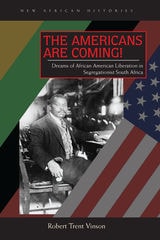
The Americans Are Coming!
Dreams of African American Liberation in Segregationist South AfricaRobert Trent Vinson
Ohio University Press, 2011
For more than half a century before World War II, black South Africans and “American Negroes”—a group that included African Americans and black West Indians—established close institutional and personal relationships that laid the necessary groundwork for the successful South African and American antiapartheid movements. Though African Americans suffered under Jim Crow racial discrimination, oppressed Africans saw African Americans as free people who had risen from slavery to success and were role models and potential liberators.
Many African Americans, regarded initially by the South African government as “honorary whites” exempt from segregation, also saw their activities in South Africa as a divinely ordained mission to establish “Africa for Africans,” liberated from European empires. The Jamaican-born Marcus Garvey’s Universal Negro Improvement Association, the largest black-led movement with two million members and supporters in forty-three countries at its height in the early 1920s, was the most anticipated source of liberation. Though these liberation prophecies went unfulfilled, black South Africans continued to view African Americans as inspirational models and as critical partners in the global antiapartheid struggle.
The Americans Are Coming! is a rare case study that places African history and American history in a global context and centers Africa in African Diaspora studies.
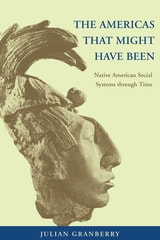
The Americas That Might Have Been
Native American Social Systems through TimeJulian Granberry
University of Alabama Press, 2005
This work answers the hypothetical question: What would the Americas be like today—politically, economically, culturally—if Columbus and the Europeans had never found them, and how would American peoples interact with the world’s other societies? It assumes that Columbus did not embark from Spain in 1492 and that no Europeans found or settled the New World afterward, leaving the peoples of the two American continents free to follow the natural course of their Native lives.
The Americas That Might Have Been is a professional but layman-accessible, fact-based, nonfiction account of the major Native American political states that were thriving in the New World in 1492. Granberry considers a contemporary New World in which the glories of Aztec Mexico, Maya Middle America, and Inca Peru survived intact. He imagines the roles that the Iroquois Confederacy of the American Northeast, the powerful city-states along the Mississippi River in the Midwest and Southeast, the Navajo Nation and the Pueblo culture of the Southwest, the Eskimo Nation in the Far North, and the Taino/Arawak chiefdoms of the Caribbean would play in American and world politics in the 21st Century.
Following a critical examination of the data using empirical archaeology, linguistics, and ethnohistory, Granberry presents a reasoned and compelling discussion of native cultures and the paths they would have logically taken over the past five centuries. He reveals the spectacular futures these brilliant pre-Columbian societies might have had, if not for one epochal meeting that set off a chain of events so overwhelming to them that the course of human history was forever changed.
The Americas, Otherwise, Volume 61
Lois Parkinson Zamora and Silvia Spitta, eds.
Duke University Press, 0
These essays foreground the work of important hemispheric writers, artists, and public intellectuals such as Roberto Bolaño, Alejo Carpentier, Aimé Césaire, Gabriel García Márquez, Édouard Glissant, José Martí, Ricardo Piglia, and Leopoldo Zea. Topics include migration to the Americas from Asia, Europe, and Africa; hemispheric exceptionalisms since the establishment of the first colonies; the interdisciplinary foundations of border studies; theories of the neobaroque and their application to Latin American cultural formations; Latino critical theory; and the emergence of a southern theory inclusive of the intellectual work of often-marginalized cultures.

The Amish Struggle with Modernity
Edited by Donald B. Kraybill and Marc A. Olshan
University Press of New England, 1994
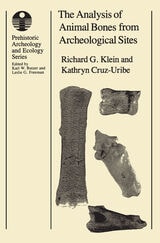
The Analysis of Animal Bones from Archeological Sites
Richard G. Klein and Kathryn Cruz-Uribe
University of Chicago Press, 1984
After setting forth the interpretive framework that governs their use of numbers in faunal analysis, Richard G. Klein and Kathryn Cruz-Uribe survey various measures of taxonomic abundance, review methods for estimating the sex and age composition of a fossil species sample, and then give examples to show how these measures and sex/age profiles can provide useful information about the past. In the second part of their book, the authors present the computer programs used to calculate and analyze each numerical measure or count discussed in the earlier chapters. These elegant and original programs, written in BASIC, can easily be used by anyone with a microcomputer or with access to large mainframe computers.

The Analysis of Ideology
Raymond Boudon
University of Chicago Press, 1989
Boudon begins by providing an exhaustive and subtle critique of sociological explanations of ideology from early conceptions to its current usage in the works of Barthes, Foucault, Habermas, Sartre, and others. He then offers his own interpretation of the origins and emergence of ideological beliefs. In opposition to those views which associate ideology with irrationalism, Boudon shows that ideologies are a natural ingredient of social life; he develops a rationalist theory that helps to explain why certain ideas are believed by individuals and thereby effective in the social world. Finally, he examines case studies of two modern-day ideologies—developmentalism and Third Worldism.
Moving easily across disciplinary boundaries, Boudon's provocative contribution to a subject of growing significance will be of great interest to scholars in sociology and social theory, as well as philosophy, political science, and development studies.
The Anarchist Roots of Geography
Toward Spatial EmancipationSimon Springer
University of Minnesota Press, 2016
The Anarchist Roots of Geography sets the stage for a radical politics of possibility and freedom through a discussion of the insurrectionary geographies that suffuse our daily experiences. By embracing anarchist geographies as kaleidoscopic spatialities that allow for nonhierarchical connections between autonomous entities, Simon Springer configures a new political imagination.
Experimentation in and through space is the story of humanity’s place on the planet, and the stasis and control that now supersede ongoing organizing experiments are an affront to our survival. Singular ontological modes that favor one particular way of doing things disavow geography by failing to understand the spatial as a mutable assemblage intimately bound to temporality. Even worse, such stagnant ideas often align to the parochial interests of an elite minority and thereby threaten to be our collective undoing. What is needed is the development of new relationships with our world and, crucially, with each other.
By infusing our geographies with anarchism we unleash a spirit of rebellion that foregoes a politics of waiting for change to come at the behest of elected leaders and instead engages new possibilities of mutual aid through direct action now. We can no longer accept the decaying, archaic geographies of hierarchy that chain us to statism, capitalism, gender domination, racial oppression, and imperialism. We must reorient geographical thinking towards anarchist horizons of possibility. Geography must become beautiful, wherein the entirety of its embrace is aligned to emancipation.
The Anarchy of Black Religion
A Mystic SongJ. Kameron Carter
Duke University Press, 2023
The Anatomy of Eleven Towns in Michoacán
By Dan Stanislawski
University of Texas Press, 1950
In this book, Dan Stanislawski studies the geography of various small towns in one Mexican state. He discusses the factors—landscape, buildings, culture groups, and so forth—that create a unique personality for each of these towns.
The Anatomy of Post-Communist Regimes
A Conceptual FrameworkBálint Magyar
Central European University Press, 2021
Offering a single, coherent framework of the political, economic, and social phenomena that characterize post-communist regimes, this is the most comprehensive work on the subject to date. Focusing on Central Europe, the post-Soviet countries and China, the study provides a systematic mapping of possible post-communist trajectories.
At exploring the structural foundations of post-communist regime development, the work discusses the types of state, with an emphasis on informality and patronalism; the variety of actors in the political, economic, and communal spheres; the ways autocrats neutralize media, elections, etc. The analysis embraces the color revolutions of civil resistance (as in Georgia and in Ukraine) and the defensive mechanisms of democracy and autocracy; the evolution of corruption and the workings of “relational economy”; an analysis of China as “market-exploiting dictatorship”; the sociology of “clientage society”; and the instrumental use of ideology, with an emphasis on populism. Beyond a cataloguing of phenomena—actors, institutions, and dynamics of post-communist democracies, autocracies, and dictatorships—Magyar and Madlovics also conceptualize everything as building blocks to a larger, coherent structure: a new language for post-communist regimes.
While being the most definitive book on the topic, the book is nevertheless written in an accessible style suitable for both beginners who wish to understand the logic of post-communism and scholars who are interested in original contributions to comparative regime theory. The book is equipped with QR codes that link to www.postcommunistregimes.com, which contains interactive, 3D supplementary material for teaching.